REVIEW 3 major objections 5 minor 46 references
ConformalSAM: Unlocking the Potential of Foundational Segmentation Models in Semi-Supervised Semantic Segmentation with Conformal Prediction
T0 review · 3 major / 5 minor · reviewed 2026-08-06 · deepseek-v4-flash
Pith's one-line read ConformalSAM claims that a frozen foundation segmentation model can supervise unlabeled images when conformal prediction calibrates it on labeled target data and filters unreliable pixel labels.
desk verdict A practical semi-supervised segmentation pipeline that clearly works on benchmarks, but the conformal-prediction framing is doing less work than the background-suppression heuristic, and the paper overclaims what CP certifies. read the letter →
The pith
A machine-rendered reading of the paper's core claim, the machinery that carries it, and where it could break.
The reading
What carries the argument
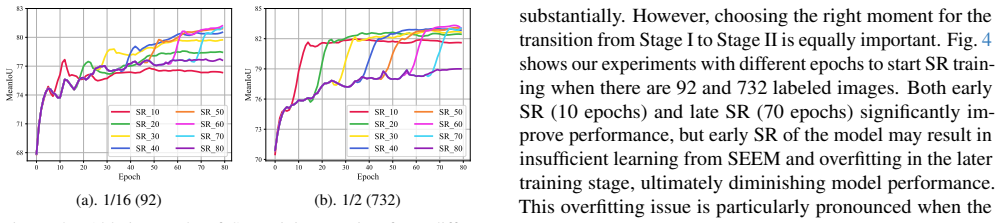
The central object is the per-pixel conformal quantile map $\hat{q}_\alpha(a,b)$, computed by pooling inverse probability scores $1-P^j_i(a,b)$ from all labeled images at each spatial location $(a,b)$ and taking their $(1-\alpha)$-quantile. This map turns SEEM's raw class probabilities on unlabeled images into prediction sets: class $j$ is kept for a pixel when its inverse score is at most $\hat{q}_\alpha(a,b)$. The class-conditional selection rule of Eq. (4) then turns those sets into pseudo-labels, preferring an object class over background when both pass the threshold. A second mechanism, the self-reliance stage, replaces SEEM masks with the target model's own pseudo-labels and anneals the unsupervised loss weight $\lambda(t)$ over epochs, suppressing late-stage overfitting to foundation-model noise.
What would settle it
Take a segmentation dataset where the same classes appear at very different positions across images, or translate crops randomly, and compare per-pixel conformal filtering against a spatially pooled calibration; if per-pixel filtering no longer improves pseudo-label quality, the exchangeability assumption is the broken link.
Extended reading notes
Core claim
The paper's central claim is that the gap between a foundation segmentation model and a downstream semi-supervised task can be closed by treating the foundation model as a black-box annotator and using conformal prediction to decide which of its pixel predictions to trust. On labeled images, the method builds an inverse probability map for each class, pools non-conformity scores at each pixel coordinate across the labeled set, and takes the $(1-\alpha)$-quantile as a threshold map. Pixels whose SEEM prediction set passes that threshold become pseudo-labels; in datasets with a background class, a class-conditional rule favors object labels so minority classes are not drowned out. A second stage discards SEEM masks and trains only on the target model's own pseudo-labels with a decaying unsupervised-loss weight. The author's evidence is that this two-stage calibration-plus-self-reliance design beats recent semi-supervised segmentation methods across three benchmarks and improves AllSpark by 2.07% mIoU on average when used as a plug-in.
Load-bearing premise
The calibration step assumes that a pixel at position (a,b) in one labeled image is exchangeable with the pixel at the same position in an unlabeled image, so the same quantile threshold can be transferred across images without spatial alignment.
Editorial extensions
If this is right
- A frozen foundation segmentation model can serve as an annotator in semi-supervised segmentation without fine-tuning, shifting the typical use of SAM-style models from prompting to calibration.
- Because ConformalSAM is a plug-in, existing semi-supervised segmentation pipelines such as AllSpark can adopt it by swapping in calibrated pseudo-labels during Stage I and keeping their own training machinery.
- The ablations identify pixel-wise conformal calibration with $\alpha=0.05$ and class-conditional selection as the effective configuration; the other calibration variants tested underperform it.
- On datasets with a background class, the class-conditional filtering accounts for a large reported gain, so the method's benefit is partly a solution to background and object imbalance in pseudo-labels.
- The self-reliance transition shows that foundation-model pseudo-labels are most valuable early in training, after which the target model should be trusted with its own pseudo-labels.
Reading between the lines
- A testable extension would apply ConformalSAM to datasets whose images are not spatially aligned, where the per-pixel quantile assumption weakens; spatially pooled calibration would likely be needed instead.
- The same calibration-plus-annealing recipe could be carried to other foundation-model outputs, including the large language models the paper names as future work.
- The fixed epoch switch to self-reliance could be made adaptive, triggered by the target model's confidence on held-out labeled data, which might improve robustness when labeled sets are very small.
- The large gain from class-conditional selection suggests that a class-balanced conformal threshold, rather than a single $\alpha$, could transfer better to datasets with long-tailed class distributions.
Editorial analysis
A structured set of objections, weighed in public.
Referee Report
Summary. The paper proposes ConformalSAM, a semi-supervised semantic segmentation (SSSS) framework that uses SEEM, a foundation segmentation model, to generate pseudo-labels for unlabeled images, and applies conformal prediction (CP) to filter unreliable pixel predictions. The method first calibrates SEEM with labeled target-domain data to obtain per-pixel non-conformity thresholds, then uses these thresholds to construct prediction sets and derive pseudo-labels, with a class-conditional rule that favors object classes over background. In a second stage, SEEM-generated labels are dropped and the model is trained with self-reliance, using a time-decayed weighting of the unsupervised loss. Experiments on PASCAL VOC, PASCAL VOC augmented, and ADE20K report gains over recent SSSS methods, including AllSpark, and show that ConformalSAM can be used as a plug-in to improve existing methods. The main ablations indicate that both the CP filtering and the class-conditional selection contribute to the final performance.
Significance. If the central claim is substantiated, the paper makes a useful contribution: it demonstrates that a foundation segmentation model can be turned into a reliable pseudo-label annotator for SSSS through uncertainty calibration, and it provides a plug-in component that improves existing methods. The experiments are extensive, cover three benchmarks and multiple label ratios, and include ablations of the main components. The paper also explicitly acknowledges limitations concerning the overlap between the foundation model's knowledge and the target domain. However, the theoretical motivation is weakened by a class-conditional selection rule that lies outside the conformal guarantee, and the reported performance gains are not cleanly attributed to the conformal component. As presented, the manuscript's support for the claim that CP-based uncertainty filtering is the source of the improvements is incomplete.
major comments (3)
- [Sec. 3.3.1, Eq. (4)] The class-conditional selection rule in Eq. (4) is not covered by the conformal guarantee. The conformal guarantee applies only to the event that the true class is contained in the prediction set C; the subsequent rule that selects an object class whenever background is in C, and that is undefined when C={0}, can output a wrong label even when the true class is in C. The paper does not specify the output for C={0}, and the rule can select a low-confidence object class over a high-confidence background class. The ablation in Sec. 4.3 reports a 34.11 mIoU improvement when this rule is applied, which is far larger than the improvement attributed to CP filtering alone, suggesting that the headline gains may be driven by this heuristic rather than by conformal uncertainty quantification. The authors should report the CP-only variant with a well-defined fallback for C={0}, provide an empirical coverage analysis of the final pseudo-labels, and either justify the heuristic theoretically (e.g., through class-wise conformal thresholds) or separate it cleanly from the conformal component in the claims.
- [Sec. 3.3.1, non-conformity score aggregation] The text states that the non-conformity scores from all categories at the same pixel location are combined to obtain S(a,b) ∈ R^{L·K}, but Eq. (3) defines a score only for the true class at each pixel, so each labeled image contributes exactly one score at each coordinate, giving dimension L, not L·K. If the authors instead include all K channels (with NaNs for non-true classes), the quantile computation changes substantially. This ambiguity affects the reproducibility of the threshold and the claimed coverage level. Please correct the dimension and specify exactly which scores enter the quantile calculation.
- [Sec. 4.3 and Sec. 3.3.1] The paper claims that ConformalSAM produces 'high-confidence' and 'reliable' pseudo-labels, but no empirical coverage or pseudo-label accuracy numbers are reported. Given that the final labeling rule in Eq. (4) can discard the conformal guarantee, the authors should measure and report the empirical coverage of the prediction sets and the accuracy of the resulting pseudo-labels on a held-out split. Without these numbers, the central reliability claim is not directly supported by the experiments.
minor comments (5)
- [Sec. 3.1, Eq. (2)] The summation indices run from i=0 to L and j=0 to U; presumably they should run from 1 to L and 1 to U.
- [Sec. 2, conformal prediction background] The description of the quantile as the '⌈(n+1)(1−α)/n⌉ quantile' is ambiguous; standard conformal prediction uses the ⌈(n+1)(1-α)⌉-th order statistic or the empirical quantile at level (n+1)(1-α)/n. Please clarify the exact computation.
- [Sec. 4.3] The ablation reports an average improvement of 34.11 mIoU from class-conditional label selection; this number appears implausibly large and may be a typo. Please verify and, if correct, explain why the effect is so large.
- [Table 3] The table header contains the typo 'Lable-only' instead of 'Label-only'.
- [Sec. 4.3] The CP variants Image, K-Means, and GenAnn are mentioned in Table 6 but not described in the main text; a brief definition or a clear reference to [4] would improve readability.
Circularity Check
No significant circularity: the conformal calibration and pseudo-label pipeline is validated against external SSSS benchmarks and does not reduce to its own inputs.
full rationale
The paper's derivation chain is not circular. CP is applied as a standard split-conformal procedure: the labeled set serves as the calibration set to compute per-pixel quantiles q_hat, and those thresholds are applied to SEEM's outputs on unlabeled images; the resulting pseudo-labels are then used to train a separate segmentation model that is evaluated on held-out validation sets (Tabs. 2-4). The headline gains are benchmarked against external methods (AllSpark, UniMatch, etc.), so the 'prediction' is not a refitting of the target quantity. The self-citations [19,27,28] appear as motivation, e.g., 'The class-conditional filtering favors minority classes over the majority class, which is motivated by [27] revealing the class-wise coverage in CP is non-trivial for minority classes,' but the class-conditional rule in Eq. 4 is an ad hoc design choice whose contribution is assessed by the paper's own ablation (34.11 mIoU over vanilla CP) and by external comparisons, not by the cited result alone. The choice alpha=0.05 is ordinary hyperparameter selection, and the paper explicitly reports a sensitivity study; it is not a fitted-parameter-renamed-prediction. The stated limitation that performance 'relies on the degree of overlap between the foundation model's knowledge and the target downstream task' is an honest boundary condition. The skeptic's concern about Eq. 4's background-exclusion heuristic is a validity/overclaim issue (the conformal coverage guarantee does not cover the subsequent class-biased selection), not circularity. No load-bearing step reduces by construction to its input.
Assumptions & free parameters
free parameters (3)
- mis-coverage rate alpha =
0.05
- Stage I/II epoch split =
60/20 (VOC), 30/10 (ADE20K)
- lambda(t) exponential decay schedule =
not specified
assumptions (5)
- domain assumption Calibration set D_l is exchangeable with unlabeled data so split-conformal coverage applies.
- ad hoc to paper Non-conformity scores at the same pixel coordinate across different images are exchangeable.
- domain assumption SEEM's outputs can be used directly as probabilities for non-conformity scoring.
- ad hoc to paper Favoring object classes over background in Eq (4) improves pseudo-label quality.
- standard math The standard coverage guarantee (Eq 1) applies to the actual pipeline.
Cite this review
Pith. "Pith review of ConformalSAM: Unlocking the Potential of Foundational Segmentation Models in Semi-Supervised Semantic Segmentation with Conformal Prediction." pith.science (2026). https://pith.science/paper/YKICVZRF
@misc{pith2026250715803,
  author       = {Pith},
  title        = {Pith review of: ConformalSAM: Unlocking the Potential of Foundational Segmentation Models in Semi-Supervised Semantic Segmentation with Conformal Prediction},
  year         = {2026},
  howpublished = {\url{https://pith.science/paper/YKICVZRF}},
  note         = {Machine review of arXiv:2507.15803}
}
read the original abstract
Pixel-level vision tasks, such as semantic segmentation, require extensive and high-quality annotated data, which is costly to obtain. Semi-supervised semantic segmentation (SSSS) has emerged as a solution to alleviate the labeling burden by leveraging both labeled and unlabeled data through self-training techniques. Meanwhile, the advent of foundational segmentation models pre-trained on massive data, has shown the potential to generalize across domains effectively. This work explores whether a foundational segmentation model can address label scarcity in the pixel-level vision task as an annotator for unlabeled images. Specifically, we investigate the efficacy of using SEEM, a Segment Anything Model (SAM) variant fine-tuned for textual input, to generate predictive masks for unlabeled data. To address the shortcomings of using SEEM-generated masks as supervision, we propose ConformalSAM, a novel SSSS framework which first calibrates the foundation model using the target domain's labeled data and then filters out unreliable pixel labels of unlabeled data so that only high-confidence labels are used as supervision. By leveraging conformal prediction (CP) to adapt foundation models to target data through uncertainty calibration, ConformalSAM exploits the strong capability of the foundational segmentation model reliably which benefits the early-stage learning, while a subsequent self-reliance training strategy mitigates overfitting to SEEM-generated masks in the later training stage. Our experiment demonstrates that, on three standard benchmarks of SSSS, ConformalSAM achieves superior performance compared to recent SSSS methods and helps boost the performance of those methods as a plug-in.
Figures


Figures from the paper (1 more)
Reference graph
Works this paper leans on
-
[1]
Uncertainty sets for image classifiers using conformal prediction
Anastasios Angelopoulos, Stephen Bates, Jitendra Malik, and Michael I Jordan. Uncertainty sets for image classifiers using conformal prediction. arXiv preprint arXiv:2009.14193, 2020. 2
arXiv 2009
-
[2]
A gentle introduction to conformal prediction and distribution-free uncertainty quantification
Anastasios N Angelopoulos and Stephen Bates. A gentle introduction to conformal prediction and distribution-free uncertainty quantification. arXiv preprint arXiv:2107.07511,
-
[3]
Prediction-powered infer- ence
Anastasios N Angelopoulos, Stephen Bates, Clara Fannjiang, Michael I Jordan, and Tijana Zrnic. Prediction-powered infer- ence. Science, 382(6671):669–674, 2023. 4
work page 2023
-
[4]
Kandinsky conformal prediction: Efficient calibration of image segmentation algorithms
Joren Brunekreef, Eric Marcus, Ray Sheombarsing, Jan-Jakob Sonke, and Jonas Teuwen. Kandinsky conformal prediction: Efficient calibration of image segmentation algorithms. In Proceedings of the IEEE/CVF Conference on Computer Vi- sion and Pattern Recognition, pages 4135–4143, 2024. 2, 3, 8
work page 2024
-
[5]
Keyan Chen, Chenyang Liu, Hao Chen, Haotian Zhang, Wenyuan Li, Zhengxia Zou, and Zhenwei Shi. Rsprompter: Learning to prompt for remote sensing instance segmentation based on visual foundation model. IEEE Transactions on Geoscience and Remote Sensing, 2024. 3
work page 2024
-
[6]
Semi-supervised semantic segmentation with cross pseudo supervision
Xiaokang Chen, Yuhui Yuan, Gang Zeng, and Jingdong Wang. Semi-supervised semantic segmentation with cross pseudo supervision. In Proceedings of the IEEE/CVF conference on computer vision and pattern recognition, pages 2613–2622,
-
[7]
The cityscapes dataset for semantic urban scene understanding
Marius Cordts, Mohamed Omran, Sebastian Ramos, Timo Rehfeld, Markus Enzweiler, Rodrigo Benenson, Uwe Franke, Stefan Roth, and Bernt Schiele. The cityscapes dataset for semantic urban scene understanding. In Proceedings of the IEEE conference on computer vision and pattern recognition, pages 3213–3223, 2016. 8
work page 2016
-
[8]
The pascal visual object classes challenge: A retrospective
Mark Everingham, SM Ali Eslami, Luc Van Gool, Christo- pher KI Williams, John Winn, and Andrew Zisserman. The pascal visual object classes challenge: A retrospective. Inter- national journal of computer vision, 111:98–136, 2015. 1, 4, 5, 6
work page 2015
Show all 46 references
-
[9]
Finlayson
Geoff French, Timo Aila, Samuli Laine, Michal Mackiewicz, and Graham D. Finlayson. Semi-supervised semantic segmen- tation needs strong, high-dimensional perturbations. arXiv: Computer Vision and Pattern Recognition, 2019. 6, 7
2019
-
[10]
Semantic contours from inverse detectors
Bharath Hariharan, Pablo Arbel ´aez, Lubomir Bourdev, Subhransu Maji, and Jitendra Malik. Semantic contours from inverse detectors. In 2011 international conference on com- puter vision, pages 991–998. IEEE, 2011. 6, 7
2011
-
[11]
Weakly- supervised concealed object segmentation with sam-based pseudo labeling and multi-scale feature grouping
Chunming He, Kai Li, Yachao Zhang, Guoxia Xu, Longxiang Tang, Yulun Zhang, Zhenhua Guo, and Xiu Li. Weakly- supervised concealed object segmentation with sam-based pseudo labeling and multi-scale feature grouping. Advances in Neural Information Processing Systems, 36, 2024. 3
2024
-
[12]
Semi-supervised semantic segmentation via adaptive equalization learning
Hanzhe Hu, Fangyun Wei, Han Hu, Qiwei Ye, Jinshi Cui, and Liwei Wang. Semi-supervised semantic segmentation via adaptive equalization learning. Advances in Neural In- formation Processing Systems, 34:22106–22118, 2021. 5, 7
2021
-
[13]
Semicvt: Semi-supervised convolutional vi- sion transformer for semantic segmentation
Huimin Huang, Shiao Xie, Lanfen Lin, Ruofeng Tong, Yen- Wei Chen, Yuexiang Li, Hong Wang, Yawen Huang, and Yefeng Zheng. Semicvt: Semi-supervised convolutional vi- sion transformer for semantic segmentation. In Proceedings of the IEEE/CVF Conference on Computer Vision and Patt...
2023
-
[14]
Semi-supervised se- mantic segmentation via gentle teaching assistant
Ying Jin, Jiaqi Wang, and Dahua Lin. Semi-supervised se- mantic segmentation via gentle teaching assistant. Advances in Neural Information Processing Systems , 35:2803–2816,
-
[15]
Segment any- thing
Alexander Kirillov, Eric Mintun, Nikhila Ravi, Hanzi Mao, Chloe Rolland, Laura Gustafson, Tete Xiao, Spencer White- head, Alexander C Berg, Wan-Yen Lo, et al. Segment any- thing. In Proceedings of the IEEE/CVF International Confer- ence on Computer Vision, pages 4015–4026, 2023. 1, 3
2023
-
[16]
From sam to cams: Exploring segment anything model for weakly supervised semantic segmentation
Hyeokjun Kweon and Kuk-Jin Yoon. From sam to cams: Exploring segment anything model for weakly supervised semantic segmentation. In Proceedings of the IEEE/CVF Conference on Computer Vision and Pattern Recognition , pages 19499–19509, 2024. 3
2024
-
[17]
Distribution-free prediction bands for non-parametric regression
Jing Lei and Larry Wasserman. Distribution-free prediction bands for non-parametric regression. Journal of the Royal Statistical Society Series B: Statistical Methodology, 76(1): 71–96, 2014. 3
2014
-
[18]
Logic- induced diagnostic reasoning for semi-supervised semantic segmentation
Chen Liang, Wenguan Wang, Jiaxu Miao, and Yi Yang. Logic- induced diagnostic reasoning for semi-supervised semantic segmentation. In Proceedings of the IEEE/CVF International Conference on Computer Vision, pages 16197–16208, 2023. 6, 7
2023
-
[19]
The pitfalls and promise of confor- mal inference under adversarial attacks
Ziquan Liu, Yufei Cui, Yan Yan, Yi Xu, Xiangyang Ji, Xue Liu, and Antoni B Chan. The pitfalls and promise of confor- mal inference under adversarial attacks. In International Con- ference on Machine Learning, pages 30908–30928. PMLR,
-
[20]
Enhanced soft label for semi-supervised semantic seg- mentation
Jie Ma, Chuan Wang, Yang Liu, Liang Lin, and Guanbin Li. Enhanced soft label for semi-supervised semantic seg- mentation. In Proceedings of the IEEE/CVF International Conference on Computer Vision, pages 1185–1195, 2023. 6, 7
2023
-
[21]
Rankmatch: Exploring the better consistency regularization for semi-supervised semantic segmentation
Huayu Mai, Rui Sun, Tianzhu Zhang, and Feng Wu. Rankmatch: Exploring the better consistency regularization for semi-supervised semantic segmentation. In Proceedings of the IEEE/CVF Conference on Computer Vision and Pattern Recognition, pages 3391–3401, 2024. 6, 7
2024
-
[22]
Cross prompting con- sistency with segment anything model for semi-supervised medical image segmentation
Juzheng Miao, Cheng Chen, Keli Zhang, Jie Chuai, Quanzheng Li, and Pheng-Ann Heng. Cross prompting con- sistency with segment anything model for semi-supervised medical image segmentation. In International Conference on Medical Image Computing and Computer-Assisted Interven- t...
2024
-
[23]
Inductive confidence machines for re- gression
Harris Papadopoulos, Kostas Proedrou, V olodya V ovk, and Alex Gammerman. Inductive confidence machines for re- gression. In Machine learning: ECML 2002: 13th European conference on machine learning Helsinki, Finland, August 19–23, 2002 proceedings 13, pages 345–356. Springer, 2002. 3
2002
-
[24]
Learning transferable visual models from natural language supervi- sion
Alec Radford, Jong Wook Kim, Chris Hallacy, Aditya Ramesh, Gabriel Goh, Sandhini Agarwal, Girish Sastry, Amanda Askell, Pamela Mishkin, Jack Clark, et al. Learning transferable visual models from natural language supervi- sion. In International conference on machine learning, ...
2021
-
[25]
Glamm: Pixel grounding large multimodal model
Hanoona Rasheed, Muhammad Maaz, Sahal Shaji, Abdelrah- man Shaker, Salman Khan, Hisham Cholakkal, Rao M Anwer, Eric Xing, Ming-Hsuan Yang, and Fahad S Khan. Glamm: Pixel grounding large multimodal model. In Proceedings of the IEEE/CVF Conference on Computer Vision and Pattern ...
2024
-
[26]
A tutorial on conformal prediction
Glenn Shafer and Vladimir V ovk. A tutorial on conformal prediction. Journal of Machine Learning Research , 9(3),
-
[27]
Conformal prediction for class-wise coverage via augmented label rank calibration
Yuanjie Shi, SUBHANKAR GHOSH, Taha Belkhouja, Jana Doppa, and Yan Yan. Conformal prediction for class-wise coverage via augmented label rank calibration. In The Thirty- eighth Annual Conference on Neural Information Processing Systems, 2024. 3, 5
2024
-
[28]
Direct prediction set min- imization via bilevel conformal classifier training
Yuanjie Shi, Hooman Shahrokhi, Xuesong Jia, Xiongzhi Chen, Jana Doppa, and Yan Yan. Direct prediction set min- imization via bilevel conformal classifier training. In Forty- second International Conference on Machine Learning, 2025. 3
2025
-
[29]
Fixmatch: Simplifying semi-supervised learning with consistency and confidence
Kihyuk Sohn, David Berthelot, Nicholas Carlini, Zizhao Zhang, Han Zhang, Colin A Raffel, Ekin Dogus Cubuk, Alexey Kurakin, and Chun-Liang Li. Fixmatch: Simplifying semi-supervised learning with consistency and confidence. Advances in neural information processing systems, 33:5...
2020
-
[30]
Corrmatch: Label propagation via correlation matching for semi-supervised semantic segmentation
Boyuan Sun, Yuqi Yang, Le Zhang, Ming-Ming Cheng, and Qibin Hou. Corrmatch: Label propagation via correlation matching for semi-supervised semantic segmentation. In Pro- ceedings of the IEEE/CVF Conference on Computer Vision and Pattern Recognition, pages 3097–3107, 2024. 6, 7
2024
-
[31]
Daw: exploring the better weighting function for semi-supervised semantic segmentation
Rui Sun, Huayu Mai, Tianzhu Zhang, and Feng Wu. Daw: exploring the better weighting function for semi-supervised semantic segmentation. Advances in Neural Information Processing Systems, 36, 2024. 5, 6, 7
2024
-
[32]
Mean teachers are better role models: Weight-averaged consistency targets improve semi-supervised deep learning results
Antti Tarvainen and Harri Valpola. Mean teachers are better role models: Weight-averaged consistency targets improve semi-supervised deep learning results. Advances in neural information processing systems, 30, 2017. 1, 3
2017
-
[33]
Algorithmic learning in a random world
Vladimir V ovk, Alexander Gammerman, and Glenn Shafer. Algorithmic learning in a random world. Springer, 2005. 3
2005
-
[34]
Allspark: Reborn labeled features from unlabeled in trans- former for semi-supervised semantic segmentation
Haonan Wang, Qixiang Zhang, Yi Li, and Xiaomeng Li. Allspark: Reborn labeled features from unlabeled in trans- former for semi-supervised semantic segmentation. In Pro- ceedings of the IEEE/CVF Conference on Computer Vision and Pattern Recognition, pages 3627–3636, 2024. 1, 2, 3, 6, 7
2024
-
[35]
Hunting sparsity: Density-guided contrastive learning for semi-supervised semantic segmentation
Xiaoyang Wang, Bingfeng Zhang, Limin Yu, and Jimin Xiao. Hunting sparsity: Density-guided contrastive learning for semi-supervised semantic segmentation. In Proceedings of the IEEE/CVF Conference on Computer Vision and Pattern Recognition, pages 3114–3123, 2023. 7
2023
-
[36]
Towards the uncharted: Density-descending feature perturbation for semi-supervised semantic segmentation
Xiaoyang Wang, Huihui Bai, Limin Yu, Yao Zhao, and Jimin Xiao. Towards the uncharted: Density-descending feature perturbation for semi-supervised semantic segmentation. In Proceedings of the IEEE/CVF Conference on Computer Vi- sion and Pattern Recognition , pages 3303–3312, 2024. 6, 7
2024
-
[37]
Semi- supervised semantic segmentation using unreliable pseudo- labels
Yuchao Wang, Haochen Wang, Yujun Shen, Jingjing Fei, Wei Li, Guoqiang Jin, Liwei Wu, Rui Zhao, and Xinyi Le. Semi- supervised semantic segmentation using unreliable pseudo- labels. In Proceedings of the IEEE/CVF conference on com- puter vision and pattern recognition, pages 42...
2022
-
[38]
Conflict-based cross-view consistency for semi-supervised semantic segmentation
Zicheng Wang, Zhen Zhao, Xiaoxia Xing, Dong Xu, Xi- angyu Kong, and Luping Zhou. Conflict-based cross-view consistency for semi-supervised semantic segmentation. In Proceedings of the IEEE/CVF conference on computer vision and pattern recognition, pages 19585–19595, 2023. 7
2023
-
[39]
Segformer: Simple and efficient design for semantic segmentation with transformers
Enze Xie, Wenhai Wang, Zhiding Yu, Anima Anandkumar, Jose M Alvarez, and Ping Luo. Segformer: Simple and efficient design for semantic segmentation with transformers. Advances in neural information processing systems, 34:12077– 12090, 2021. 6
2021
-
[40]
Semi-supervised semantic segmentation with prototype-based consistency regularization
Haiming Xu, Lingqiao Liu, Qiuchen Bian, and Zhen Yang. Semi-supervised semantic segmentation with prototype-based consistency regularization. Advances in neural information processing systems, 35:26007–26020, 2022. 7
2022
-
[41]
Revisiting weak-to-strong consistency in semi-supervised semantic segmentation
Lihe Yang, Lei Qi, Litong Feng, Wayne Zhang, and Yinghuan Shi. Revisiting weak-to-strong consistency in semi-supervised semantic segmentation. In Proceedings of the IEEE/CVF Conference on Computer Vision and Pattern Recognition, pages 7236–7246, 2023. 1, 3, 6, 7
2023
-
[42]
Semisam: Exploring sam for enhancing semi-supervised medical image segmen- tation with extremely limited annotations
Yichi Zhang, Yuan Cheng, and Yuan Qi. Semisam: Exploring sam for enhancing semi-supervised medical image segmen- tation with extremely limited annotations. arXiv preprint arXiv:2312.06316, 2023. 2, 3
2023 arXiv
-
[43]
Augmentation matters: A simple-yet- effective approach to semi-supervised semantic segmentation
Zhen Zhao, Lihe Yang, Sifan Long, Jimin Pi, Luping Zhou, and Jingdong Wang. Augmentation matters: A simple-yet- effective approach to semi-supervised semantic segmentation. In Proceedings of the IEEE/CVF conference on computer vision and pattern recognition, pages 11350–11359,...
2023
-
[44]
Scene parsing through ade20k dataset
Bolei Zhou, Hang Zhao, Xavier Puig, Sanja Fidler, Adela Bar- riuso, and Antonio Torralba. Scene parsing through ade20k dataset. In Proceedings of the IEEE conference on computer vision and pattern recognition, pages 633–641, 2017. 4, 5, 6
2017
-
[45]
Segment everything everywhere all at once
Xueyan Zou, Jianwei Yang, Hao Zhang, Feng Li, Linjie Li, Jianfeng Wang, Lijuan Wang, Jianfeng Gao, and Yong Jae Lee. Segment everything everywhere all at once. Advances in Neural Information Processing Systems, 36, 2023. 2
2023
-
[46]
Pseudoseg: Design- ing pseudo labels for semantic segmentation
Yuliang Zou, Zizhao Zhang, Han Zhang, Chun-Liang Li, Xiao Bian, Jia-Bin Huang, and Tomas Pfister. Pseudoseg: Design- ing pseudo labels for semantic segmentation. In International Conference on Learning Representations, 2021. 1, 3
2021
Reviewed August 6, 2026 · model on record in the stance chip above.
Discussion (0). Sign in to comment.