REVIEW 4 major objections 4 minor 29 references
SiLQ: Simple Large Language Model Quantization-Aware Training
T0 review · 4 major / 4 minor · reviewed 2026-08-06 · deepseek-v4-flash
Pith's one-line read Under an extra 0.1% of training tokens, quantization-aware training keeps 8B LLMs within two points of full precision at 8-bit activations and 4-bit weights, outperforming leading post-training methods.
desk verdict The QAT recipe is real and the instruct-model results are valuable, but the “large margins” over PTQ baselines are softer than advertised because the baselines were modified in ways that flatter SiLQ. read the letter →
The pith
A machine-rendered reading of the paper's core claim, the machinery that carries it, and where it could break.
The reading
What carries the argument
The load-bearing mechanism is the combination of three named components: the straight-through estimator, which lets gradients pass through the round operation as if it were the identity; LSQ (learned step-size quantization), which makes each step size a trainable parameter; and knowledge distillation, which supervises the quantized student with the original model's output distribution. Around these, the paper adds two calibration practices: high-percentile quantile initialization for activation scales, and a newly introduced convex approximation of mean-squared quantization error for weight scales. This machinery converts quantization from a post-hoc correction problem into a small end-to-end optimization problem, so the network adjusts its weights to be easy to quantize rather than requiring the quantization scheme to make hard layers work.
What would settle it
Recompute the paper's headline comparisons using the baseline methods' own published code at their best reported settings, including online rotations where the original method uses them and 8-bit quantization of the final head, under the same A8-C8-W4 and A8-C4-W4 precision and the same single-node hardware; if the baselines reach or exceed the SiLQ averages on common-sense reasoning and the Open LLM Leaderboard, the central outperformance claim collapses.
Extended reading notes
Core claim
On the paper's own terms, SiLQ is the discovery that quantization error can be removed from LLM inference by a straightforward training run. The authors add round-to-nearest symmetric quantization with straight-through gradients to every activation, cache, and weight tensor the target accelerator will see, set the initial step sizes from a few batches of calibration data (percentile-based for activations, a new convex mean-squared-error approximation for weights), let the LSQ algorithm update those step sizes during fine-tuning, and supervise the run with knowledge distillation from the original unquantized model. In their comparisons at 8-bit activations with 8- or 4-bit cache and 4-bit weights, SiLQ lands within about two absolute points of the float16 model on average across the three benchmark suites, often matching it on common-sense reasoning, while the post-training baselines they report fall short by four to ten points or more; a direct comparison on Llama-2-7B also beats the published LLM-QAT method with far less compute. A weight-change analysis is used to argue that training is doing something a rotation-based post-training method cannot: only about 43% of the QAT-induced weight movement is attributable to matrix rotation, versus about 90% for the rotation-based baseline.
Load-bearing premise
The load-bearing premise is that the authors' modified runs of the leading post-training methods faithfully represent those methods at their strongest under the same hardware constraints, since the headline margins are computed from those re-runs rather than from the original papers' published numbers.
Editorial extensions
If this is right
- 8B-parameter instruction-tuned models can be deployed with integer-only activations, cache, and 4-bit weights at near-full precision, which directly cuts inference memory, latency, and energy.
- The same training loop works on base and instruct variants and on open datasets, so a deployment team does not need the model's proprietary fine-tuning data to get most of the benefit.
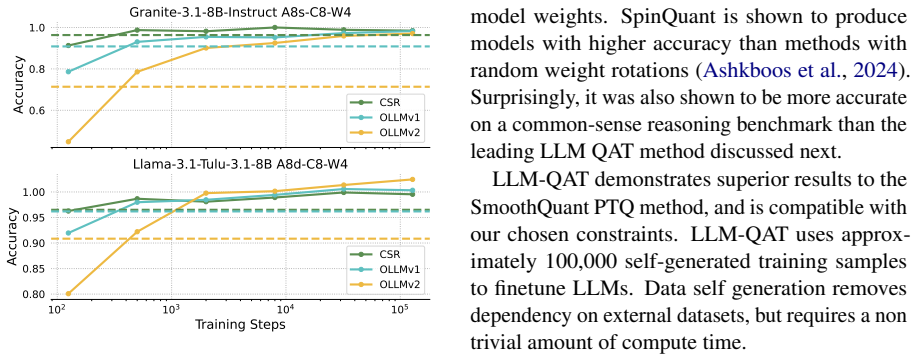
- Accuracy improves steadily with training duration, so a user can spend a few hundred steps for a quick quantized model or run longer for more points, rather than redesigning the calibration process for each accuracy target.
- The rotation analysis implies that incremental improvements to rotation-based post-training quantization will not find the solutions QAT finds, because most of the QAT weight change is non-rotational.
- The under-0.1% token overhead makes quantization a normal fine-tuning step rather than a separate large-scale training program.
Reading between the lines
- The token-budget claim is demonstrated at 8B scale; if the under-0.1% overhead carries to much larger models, the same recipe would make per-deployment quantization of frontier-sized models a routine fine-tuning step.
- The success with open-source SFT data suggests the value of proprietary fine-tuning data is largely already encoded in the teacher model's outputs, since distillation alone transfers it into the quantized student.
- The authors' scaling curves on the hardest benchmark do not plateau at their longest run, so a direct test of the method is to train beyond 128,000 steps and check whether the harder leaderboard tasks reach full-precision scores.
Editorial analysis
A structured set of objections, weighed in public.
Referee Report
Summary. The paper proposes SiLQ, a quantization-aware training recipe for LLMs that combines straight-through-estimator quantization, percentile-based initialization of activation step sizes followed by LSQ refinement, a new MSE-based weight step-size calibration, and knowledge distillation from the unquantized model. The experiments cover Llama-2/3, Llama-3.1-Tulu, and Granite 8B models at A8-C4/C8-W4 precisions, reporting near-lossless accuracy on CSR, OLLMv1, and OLLMv2 after 128k training steps, with claimed large margins over recomputed SpinQuant and SmoothQuant baselines, plus a comparison to LLM-QAT on Llama-2-7B. Appendices document evaluation flags, training details, and the exact modifications made to the baseline implementations.
Significance. If the empirical results are reproducible, this is a practically significant result: a simple QAT procedure with a very small additional training budget could make 8B LLMs deployable on integer accelerators without extra inference operations, across both base and instruction-tuned models. The paper is stronger than many empirical submissions in that it provides detailed appendices, explicit limitations, multiple benchmark suites, and ablations of the key components (knowledge distillation, activation calibration, online rotations). The appendix tables are internally consistent: the averaged values in Table 1 match Tables 5-7. The main value depends, however, on whether the SpinQuant and SmoothQuant baselines are fair representations of the leading published methods, and on whether the headline training-budget arithmetic is correct.
major comments (4)
- [Table 1, Appendix C] The SpinQuant baseline is recomputed with online Hadamard rotations disabled, as stated in Appendix C. Online rotations are part of the published SpinQuant method, and the paper's own ablation (Table 4, 'Online Rot: Yes') shows that enabling online rotations improves accuracy by +1.37 points on OLLMv1 for SiLQ. Several Table 1 margins against SpinQuant are in the 2-4 point range, so the claim that SiLQ outperforms the leading published SpinQuant configuration is not established by the reported numbers. Please report the original published SpinQuant scores under the same evaluation flags, or at least provide SpinQuant results both with and without online rotations, and justify which configuration is the appropriate hardware-matched baseline.
- [Table 1, Appendix D] SmoothQuant is designed for 8-bit weights and activations, but the authors extend it to 4-bit weights and 4-bit KV cache. The resulting scores (for example, 58.73 CSR for Llama-3-8B at A8d-C8-W4) may reflect an extrapolation of the method rather than its intended performance, so they do not constitute a fair 'leading published method' baseline at the tested precision. Please add W4-compatible PTQ baselines whose published configurations apply at this precision (for example, QuaRot with offline rotations, or GPTQ/AWQ variants with 8-bit activations), and clearly label SmoothQuant as an adapted baseline rather than as the original method.
- [Abstract, Section 4.1, Appendix B] The training-budget claim is arithmetically inconsistent. A 128,000-step run with batch size 128 and sequence length 1024, as specified in Appendix B, processes 16.8B tokens. For Llama-3-8B, whose pretraining corpus is on the order of 15T tokens, this is about 0.11%, not 'less than 0.1%'. The paper reports 0.1%, 0.07%, and 0.08% for the three models without stating the assumed pretraining token counts. Please provide the exact token counts used in the calculation and correct the abstract and Section 4.1 if the claim is not supported.
- [Section 4.1, Table 1, Limitations] All results are single runs without error bars or seeds, and the limitations paragraph acknowledges this. The claimed margin over SpinQuant on OLLMv2 for Llama-3-8B is only 0.38 points, which may be within run-to-run variance for an 8B model. Because the central claim is quantitative superiority, please provide repeated runs for the headline comparisons, or report confidence intervals or bootstrapped errors, to show that the small margins are not noise.
minor comments (4)
- [Section 4.2] The word 'banchmarks' appears in the text and should be corrected to 'benchmarks'; Section 4.5 contains 'mehods' and should read 'methods'.
- [Section 3.1, Eq. (2)] The MSE-based weight calibration is stated to be convex and 'easily solved', but no minimization procedure or closed-form update is given. In addition, the bound b = 2^{p-1} - 0.5 should be reconciled with the integer bounds in Eq. (1); for symmetric signed quantization the largest integer is 2^{p-1} - 1, so the relationship between b and the actual clipping threshold should be explained.
- [Section 3.2] The notation A8 is slightly misleading because the query tensor and the softmax output tensor are quantized to INT16, not INT8. A small per-tensor precision table or a sentence clarifying which tensors are INT8 and which are INT16 would improve reproducibility.
- [General] No code or trained model release is mentioned. Given that the baselines are recomputed with modified settings, releasing the evaluation and baseline scripts would substantially increase confidence in the comparisons.
Circularity Check
No significant circularity: SiLQ's reported accuracies are measured against external benchmarks, and the only self-citation (LSQ) is an independently established component that does not carry the derivation.
full rationale
SiLQ's central claim is that a short QAT run using the straight-through estimator, calibrated step sizes refined by LSQ, and knowledge distillation preserves accuracy on CSR/OLLM benchmarks. This claim is supported by direct evaluation of the quantized models with lm-evaluation-harness (Appendix A, Tables 5-7), not by a derivation that assumes the result. The MSE weight calibration (Eq. 2) is a new initialization heuristic; it does not by construction determine the reported benchmark scores, and its contribution is tested empirically in the Table 4 ablation rather than assumed. The only self-citation used as a component is 'refine further using LSQ (Esser et al., 2019)', but LSQ is an independently published, externally adopted step-size learning method; citing it does not make the benchmark numbers equivalent to LSQ's behavior, nor does the paper invoke a self-cited uniqueness theorem to force its methodology. The modified SpinQuant/SmoothQuant baselines (Appendices C-D) raise a legitimate comparison-fairness concern, but that is a correctness or benchmark-fidelity issue, not circular reasoning: those baselines are empirical measurements, not consequences of SiLQ's own assumptions. No step in the claimed derivation chain reduces to its own inputs.
Assumptions & free parameters
free parameters (6)
- Activation step-size calibration percentiles =
99.91, 99.99, 99.995 for 4/8/16-bit
- Activation step-size learning-rate boost =
50x
- Knowledge distillation temperature =
1.0
- DCLM data mixing ratio for instruct models =
0.25
- QAT duration for headline comparisons =
128,000 steps
- Base learning rate =
5e-6
assumptions (5)
- domain assumption The straight-through estimator provides useful gradients through the round operation during QAT.
- domain assumption Knowledge distillation from the full-precision teacher at temperature 1 is a sufficient training signal.
- ad hoc to paper The MSE weight calibration error model (uniform in-bin error plus clamp error for outliers) is a valid convex surrogate.
- domain assumption DCLM and Tulu3 SFT datasets are suitable substitutes for proprietary training data.
- domain assumption Single training runs are representative and reported accuracy differences are not noise.
Cite this review
Pith. "Pith review of SiLQ: Simple Large Language Model Quantization-Aware Training." pith.science (2026). https://pith.science/paper/F3J2AOSJ
@misc{pith2026250716933,
  author       = {Pith},
  title        = {Pith review of: SiLQ: Simple Large Language Model Quantization-Aware Training},
  year         = {2026},
  howpublished = {\url{https://pith.science/paper/F3J2AOSJ}},
  note         = {Machine review of arXiv:2507.16933}
}
read the original abstract
Large language models can be quantized to reduce inference time latency, model size, and energy consumption, thereby delivering a better user experience at lower cost. A challenge exists to deliver quantized models with minimal loss of accuracy in reasonable time, and in particular to do so without requiring mechanisms incompatible with specialized inference accelerators. Here, we demonstrate a simple, end-to-end quantization-aware training approach that, with an increase in total model training budget of less than 0.1%, outperforms the leading published quantization methods by large margins on several modern benchmarks, with both base and instruct model variants. The approach easily generalizes across different model architectures, can be applied to activations, cache, and weights, and requires the introduction of no additional operations to the model other than the quantization itself.
Figures


Reference graph
Works this paper leans on
-
[1]
Rathinakumar Appuswamy, Michael V Debole, Brian Taba, Steven K Esser, Andrew S Cassidy, Arnon Amir, Alexander Andreopoulos, Deepika Bablani, Pallab Datta, Jeffrey A Kusnitz, and 1 others. 2024. Breakthrough low-latency, high-energy-efficiency llm inference performance using northpole. In 2024 IEEE High Performance Extreme Computing Conference (HPEC), page...
work page 2024
-
[2]
Saleh Ashkboos, Amirkeivan Mohtashami, Maximilian L Croci, Bo Li, Pashmina Cameron, Martin Jaggi, Dan Alistarh, Torsten Hoefler, and James Hensman. 2024. Quarot: Outlier-free 4-bit inference in rotated llms. Advances in Neural Information Processing Systems, 37:100213--100240
work page 2024
-
[3]
Yoshua Bengio, Nicholas L \'e onard, and Aaron Courville. 2013. Estimating or propagating gradients through stochastic neurons for conditional computation. arXiv preprint arXiv:1308.3432
arXiv 2013
-
[4]
Mengzhao Chen, Yi Liu, Jiahao Wang, Yi Bin, Wenqi Shao, and Ping Luo. 2024 a . Prefixquant: Static quantization beats dynamic through prefixed outliers in llms. arXiv preprint arXiv:2410.05265
arXiv 2024
-
[5]
Mengzhao Chen, Wenqi Shao, Peng Xu, Jiahao Wang, Peng Gao, Kaipeng Zhang, and Ping Luo. 2024 b . Efficientqat: Efficient quantization-aware training for large language models. arXiv preprint arXiv:2407.11062
arXiv 2024
-
[6]
Fu, Stefano Ermon, Atri Rudra, and Christopher R \'e
Tri Dao, Daniel Y. Fu, Stefano Ermon, Atri Rudra, and Christopher R \'e . 2022. Flash A ttention: Fast and memory-efficient exact attention with IO -awareness. In Advances in Neural Information Processing Systems (NeurIPS)
work page 2022
-
[7]
Dayou Du, Yijia Zhang, Shijie Cao, Jiaqi Guo, Ting Cao, Xiaowen Chu, and Ningyi Xu. 2024. Bitdistiller: Unleashing the potential of sub-4-bit llms via self-distillation. arXiv preprint arXiv:2402.10631
arXiv 2024
-
[8]
Steven K Esser, Jeffrey L McKinstry, Deepika Bablani, Rathinakumar Appuswamy, and Dharmendra S Modha. 2019. Learned step size quantization. In International Conference on Learning Representations
work page 2019
Show all 29 references
-
[9]
Elias Frantar, Saleh Ashkboos, Torsten Hoefler, and Dan Alistarh. 2022. Gptq: Accurate post-training quantization for generative pre-trained transformers. arXiv preprint arXiv:2210.17323
2022 arXiv
-
[10]
Leo Gao, Jonathan Tow, Baber Abbasi, Stella Biderman, Sid Black, Anthony DiPofi, Charles Foster, Laurence Golding, Jeffrey Hsu, Alain Le Noac'h, Haonan Li, Kyle McDonell, Niklas Muennighoff, Chris Ociepa, Jason Phang, Laria Reynolds, Hailey Schoelkopf, Aviya Skowron, Lintang S...
2023 doi
-
[11]
Geoffrey Hinton, Oriol Vinyals, Jeff Dean, and 1 others. 2015. Distilling the knowledge in a neural network. arXiv preprint arXiv:1503.02531, 2(7)
2015 arXiv
-
[12]
Wei Huang, Xingyu Zheng, Xudong Ma, Haotong Qin, Chengtao Lv, Hong Chen, Jie Luo, Xiaojuan Qi, Xianglong Liu, and Michele Magno. 2024. An empirical study of llama3 quantization: From llms to mllms. Visual Intelligence, 2(1):36
2024
-
[13]
Sft trainer — trl documentation
Hugging Face SFTTrainer . Sft trainer — trl documentation. https://huggingface.co/docs/trl/en/sft_trainer. Accessed: 2025-05-16
2025
-
[14]
Nathan Lambert, Jacob Morrison, Valentina Pyatkin, Shengyi Huang, Hamish Ivison, Faeze Brahman, Lester James V Miranda, Alisa Liu, Nouha Dziri, Shane Lyu, and 1 others. 2024. T " ulu 3: Pushing frontiers in open language model post-training. arXiv preprint arXiv:2411.15124
2024 arXiv
-
[15]
Jemin Lee, Sihyeong Park, Jinse Kwon, Jihun Oh, and Yongin Kwon. 2024. A comprehensive evaluation of quantized instruction-tuned large language models: An experimental analysis up to 405b. arXiv preprint arXiv:2409.11055
2024 arXiv
-
[16]
Jeffrey Li, Alex Fang, Georgios Smyrnis, Maor Ivgi, Matt Jordan, Samir Yitzhak Gadre, Hritik Bansal, Etash Guha, Sedrick Scott Keh, Kushal Arora, and 1 others. 2024. Datacomp-lm: In search of the next generation of training sets for language models. Advances in Neural Informat...
2024
-
[17]
Zechun Liu, Barlas Oguz, Changsheng Zhao, Ernie Chang, Pierre Stock, Yashar Mehdad, Yangyang Shi, Raghuraman Krishnamoorthi, and Vikas Chandra. 2023. Llm-qat: Data-free quantization aware training for large language models. arXiv preprint arXiv:2305.17888
2023 arXiv
-
[18]
Zechun Liu, Changsheng Zhao, Igor Fedorov, Bilge Soran, Dhruv Choudhary, Raghuraman Krishnamoorthi, Vikas Chandra, Yuandong Tian, and Tijmen Blankevoort. 2024. Spinquant: Llm quantization with learned rotations. arXiv preprint arXiv:2405.16406
2024 arXiv
-
[19]
Zechun Liu, Changsheng Zhao, Hanxian Huang, Sijia Chen, Jing Zhang, Jiawei Zhao, Scott Roy, Lisa Jin, Yunyang Xiong, Yangyang Shi, and 1 others. 2025. Paretoq: Scaling laws in extremely low-bit llm quantization. arXiv preprint arXiv:2502.02631
2025
-
[20]
Ilya Loshchilov and Frank Hutter. 2017. Decoupled weight decay regularization. arXiv preprint arXiv:1711.05101
2017 arXiv
-
[21]
Dharmendra S Modha, Filipp Akopyan, Alexander Andreopoulos, Rathinakumar Appuswamy, John V Arthur, Andrew S Cassidy, Pallab Datta, Michael V DeBole, Steven K Esser, Carlos Ortega Otero, and 1 others. 2023. Neural inference at the frontier of energy, space, and time. Science, 3...
2023
-
[22]
Peter H Sch \"o nemann. 1966. A generalized solution of the orthogonal procrustes problem. Psychometrika, 31(1):1--10
1966
-
[23]
Yikang Shen, Matthew Stallone, Mayank Mishra, Gaoyuan Zhang, Shawn Tan, Aditya Prasad, Adriana Meza Soria, David D Cox, and Rameswar Panda. 2024. Power scheduler: A batch size and token number agnostic learning rate scheduler. arXiv preprint arXiv:2408.13359
2024 arXiv
-
[24]
https://github.com/facebookresearch/LLM-QAT, Accessed: 2025-06-19
https://github.com/facebookresearch/LLM-QAT. https://github.com/facebookresearch/LLM-QAT, Accessed: 2025-06-19
2025
-
[25]
Hongyu Wang, Shuming Ma, and Furu Wei. 2024. Bitnet a4. 8: 4-bit activations for 1-bit llms. arXiv preprint arXiv:2411.04965
2024 arXiv
-
[26]
World Economic Forum . 2024. How to manage ai’s energy demand—today, tomorrow and in the future. https://www.weforum.org/stories/2024/04/how-to-manage-ais-energy-demand-today-tomorrow-and-in-the-future/. Accessed: 2025-06-06
2024
-
[27]
Guangxuan Xiao, Ji Lin, Mickael Seznec, Hao Wu, Julien Demouth, and Song Han. 2023. Smoothquant: Accurate and efficient post-training quantization for large language models. In International Conference on Machine Learning, pages 38087--38099. PMLR
2023
-
[28]
Yuhui Xu, Lingxi Xie, Xiaotao Gu, Xin Chen, Heng Chang, Hengheng Zhang, Zhengsu Chen, Xiaopeng Zhang, and Qi Tian. 2023. Qa-lora: Quantization-aware low-rank adaptation of large language models. arXiv preprint arXiv:2309.14717
2023 arXiv
-
[29]
Shunyu Yao, Dian Yu, Jeffrey Zhao, Izhak Shafran, Tom Griffiths, Yuan Cao, and Karthik Narasimhan. 2023. Tree of thoughts: Deliberate problem solving with large language models. Advances in neural information processing systems, 36:11809--11822
2023
Reviewed August 6, 2026 · model on record in the stance chip above.
Discussion (0). Sign in to comment.