REVIEW 4 major objections 5 minor 1 cited by
Ctx2TrajGen: Traffic Context-Aware Microscale Vehicle Trajectories using Generative Adversarial Imitation Learning
T0 review · 4 major / 5 minor · reviewed 2026-08-06 · deepseek-v4-flash
Pith's one-line read Ctx2TrajGen generates realistic microscale vehicle trajectories by imitating drone-recorded expert driving, reporting a 99.9% drop in MMD versus the DiffTraj baseline on DRIFT.
desk verdict Plausible GAIL-based microscale trajectory generator with an evaluation that is not yet credible: macroscale baselines, no held-out split, and negative speeds. read the letter →
The pith
A machine-rendered reading of the paper's core claim, the machinery that carries it, and where it could break.
The reading
What carries the argument
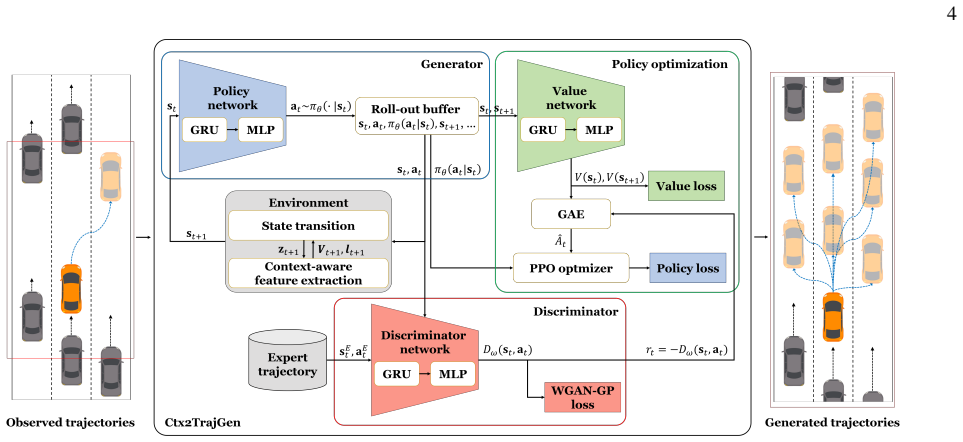
The carrying mechanism is a context-aware adversarial imitation loop. The state fed to the policy is $s_t = (z_t, V_t, \ell_t)$, where $z_t$ holds the ego vehicle's position, velocity, and acceleration, $V_t \in \mathbb{R}^{N \times d}$ encodes relative positions and velocities of surrounding vehicles, and $\ell_t$ is a one-hot lane-occupancy vector. The generator is a Gated Recurrent Unit policy that outputs a Gaussian Mixture Model over two-dimensional displacements $a_t = [\Delta x_t, \Delta y_t]$, and a deterministic environment updates the ego state. A GRU-based discriminator scores state-action pairs with a WGAN-GP loss, and PPO with GAE updates the policy using the discriminator's score as reward. This combination is what the paper claims converts drone-recorded traffic context into stable, interaction-aware microscale trajectory generation.
What would settle it
Train Ctx2TrajGen on a random subset of DRIFT site C trajectories, then compute MMD, KL, and JS against a held-out subset from the same site and against trajectories from another DRIFT intersection. If the held-out or cross-site metrics rise substantially relative to the reported training-distribution numbers, or if a microscale baseline such as TrajGAIL tuned to microscale states matches or beats them, the claim that the model generalizes beyond its training distribution would be refuted.
Extended reading notes
Core claim
The paper's central claim is that microscopic trajectory generation can be made stable and context-sensitive by combining an explicit spatiotemporal context representation with two training stabilizers inside GAIL. On DRIFT site C, comprising 920 trajectories with lane curvature and six surrounding vehicles per ego, Ctx2TrajGen achieves the best distributional alignment across MMD, KL, and JS among the tested methods, with a Wasserstein distance of 0.2781 that is second only to TrajSynVAE's 0.2233. Ablation results attribute the gain to synergy between PPO and WGAN-GP: the full configuration produces an MMD of 0.0021 versus 0.0125 to 0.0133 for partial configurations. The paper frames this as evidence that interaction-aware, simulation-free microscale trajectory generation is feasible and can mitigate domain shift.
Load-bearing premise
The evaluation assumes that distributional similarity to the same DRIFT site C data used for training, measured with MMD, KL, and JS against macroscale GPS baselines, is a valid measure of realistic microscale generation; if a held-out split or a true microscale comparator were used, the reported performance gap could shrink or disappear.
Editorial extensions
If this is right
- Microscale trajectory data could be generated on demand from a small set of drone-recorded expert trajectories, easing the data scarcity that limits traffic safety analysis.
- Because the generator conditions on surrounding vehicles and lane occupancy, the same framework can produce interaction-aware maneuvers such as car-following, lane changes, and gap acceptance without explicit rules.
- The reported stability of PPO plus WGAN-GP suggests that GAIL-based trajectory generators can avoid mode collapse while staying computationally cheap, with the full configuration running in 29.8 seconds.
- Synthetic trajectories that match expert distributions on MMD, KL, and JS could serve as training or validation inputs for trajectory prediction and automated driving systems.
- The architecture separates environment transitions from policy learning, so the same trained policy could be rolled out in other road geometries by swapping the context encoder.
Reading between the lines
- The paper never ablates the context representation itself, so the reported gains could come largely from conditioning on surrounding vehicles and lane geometry rather than from GAIL, PPO, or WGAN-GP; a context-free ablation would isolate the active ingredient.
- Because evaluation uses the same site C distribution used for training and no held-out split is described, the MMD, KL, and JS numbers likely measure distributional reproduction rather than generalization; evaluating on another DRIFT intersection would test transfer.
- The Wasserstein result of 0.2781 versus TrajSynVAE's 0.2233 shows Ctx2TrajGen is not uniformly best across all distributional metrics, suggesting the outperformance claim is metric-dependent.
- A natural next step is to test whether the generated trajectories improve downstream tasks such as trajectory prediction or adaptive signal control, thereby turning distributional similarity into functional utility.
Editorial analysis
A structured set of objections, weighed in public.
Referee Report
Summary. The paper proposes Ctx2TrajGen, a generative adversarial imitation learning framework for microscale vehicle trajectory generation. The generator is a GRU-based stochastic policy that outputs two-dimensional displacement actions from a Gaussian mixture model, conditioned on ego kinematics, relative positions and velocities of surrounding vehicles, and lane occupancy. Training uses PPO for policy updates and a WGAN-GP discriminator whose output supplies the reward. The method is evaluated on 920 trajectories from site C of the DRIFT dataset, with distributional metrics (MMD, Wasserstein distance, KL, JS) against four baselines, and ablations that toggle PPO and WGAN-GP. The paper also includes qualitative trajectory-level validation, where it acknowledges negative speeds and standstill speed fluctuations in the generated data.
Significance. The problem is relevant: realistic microscale trajectory generation is useful for traffic simulation and autonomous driving, and a non-simulator GAIL approach conditioned on local context is a plausible direction. The paper's architecture is transparent, and the ablation design is appropriate in principle. However, the central empirical claim—that Ctx2TrajGen outperforms state-of-the-art baselines in realism, diversity, and contextual fidelity—is not established by the presented evidence. The baselines are macroscale GPS generators, no held-out split or repeated runs are reported, and the paper's own trajectory-level validation reports physically impossible negative speeds. If the result were supported by a proper evaluation, it would be a meaningful contribution; as it stands, the empirical core needs substantial reworking.
major comments (4)
- [Validation, 'Baselines' and Table 1] The four baseline models (TrajSynVAE, TrajGDM, LSTM-TrajGAN, DiffTraj) are macroscale GPS trajectory generators, as stated in the Related Work section, and no adaptation or retraining on microscale DRIFT data is described. Comparing them with a microscale model on drone-captured high-resolution trajectories is not a valid state-of-the-art comparison, and the reported MMD reduction of 99.9% relative to DiffTraj is therefore not interpretable as evidence of superiority over microscale generation methods.
- [Validation, 'Data', 'Evaluation Metrics', and Table 1] The evaluation does not state a train/test split; all metrics appear to be computed on the same site-C distribution used for training. This does not support the abstract's claims about generalization, data scarcity, or domain shift. In addition, no random seeds, number of runs, or error bars are reported, so the numerical differences in Table 1 cannot be assessed for statistical reliability.
- [Trajectory-Level Validation, Figures 5 and 6] The paper reports negative speed values in the generated data and 'minor speed fluctuations during standstill phases.' Speed is nonnegative by definition, and these artifacts contradict the assertion in 'Context-Aware Encoded Environment' that generated motions remain physically consistent. Low aggregate distributional divergence does not preclude per-trajectory kinematic violations, so the realism claim is not supported.
- [Ablation Studies, Table 2 and Figure 4] The ablation table reports single-run values without variance, and the convergence curves are qualitative. The conclusion that PPO and WGAN-GP 'synergistically improve' training stability and fidelity therefore lacks statistical support, especially given the small data subset (920 trajectories) and the absence of multiple seeds.
minor comments (5)
- [Policy Network, Eq. (1)] The GMM weights w^k_t are not constrained or defined; specify that they sum to one and describe how means and variances are parameterized.
- [Trajectory Discriminator, Eq. (2)] The interpolation distribution P_{\hat{x}} for the gradient penalty is not defined; specify the sampling procedure.
- [Validation, 'Implementation Details'] The description 'PPO epsilon tuned to 0.98 within a threshold range [0.95,1.01]' is unclear; in Eq. (7), epsilon is the clipping bound, so a value near 1 would make the clipping range unusually wide. Clarify.
- [Related Work and Validation] The baseline TrajSynVAE (Wang et al. 2023) is described inconsistently; the Related Work section discusses TrajVAE (Chen et al. 2021) as a VAE baseline, but the validation table calls the baseline TrajSynVAE. Clarify which model is used.
- [Trajectory-Level Validation, Figure 6a] The terms 'speed' and 'velocity' are used interchangeably; define them, because negative 'speed' is later discussed.
Circularity Check
No equation-level circularity; the central empirical claim is nevertheless an in-sample fit to the DRIFT site C training distribution, not an independent prediction.
-
fitted input called prediction
[Validation / Experimental Setup - Data; Main Results (Table 1)]
"The data underwent preprocessing, focusing on site C, utilizing 920 trajectories, where lane structure information with curvature was integrated."
The policy is trained with GAIL on DRIFT site C expert demonstrations; the discriminator loss (Eq. 2) and reward (Eq. 3) directly minimize distributional divergence to those expert trajectories. The Validation section describes preprocessing on site C with 920 trajectories but states no train/test split, and Table 1 reports MMD/KL/JS against the same site C distribution. Reporting divergence to the training distribution is therefore an in-sample fit to the training objective, not an independent prediction of realism or generalization. The DRIFT citation is co-authored by current authors, but the operative circularity is the missing held-out split, not the citation itself.
full rationale
The paper contains no derivation chain in which an output equation reduces to an input equation. The architecture (GAIL+PPO+WGAN-GP) is standard, and the loss functions are not used to define the evaluation metrics. However, the central empirical claim is weakened by an in-sample evaluation: the model is fit to DRIFT site C and then 'predicts' distributional similarity on the same site C trajectories, with no held-out split or error bars. This makes the MMD 0.0021 a measure of training-set alignment rather than a validated generalization result, and the comparison to macroscale GPS baselines is not apples-to-apples. The paper's own trajectory-level validation reports negative speeds, which further undermines the realism claim, but that is a correctness issue rather than circularity. The DRIFT self-citation is real, yet the dataset itself is external drone-collected sensor data, so it is not load-bearing in the sense of a uniqueness theorem or ansatz smuggled by citation. Overall, the empirical numbers are not derived from the inputs, so the score is 2 rather than higher.
Assumptions & free parameters
free parameters (10)
- Number of surrounding vehicles N =
6
- PPO clipping threshold =
0.98 (range [0.95, 1.01])
- Policy learning rate =
5e-5
- Value learning rate =
1e-4
- Discriminator learning rate =
1e-8
- WGAN-GP gradient penalty coefficient =
1.0
- GMM component count K =
not reported
- Discount factor gamma and GAE lambda =
not reported
- GRU hidden units =
128
- Data subset size =
920 trajectories out of 81,699
assumptions (6)
- domain assumption The state st=(zt, Vt, lt) is a sufficient statistic for interaction-aware driving decisions.
- domain assumption The deterministic transition function T produces physically consistent states without stochastic noise.
- domain assumption The DRIFT dataset annotations, lane geometry, and vehicle tracks are accurate.
- standard math GAIL, PPO, and WGAN-GP are valid for this setting and the standard equations apply.
- domain assumption The discriminator reward rt=-D(st,at) provides an appropriate training signal.
- ad hoc to paper The four baselines are appropriate state-of-the-art comparators for microscale trajectory generation.
Cite this review
Pith. "Pith review of Ctx2TrajGen: Traffic Context-Aware Microscale Vehicle Trajectories using Generative Adversarial Imitation Learning." pith.science (2026). https://pith.science/paper/2Z6N54G6
@misc{pith2026250717418,
  author       = {Pith},
  title        = {Pith review of: Ctx2TrajGen: Traffic Context-Aware Microscale Vehicle Trajectories using Generative Adversarial Imitation Learning},
  year         = {2026},
  howpublished = {\url{https://pith.science/paper/2Z6N54G6}},
  note         = {Machine review of arXiv:2507.17418}
}
read the original abstract
Precise modeling of microscopic vehicle trajectories is critical for traffic behavior analysis and autonomous driving systems. We propose Ctx2TrajGen, a context-aware trajectory generation framework that synthesizes realistic urban driving behaviors using GAIL. Leveraging PPO and WGAN-GP, our model addresses nonlinear interdependencies and training instability inherent in microscopic settings. By explicitly conditioning on surrounding vehicles and road geometry, Ctx2TrajGen generates interaction-aware trajectories aligned with real-world context. Experiments on the drone-captured DRIFT dataset demonstrate superior performance over existing methods in terms of realism, behavioral diversity, and contextual fidelity, offering a robust solution to data scarcity and domain shift without simulation.
Figures


Figures from the paper (2 more)


Forward citations
Cited by 1 Pith paper
-
DRIFT: Risk-Constrained Diffusion with Imitation Priors for Mixed-Autonomy Traffic Generation
DRIFT couples penetration-aware encoding, diffusion of executable controls, and long-tail risk reweighting to produce competitive safety–efficiency tradeoffs in closed-loop Flow/SUMO mixed-autonomy traffic.
Reference graph
Works this paper leans on
-
[1]
, " * write output.state after.block = add.period write newline
ENTRY address archivePrefix author booktitle chapter edition editor eid eprint howpublished institution isbn journal key month note number organization pages publisher school series title type volume year label extra.label sort.label short.list INTEGERS output.state before.all mid.sentence after.sentence after.block FUNCTION init.state.consts #0 'before.a...
-
[2]
write newline
" write newline "" before.all 'output.state := FUNCTION n.dashify 't := "" t empty not t #1 #1 substring "-" = t #1 #2 substring "--" = not "--" * t #2 global.max substring 't := t #1 #1 substring "-" = "-" * t #2 global.max substring 't := while if t #1 #1 substring * t #2 global.max substring 't := if while FUNCTION word.in bbl.in capitalize " " * FUNCT...
-
[3]
Cabanas-Tirapu, O.; Dan \'u s, L.; Moro, E.; Sales-Pardo, M.; and Guimer \`a , R. 2025. Human mobility is well described by closed-form gravity-like models learned automatically from data. Nature Communications, 16(1): 1336
work page 2025
-
[4]
Chen, X.; Xu, J.; Zhou, R.; Chen, W.; Fang, J.; and Liu, C. 2021. Trajvae: A variational autoencoder model for trajectory generation. Neurocomputing, 428: 332--339
work page 2021
-
[5]
Choi, S.; Kim, J.; and Yeo, H. 2021. TrajGAIL: Generating urban vehicle trajectories using generative adversarial imitation learning. Transportation Research Part C: Emerging Technologies, 128: 103091
work page 2021
-
[6]
Chu, C.; Zhang, H.; Wang, P.; and Lu, F. 2024. Simulating human mobility with a trajectory generation framework based on diffusion model. International Journal of Geographical Information Science, 38(5): 847--878
work page 2024
-
[7]
Gulrajani, I.; Ahmed, F.; Arjovsky, M.; Dumoulin, V.; and Courville, A. C. 2017. Improved training of wasserstein gans. Advances in neural information processing systems, 30
work page 2017
-
[8]
Ho, J.; and Ermon, S. 2016. Generative adversarial imitation learning. Advances in neural information processing systems, 29
work page 2016
Show all 27 references
-
[9]
X.; Wang, J.; and Jiang, J
Jiang, W.; Zhao, W. X.; Wang, J.; and Jiang, J. 2023. Continuous trajectory generation based on two-stage GAN. In Proceedings of the AAAI Conference on Artificial Intelligence, volume 37, 4374--4382
2023
-
[10]
Lee, H.; Hong, S.; Song, J.; Cho, H.; Jin, Z.; Kim, B.; Jin, J.; Im, J.; Noh, B.; and Yeo, H. 2025. DRIFT open dataset: A drone-derived intelligence for traffic analysis in urban environment. arXiv preprint arXiv:2504.11019
2025 arXiv
-
[11]
Lu, Y.; Wang, W.; Hu, X.; Xu, P.; Zhou, S.; and Cai, M. 2022. Vehicle trajectory prediction in connected environments via heterogeneous context-aware graph convolutional networks. IEEE Transactions on intelligent transportation systems, 24(8): 8452--8464
2022
-
[12]
Lu, Y.; Zhang, Z.; Bai, R.; Liu, H.; and Wang, W. 2025. Dual-View Interaction-Aware Lane Change Prediction for Autonomous Driving. In Proceedings of the AAAI Conference on Artificial Intelligence, volume 39, 28222--28230
2025
-
[13]
Naing, H.; Cai, W.; Yu, J.; Zhong, J.; and Yu, L. 2024. Fine-Grained Trajectory Reconstruction by Microscopic Traffic Simulation With Dynamic Data-Driven Evolutionary Optimization. IEEE Transactions on Intelligent Transportation Systems
2024
-
[14]
Owais, M. 2024. Deep learning for integrated origin--destination estimation and traffic sensor location problems. IEEE Transactions on Intelligent Transportation Systems, 25(7): 6501--6513
2024
-
[15]
Qi, H. 2024. Microscopic Modeling of Abnormal Driving Behavior: A Two-Dimensional Stochastic Formulation with Customizable Safety Levels. IEEE Transactions on Intelligent Transportation Systems
2024
-
[16]
Rao, J.; Gao, S.; Kang, Y.; and Huang, Q. 2020. LSTM-TrajGAN: A deep learning approach to trajectory privacy protection. arXiv preprint arXiv:2006.10521
2020 arXiv
-
[17]
Rong, C.; Feng, J.; and Ding, J. 2023. Goddag: Generating origin-destination flow for new cities via domain adversarial training. IEEE Transactions on Knowledge and Data Engineering, 35(10): 10048--10057
2023
-
[18]
Schulman, J.; Moritz, P.; Levine, S.; Jordan, M.; and Abbeel, P. 2015. High-dimensional continuous control using generalized advantage estimation. arXiv preprint arXiv:1506.02438
2015 arXiv
-
[19]
Schulman, J.; Wolski, F.; Dhariwal, P.; Radford, A.; and Klimov, O. 2017. Proximal policy optimization algorithms. arXiv preprint arXiv:1707.06347
2017 arXiv
-
[20]
Sun, C.; Qian, H.; and Miao, C. 2024. Cudc: A curiosity-driven unsupervised data collection method with adaptive temporal distances for offline reinforcement learning. In Proceedings of the AAAI Conference on Artificial Intelligence, volume 38, 15145--15153
2024
-
[21]
Sun, L.; and Yin, Y. 2017. Discovering themes and trends in transportation research using topic modeling. Transportation Research Part C: Emerging Technologies, 77: 49--66
2017
-
[22]
Wang, H.; Zhang, Q.; Wu, Y.; Jin, D.; Wang, X.; Zhu, L.; and Yu, L. 2023. Synthesizing human trajectories based on variational point processes. IEEE Transactions on Knowledge and Data Engineering, 36(4): 1785--1799
2023
-
[23]
Wang, Z.; Miao, H.; Wang, S.; Wang, R.; Wang, J.; and Zhang, J. 2025. C2f-tp: A coarse-to-fine denoising framework for uncertainty-aware trajectory prediction. In Proceedings of the AAAI Conference on Artificial Intelligence, volume 39, 12810--12817
2025
-
[24]
Xiong, W.; Fonod, R.; Alahi, A.; and Geroliminis, N. 2025. Multi-Source Urban Traffic Flow Forecasting with Drone and Loop Detector Data. arXiv preprint arXiv:2501.03492
2025 arXiv
-
[25]
J.; Flannagan, C.; and Liu, H
Yan, X.; Feng, S.; LeBlanc, D. J.; Flannagan, C.; and Liu, H. X. 2024. Evaluation of automated driving system safety metrics with logged vehicle trajectory data. IEEE Transactions on Intelligent Transportation Systems, 25(8): 8913--8925
2024
-
[26]
Yan, X.; Zou, Z.; Feng, S.; Zhu, H.; Sun, H.; and Liu, H. X. 2023. Learning naturalistic driving environment with statistical realism. Nature communications, 14(1): 2037
2023
-
[27]
Zhu, Y.; Ye, Y.; Zhang, S.; Zhao, X.; and Yu, J. 2023. Difftraj: Generating gps trajectory with diffusion probabilistic model. Advances in Neural Information Processing Systems, 36: 65168--65188
2023
Reviewed August 6, 2026 · model on record in the stance chip above.
Discussion (0). Continue with ORCID to comment.