REVIEW 4 major objections 6 minor 1 cited by
InvRGB+L: Inverse Rendering of Complex Scenes with Unified Color and LiDAR Reflectance Modeling
T0 review · 4 major / 6 minor · reviewed 2026-08-06 · deepseek-v4-flash
Pith's one-line read InvRGB+L treats LiDAR intensity as a material cue, not just geometry, to recover relightable, dynamic scenes from one RGB+LiDAR sequence.
desk verdict InvRGB+L is a real step forward for LiDAR-aware inverse rendering—its specular LiDAR model and RGB-LiDAR consistency losses are novel—but the material-quality evidence is more suggestive than conclusive. read the letter →
The pith
A machine-rendered reading of the paper's core claim, the machinery that carries it, and where it could break.
The reading
What carries the argument
The load-bearing object is the physics-based LiDAR reflectance model of Eq. 2, a microfacet BRDF with a diffuse term $\rho_{\text{lidar}}/\pi$ and an explicit specular term controlled by roughness $\tau$, Fresnel factor $F_0=0.04$, and incidence cosine $\cos\theta$. It replaces the Lambertian model used by earlier LiDAR simulators and, because it shares the same Cook–Torrance shading structure as the RGB renderer, it lets RGB and LiDAR be optimized in one framework. The second piece of machinery is the pair of RGB–LiDAR consistency losses, especially the regional loss that assumes similar LiDAR albedo implies similar spectral reflectance; that assumption is what lets active near-infrared measurements correct lighting-induced errors in the visible albedo.
What would settle it
Set up a calibration board with two adjacent panels that have nearly identical near-infrared reflectance but clearly different visible colors, scan it with a LiDAR-camera rig, and run the model: if the regional consistency loss is correct, the two panels should still be recovered with their true visible albedos, whereas merging them into one albedo would falsify the load-bearing assumption. A complementary spectral check is to measure visible and 905 nm reflectance curves across common urban materials and test how often equal LiDAR albedo co-occurs with unequal visible albedo.
Extended reading notes
Core claim
The paper's central claim is that LiDAR returned power should be treated as a second spectral measurement of surface material, nearly independent of visible illumination, and that a rendering model built on this idea outperforms RGB-only inverse rendering and Lambertian LiDAR simulation. The LiDAR reflectance model extends the standard diffuse Lambertian assumption by adding a specular term derived from a microfacet BRDF, so that intensity depends on both diffuse LiDAR albedo $\rho_{\text{lidar}}$ and surface roughness $\tau$; this lets the same roughness drive RGB and LiDAR shading. Two consistency losses then couple the modalities: a smoothness term propagates sparse LiDAR albedo into a dense map guided by RGB albedo, and a regional term forces RGB albedo to be constant where LiDAR albedo is constant, using superpixel regions. The paper reports that this joint optimization yields visible albedo without baked-in shadows, consistent LiDAR albedo, and novel-view LiDAR intensity with the lowest error among the compared simulators.
Load-bearing premise
The method assumes that surfaces which look the same to a near-infrared LiDAR sensor also have similar visible color, so that sparse LiDAR intensity can be safely propagated into dense RGB albedo; if real materials break that correlation, the consistency loss will flatten genuine color differences.
Editorial extensions
If this is right
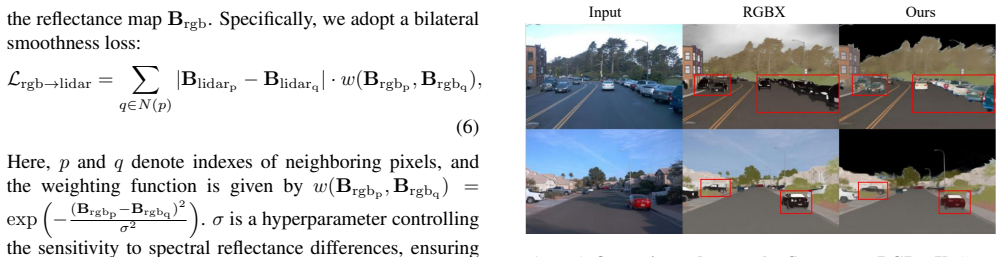
- In urban inverse rendering, LiDAR intensity removes cast-shadow and overexposure artifacts that RGB-only methods bake into albedo, so relit images no longer carry static shadow ghosts.
- A specular LiDAR reflectance model recovers highlights on cars and wet surfaces; ignoring specularity yields visibly diffuse shading and higher novel-view intensity error.
- Because geometry, material, and illumination are disentangled in a relightable scene graph, one RGB+LiDAR sequence supports relighting, night-time simulation, and object insertion without retraining.
- Night-simulation can turn labeled daytime sequences into synthetic nighttime frames, improving a downstream detector's precision, recall, and mAP@50 on real nighttime images.
- On the paper's four test scenes, average LiDAR intensity RMSE drops to 0.063, below the best compared baseline at 0.073.
Reading between the lines
- If the LiDAR-to-RGB albedo correlation holds broadly, LiDAR intensity could act as a stable calibrator for intrinsic-image decomposition in scenes with extreme lighting changes, since active near-infrared reflectance does not depend on sun or sky.
- The same physics-based reflectance idea should transfer to other active sensors that report returned power, such as radar or thermal imagers, whose controlled illumination may expose material properties that visible light confounds.
- A testable extension is to run the method on scenes containing materials with deliberately mismatched visible and near-infrared reflectance; the speed at which the consistency loss breaks down would quantify how much the assumption can be trusted.
Editorial analysis
A structured set of objections, weighed in public.
Referee Report
Summary. The manuscript proposes InvRGB+L, an inverse rendering framework that reconstructs large, dynamic, relightable scenes from a single RGB+LiDAR sequence. The scene is represented as a dynamic 3D Gaussian scene graph; RGB rendering uses a Cook-Torrance BRDF, while LiDAR intensity rendering uses a new physically motivated reflectance model with a specular term. The optimization combines fidelity losses, diffusion priors for normals and materials, and two RGB-LiDAR consistency losses that propagate cues between visible albedo and LiDAR albedo. Experiments report qualitative inverse rendering comparisons on Waymo, a quantitative relighting evaluation on one custom scene, LiDAR novel-view intensity synthesis on Waymo, ablations, and a nighttime data augmentation application for object detection.
Significance. Assuming the central claims hold, the paper identifies a genuinely useful signal: LiDAR intensity, measured under active illumination at 905 nm, can help disambiguate albedo from lighting in inverse rendering. The explicit Cook-Torrance treatment of LiDAR specularity is a reasonable step beyond Lambertian models and is directly applicable to LiDAR simulation. The authors collect custom outdoor and indoor LiDAR-camera data for relighting and indoor evaluations, which is a strength, and the LiDAR simulation comparison on Waymo follows a concrete protocol. However, the margin of the specular model over a Lambertian baseline is small, and the cross-spectral consistency assumption that underpins the material-cue contribution is not validated. The paper is therefore promising but needs substantially stronger evidence before the headline claims can be accepted.
major comments (4)
- [§4.3, Eq. (7)] The regional consistency loss Llidar→rgb is load-bearing for the paper's material-estimation claims, but it rests on an assumption that is asserted, not validated: 'Assume surfaces with similar albedo will have similar spectral reflectance.' The two citations ([21], [26]) are pre-LiDAR color-constancy references and do not supply paired measurements of visible reflectance and 905 nm LiDAR albedo. Because Eq. (7) penalizes the variance of Brgb inside regions of similar LiDAR albedo, it can actively erase true visible-albedo differences for materials that are distinct in the visible spectrum but have similar near-infrared reflectance (for example, differently colored paints or certain vegetation/man-made pairs). The ablation in Table 1 and the qualitative results in Fig. 5 credit this loss with correcting shadow and illuminant errors, so the central claim of 'more accurate materials than SOTA' is not established in exactly the regime where the assumption fails. Please validate the cross-spectral assumption with paired visible/NIR reflectance data or a controlled experiment, and consider a softer form of Eq. (7) that enforces correlation only across material boundaries rather than a hard variance penalty. Also, the notation var(BrgbΩ | BlidarΩ) is non-standard; please specify whether the variance is computed within each SAM superpixel or within LiDAR-albedo bins.
- [§5.2, Table 1] The quantitative relighting evaluation rests on a single custom scene (Sec. A.1) and reports no error bars or statistical significance. The claim that InvRGB+L surpasses state-of-the-art urban inverse rendering is otherwise supported only by qualitative comparisons on Waymo, where the UrbanIR and FEGR baselines are provided by the authors and are not re-run under identical conditions. A single-scene PSNR improvement of 1.58 dB over UrbanIR and 0.45 dB over the w/o Llidar→rgb variant is insufficient to support the headline claim. Please add multiple relighting scenes, report per-scene numbers and variance, and consider a direct albedo/reflectance metric (e.g., on synthetic scenes with ground truth) so that rendered-image metrics are not the only evidence.
- [§A.5, Table 5; §5.2, Table 2] The evidence that the specular LiDAR reflectance model is responsible for the reported simulation gains is thin. In Table 5, the Lambertian baseline achieves 0.0493 RMSE versus 0.0470 for the full model on one scene; the difference is small and no variance is reported. Table 2 does not include a Lambertian variant of the same system on the same four Waymo scenes, so the reader cannot attribute the best RMSE in Table 2 to the specular term rather than to other components such as LiDAR-based initialization or the consistency losses. Please report the Lambertian ablation on the same evaluation protocol as Table 2, with per-scene numbers.
- [§5.3, Table 3] The ablation labeled 'w/o LiDAR' removes both the LiDAR-based initialization of the 3D Gaussians and all LiDAR-related losses. As a result, the performance drop in Table 3 cannot be attributed to LiDAR intensity cues for material estimation as opposed to LiDAR geometry initialization. Please include an ablation that retains LiDAR initialization but disables only Llidar, Lrgb→lidar, and Llidar→rgb; the 'w/o Llidar→rgb' row in Table 1 partially addresses this for relighting, but not for the reconstruction results in Table 3.
minor comments (6)
- [§3, Eq. (2) vs Appendix A.3] I checked the derivation and the apparent missing π in the specular denominator is absorbed by the 1/π prefactor Pe cosθ/(πd²); the two expressions are consistent. Please add a note to this effect to avoid reader confusion.
- [§4] The LiDAR intensity maps are denoted {It ∈ R^{W×H×3}}; LiDAR intensity is single-channel, so the dimension should be R^{W×H} (or R^{W×H×1}).
- [§4.3, Eq. (4)] The mask Mlidar is described as obtained by thresholding; please specify the threshold value and how it was chosen, since it directly controls the LiDAR fidelity loss.
- [§1] The statement that 'material properties change very slowly with wavelength' is too strong for the visible-to-905 nm comparison; many common materials change substantially between visible and near-infrared. Please qualify the claim.
- [§5.2, Table 2] Please state the intensity normalization procedure used for Waymo intensities (including any gain/offset and whether the values are linear or log-scaled), since all compared methods are sensitive to this preprocessing.
- [§A.5] The Lambertian ablation appears in Table 5 and Fig. 17 but is not referenced in the main text; add a pointer from Section 5.2 to these results.
Circularity Check
No significant circularity: LiDAR prediction and relighting tests are externally evaluated; consistency losses are regularizers, not fitted targets.
full rationale
The paper's central derivation chain is not circular. Eq. (2) is a forward physical LiDAR reflectance model with fixed constants (F0 = 0.04, Pe = 1) and per-Gaussian albedo and roughness parameters estimated from observed intensity. Table 2 evaluates intensity on held-out frames, so the novel-view LiDAR output is a genuine generalization test rather than a restatement of training data. The RGB-LiDAR losses in Eqs. (6) and (7) are regularizers that explicitly assume a cross-spectral correlation ('Assume surfaces with similar albedo will have similar spectral reflectance'); they enforce, rather than derive, that correlation, and the paper's quantitative claims do not reduce to this enforcement. The relighting protocol (train the same scene at 9 AM and 1 PM separately, then swap illumination parameters; Table 1) is an external counterfactual test, and the LiDAR simulation is benchmarked against four external baselines on Waymo. Self-citations appear only in related work, baseline comparisons, and implementation details (e.g., [2], [3], [4], [5], [25], [27]) and are not load-bearing for the main claims. The main weakness, as the paper itself concedes in Sec. 6, is that shadow ray tracing and a skylight-plus-sun illumination model limit accuracy in complex and nighttime scenes; that is a correctness and robustness concern, not circularity. No step reduces by construction to its own input.
Assumptions & free parameters
free parameters (5)
- Fresnel reflectance F0 =
0.04
- Bilateral smoothness bandwidth sigma =
not reported
- Loss weights lambda_1..lambda_6 =
1, 1, 0.1, 0.1, 0.05, 0.05
- Per-Gaussian sun visibility vsun =
learned per Gaussian
- LiDAR mask threshold =
not specified
assumptions (7)
- domain assumption LiDAR reflectance follows the rendering equation with no in/out scattering.
- domain assumption LiDAR incident radiance is a narrow constant beam with inverse-square falloff, and the sensor responds linearly to radiance.
- ad hoc to paper The Cook-Torrance specular BRDF with GGX distribution, F0=0.04, and G=min(1,2cos^2 theta) models LiDAR retroreflection.
- domain assumption Surface normal and roughness are identical at visible and LiDAR wavelengths; only diffuse albedo differs.
- ad hoc to paper Spectral reflectance (visible) and LiDAR albedo are strongly spatially correlated.
- ad hoc to paper Sparse LiDAR albedo can be densified by bilateral smoothness weighted by RGB albedo similarity.
- domain assumption The scene decomposes into static background, rigid dynamic objects with given SE(3) poses, and sky/sun illumination.
Cite this review
Pith. "Pith review of InvRGB+L: Inverse Rendering of Complex Scenes with Unified Color and LiDAR Reflectance Modeling." pith.science (2026). https://pith.science/paper/A6F27IHX
@misc{pith2026250717613,
  author       = {Pith},
  title        = {Pith review of: InvRGB+L: Inverse Rendering of Complex Scenes with Unified Color and LiDAR Reflectance Modeling},
  year         = {2026},
  howpublished = {\url{https://pith.science/paper/A6F27IHX}},
  note         = {Machine review of arXiv:2507.17613}
}
read the original abstract
We present InvRGB+L, a novel inverse rendering model that reconstructs large, relightable, and dynamic scenes from a single RGB+LiDAR sequence. Conventional inverse graphics methods rely primarily on RGB observations and use LiDAR mainly for geometric information, often resulting in suboptimal material estimates due to visible light interference. We find that LiDAR's intensity values-captured with active illumination in a different spectral range-offer complementary cues for robust material estimation under variable lighting. Inspired by this, InvRGB+L leverages LiDAR intensity cues to overcome challenges inherent in RGB-centric inverse graphics through two key innovations: (1) a novel physics-based LiDAR shading model and (2) RGB-LiDAR material consistency losses. The model produces novel-view RGB and LiDAR renderings of urban and indoor scenes and supports relighting, night simulations, and dynamic object insertions, achieving results that surpass current state-of-the-art methods in both scene-level urban inverse rendering and LiDAR simulation.
Figures


Figures from the paper (13 more)




Forward citations
Cited by 1 Pith paper
-
LR-SGS: Robust LiDAR-Reflectance-Guided Salient Gaussian Splatting for Self-Driving Scene Reconstruction
LR-SGS adds LiDAR reflectance as a lighting-invariant channel to guide salient Gaussian placement and density control, yielding higher PSNR than prior methods on Waymo complex-lighting scenes while using fewer Gaussians.
Reference graph
Works this paper leans on
-
[21]
E.L. Krinov. Spectral reflectance properties of natural for- mations. Technical report, National Research Council of Canada, Technical Translation: TT-439, 1947. 4
work page 1947
-
[26]
L.T. Maloney and B.A. Wandell. A computational model of color constancy. J. Opt. Soc. Am, 1:29–33, 1986. 4
work page 1986
-
[1]
Lidar-gs: Real-time lidar re-simulation us- ing gaussian splatting
Qifeng Chen, Sheng Yang, Sicong Du, Tao Tang, Peng Chen, and Yuchi Huo. Lidar-gs: Real-time lidar re-simulation us- ing gaussian splatting. arXiv preprint arXiv:2410.05111 ,
-
[2]
Xiaoxue Chen, Junchen Liu, Hao Zhao, Guyue Zhou, and Ya-Qin Zhang. Nerrf: 3d reconstruction and view synthesis for transparent and specular objects with neural refractive- reflective fields. arXiv preprint arXiv:2309.13039, 2023. 2
arXiv 2023
-
[3]
Dpf: Learning dense prediction fields with weak supervision
Xiaoxue Chen, Yuhang Zheng, Yupeng Zheng, Qiang Zhou, Hao Zhao, Guyue Zhou, and Ya-Qin Zhang. Dpf: Learning dense prediction fields with weak supervision. In Proceed- ings of the IEEE/CVF Conference on Computer Vision and Pattern Recognition, pages 15347–15357, 2023. 2
work page 2023
-
[4]
Time-conditioned illumination for inverse rendering of out- door scenes
Xiaoxue Chen, Hao Zhao, Guyue Zhou, and Ya-Qin Zhang. Time-conditioned illumination for inverse rendering of out- door scenes. 2024. 2
work page 2024
-
[5]
Xiaoxue Chen, Jv Zheng, Hao Huang, Haoran Xu, Wei- hao Gu, Kangliang Chen, Huan-ang Gao, Hao Zhao, Guyue Zhou, Yaqin Zhang, et al. Rgm: Reconstructing high-fidelity 3d car assets with relightable 3d-gs generative model from a single image. arXiv preprint arXiv:2410.08181, 2024. 2
-
[6]
Omnire: Omni ur- ban scene reconstruction
Ziyu Chen, Jiawei Yang, Jiahui Huang, Riccardo de Lutio, Janick Martinez Esturo, Boris Ivanovic, Or Litany, Zan Go- jcic, Sanja Fidler, Marco Pavone, et al. Omnire: Omni ur- ban scene reconstruction. arXiv preprint arXiv:2408.16760,
Show all 55 references
-
[7]
General- ized lidar intensity normalization and its positive impact on geometric and learning-based lane marking detection
Yi-Ting Cheng, Yi-Chun Lin, and Ayman Habib. General- ized lidar intensity normalization and its positive impact on geometric and learning-based lane marking detection. Re- mote Sensing, 14(17):4393, 2022. 2
2022
-
[8]
Blender — a 3d modelling and rendering package, 2025
Blender Online Community. Blender — a 3d modelling and rendering package, 2025. Version 4.4. 8
2025
-
[9]
Torrance
Robert L Cook and Kenneth E. Torrance. A reflectance model for computer graphics. ACM Transactions on Graph- ics (ToG), 1(1):7–24, 1982. 2, 11
1982
-
[10]
Material parameter estimation with terahertz time- domain spectroscopy
Timothy D Dorney, Richard G Baraniuk, and Daniel M Mit- tleman. Material parameter estimation with terahertz time- domain spectroscopy. JOSA A, 18(7):1562–1571, 2001. 2
2001
-
[11]
Geowiz- ard: Unleashing the diffusion priors for 3d geometry esti- mation from a single image
Xiao Fu, Wei Yin, Mu Hu, Kaixuan Wang, Yuexin Ma, Ping Tan, Shaojie Shen, Dahua Lin, and Xiaoxiao Long. Geowiz- ard: Unleashing the diffusion priors for 3d geometry esti- mation from a single image. In European Conference on Computer Vision, pages 241–258. Springer, 2024. 2, 4, 12
2024
-
[12]
Relightable 3d gaussians: Re- alistic point cloud relighting with brdf decomposition and ray tracing
Jian Gao, Chun Gu, Youtian Lin, Zhihao Li, Hao Zhu, Xun Cao, Li Zhang, and Yao Yao. Relightable 3d gaussians: Re- alistic point cloud relighting with brdf decomposition and ray tracing. In European Conference on Computer Vision , pages 73–89. Springer, 2024. 2, 4
2024
-
[13]
Neural kernel surface re- construction
Jiahui Huang, Zan Gojcic, Matan Atzmon, Or Litany, Sanja Fidler, and Francis Williams. Neural kernel surface re- construction. In Proceedings of the IEEE/CVF Conference on Computer Vision and Pattern Recognition , pages 4369– 4379, 2023. 2
2023
-
[14]
Neural lidar fields for novel view synthesis
Shengyu Huang, Zan Gojcic, Zian Wang, Francis Williams, Yoni Kasten, Sanja Fidler, Konrad Schindler, and Or Litany. Neural lidar fields for novel view synthesis. In Proceedings of the IEEE/CVF International Conference on Computer Vi- sion, pages 18236–18246, 2023. 2, 6, 7
2023
-
[15]
Tensoir: Tensorial inverse rendering
Haian Jin, Isabella Liu, Peijia Xu, Xiaoshuai Zhang, Song- fang Han, Sai Bi, Xiaowei Zhou, Zexiang Xu, and Hao Su. Tensoir: Tensorial inverse rendering. In Proceedings of the IEEE/CVF Conference on Computer Vision and Pattern Recognition, pages 165–174, 2023. 2, 3
2023
-
[16]
ultralytics/yolov5: v3
Glenn Jocher, Alex Stoken, Jirka Borovec, Liu Changyu, Adam Hogan, Laurentiu Diaconu, Jake Poznanski, Lijun Yu, Prashant Rai, Russ Ferriday, et al. ultralytics/yolov5: v3. 0. Zenodo, 2020. 8
2020
-
[17]
James T. Kajiya. The rendering equation. In Proceedings of the 13th Annual Conference on Computer Graphics and Interactive Techniques (SIGGRAPH ’86) , pages 143–150. ACM, 1986. 2
1986
-
[18]
Segment any- thing
Alexander Kirillov, Eric Mintun, Nikhila Ravi, Hanzi Mao, Chloe Rolland, Laura Gustafson, Tete Xiao, Spencer White- head, Alexander C Berg, Wan-Yen Lo, et al. Segment any- thing. In Proceedings of the IEEE/CVF international confer- ence on computer vision, pages 4015–4026, 2023. 5
2023
-
[19]
In- trinsic image diffusion for indoor single-view material es- timation
Peter Kocsis, Vincent Sitzmann, and Matthias Nießner. In- trinsic image diffusion for indoor single-view material es- timation. In Proceedings of the IEEE/CVF Conference on Computer Vision and Pattern Recognition , pages 5198– 5208, 2024. 2
2024
-
[20]
General, single-shot, target-less, and automatic lidar- camera extrinsic calibration toolbox
Kenji Koide, Shuji Oishi, Masashi Yokozuka, and Atsuhiko Banno. General, single-shot, target-less, and automatic lidar- camera extrinsic calibration toolbox. In 2023 IEEE Inter- national Conference on Robotics and Automation (ICRA) . IEEE,, 2023-5-29. 11
2023
-
[22]
Pcgen: Point cloud generator for lidar simulation
Chenqi Li, Yuan Ren, and Bingbing Liu. Pcgen: Point cloud generator for lidar simulation. In 2023 IEEE Inter- national Conference on Robotics and Automation (ICRA) , pages 11676–11682. IEEE, 2023. 2, 6, 7
2023
-
[23]
Diffusionrenderer: Neu- ral inverse and forward rendering with video diffusion mod- els
Ruofan Liang, Zan Gojcic, Huan Ling, Jacob Munkberg, Jon Hasselgren, Zhi-Hao Lin, Jun Gao, Alexander Keller, Nan- dita Vijaykumar, Sanja Fidler, et al. Diffusionrenderer: Neu- ral inverse and forward rendering with video diffusion mod- els. arXiv preprint arXiv:2501.18590, 2025. 2
2025 arXiv
-
[24]
Gs-ir: 3d gaussian splatting for inverse rendering
Zhihao Liang, Qi Zhang, Ying Feng, Ying Shan, and Kui Jia. Gs-ir: 3d gaussian splatting for inverse rendering. In Pro- ceedings of the IEEE/CVF Conference on Computer Vision and Pattern Recognition, pages 21644–21653, 2024. 2
2024
-
[25]
Urbanir: Large-scale urban scene inverse render- ing from a single video
Zhi-Hao Lin, Bohan Liu, Yi-Ting Chen, Kuan-Sheng Chen, David Forsyth, Jia-Bin Huang, Anand Bhattad, and Shen- long Wang. Urbanir: Large-scale urban scene inverse render- ing from a single video. arXiv preprint arXiv:2306.09349,
-
[27]
Lidarsim: Realistic lidar simulation by leveraging the real world
Sivabalan Manivasagam, Shenlong Wang, Kelvin Wong, Wenyuan Zeng, Mikita Sazanovich, Shuhan Tan, Bin Yang, Wei-Chiu Ma, and Raquel Urtasun. Lidarsim: Realistic lidar simulation by leveraging the real world. In Proceedings of the IEEE/CVF Conference on Computer Vision and Patter...
2020
-
[28]
Lime: Live intrinsic material esti- mation
Abhimitra Meka, Maxim Maximov, Michael Zollhoefer, Avishek Chatterjee, Hans-Peter Seidel, Christian Richardt, and Christian Theobalt. Lime: Live intrinsic material esti- mation. In Proceedings of the IEEE conference on computer vision and pattern recognition, pages 6315–6324, 2018. 2
2018
-
[29]
Diffusionlight: Light probes for free by painting a chrome ball
Pakkapon Phongthawee, Worameth Chinchuthakun, Non- taphat Sinsunthithet, Varun Jampani, Amit Raj, Pramook Khungurn, and Supasorn Suwajanakorn. Diffusionlight: Light probes for free by painting a chrome ball. In Proceed- ings of the IEEE/CVF conference on computer vision and pa...
2024
-
[30]
Neural lighting simulation for urban scenes
Ava Pun, Gary Sun, Jingkang Wang, Yun Chen, Ze Yang, Sivabalan Manivasagam, Wei-Chiu Ma, and Raquel Urta- sun. Neural lighting simulation for urban scenes. Advances in Neural Information Processing Systems, 36:19291–19326,
-
[31]
Neural inverse rendering of an indoor scene from a single image
Soumyadip Sengupta, Jinwei Gu, Kihwan Kim, Guilin Liu, David W Jacobs, and Jan Kautz. Neural inverse rendering of an indoor scene from a single image. In Proceedings of the IEEE/CVF International Conference on Computer Vi- sion, pages 8598–8607, 2019. 2
2019
-
[32]
Gir: 3d gaussian inverse render- ing for relightable scene factorization
Yahao Shi, Yanmin Wu, Chenming Wu, Xing Liu, Chen Zhao, Haocheng Feng, Jian Zhang, Bin Zhou, Errui Ding, and Jingdong Wang. Gir: 3d gaussian inverse render- ing for relightable scene factorization. arXiv preprint arXiv:2312.05133, 2023. 2
2023 arXiv
-
[33]
Scalability in perception for autonomous driving: Waymo open dataset
Pei Sun, Henrik Kretzschmar, Xerxes Dotiwalla, Aurelien Chouard, Vijaysai Patnaik, Paul Tsui, James Guo, Yin Zhou, Yuning Chai, Benjamin Caine, et al. Scalability in perception for autonomous driving: Waymo open dataset. In Proceed- ings of the IEEE/CVF conference on computer ...
2020
-
[34]
Lidar-nerf: Novel li- dar view synthesis via neural radiance fields
Tang Tao, Longfei Gao, Guangrun Wang, Yixing Lao, Peng Chen, Hengshuang Zhao, Dayang Hao, Xiaodan Liang, Mathieu Salzmann, and Kaicheng Yu. Lidar-nerf: Novel li- dar view synthesis via neural radiance fields. In Proceedings of the 32nd ACM International Conference on Multimedi...
2024
-
[35]
Alignmif: Geometry-aligned multimodal implicit field for lidar-camera joint synthesis
Tang Tao, Guangrun Wang, Yixing Lao, Peng Chen, Jie Liu, Liang Lin, Kaicheng Yu, and Xiaodan Liang. Alignmif: Geometry-aligned multimodal implicit field for lidar-camera joint synthesis. In Proceedings of the IEEE/CVF Conference on Computer Vision and Pattern Recognition, page...
2024
-
[36]
Neurad: Neural rendering for autonomous driving
Adam Tonderski, Carl Lindstr ¨om, Georg Hess, William Ljungbergh, Lennart Svensson, and Christoffer Petersson. Neurad: Neural rendering for autonomous driving. In Pro- ceedings of the IEEE/CVF Conference on Computer Vision and Pattern Recognition, pages 14895–14904, 2024. 2
2024
-
[37]
Learning to predict lidar intensities
Patrik Vacek, Otakar Ja ˇsek, Karel Zimmermann, and Tom´aˇs Svoboda. Learning to predict lidar intensities. IEEE Trans- actions on Intelligent Transportation Systems , 23(4):3556– 3564, 2021. 2
2021
-
[38]
Off-road lidar intensity based semantic segmentation
Kasi Viswanath, Peng Jiang, PB Sujit, and Srikanth Saripalli. Off-road lidar intensity based semantic segmentation. In International Symposium on Experimental Robotics , pages 608–617. Springer, 2023
2023
-
[39]
Reflec- tivity is all you need!: Advancing lidar semantic segmenta- tion
Kasi Viswanath, Peng Jiang, and Srikanth Saripalli. Reflec- tivity is all you need!: Advancing lidar semantic segmenta- tion. arXiv preprint arXiv:2403.13188, 2024. 2
2024 arXiv
-
[40]
Stylelight: Hdr panorama generation for lighting estimation and editing
Guangcong Wang, Yinuo Yang, Chen Change Loy, and Zi- wei Liu. Stylelight: Hdr panorama generation for lighting estimation and editing. In European conference on computer vision, pages 477–492. Springer, 2022. 2
2022
-
[41]
Dust3r: Geometric 3d vi- sion made easy
Shuzhe Wang, Vincent Leroy, Yohann Cabon, Boris Chidlovskii, and Jerome Revaud. Dust3r: Geometric 3d vi- sion made easy. InProceedings of the IEEE/CVF Conference on Computer Vision and Pattern Recognition, pages 20697– 20709, 2024. 2
2024
-
[42]
Image quality assessment: from error visibility to structural similarity
Zhou Wang, Alan C Bovik, Hamid R Sheikh, and Eero P Si- moncelli. Image quality assessment: from error visibility to structural similarity. IEEE transactions on image processing, 13(4):600–612, 2004. 5
2004
-
[43]
Neural fields meet explicit geomet- ric representations for inverse rendering of urban scenes
Zian Wang, Tianchang Shen, Jun Gao, Shengyu Huang, Jacob Munkberg, Jon Hasselgren, Zan Gojcic, Wenzheng Chen, and Sanja Fidler. Neural fields meet explicit geomet- ric representations for inverse rendering of urban scenes. In Proceedings of the IEEE/CVF Conference on Computer ...
2023
-
[44]
Dynamic lidar re- simulation using compositional neural fields
Hanfeng Wu, Xingxing Zuo, Stefan Leutenegger, Or Litany, Konrad Schindler, and Shengyu Huang. Dynamic lidar re- simulation using compositional neural fields. InProceedings of the IEEE/CVF Conference on Computer Vision and Pat- tern Recognition, pages 19988–19998, 2024. 2
2024
-
[45]
Factorized inverse path tracing for efficient and accurate material-lighting estima- tion
Liwen Wu, Rui Zhu, Mustafa B Yaldiz, Yinhao Zhu, Hong Cai, Janarbek Matai, Fatih Porikli, Tzu-Mao Li, Manmohan Chandraker, and Ravi Ramamoorthi. Factorized inverse path tracing for efficient and accurate material-lighting estima- tion. In Proceedings of the IEEE/CVF Internatio...
2023
-
[46]
Airborne lidar intensity correction based on a new method for incidence angle correction for improving land-cover classification
Qiong Wu, Ruofei Zhong, Pinliang Dong, You Mo, and Yunxiang Jin. Airborne lidar intensity correction based on a new method for incidence angle correction for improving land-cover classification. Remote Sensing, 13(3):511, 2021. 2
2021
-
[47]
Street gaussians: Modeling dynamic urban scenes with gaussian splatting
Yunzhi Yan, Haotong Lin, Chenxu Zhou, Weijie Wang, Haiyang Sun, Kun Zhan, Xianpeng Lang, Xiaowei Zhou, and Sida Peng. Street gaussians: Modeling dynamic urban scenes with gaussian splatting. In European Conference on Computer Vision, pages 156–173. Springer, 2024. 2
2024
-
[48]
Unisim: A neural closed-loop sensor simulator
Ze Yang, Yun Chen, Jingkang Wang, Sivabalan Mani- vasagam, Wei-Chiu Ma, Anqi Joyce Yang, and Raquel Ur- tasun. Unisim: A neural closed-loop sensor simulator. In Proceedings of the IEEE/CVF Conference on Computer Vi- sion and Pattern Recognition, pages 1389–1399, 2023. 2
2023
-
[49]
Inverserendernet: Learn- ing single image inverse rendering
Ye Yu and William AP Smith. Inverserendernet: Learn- ing single image inverse rendering. In Proceedings of the IEEE/CVF Conference on Computer Vision and Pattern Recognition, pages 3155–3164, 2019. 2
2019
-
[50]
Rgb-x: Image decomposition and synthesis using material- and lighting-aware diffusion models
Zheng Zeng, Valentin Deschaintre, Iliyan Georgiev, Yannick Hold-Geoffroy, Yiwei Hu, Fujun Luan, Ling-Qi Yan, and Miloˇs Ha ˇsan. Rgb-x: Image decomposition and synthesis using material- and lighting-aware diffusion models. In Spe- cial Interest Group on Computer Graphics and I...
2024
-
[51]
Em- light: Lighting estimation via spherical distribution approxi- mation
Fangneng Zhan, Changgong Zhang, Yingchen Yu, Yuan Chang, Shijian Lu, Feiying Ma, and Xuansong Xie. Em- light: Lighting estimation via spherical distribution approxi- mation. In Proceedings of the AAAI Conference on Artificial Intelligence, pages 3287–3295, 2021. 2
2021
-
[52]
Efros, Eli Shecht- man, and Oliver Wang
Richard Zhang, Phillip Isola, Alexei A. Efros, Eli Shecht- man, and Oliver Wang. The unreasonable effectiveness of deep features as a perceptual metric. In IEEE Conference on Computer Vision and Pattern Recognition (CVPR), pages 586–595, 2018. 5
2018
-
[53]
Learning-based inverse rendering of complex indoor scenes with differentiable monte carlo raytracing
Jingsen Zhu, Fujun Luan, Yuchi Huo, Zihao Lin, Zhihua Zhong, Dianbing Xi, Rui Wang, Hujun Bao, Jiaxiang Zheng, and Rui Tang. Learning-based inverse rendering of complex indoor scenes with differentiable monte carlo raytracing. In SIGGRAPH Asia 2022 Conference Papers, pages 1–8...
2022
-
[54]
I2-sdf: Intrinsic indoor scene reconstruction and editing via raytracing in neural sdfs
Jingsen Zhu, Yuchi Huo, Qi Ye, Fujun Luan, Jifan Li, Dian- bing Xi, Lisha Wang, Rui Tang, Wei Hua, Hujun Bao, et al. I2-sdf: Intrinsic indoor scene reconstruction and editing via raytracing in neural sdfs. In Proceedings of the IEEE/CVF Conference on Computer Vision and Patter...
2023
-
[55]
Irisformer: Dense vision transform- ers for single-image inverse rendering in indoor scenes
Rui Zhu, Zhengqin Li, Janarbek Matai, Fatih Porikli, and Manmohan Chandraker. Irisformer: Dense vision transform- ers for single-image inverse rendering in indoor scenes. In Proceedings of the IEEE/CVF Conference on Computer Vi- sion and Pattern Recognition, pages 2822–2831, 2...
2022
Reviewed August 6, 2026 · model on record in the stance chip above.
Discussion (0). Sign in to comment.