REVIEW 4 major objections 5 minor 1 cited by
Page Curve for an Evaporating Schwarzschild Black Hole in Dimensionally-Reduced Model of Dilaton Gravity
T0 review · 4 major / 5 minor · reviewed 2026-08-06 · deepseek-v4-flash
Pith's one-line read For an evaporating Schwarzschild black hole in a dimensionally-reduced dilaton gravity model, the fine-grained entropy of Hawking radiation follows the Page curve and vanishes at the endpoint of evaporation, implying that the evolution is…
desk verdict A new model instance of the island formula's Page curve, but the endpoint vanishing is imposed by regularization and the evaporation time has an internal factor-of-2π discrepancy, so the central curve is not yet established. read the letter →
The pith
A machine-rendered reading of the paper's core claim, the machinery that carries it, and where it could break.
The reading
What carries the argument
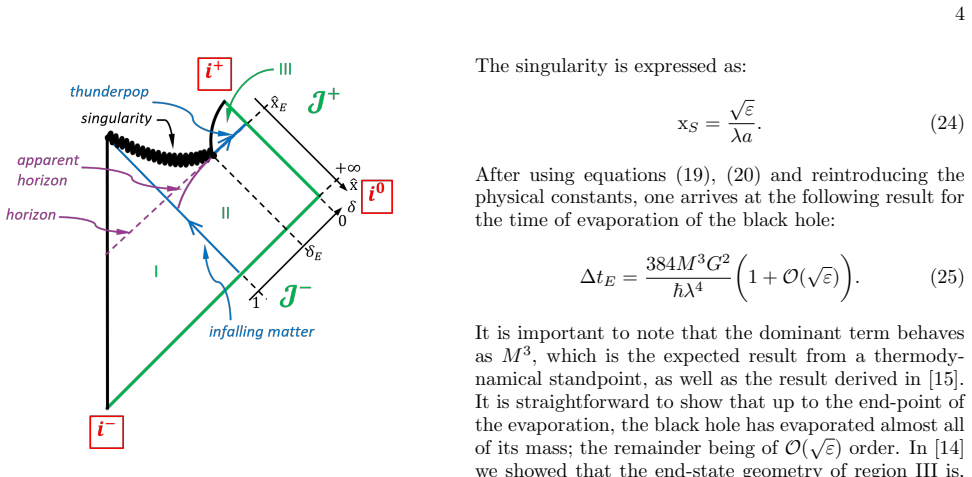
The load-bearing object is the island formula for fine-grained entropy, $$S_{\rm FG}(R) = \min_I\,{\rm ext}_I\left[\frac{A(\partial I)}{4G_N} + S_{\rm matter}(R\cup I)\right],$$ which delivers two saddle points: the Hawking saddle (no island), whose matter term grows linearly, and the replica-wormhole saddle with an island behind the event horizon, whose area term shrinks as the black hole loses mass. The computation is fed by the quantum-corrected evaporating black hole solution of the dimensionally-reduced Einstein-Hilbert (DREH) model (Eqs. (15)-(18), imported from the authors' earlier work), including its apparent horizon and evaporation endpoint. Extremizing the generalized entropy fixes the island position, $\delta_I = e^{-\Delta\tau/(2\bar a)}$, $\hat{x}_I = 1 + \frac{\tilde\varepsilon}{4}\left(1-e^{-\Delta\tau/(2\bar a)}\right)$, $x_I = 1 - \frac{\tilde\varepsilon}{4}\frac{\Delta\tau}{2\bar a}$, with $\tilde\varepsilon=\varepsilon/(\lambda a)^2$, so the island sits behind the event horizon and approaches the singularity as evaporation ends. The slope of the Hawking branch is set by the quantum-corrected surface gravity $\kappa = \frac{1}{2\bar a} = \frac{1}{2a}\left(1-\frac{11}{8}\tilde\varepsilon\right)e^{-\tilde\varepsilon/4\,\ln(3\tilde\varepsilon/4)}$, which also sets the Page time through $\kappa\tau_P = \frac{4(\lambda a)^2}{\varepsilon}(3-2\sqrt2)$.
What would settle it
A direct computation of the von Neumann entropy of the Hawking radiation on a Cauchy slice after the evaporation endpoint, using the scalar field state in the post-evaporation Minkowski region rather than the island prescription, would settle the claim: if the entropy does not vanish as the endpoint is approached, the unitary Page curve is ruled out.
Extended reading notes
Core claim
In the quantum-corrected collapse scenario, the fine-grained entropy of the Hawking radiation at late times is given by Eq. (114): $$S_{\rm FG} = \min\left\{\frac{\$\Delta$\tau}{24\bar a} + \frac{1}{6}\ln\frac{\tau}{2b} - \frac{1}{12}\ln\left(\frac{-3\varepsilon F^+_\infty}{4(\$\lambda$ a)^2}\right),\; \frac{(\$\lambda$ a)^2}{12\varepsilon}\left(1 - \frac{\varepsilon}{4(\$\lambda$ a)^2}\frac{\$\Delta$\tau}{2\bar a}\right)^2 - \frac{1}{12} - \frac{\varepsilon}{6(\$\lambda$ a)^2}\frac{1}{1+\$\Delta$\tau/(2\bar a)}\,e^{-\$\Delta$\tau/(2\bar a)}\right\},$$ where the first term is the ever-growing Hawking saddle and the second is the replica-wormhole (island) saddle. The island branch decreases with time and vanishes at the evaporation endpoint, so the entropy returns to zero; the Page time at the crossover is $\kappa\tau_P = \frac{4(\lambda a)^2}{\varepsilon}(3-2\sqrt2)$. The island itself forms behind the event horizon at $\tau_0$, tracks the shrinking horizon, and crosses the singularity just before evaporation ends. Without back-reaction (classical collapse), the island branch instead saturates at the Bekenstein-Hawking entropy, and no decreasing Page curve is obtained.
Load-bearing premise
The computation rests on the quantum-corrected evaporating black hole solution imported from the authors' earlier work and on a first-order-in-Planck's-constant perturbative treatment; if that solution's late-time geometry is wrong, or if the semiclassical approximation fails before the endpoint (as the paper itself notes in the last paragraph of Section IV), the decreasing island branch and the vanishing entropy do not follow.
Editorial extensions
If this is right
- If the central claim is correct, the information-loss paradox is resolved in this dimensionally-reduced model of general relativity: the fine-grained entropy of the Hawking radiation returns to zero when the black hole finishes evaporating, so the final radiation state can be pure even though individual Hawking quanta look thermal.
- The switch between the two saddles happens at a definite Page time $\kappa\tau_P = 4(\lambda a)^2(3-2\sqrt2)/\varepsilon$, and the peak fine-grained entropy lies below the classical Bekenstein-Hawking bound, $S_{\max} = \frac{4}{3+2\sqrt2}S_{\rm BH}^{\rm(class)}$, so the thermodynamic second law is never violated by the fine-grained entropy.
- Back-reaction is essential: without the Polyakov-Liouville corrections to the geometry, the island branch saturates at the Bekenstein-Hawking value and the Page curve is not reproduced; the decreasing branch is driven by the shrinking apparent horizon.
- The island position computed here (behind the event horizon, mirroring the apparent horizon, and crossing the singularity at the end) gives a concrete semiclassical picture of where information is stored during evaporation: in degrees of freedom behind the horizon that are entangled with the outgoing radiation.
Reading between the lines
- The island rule itself is imported as a fundamental prescription; the paper does not derive the replica-wormhole saddle from the path integral within this model. If a future derivation showed the island saddle to be an artifact of the perturbative approximation, or to require a holographic dual that this asymptotically flat model lacks, the Page curve result would still be mathematically correct b
- The authors propose extending the computation to charged (Reissner-Nordström) and five-dimensional Chern-Simons reductions; a natural check is whether the same island mechanism again drives the entropy to zero, since a failure there would mark the boundary of the unitarity mechanism.
- A sharper test of the claim would be to compute the fine-grained entropy via the exact replica trick rather than the two-saddle extremization at the same order in the perturbative solution; agreement would strengthen confidence that the island branch is the true late-time saddle rather than a selection artifact.
- The paper itself notes, in the last paragraph of Section IV, that the semiclassical approximation breaks near the evaporation endpoint; the strict vanishing of the entropy at the endpoint should therefore be read as the extrapolated limit of a semiclassical curve, not as a fully quantum-gravity statement about the final instant.
Editorial analysis
A structured set of objections, weighed in public.
Referee Report
Summary. The paper computes the fine-grained entropy of Hawking radiation for an evaporating Schwarzschild black hole in the dimensionally-reduced Einstein-Hilbert (DREH) dilaton-gravity model, using the quantum extremal surface/island formula. In the classical (no-backreaction) collapse scenario the authors find that the island contribution saturates near the Bekenstein-Hawking entropy, so no decreasing Page curve is obtained. In the quantum-corrected scenario, using the evaporating solution imported from their companion preprint [14], they derive a linearly growing Hawking saddle and a decreasing replica-wormhole saddle, take their minimum, and obtain a Page curve with a maximum at the Page time and vanishing entropy at the end of evaporation. The paper concludes that the Hawking radiation evolution is unitary.
Significance. If the result were established, it would extend the island-formula Page-curve program to a two-dimensional model with a direct four-dimensional reduction origin, beyond the more common JT/CGHS-like settings. The paper is explicit about the classical-versus-quantum contrast and produces concrete formulas for the island position, Page time, and maximal fine-grained entropy; the comparison with the eternal-black-hole case is also helpful. However, the central claim is not yet supported as written: it relies on an unpublished and unchecked evaporating solution, on an internal time/endpoint consistency that appears to fail, and on a UV regularization that is chosen precisely so that the entropy vanishes at the endpoint. These are load-bearing issues, not presentation matters.
major comments (4)
- [Section II, Eqs. (19) and (25)] The imported evaporating solution is internally inconsistent under the time relation used later in the paper. With −ln δ_S = τ/(2a) (Sections III A, IV A, Eq. (76)) and the definitions a = 2MG/λ² and ε = ℏG/(12π) (Section II), Eq. (19) gives τ_E = 2a[−ln δ_E] ≈ 8a(λa)²/ε = 768π M³G²/(ℏλ⁴), whereas Eq. (25) quotes Δt_E = 384 M³G²/(ℏλ⁴). The two differ by exactly a factor 2π. This is not cosmetic: the island branch of Eq. (114) is calibrated to δ_E through Eq. (107) and the area term (113), so the claimed vanishing of S_FG at the endpoint and the unitarity conclusion inherit this factor. The authors must either reconcile the endpoint with the evaporation time or explain explicitly why τ and Δt_E are different time coordinates and how the factor arises.
- [Section IV B, Eqs. (111)–(114)] The final vanishing of the fine-grained entropy is imposed by the regularization choice rather than derived. The matter term (111) still contains the UV cut-off ϵ and the coordinate-transformation constant F⁺_∞, and no cancellation of the ϵ-dependence against the Hawking branch (79) is demonstrated. The sentence 'The regularization selected... is the one that ensures the fine-grained entropy vanishes' makes the endpoint condition an input to the calculation. A common renormalization prescription for both saddles is needed; otherwise the relative offset of the two branches, the Page time (115), and the final vanishing are not predictions of the island formula.
- [Equations (76), (79), (104)] The late-time expansions contain logarithms of expressions that can be negative or that require a branch choice: Eq. (76) includes ln(ε̃(µ−1/4)), Eq. (79) includes ln(−3ε̃F⁺_∞/4), and Eq. (104) includes logarithms of combinations of µ and ε̃. No branch specification is given. Since these expressions feed into the late-time positions of the island (107)–(110), the quantum-corrected surface gravity κ in Eq. (106), and the final entropy (114), the derivation is incomplete as written. The authors should specify the domain of validity of each expansion and the branch of the logarithm.
- [Section IV, Eqs. (15)–(20)] The entire quantum-corrected calculation is built upon the evaporating black hole solution (15)–(18), including the endpoint (19)–(20), imported from the authors' unpublished preprint [14]. None of these ingredients is re-derived or independently checked in the present paper. Because the endpoint consistency check in the first comment already reveals a discrepancy at the level of a factor 2π, the Page curve (114) cannot be considered established until the companion solution is available and verified, or until the relevant parts are derived and checked in this manuscript.
minor comments (5)
- [Appendix A, Eq. (A10)] The symbol ε̃ is defined in Section III B as ε̃ = ε/(λa)², but in Appendix A, Eq. (A10), it is defined as ε̃ = ε/[4(λa)²]. This conflicting notation affects the reading of the derivative formulas (A22)–(A25) used in Section IV B and should be fixed, for example by using different symbols.
- [Section III A, Eq. (29)] The relation −ln δ_S = τ/(2a) is used before it is introduced; it should be stated explicitly at or before Eq. (29) so that the time coordinate τ is unambiguously defined.
- [Section IV A, Eqs. (71)–(76)] The assumption b*ε̃ ≫ 1 and the precise role of the cut-off surface b* should be explained more prominently before Eq. (71), since the late-time expansions use this assumption without restating it.
- [Section V and Appendix B captions] There are several typographical errors: 'Summery' in Section V should be 'Summary', and the captions of Figures A1–A3 contain 'in witch' instead of 'in which'.
- [Eq. (115)] The Page time is written as κτP = 4(λa)²/ε (3−2√2); since κ is renormalized in Eq. (106), the authors should state explicitly that the quantum-corrected κ is being used, or give the corresponding expression in terms of the bare surface gravity.
Circularity Check
The endpoint vanishing of the fine-grained entropy is imposed by choosing the regularization, not derived; the rest of the Page-curve computation is an honest calculation on the geometry imported from [14].
-
self definitional
[Section IV B, between Eqs. (113) and (114)]
"The regularization selected, aligning with the observation that the island intersects the singularity close to the evaporation’s end-point, is the one that ensures the fine-grained entropy vanishes. ... Note that the fine-grained entropy vanishes at the end-point of the evaporation."
The paper's advertised conclusion is that the fine-grained entropy follows the Page curve and vanishes at the endpoint, read as evidence for unitary evaporation. That final zero is not an output of the island extremization: the matter contribution (111) still contains the UV cutoff and an undetermined constant, and the area term (113) alone does not vanish at the endpoint. The authors instead select the regularization precisely so that S_FG(τ_E)=0, and then report the endpoint vanishing as a result. The decreasing branch and Page time retain derived content, but the terminal condition of the Page curve is an input chosen to match the unitarity conclusion, so the central claim is partially self-fulfilling.
full rationale
The computation is otherwise an honest application of the island formula: the Hawking branch is regularized at τ=0, the island position is obtained by extremizing (80)-(81), and the decreasing branch follows from the imported quantum-corrected geometry. I do not count the heavy reliance on the authors' prior preprint [14] as circularity: that work is a separate derivation of the evaporating solution, not of the Page curve, and the current paper's conclusion does not reduce to [14] by construction. The suspicious factor-2π discrepancy between the endpoint (19) and the evaporation time (25) is an internal-consistency or correctness issue, not a circularity, and I do not use it in the score. The one genuine circular step is the endpoint normalization: the final entropy zero is selected by the regularization, so the unitarity conclusion is partly assumed. Score 6 reflects that the central terminal prediction reduces by construction, while the rest of the curve is independently computed.
Assumptions & free parameters
free parameters (2)
- Entropy UV regularization constant =
chosen so S_FG goes to 0 at the evaporation endpoint
- Cutoff surface location b* =
arbitrary, with b*/a >> (lambda a)^2/epsilon
assumptions (5)
- domain assumption Island formula (QES prescription), Eq (1)
- domain assumption DREH action Eq (3) as dimensional reduction of 4D Einstein-Hilbert
- domain assumption Polyakov-Liouville action (14) for quantum back-reaction
- domain assumption Validity of perturbative expansion in epsilon = hbar G / 12pi to the order used
- domain assumption Reflective boundary conditions at r = 0
Cite this review
Pith. "Pith review of Page Curve for an Evaporating Schwarzschild Black Hole in Dimensionally-Reduced Model of Dilaton Gravity." pith.science (2026). https://pith.science/paper/OFLU26AJ
@misc{pith2026250717855,
  author       = {Pith},
  title        = {Pith review of: Page Curve for an Evaporating Schwarzschild Black Hole in Dimensionally-Reduced Model of Dilaton Gravity},
  year         = {2026},
  howpublished = {\url{https://pith.science/paper/OFLU26AJ}},
  note         = {Machine review of arXiv:2507.17855}
}
read the original abstract
We study entanglement entropy of quantum fields in a (1+1)-dimensional model of dilaton gravity derived from the four-dimensional Einstein-Hilbert action by dimensional reduction. Scalar matter is coupled to gravity, while the back-reaction is included via the Polyakov-Liouville action. This theory exhibits both eternal and evaporating Schwarzschild black hole solutions. The fine-grained entropy in a collapse scenario is investigated by applying the "island rule" via the quantum extremal surface approach. We demonstrate that the fine-grained entropy of the Hawking radiation follows the Page curve, and therefore the evolution of the Hawking radiation is unitary.
Figures


Figures from the paper (3 more)


Forward citations
Cited by 1 Pith paper
-
Wald-like entropy and Islands in Dimensionally Reduced Einstein-Hilbert Gravity
Wald-like Noether charge of the DREH plus Polyakov-Liouville action yields the island generalized entropy and unitary Page curves for eternal and quasi-stationary evaporating black holes.
Reference graph
Works this paper leans on
-
[13]
Page Curve for Eternal Schwarzschild Black Hole in Dimensionally-Reduced Model of Dilaton Gravity
S. Djordjevi´ c, A. Goˇ canin, D. Goˇ canin, and V. Radovanovi´ c, Page curve for an eternal Schwarzschild black hole in a dimensionally reduced model of dilaton gravity, Phys. Rev. D 106, 105015 (2022), arXiv:2207.07409 [hep-th]
work page Pith review arXiv 2022
-
[14]
S. Dord ¯ evi´ c and V. Radovanovi´ c, Collapse scenario and final state of evaporation for schwarzschild black hole in dimensionally-reduced model of dilaton gravity (2025), arXiv:2506.09946 [hep-th]
work page Pith review arXiv 2025
-
[1]
S. W. Hawking, Breakdown of predictability in gravita- tional collapse, Phys. Rev. D 14, 2460 (1976)
work page 1976
-
[2]
Bekenstein, Black holes and the second law, Lettere al Nuovo Cimento (1971-1985) 4, 737 (1972)
J. Bekenstein, Black holes and the second law, Lettere al Nuovo Cimento (1971-1985) 4, 737 (1972)
work page 1972
-
[3]
J. D. Bekenstein, Black holes and entropy, Phys. Rev. D 7, 2333 (1973)
1973
-
[4]
S. W. Hawking, Black holes and thermodynamics, Phys. Rev. D 13, 191 (1976)
1976
-
[5]
S. W. Hawking, Particle Creation by Black Holes, Com- mun. Math. Phys. 43, 199 (1975), [Erratum: Com- mun.Math.Phys. 46, 206 (1976)]
work page 1975
-
[6]
Teitelboim, Gravitation and Hamiltonian Structure in Two Space-Time Dimensions, Phys
C. Teitelboim, Gravitation and Hamiltonian Structure in Two Space-Time Dimensions, Phys. Lett. B 126, 41 (1983)
1983
Show all 55 references
-
[7]
Jackiw, Lower Dimensional Gravity, Nucl
R. Jackiw, Lower Dimensional Gravity, Nucl. Phys. B 252, 343 (1985)
1985
-
[8]
C. G. Callan, S. B. Giddings, J. A. Harvey, and A. Stro- minger, Evanescent black holes, Physical Review D 45, R1005–R1009 (1992)
1992
-
[9]
J. G. Russo, L. Susskind, and L. Thorlacius, End point of hawking radiation, Phys. Rev. D 46, 3444 (1992)
1992
-
[10]
J. G. Russo, L. Susskind, and L. Thorlacius, Cosmic cen- sorship in two-dimensional gravity, Phys. Rev. D 47, 533 (1993)
1993
-
[11]
S. Bose, L. Parker, and Y. Peleg, Semi-infinite throat as the end-state geometry of two-dimensional black hole evaporation, Physical Review D 52, 3512–3517 (1995)
1995
-
[12]
T. M. Fiola, J. Preskill, A. Strominger, and S. P. Trivedi, Black hole thermodynamics and information loss in two dimensions, Physical Review D 50, 3987–4014 (1994)
1994
-
[15]
Buri´ c and V
M. Buri´ c and V. Radovanovi´ c, Quantum corrections for an (anti)evaporating black hole, Physical Review D 63, 10.1103/physrevd.63.044020 (2001)
2001 doi
-
[16]
Fabbri and J
A. Fabbri and J. Navarro-Salas,Modeling black hole evap- oration (2005)
2005
-
[17]
Grumiller, W
D. Grumiller, W. Kummer, and D. V. Vassilevich, Dila- ton gravity in two-dimensions, Phys. Rept. 369, 327 (2002), arXiv:hep-th/0204253
2002 arXiv
-
[18]
D. N. Page, Information in black hole radiation, Physical Review Letters 71, 3743–3746 (1993)
1993
-
[19]
D. N. Page, Time dependence of hawking radiation en- tropy, Journal of Cosmology and Astroparticle Physics 2013 (09), 028–028
2013
-
[20]
Ryu and T
S. Ryu and T. Takayanagi, Holographic derivation of entanglement entropy from the anti–de sitter space/conformal field theory correspondence, Physi- cal Review Letters 96, 10.1103/physrevlett.96.181602 (2006)
2006 doi
-
[21]
V. E. Hubeny, M. Rangamani, and T. Takayanagi, A Covariant holographic entanglement entropy proposal, JHEP 07, 062, arXiv:0705.0016 [hep-th]
-
[22]
Engelhardt and A
N. Engelhardt and A. C. Wall, Quantum Extremal Sur- faces: Holographic Entanglement Entropy beyond the Classical Regime, JHEP 01, 073, arXiv:1408.3203 [hep- th]
-
[23]
Penington, Entanglement wedge reconstruction and the information paradox (2020), arXiv:1905.08255 [hep- th]
G. Penington, Entanglement wedge reconstruction and the information paradox (2020), arXiv:1905.08255 [hep- th]
2020 arXiv
-
[24]
Almheiri, N
A. Almheiri, N. Engelhardt, D. Marolf, and H. Maxfield, The entropy of bulk quantum fields and the entanglement wedge of an evaporating black hole, Journal of High En- ergy Physics 2019, 10.1007/jhep12(2019)063 (2019)
2019 doi
-
[25]
Almheiri, R
A. Almheiri, R. Mahajan, and J. Maldacena, Islands out- side the horizon (2023), arXiv:1910.11077 [hep-th]
2023 arXiv
-
[26]
Almheiri, R
A. Almheiri, R. Mahajan, J. Maldacena, and Y. Zhao, The page curve of hawking radiation from semiclassi- cal geometry, Journal of High Energy Physics 2020, 10.1007/jhep03(2020)149 (2020)
2020 doi
-
[27]
Almheiri, T
A. Almheiri, T. Hartman, J. Maldacena, E. Shaghoulian, and A. Tajdini, Replica wormholes and the entropy of hawking radiation, Journal of High Energy Physics2020, 10.1007/jhep05(2020)013 (2020)
2020 doi
-
[28]
Penington, S
G. Penington, S. H. Shenker, D. Stanford, and Z. Yang, Replica wormholes and the black hole interior (2020), arXiv:1911.11977 [hep-th]
2020 arXiv
-
[29]
F. F. Gautason, L. Schneiderbauer, W. Sybesma, and L. Thorlacius, Page Curve for an Evaporating Black Hole, JHEP 05, 091, arXiv:2004.00598 [hep-th]
2004 arXiv
-
[30]
H. Z. Chen, Z. Fisher, J. Hernandez, R. C. My- ers, and S.-M. Ruan, Information flow in black hole evaporation, Journal of High Energy Physics 2020, 10.1007/jhep03(2020)152 (2020)
2020 doi
-
[31]
Chen, Pulling Out the Island with Modular Flow, JHEP 03, 033, arXiv:1912.02210 [hep-th]
Y. Chen, Pulling Out the Island with Modular Flow, JHEP 03, 033, arXiv:1912.02210 [hep-th]
1912 arXiv
-
[32]
Akers, N
C. Akers, N. Engelhardt, G. Penington, and M. Usatyuk, Quantum maximin surfaces (2020), arXiv:1912.02799 [hep-th]
2020 arXiv
-
[33]
Liu and S
H. Liu and S. Vardhan, A dynamical mechanism for the Page curve from quantum chaos, JHEP 03, 088, arXiv:2002.05734 [hep-th]
2002 arXiv
-
[34]
Marolf and H
D. Marolf and H. Maxfield, Transcending the ensemble: baby universes, spacetime wormholes, and the order and disorder of black hole information, Journal of High En- ergy Physics 2020, 10.1007/jhep08(2020)044 (2020)
2020 doi
-
[35]
Balasubramanian, A
V. Balasubramanian, A. Kar, O. Parrikar, G. S´ arosi, and T. Ugajin, Geometric secret sharing in a model of Hawk- ing radiation, JHEP 01, 177, arXiv:2003.05448 [hep-th]
2003 arXiv
-
[36]
Bhattacharya, Multipartite purification, multibound- ary wormholes, and islands in AdS3/CF T2, Phys
A. Bhattacharya, Multipartite purification, multibound- ary wormholes, and islands in AdS3/CF T2, Phys. Rev. D 102, 046013 (2020), arXiv:2003.11870 [hep-th]
2020 arXiv
-
[37]
K. Goto, T. Hartman, and A. Tajdini, Replica wormholes for an evaporating 2d black hole, Journal of High Energy Physics 2021, 10.1007/jhep04(2021)289 (2021). 15
2021 doi
-
[38]
Verlinde, Er = epr revisited: On the entropy of an einstein-rosen bridge (2020), arXiv:2003.13117 [hep-th]
H. Verlinde, Er = epr revisited: On the entropy of an einstein-rosen bridge (2020), arXiv:2003.13117 [hep-th]
2020 arXiv
-
[39]
Hartman, E
T. Hartman, E. Shaghoulian, and A. Strominger, Islands in asymptotically flat 2d gravity, Journal of High Energy Physics 2020, 10.1007/jhep07(2020)022 (2020)
2020 doi
-
[40]
X. Wang, R. Li, and J. Wang, Page curves for a family of exactly solvable evaporating black holes, Physical Review D 103, 10.1103/physrevd.103.126026 (2021)
2021 doi
-
[41]
Anegawa and N
T. Anegawa and N. Iizuka, Notes on islands in asymptot- ically flat 2d dilaton black holes, Journal of High Energy Physics 2020, 10.1007/jhep07(2020)036 (2020)
2020 doi
-
[42]
Yu and X.-H
M.-H. Yu and X.-H. Ge, Islands and Page curves in charged dilaton black holes, Eur. Phys. J. C 82, 14 (2022), arXiv:2107.03031 [hep-th]
2022 arXiv
-
[43]
X. Wang, R. Li, and J. Wang, Islands and Page curves of Reissner-Nordstr¨ om black holes, JHEP04, 103, arXiv:2101.06867 [hep-th]
-
[44]
Hashimoto, N
K. Hashimoto, N. Iizuka, and Y. Matsuo, Islands in schwarzschild black holes, Journal of High Energy Physics 2020, 10.1007/jhep06(2020)085 (2020)
2020 doi
-
[45]
Almheiri, R
A. Almheiri, R. Mahajan, and J. E. Santos, Entangle- ment islands in higher dimensions, SciPost Phys. 9, 001 (2020), arXiv:1911.09666 [hep-th]
2020 arXiv
-
[46]
Tong, D.-H
C.-W. Tong, D.-H. Du, and J.-R. Sun, Island of Reissner- Nordstr¨ om anti–de Sitter black holes in the large D limit, Phys. Rev. D 109, 104053 (2024), arXiv:2306.06682 [hep- th]
2024 arXiv
-
[47]
Wang and R
L. Wang and R. Li, Entanglement islands and the Page curve of Hawking radiation for rotating Kerr black holes, Phys. Rev. D 110, 066012 (2024), arXiv:2406.13949 [hep- th]
2024 arXiv
-
[48]
D. S. Ageev, I. Y. Aref’eva, A. I. Belokon, A. V. Er- makov, V. V. Pushkarev, and T. A. Rusalev, Infrared regularization and finite size dynamics of entanglement entropy in Schwarzschild black hole, Phys. Rev. D 108, 046005 (2023), arXiv:2209.00036 [hep-th]
2023 arXiv
-
[49]
Wu and J
C.-H. Wu and J. Xu, Islands in non-minimal dilaton grav- ity: exploring effective theories for black hole evapora- tion, JHEP 10, 094, arXiv:2303.03410 [hep-th]
-
[50]
Note that the time when the island forms τ0 is the same as in the classical result up to the O(1) order
we see that the first correction for the position of the island xI along the δI = 1 hypersurface is of O(˜ε2) order opposite to the O(˜ε) order in the classical case. Note that the time when the island forms τ0 is the same as in the classical result up to the O(1) order. The c...
2023
-
[51]
D. S. Ageev, I. Y. Aref’eva, A. I. Belokon, V. V. Pushkarev, and T. A. Rusalev, Entanglement entropy in de Sitter: no pure states for conformal matter, JHEP 05, 308, arXiv:2304.12351 [hep-th]
-
[52]
A. I. Belokon, Finite entangling regions and information paradox in charged black holes, Theor. Math. Phys. 222, 154 (2025), arXiv:2409.01409 [hep-th]
2025 arXiv
-
[53]
Yadav and N
G. Yadav and N. Joshi, Cosmological and black hole is- lands in multi-event horizon spacetimes, Phys. Rev. D 107, 026009 (2023), arXiv:2210.00331 [hep-th]
2023 arXiv
-
[54]
Buric, V
M. Buric, V. Radovanovic, and A. R. Mikovic, One loop correction for Schwarzschild black hole via 2-D dila- ton gravity, Phys. Rev. D 59, 084002 (1999), arXiv:gr- qc/9804083
1999
-
[55]
1 − ˜ε 8 2(y − 2) ln y− 8 + 5y + 3 y − (y − 1) ∞X n=1 δn n! y − 1 y dS< n dy − nS< n !#) , (A22) ∂−x = − 1 2aF− ( 1 − 1p y2 − ˜ε
A. M. Polyakov, Quantum geometry of bosonic strings, Physics Letters B 103, 207 (1981). APPENDIX A. Details on the quantum corrected solution In this section we delve into the details regarding the solution (15-18). For more details, see [14]. Firstly, we define all the functi...
1981
Reviewed August 6, 2026 · model on record in the stance chip above.
Discussion (0). Sign in to comment.