REVIEW 5 major objections 4 minor 4 cited by
Quark and lepton mixing in the asymptotically safe Standard Model
T0 review · 5 major / 4 minor · reviewed 2026-08-15 · deepseek-v4-flash
Pith's one-line read The measured quark and lepton mixing patterns are generic consequences of an asymptotically safe ultraviolet completion of the Standard Model.
desk verdict Two-stage fixed-point cascade that explains the CKM/PMNS dichotomy deserves a referee, but 'generically' is not backed up by the single tuned trajectory shown. read the letter →
The pith
A machine-rendered reading of the paper's core claim, the machinery that carries it, and where it could break.
The reading
What carries the argument
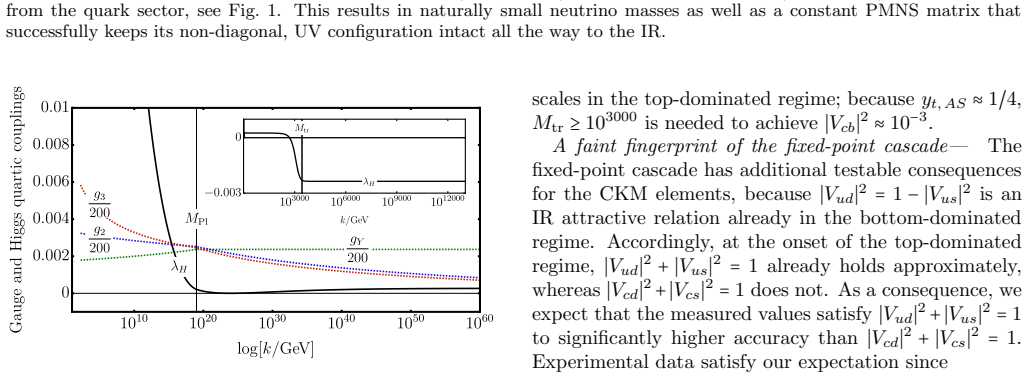
The central mechanism is the fixed-point cascade: a sequence of three renormalization-group regimes (bottom-dominated deep UV, top-dominated intermediate, Standard Model IR) generated by nonzero gravitational contributions to the $\beta$ functions, parameterized as linear terms $-f_y y_i$, $-f_g g$, and $f_\lambda \lambda_H$. The argument is carried by the one-loop $\beta$ functions for the CKM and PMNS matrix elements, whose infrared-attractive fixed lines have critical exponents set by $-3 y_t^2/(16\pi^2)$ in the top-dominated regime and $-3 y_b^2/(16\pi^2)$ in the bottom-dominated regime. The mixing flow's rate is controlled by the product $y_h^2 \, \Sigma m_{ij}^2 / \Delta m_{ij}^2$ for a heavy fermion, which determines how quickly off-diagonal elements are driven to zero and hence how accurately each row-unitarity relation holds.
What would settle it
A first-principles computation of the quantum-gravity contributions that fails to yield the fitted values $f_y=-3.27\times 10^{-4}$, $f_g=9.749\times 10^{-3}$, and $f_\lambda=-5.31\times 10^{-2}$, or finds no fixed point with these signs, would break the cascade; observationally, improved data showing that $|V_{ud}|^2+|V_{us}|^2-1$ and $|V_{cd}|^2+|V_{cs}|^2-1$ approach zero at the same rate, or that $|V_{ub}|^2\gtrsim |V_{cb}|^2$, would falsify the predicted hierarchy.
Extended reading notes
Core claim
In an asymptotically safe Standard Model, the ultraviolet fixed point is not a single regime but a cascade. Deep in the ultraviolet, the bottom Yukawa coupling dominates the running of the mixing matrices, and a fixed line characterized by $|V_{ud}|^2+|V_{us}|^2=1$ attracts the RG flow; in a later, intermediate top-dominated regime, the complementary relation $|V_{cd}|^2+|V_{cs}|^2=1$ also becomes infrared attractive. Because the first relation is established over a much longer stretch of scales, the flow predicts that $|V_{ud}|^2+|V_{us}|^2-1$ is smaller than $|V_{cd}|^2+|V_{cs}|^2-1$ by roughly two orders of magnitude, exactly the $10^{-5}$ versus $10^{-3}$ accuracy seen in data, and equivalently $|V_{ub}|^2 \ll |V_{cb}|^2$, with visible consequences for B-meson decays. The PMNS matrix obeys the same evolution equations, so it would also be driven toward a near-diagonal form if neutrino Yukawa couplings were large; the cascade prevents this by giving neutrino Yukawa couplings a tiny or negative critical exponent, keeping them small throughout. Consequently the large observed lepton mixing survives only if the Dirac neutrino mass scale is small, $\sum m_\nu \lesssim \mathcal{O}(1)\,\mathrm{eV}$, and the vertical spread of Standard Model fermion masses acts as a prerequisite for the neutrino sector rather than an accident.
Load-bearing premise
The construction rests on the assumption that quantum-gravity fluctuations modify the Standard-Model $\beta$ functions by constant linear terms $-f_y y_i$, $-f_g g$, and $f_\lambda \lambda_H$ with coefficients $f_y=-3.27\times 10^{-4}$, $f_g=9.749\times 10^{-3}$, and $f_\lambda=-5.31\times 10^{-2}$ that remain active over roughly $10^{25{,}000}$ orders of magnitude and switch off at the Planck scale, with those coefficients fitted to reproduce $g_Y$, $y_t$, and $\lambda_H$ rather than derived from first principles, and with the CKM deep-ultraviolet initial values chosen inside the fixed point's basin of attraction.
Editorial extensions
If this is right
- The measured unitarity relations $|V_{ud}|^2+|V_{us}|^2\approx 1$ and $|V_{cd}|^2+|V_{cs}|^2\approx 1$ become predictions of the ultraviolet completion, with their different accuracies directly measuring how long the flow spends in the bottom- and top-dominated regimes.
- The hierarchy $|V_{ub}|^2 \ll |V_{cb}|^2$ is a necessary consequence of the cascade, ruling out the opposite ordering at the level of $29\sigma$ and imprinting on B-meson lifetimes and branching fractions.
- The PMNS matrix stays non-diagonal only because neutrino Yukawa couplings are dynamically suppressed; therefore large lepton mixing is tied to a small Dirac neutrino mass sum, $\sum m_\nu \lesssim \mathcal{O}(1)\,\mathrm{eV}$, consistent with the current laboratory bound on the effective electron-neutrino mass and with cosmological limits.
- For heavier Dirac neutrinos with $m_{\nu,\mathrm{eff}} \gtrsim \mathcal{O}(1\text{--}10)\,\mathrm{eV}$, the RG flow would drive PMNS elements toward a diagonal matrix, ruling out such masses independently of the ultraviolet completion.
- A purely top-dominated regime cannot serve as the ultraviolet completion once mixing is included; the cascade requires the earlier bottom-dominated fixed point, otherwise the bottom Yukawa would vanish in the infrared, contradicting measured quark masses.
Reading between the lines
- Because the gravity coefficients are fitted rather than derived, the cascade is only as secure as the constancy of those coefficients across $10^{25{,}000}$ orders of magnitude; a first-principles computation that found strong scale dependence would call for revision of the mixing predictions even if every low-energy check here passes.
- The same critical-exponent logic used for the CKM matrix can be turned into a selection rule for new physics: any sector with large Yukawa couplings, for example heavy seesaw partners, would re-ignite the RG flow of the PMNS matrix, so such states must either be absent or very weakly coupled.
- Observing any RG-induced deviation in PMNS elements as neutrino-mass bounds improve would be a direct test of the claim that lepton mixing is frozen by tiny Yukawa couplings; current bounds already limit such changes to at most a few percent.
- The accuracy split between the two CKM row-unitarity relations is the cleanest quantitative fingerprint of the cascade, and improved measurements of $|V_{ub}|$ and $|V_{cb}|$ should keep that split at roughly two orders of magnitude if the mechanism is correct.
Signed reviews
Editorial analysis
A structured set of objections, weighed in public.
Referee Report
Summary. The manuscript proposes an asymptotically safe UV completion of the Standard Model, realized as a 'fixed-point cascade' extending over roughly 10^25000 orders of magnitude above the Planck scale, with quantum-gravity effects parameterized by constant linear shifts fg, fy, and f_lambda. It argues that the near-unitarity CKM relations |V_ud|^2+|V_us|^2 ≈ 1 and |V_cd|^2+|V_cs|^2 ≈ 1, with the former holding to 10^-5 and the latter to 10^-3, follow generically because the first relation is IR-attractive already in a deep-UV bottom-dominated fixed-point regime while the second becomes attractive only in a later top-dominated regime; equivalently, |V_ub|^2 << |V_cb|^2. It further argues that large PMNS mixing is compatible with the same RG dynamics because neutrino Yukawa couplings are dynamically suppressed, linking large lepton mixing to small Dirac neutrino masses, sum m_nu ≲ O(1) eV. The evidence consists of numerical integrations of 1-loop beta functions with gravitational contributions, with UV initial conditions tabulated in Table I.
Significance. If the genericity claim could be established, this would be a notable step toward deriving a flavor pattern, namely the CKM hierarchy and the PMNS structure, from a UV-completion hypothesis, with concrete falsifiable consequences: the accuracy hierarchy in Eq. (11), |V_ub|^2 << |V_cb|^2, and a neutrino-mass-dependent bound on PMNS running. The paper uses standard 1-loop RG equations, quotes experimental values accurately, and provides explicit UV initial conditions in Table I, which makes the numerical results reproducible. The fixed-point mechanism itself is physically coherent. The principal weakness is that the central 'generic' claim is currently supported by a single tuned trajectory rather than by a basin-of-attraction analysis, and several quantities advertised as predictions are in fact used to fit the gravitational parameters.
major comments (5)
- [Fixed-point cascade and its predictive power; Table I; Fig. 4] The central claim that the CKM relations (3) and their accuracy hierarchy hold 'generically' is not established by the presented numerical evidence, because Table I supplies a single set of UV initial conditions for the four independent CKM moduli, chosen so that the IR values match experiment; in particular, (X+Y-1)(k_UV) is approximately -0.988 and (Z+W-1)(k_UV) is approximately -0.0125. Since the UV fixed line has three relevant directions, these initial deviations are free parameters, and the final hierarchy could in principle be inherited from the initial offsets rather than produced by the cascade dynamics. The authors should either scan the basin of initial data and show that the hierarchy is robust, or derive a prior or measure on the relevant directions; otherwise the word 'generically' should be replaced by 'for suitably chosen initial data.'
- [Conclusion; Table I] The statement that the fixed-point cascade has 'just three free parameters, fg, fy and f_lambda' is not supported by the construction in the paper. Table I also fixes UV initial conditions for the 11 asymptotically free Yukawa couplings, four independent CKM moduli, four PMNS elements, and the effective electron neutrino mass, m_nu_e(eff) ≈ 0.009 eV. Unless the basin of the UV fixed point is characterized and the chosen values are shown to be generic points in that basin, these are additional free inputs. The predictive-power counting and the abstract's 'generically' should be revised accordingly.
- [Conclusion] The sentence 'gY, yt and lambda_H are accurate predictions of the cascade which we use to set fg, fy and f_lambda' is circular for those three couplings: agreement for gY, yt, and lambda_H is enforced by the fit of fg, fy, and f_lambda. This should be presented as a fit rather than as a prediction unless fg, fy, and f_lambda are obtained from an independent gravity computation. The issue is partly acknowledged in the text, but the wording in the abstract and conclusion still overstates the predictive content.
- [Explaining the PMNS matrix; Fig. 2; Table I] The claim that large lepton mixing is 'generically' explained is likewise not yet demonstrated. The PMNS matrix stays non-diagonal because the neutrino Yukawa couplings are small and because the UV values of the PMNS elements are chosen as in Table I. Dynamical suppression of neutrino Yukawa couplings is a necessary condition, not a sufficient one, for the observed PMNS structure; the current evidence shows consistency for the chosen trajectory, not genericity within the UV fixed-point basin.
- [Fixed-point cascade; Eqs. (10)-(14)] The numerical results rely on the assumption that gravitational contributions are exactly linear and constant, namely -fy yi, -fg g, and f_lambda lambda_H, over roughly 10^25000 orders of magnitude and then switch off at M_Planck. This is not derived from a first-principles gravity computation in the manuscript. Given the enormous extrapolation, the stability of the two-stage cascade under a scale-dependent gravitational coefficient should be checked, or the assumption should be explicitly flagged as a model input whose robustness is currently unknown.
minor comments (4)
- [Supplemental Material, Eqs. (15)-(18)] The displayed Yukawa beta functions in the supplemental material do not contain the -fy yi term that appears in Eq. (10) of the main text, while the gauge beta functions in Eqs. (12)-(14) do contain -fg g. Please reconcile the formulas so that the numerical results can be reproduced from the supplemental material alone.
- [Footnote 29] Footnote 29 contains an unresolved '[?]' placeholder for the reference on experimental constraints on unitarity violations; the citation should be provided.
- [Fig. 4 caption] In the caption of Fig. 4, the sign of the top-dominated critical exponent is written as theta_top = -3 y_t^2/(16 pi^2) ≈ 1.1 x 10^-3; the numerical value should carry a negative sign to match the convention in Eq. (29) and Table II.
- [Fixed-point cascade section] The statement that 'we start the RG flows in the deep UV with fixed-point configurations for CKM elements' is difficult to reconcile with Table I, whose UV values satisfy X+Y-1 ≈ -0.988 and therefore are not on the fixed line X+Y=1. Please clarify that the trajectories start with finite deviations along the relevant directions.
Circularity Check
The paper fits fg/fy/fλ to gY/yt/λH and selects UV CKM initial data along three relevant directions to reproduce the measured CKM matrix, then reports these as predictions; the claimed genericity over the basin is not demonstrated.
-
fitted input called prediction
[Conclusion, p. 5; matching prescriptions in the Supplemental Material]
"Among these couplings, gY , yt and λH are accurate predictions of the cascade which we use to set fg, fy and fλ."
This sentence states the reduction explicitly: gY, yt and λH are called predictions of the cascade, but they are the inputs used to determine the three free parameters fg, fy and fλ. The supplement confirms that fy is chosen so that the top pole mass comes out at Mt ≈ 171 GeV and fλ is adjusted so that λH(k = MPlanck) ≈ 0. Fitting the free parameters to the target observables and then reporting those observables as successful predictions is circular by construction: the agreement is guaranteed by the fitting and carries no independent evidence for the fixed-point cascade.
-
fitted input called prediction
[Supplement, 'Overview of couplings' and Table I; main text, 'Fixed-point cascade and its predictive power']
"While the trajectories that we show in the main text can be hard to find from the IR, they are easily reproducible starting from a set of UV values. ... Both UV fixed lines have 3 relevant directions. ... A further prediction of our cascade are the relations (3) between the CKM matrix elements which we expect to hold approximately, as they do."
The CKM elements at kUV in Table I (|Vud|² = 8.63·10⁻³, |Vus|² = 3.81·10⁻³, |Vcd|² = 6.97·10⁻¹, |Vcs|² = 2.91·10⁻¹) are free initial data, because the UV fixed line has three relevant directions and asymptotic safety alone does not determine them. The paper presents a single trajectory whose UV values were located from the IR direction, as the quoted sentence indicates, and then lists the resulting IR CKM matrix as a prediction and independent cross-check. The same four measured CKM moduli determine the chosen UV initial conditions, so forward integration returns the input data by construction.
full rationale
The paper's derivation chain consists of four steps: (i) parameterize quantum-gravity effects as linear terms −fy yi, −fg g, fλ λH; (ii) set fg, fy, fλ so that gY, yt and λH come out at their measured values; (iii) choose UV initial conditions for the CKM (and PMNS) elements; (iv) integrate the 1-loop beta functions forward and compare with experiment. Step (ii) is explicitly circular for gY, yt and λH, since the paper states that these couplings are 'predictions of the cascade which we use to set fg, fy and fλ'. Step (iii) and (iv) make the CKM 'prediction' circular in a weaker but still material sense: the UV fixed line has three relevant directions, so the four independent CKM moduli at kUV in Table I are not predicted by the UV completion but are supplied as initial data. The paper does not vary these initial data or map the basin of attraction; it exhibits a single trajectory that has been tuned (as the supplement's remark that the trajectories are 'hard to find from the IR' suggests) to land on the measured CKM values. The subsequent agreement of |Vud|²+|Vus|² and |Vcd|²+|Vcs|² with experiment is therefore a consistency check of the chosen trajectory, not a generic consequence established by the paper. The genuinely nontrivial content is the fixed-line attractor structure and the different critical exponents in the bottom- and top-dominated regimes, which are derived from the beta functions in the supplement and could in principle be checked independently; this prevents the circularity from being total. On balance, one explicit fitted-input-called-prediction step and one central prediction that relies on hand-picked UV initial data justify a partial-circularity score of 6.
Assumptions & free parameters
free parameters (7)
- fg =
9.749e-3
- fy =
-3.27e-4
- fλ =
-5.31e-2
- CKM UV initial conditions =
|Vcs|^2=0.29101178, |Vud|^2=0.00863112, |Vus|^2=0.003814289, |Vcd|^2=0.69654997
- PMNS UV initial conditions =
approximately the experimental values, e.g. |Uνee|^2=0.67799
- effective electron neutrino mass =
0.009 eV
- UV initial conditions for the 12 Yukawa couplings =
Table I, e.g. yt=4.58839e-36, yb=9.68782e-2
assumptions (5)
- ad hoc to paper Asymptotically safe gravity exists and its effect on SM couplings is a constant linear shift fy, fg, fλ above the Planck scale, switching off at k=M_Planck.
- domain assumption The SM field content with three Dirac right-handed neutrinos is the complete matter content up to 10^25,000 GeV; any beyond-SM physics is only weakly coupled to the SM.
- domain assumption 1-loop beta functions remain valid over ~25,000 orders of magnitude in RG scale, with gravitational contributions switched off abruptly at the Planck scale.
- domain assumption Gravity does not directly enter the beta functions of CKM/PMNS elements because it is flavor-blind.
- ad hoc to paper UV initial conditions for CKM and PMNS elements are realizable in the underlying theory.
invented entities (1)
-
Fixed-point cascade
Cite this review
Pith. "Pith review of Quark and lepton mixing in the asymptotically safe Standard Model." pith.science (2026). https://pith.science/paper/CX7KNN7I
@misc{pith2026250718304,
  author       = {Pith},
  title        = {Pith review of: Quark and lepton mixing in the asymptotically safe Standard Model},
  year         = {2026},
  howpublished = {\url{https://pith.science/paper/CX7KNN7I}},
  note         = {Machine review of arXiv:2507.18304}
}
abstract
The quark mixing (CKM) matrix is near-diagonal, whereas the lepton mixing (PMNS) matrix is not. We learn that both observations can generically be explained within an ultraviolet completion of the Standard Model with gravity. We find that certain relations between CKM matrix elements should hold approximately because of asymptotically safe regimes, including $|V_{ud}|^2+|V_{us}|^2 \approx 1$ and $|V_{cd}|^2+|V_{cs}|^2\approx 1$. Theoretically, the accuracies of these relations determine the length of the asymptotically safe regimes. Experimental data confirms these relations with an accuracy of $10^{-5}$ and $10^{-3}$, respectively. This difference in accuracies is also expected, because the ultraviolet completion consists in a fixed-point cascade during which one relation is established already much deeper in the ultraviolet. This results in $|V_{ub}|^2 < |V_{cb}|^2$ and translates into measurable properties of $B$-mesons. Similar results would hold for the PMNS matrix, if neutrino Yukawa couplings were large. The ultraviolet complete theory therefore must -- and in fact can -- avoid such an outcome. It contains a mechanism that dynamically limits the size of neutrino Yukawa couplings. Below an upper bound on the sum of Dirac neutrino masses, this allows the PMNS matrix to avoid a near-diagonal structure like the CKM matrix. Thus, large neutrino mixing is intimately tied to small Dirac neutrino masses, $\sum m_{\nu} \lesssim {\mathcal{O}} (1)\, \rm eV$ and a mass gap in the Standard Model fermion masses.
Figures


Figures from the paper (2 more)


Forward citations
Cited by 4 Pith papers
-
The fermion sector of the SMEFT from asymptotically safe gravity
In a toy model of one quark generation, asymptotically safe gravity predicts four-fermion SMEFT coefficients are either Planck-scale suppressed or zero, with exceptions only at very large gravitational coupling.
-
Scaling solutions for gauge invariant flow equations in dilaton quantum gravity
Scaling solutions of a gauge-invariant functional flow equation support the dilaton quantum gravity fixed point, with Planck mass ~ φ² at large field and a stable negative kinetial in the infrared.
-
Impact of quantum gravity on the UV sensitivity of extremal black holes
Asymptotically safe quantum gravity predicts a positive Goroff-Sagnotti Wilson coefficient at the Planck scale, which would keep extremal Kerr black hole tidal forces finite, but the paper's bound on the quantum gravi...
-
Charting GLOBs in Asymptotically Safe Gravity
Within the Einstein-Weyl truncation, asymptotically safe gravity predicts a Weyl coefficient m_2 = 1.4 m_Pl, which constrains the phase diagram of compact objects: attractive naked singularities are disfavored while w...
Reference graph
Works this paper leans on
-
[1]
Cabibbo, Phys
N. Cabibbo, Phys. Rev. Lett. 10, 531 (1963)
1963
-
[2]
For the up-type leptons (neutrinos), CU (1) = 3
-
[3]
Navas et al
S. Navas et al. (Particle Data Group), Phys. Rev. D 110, 030001 (2024)
2024
-
[4]
For the down-type leptons, CU (1) = 5
-
[5]
flavor-blind
The index i runs over all quark and lepton flavors and we implicitly assume ∣Vti∣ = 0 and ∣Vib∣ = 0, if the respective matrix element does not exist. The gravitational contribution fy is the same for all Yukawa couplings, because gravity is “flavor-blind”. Eq. (16) has two fixed points for each Yukawa coupling, namely a free fixed point, yi, AF = 0, and a...
2020
-
[6]
Kobayashi and T
M. Kobayashi and T. Maskawa, Prog. Theor. Phys. 49, 652 (1973)
1973
-
[7]
D. Besson et al. (CLEO), Phys. Rev. D 80, 032005 (2009), arXiv:0906.2983 [hep-ex]
arXiv 2009
-
[8]
D. Pocanic et al. , Phys. Rev. Lett. 93, 181803 (2004), arXiv:hep-ex/0312030
arXiv 2004
Show all 184 references
-
[9]
Ambrosino et al
F. Ambrosino et al. (KLOE), Phys. Lett. B 636, 173 (2006), arXiv:hep-ex/0601026
2006 arXiv
-
[10]
J. R. Batley et al. (NA48/2), Eur. Phys. J. C 50, 329 (2007), [Erratum: Eur.Phys.J.C 52, 1021–1023 (2007)], arXiv:hep-ex/0702015
2007 arXiv
- [11]
-
[12]
For the down-type quarks, CU (1) = 5
-
[13]
J. P. Alexander et al. (CLEO), Phys. Rev. D 79, 052001 (2009), arXiv:0901.1216 [hep-ex]
2009 arXiv
-
[14]
Naik et al
P. Naik et al. (CLEO), Phys. Rev. D 80, 112004 (2009), arXiv:0910.3602 [hep-ex]
2009 arXiv
-
[15]
del Amo Sanchez et al
P. del Amo Sanchez et al. (BaBar), Phys. Rev. D 82, 091103 (2010), [Erratum: Phys.Rev.D 91, 019901 (2015)], arXiv:1008.4080 [hep-ex]
2010 arXiv
-
[16]
J. P. Lees et al. (BaBar), Phys. Rev. D 91, 052022 (2015), arXiv:1412.5502 [hep-ex]
2015 arXiv
-
[17]
Ablikim et al
M. Ablikim et al. (BESIII), Phys. Rev. D 94, 072004 (2016), arXiv:1608.06732 [hep-ex]
2016 arXiv
-
[18]
Ablikim et al
M. Ablikim et al. (BESIII), Phys. Rev. D 96, 012002 (2017), arXiv:1703.09084 [hep-ex]
2017 arXiv
-
[19]
M¨ arkischet al., Phys
B. M¨ arkischet al., Phys. Rev. Lett. 122, 242501 (2019), arXiv:1812.04666 [nucl-ex]
2019 arXiv
-
[20]
Czarnecki, W
A. Czarnecki, W. J. Marciano, and A. Sirlin, Phys. Rev. D 101, 091301 (2020), arXiv:1911.04685 [hep-ph]
2020 arXiv
-
[21]
J. C. Hardy and I. S. Towner, Phys. Rev. C 102, 045501 (2020)
2020
-
[22]
Ablikim et al
M. Ablikim et al. (BESIII), Phys. Rev. D 104, 052009 (2021), arXiv:2102.11734 [hep-ex]
2021
-
[23]
Cirigliano, A
V. Cirigliano, A. Crivellin, M. Hoferichter, and M. Moulson, Phys. Lett. B 838, 137748 (2023), arXiv:2208.11707 [hep-ph]
2023 arXiv
-
[24]
C.-Y. Seng, D. Galviz, W. J. Marciano, and U.- G. Meißner, Phys. Rev. D 105, 013005 (2022), arXiv:2107.14708 [hep-ph]
2022 arXiv
-
[25]
Y. S. Amhis et al. (HFLAV), Phys. Rev. D 107, 052008 (2023), arXiv:2206.07501 [hep-ex]. 6
2023 arXiv
-
[26]
C.-Y. Seng, D. Galviz, M. Gorchtein, and U.-G. Meißner, JHEP 07, 071, arXiv:2203.05217 [hep-ph]
-
[27]
Pendleton and G
B. Pendleton and G. G. Ross, Phys. Lett. B 98, 291 (1981)
1981
-
[28]
Alkofer, A
R. Alkofer, A. Eichhorn, A. Held, C. M. Nieto, R. Per- cacci, and M. Schr¨ ofl, Annals Phys.421, 168282 (2020), arXiv:2003.08401 [hep-ph]
2020 arXiv
-
[29]
The beta- functions, β∣Vij ∣2 = ∂t∣Vij∣2 describe the RG flow as a function of the logarithmic scale derivative ∂t =k∂k
Critical exponents for our case can be calculated as − ∂β∣Vij ∣2 ∂∣Vij ∣2 ∣, evaluated at the fixed line. The beta- functions, β∣Vij ∣2 = ∂t∣Vij∣2 describe the RG flow as a function of the logarithmic scale derivative ∂t =k∂k
-
[30]
Buttazzo, G
D. Buttazzo, G. Degrassi, P. P. Giardino, G. F. Giudice, F. Sala, A. Salvio, and A. Strumia, JHEP 12 (89), 089, arXiv:1307.3536 [hep-ph]
-
[31]
Pontecorvo, Sov
B. Pontecorvo, Sov. Phys. JETP 7, 172 (1958)
1958
-
[32]
Z. Maki, M. Nakagawa, and S. Sakata, Prog. Theor. Phys. 28, 870 (1962)
1962
-
[33]
Unitarity is imposed through the relations ∣Uνeτ ∣2 = 1 − ∣Uνee∣2 − ∣Uνeµ∣2, ∣Uνµτ ∣2 = 1 − ∣Uνµµ∣2 − ∣Uνµe∣2, ∣Uντe∣2 = 1−∣Uνee∣2−∣Uνµe∣2, ∣Uντµ∣2 = 1−∣Uνeµ∣2−∣Uνµµ∣2 and ∣Uνττ ∣2 = ∣Uνee∣2+ ∣Uνeµ∣2+ ∣Uνµe∣2+ ∣Uνµµ∣2− 1 and unitarity violations are experimentally constrained [? ]
-
[34]
Aharmim et al
B. Aharmim et al. (SNO), Phys. Rev. C 88, 025501 (2013), arXiv:1109.0763 [nucl-ex]
2013 arXiv
-
[35]
Adamson et al
P. Adamson et al. (MINOS), Phys. Rev. Lett. 110, 251801 (2013), arXiv:1304.6335 [hep-ex]
2013 arXiv
-
[36]
Gando et al
A. Gando et al. (KamLAND), Phys. Rev. D 88, 033001 (2013), arXiv:1303.4667 [hep-ex]
2013 arXiv
-
[37]
M. G. Aartsen et al. (IceCube), Phys. Rev. D 99, 032007 (2019), arXiv:1901.05366 [hep-ex]
2019 arXiv
-
[38]
P. F. de Salas, D. V. Forero, S. Gariazzo, P. Mart´ ınez- Mirav´ e, O. Mena, C. A. Ternes, M. T´ ortola, and J. W. F. Valle, JHEP 02 (71), 071, arXiv:2006.11237 [hep-ph]
2006 arXiv
-
[39]
Esteban, M
I. Esteban, M. C. Gonzalez-Garcia, M. Mal- toni, T. Schwetz, and A. Zhou, JHEP 09, 178, arXiv:2007.14792 [hep-ph]
2007 arXiv
-
[40]
Capozzi, E
F. Capozzi, E. Di Valentino, E. Lisi, A. Marrone, A. Melchiorri, and A. Palazzo, Phys. Rev. D 104, 083031 (2021), arXiv:2107.00532 [hep-ph]
2021 arXiv
-
[41]
F. P. An et al. (Daya Bay), Phys. Rev. Lett.130, 161802 (2023), arXiv:2211.14988 [hep-ex]
2023
-
[42]
Abe et al
K. Abe et al. (T2K), Eur. Phys. J. C 83, 782 (2023), arXiv:2303.03222 [hep-ex]
2023
-
[43]
Esteban, M
I. Esteban, M. C. Gonzalez-Garcia, M. Maltoni, I. Martinez-Soler, J. P. Pinheiro, and T. Schwetz, JHEP 12, 216, arXiv:2410.05380 [hep-ph]
-
[44]
Abe et al
K. Abe et al. (T2K, Super-Kamiokande), Phys. Rev. Lett. 134, 011801 (2025), arXiv:2405.12488 [hep-ex]
2025
-
[45]
Ohlsson and S
T. Ohlsson and S. Zhou, Nature Commun. 5, 5153 (2014), arXiv:1311.3846 [hep-ph]
2014 arXiv
-
[46]
Quantitatively, this condition reads log 10 (kUV kIR ) ≪ y−2 h ∆m2 ij Σm2 ij
-
[47]
Weinberg, Ultraviolet Divergences in Quantum The- ories of Gravitation, in General Relativity: An Einstein Centenary Survey (Cambridge University Press, 1980) pp
S. Weinberg, Ultraviolet Divergences in Quantum The- ories of Gravitation, in General Relativity: An Einstein Centenary Survey (Cambridge University Press, 1980) pp. 790–831
1980
-
[48]
Reuter, Phys
M. Reuter, Phys. Rev. D 57, 971 (1998), arXiv:hep- th/9605030
1998
-
[49]
Eichhorn, Front
A. Eichhorn, Front. Astron. Space Sci. 5, 47 (2019), arXiv:1810.07615 [hep-th]
2019 arXiv
-
[50]
Reuter and F
M. Reuter and F. Saueressig, Quantum Gravity and the Functional Renormalization Group: The Road towards Asymptotic Safety (Cambridge University Press, 2019)
2019
-
[51]
Reichert, PoS 384, 005 (2020)
M. Reichert, PoS 384, 005 (2020)
2020
-
[52]
Eichhorn, in 57th International School of Subnu- clear Physics: In Search for the Unexpected (2020) arXiv:2003.00044 [gr-qc]
A. Eichhorn, in 57th International School of Subnu- clear Physics: In Search for the Unexpected (2020) arXiv:2003.00044 [gr-qc]
2020 arXiv
-
[53]
Bonanno, A
A. Bonanno, A. Eichhorn, H. Gies, J. M. Pawlowski, R. Percacci, M. Reuter, F. Saueressig, and G. P. Vacca, Front. in Phys. 8, 269 (2020), arXiv:2004.06810 [gr-qc]
2020 arXiv
-
[54]
J. M. Pawlowski and M. Reichert, Front. in Phys. 8, 551848 (2021), arXiv:2007.10353 [hep-th]
2021 arXiv
-
[55]
Knorr, C
B. Knorr, C. Ripken, and F. Saueressig, Form factors in asymptotically safe quantum gravity, in Handbook of Quantum Gravity, edited by C. Bambi, L. Modesto, and I. Shapiro (Springer Nature Singapore, 2024) pp. 1–49
2024
- [56]
-
[57]
Eichhorn and M
A. Eichhorn and M. Schiffer, Asymptotic safety of gravity with matter, in Handbook of Quantum Grav- ity, edited by C. Bambi, L. Modesto, and I. Shapiro (Springer Nature Singapore, 2024) Chap. Asymptoti- cally Safe Quantum Gravity, pp. 915–1001
2024
-
[58]
Eichhorn, Nature Phys
A. Eichhorn, Nature Phys. 19, 1527 (2023)
2023
-
[59]
Saueressig, The functional renormalization group in quantum gravity, in Handbook of Quantum Grav- ity, edited by C
F. Saueressig, The functional renormalization group in quantum gravity, in Handbook of Quantum Grav- ity, edited by C. Bambi, L. Modesto, and I. Shapiro (Springer Singapore, 2024) pp. 717–760
2024
-
[60]
J. M. Pawlowski and M. Reichert, Quantum Gravity from Dynamical Metric Fluctuations, in Handbook of Quantum Gravity (Springer Nature Singapore, 2024) pp. 761–830, arXiv:2309.10785 [hep-th]
2024 arXiv
-
[61]
Basile, L
I. Basile, L. Buoninfante, F. Di Filippo, B. Knorr, A. Platania, and A. Tokareva, arXiv:2412.08690 [hep- th] (2024), unpublished
2024
-
[62]
Falls, D
K. Falls, D. F. Litim, K. Nikolakopoulos, and C. Rahmede, arXiv:1301.4191 [hep-th] (2013), unpub- lished
2013 arXiv
-
[63]
Falls, D
K. Falls, D. F. Litim, K. Nikolakopoulos, and C. Rahmede, Phys. Rev. D 93, 104022 (2016), arXiv:1410.4815 [hep-th]
2016 arXiv
-
[64]
Falls, C
K. Falls, C. R. King, D. F. Litim, K. Nikolakopou- los, and C. Rahmede, Phys. Rev. D 97, 086006 (2018), arXiv:1801.00162 [hep-th]
2018 arXiv
-
[65]
K. G. Falls, D. F. Litim, and J. Schr¨ oder, Phys. Rev. D 99, 126015 (2019), arXiv:1810.08550 [gr-qc]
2019 arXiv
-
[66]
Eichhorn, P
A. Eichhorn, P. Labus, J. M. Pawlowski, and M. Re- ichert, SciPost Phys. 5, 031 (2018), arXiv:1804.00012 [hep-th]
2018 arXiv
-
[67]
Eichhorn, S
A. Eichhorn, S. Lippoldt, J. M. Pawlowski, M. Re- ichert, and M. Schiffer, Phys. Lett. B 792, 310 (2019), arXiv:1810.02828 [hep-th]
2019 arXiv
-
[68]
Eichhorn, S
A. Eichhorn, S. Lippoldt, and M. Schiffer, Phys. Rev. D 99, 086002 (2019), arXiv:1812.08782 [hep-th]
2019 arXiv
-
[69]
Eichhorn and M
A. Eichhorn and M. Pauly, Phys. Rev. D 103, 026006 (2021), arXiv:2009.13543 [hep-th]
2021 arXiv
- [70]
-
[71]
Reuter and F
M. Reuter and F. Saueressig, Phys. Rev. D 65, 065016 (2002), arXiv:hep-th/0110054
2002 arXiv
-
[72]
D. F. Litim, Phys. Rev. Lett. 92, 201301 (2004), arXiv:hep-th/0312114
2004 arXiv
-
[73]
Codello, R
A. Codello, R. Percacci, and C. Rahmede, Annals Phys. 324, 414 (2009), arXiv:0805.2909 [hep-th]. 7
2009 arXiv
-
[74]
Benedetti, P
D. Benedetti, P. F. Machado, and F. Saueressig, Mod. Phys. Lett. A 24, 2233 (2009), arXiv:0901.2984 [hep-th]
2009 arXiv
-
[75]
M. R. Niedermaier, Phys. Rev. Lett. 103, 101303 (2009)
2009
-
[76]
Manrique, S
E. Manrique, S. Rechenberger, and F. Saueressig, Phys. Rev. Lett. 106, 251302 (2011), arXiv:1102.5012 [hep- th]
2011 arXiv
-
[77]
Don` a, A
P. Don` a, A. Eichhorn, and R. Percacci, Phys. Rev. D 89, 084035 (2014), arXiv:1311.2898 [hep-th]
2014 arXiv
-
[78]
Christiansen, B
N. Christiansen, B. Knorr, J. M. Pawlowski, and A. Rodigast, Phys. Rev. D 93, 044036 (2016), arXiv:1403.1232 [hep-th]
2016 arXiv
-
[79]
Becker and M
D. Becker and M. Reuter, Annals Phys.350, 225 (2014), arXiv:1404.4537 [hep-th]
2014 arXiv
-
[80]
Meibohm, J
J. Meibohm, J. M. Pawlowski, and M. Reichert, Phys. Rev. D 93, 084035 (2016), arXiv:1510.07018 [hep-th]
2016 arXiv
-
[81]
H. Gies, B. Knorr, S. Lippoldt, and F. Saueressig, Phys. Rev. Lett. 116, 211302 (2016), arXiv:1601.01800 [hep- th]
2016 arXiv
-
[82]
T. Denz, J. M. Pawlowski, and M. Reichert, Eur. Phys. J. C 78, 336 (2018), arXiv:1612.07315 [hep-th]
2018 arXiv
-
[83]
Biemans, A
J. Biemans, A. Platania, and F. Saueressig, JHEP 05 (93), 093, arXiv:1702.06539 [hep-th]
-
[84]
Wetterich and M
C. Wetterich and M. Yamada, Phys. Rev. D100, 066017 (2019), arXiv:1906.01721 [hep-th]
2019 arXiv
-
[85]
B¨ urger, J
B. B¨ urger, J. M. Pawlowski, M. Reichert, and B.- J. Schaefer, arXiv:1912.01624 [hep-th] (2019), unpub- lished
2019 arXiv
-
[86]
Fehre, D
J. Fehre, D. F. Litim, J. M. Pawlowski, and M. Reichert, Phys. Rev. Lett. 130, 081501 (2023), arXiv:2111.13232 [hep-th]
2023 arXiv
-
[87]
S. Sen, C. Wetterich, and M. Yamada, JHEP 03 (130), 130, arXiv:2111.04696 [hep-th]
- [88]
-
[89]
Baldazzi, K
A. Baldazzi, K. Falls, Y. Kluth, and B. Knorr, arXiv:2312.03831 [hep-th] (2023), unpublished
2023 arXiv
- [90]
- [91]
-
[92]
Saueressig and J
F. Saueressig and J. Wang, Phys. Rev. D 111, 106007 (2025), arXiv:2501.03752 [hep-th]
2025 arXiv
-
[93]
D’Angelo, R
E. D’Angelo, R. Ferrero, and M. B. Fr¨ ob, Class. Quant. Grav. 42, 125008 (2025), arXiv:2502.05135 [hep-th]
2025 arXiv
-
[94]
Eichhorn and A
A. Eichhorn and A. Held, Phys. Lett. B777, 217 (2018), arXiv:1707.01107 [hep-th]
2018 arXiv
-
[95]
Eichhorn and A
A. Eichhorn and A. Held, Phys. Rev. Lett. 121, 151302 (2018), arXiv:1803.04027 [hep-th]
2018 arXiv
- [96]
-
[97]
A. M. Sirunyan et al. (CMS), Phys. Lett. B 779, 283 (2018), arXiv:1708.00373 [hep-ex]
2018 arXiv
- [98]
-
[99]
Eichhorn and A
A. Eichhorn and A. Held, Phys. Lett. B 846, 138196 (2023), arXiv:2204.09008 [hep-ph]
2023 arXiv
-
[100]
Kowalska, S
K. Kowalska, S. Pramanick, and E. M. Sessolo, JHEP 08 (262), 262, arXiv:2204.00866 [hep-ph]
-
[101]
Pastor-Guti´ errez, J
´A. Pastor-Guti´ errez, J. M. Pawlowski, and M. Reichert, SciPost Phys. 15, 105 (2023), arXiv:2207.09817 [hep- th]
2023 arXiv
-
[102]
Held, From particle physics to black holes: The pre- dictive power of asymptotic safety., Ph.D
A. Held, From particle physics to black holes: The pre- dictive power of asymptotic safety., Ph.D. thesis, U. Hei- delberg (main) (2019)
2019
-
[103]
G. P. de Brito, A. Eichhorn, A. D. Pereira, and M. Ya- mada, arXiv:2505.01422 [hep-ph] (2025), unpublished
2025 arXiv
-
[104]
Oda and M
K.-y. Oda and M. Yamada, Class. Quant. Grav. 33, 125011 (2016), arXiv:1510.03734 [hep-th]
2016 arXiv
-
[105]
Eichhorn, A
A. Eichhorn, A. Held, and J. M. Pawlowski, Phys. Rev. D 94, 104027 (2016), arXiv:1604.02041 [hep-th]
2016 arXiv
-
[106]
Eichhorn and A
A. Eichhorn and A. Held, Phys. Rev. D 96, 086025 (2017), arXiv:1705.02342 [gr-qc]
2017 arXiv
- [107]
-
[108]
G. P. de Brito and A. Eichhorn, Eur. Phys. J. C 83, 161 (2023), arXiv:2201.11402 [hep-th]
2023 arXiv
-
[109]
J.-E. Daum, U. Harst, and M. Reuter, JHEP 01 (84), 084, arXiv:0910.4938 [hep-th]
-
[110]
J. E. Daum, U. Harst, and M. Reuter, Gen. Rel. Grav. 43, 2393 (2011), arXiv:1005.1488 [hep-th]
2011 arXiv
- [111]
-
[112]
Folkerts, D
S. Folkerts, D. F. Litim, and J. M. Pawlowski, Phys. Lett. B 709, 234 (2012), arXiv:1101.5552 [hep-th]
2012 arXiv
-
[113]
Christiansen, D
N. Christiansen, D. F. Litim, J. M. Pawlowski, and M. Reichert, Phys. Rev. D 97, 106012 (2018), arXiv:1710.04669 [hep-th]
2018 arXiv
- [114]
-
[115]
Christiansen and A
N. Christiansen and A. Eichhorn, Phys. Lett. B 770, 154 (2017), arXiv:1702.07724 [hep-th]
2017 arXiv
-
[116]
G. P. De Brito, A. Eichhorn, and A. D. Pereira, JHEP 09 (100), 100, arXiv:1907.11173 [hep-th]
1907 arXiv
-
[117]
Eichhorn and M
A. Eichhorn and M. Schiffer, Phys. Lett. B 793, 383 (2019), arXiv:1902.06479 [hep-th]
2019 arXiv
-
[118]
Eichhorn, J
A. Eichhorn, J. H. Kwapisz, and M. Schiffer, Phys. Rev. D 105, 106022 (2022), arXiv:2112.09772 [gr-qc]
2022 arXiv
-
[119]
Narain and R
G. Narain and R. Percacci, Class. Quant. Grav. 27, 075001 (2010), arXiv:0911.0386 [hep-th]
2010 arXiv
-
[120]
Labus, R
P. Labus, R. Percacci, and G. P. Vacca, Phys. Lett. B 753, 274 (2016), arXiv:1505.05393 [hep-th]
2016 arXiv
-
[121]
Percacci and G
R. Percacci and G. P. Vacca, Eur. Phys. J. C 75, 188 (2015), arXiv:1501.00888 [hep-th]
2015 arXiv
-
[122]
Eichhorn, Y
A. Eichhorn, Y. Hamada, J. Lumma, and M. Yamada, Phys. Rev. D 97, 086004 (2018), arXiv:1712.00319 [hep- th]
2018 arXiv
-
[123]
J. M. Pawlowski, M. Reichert, C. Wetterich, and M. Yamada, Phys. Rev. D 99, 086010 (2019), arXiv:1811.11706 [hep-th]
2019 arXiv
-
[124]
Wetterich, Universe 7, 45 (2021), arXiv:1911.06100 [hep-th]
C. Wetterich, Universe 7, 45 (2021), arXiv:1911.06100 [hep-th]
2021 arXiv
-
[125]
Eichhorn, R
A. Eichhorn, R. Gurau, and Z. Gyftopoulos, Phys. Rev. D 111, 085030 (2025), arXiv:2501.10307 [hep-th]
2025 arXiv
-
[126]
Bezrukov, M
F. Bezrukov, M. Y. Kalmykov, B. A. Kniehl, and M. Shaposhnikov, JHEP 10 (140), 140, arXiv:1205.2893 [hep-ph]
-
[127]
Eichhorn, JHEP 04 (096), 096, arXiv:1501.05848 [gr- qc]
A. Eichhorn, JHEP 04 (096), 096, arXiv:1501.05848 [gr- qc]
-
[128]
Alkofer and F
N. Alkofer and F. Saueressig, Annals Phys. 396, 173 (2018), arXiv:1802.00498 [hep-th]
2018 arXiv
-
[129]
Aaboud et al
M. Aaboud et al. (ATLAS), Phys. Lett. B 786, 59 (2018), arXiv:1808.08238 [hep-ex]
2018 arXiv
-
[130]
A. M. Sirunyan et al. (CMS), Phys. Rev. Lett. 121, 121801 (2018), arXiv:1808.08242 [hep-ex]
2018 arXiv
-
[131]
Previous studies, when neglecting mixing, suggested a top-dominated regime as a UV completion [90, 91]; 8 when including mixing, a top-dominated regime (at nonzero hypercharge coupling) was ruled out as a UV completion because it results in a top pole mass that is too large to...
-
[132]
For the PMNS matrix elements, this is actually a fixed hypersurface: because all lepton Yukawas approach van- ishing values at fixed ratios, the RG flow of the PMNS matrix elements vanishes, see [24]
-
[133]
Bornheim et al
A. Bornheim et al. (CLEO), Phys. Rev. Lett.88, 231803 (2002), arXiv:hep-ex/0202019
2002 arXiv
-
[134]
Waheed et al
E. Waheed et al. (Belle), Phys. Rev. D 100, 052007 (2019), [Erratum: Phys.Rev.D 103, 079901 (2021)], arXiv:1809.03290 [hep-ex]
2019 arXiv
-
[135]
J. P. Lees et al. (BaBar), Phys. Rev. Lett. 123, 091801 (2019), arXiv:1903.10002 [hep-ex]
2019 arXiv
-
[136]
Aaij et al
R. Aaij et al. (LHCb), Phys. Rev. Lett. 126, 081804 (2021), arXiv:2012.05143 [hep-ex]
2021
-
[137]
Bazavov et al
A. Bazavov et al. (Fermilab Lattice, MILC), Eur. Phys. J. C 82, 1141 (2022), [Erratum: Eur.Phys.J.C 83, 21 (2023)], arXiv:2105.14019 [hep-lat]
2022 arXiv
-
[138]
Bordone, B
M. Bordone, B. Capdevila, and P. Gambino, Phys. Lett. B 822, 136679 (2021), arXiv:2107.00604 [hep-ph]
2021 arXiv
-
[139]
Bernlochner, M
F. Bernlochner, M. Fael, K. Olschewsky, E. Persson, R. van Tonder, K. K. Vos, and M. Welsch, JHEP 10, 068, arXiv:2205.10274 [hep-ph]
-
[140]
The Higgs mass parameter remains a relevant parame- ter, such that we can achieve a Higgs vev of 246 GeV in agreement with experimental data
-
[141]
Shaposhnikov and C
M. Shaposhnikov and C. Wetterich, Phys. Lett. B 683, 196 (2010), arXiv:0912.0208 [hep-th]
2010 arXiv
- [142]
-
[143]
Ohta and M
N. Ohta and M. Yamada, Phys. Rev. D 105, 10.1103/PhysRevD.105.026013 (2022), arXiv:2110.08594 [hep-th]
2022 arXiv
-
[144]
Hiller, T
G. Hiller, T. H¨ ohne, D. F. Litim, and T. Steudtner, Phys. Rev. D 110, 115017 (2024), arXiv:2401.08811 [hep-ph]
2024
-
[145]
Fodor, K
Z. Fodor, K. Holland, J. Kuti, D. Nogradi, and C. Schroeder, PoS LA TTICE2007, 056 (2007), arXiv:0710.3151 [hep-lat]
2007 arXiv
-
[146]
Gies and R
H. Gies and R. Sondenheimer, Eur. Phys. J. C 75, 68 (2015), arXiv:1407.8124 [hep-ph]
2015 arXiv
-
[147]
Eichhorn, H
A. Eichhorn, H. Gies, J. Jaeckel, T. Plehn, M. M. Scherer, and R. Sondenheimer, JHEP 04, 022, arXiv:1501.02812 [hep-ph]
-
[148]
Borchardt, H
J. Borchardt, H. Gies, and R. Sondenheimer, Eur. Phys. J. C 76, 472 (2016), arXiv:1603.05861 [hep-ph]
2016 arXiv
-
[149]
H. Gies, R. Sondenheimer, and M. Warschinke, Eur. Phys. J. C 77, 743 (2017), arXiv:1707.04394 [hep-ph]
2017 arXiv
-
[150]
S. R. Coleman, Phys. Rev. D 15, 2929 (1977), [Erratum: Phys.Rev.D 16, 1248 (1977)]
1977
-
[151]
C. G. Callan, Jr. and S. R. Coleman, Phys. Rev. D 16, 1762 (1977)
1977
-
[152]
Sher, Phys
M. Sher, Phys. Rept. 179, 273 (1989)
1989
-
[153]
J. A. Casas, J. R. Espinosa, and M. Quiros, Phys. Lett. B 342, 171 (1995), arXiv:hep-ph/9409458
1995 arXiv
-
[154]
J. R. Espinosa, G. F. Giudice, and A. Riotto, JCAP 05, 002, arXiv:0710.2484 [hep-ph]
-
[155]
Degrassi, S
G. Degrassi, S. Di Vita, J. Elias-Miro, J. R. Espinosa, G. F. Giudice, G. Isidori, and A. Strumia, JHEP 08, 098, arXiv:1205.6497 [hep-ph]
-
[156]
Aker et al
M. Aker et al. (KATRIN), Nature Phys. 18, 160 (2022), arXiv:2105.08533 [hep-ex]
2022 arXiv
-
[157]
Aker et al
M. Aker et al. (KATRIN), Science 388, adq9592 (2025), arXiv:2406.13516 [nucl-ex]
2025
-
[158]
A. G. Adame et al. (DESI), JCAP 02 (02), 021, arXiv:2404.03002 [astro-ph.CO]
-
[159]
Elbers et al
W. Elbers et al. (DESI), arXiv:2503.14744 [astro- ph.CO] (2025), unpublished
2025 arXiv
-
[161]
Eichhorn, Z
A. Eichhorn, Z. Gyftopoulos, and A. Held, to appear (2025)
2025
-
[162]
This holds under the assumption that beyond-SM physics, required to explain dark matter and the matter- antimatter asymmetry, is only very weakly coupled to the SM, so that the resulting RG flows are not too dif- ferent from those we present here
-
[163]
Kotlarski, K
W. Kotlarski, K. Kowalska, D. Rizzo, and E. M. Sessolo, Eur. Phys. J. C 83, 644 (2023), arXiv:2304.08959 [hep- ph]
2023 arXiv
- [164]
-
[165]
T. R. Morris, Int. J. Mod. Phys. A 9, 2411 (1994), arXiv:hep-ph/9308265
1994 arXiv
-
[166]
Dupuis, L
N. Dupuis, L. Canet, A. Eichhorn, W. Metzner, J. M. Pawlowski, M. Tissier, and N. Wschebor, Phys. Rept. 910, 1 (2021), arXiv:2006.04853 [cond-mat.stat-mech]
2021 arXiv
-
[167]
J. F. Donoghue, Front. in Phys. 8, 56 (2020), arXiv:1911.02967 [hep-th]
2020 arXiv
-
[168]
Buccio, J
D. Buccio, J. F. Donoghue, G. Menezes, and R. Percacci, Phys. Rev. Lett. 133, 021604 (2024), arXiv:2403.02397 [hep-th]
2024 arXiv
-
[169]
S. P. Robinson and F. Wilczek, Phys. Rev. Lett. 96, 231601 (2006), arXiv:hep-th/0509050
2006 arXiv
-
[170]
A. R. Pietrykowski, Phys. Rev. Lett. 98, 061801 (2007), arXiv:hep-th/0606208
2007 arXiv
-
[171]
Ebert, J
D. Ebert, J. Plefka, and A. Rodigast, Phys. Lett. B 660, 579 (2008), arXiv:0710.1002 [hep-th]
2008 arXiv
-
[172]
D. J. Toms, Phys. Rev. D 76, 045015 (2007), arXiv:0708.2990 [hep-th]
2007 arXiv
-
[173]
D. J. Toms, Phys. Rev. Lett. 101, 131301 (2008), arXiv:0809.3897 [hep-th]
2008 arXiv
-
[174]
Tang and Y.-L
Y. Tang and Y.-L. Wu, Commun. Theor. Phys.54, 1040 (2010), arXiv:0807.0331 [hep-ph]
2010 arXiv
-
[175]
Rodigast and T
A. Rodigast and T. Schuster, Phys. Rev. Lett. 104, 081301 (2010), arXiv:0908.2422 [hep-th]
2010 arXiv
-
[176]
D. J. Toms, Nature 468, 56 (2010), arXiv:1010.0793 [hep-th]
2010 arXiv
-
[177]
M. M. Anber, J. F. Donoghue, and M. El-Houssieny, Phys. Rev. D 83, 124003 (2011), arXiv:1011.3229 [hep- th]
2011 arXiv
-
[178]
Ellis and N
J. Ellis and N. E. Mavromatos, Phys. Lett. B 711, 139 (2012), arXiv:1012.4353 [hep-th]
2012 arXiv
-
[179]
D. J. Toms, Phys. Rev. D 84, 084016 (2011)
2011
-
[180]
M. B. Fr¨ ob, Class. Quant. Grav. 35, 055006 (2018), arXiv:1710.00839 [gr-qc]
2018 arXiv
-
[181]
Ferreiro and J
A. Ferreiro and J. Navarro-Salas, Phys. Lett. B 792, 81 (2019), arXiv:1812.05564 [gr-qc]
2019 arXiv
-
[182]
Knorr, S
B. Knorr, S. Pirlo, C. Ripken, and F. Saueressig, arXiv:2205.01738 [hep-th] (2022), unpublished
2022 arXiv
-
[183]
Pastor-Guti´ errez, J
´A. Pastor-Guti´ errez, J. M. Pawlowski, M. Reichert, and G. Ruisi, Phys. Rev. D 111, 106005 (2025), arXiv:2412.13800 [hep-ph]
2025 arXiv
-
[184]
Saueressig and A
F. Saueressig and A. Silva, Phys. Rev. D 110, 085005 (2024), arXiv:2403.08541 [hep-th]. 9
2024 arXiv
-
[185]
Huang and S
G.-y. Huang and S. Zhou, Phys. Rev. D 103, 016010 (2021), arXiv:2009.04851 [hep-ph]. 10 SUPPLEMENT AL MA TERIAL Beta functions We provide the 1-loop beta functions of the Stan- dard Model couplings extended with three Dirac right- handed neutrinos. We denote as {g3,g 2,gY } th...
2021 arXiv
Reviewed August 15, 2026 · model on record in the stance chip above.
Discussion (0). Continue with ORCID to comment.