REVIEW 3 major objections 5 minor 24 references
CLEAR: Error Analysis via LLM-as-a-Judge Made Easy
T0 review · 3 major / 5 minor · reviewed 2026-08-06 · deepseek-v4-flash
Pith's one-line read CLEAR is an open-source pipeline that turns per-instance LLM judge critiques into a quantified list of recurring system-level error issues, letting developers see what a model gets wrong and how often without manual inspection.
desk verdict CLEAR is a useful open-source error-analysis tool, but its prevalence numbers are self-referential and need external validation before being taken as measurements. read the letter →
The pith
A machine-rendered reading of the paper's core claim, the machinery that carries it, and where it could break.
The reading
What carries the argument
The load-bearing mechanism is the aggregation module K, implemented two ways. The first is classical Key Point Analysis (KPA), a method for clustering short textual statements into representative key points, applied after an LLM breaks each critique into a brief well-formed sentence. The second, LLM-based KPA, summarizes each critique, prompts an LLM to identify high-level recurring issues from a batch of summaries, consolidates duplicates, and matches each critique to the final issue set with roughly 2N LLM calls. In both versions, the mapping from critiques back to issues is what turns free-text feedback into quantified, system-level error categories; the interactive dashboard then lets users filter by issue and score range and compare issue frequencies across subsets.
What would settle it
Run CLEAR on a dataset whose responses carry human-annotated error types, then compare the top discovered issues and their prevalence to the human taxonomy. If the automatic issue list omits the most common human-labeled error, or if its prevalence figures diverge sharply from the human counts, the claim that CLEAR surfaces the system's real recurring failures is refuted.
Extended reading notes
Core claim
On its own terms, the paper's central discovery is that the two stages already used separately, LLM-as-a-judge evaluation and Key Point Analysis, can be chained into an automatic error-analysis system. Given only a dataset of instructions and a target system's responses, CLEAR obtains per-instance judgments of the form (critique, score), keeps only the critiques attached to imperfect scores, and aggregates them into a small set of issue categories. Each instance is then mapped back to the issues it expresses, which converts abstract categories into quantified prevalence numbers and lets a user drill from an issue to its concrete examples. Because the judge is reference-less and no labels are required, the same machinery applies to any task where an LLM judge can produce textual feedback; the case studies show that the discovered issues differ across datasets and across systems in ways that track known quality differences.
Load-bearing premise
The pipeline inherits whatever the judge model gets wrong: if the LLM judge's critiques are incomplete, biased, or hallucinated, the issue categories and their percentages are unreliable, and the paper does not validate them against human annotation.
Editorial extensions
If this is right
- Developers can replace manual error triage with an automated issue list and use it to decide between prompt changes, fine-tuning targets, or switching models.
- The same pipeline highlights system-specific failure modes: on the TechQA benchmark, the issue lists for two different systems share little overlap, so the feedback is tied to the model, not just the dataset.
- Issue frequencies give a coarse system-comparison signal: the better-performing system in the case study had a much lower share of flagged instances, matching its higher public benchmarks.
- Task-specific evaluation modes expose task-relevant issues such as unsupported or speculative claims in RAG settings, while the general mode catches unexpected problems like abrupt or incomplete endings.
- LLM-based KPA produces fewer, more synthesized issue categories than extractive key-point clustering, making the output easier to act on.
Reading between the lines
- If CLEAR's issue lists are stable, the same critique-to-issue mapping could be reused as a regression suite: developers could re-run only the instances tagged with a target issue after each model update and check whether that failure rate drops.
- The quantified issue prevalences look like a ready-made input for data augmentation, for example, an issue list dominated by calculation errors suggests pairing the model with a calculator tool or adding synthetic numeric-reasoning examples, although the paper does not test whether fixing the top issue actually improves the score.
- A natural next test, which the paper does not run, is to compare the automatically discovered issues against a human-labeled error taxonomy on the same responses; agreement on both categories and prevalence would separate judge artifacts from true model errors.
- One could also wire the pipeline to a second judge to check whether its own critique style is biasing the issue list, for instance, by running the same responses through judges with different length or style preferences and seeing whether the issue categories shift.
Editorial analysis
A structured set of objections, weighed in public.
Referee Report
Summary. The paper introduces CLEAR, an open-source package that combines LLM-as-a-Judge evaluations with Key Point Analysis to derive a concise set of system-level error issues from per-instance textual critiques, and to report the prevalence of each issue. The pipeline first has a judge produce a numeric score and natural-language critique for every response, then aggregates the critiques (via either a classical KPA implementation or an LLM-based KPA variant) into discovered issues, and finally maps each critique back to the issue set. The authors demonstrate the tool on GSM8K, TechQA, and DelucionQA across four open models, compare three KPA implementations, and report a 12-participant user study of perceived usefulness. The main claimed contribution is that developers can obtain structured, quantifiable, and actionable failure patterns without manual inspection.
Significance. If the prevalence numbers were validated, CLEAR would fill a real gap in LLM evaluation practice: converting otherwise-unused judge feedback into a small set of system-level issues with attached frequencies is genuinely useful for debugging and model selection. The package is open source, configurable, and includes a functional dashboard, and the three evaluation modes (general, task-specific, static) are a sensible design. The KPA-based aggregation is a reasonable adaptation of an existing summarization method, and the paper is honest about some limitations, such as dependence on judge quality and lack of causal diagnosis. The principal weakness is that the headline quantitative claim, that CLEAR 'quantifies the prevalence of each identified issue,' is never checked against human-annotated errors, an independent taxonomy, or synthetic data with known error rates; as a result, the contribution is currently a tool demonstration with illustrative numbers rather than a measurement study.
major comments (3)
- [Section 2 (LLM-Based KPA) and Tables 1-4] The central quantification claim is not validated against any external ground truth. The pipeline in Section 2 generates issues and then maps each critique t_n to one or more issues with an LLM matching prompt; both stages consume the same judge-generated critiques, so the prevalence percentages in Tables 1-4 are measures of self-consistency of the LLM judge plus KPA chain, not calibrated error rates. The Limitations appendix concedes that 'the discovered issues are only as reliable as the initial critiques from the judge model,' but it does not address the additional uncalibrated matching step, which is itself an LLM classifier. I therefore ask for an evaluation with human-annotated issue labels on a sample (reporting inter-annotator agreement and precision/recall of issue assignment), a synthetic error-injection benchmark with known issue prevalence, or a comparison against an independent error taxonomy. Without such evidence, the stated contribution that CLEAR 'quantifies the prevalence of each identified issue' is not established.
- [Section 4.2, 'Impact of KPA method'] The sentence 'Among the models evaluated, GPT-4o produced more accurate and specific issue types compared to LLaMA-3.3 and Watsonx's implementation' uses the word 'accurate' without any quantitative accuracy measure. Appendix B is a qualitative discussion of phrasing style (extractive versus synthesized), which does not support a claim of correctness. Either provide a scoring metric from human raters or a task-based evaluation, or downgrade the claim to describe the issues as more abstract or more synthesized, as the qualitative examples actually show.
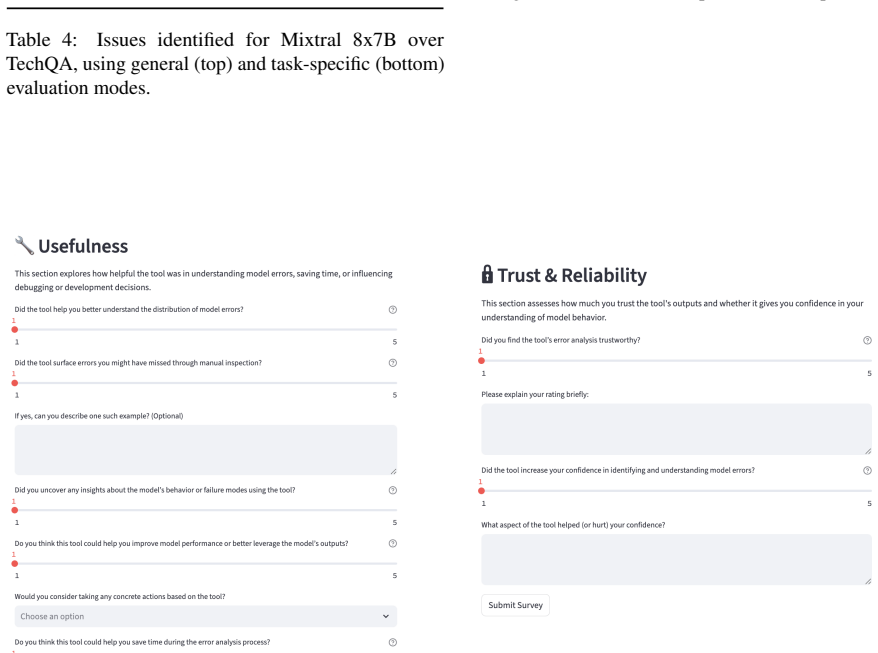
- [Section 4.3 and Appendix D] The user study provides only weak support for the utility claims. With N=12 participants, no control condition, no comparison against manual error analysis or an existing tool, and no significance testing on the Likert scores, the statement that participants found CLEAR 'better than existing practices' (average 4.25) cannot be substantiated. I recommend either adding a small controlled comparison with a baseline workflow or substantially tempering the conclusions drawn from this study.
minor comments (5)
- [Section 4.2, 'System Impact'] The comparison cites '1194 MMLU' for Mixtral 8x7B, which is not a valid MMLU score on the usual 0-100 scale; the correct MMLU value is about 70.6, and the Elo figure appears to be duplicated. This factual error should be corrected.
- [Table 3] In the GSM8K row for 'LLM-based (LLaMA-3-70B)', the entry 'No Issues Detected (81.4' is missing a closing parenthesis, and the percentages reported for the GPT-4o column differ from Table 1 for nominally the same setup (e.g., No Issues Detected 83.7% versus 78.4%) without an explanation; the relation between these two tables should be clarified.
- [Appendix D] The participant breakdown '7 application developers, 3 business analysts, and 1 model developer' sums to 11, not the stated 12 participants; please correct the inconsistency.
- [Section 2] The range of the numeric score s_n is never defined, and the condition 'sn < 1' determines which feedback enters issue generation; the paper should state explicitly whether scores are binary, on a 0-1 scale, or on some other scale, and what 'No Issues Detected' means in the tables.
- [Section 2 (notation) and Section 3.2 (typos)] The symbol s is used both for the target system and for the numeric score s_n, which is confusing and should be renamed; also, 'makeCLEAR' should be 'make CLEAR' and 'effect their system behavior' should be 'affect their system behavior'.
Circularity Check
No significant circularity: CLEAR's issue discovery and prevalence are explicitly defined as aggregations of LLM-judge critiques, and the paper disclaims external validity for those critiques.
full rationale
CLEAR's derivation chain is a sequence of defined transformations: an LLM judge produces per-instance critiques tn, a KPA module clusters those critiques into issues im, and each tn is linked to relevant issues; the reported prevalence is the fraction of linked critiques per issue. This is an operational summary of the input data, not a prediction of an independent quantity. The paper does not claim the issue list or percentages are ground-truth error rates; Appendix A states 'The discovered issues are only as reliable as the initial critiques from the judge model,' acknowledging that validity is inherited from the judge rather than established by the pipeline. The user study and cross-system comparisons provide independent evidence of usefulness, but the paper does not use them to certify the accuracy of issue prevalence. The KPA self-citations (Bar-Haim et al., 2020a,b) describe a published, reusable method and are not invoked as a uniqueness theorem or as the sole justification for the central claim. Consequently, no load-bearing step reduces to its own input in the sense required for circularity, and the appropriate finding is no significant circularity.
Assumptions & free parameters
free parameters (3)
- Score threshold for issue generation =
sn < 1
- Number of key points =
3 to 15
- Maximum summaries for synthesis =
150
assumptions (4)
- domain assumption LLM judge produces valid critiques
- domain assumption KPA clustering yields meaningful issues
- domain assumption Reference-less evaluation is sufficient
- domain assumption LLM matching maps critiques to issues correctly
Cite this review
Pith. "Pith review of CLEAR: Error Analysis via LLM-as-a-Judge Made Easy." pith.science (2026). https://pith.science/paper/HLTTQN63
@misc{pith2026250718392,
  author       = {Pith},
  title        = {Pith review of: CLEAR: Error Analysis via LLM-as-a-Judge Made Easy},
  year         = {2026},
  howpublished = {\url{https://pith.science/paper/HLTTQN63}},
  note         = {Machine review of arXiv:2507.18392}
}
read the original abstract
The evaluation of Large Language Models (LLMs) increasingly relies on other LLMs acting as judges. However, current evaluation paradigms typically yield a single score or ranking, answering which model is better but not why. While essential for benchmarking, these top-level scores obscure the specific, actionable reasons behind a model's performance. To bridge this gap, we introduce CLEAR, an interactive, open-source package for LLM-based error analysis. CLEAR first generates per-instance textual feedback, then it creates a set of system-level error issues, and quantifies the prevalence of each identified issue. Our package also provides users with an interactive dashboard that allows for a comprehensive error analysis through aggregate visualizations, applies interactive filters to isolate specific issues or score ranges, and drills down to the individual instances that exemplify a particular behavioral pattern. We demonstrate CLEAR analysis for RAG and Math benchmarks, and showcase its utility through a user case study.
Figures


Figures from the paper (2 more)

Reference graph
Works this paper leans on
-
[1]
Hewett, Mojan Javaheripi, Piero Kauffmann, James R
Marah Abdin, Jyoti Aneja, Harkirat Behl, Sébastien Bubeck, Ronen Eldan, Suriya Gunasekar, Michael Harrison, Russell J. Hewett, Mojan Javaheripi, Piero Kauffmann, James R. Lee, Yin Tat Lee, Yuanzhi Li, Weishung Liu, Caio C. T. Mendes, Anh Nguyen, Eric Price, Gustavo de Rosa, Olli Saarikivi, Adil Salim, Shital Shah, Xin Wang, Rachel Ward, Yue Wu, Dingli Yu,...
arXiv 2024
-
[2]
Roy Bar-Haim, Lilach Eden, Roni Friedman, Yoav Kantor, Dan Lahav, and Noam Slonim. 2020 a . https://doi.org/10.18653/v1/2020.acl-main.371 From arguments to key points: T owards automatic argument summarization . In Proceedings of the 58th Annual Meeting of the Association for Computational Linguistics, pages 4029--4039, Online. Association for Computation...
-
[3]
Roy Bar-Haim, Yoav Kantor, Lilach Eden, Roni Friedman, Dan Lahav, and Noam Slonim. 2020 b . https://doi.org/10.18653/v1/2020.emnlp-main.3 Quantitative argument summarization and beyond: Cross-domain key point analysis . In Proceedings of the 2020 Conference on Empirical Methods in Natural Language Processing (EMNLP), pages 39--49, Online. Association for ...
-
[4]
Vittorio Castelli, Rishav Chakravarti, Saswati Dana, Anthony Ferritto, Radu Florian, Martin Franz, Dinesh Garg, Dinesh Khandelwal, Scott McCarley, Mike McCawley, Mohamed Nasr, Lin Pan, Cezar Pendus, John Pitrelli, Saurabh Pujar, Salim Roukos, Andrzej Sakrajda, Avirup Sil, Rosario Uceda-Sosa, Todd Ward, and Rong Zhang. 2019. https://arxiv.org/abs/1911.0298...
arXiv 2019
-
[5]
Wei-Lin Chiang, Lianmin Zheng, Ying Sheng, Anastasios Nikolas Angelopoulos, Tianle Li, Dacheng Li, Hao Zhang, Banghua Zhu, Michael Jordan, Joseph E. Gonzalez, and Ion Stoica. 2024. https://arxiv.org/abs/2403.04132 Chatbot arena: An open platform for evaluating llms by human preference . Preprint, arXiv:2403.04132
arXiv 2024
-
[6]
Karl Cobbe, Vineet Kosaraju, Mohammad Bavarian, Mark Chen, Heewoo Jun, Lukasz Kaiser, Matthias Plappert, Jerry Tworek, Jacob Hilton, Reiichiro Nakano, Christopher Hesse, and John Schulman. 2021. https://arxiv.org/abs/2110.14168 Training verifiers to solve math word problems . Preprint, arXiv:2110.14168
arXiv 2021
-
[7]
Robert Friel, Masha Belyi, and Atindriyo Sanyal. 2024. Ragbench: Explainable benchmark for retrieval-augmented generation systems. arXiv preprint arXiv:2407.11005
arXiv 2024
-
[8]
Ariel Gera, Odellia Boni, Yotam Perlitz, Roy Bar-Haim, Lilach Eden, and Asaf Yehudai. 2025. https://arxiv.org/abs/2412.09569 Justrank: Benchmarking llm judges for system ranking . Preprint, arXiv:2412.09569
arXiv 2025
Show all 24 references
-
[9]
IBM Granite Team. 2024. https://github.com/ibm-granite/granite-3.0-language-models/ Granite 3.0 language models
2024
-
[10]
Aaron Grattafiori, Abhimanyu Dubey, Abhinav Jauhri, Abhinav Pandey, Abhishek Kadian, Ahmad Al-Dahle, et al. 2024. https://arxiv.org/abs/2407.21783 The L lama 3 herd of models . Preprint, arXiv:2407.21783
2024 arXiv
-
[11]
Dan Hendrycks, Collin Burns, Steven Basart, Andy Zou, Mantas Mazeika, Dawn Song, and Jacob Steinhardt. 2021. https://arxiv.org/abs/2009.03300 Measuring massive multitask language understanding . Preprint, arXiv:2009.03300
2021 arXiv
-
[12]
Albert Q. Jiang, Alexandre Sablayrolles, Antoine Roux, Arthur Mensch, Blanche Savary, Chris Bamford, Devendra Singh Chaplot, Diego de las Casas, Emma Bou Hanna, Florian Bressand, Gianna Lengyel, Guillaume Bour, Guillaume Lample, Lélio Renard Lavaud, Lucile Saulnier, Marie-Anne...
2024 arXiv
-
[13]
Yang Liu, Dan Iter, Yichong Xu, Shuohang Wang, Ruochen Xu, and Chenguang Zhu. 2023. https://arxiv.org/abs/2303.16634 G-eval: Nlg evaluation using gpt-4 with better human alignment . Preprint, arXiv:2303.16634
2023 arXiv
-
[14]
Vishvak Murahari, Ameet Deshpande, Peter Clark, Tanmay Rajpurohit, Ashish Sabharwal, Karthik Narasimhan, and Ashwin Kalyan. 2023. Qualeval: Qualitative evaluation for model improvement. arXiv preprint arXiv:2311.02807
2023 arXiv
-
[15]
Goucher, Adam Perelman, Aditya Ramesh, Aidan Clark, AJ Ostrow, Akila Welihinda, et al
OpenAI, :, Aaron Hurst, Adam Lerer, Adam P. Goucher, Adam Perelman, Aditya Ramesh, Aidan Clark, AJ Ostrow, Akila Welihinda, et al. 2024. https://arxiv.org/abs/2410.21276 Gpt-4o system card . Preprint, arXiv:2410.21276
2024 arXiv
-
[16]
Yujia Qin, Shihao Liang, Yining Ye, Kunlun Zhu, Lan Yan, Yaxi Lu, Yankai Lin, Xin Cong, Xiangru Tang, Bill Qian, Sihan Zhao, Lauren Hong, Runchu Tian, Ruobing Xie, Jie Zhou, Mark Gerstein, Dahai Li, Zhiyuan Liu, and Maosong Sun. 2023. https://arxiv.org/abs/2307.16789 Toolllm: ...
2023 arXiv
-
[17]
Mobashir Sadat, Zhengyu Zhou, Lukas Lange, Jun Araki, Arsalan Gundroo, Bingqing Wang, Rakesh Menon, Md Parvez, and Zhe Feng. 2023. https://doi.org/10.18653/v1/2023.findings-emnlp.59 D elucion QA : Detecting hallucinations in domain-specific question answering . In Findings of ...
2023 doi
-
[18]
Tongshuang Wu, Marco Tulio Ribeiro, Jeffrey Heer, and Daniel S Weld. 2019. Errudite: Scalable, reproducible, and testable error analysis. In Proceedings of the 57th Annual Meeting of the Association for Computational Linguistics, pages 747--763
2019
-
[19]
Zishan Xu, Shuyi Xie, Shupei Xiao, Linlin Song, Sui Wenjuan, Fan Lin, and Lv Qingsong. 2025. https://openreview.net/forum?id=Q5eo3VMxF6 Misattribution LLM : Integrating error attribution capability into LLM evaluation
2025
-
[20]
Asaf Yehudai, Boaz Carmeli, Yosi Mass, Ofir Arviv, Nathaniel Mills, Assaf Toledo, Eyal Shnarch, and Leshem Choshen. 2024. https://arxiv.org/abs/2401.14367 Genie: Achieving human parity in content-grounded datasets generation . Preprint, arXiv:2401.14367
2024 arXiv
-
[21]
Zhiyuan Zeng, Yizhong Wang, Hannaneh Hajishirzi, and Pang Wei Koh. 2025. Evaltree: Profiling language model weaknesses via hierarchical capability trees. arXiv preprint arXiv:2503.08893
2025 arXiv
-
[22]
Lianmin Zheng, Wei-Lin Chiang, Ying Sheng, Siyuan Zhuang, Zhanghao Wu, Yonghao Zhuang, Zi Lin, Zhuohan Li, Dacheng Li, Eric Xing, Hao Zhang, Joseph E Gonzalez, and Ion Stoica. 2023. https://proceedings.neurips.cc/paper_files/paper/2023/file/91f18a1287b398d378ef22505bf41832-Pap...
2023
-
[23]
online" 'onlinestring :=
ENTRY address archivePrefix author booktitle chapter edition editor eid eprint eprinttype howpublished institution journal key month note number organization pages publisher school series title type volume year doi pubmed url lastchecked label extra.label sort.label short.list...
-
[24]
write newline
" write newline "" before.all 'output.state := FUNCTION n.dashify 't := "" t empty not t #1 #1 substring "-" = t #1 #2 substring "--" = not "--" * t #2 global.max substring 't := t #1 #1 substring "-" = "-" * t #2 global.max substring 't := while if t #1 #1 substring * t #2 gl...
Reviewed August 6, 2026 · model on record in the stance chip above.
Discussion (0). Sign in to comment.