REVIEW 3 major objections 5 minor 53 references
Querying Autonomous Vehicle Point Clouds: Enhanced by 3D Object Counting with CounterNet
T0 review · 3 major / 5 minor · reviewed 2026-08-15 · deepseek-v4-flash
Pith's one-line read CounterNet lifts LiDAR object counting and point-cloud query accuracy
desk verdict Sensible system, permissive evaluation: the counting-vs-detection claim is plausible but the abstract overstates it. read the letter →
The pith
A machine-rendered reading of the paper's core claim, the machinery that carries it, and where it could break.
The reading
What carries the argument
The load-bearing mechanism is a center-detection heatmap plus two refinement stages. First, a bird's-eye-view feature map feeds a heatmap head whose peaks indicate object centers; thresholded local-maxima detection turns peaks into counts, and the model is trained with focal loss plus an L1 counter loss. Second, the feature map is split into partitions to tame dense scenes, each partition gets an Otsu-derived dynamic threshold, and overlapping partitions prevent objects near boundaries from being split; finally, a per-frame model-selection step estimates each model variant's center in feature space and uses a Chernoff bound to compute confidence, so the closest center, adjusted by that confidence, picks the best partition-and-overlap configuration for each frame.
What would settle it
Measure per-frame counting accuracy of CounterNet against ground-truth annotations on a contiguous held-out sequence of several thousand frames; if the claimed 5–20% improvement over detection baselines does not appear, or if the Chernoff-adjusted model selection picks configurations that give lower average count accuracy than a fixed best single model, the core claims are falsified.
Extended reading notes
Core claim
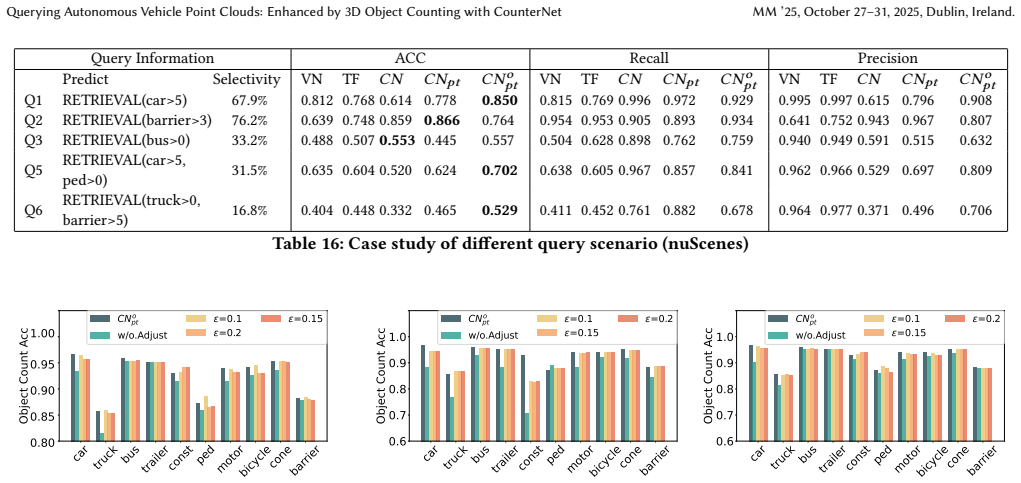
The paper's central claim is that object counting—not localization—is the weak link in point-cloud querying, and that a heatmap-based center detector trained with a counting-specific loss repairs it. CounterNet projects a point-cloud frame to a bird's-eye-view feature map, produces a K-channel heatmap of object centers, and counts objects via thresholded local maxima; it is supervised jointly by focal loss on the heatmap and an L1 count loss. The paper reports that this beats state-of-the-art detection models on counting accuracy by 5–20% across object categories on nuScenes, KITTI, and Waymo, and that the gain transfers to higher accuracy for all three query types, with the overlapped-partition variant typically the strongest.
Load-bearing premise
The model-selection step assumes point cloud frames are independent samples when it uses the Chernoff bound to estimate confidence in each model's center, yet consecutive LiDAR frames are temporally correlated, so a miscalibrated bound could select suboptimal models and cut into the reported query accuracy.
Editorial extensions
If this is right
- On nuScenes, KITTI, and Waymo, counting accuracy improves by 5–20% per object category, with the overlapped-partition CounterNet usually the best.
- RETRIEVAL, COUNT, and AGGREGATION queries all become more accurate, since each query type depends on correct per-frame counts.
- Overlap between partitions specifically fixes the failures that plain partitioning causes for large, sparsely distributed objects.
- Model selection with the Chernoff-based adjustment reallocates frames from the dominant model to complementary ones, improving the worst-category counting accuracy while preserving overall performance.
Reading between the lines
- The count-first, localize-later design could transfer to other 3D sparse data, such as warehouse robots or indoor scanning, where aggregate statistics matter more than boxes.
- If counting becomes reliable enough, query engines could build indexes from cheap counting models rather than running full detectors, an efficiency lever the paper leaves unexplored.
- The independence assumption behind the Chernoff adjustment is testable: on a contiguous sequence, shuffling frame order should change selection accuracy if the confidence probabilities are miscalibrated, pointing to a temporal-aware bound as a direct extension.
- The baseline uses a fixed heatmap threshold of 0.5 while the partitioned variant uses per-partition Otsu thresholds; per-category thresholds, rather than per-partition ones, might be an even sharper refinement.
Signed reviews
Editorial analysis
A structured set of objections, weighed in public.
Referee Report
Summary. The paper proposes CounterNet, a heatmap-based object counting network for autonomous vehicle point clouds, together with three performance enhancements: feature map partitioning, overlapping partitions, and per-frame dynamic model selection. It formalizes three query types over point cloud sequences (RETRIEVAL, COUNT, AGGREGATION) and evaluates query accuracy on the nuScenes, KITTI, and Waymo datasets against several state-of-the-art 3D detection baselines. The abstract claims a 5% to 20% improvement in counting accuracy across object categories and more reliable query outcomes across all query types.
Significance. If the claims are substantiated, the paper addresses a real and practical problem: existing point cloud query pipelines assume that detection models provide reliable object counts, which is often false in 3D autonomous driving data. The formalization of three query types and the emphasis on counting as a first-class operation are useful contributions, and the experimental breadth (three datasets, multiple detectors, three query types) is a strength. The code appears to be available. However, the method is largely a composition of established techniques (heatmap center detection, focal loss, Otsu thresholding, a Chernoff heuristic), and the reported gains are uneven across categories. The significance is therefore moderate rather than high, subject to the evaluation concerns below.
major comments (3)
- [§6.1, Evaluation Metrics] The RETRIEVAL and COUNT query accuracies are computed with tolerances derived from the maximum number of objects in a scene multiplied by the error tolerance, rather than from the query threshold. When the scene maximum is large, this tolerance can exceed the query threshold itself: with M=30 cars and a 10% tolerance, a frame whose true count is 3 and predicted count is 0 would be scored correct for a "car >= 3" query even though the predicted count does not satisfy the condition. Similarly, the COUNT query error is applied to the number of returned frames, which does not verify that each frame satisfies the condition in Definition 2. The reported query-accuracy numbers therefore do not directly measure correctness under Definitions 1–3, and the central claim of "more reliable query outcomes" is not supported by the current protocol. The authors should re-evaluate with exact matching or with a tolerance proportional to the query threshold, and report per-category results under that stricter protocol.
- [§5.3, Eq. (4) and Algorithm 2] The Chernoff bound is applied to high-dimensional feature vectors p_i.f without defining a proper scalar concentration quantity. In Algorithm 2, the "sample variance" ξ^2 is written as the average of (p_i.f − ω̂)^2, which is undefined for vector-valued features. The bound also assumes independent samples, but LiDAR frames in a continuous sequence are temporally correlated; this premise is not discussed. Because the dynamic model selection contribution and its reported gains (Figure 11) depend on this confidence adjustment, the authors must either replace the bound with a valid concentration inequality (e.g., a vector-valued or empirically calibrated bound) or provide direct empirical evidence that the adjustment improves selection accuracy rather than acting as an uncontrolled heuristic.
- [Abstract and Table 13] The abstract claims that CounterNet "improves counting accuracy by 5% to 20% across object categories," but the per-category COUNT query accuracy in Table 13 shows several categories where the best CounterNet variant is below the best baseline (bus: CN_o_pt 0.860 vs. SN 0.995; truck: CN_o_pt 0.592 vs. SN 0.602). Additionally, the "Object Count Accuracy" metric used in Figure 2 is never defined in Section 6.1 or in the appendices, and the 5–20% range is not traced to any specific table or definition. The quantitative claim should be revised to match the reported data, and the metric should be explicitly defined before it is used to support the paper's main selling point.
minor comments (5)
- [Table 4 caption] The caption reads "ETRIEV AL-MULTIPLE (KITTI)"; this should be "RETRIEVAL-MULTIPLE (KITTI)".
- [Appendix B, Figure reference] The text in Appendix B refers to "Figure 10" for the KITTI subset experiment, but the experiment result is a table (Table 10), not a figure. The cross-reference appears to be a mistake.
- [§5.3, typo] The sentence "p_i.f demoted the feature vector" should read "p_i.f denotes the feature vector".
- [Appendix C.1, JSON data model] In the example JSON, the object "count" is stored as a string ("10"); it should be a numeric value for arithmetic query operations such as SUM and AGGREGATION.
- [Tables 8, 17–19] The column headings "dist" and "rate" in the model selection tables are not explained. Defining these abbreviations in the table caption or in the text would improve reproducibility.
Circularity Check
No circularity: CounterNet's counting and query results are trained and evaluated on held-out data; no prediction reduces by construction to a fitted input or self-citation.
full rationale
The derivation chain is self-contained. CounterNet is trained with heatmap focal loss plus an L1 count loss (Eqs. 1-2) against ground-truth object centers/counts; at test time, counts are obtained from thresholded local maxima on held-out frames, so no target quantity is fitted and then reported as a prediction. Partitioning, overlap, and Otsu thresholding are architectural/data-dependent transforms, not fitted parameters that reappear as query outputs. The model selection in Sec. 5.3 and Algorithm 2 computes model centers on training frames and selects nearest centers on validation frames; the Chernoff adjustment is a heuristic confidence multiplier, not a quantity that defines query accuracy, so its looseness is a modeling concern rather than a circular step. No load-bearing self-citation or imported uniqueness theorem is used; the only self-reference is the code repository [1], and the evaluations compare against external detection baselines on held-out query frames. The per-scene maximum-count tolerance in Sec. 6.1 can exceed a query threshold (e.g., 10% of the maximum car count), which may inflate absolute query-accuracy numbers, but every method is scored under the same tolerance and the CounterNet advantage is an empirical comparison, not a definitional reduction. The undefined "Object Count Accuracy" in Fig. 2 is a reporting gap, not a circular step. Overall, no prediction in the paper reduces by construction to its inputs.
Assumptions & free parameters
free parameters (5)
- Fixed heatmap threshold t =
0.5
- Partition count pt =
4 (default); 2 and 9 studied
- Overlap expansion ratio delta =
0.2 (default)
- Chernoff margin epsilon =
0.1 to 0.2 (nuScenes); 0.05 to 0.15 (KITTI)
- Duplicate merge radius gamma =
not specified
assumptions (4)
- domain assumption BEV-projected object centers are sufficient as counting supervision; box size and orientation provide no necessary information for counts.
- domain assumption Point cloud frames are independent, justifying the Chernoff-bound confidence estimate in model selection.
- domain assumption The ground-truth 3D annotations in nuScenes, KITTI, and Waymo are accurate enough to define heatmap targets.
- domain assumption The 10% query error tolerance (scaled by per-scene maximum object count) is a meaningful correctness criterion.
invented entities (1)
-
CounterNet heatmap counting head
Cite this review
Pith. "Pith review of Querying Autonomous Vehicle Point Clouds: Enhanced by 3D Object Counting with CounterNet." pith.science (2026). https://pith.science/paper/X5UQRMKL
@misc{pith2026250719209,
  author       = {Pith},
  title        = {Pith review of: Querying Autonomous Vehicle Point Clouds: Enhanced by 3D Object Counting with CounterNet},
  year         = {2026},
  howpublished = {\url{https://pith.science/paper/X5UQRMKL}},
  note         = {Machine review of arXiv:2507.19209}
}
read the original abstract
Autonomous vehicles generate massive volumes of point cloud data, yet only a subset is relevant for specific tasks such as collision detection, traffic analysis, or congestion monitoring. Effectively querying this data is essential to enable targeted analytics. In this work, we formalize point cloud querying by defining three core query types: RETRIEVAL, COUNT, and AGGREGATION, each aligned with distinct analytical scenarios. All these queries rely heavily on accurate object counts to produce meaningful results, making precise object counting a critical component of query execution. Prior work has focused on indexing techniques for 2D video data, assuming detection models provide accurate counting information. However, when applied to 3D point cloud data, state-of-the-art detection models often fail to generate reliable object counts, leading to substantial errors in query results. To address this limitation, we propose CounterNet, a heatmap-based network designed for accurate object counting in large-scale point cloud data. Rather than focusing on accurate object localization, CounterNet detects object presence by finding object centers to improve counting accuracy. We further enhance its performance with a feature map partitioning strategy using overlapping regions, enabling better handling of both small and large objects in complex traffic scenes. To adapt to varying frame characteristics, we introduce a per-frame dynamic model selection strategy that selects the most effective configuration for each input. Evaluations on three real-world autonomous vehicle datasets show that CounterNet improves counting accuracy by 5% to 20% across object categories, resulting in more reliable query outcomes across all supported query types.
Figures


Figures from the paper (8 more)




Reference graph
Works this paper leans on
-
[1]
Authors. 2025. Code. https://github.com/PetalZh/PCQuery
work page 2025
-
[2]
Xuyang Bai, Zeyu Hu, Xinge Zhu, Qingqiu Huang, Yilun Chen, Hongbo Fu, and Chiew-Lan Tai. 2022. Transfusion: Robust lidar-camera fusion for 3d object detection with transformers. In CVPR. 1090–1099
work page 2022
-
[3]
Jaeho Bang, Gaurav Tarlok Kakkar, Pramod Chunduri, Subrata Mitra, and Joy Arulraj. 2023. Seiden: Revisiting Query Processing in Video Database Systems. VLDB 16, 9 (2023), 2289–2301
work page 2023
-
[4]
Behley, M
J. Behley, M. Garbade, A. Milioto, J. Quenzel, S. Behnke, C. Stachniss, and J. Gall
-
[5]
Holger Caesar, Varun Bankiti, Alex H. Lang, Sourabh Vora, Venice Erin Li- ong, Qiang Xu, Anush Krishnan, Yu Pan, Giancarlo Baldan, and Oscar Beijbom
-
[6]
Jiashen Cao, Karan Sarkar, Ramyad Hadidi, Joy Arulraj, and Hyesoon Kim. 2022. Figo: Fine-grained query optimization in video analytics. In SIGMOD. 559–572
work page 2022
-
[7]
arXiv preprint arXiv:1903.11027 (2019)
nuScenes: A multimodal dataset for autonomous driving. arXiv preprint arXiv:1903.11027 (2019)
arXiv 2019
-
[8]
Xiaozhi Chen, Huimin Ma, Ji Wan, Bo Li, and Tian Xia. 2017. Multi-view 3d object detection network for autonomous driving. In CVPR. 1907–1915
work page 2017
Show all 53 references
-
[9]
Prithvijit Chattopadhyay, Ramakrishna Vedantam, Ramprasaath R Selvaraju, Dhruv Batra, and Devi Parikh. 2017. Counting everyday objects in everyday scenes. In CVPR. 1135–1144
2017
-
[10]
Hisham Cholakkal, Guolei Sun, Salman Khan, Fahad Shahbaz Khan, Ling Shao, and Luc Van Gool. 2020. Towards partial supervision for generic object counting in natural scenes. IEEE Transactions on Pattern Analysis and Machine Intelligence 44, 3 (2020), 1604–1622
2020
-
[11]
Yukang Chen, Jianhui Liu, Xiangyu Zhang, Xiaojuan Qi, and Jiaya Jia. 2023. Voxelnext: Fully sparse voxelnet for 3d object detection and tracking. In CVPR. 21674–21683
2023
-
[12]
Yuxing Han, Ziniu Wu, Peizhi Wu, Rong Zhu, Jingyi Yang, Liang Wei Tan, Kai Zeng, Gao Cong, Yanzhao Qin, Andreas Pfadler, Zhengping Qian, Jingren Zhou, Jiangneng Li, and Bin Cui. 2021. Cardinality Estimation in DBMS: A Comprehen- sive Benchmark Evaluation. Proc. VLDB Endow. 15,...
2021
-
[13]
Vance Faber et al. 1994. Clustering and the continuous k-means algorithm. Los Alamos Science 22, 138144.21 (1994), 67
1994
-
[14]
Kaiming He, Xiangyu Zhang, Shaoqing Ren, and Jian Sun. 2016. Deep residual learning for image recognition. In CVPR. 770–778
2016
-
[15]
Kaiming He, Georgia Gkioxari, Piotr Dollár, and Ross Girshick. 2017. Mask r-cnn. In ICCV. 2961–2969
2017
-
[16]
Porter Jenkins, Kyle Armstrong, Stephen Nelson, Siddhesh Gotad, J Stockton Jenkins, Wade Wilkey, and Tanner Watts. 2023. Countnet3d: A 3d computer vision approach to infer counts of occluded objects. InProceedings of the IEEE/CVF Winter Conference on Applications of Computer V...
2023
-
[17]
Martin Hellman and Josef Raviv. 1970. Probability of error, equivocation, and the Chernoff bound. IEEE Transactions on Information Theory 16, 4 (1970), 368–372
1970
-
[18]
Glenn Jocher, Alex Stoken, Jirka Borovec, NanoCode012, ChristopherSTAN, Liu Changyu, Laughing, tkianai, Adam Hogan, lorenzomammana, yxNONG, AlexWang1900, Laurentiu Diaconu, Marc, wanghaoyang0106, ml5ah, Doug, Fran- cisco Ingham, Frederik, Guilhen, Hatovix, Jake Poznanski, Jiac...
2020 doi
-
[19]
Ruixiang Jiang, Lingbo Liu, and Changwen Chen. 2023. Clip-count: Towards text- guided zero-shot object counting. In Proceedings of the 31st ACM International Conference on Multimedia. 4535–4545
2023
-
[20]
Daniel Kang, John Guibas, Peter D Bailis, Tatsunori Hashimoto, and Matei Za- haria. 2022. Tasti: Semantic indexes for machine learning-based queries over unstructured data. In SIGMOD. 1934–1947
2022
-
[21]
Daniel Kang, Peter Bailis, and Matei Zaharia. 2019. BlazeIt: Optimizing Declara- tive Aggregation and Limit Queries for Neural Network-Based Video Analytics. VLDB 13, 4 (2019)
2019
-
[22]
Fiodar Kazhamiaka, Matei Zaharia, and Peter Bailis. 2021. Challenges and Op- portunities for Autonomous Vehicle Query Systems.. In CIDR
2021
-
[23]
Seunggu Kang, WonJun Moon, Euiyeon Kim, and Jae-Pil Heo. 2024. Vlcounter: Text-aware visual representation for zero-shot object counting. In Proceedings of the AAAI Conference on Artificial Intelligence , Vol. 38. 2714–2722
2024
-
[24]
Alex H Lang, Sourabh Vora, Holger Caesar, Lubing Zhou, Jiong Yang, and Oscar Beijbom. 2019. Pointpillars: Fast encoders for object detection from point clouds. In CVPR. 12697–12705
2019
-
[25]
Xin Lai, Yukang Chen, Fanbin Lu, Jianhui Liu, and Jiaya Jia. 2023. Spherical transformer for lidar-based 3d recognition. In CVPR. 17545–17555
2023
-
[26]
Hei Law and Jia Deng. 2018. Cornernet: Detecting objects as paired keypoints. In ECCV. 734–750
2018
-
[27]
Issam H Laradji, Negar Rostamzadeh, Pedro O Pinheiro, David Vazquez, and Mark Schmidt. 2018. Where are the blobs: Counting by localization with point supervision. In ECCV. 547–562
2018
-
[28]
Jiangneng Li, Haitao Yuan, Gao Cong, Han Mao Kiah, and Shuhao Zhang. 2025. MAST: Towards Efficient Analytical Query Processing on Point Cloud Data. Proceedings of the ACM on Management of Data 3, 1 (2025), 1–27
2025
-
[29]
Asad Lesani, Ehsan Nateghinia, and Luis F Miranda-Moreno. 2020. Development and evaluation of a real-time pedestrian counting system for high-volume condi- tions based on 2D LiDAR. Transportation research part C: emerging technologies 114 (2020), 20–35
2020
-
[30]
Shaoshan Liu, Liangkai Liu, Jie Tang, Bo Yu, Yifan Wang, and Weisong Shi. 2019. Edge computing for autonomous driving: Opportunities and challenges. Proc. IEEE 107, 8 (2019), 1697–1716
2019
-
[31]
Tsung-Yi Lin, Priya Goyal, Ross Girshick, Kaiming He, and Piotr Dollár. 2017. Focal loss for dense object detection. In ICCV. 2980–2988
2017
-
[32]
Guo Ming. 2023. Exploration of the intelligent control system of autonomous vehicles based on edge computing. PLoS One 18, 2 (2023), e0281294
2023
-
[33]
Zhijian Liu, Haotian Tang, Shengyu Zhao, Kevin Shao, and Song Han. 2021. Pvnas: 3d neural architecture search with point-voxel convolution. IEEE Transactions on Pattern Analysis and Machine Intelligence 44, 11 (2021), 8552–8568
2021
-
[34]
Nobuyuki Otsu et al. 1975. A threshold selection method from gray-level his- tograms. Automatica 11, 285-296 (1975), 23–27
1975
-
[35]
Anjana K Nellithimaru and George A Kantor. 2019. Rols: Robust object-level slam for grape counting. In CVPR workshops. 0–0
2019
-
[36]
Charles Ruizhongtai Qi, Li Yi, Hao Su, and Leonidas J Guibas. 2017. Pointnet++: Deep hierarchical feature learning on point sets in a metric space. NeurIPS 30 (2017)
2017
-
[37]
Charles R Qi, Hao Su, Kaichun Mo, and Leonidas J Guibas. 2017. Pointnet: Deep learning on point sets for 3d classification and segmentation. In CVPR. 652–660
2017
-
[38]
Tobias Stahl, Silvia L Pintea, and Jan C Van Gemert. 2018. Divide and count: Generic object counting by image divisions.IEEE Transactions on Image Processing 28, 2 (2018), 1035–1044
2018
-
[39]
Shaoshuai Shi, Chaoxu Guo, Li Jiang, Zhe Wang, Jianping Shi, Xiaogang Wang, and Hongsheng Li. 2020. Pv-rcnn: Point-voxel feature set abstraction for 3d object detection. In CVPR. 10529–10538
2020
-
[40]
Pei Sun, Mingxing Tan, Weiyue Wang, Chenxi Liu, Fei Xia, Zhaoqi Leng, and Dragomir Anguelov. 2022. SWFormer: Sparse Window Transformer for 3D Object Detection in Point Clouds. In ECCV, Shai Avidan, Gabriel J. Brostow, Moustapha Cissé, Giovanni Maria Farinella, and Tal Hassner ...
2022
-
[41]
Pei Sun, Henrik Kretzschmar, Xerxes Dotiwalla, Aurelien Chouard, Vijaysai Patnaik, Paul Tsui, James Guo, Yin Zhou, Yuning Chai, Benjamin Caine, Vijay Vasudevan, Wei Han, Jiquan Ngiam, Hang Zhao, Aleksei Timofeev, Scott Ettinger, Maxim Krivokon, Amy Gao, Aditya Joshi, Yu Zhang,...
2020
-
[42]
OpenPCDet Development Team. 2020. OpenPCDet: An Open-source Toolbox for 3D Object Detection from Point Clouds. https://github.com/open-mmlab/ OpenPCDet
2020
-
[43]
Sihai Tang, Bruce Chen, Harold Iwen, Jason Hirsch, Song Fu, Qing Yang, Paparao Palacharla, Nannan Wang, Xi Wang, and Weisong Shi. 2021. Vecframe: A vehicu- lar edge computing framework for connected autonomous vehicles. In 2021 IEEE International Conference on Edge Computing (...
2021
-
[44]
Yan Yan, Yuxing Mao, and Bo Li. 2018. Second: Sparsely embedded convolutional detection. Sensors 18, 10 (2018), 3337
2018
-
[45]
Jingyi Xu, Hieu Le, Vu Nguyen, Viresh Ranjan, and Dimitris Samaras. 2023. Zero-shot object counting. In CVPR. 15548–15557
2023
-
[46]
Tianwei Yin, Xingyi Zhou, and Philipp Krahenbuhl. 2021. Center-based 3d object detection and tracking. In CVPR. 11784–11793
2021
-
[47]
Zetong Yang, Yanan Sun, Shu Liu, and Jiaya Jia. 2020. 3dssd: Point-based 3d single stage object detector. In CVPR. 11040–11048
2020
-
[48]
Hui Zhou, Xinge Zhu, Xiao Song, Yuexin Ma, Zhe Wang, Hongsheng Li, and Dahua Lin. 2020. Cylinder3d: An effective 3d framework for driving-scene lidar semantic segmentation. arXiv preprint arXiv:2008.01550 (2020)
2020 arXiv
-
[49]
Gang Zhang, Junnan Chen, Guohuan Gao, Jianmin Li, Si Liu, and Xiaolin Hu
-
[50]
f r a m e _ i d
Yin Zhou and Oncel Tuzel. 2018. Voxelnet: End-to-end learning for point cloud based 3d object detection. In CVPR. 4490–4499. MM ’25, October 27–31, 2025, Dublin, Ireland. Xiaoyu Zhang, Zhifeng Bao, Hai Dong, Ziwei Wang, and Jiajun Liu A Table of Notations P set of point cloud ...
2018
-
[52]
Xingyi Zhou, Vladlen Koltun, and Philipp Krähenbühl. 2020. Tracking Objects as Points. In ECCV, Andrea Vedaldi, Horst Bischof, Thomas Brox, and Jan-Michael Frahm (Eds.), Vol. 12349. Springer, 474–490
2020
-
[2019]
SemanticKITTI: A Dataset for Semantic Scene Understanding of LiDAR Sequences. In ICCV
-
[2024]
In IEEE/CVF Conference on Computer Vision and Pattern Recognition, CVPR 2024, Seattle, W A, USA, June 16-22, 2024
SAFDNet: A Simple and Effective Network for Fully Sparse 3D Object Detection. In IEEE/CVF Conference on Computer Vision and Pattern Recognition, CVPR 2024, Seattle, W A, USA, June 16-22, 2024. IEEE, 14477–14486
2024
Reviewed August 15, 2026 · model on record in the stance chip above.
Discussion (0). Continue with ORCID to comment.