REVIEW 4 major objections 4 minor 32 references
Quantum Reinforcement Learning by Adaptive Non-local Observables
T0 review · 4 major / 4 minor · reviewed 2026-08-06 · deepseek-v4-flash
Pith's one-line read A variational quantum circuit that trains its final measurement operator, not just its rotation gates, learns faster and scores higher on reinforcement-learning benchmarks.
desk verdict Applies the authors' prior adaptive-observable idea to DQN/A3C; plausible gains but the depth claim and missing seed statistics make the central interpretation unsupported. read the letter →
The pith
A machine-rendered reading of the paper's core claim, the machinery that carries it, and where it could break.
The reading
What carries the argument
The ANO is a trainable Hermitian observable $H(\phi)$ on $k \le n$ qubits, parameterized by real diagonal entries and complex off-diagonal entries, $\phi = (a_{ij}, b_{ij}, c_{ii})$, whose output replaces the fixed Pauli measurement in the VQC expectation. It carries the argument in two ways: the Rayleigh quotient bound $\lambda_1 \le \langle \psi | H(\phi) | \psi \rangle \le \lambda_n$ gives a tunable output scale suited to Q-values, and the $k$-local structure yields measurements that no fixed single-qubit Pauli basis can express. Both effects enlarge the function space while keeping circuit depth constant.
What would settle it
Re-running each configuration across at least ten random seeds and plotting mean plus or minus standard error would settle it: if ANO's advantage over fixed-Pauli baselines vanishes or the confidence intervals overlap, the claim of consistent outperformance fails. A second test would replace the adaptive observable with a fixed Pauli measurement plus a single trainable scalar output scale; if that matches ANO's performance, the gain is output range, not multi-qubit structure.
Extended reading notes
Core claim
The central claim is that a variational quantum circuit whose final observable is a parameterized $k$-local Hermitian operator $H(\phi)$, trained end-to-end with the circuit parameters $\theta$, consistently outperforms a conventional VQC with a fixed Pauli-$Z$ measurement when used as the function approximator in DQN and A3C agents. Because the eigenvalues of $H(\phi)$ adapt during training, the output range of the model is no longer confined to $[-1,1]$, and the measurable correlations are no longer restricted to single-qubit axes, expanding the reachable function space without adding circuit depth. The evidence is the learning curves on CartPole, MountainCar, MiniGrid 8x8, and MiniGrid-SimpleCrossing S9N1, where the ANO-with-rotations configuration typically learns fastest and highest, with the measurement-only variant showing that much of the gain survives even without the variational layer.
Load-bearing premise
The load-bearing premise is that the reported ordering of learning curves reflects a systematic advantage of adaptive measurements rather than random variation between runs, since the paper does not report seed-level statistics or standard errors across independent runs.
Editorial extensions
If this is right
- ANO-VQC agents converge faster than fixed-Pauli VQC baselines in DQN on CartPole and MountainCar.
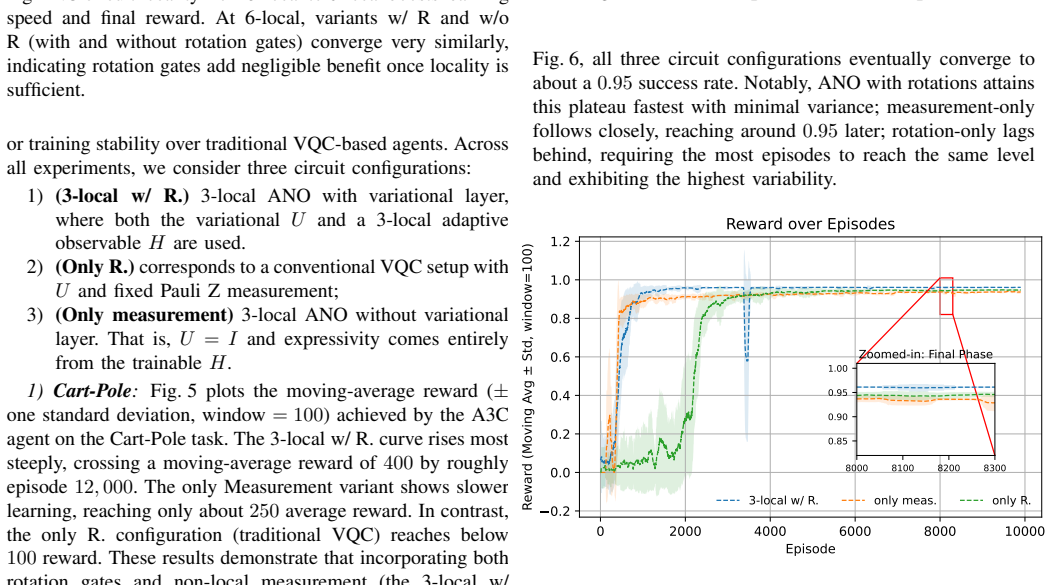
- In A3C, ANO with rotations reaches high reward fastest on CartPole, MiniGrid 8x8, and MiniGrid-SimpleCrossing S9N1, while rotation-only and measurement-only variants lag.
- Increasing ANO locality from 3 to 6 improves MountainCar performance, and at locality 6 the addition of rotation gates yields negligible extra benefit.
- A measurement-only ANO variant (no variational layer at all) learns effectively when locality is large or the task is simple, showing that the observable alone carries meaningful expressive power.
- These gains come without increasing circuit depth, so the improved function space is purchased at the readout, not through deeper circuits.
Reading between the lines
- If the benefit is largely the tunable output range, similar gains may transfer to supervised regression or classification tasks that also need non-binary outputs, a direction the paper does not explore.
- A direct head-to-head with a classical network of matched parameter count, or with a fixed-Pauli VQC augmented by a trainable scalar output scale, would reveal whether the advantage comes from the multi-qubit structure or merely from freeing the output range; the paper does not run that comparison.
- The claim of practical quantum advantage would be placed on firmer ground by seed-level statistics and standard errors across independent runs, which the paper does not report.
- The learned observable could be reused as a drop-in readout for other variational algorithms, such as generative models or classifiers, provided the same joint optimization loop is kept.
Editorial analysis
A structured set of objections, weighed in public.
Referee Report
Summary. The paper proposes to replace the fixed local Pauli measurement in variational quantum circuits (VQCs) with a trainable, adaptive non-local observable (ANO) H(φ), and to apply the resulting ANO-VQC as the function approximator in Deep Q-Network (DQN) and Asynchronous Advantage Actor-Critic (A3C) reinforcement learning agents. The observable is parameterized as a general Hermitian matrix in Eq. (11), and its parameters are optimized jointly with the circuit parameters. The authors report experiments on CartPole, Mountain Car, and two MiniGrid tasks, with ablations over measurement locality and whether the variational rotation layer is present. They conclude that ANO-VQC agents consistently outperform baselines with fixed Pauli measurements, and that adaptive measurements enhance the function space without increasing circuit depth.
Significance. If the central empirical claim were substantiated, the idea of jointly training a multi-qubit observable in RL agents would be a useful extension of recent learnable-measurement proposals, and the paper would provide a concrete application of those ideas to DQN and A3C. The paper identifies a plausible limitation of fixed local measurements—restricted output range and limited expressivity—and offers a principled remedy. The ablation structure (locality versus rotation) is a reasonable way to probe the source of improvement. However, the current evidence is not sufficient to support the paper's claims: the learning curves are single runs, no classical baselines are given, and the 'no extra circuit depth' assertion is not justified given how a general Hermitian observable must be implemented. The potential significance is real but conditional on substantially stronger empirical and theoretical support.
major comments (4)
- [Section III, Figs. 3-7] All reported learning curves are single-run moving averages (with within-run standard deviation), not aggregated over independent random seeds. The claim that ANO-VQC agents 'consistently outperform' baselines is therefore unsupported: with one seed per configuration, the observed ordering could easily invert under different initializations, replay-buffer randomness, or environment stochasticity. Please provide seed-level statistics (means and error bars across at least 5-10 seeds) and, where appropriate, a pairwise significance test.
- [Section II-B, Eq. (11)-(12)] The abstract and conclusion claim that ANO enhances the function space 'without increasing circuit depth.' This claim is unverified and likely false on current hardware. Any Hermitian H(φ) can be written as H = P†(φ) D P(φ) with diagonal D and unitary P; implementing the measurement of H therefore requires compiling P into quantum gates, adding circuit depth before the final measurement. The ablations in Section III compare configurations that differ both in the number of trainable parameters and in effective circuit depth (e.g., '3-local w/ R.' has additional φ parameters and a compiled P, whereas 'only R.' has neither). The observed improvements may thus be due to added model capacity rather than to adaptive or non-local measurement per se. Please provide depth-matched and parameter-matched baselines, or explicitly measure and report the compiled circuit depth for each configuration.
- [Section IV, Conclusion] The closing statement that adaptive multi-qubit observables 'can enable practical quantum advantages in reinforcement learning' is not supported by the experiments, because no classical baselines (e.g., classical DQN or A3C with comparable neural-network capacity) are reported. All comparisons are between quantum variants. To make any claim about practical quantum advantage, the paper must compare against a classical agent on the same tasks, or remove the claim and limit the conclusions to relative performance among quantum architectures.
- [Section III-A, Eq. (12) and Fig. 2] The architecture mapping from the scalar expectation value in Eq. (12) to a vector of action values is underspecified. The text states that the model outputs a vector (Q(s,a1),...,Q(s,ak)) and refers to Fig. 2's 'groupings,' but there is no formal definition of how multiple outputs are obtained from the k-qubit observable or how the action space dimension relates to the number of groupings. Without this, the DQN and A3C implementations are not reproducible. Please provide a precise mathematical description of the full output layer, including how the groups in Fig. 2 are selected and how the observables for different groups are parameterized and measured.
minor comments (4)
- [Section III-A-2, Fig. 4] The y-axis of Fig. 4 appears inconsistent with the Mountain Car reward scale described in the text (typical rewards are negative, in the range of about -200 to -100). Please clarify whether the plotted quantity is the raw reward, a shifted reward, or the negative reward, and fix the axis labels accordingly.
- [Section III-A-2] The sentence 'To evaluate the influence of locality and variational rotation gates in the ANO model.' is a fragment and should be completed. There are also several other grammatical and typographical issues throughout the paper (e.g., Section III-B-1's 'The only Measurement variant shows slower learning...' mixing capitalization), which should be corrected.
- [References [30]-[32]] The ANO definition in Eq. (11) is attributed to the authors' own prior work [32], and Eqs. (12)-(15) are close in form to earlier learnable-measurement approaches [30], [31]. Please clarify the specific novel contribution of this paper relative to [30]-[32], beyond applying ANO to RL, and ensure the distinction is explicit in the introduction.
- [General] No hyperparameters (learning rates, batch sizes, replay buffer size, number of A3C workers, optimizer choice, total episodes, etc.) are reported. For reproducibility, please include a full hyperparameter table and state the number of independent runs.
Circularity Check
No significant circularity: the ANO-VQC RL comparison is self-contained and no claimed prediction reduces to its inputs.
full rationale
The paper's load-bearing results are empirical learning curves comparing ANO-VQC agents (Eq. 12) against fixed-Pauli VQC baselines on CartPole, MountainCar, and MiniGrid. The adaptive observable H(phi) is fully defined in Eq. 11 and its optimization is specified in Eqs. 12-15; it is not fitted to the quantities it later 'predicts'. The only self-citation is [32], which is credited for the ANO concept, but the architecture and training are restated locally, so the derivation does not reduce to an unverified self-citation. The skeptical observation that any Hermitian H(phi) can be compiled as P-dagger D P, making the measurement equivalent to an extra trainable unitary before a fixed measurement, undermines (or at least complicates) the paper's claim that ANO increases expressivity 'without increasing circuit depth' and leaves the ablations with unmatched parameter counts; however, that is an interpretation/hardware claim and a confounding-variable issue, not circularity. Similarly, the absence of seed-level statistics affects statistical robustness of the claimed ordering, not the logical dependency of the results. No fitted input is renamed as a prediction, no uniqueness theorem is imported from the authors, and no known result is merely renamed as organization. Hence the appropriate circularity score is 0.
Assumptions & free parameters
free parameters (2)
- H(phi) observable matrix entries a_ij, b_ij, c_ii =
learned per environment
- variational rotation angles theta, vartheta =
learned per environment
assumptions (3)
- standard math The Rayleigh quotient bounds the expectation of a Hermitian operator between its extreme eigenvalues.
- domain assumption The generalized k-local Hermitian observable H(phi) can be evaluated with acceptable measurement overhead on NISQ hardware (or exactly in simulation).
- domain assumption Standard DQN and A3C training details (replay buffer, optimizer, entropy weight, worker count) are sufficient and were not adversarially tuned.
Cite this review
Pith. "Pith review of Quantum Reinforcement Learning by Adaptive Non-local Observables." pith.science (2026). https://pith.science/paper/ZS74BMRN
@misc{pith2026250719629,
  author       = {Pith},
  title        = {Pith review of: Quantum Reinforcement Learning by Adaptive Non-local Observables},
  year         = {2026},
  howpublished = {\url{https://pith.science/paper/ZS74BMRN}},
  note         = {Machine review of arXiv:2507.19629}
}
read the original abstract
Hybrid quantum-classical frameworks leverage quantum computing for machine learning; however, variational quantum circuits (VQCs) are limited by the need for local measurements. We introduce an adaptive non-local observable (ANO) paradigm within VQCs for quantum reinforcement learning (QRL), jointly optimizing circuit parameters and multi-qubit measurements. The ANO-VQC architecture serves as the function approximator in Deep Q-Network (DQN) and Asynchronous Advantage Actor-Critic (A3C) algorithms. On multiple benchmark tasks, ANO-VQC agents outperform baseline VQCs. Ablation studies reveal that adaptive measurements enhance the function space without increasing circuit depth. Our results demonstrate that adaptive multi-qubit observables can enable practical quantum advantages in reinforcement learning.
Figures


Figures from the paper (3 more)


Reference graph
Works this paper leans on
-
[32]
Adaptive Non-local Observable on Quantum Neural Networks
H.-Y . Lin, H.-H. Tseng, S. Y .-C. Chen, and S. Yoo, “Adaptive non-local observable on quantum neural networks,” arXiv preprint arXiv:2504.13414, 2025
work page Pith review arXiv 2025
-
[1]
M. A. Nielsen and I. L. Chuang, Quantum computation and quantum information. Cambridge university press, 2010
2010
-
[2]
Hardware-efficient variational quantum eigensolver for small molecules and quantum magnets,
A. Kandala, A. Mezzacapo, K. Temme, M. Takita, M. Brink, J. M. Chow, and J. M. Gambetta, “Hardware-efficient variational quantum eigensolver for small molecules and quantum magnets,” nature, vol. 549, no. 7671, pp. 242–246, 2017
2017
-
[3]
Quantum computing in the nisq era and beyond,
J. Preskill, “Quantum computing in the nisq era and beyond,” Quantum, vol. 2, p. 79, 2018
2018
-
[4]
Quantum machine learning,
J. Biamonte, P. Wittek, N. Pancotti, P. Rebentrost, N. Wiebe, and S. Lloyd, “Quantum machine learning,” Nature, vol. 549, no. 7671, pp. 195–202, 2017
2017
-
[5]
An introduction to quantum machine learning,
M. Schuld, I. Sinayskiy, and F. Petruccione, “An introduction to quantum machine learning,” Contemporary Physics, vol. 56, no. 2, pp. 172–185, 2015
2015
-
[6]
Supervised learning with quantum- enhanced feature spaces,
V . Havl ´ıˇcek, A. D. C ´orcoles, K. Temme, A. W. Harrow, A. Kandala, J. M. Chow, and J. M. Gambetta, “Supervised learning with quantum- enhanced feature spaces,” Nature, vol. 567, no. 7747, pp. 209–212, 2019
work page 2019
-
[7]
K. Mitarai, M. Negoro, M. Kitagawa, and K. Fujii, “Quantum circuit learning,” Physical Review A , vol. 98, no. 3, p. 032309, 2018
work page 2018
Show all 32 references
-
[8]
Parameterized quantum circuits as machine learning models,
M. Benedetti, E. Lloyd, S. Sack, and M. Fiorentini, “Parameterized quantum circuits as machine learning models,” Quantum science and technology, vol. 4, no. 4, p. 043001, 2019
2019
-
[9]
Data re-uploading for a universal quantum classifier,
A. P ´erez-Salinas, A. Cervera-Lierta, E. Gil-Fuster, and J. I. Latorre, “Data re-uploading for a universal quantum classifier,” Quantum, vol. 4, p. 226, 2020
2020
-
[10]
Variational quantum algorithms,
M. Cerezo, A. Arrasmith, R. Babbush, S. C. Benjamin, S. Endo, K. Fujii, J. R. McClean, K. Mitarai, X. Yuan, L. Cincio et al. , “Variational quantum algorithms,” Nature Reviews Physics , vol. 3, no. 9, pp. 625– 644, 2021
2021
-
[11]
Noisy intermediate-scale quantum algorithms,
K. Bharti, A. Cervera-Lierta, T. H. Kyaw, T. Haug, S. Alperin-Lea, A. Anand, M. Degroote, H. Heimonen, J. S. Kottmann, T. Menke et al., “Noisy intermediate-scale quantum algorithms,” Reviews of Modern Physics, vol. 94, no. 1, p. 015004, 2022
2022
-
[12]
Expressive power of parametrized quantum circuits,
Y . Du, M.-H. Hsieh, T. Liu, and D. Tao, “Expressive power of parametrized quantum circuits,” Physical Review Research, vol. 2, no. 3, p. 033125, 2020
2020
-
[13]
Effect of data encoding on the expressive power of variational quantum-machine-learning models,
M. Schuld, R. Sweke, and J. J. Meyer, “Effect of data encoding on the expressive power of variational quantum-machine-learning models,” Physical Review A , vol. 103, no. 3, p. 032430, 2021
2021
-
[14]
Demonstration of quantum advantage in machine learning,
D. Rist `e, M. P. Da Silva, C. A. Ryan, A. W. Cross, A. D. C ´orcoles, J. A. Smolin, J. M. Gambetta, J. M. Chow, and B. R. Johnson, “Demonstration of quantum advantage in machine learning,” npj Quantum Information , vol. 3, no. 1, p. 16, 2017
2017
-
[15]
Noisy networks for exploration,
M. Fortunato, M. G. Azar, B. Piot, J. Menick, I. Osband, A. Graves, V . Mnih, R. Munos, D. Hassabis, O. Pietquin et al. , “Noisy networks for exploration,” arXiv preprint arXiv:1706.10295 , 2017
2017 arXiv
-
[16]
A survey on quantum reinforcement learning,
N. Meyer, C. Ufrecht, M. Periyasamy, D. D. Scherer, A. Plinge, and C. Mutschler, “A survey on quantum reinforcement learning,” arXiv preprint arXiv:2211.03464, 2022
2022 arXiv
-
[17]
Playing atari with deep reinforcement learn- ing,
V . Mnih, K. Kavukcuoglu, D. Silver, A. Graves, I. Antonoglou, D. Wier- stra, and M. Riedmiller, “Playing atari with deep reinforcement learn- ing,” arXiv preprint arXiv:1312.5602 , 2013
2013 arXiv
-
[18]
Human-level control through deep reinforcement learning,
V . Mnih, K. Kavukcuoglu, D. Silver, A. A. Rusu, J. Veness, M. G. Bellemare, A. Graves, M. Riedmiller, A. K. Fidjeland, G. Ostrovski et al. , “Human-level control through deep reinforcement learning,” nature, vol. 518, no. 7540, pp. 529–533, 2015
2015
-
[19]
Asynchronous methods for deep rein- forcement learning,
V . Mnih, A. P. Badia, M. Mirza, A. Graves, T. Lillicrap, T. Harley, D. Silver, and K. Kavukcuoglu, “Asynchronous methods for deep rein- forcement learning,” in International conference on machine learning . PmLR, 2016, pp. 1928–1937
2016
-
[20]
Variational quantum circuits for deep reinforcement learning,
S. Y .-C. Chen, C.-H. H. Yang, J. Qi, P.-Y . Chen, X. Ma, and H.-S. Goan, “Variational quantum circuits for deep reinforcement learning,” IEEE access, vol. 8, pp. 141 007–141 024, 2020
2020
-
[21]
Reinforcement learning with quantum vari- ational circuit,
O. Lockwood and M. Si, “Reinforcement learning with quantum vari- ational circuit,” in Proceedings of the AAAI conference on artificial intelligence and interactive digital entertainment , vol. 16, no. 1, 2020, pp. 245–251
2020
-
[22]
Parametrized quantum policies for reinforcement learning,
S. Jerbi, C. Gyurik, S. Marshall, H. Briegel, and V . Dunjko, “Parametrized quantum policies for reinforcement learning,” Advances in Neural Information Processing Systems , vol. 34, pp. 28 362–28 375, 2021
2021
-
[23]
Variational quantum reinforcement learning via evolutionary optimiza- tion,
S. Y .-C. Chen, C.-M. Huang, C.-W. Hsing, H.-S. Goan, and Y .-J. Kao, “Variational quantum reinforcement learning via evolutionary optimiza- tion,” Machine Learning: Science and Technology , vol. 3, no. 1, p. 015025, 2022
2022
-
[24]
Quantum agents in the gym: a variational quantum algorithm for deep q-learning,
A. Skolik, S. Jerbi, and V . Dunjko, “Quantum agents in the gym: a variational quantum algorithm for deep q-learning,” Quantum, vol. 6, p. 720, 2022
2022
-
[25]
Asynchronous training of quantum reinforcement learn- ing,
S. Y .-C. Chen, “Asynchronous training of quantum reinforcement learn- ing,” Procedia Computer Science , vol. 222, pp. 321–330, 2023
2023
-
[26]
Quantum advantage actor-critic for reinforcement learning,
M. K ¨olle, M. Hgog, F. Ritz, P. Altmann, M. Zorn, J. Stein, and C. Linnhoff-Popien, “Quantum advantage actor-critic for reinforcement learning,” arXiv preprint arXiv:2401.07043 , 2024
2024 arXiv
-
[27]
Quantum machine learning of large datasets using randomized measurements,
T. Haug, C. N. Self, and M. S. Kim, “Quantum machine learning of large datasets using randomized measurements,” Machine Learning: Science and Technology, vol. 4, no. 1, p. 015005, 2023
2023
-
[28]
Enhanced observable estimation through classical optimization of informationally overcomplete measurement data: Beyond classical shadows,
J. Malmi, K. Korhonen, D. Cavalcanti, and G. Garc ´ıa-P´erez, “Enhanced observable estimation through classical optimization of informationally overcomplete measurement data: Beyond classical shadows,” Physical Review A, vol. 109, no. 6, p. 062412, 2024
2024
-
[29]
Quantum convolutional neural networks,
I. Cong, S. Choi, and M. D. Lukin, “Quantum convolutional neural networks,” Nature Physics, vol. 15, no. 12, pp. 1273–1278, 2019
2019
-
[30]
Learning to measure quantum neural networks,
S. Y .-C. Chen, H.-H. Tseng, H.-Y . Lin, and S. Yoo, “Learning to measure quantum neural networks,” arXiv preprint arXiv:2501.05663 , 2025
2025 arXiv
-
[31]
Learning to program quantum measurements for machine learn- ing,
——, “Learning to program quantum measurements for machine learn- ing,” arXiv preprint arXiv:2505.13525 , 2025
2025 arXiv
Reviewed August 6, 2026 · model on record in the stance chip above.
Discussion (0). Sign in to comment.