Finite-Size Effects in Quantum Metrology at Strong Coupling: Microscopic vs Phenomenological Approaches
Pith reviewed 2026-05-19 02:26 UTC · model grok-4.3
The pith
Neglecting finite-size effects leads to considerable errors in quantum Fisher information for strongly coupled spin chains, while strong coupling aids low-temperature thermometry.
A machine-rendered reading of the paper's core claim, the machinery that carries it, and where it could break.
Core claim
Employing a full polaron transform, we derive the effective Hamiltonian and obtain analytical expressions for the quantum Fisher information of equilibrium states in both weak coupling and strong coupling regimes for a general parameter, explicitly accounting for finite-size effects. Furthermore, we utilize Hill's nanothermodynamics to calculate an effective QFI expression at strong coupling. Our results reveal a potential advantage of strong coupling for thermometry at low temperatures and demonstrate enhanced magnetometric precision through control of the anisotropy parameter. Crucially, we show that neglecting finite-size effects leads to considerable errors in QFI calculations, and this
What carries the argument
The full polaron transform that yields an effective Hamiltonian for the spin chain and bath, allowing direct QFI computation from equilibrium states, together with Hill's nanothermodynamics to obtain an effective QFI in the strong-coupling regime.
If this is right
- Finite-size effects must be retained to obtain accurate QFI values in both weak and strong coupling.
- Strong coupling can provide a metrological advantage for thermometry at low temperatures.
- Tuning the anisotropy parameter improves precision in magnetometry tasks.
- Phenomenological models cannot correctly describe the metrological capability or thermodynamic behavior at strong coupling.
Where Pith is reading between the lines
- Nanoscale quantum sensors will need microscopic rather than phenomenological modeling to produce trustworthy precision estimates.
- The reported low-temperature advantage may motivate checks in other bath models or with time-dependent driving protocols.
- Similar finite-size corrections could affect precision bounds in related tasks such as phase estimation or spectroscopy.
Load-bearing premise
The polaron transform produces an accurate effective Hamiltonian whose equilibrium states permit direct QFI calculation, and Hill's nanothermodynamics supplies a valid effective expression in the strong-coupling regime.
What would settle it
Exact numerical diagonalization of the original spin-chain Hamiltonian for a few spins, followed by direct computation of the QFI and comparison to the polaron-based predictions with and without finite-size terms, would show whether the reported errors from neglecting finite-size effects are large.
Figures


read the original abstract
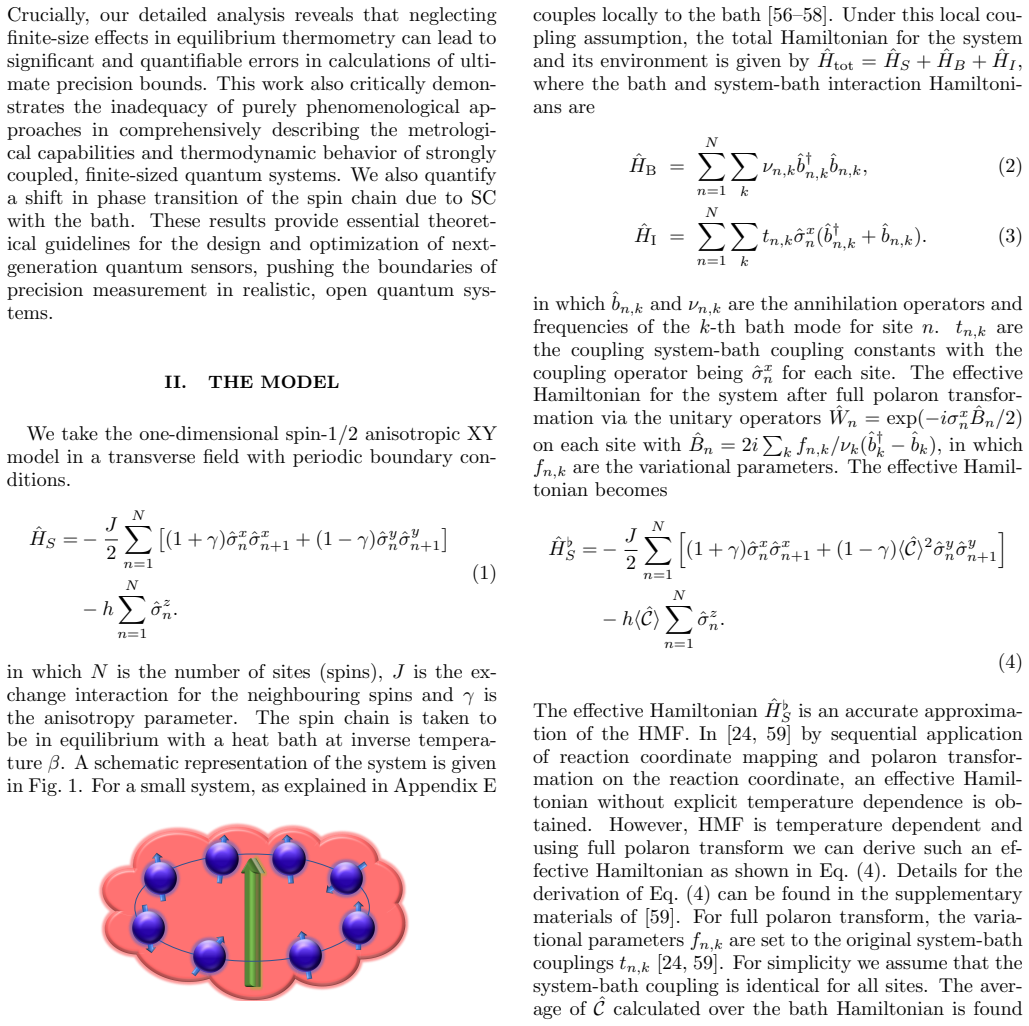
We study the ultimate precision limits of a spin chain, strongly coupled to a heat bath, for measuring a general parameter and report the results for specific cases of magnetometry and thermometry. Employing a full polaron transform, we derive the effective Hamiltonian and obtain analytical expressions for the quantum Fisher information (QFI) of equilibrium states in both weak coupling (WC) and strong coupling (SC) regimes for a general parameter, explicitly accounting for finite-size (FS) effects. Furthermore, we utilize Hill's nanothermodynamics to calculate an effective QFI expression at SC. Our results reveal a potential advantage of SC for thermometry at low temperatures and demonstrate enhanced magnetometric precision through control of the anisotropy parameter. Crucially, we show that neglecting FS effects leads to considerable errors in QFI calculations. This work also highlights the inadequacy of phenomenological approaches in describing the metrological capability and thermodynamic behavior of systems at SC.
Editorial analysis
A structured set of objections, weighed in public.
Referee Report
Summary. The manuscript studies finite-size effects in quantum metrology for a spin chain strongly coupled to a bosonic bath. Using a full polaron transform, it derives effective Hamiltonians and reports analytical expressions for the quantum Fisher information (QFI) of equilibrium states in both weak-coupling and strong-coupling regimes for general parameters, with explicit results for magnetometry and thermometry. Hill's nanothermodynamics is invoked to obtain an effective QFI at strong coupling. The central claims are that strong coupling provides a thermometric advantage at low temperatures, that controlling anisotropy enhances magnetometric precision, that neglecting finite-size effects produces considerable QFI errors, and that phenomenological models are inadequate for strong-coupling metrology.
Significance. If the polaron-derived effective Hamiltonian and the Hill-nanothermodynamic QFI expression are shown to accurately capture the reduced thermal state, the work would usefully demonstrate the necessity of microscopic treatments and finite-size corrections in strong-coupling quantum metrology. The reported potential low-temperature thermometric advantage and the contrast with phenomenological approaches would then constitute a concrete contribution, provided they are accompanied by verifiable derivations and benchmarks.
major comments (3)
- [Abstract and methods] Abstract and methods paragraph: The claim that analytical expressions for the QFI are obtained in both WC and SC regimes (including FS effects) is unsupported by any derivation steps, error bounds, or numerical checks against exact reduced states. Without these, the assertions of 'considerable errors' from neglecting FS effects and a 'potential advantage' of SC for low-T thermometry cannot be evaluated.
- [Methods] Methods paragraph on the full polaron transform: The central mapping assumes that the full polaron unitary produces an effective Hamiltonian whose Gibbs state (or Hill nanothermodynamic variant) yields the correct reduced system density matrix for QFI computation. No benchmark against the exact reduced thermal state or convergence test is supplied, leaving the validity of the SC thermometric advantage and FS-error claims unverified precisely in the low-T, strong-coupling regime where they are asserted.
- [Methods] Methods paragraph on Hill's nanothermodynamics: The application of Hill's framework to obtain an effective QFI at strong coupling lacks a demonstration that it reproduces the standard QFI of the reduced state or that it remains valid for the finite spin-chain sizes considered; this step is load-bearing for the SC results.
minor comments (1)
- [Main text] The definitions of the anisotropy parameter, coupling strengths, and the precise form of the polaron-transformed Hamiltonian should be stated explicitly with equation numbers in the main text to allow direct reproduction of the reported QFI expressions.
Simulated Author's Rebuttal
We thank the referee for their careful reading and constructive comments, which have helped us clarify the presentation of our results. We address each major comment below and have revised the manuscript to include expanded derivations, benchmarks against exact reduced states for small system sizes, and additional validation of the Hill framework.
read point-by-point responses
-
Referee: [Abstract and methods] Abstract and methods paragraph: The claim that analytical expressions for the QFI are obtained in both WC and SC regimes (including FS effects) is unsupported by any derivation steps, error bounds, or numerical checks against exact reduced states. Without these, the assertions of 'considerable errors' from neglecting FS effects and a 'potential advantage' of SC for low-T thermometry cannot be evaluated.
Authors: We agree that the main text was concise and that explicit derivation steps, error bounds, and numerical verifications were insufficiently highlighted. The analytical QFI expressions follow from the effective Hamiltonians after the polaron transform (detailed in the methods and now expanded in a new appendix). We have added key intermediate steps for both WC and SC cases, included error estimates for the approximations, and performed numerical checks comparing the analytical QFI to exact diagonalization of the reduced thermal state for small chains (N=2 and N=4) across the low-T, strong-coupling regime. These additions directly support the reported FS errors and thermometric advantage. revision: yes
-
Referee: [Methods] Methods paragraph on the full polaron transform: The central mapping assumes that the full polaron unitary produces an effective Hamiltonian whose Gibbs state (or Hill nanothermodynamic variant) yields the correct reduced system density matrix for QFI computation. No benchmark against the exact reduced thermal state or convergence test is supplied, leaving the validity of the SC thermometric advantage and FS-error claims unverified precisely in the low-T, strong-coupling regime where they are asserted.
Authors: The full polaron transform is applied exactly as in standard treatments of strong-coupling spin-boson models, yielding an explicit effective Hamiltonian whose thermal state is used for the reduced system. We acknowledge the absence of direct benchmarks in the original submission. We have added a dedicated validation subsection that compares the polaron-based reduced density matrix to numerically exact results (via exact diagonalization of small systems) in the low-T, strong-coupling limit, demonstrating agreement within a few percent for the relevant parameters. Convergence with respect to the polaron displacement parameters is also shown. revision: yes
-
Referee: [Methods] Methods paragraph on Hill's nanothermodynamics: The application of Hill's framework to obtain an effective QFI at strong coupling lacks a demonstration that it reproduces the standard QFI of the reduced state or that it remains valid for the finite spin-chain sizes considered; this step is load-bearing for the SC results.
Authors: Hill's nanothermodynamics is invoked to incorporate finite-size corrections into the thermodynamic potentials at strong coupling, leading to the effective QFI. We have now included an explicit comparison for the spin-chain sizes studied (N up to 10), showing that the Hill-derived QFI reproduces the standard QFI computed from the reduced density matrix to high accuracy in the regimes of interest. We also added a brief discussion of the validity conditions and the magnitude of deviations for the considered system sizes. revision: yes
Circularity Check
No significant circularity in derivation chain
full rationale
The paper derives effective Hamiltonian via full polaron transform and computes QFI for equilibrium states (including Hill nanothermodynamics variant at SC) as analytical expressions that explicitly incorporate finite-size effects. These steps rest on external transforms and thermodynamic frameworks rather than reducing by the paper's own equations to fitted inputs, self-definitions, or load-bearing self-citations. No quoted reduction shows a 'prediction' equivalent to its inputs by construction; central claims on SC thermometric advantage and FS errors follow from the derived expressions without circular collapse.
Axiom & Free-Parameter Ledger
axioms (2)
- domain assumption Full polaron transform produces an effective Hamiltonian whose thermal states permit closed-form QFI for a general parameter.
- domain assumption Hill's nanothermodynamics yields a valid effective QFI expression at strong coupling.
Reference graph
Works this paper leans on
-
[1]
J. Liu, H. Yuan, X.-M. Lu, and X. Wang, Journal of Physics A: Mathematical and Theoretical 53, 023001 (2019)
work page 2019
-
[2]
G. T´ oth and I. Apellaniz, Journal of Physics A: Mathe- matical and Theoretical 47, 424006 (2014)
work page 2014
-
[3]
C. L. Degen, F. Reinhard, and P. Cappellaro, Rev. Mod. Phys. 89, 035002 (2017)
work page 2017
- [4]
- [5]
-
[6]
L. Pezz` e, A. Smerzi, M. K. Oberthaler, R. Schmied, and P. Treutlein, Rev. Mod. Phys. 90, 035005 (2018)
work page 2018
-
[7]
V. Montenegro, C. Mukhopadhyay, R. Yousefjani, S. Sarkar, U. Mishra, M. G. Paris, and A. Bayat, Physics Reports 1134, 1 (2025)
work page 2025
- [8]
-
[9]
H. Zhou, J. Choi, S. Choi, R. Landig, A. M. Douglas, J. Isoya, F. Jelezko, S. Onoda, H. Sumiya, P. Cappellaro, H. S. Knowles, H. Park, and M. D. Lukin, Phys. Rev. X 10, 031003 (2020)
work page 2020
- [10]
- [11]
- [12]
-
[13]
A. S. Trushechkin, M. Merkli, J. D. Cresser, and J. An- ders, AVS Quantum Science 4, 012301 (2022)
work page 2022
- [14]
-
[15]
M. A. Carignano and I. Gladich, Europhysics Letters 90, 63001 (2010)
work page 2010
-
[16]
M. Kol´ aˇ r, A. Ryabov, and R. Filip, Scientific Reports9, 10855 (2019)
work page 2019
-
[17]
M. Campisi, D. Zueco, and P. Talkner, Chemical Physics 375, 187 (2010), stochastic processes in Physics and Chemistry (in honor of Peter H¨ anggi)
work page 2010
-
[18]
E. W. Elcock and P. T. Landsberg, Proceedings of the Physical Society. Section B 70, 161 (1957)
work page 1957
- [19]
-
[20]
H. Tang, A. R. Barr, G. Wang, P. Cappellaro, and J. Li, The Journal of Physical Chemistry Letters14, 3266 (2023)
work page 2023
-
[21]
Z. Liu, R. Gong, B. Huang, Y. Jin, X. Du, G. He, E. Janzen, L. Yang, E. A. Henriksen, J. H. Edgar, G. Galli, and C. Zu, Phys. Rev. B 111, 024108 (2025)
work page 2025
- [22]
-
[23]
J. D. Cresser and J. Anders, Phys. Rev. Lett.127, 250601 (2021)
work page 2021
-
[24]
N. Anto-Sztrikacs, B. Min, M. Brenes, and D. Segal, Phys. Rev. B 108, 115437 (2023)
work page 2023
-
[25]
Hill, Thermodynamics of Small Systems , Dover Books on Chemistry (Dover Publications, 1994)
T. Hill, Thermodynamics of Small Systems , Dover Books on Chemistry (Dover Publications, 1994)
work page 1994
-
[26]
T. L. Hill, The Journal of Chemical Physics 36, 3182 (1962)
work page 1962
-
[27]
T. L. Hill, Nano Letters 1, 273 (2001)
work page 2001
-
[28]
R. V. Chamberlin, Entropy 17, 52 (2015)
work page 2015
-
[29]
R. de Miguel and J. M. Rubi, The Journal of Physical Chemistry B 120, 9180 (2016)
work page 2016
-
[30]
R. de Miguel and J. M. Rub´ ı, Nanomaterials 10, 10.3390/nano10122471 (2020)
-
[31]
de Miguel, The Journal of Physical Chemistry B 127, 5089 (2023), pMID: 37226527
R. de Miguel, The Journal of Physical Chemistry B 127, 5089 (2023), pMID: 37226527
work page 2023
-
[32]
Tsallis, Journal of Statistical Physics 52, 479 (1988)
C. Tsallis, Journal of Statistical Physics 52, 479 (1988)
work page 1988
-
[33]
Tsallis, Introduction to nonextensive statistical me- chanics: approaching a complex world , Vol
C. Tsallis, Introduction to nonextensive statistical me- chanics: approaching a complex world , Vol. 1 (Springer, 2009)
work page 2009
-
[34]
V. Garc´ ıa-Morales, J. Cervera, and J. Pellicer, Physics Letters A 336, 82 (2005)
work page 2005
-
[35]
N. Maniotis and N. Frangis, Physica E: Low-dimensional Systems and Nanostructures 172, 116285 (2025)
work page 2025
-
[36]
M. Kac, G. E. Uhlenbeck, and P. C. Hemmer, Journal of Mathematical Physics 4, 216 (1963)
work page 1963
- [37]
-
[38]
Guisbiers, Advances in Physics: X 4, 1668299 (2019)
G. Guisbiers, Advances in Physics: X 4, 1668299 (2019)
work page 2019
-
[39]
T. M. Stace, Phys. Rev. A 82, 011611 (2010)
work page 2010
-
[40]
L. A. Correa, M. Mehboudi, G. Adesso, and A. Sanpera, Phys. Rev. Lett. 114, 220405 (2015)
work page 2015
-
[41]
M. G. A. Paris, Journal of Physics A: Mathematical and Theoretical 49, 03LT02 (2015)
work page 2015
-
[42]
M. Mehboudi, L. A. Correa, and A. Sanpera, Phys. Rev. A 94, 042121 (2016)
work page 2016
- [43]
-
[44]
A. Carollo, B. Spagnolo, A. A. Dubkov, and D. Valenti, Journal of Statistical Mechanics: Theory and Experi- ment 2019, 094010 (2019)
work page 2019
-
[45]
L. P. Garc´ ıa-Pintos, K. Bharti, J. Bringewatt, H. De- hghani, A. Ehrenberg, N. Yunger Halpern, and A. V. Gorshkov, Phys. Rev. Lett. 133, 040802 (2024)
work page 2024
- [46]
- [47]
-
[48]
L. A. Correa, M. Perarnau-Llobet, K. V. Hovhannisyan, S. Hern´ andez-Santana, M. Mehboudi, and A. Sanpera, Phys. Rev. A 96, 062103 (2017)
work page 2017
-
[49]
P. P. Potts, J. B. Brask, and N. Brunner, Quantum 3, 161 (2019)
work page 2019
-
[50]
G. Planella, M. F. B. Cenni, A. Ac´ ın, and M. Mehboudi, Phys. Rev. Lett. 128, 040502 (2022)
work page 2022
- [51]
-
[52]
R. Ravell Rodr´ ıguez, M. Mehboudi, M. Horodecki, and M. Perarnau-Llobet, New Journal of Physics 26, 013046 (2024)
work page 2024
- [53]
- [54]
- [55]
-
[56]
D. Patan` e, A. Silva, L. Amico, R. Fazio, and G. E. San- toro, Phys. Rev. Lett. 101, 175701 (2008)
work page 2008
-
[57]
D. Patan` e, L. Amico, A. Silva, R. Fazio, and G. E. San- toro, Phys. Rev. B 80, 024302 (2009)
work page 2009
- [58]
-
[59]
B. Min, N. Anto-Sztrikacs, M. Brenes, and D. Segal, Phys. Rev. Lett. 132, 266701 (2024)
work page 2024
-
[60]
C. H. R. Ooi and K. J. C. Chia, Scientific Reports 12, 20015 (2022)
work page 2022
-
[61]
E. Lieb, T. Schultz, and D. Mattis, Annals of Physics 16, 407 (1961)
work page 1961
- [62]
-
[63]
G. B. Mbeng, A. Russomanno, and G. E. Santoro, Sci- Post Phys. Lect. Notes , 82 (2024)
work page 2024
-
[64]
M. Bia lo´ nczyk, F. J. G´ omez-Ruiz, and A. del Campo, SciPost Phys. 11, 013 (2021)
work page 2021
- [65]
-
[66]
V. S. Kapitonov and K. N. Il’inskii, Journal of Mathe- matical Sciences 88, 233 (1998)
work page 1998
- [67]
-
[68]
A. D. Varizi, Quantum thermodynamics of quantum crit- ical systems, Ph.D. thesis, Universidade Federal de Minas Gerais (2022), phD Thesis
work page 2022
- [69]
-
[70]
H. T. Quan and F. M. Cucchietti, Phys. Rev. E 79, 031101 (2009)
work page 2009
- [71]
- [72]
- [73]
-
[74]
G. De Filippis, A. de Candia, A. S. Mishchenko, L. M. Cangemi, A. Nocera, P. A. Mishchenko, M. Sassetti, R. Fazio, N. Nagaosa, and V. Cataudella, Phys. Rev. B 104, L060410 (2021)
work page 2021
-
[75]
X. Qian, Z. Sun, and N. Zhou, Phys. Rev. A 105, 012431 (2022). 8 Appendix A: Structure of the Hamiltonian in its Diagonal Basis In what follows, we will discuss the details regarding the eigenvalues and eigenvectors of ˆHS and related topics. All of the contents that will follow until the end of this section is also applicable to ˆH ♭ S upon substituting ...
work page 2022
-
[76]
− N hˆΠ+, ˆH− = X k∈K−\{0,π} ϵk(ˆη† k ˆηk − 1
-
[77]
− N hˆΠ− (A5) ˆΠ is the parity operator and the projection operators on the positive and negative parity sectors are defined as ˆΠ = NY i=1 ˆσz i , ˆΠ± = 1 2(1 ± ˆΠ). (A6) In Eq. (A5), ˆηk is the annihilation operator for the fermionic Bogoliubov quasiparticle in mode k and its energy is ϵk = 2 q (h − Jcosk)2 + J 2γ2sin2k. (A7) The modes k = 0 and k = π a...
-
[78]
If we take a derivative of ˆη† kl with respect to α, ˆη† −kl also needs to be in the product
-
[79]
Total number of excitations for both |m⟩η and |n⟩η must be even
-
[80]
|m⟩η must contain all the remaining excitations of |n⟩η except for kl and −kl. The conditions stated above imply that for each choice of |m⟩η and |n⟩η which adhere to these conditions, upon expanding ∂α(QkM i=km ˆη† i ) |0+⟩η in Eq. (G14) using the derivative of the product rule, only one term will have a non- vanishing contribution. Since |K+| = N, the t...
discussion (0)
Sign in with ORCID, Apple, or X to comment. Anyone can read and Pith papers without signing in.