REVIEW 2 major objections 5 minor 93 references
Two fluctuating interfaces with sticking interactions: Invariant measures and dynamics
T0 review · 2 major / 5 minor · reviewed 2026-08-15 · deepseek-v4-flash
Pith's one-line read This paper proves that when two fluctuating interfaces obey identical Edwards-Wilkinson or Kardar-Parisi-Zhang dynamics with sticking at contacts, the exact steady-state measure equals the equilibrium Poland-Scheraga measure of DNA…
desk verdict Exact steady state in the a=a' subspace is real and well supported; the 'always entangled for any s' phase claim drops a loop-initiation prefactor and is likely wrong near s=1. read the letter →
The pith
A machine-rendered reading of the paper's core claim, the machinery that carries it, and where it could break.
The reading
What carries the argument
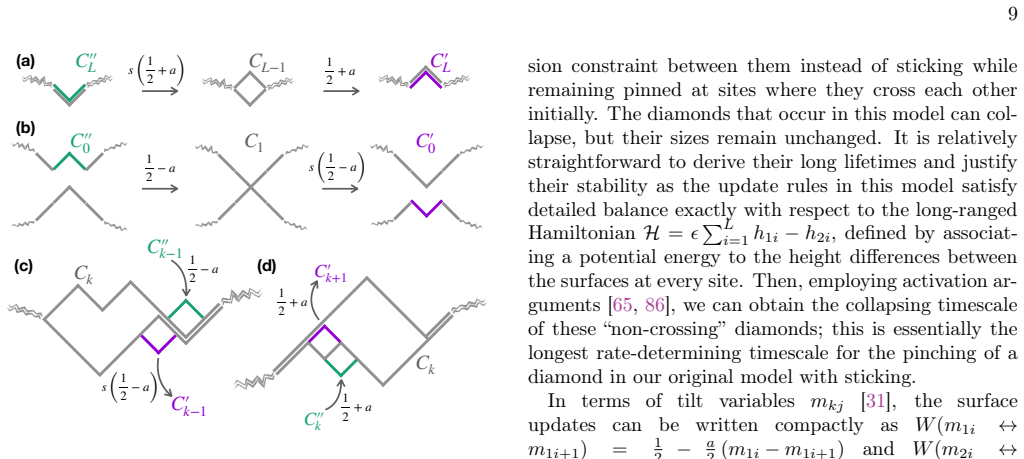
The carrying object is the mapping of each single-step surface to a sequence of tilts, equivalently particles and holes in an exclusion process, and then to a 'brackets' notation in which only the local hills and valleys of the two-surface configuration are kept; stuck bends are angular brackets and detached bends are round brackets. The proof of the steady state uses pairwise balance of probability fluxes: incoming and outgoing fluxes at every bend are paired so that the master equation splits into terms $A(w_{C''\to C}P(C'')-w_{C\to C'}P(C))$, and the product measure $P(C)=p_0\prod_i p_i$ with $p_i=1$ for a stuck site and $p_i=s$ for a detached site makes each paired flux difference vanish. The identification with the Poland-Scheraga model is carried by the exact configurational counting of bubbles, which gives a generating function whose large-length behavior is $B(l)\sim 4s^l/l^{3/2}$, with stuck-segment weight $v=2$. For the ultraslow dynamics, the machinery is an Arrhenius activation picture: diamonds have area $\sim O(L^2)$, and their collapse is treated as crossing a super-extensive energy barrier set by the Hamiltonian $H=\epsilon\sum_i|h_{1i}-h_{2i}|$ of an auxiliary non-crossing model that satisfies detailed balance.
What would settle it
Simulate the 2OKPZ model with $s=0$ for system sizes $L=64,128,256,512$ and measure the mean lifetime of the largest diamond from the initial configuration; if the lifetime grows as a power of $L$ rather than as $e^{\lambda L^2}$, the activation picture is wrong. For the exact steady-state claim, sample the full configuration measure at fixed $k$ for a small system such as $L=16$ and test whether $P(C_s^k)/p_0$ equals $s^{L-k}$ for every configuration with $k$ stuck sites, and whether the measured loop weight is $4s$.
Extended reading notes
Core claim
Within the (2EW + 2KPZ) subspace $a=a'\ge 0$, the paper proves by pairwise balance of probability fluxes that the exact invariant measure is $P(C_s^k)=p_0 s^{L-k}$: all configurations with the same number $k$ of stuck sites are equally likely, and each detached site costs a factor $s$ relative to a stuck site. This measure does not depend on the bias $a$, so the interacting two-surface problem inherits the well-known $a$-invariance of a single single-step surface. Written in terms of alternating bubbles and stuck segments, the measure factorizes into loop weights $B(l)\sim g^l/l^c$ with $g=4s$ and $c=3/2$ and stuck-segment weights $R(r)\sim v^r$ with $v=2$, which is precisely the Poland-Scheraga partition function for DNA denaturation in the regime $v>v_c(s)$. Consequently, for any $s$ in $(0,1)$ the thermodynamic-limit steady state of the identical-dynamics subspaces is entangled, with a finite fraction of stuck sites. The paper further argues that outside this subspace the dynamics is controlled by large bubbles inherited from the initial condition: they close diffusively (2EW), ballistically as facets (2KPZ), deform into long-lived diamonds whose lifetimes scale as $e^{\lambda L^2}$ (2OKPZ, $s=0$), or produce two competing evolutions—near-complete sticking or complete detachment—for an EW surface against a KPZ surface.
Load-bearing premise
The load-bearing premise for the ultra-slow timescale claim is that the diamond-closing time in the original sticking model is the same as in an auxiliary exclusion model with an area-energy Hamiltonian, so that closing is an Arrhenius activation over an $O(L^2)$ energy barrier; the paper asserts this equivalence heuristically rather than proving it.
Editorial extensions
If this is right
- For all $s$ in $(0,1)$, the exact steady state in the 2EW and 2KPZ subspaces has the same form regardless of the KPZ bias $a$; any observable such as the bubble-size distribution or the stuck fraction can be computed from the Poland-Scheraga partition function.
- In the thermodynamic limit the identical-dynamics steady state is always entangled for any $s>0$, so there is no detached phase on this locus; the fraction of stuck sites is set by the PS loop weight $g=4s$ and stuck weight $v=2$.
- For the 2OKPZ case with irreversible sticking ($s=0$), the largest initial bubbles become diamonds whose closing time grows as $e^{\lambda L^2}$, making the final stuck state unreachable on any practical timescale for large $L$.
- For an EW surface against a KPZ surface at small $s$, the same initial configuration can either end detached after a ballistic time $\sim L/s$ or end stuck after the EW surface diffuses onto the KPZ facet in time $\sim L^2$; the two outcomes occur with order-one fractions when $s$ scales as $L^{-0.75}$.
- In the 2EW case with $s=0$, the transient width collapse gives a dynamic exponent $z\simeq 1.5$, different from the single-surface EW value $z\simeq 2$, and the same exponent controls short-time transients when detachments are allowed.
Reading between the lines
- If the exact measure holds, the 2EW and 2KPZ models provide a dynamical way to generate equilibrium Poland-Scheraga statistics; one could measure critical exponents of DNA denaturation from a driven system rather than from a thermal ensemble.
- The pairwise-balance bracket construction is likely to extend to other height-difference interactions, such as asymmetric sticking or short-range repulsion, producing exact measures of the same product form with modified site weights; that would generalize the set of solvable nonequilibrium coupled-interface models.
- The claimed $e^{\lambda L^2}$ diamond lifetime implies pronounced aging and history dependence in the 2OKPZ system; autocorrelation functions should exhibit two-step relaxation, and the steady state should be unattainable even at times far beyond ordinary equilibration.
- The unexplained $z\simeq 1.5$ in the 2EW $s=0$ case might be a universal property of the closure of the largest excursion in a random landscape; testing the closure-time distribution of the largest bubble in a simpler model, such as a single interface against a fixed wall, would show whether this exponent is specific to two-surface sticking or generic.
Signed reviews
Editorial analysis
A structured set of objections, weighed in public.
Referee Report
Summary. The paper studies two single-step interfaces in 1+1 dimensions with short-range sticking at contact sites; the update probabilities are (1/2±a) per site, multiplied by a detachment probability s at sites where the surfaces cross. In the subspace a=a'≥0 (two EW or two KPZ surfaces) the authors derive an exact invariant measure P(C_s^k)=p0 s^{L-k} by pairwise balance and identify it with the equilibrium Poland–Scheraga measure, concluding that the steady state is always entangled. The remaining sections analyze transient dynamics: 2EW shows a numerical dynamic exponent z≈1.5, 2KPZ forms facets, 2OKPZ produces long-lived diamond bubbles with claimed lifetimes T∼exp(λL^2), and EWKPZ exhibits two competing evolutions with a detachment fraction boundary s*∼L^{-0.75}.
Significance. The exact steady-state derivation is a valuable and nontrivial result: an out-of-equilibrium two-surface model with sticking interactions is shown, by a pairwise-balance construction, to have an inhomogeneous product measure, and the numerical support in Fig. 2 (a-invariance of the width and bubble-size distributions) is convincing. The identification with the Poland–Scheraga measure is conceptually appealing and, once the phase-boundary calculation is corrected, should provide a useful bridge between non-equilibrium interface models and DNA-denaturation models. The dynamical observations (z≈1.5 in 2EW, facet formation in 2KPZ, diamond stability in 2OKPZ, and the two-mode EWKPZ evolution) are interesting and well presented, though some of the more dramatic claims, especially T∼exp(λL^2), are heuristic at present.
major comments (2)
- [Sec. I ('The steady state in the 2EW and 2KPZ cases'), Eq. (3) and following paragraph] The conclusion following Eq. (3) that v>v_c(s) for every s<1, and hence that the steady state is always entangled, drops the loop-initiation prefactor of the bubble weight. Using the authors' exact bubble count from the Supplemental Material, B(l)=C_{l-1} (Catalan numbers), the rescaled loop weight is w(l)=C_{l-1}/4^l, and its unit-fugacity generating function is A=Σ_{l≥2} C_{l-1}/4^l = 1/4, not ζ(3/2)≈2.61. Replacing ζ(3/2) by A in the critical condition used by the authors gives v_c = g/(1+A) = 4s/(1+1/4) = 16s/5; with v=2 the bound phase therefore requires s<5/8≈0.625 (using only the asymptotic prefactor q=1/(4√π) gives s_c≈0.68). Thus for s near 1 the predicted steady state is denatured rather than entangled. The paper's own Supplemental Fig. S4(d) is consistent with this: at s=0.9 the bubble-size distribution is already close to the noninteracting l^{-3/2} law. Please recompute the Poland–Scheraga phase boundary with the exact loop generating function and revise the abstract, the bullet list, and the phase-diagram claims accordingly.
- [End Matter, 'Ultraslow timescales in the 2OKPZ case when no detachments are allowed (s=0)'] The claimed diamond lifetime T∼exp(λL^2) is presented as a property of the original sticking model, but the derivation is made for an auxiliary non-crossing exclusion model with Hamiltonian H=εΣ_i |h1_i−h2_i|. The statement that the longest closing timescale of a diamond in the original model equals that of the auxiliary model is asserted, not derived, and the activation picture over an O(L^2) area barrier is heuristic. Because the exp(λL^2) scaling is a headline claim in the abstract and in the fourth bullet point, please provide direct numerical measurements of diamond closing times as a function of L in the original model, or explicitly label the scaling as a conjecture.
minor comments (5)
- [Supplemental Material, Fig. S2(b) and accompanying text] The text states that the detachment probability s(L) follows a power law ∼ L^η with η≈0.75, but the plotted fit is s*∼L^{-0.75}; the exponent in the text should carry a minus sign.
- [End Matter, Hamiltonian H for the non-crossing model] The text defines H=εΣ_i |h1_i−h2_i| but then uses signed height differences in the energy-change formulas; please clarify whether the potential is the absolute value or a signed sum, since the claimed area barrier depends on this distinction.
- [References, [91]] The numerical dynamic exponent z≈1.5 in the 2EW case and the analysis of the closing of the largest bubbles are attributed to an unpublished work; please provide a publicly available preprint or include the numerical data and fitting procedure in the Supplemental Material.
- [End Matter, 'Pairing scheme for the Fluxes in the 2EW and 2KPZ steady state'] The pairwise-balance proof leading to Eq. (1) is compressed into Fig. 7 and a short paragraph; since this is the central exact result, a complete enumeration of the flux-pairing cases in an appendix or in the Supplemental Material would strengthen the paper.
- [Fig. 2 caption] The caption mixes the description of width-versus-time plots and bubble-size distributions in a single parenthetical phrase, making it difficult to tell which panels correspond to which observable; please separate the panel descriptions.
Circularity Check
No significant circularity: the invariant measure is derived from the update rules by explicit pairwise balance, and the Poland-Scheraga comparison is an external benchmark.
full rationale
The paper's central derivation is self-contained. Eq. (2), P(C_s^k)=p0 s^{L-k}, is obtained by pairing incoming and outgoing probability fluxes and imposing pairwise balance, with the pairing scheme spelled out in the End Matter (Figs. 6-7); no parameter entering the measure is fitted to the target conclusion. The subsequent identification with the Poland-Scheraga measure uses independently computed inputs: the bubble loop exponent c=3/2 from exact enumeration of bubble configurations in the Supplemental Material, g=4s, and v=2 from the random-walk count of stuck segments. The PS critical condition v_c = g/(1+ζ(c)) is an external standard result, not an input of this paper. Self-citations ([72] for brackets notation, [80-82] for the pairwise-balance method, [91] for the z≈1.5 explanation) are not load-bearing in the sense of forcing the result: the brackets construction is re-derived in the End Matter, and pairwise balance is an established technique that the paper verifies locally. The manuscript itself flags open points: the origin of z≈1.5 (main text: 'remains to be understood'), the full entangled-detached separatrix ('remains to be evaluated'), and the ultra-slow 2OKPZ timescale, which is asserted heuristically via an auxiliary non-crossing model in the End Matter rather than derived. These are limitations or correctness risks, not circularity. Likewise, Eq. (3) drops the non-unit amplitude of the exact bubble weight when invoking the standard PS threshold; this is an approximation concern in the external benchmark, not a circular reduction, because Eq. (2) itself is not used to define the phase boundary.
Assumptions & free parameters
free parameters (3)
- bias a
- bias a'
- detachment probability s
assumptions (3)
- standard math Single-step surfaces with periodic boundary conditions map to biased exclusion processes (SEP/ASEP).
- standard math The configurational weight of a bubble of length l is B(l) ~ (4s)^l / l^{3/2}, and of a stuck segment R(r) ~ 2^r, based on random-walk combinatorics.
- ad hoc to paper The longest closing timescale of a diamond in the original sticking model equals that of the non-crossing exclusion variant with Hamiltonian H=εΣ|h1_i-h2_i|.
Cite this review
Pith. "Pith review of Two fluctuating interfaces with sticking interactions: Invariant measures and dynamics." pith.science (2026). https://pith.science/paper/VKMLGLOR
@misc{pith2026250720350,
  author       = {Pith},
  title        = {Pith review of: Two fluctuating interfaces with sticking interactions: Invariant measures and dynamics},
  year         = {2026},
  howpublished = {\url{https://pith.science/paper/VKMLGLOR}},
  note         = {Machine review of arXiv:2507.20350}
}
read the original abstract
We introduce and study a non-equilibrium stochastic model of two fluctuating interfaces which interact through short-range attractive interactions at their points of contact. Beginning from an entangled state, the system exhibits diverse dynamics -- ranging from fast transients with small lifetimes to ultraslow evolution through quasi-stationary states -- and reaches stuck, entangled, or detached steady states. Near the stuck-detached transition, two distinct dynamical modes of evolution co-occur. When the two surfaces evolve through similar dynamics (both Edwards-Wilkinson or both Kardar-Parisi-Zhang), the invariant measure is determined and found to have an inhomogeneous product form. This exact steady state is shown to be the measure of the equilibrium Poland-Scheraga model of DNA denaturation.
Figures


Figures from the paper (2 more)

Reference graph
Works this paper leans on
-
[1]
M. E. Fisher, J. Stat. Phys34, 667 (1984)
1984
-
[2]
Rajasekaran and S
J. Rajasekaran and S. M. Bhattacharjee, J. Phys. A: Math. Gen. 24, L371 (1991)
1991
-
[3]
Igloi, Europhys
F. Igloi, Europhys. Lett.16, 171 (1991)
1991
-
[4]
R. R. Netz and R. Lipowsky, Phys. Rev. E 47, 3039 (1993)
1993
-
[5]
S. M. Bhattacharjee and A. Baumgärtner, J. Chem. Phys. 107, 7571 (1997)
1997
-
[6]
J. M. Yeomans, Directed-walk models of polymers and wetting, in Nonequilibrium Statistical Mechanics in One Dimension, edited by V. Privman (Cambridge University Press, 1997) p. 329–334
1997
-
[7]
Giacomin,Random Polymer Models (Imperial College Press, 2007)
G. Giacomin,Random Polymer Models (Imperial College Press, 2007)
2007
-
[8]
Poland and H
D. Poland and H. A. Scheraga, J. Chem. Phys.45, 1464 (1966)
1966
Show all 93 references
-
[9]
M. E. Fisher, J. Chem. Phys.45, 1469 (1966)
1966
-
[10]
Kafri, D
Y. Kafri, D. Mukamel, and L. Peliti, Phys. Rev. Lett.85, 4988 (2000)
2000
-
[11]
M. S. Causo, B. Coluzzi, and P. Grassberger, Phys. Rev. E 62, 3958 (2000)
2000
-
[12]
Kafri, D
Y. Kafri, D. Mukamel, and L. Peliti, Eur. Phys. J. B27, 135 (2002)
2002
-
[13]
D. K. Lubensky and D. R. Nelson, Phys. Rev. Lett.85, 1572 (2000)
2000
-
[14]
Marenduzzo, A
D. Marenduzzo, A. Trovato, and A. Maritan, Phys. Rev. E 64, 031901 (2001)
2001
-
[15]
Marenduzzo, S
D. Marenduzzo, S. M. Bhattacharjee, A. Maritan, E. Or- landini, and F. Seno, Phys. Rev. Lett.88, 028102 (2001)
2001
-
[16]
Carlon, E
E. Carlon, E. Orlandini, and A. L. Stella, Phys. Rev. Lett. 88, 198101 (2002)
2002
-
[17]
Richard and A
C. Richard and A. J. Guttmann, J. Stat. Phys.115, 925 (2004)
2004
-
[18]
Kafri and A
Y. Kafri and A. Polkovnikov, Phys. Rev. Lett.97, 208104 (2006)
2006
-
[19]
A. Bar, Y. Kafri, and D. Mukamel, Phys. Rev. Lett.98, 6 0 0.2 0.4 0.6 0.8 1 1 10 100 1000 10000 100000 stickfrac time (a) (b) (c) (d) (e) (f) stickfrac time L=1024 a'=0 EWKPZ stickfrac time a'=+0.02 stickfrac time a'=-0.02 diamonds 2OKPZs=0a/a'=±0.2 L=128 0.000010 0.000100 0.0...
2007
-
[20]
A. Bar, Y. Kafri, and D. Mukamel, J. Phys.: Condens. Matter 21, 034110 (2008)
2008
-
[21]
Hanke, M
A. Hanke, M. G. Ochoa, and R. Metzler, Phys. Rev. Lett. 100, 018106 (2008)
2008
-
[22]
Metzler, T
R. Metzler, T. Ambjörnsson, A. Hanke, and H. C. Fogedby, J. Phys. Condens. Matter21, 034111 (2008)
2008
-
[23]
Blatter, M
G. Blatter, M. V. Feigel’man, V. B. Geshkenbein, A. I. Larkin, and V. M. Vinokur, Rev. Mod. Phys.66, 1125 (1994)
1994
-
[24]
L.-H. Tang, J. Stat. Phys77, 581 (1994)
1994
-
[25]
Halpin-Healy and Y.-C
T. Halpin-Healy and Y.-C. Zhang, Phys. Rep.254, 215 (1995)
1995
-
[26]
A. S. Balankin, R. G. Paredes, O. Susarrey, D. Morales, and F. C. Vacio, Phys. Rev. Lett.96, 056101 (2006)
2006
-
[27]
P. J. Metaxas, R. L. Stamps, J.-P. Jamet, J. Ferré, V. Baltz, B. Rodmacq, and P. Politi, Phys. Rev. Lett. 104, 237206 (2010)
2010
-
[28]
Politi, P
P. Politi, P. J. Metaxas, J.-P. Jamet, R. L. Stamps, and J. Ferré, Phys. Rev. B84, 054431 (2011)
2011
-
[29]
Lipowsky, Nature349, 475 (1991)
R. Lipowsky, Nature349, 475 (1991)
1991
-
[30]
Lipowsky, Phys
R. Lipowsky, Phys. Rev. Lett.77, 1652 (1996)
1996
-
[31]
Supplemental Material with discussion on single step sur- faces, bubbles in the initial state and their configura- tional weights, co-occurrence of the two evolutions in the EWKPZ case, facilitated detachment by diamonds and half-diamonds, non-monotonic saturation width in 2EW...
-
[32]
Krug and L.-H
J. Krug and L.-H. Tang, Phys. Rev. E50, 104 (1994)
1994
-
[33]
Krug, Adv
J. Krug, Adv. Phys.46, 139 (1997)
1997
-
[34]
Spitzer, Adv
F. Spitzer, Adv. Math.5, 246 (1970)
1970
-
[35]
Derrida, Phys
B. Derrida, Phys. Rep.301, 65 (1998)
1998
-
[36]
Derrida, J
B. Derrida, J. Stat. Mech.: Theory Exp. 2007 (07), P07023
2007
-
[37]
R. A. Blythe and M. R. Evans, J. Phys. A: Math. Theor. 40, R333 (2007)
2007
-
[38]
Schadschneider, D
A. Schadschneider, D. Chowdhury, and K. Nishi- nari, Stochastic Transport in Complex Systems: From Molecules to Vehicles (Elsevier, 2010)
2010
-
[39]
Mallick, Physica A418, 17 (2015)
K. Mallick, Physica A418, 17 (2015)
2015
-
[40]
Odijk, Macromolecules16, 1340 (1983)
T. Odijk, Macromolecules16, 1340 (1983)
1983
-
[41]
Reisner, K
W. Reisner, K. J. Morton, R. Riehn, Y. M. Wang, Z. Yu, M. Rosen, J. C. Sturm, S. Y. Chou, E. Frey, and R. H. Austin, Phys. Rev. Lett.94, 196101 (2005)
2005
-
[42]
Yadav, W
I. Yadav, W. Rosencrans, R. Basak, J. A. van Kan, and J. R. C. van der Maarel, Phys. Rev. Res.2, 013294 (2020)
2020
-
[43]
Yadav, R
I. Yadav, R. Basak, J. A. van Kan, and J. R. van der Maarel, Europhys. Lett.148, 17002 (2024)
2024
-
[44]
Balducci, C.-C
A. Balducci, C.-C. Hsieh, and P. S. Doyle, Phys. Rev. Lett. 99, 238102 (2007)
2007
-
[45]
Tang and P
J. Tang and P. S. Doyle, Appl. Phys. Lett.90 (2007)
2007
-
[46]
A. G. Balducci, J. Tang, and P. S. Doyle, Macromolecules 41, 9914 (2008)
2008
-
[47]
J. J. Jones, J. R. C. van der Maarel, and P. S. Doyle, Phys. Rev. Lett.110, 068101 (2013)
2013
-
[48]
Maier and J
B. Maier and J. O. Rädler, Phys. Rev. Lett.82, 1911 (1999)
1999
-
[49]
Barabási, Phys
A.-L. Barabási, Phys. Rev. A46, R2977 (1992)
1992
-
[50]
Barabási, Phys
A.-L. Barabási, Phys. Rev. Lett.70, 4102 (1993)
1993
-
[51]
Ertaş and M
D. Ertaş and M. Kardar, Phys. Rev. Lett.69, 929 (1992)
1992
-
[52]
Ertaş and M
D. Ertaş and M. Kardar, Phys. Rev. E48, 1228 (1993)
1993
-
[53]
S. N. Majumdar and D. Das, Phys. Rev. E71, 036129 (2005)
2005
-
[54]
Juntunen, O
J. Juntunen, O. Pulkkinen, and J. Merikoski, Phys. Rev. E 76, 041607 (2007)
2007
-
[55]
P. L. Ferrari, T. Sasamoto, and H. Spohn, J. Stat. Phys. 153, 377 (2013)
2013
-
[56]
C. B. Mendl and H. Spohn, Phys. Rev. Lett.111, 230601 (2013)
2013
-
[57]
Spohn, J
H. Spohn, J. Stat. Phys.154, 1191 (2014)
2014
-
[58]
Spohn and G
H. Spohn and G. Stoltz, J. Stat. Phys.160, 861 (2015)
2015
-
[59]
G. M. Schütz and B. Wehefritz-Kaufmann, Phys. Rev. E 96, 032119 (2017)
2017
-
[60]
Bernardin, T
C. Bernardin, T. Funaki, and S. Sethuraman, Ann. Appl. Probab. 31, 1966 (2021)
2021
-
[61]
De Nardis, S
J. De Nardis, S. Gopalakrishnan, and R. Vasseur, Phys. 7 Rev. Lett. 131, 197102 (2023)
2023
-
[62]
D. Roy, A. Dhar, K. Khanin, M. Kulkarni, and H. Spohn, J. Stat. Mech.: Theory Exp.2024 (3), 033209
2024
-
[63]
D. Roy, A. Dhar, M. Kulkarni, and H. Spohn, arXiv:2504.04162 (2025)
2025 arXiv
-
[64]
Lahiri and S
R. Lahiri and S. Ramaswamy, Phys. Rev. Lett.79, 1150 (1997)
1997
-
[65]
Lahiri, M
R. Lahiri, M. Barma, and S. Ramaswamy, Phys. Rev. E 61, 1648 (2000)
2000
-
[66]
P. F. Arndt, T. Heinzel, and V. Rittenberg, J. Phys. A: Math. Gen. 31, L45 (1998)
1998
-
[67]
Rajewsky, T
N. Rajewsky, T. Sasamoto, and E. Speer, Physica A279, 123 (2000)
2000
-
[68]
Popkov, J
V. Popkov, J. Schmidt, and G. Schütz, Phys. Rev. Lett. 112, 200602 (2014)
2014
-
[69]
Popkov, A
V. Popkov, A. Schadschneider, J. Schmidt, and G. M. Schütz, Proc. Natl. Acad. Sci. U.S.A.112, 12645 (2015)
2015
-
[70]
Chakraborty, S
S. Chakraborty, S. Chatterjee,and M. Barma, Phys. Rev. E 96, 022127 (2017)
2017
-
[71]
Chakraborty, S
S. Chakraborty, S. Chatterjee,and M. Barma, Phys. Rev. E 96, 022128 (2017)
2017
-
[72]
Mahapatra, K
S. Mahapatra, K. Ramola, and M. Barma, Phys. Rev. Res. 2, 043279 (2020)
2020
-
[73]
Z. Chen, J. de Gier, I. Hiki, and T. Sasamoto, Phys. Rev. Lett. 120, 240601 (2018)
2018
-
[74]
Z. Chen, J. de Gier, I. Hiki, T. Sasamoto, and M. Usui, Commun. Math. Phys395, 59 (2022)
2022
-
[75]
Schmidt, G
J. Schmidt, G. M. Schütz, and H. van Beijeren, J. Stat. Phys. 183, 8 (2021)
2021
-
[76]
Dolai, A
P. Dolai, A. Simha, and A. Basu, Phys. Rev. E 109, 064122 (2024)
2024
-
[77]
Cannizzaro, P
G. Cannizzaro, P. Gonçalves, R. Misturini, and A. Oc- celli, Probab. Theory Relat. Fields191, 361 (2025)
2025
-
[78]
P. L. Ferrari and S. Gernholt, arXiv:2504.00765 (2025)
2025 arXiv
- [79]
-
[80]
G. M. Schütz, R. Ramaswamy, and M. Barma, J. Phys. A: Math. Gen.29, 837 (1996)
1996
-
[81]
Tripathy and M
G. Tripathy and M. Barma, Phys. Rev. Lett.78, 3039 (1997)
1997
-
[82]
Tripathy and M
G. Tripathy and M. Barma, Phys. Rev. E 58, 1911 (1998)
1998
-
[83]
Hinrichsen, R
H. Hinrichsen, R. Livi, D. Mukamel, and A. Politi, Phys. Rev. Lett. 79, 2710 (1997)
1997
-
[84]
Hinrichsen, R
H. Hinrichsen, R. Livi, D. Mukamel, and A. Politi, Phys. Rev. E 61, R1032 (2000)
2000
-
[85]
S. N. Majumdar,Real-space Condensation in Stochastic Mass Transport Models (Oxford University Press, 2010) p. 407
2010
-
[86]
M. R. Evans, Y. Kafri, H. M. Koduvely, and D. Mukamel, Phys. Rev. E58, 2764 (1998)
1998
-
[87]
Rajewsky, L
N. Rajewsky, L. Santen, A. Schadschneider, and M. Schreckenberg, J. Stat. Phys.92, 151 (1998)
1998
-
[88]
Feller, An introduction to probability theory and its applications, Volume 1 , Vol
W. Feller, An introduction to probability theory and its applications, Volume 1 , Vol. 81 (John Wiley & Sons, 1991)
1991
-
[89]
Hinrichsen, Adv
H. Hinrichsen, Adv. Phys.49, 815 (2000)
2000
-
[90]
Ódor, Rev
G. Ódor, Rev. Mod. Phys.76, 663 (2004)
2004
-
[91]
brackets
S. Mahapatra, M. Bandyopadhyay, and M. Barma, Un- published. 8 End Matter Same random configuration at t=0 with different orientations of surface biases EWKPZ 2OKPZ macroscopic diamonds macroscopic half-diamonds KPZ surface EW surface outward bias inward bias outward bias inwar...
-
[92]
non-crossing
(c) A stuck hill at the edge of a bubble in an arbitrary configurationCs k withk stuck sites. (d) An unstuck valley inside a bubble of an arbitrary configuration Cs k. In the four scenarios the pairs of incoming and outgoing fluxes are (a)( 1 2 +a)(sP (C ′′ L )−P (CL−1)), (b) ...
-
[93]
datafile.dat
The change in the height difference is0, 0, +2, and−2, respectively. Within every bubble configuration, the two surfaces have different tilts at the edge sites. For a bubble of size l = n + 2, where +2 accounts for the bubble’s edge sites, its exact number of configurations is...
Reviewed August 15, 2026 · model on record in the stance chip above.
Discussion (0). Continue with ORCID to comment.