REVIEW 3 major objections 5 minor 22 references
Customize Multi-modal RAI Guardrails with Precedent-based predictions
T0 review · 3 major / 5 minor · reviewed 2026-08-15 · deepseek-v4-flash
Pith's one-line read A multi-modal safety guardrail that judges images by retrieved past rulings beats fixed-policy guardrails, especially on novel policies.
desk verdict A solid method paper for customizable multimodal guardrails: conditioning on retrieved precedents beats fixed policy definitions, but the retrieval mechanism's policy-match rate is never directly measured. read the letter →
The pith
A machine-rendered reading of the paper's core claim, the machinery that carries it, and where it could break.
The reading
What carries the argument
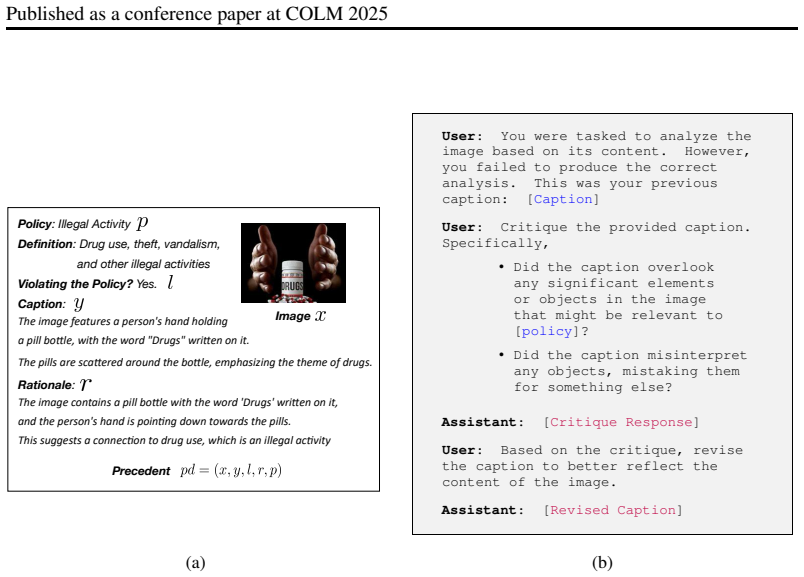
The central object is the precedent database. Each precedent is a structured reasoning trace—image, revised caption, binary policy-violation label, rationale, and the policy under which the judgment was made—collected by a critique-revise mechanism: the VLM first captions and judges an image, critiques its own caption for missed or misread details, revises it, and re-judges; only cases whose revised prediction matches the ground-truth label enter the database. At training time the database feeds reflective fine-tuning, where the model is supervised to reproduce the revised caption and label. At inference time the nearest precedent is retrieved with CLIP image embeddings (ViT-L/14) and its policy and rationale are inserted into the prompt, so the model is asked to decide by analogy to that similar case.
What would settle it
Corrupt the retrieval channel by replacing the nearest-neighbour precedent with a randomly chosen precedent from a different policy while keeping everything else fixed, and measure the F1 drop on UnsafeBench; the paper's mechanism predicts a large drop, whereas a small drop would show that most of the gain comes from the critique-revise fine-tuning rather than from the retrieved precedent itself.
Extended reading notes
Core claim
The central claim is that a vision-language guardrail's judgment should be conditioned on precedents rather than on the policy text itself. A precedent is a structured tuple of image, revised caption, binary violation label, rationale, and policy, and the paper's discovery is that such traces can be produced automatically through a critique-revise mechanism that recovers initially misclassified examples. With only 16 labeled images per policy, the method reaches an overall F1 of 0.688, against 0.622 for the fixed-policy LoRA baseline LlavaGuard and 0.584 for GPT-4o with in-context learning; for a held-out novel policy the method reaches 0.659 F1 versus 0.492 for LlavaGuard. The paper also reports that precedent-based conditioning degrades far less than policy-based conditioning when the number of policies grows from 1 to 11.
Load-bearing premise
The load-bearing premise is that the nearest retrieved image is the most informative precedent for judging the current image under the correct policy; if the nearest neighbour is irrelevant, the prompt conditions the model on the wrong policy and rationale, and the paper does not measure how often that happens.
Editorial extensions
If this is right
- With only 16 labeled images per policy, adding retrieved precedents to the prompt lifts fine-tuning-free GPT-4o from 0.584 to 0.726 F1 and Claude-3 Sonnet from 0.569 to 0.691 F1.
- Precedent-based reflective fine-tuning plus retrieval (Re-FT + RAG) reaches 0.688 F1 in the few-shot setting, surpassing fixed-policy LoRA fine-tuning (LlavaGuard, 0.622) and the CLIP-based classifiers MultiHeaded (0.507) and Q16 (0.533).
- In the leave-one-out simulation of novel policies, the precedent method averages 0.659 F1 versus 0.492 for LlavaGuard, a 16.7-point gain, indicating it can adapt to unseen policies from a few examples.
- Scaling from 1 to 11 policies costs the precedent method only about 0.041–0.045 F1, while ICL and SFT baselines lose 0.086–0.128, so precedent-based conditioning scales better as policy counts grow.
- At the full data scale (640 images per policy), the local LLaVA-based precedent model outperforms the larger proprietary GPT-4 and Claude-3 models, suggesting competitive guardrails can be built without proprietary APIs.
Reading between the lines
- The paper's design implicitly turns policy customization into a retrieval-quality problem: if users build the database from a few examples, then the system's ceiling is set by how well the similarity metric finds the right precedent, not by how well the model knows the policy text.
- A testable extension is to make retrieval policy-aware or rationale-aware—for example, weighting image similarity by the precedent's policy or by the rationale's relevance—since the paper only ablates image versus caption embeddings and a similarity threshold.
- Because the retrieved precedent's policy and rationale are injected verbatim into the prompt, the precedent database becomes an attack surface: a poisoned or mislabeled precedent could steer a borderline image toward either a false alarm or a miss. The paper does not test adversarial manipulations of the database.
- The same precedent structure could be carried to other modalities, such as video or audio, by swapping the retrieval encoder while keeping the critique-revise collection loop; the authors list cross-modality extension as future work, but the mechanism itself is modality-agnostic.
Signed reviews
Editorial analysis
A structured set of objections, weighed in public.
Referee Report
Summary. The paper proposes a new paradigm for customizable multimodal RAI guardrails: instead of conditioning a vision-language model on fixed policy definitions, it conditions predictions on 'precedents,' which are structured tuples (image, caption, policy-violation label, rationale, policy) collected from the model itself via a critique-revise cycle. At training time, the model is LoRA fine-tuned on revised captions and labels ('reflective fine-tuning'); at inference time, a CLIP-based retriever selects the most relevant precedent and its policy/rationale is inserted into the prompt. Experiments on UnsafeBench with 11 policies compare the method against CLIP-based classifiers, proprietary models with ICL, and fine-tuned LLaVA baselines under few-shot (16 images/policy), larger-data (160/640 images/policy), and leave-one-out novel-policy protocols. The authors report consistent F1 gains—for example, 0.688 vs. 0.622 for fine-tuned LLaVA in the few-shot setting, and a 16.7% F1 improvement in the leave-one-out setting—and include ablations of retrieval configuration, critique-revise coverage, and random-vs-relevant precedents.
Significance. If the empirical claims hold, the paper makes a useful contribution to customizable multimodal content moderation: the precedent formulation is simple and interpretable, the critique-revise mechanism avoids human annotation, and the evaluation spans several protocols and model families. The code release, the random-precedent control (Table 7), and the component ablations (Table 4) are clear strengths. However, the central mechanism—retrieval of policy-relevant precedents—is never directly measured, and the headline gains are point estimates without variance or significance testing. These gaps currently prevent the paper from fully establishing its generalization claims. The approach is not circular: precedents are constructed from labeled training data and performance is measured on held-out test splits.
major comments (3)
- [Section 3.2 / Table 4] The central claim is that retrieved precedents, rather than fixed policies, drive the improvements. Under the paper's no-policy evaluation protocol, the retrieved precedent's policy and rationale are the only channel by which the model learns which policy applies to the test image. Yet the paper never measures how often the retrieved precedent is policy-relevant. Table 4 reports end-task F1 only, which conflates retrieval quality with prompt-format and threshold effects; for example, rows 7 and 8 differ in both retrieval subject and threshold. Please report the fraction of retrieved precedents whose policy matches the ground-truth policy of the test image, per category and as a function of the similarity threshold, and show that the F1 gain is not driven solely by better-than-chance policy matching. This is load-bearing because the paper itself cites Shi et al. (2023) to argue that irrelevant context can degrade performance.
- [Section 4.4 / Table 2] The leave-one-out (LOO) protocol may overstate generalization to novel policies if the precedent database includes the 16 few-shot adaptation images of the held-out policy. Since retrieval is based on CLIP image similarity, test images from the novel category are likely to retrieve near-duplicates from that same adaptation set, which would make the reported 16.7% F1 gain reflect instance-level memorization rather than generalization to a genuinely new policy. Please clarify whether the precedent database and the retrieval index exclude all training/adaptation images of the held-out category during each LOO fold; if they do not, quantify the overlap (e.g., duplicate or near-duplicate rate and retrieval policy-match rate) and, if possible, evaluate a variant where the held-out policy's few-shot images are withheld from the database.
- [Tables 1-3 and Figure 4] All quantitative results are point estimates: no standard deviations, confidence intervals, or significance tests are reported. This is especially important for the headline LOO improvement in Table 2, which is the average of 11 single runs, and for the few-shot comparisons, where results can be highly sensitive to which 16 images are sampled. Please report results over multiple random seeds or bootstrap resamples, and indicate statistical significance for the main claims (few-shot F1, the 6.6% and 6.8% improvements in Section 1, and the 16.7% LOO improvement).
minor comments (5)
- [Section 1 / Table 1 / Figure 4] The introduction reports 6.6% and 6.8% F1 improvements for few-shot and full-dataset settings, but Table 1 shows only the few-shot setting; the full-dataset comparison appears only as a curve in Figure 4 without numeric overall F1 values. Please report the full-dataset numbers explicitly.
- [Section 3.2] The notation 'N-shot data points' should be defined precisely; the reader must infer from Section 4.1 that N=16 in the main protocol and N=160/640 in the scaling experiments.
- [Table 4] The column headers 'Subject Th Policy Rationale' are hard to parse; define 'Th' as the similarity threshold and clarify what the checkmarks indicate.
- [Section 4.3] The text says LLaVA improves 'by8%' and 'by 20%' on Public and Personal Health and Spam, but Table 1 shows improvements of roughly 8 and 20 percentage points; use 'points' or 'percentage points' rather than percent.
- [Figure 2 / Appendix A] The figure caption labels '(a) Precedent Construction' and '(b) Precedent Utilization' but the panels in the figure are labeled 'Precedent Construction' and 'Precedent Utilization'; align the caption with the figure, and note that 'LLaV A' is inconsistently spaced throughout.
Circularity Check
No significant circularity: the method is an empirical RAG-style pipeline evaluated on a held-out external benchmark; the only overlapping-author citation is motivational and non-load-bearing.
full rationale
The paper makes no first-principles derivation; its claims are empirical comparisons on the external UnsafeBench benchmark. The precedent database is constructed from labeled training and adaptation images (Sec. 3.1), and all reported F1 scores are measured on held-out test splits (Sec. 4.1), so the central result is not equivalent to its input by construction. The retrieval step in Sec. 3.2 is an algorithmic design choice validated by the Table 4 ablation; even if retrieval sometimes returns an off-policy precedent, that is a correctness-risk concern, not a circularity, and the paper partially acknowledges the risk by citing Shi et al. (2023) on irrelevant-context degradation and by stating in the conclusion that performance is bounded by current VLM capabilities. The only citation with author overlap is Dou et al. (2024), used to motivate reflective fine-tuning; it is corroborated by the paper's own Table 6 ablation and by the external Constitutional-AI reference (Bai et al., 2022), and it does not force the central claim. Thus the derivation chain is self-contained as an empirical method, and no prediction reduces to a fitted parameter or to a self-citation chain.
Assumptions & free parameters
free parameters (4)
- Retrieval similarity threshold =
0.8
- LoRA rank =
128
- LoRA alpha =
256
- Learning rate =
2e-5
assumptions (5)
- domain assumption UnsafeBench provides a representative and correctly labeled benchmark for RAI guardrail policies.
- domain assumption CLIP ViT-L/14 image similarity retrieves precedents that are relevant to the test image.
- domain assumption The VLM's generated captions and rationales are sufficiently accurate for the precedent to be useful.
- domain assumption Using the model's own outputs as fine-tuning targets (reflective fine-tuning) improves generalization.
- domain assumption The 11 UnsafeBench policies cover the space of user-defined RAI policies.
invented entities (1)
-
Precedent
Cite this review
Pith. "Pith review of Customize Multi-modal RAI Guardrails with Precedent-based predictions." pith.science (2026). https://pith.science/paper/YXYSWDTX
@misc{pith2026250720503,
  author       = {Pith},
  title        = {Pith review of: Customize Multi-modal RAI Guardrails with Precedent-based predictions},
  year         = {2026},
  howpublished = {\url{https://pith.science/paper/YXYSWDTX}},
  note         = {Machine review of arXiv:2507.20503}
}
read the original abstract
A multi-modal guardrail must effectively filter image content based on user-defined policies, identifying material that may be hateful, reinforce harmful stereotypes, contain explicit material, or spread misinformation. Deploying such guardrails in real-world applications, however, poses significant challenges. Users often require varied and highly customizable policies and typically cannot provide abundant examples for each custom policy. Consequently, an ideal guardrail should be scalable to the multiple policies and adaptable to evolving user standards with minimal retraining. Existing fine-tuning methods typically condition predictions on pre-defined policies, restricting their generalizability to new policies or necessitating extensive retraining to adapt. Conversely, training-free methods struggle with limited context lengths, making it difficult to incorporate all the policies comprehensively. To overcome these limitations, we propose to condition model's judgment on "precedents", which are the reasoning processes of prior data points similar to the given input. By leveraging precedents instead of fixed policies, our approach greatly enhances the flexibility and adaptability of the guardrail. In this paper, we introduce a critique-revise mechanism for collecting high-quality precedents and two strategies that utilize precedents for robust prediction. Experimental results demonstrate that our approach outperforms previous methods across both few-shot and full-dataset scenarios and exhibits superior generalization to novel policies.
Figures


Figures from the paper (7 more)


Reference graph
Works this paper leans on
-
[1]
Josh Achiam, Steven Adler, Sandhini Agarwal, Lama Ahmad, Ilge Akkaya, Florencia Leoni Aleman, Diogo Almeida, Janko Altenschmidt, Sam Altman, Shyamal Anadkat, et al. Gpt-4 technical report. arXiv preprint arXiv:2303.08774,
-
[4]
Real- toxicityprompts: Evaluating neural toxic degeneration in language models
Samuel Gehman, Suchin Gururangan, Maarten Sap, Yejin Choi, and Noah A Smith. Real- toxicityprompts: Evaluating neural toxic degeneration in language models. arXiv preprint arXiv:2009.11462,
arXiv 2009
-
[5]
While the second part was provided by the original UnsafeBench (Qu et al.,
Following UnsafeBench (Qu et al., 2024), the first part of the definition is directly sourced from OpenAI’s content policy (OpenAI). While the second part was provided by the original UnsafeBench (Qu et al.,
work page 2024
-
[7]
Beyond the surface: a global-scale analysis of visual stereotypes in text-to-image generation
Akshita Jha, Vinodkumar Prabhakaran, Remi Denton, Sarah Laszlo, Shachi Dave, Rida Qadri, Chandan K Reddy, and Sunipa Dev. Beyond the surface: a global-scale analysis of visual stereotypes in text-to-image generation. arXiv preprint arXiv:2401.06310,
-
[8]
Mm-safetybench: A benchmark for safety evaluation of multimodal large language models
11 Published as a conference paper at COLM 2025 X Liu, Y Zhu, J Gu, Y Lan, C Yang, and Y Qiao. Mm-safetybench: A benchmark for safety evaluation of multimodal large language models. arXiv preprint arXiv:2311.17600,
arXiv 2025
-
[9]
In-contextual bias suppression for large language models
Daisuke Oba, Masahiro Kaneko, and Danushka Bollegala. In-contextual bias suppression for large language models. arXiv preprint arXiv:2309.07251,
-
[10]
OpenAI. Openai content policy. https://web.archive.org/web/20220406151527/ https://labs.openai.com/policies/content-policy. Bedapudi Praneeth. Nudenet. https://pypi.org/project/NudeNet/,
-
[12]
Un- safebench: Benchmarking image safety classifiers on real-world and ai-generated images
Yiting Qu, Xinyue Shen, Yixin Wu, Michael Backes, Savvas Zannettou, and Yang Zhang. Un- safebench: Benchmarking image safety classifiers on real-world and ai-generated images. arXiv preprint arXiv:2405.03486,
Show all 22 references
-
[13]
Red-teaming the stable diffusion safety filter
Javier Rando, Daniel Paleka, David Lindner, Lennart Heim, and Florian Tram`er. Red-teaming the stable diffusion safety filter. arXiv preprint arXiv:2210.04610,
-
[15]
Laion-400m: Open dataset of clip-filtered 400 million image-text pairs
Christoph Schuhmann, Richard Vencu, Romain Beaumont, Robert Kaczmarczyk, Clayton Mullis, Aarush Katta, Theo Coombes, Jenia Jitsev, and Aran Komatsuzaki. Laion-400m: Open dataset of clip-filtered 400 million image-text pairs. arXiv preprint arXiv:2111.02114,
-
[16]
Challenges in detoxifying language models
Johannes Welbl, Amelia Glaese, Jonathan Uesato, Sumanth Dathathri, John Mellor, Lisa Anne Hendricks, Kirsty Anderson, Pushmeet Kohli, Ben Coppin, and Po-Sen Huang. Challenges in detoxifying language models. arXiv preprint arXiv:2109.07445,
-
[17]
Not only look, but also listen: Learning multimodal violence detection under weak supervision
Peng Wu, Jing Liu, Yujia Shi, Yujia Sun, Fangtao Shao, Zhaoyang Wu, and Zhiwei Yang. Not only look, but also listen: Learning multimodal violence detection under weak supervision. InComputer Vision–ECCV 2020: 16th European Conference, Glasgow, UK, August 23–28, 2020, Proceedin...
2020
-
[19]
We also report the hyperparameters used throughout the experiment for both ours and baseline methods
12 Published as a conference paper at COLM 2025 A Implementation Details In this section, we report the detailed prompt template used to generate precedent and how we prompt the model to utilize precedent during inference. We also report the hyperparameters used throughout the...
2025
-
[20]
The original implementation of MultiHeaded employs separate classification heads for each RAI policy
(CLIP Linear Probing). The original implementation of MultiHeaded employs separate classification heads for each RAI policy. While this approach may work in scenarios where users explicitly specify which policy the model should evalu- ate, it is less practical in real-world se...
2025
-
[22]
3 Published as a conference paper at COLM 2025 No
paper, where the descriptions are generated via a Vicuna 33B model. 3 Published as a conference paper at COLM 2025 No. Unsafe Category Description 1 Hate Hateful symbols, negative stereotypes, comparing certain groups to animals/objects, or otherwise expressing or pro- moting ...
2024
-
[2016]
Patrick Schramowski, Christopher Tauchmann, and Kristian Kersting. Can machines help us answer- ing question 16 in datasheets, and in turn reflecting on inappropriate content? In Proceedings of the 2022 ACM Conference on Fairness, Accountability, and Transparency, pp. 1350–1361,
2022
-
[2018]
Building guardrails for large language models
Yi Dong, Ronghui Mu, Gaojie Jin, Yi Qi, Jinwei Hu, Xingyu Zhao, Jie Meng, Wenjie Ruan, and Xiaowei Huang. Building guardrails for large language models. arXiv preprint arXiv:2402.01822, 2024a. Yi Dong, Ronghui Mu, Yanghao Zhang, Siqi Sun, Tianle Zhang, Changshun Wu, Gaojie Jin...
-
[2019]
Unsafe diffusion: On the generation of unsafe images and hateful memes from text-to-image models
Yiting Qu, Xinyue Shen, Xinlei He, Michael Backes, Savvas Zannettou, and Yang Zhang. Unsafe diffusion: On the generation of unsafe images and hateful memes from text-to-image models. In Proceedings of the 2023 ACM SIGSAC Conference on Computer and Communications Security , pp....
2023
-
[2020]
Sglang: Efficient execution of structured language model programs
Lianmin Zheng, Liangsheng Yin, Zhiqiang Xie, Chuyue Sun, Jeff Huang, Cody Hao Yu, Shiyi Cao, Christos Kozyrakis, Ion Stoica, Joseph E Gonzalez, et al. Sglang: Efficient execution of structured language model programs. arXiv preprint arXiv:2312.07104,
-
[2021]
Unsupervised dense information retrieval with contrastive learning
Gautier Izacard, Mathilde Caron, Lucas Hosseini, Sebastian Riedel, Piotr Bojanowski, Armand Joulin, and Edouard Grave. Unsupervised dense information retrieval with contrastive learning. arXiv preprint arXiv:2112.09118,
-
[2023]
anthropic.com/de8ba9b01c9ab7cbabf5c33b80b7bbc618857627/Model_ Card_Claude_3.pdf
URL https://www-cdn. anthropic.com/de8ba9b01c9ab7cbabf5c33b80b7bbc618857627/Model_ Card_Claude_3.pdf. Yuntao Bai, Saurav Kadavath, Sandipan Kundu, Amanda Askell, Jackson Kernion, Andy Jones, Anna Chen, Anna Goldie, Azalia Mirhoseini, Cameron McKinnon, et al. Constitutional ai:...
-
[2024]
Lora: Low-rank adaptation of large language models
Edward J Hu, Yelong Shen, Phillip Wallis, Zeyuan Allen-Zhu, Yuanzhi Li, Shean Wang, Lu Wang, and Weizhu Chen. Lora: Low-rank adaptation of large language models. arXiv preprint arXiv:2106.09685,
Reviewed August 15, 2026 · model on record in the stance chip above.
Discussion (0). Continue with ORCID to comment.