REVIEW 4 major objections 9 minor 1 cited by
A Multimodal Architecture for Endpoint Position Prediction in Team-based Multiplayer Games
T0 review · 4 major / 9 minor · reviewed 2026-08-06 · deepseek-v4-flash
Pith's one-line read A multimodal U-Net, conditioned on game state and cross-vehicle attention, predicts player endpoints in team-based multiplayer games with a relative final displacement error at three samples of 1.78, versus 1.66 for a context-free U-Net++…
desk verdict Competent engineering on a large game dataset, but the headline improvement is partly an artifact of an unfair baseline that cannot see the prediction horizon. read the letter →
The pith
A machine-rendered reading of the paper's core claim, the machinery that carries it, and where it could break.
The reading
What carries the argument
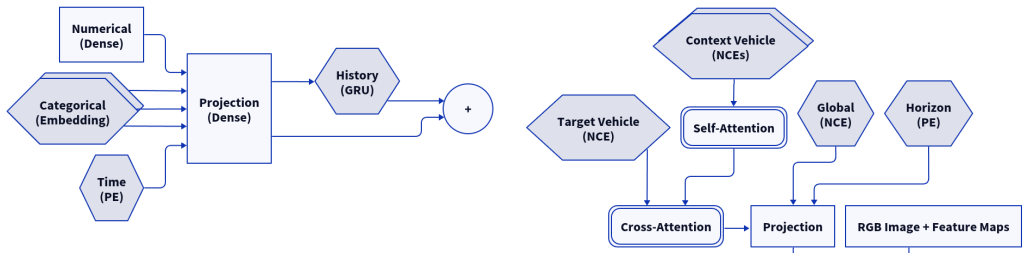
The load-bearing mechanism is the U-Net++ image encoder-decoder with an EfficientNet-B2 backbone, fused with a numerical-categorical encoder that turns global game state, the target vehicle, and each context vehicle into embeddings. A GRU over the vehicle's position, orientation, and health history is initialized with that embedding; a multi-head self-attention layer lets context vehicles exchange information, and a cross-attention layer with the target vehicle as query compresses the attended vehicles into one context vector. That vector, combined with a sinusoidal encoding of the prediction horizon, is injected into the U-Net decoder hidden layers via cross-attention, so the same image backbone can answer where a vehicle will be in 15, 30, ..., 90 seconds without predicting an intermediate trajectory. The training target is a stretched, rotated Gaussian ellipsoid encoding position and velocity, masked to inaccessible areas, which gives the model a smooth probability distribution to fit.
What would settle it
Compute the speed distribution over the held-out test vehicles used for the ablation table. If a nontrivial fraction of those test vehicles are stationary or near-stationary, the denominator in the relative FDE formula approaches zero and the reported 1.78 versus 1.66 gap can be inflated; reweighting the test set to match the training mix, or reporting raw FDE on a uniformly sampled test set, would settle whether the improvement persists.
Extended reading notes
Core claim
The central claim is that a U-Net-based image-to-image predictor, when conditioned on a multimodal encoding of global state, target vehicle, and all other vehicles, and when allowed to exchange information between vehicles through self- and cross-attention, produces noticeably more accurate endpoint position heatmaps than the same U-Net with no context. The authors demonstrate this through an ablation study in which each component adds a measurable gain: replay context raises relative FDE@3 from 1.66 to 1.70, target-vehicle context to 1.74, and full multi-vehicle attention to 1.78. They also establish that a KL-divergence loss suits this heatmap task better than BCE, MSE, or focal loss, and that rendering extra vehicle attributes as icons on the input map matches stacked Gaussian channels at lower parameter cost. The prediction is a normalized probability map, masked by obstacles, so the output is a full distribution of plausible endpoints rather than a single point.
Load-bearing premise
The result depends on evaluating on test vehicles drawn the same way as training vehicles, mostly moving at at least 6% of max speed with a 10% stationary slice, because the relative-FDE metric divides by the distance the vehicle actually travels.
Editorial extensions
If this is right
- KL-divergence is the recommended loss for this heatmap endpoint task; with it, clustering the predicted distribution with DBSCAN gives a large gain over the other losses evaluated.
- Each architectural addition — replay history, target context, and all-vehicle attention — independently improves endpoint accuracy, so the gains are additive rather than coming from a single component.
- Because prediction is conditioned on the prediction horizon, a single trained model serves every forecasting window from 15 to 90 seconds instead of requiring one model per horizon.
- The authors note that the final embedding vector encodes the whole game situation and can be reused for downstream heads such as anomaly detection, strategy classification, or multi-agent prediction with one embedding per vehicle.
Reading between the lines
- The reported relative FDE metric divides by the true distance traveled, so if the held-out evaluation set is not sampled with the same moving-vehicle and 10%-stationary mix as training, stationary test vehicles make the denominator near zero and can inflate the score; the 1.78 figure should be read as conditional on the sample.
- The architecture is trained and evaluated on the fully observable game state with every vehicle visible, which is stronger than the partial observability of real gameplay; a fair-state evaluation using last-known positions would likely lower the numbers, though the same machinery would still apply.
- The attention weights are presented as interpretable arrows between vehicles, which suggests a cheap testable extension: check whether the attended vehicles' positions and headings correlate with the target's eventual movement direction before the prediction window.
Editorial analysis
A structured set of objections, weighed in public.
Referee Report
Summary. The paper proposes a multimodal architecture for predicting the future position (endpoint) of a player vehicle in team-based multiplayer games, specifically World of Tanks. The method combines a U-Net++ image backbone with a multimodal feature encoder that processes global context, per-vehicle features, vehicle history, and a prediction horizon. The final embedding conditions the U-Net decoder via cross-attention. The authors report an ablation study on a large dataset (2.19 million battles) and claim that integrating spatial and temporal data, conditioning on prediction horizons, and using attention mechanisms noticeably improve location accuracy, as measured by relative Final Displacement Error (Rel. FDE).
Significance. If the claims hold, the paper offers a practical architecture for a domain (game analytics, bot AI) that is underrepresented in the trajectory-prediction literature, and it leverages a large industrial dataset. The ablation study is a useful contribution, and the idea of conditioning heatmap prediction on a variable horizon is sensible. However, the central comparison is weakened by an unfair baseline that does not receive the prediction horizon, and the reported improvements are small and lack uncertainty quantification. These issues must be addressed before the paper can be considered a reliable basis for the claimed 'noticeable improvement'.
major comments (4)
- [Section III-A6, III-A3, III-B1, Table III] The baseline 'U-Net++ without any context' in Table III is not given the prediction horizon, even though the task requires predicting the endpoint at a randomly sampled horizon h (Section III-A6). The input image (Section III-A2) contains only RGB terrain plus Gaussian ellipsoids for positions and velocities; it has no channel or embedding for h. Therefore this baseline must fit a mixture over all horizons. The full model receives h through the global context (Section III-A3) and the sinusoidal positional encoding (Section III-B1). The improvement from 1.66 to 1.70 when adding 'replay context' is thus partly or wholly due to providing the task parameter h, not to the architectural contributions claimed in the Conclusion. Please add a baseline that is conditioned on h in a simple way (e.g., an extra input channel or a FiLM layer), or ablate the horizon encoding in the full model, to isolate the effect of the proposed components.
- [Section IV, Tables I-IV] No confidence intervals, standard deviations, or significance tests are reported anywhere. The differences in Table III (1.66, 1.70, 1.74, 1.78) are small, and without error bars or a paired test the incremental gains could be noise. Even if statistically significant at this test size, the practical magnitude is unclear. Please report means and standard errors across multiple seeds or across maps/vehicle types, and state whether differences between configurations are statistically significant.
- [Section III-A6 and Section IV] The test sampling protocol is not specified. The training set is resampled to vehicles moving at least 6% of maximum speed, plus a 10% stationary-vehicle sample, but the paper does not state whether the test set is drawn in the same way. If the test set contains stationary vehicles, the relative FDE in Equation (13) can be undefined (0/0) for targets that remain at the current position and are correctly predicted, and any model that tends to predict near the current position would be penalized or rewarded in an unclear way. Please specify how test samples are selected and how stationary cases are handled in the metric (e.g., by excluding them, or by using a small epsilon in the denominator).
- [Section III and Section IV] The paper does not compare against any existing endpoint or trajectory prediction method, despite citing THOMAS [17], PECNet [11], Trajectron [10], and Social LSTM [14]. A comparison to a heatmap-based baseline such as THOMAS, adapted to the game domain, would substantiate the claim that the proposed architecture is superior to prior approaches. Without such a comparison, the contribution remains an internal ablation on a single architecture, which is too narrow to support the general conclusion in Section VI.
minor comments (9)
- [Section I (Introduction)] The phrase 'Sandro et. al.' in Section II (Related Work) is misattributed; reference [3] is by Hauri et al. Please correct the citation style.
- [Table III caption] The caption says 'SECTION 5' but the relevant section is Section III (Method) or Section IV (Evaluation). Please update the cross-reference to the correct section number.
- [Section III-A1, Eq. (1)] The statement that the kernel is 'normalized to 1.0 to get a probability distribution' is inconsistent with Eq. (1), which divides by the maximum of the product, so the peak value is 1 but the sum over pixels is not 1. Please clarify whether the target is intended as a probability distribution (sum to 1) or a scaled soft target, and adjust the text and equations accordingly.
- [Section III-A6] The values for the minimum speed threshold (6%) and the stationary-vehicle sampling probability (10%) are described as 'chosen based on internal requirements'; please provide a brief justification or a sensitivity analysis for these choices, or at least state whether they affect the main results.
- [Section IV, Eq. (13)] The description of the relative FDE metric says 'a value of 1.0 would imply baseline behavior, with a value of 2.0 being twice as good.' This is accurate only if the baseline error is compared in the ratio as written; consider rewording to 'a value of 2.0 means the prediction error is half the distance from the current position to the target' to avoid confusion.
- [Section III-C] The DBSCAN parameters (epsilon=3, min_samples=10) are given without units or reference to the image resolution; please specify the map resolution (pixels per meter) and whether these values are in pixels or meters.
- [Section III-B, Eq. (6)] The symbol h is used both for the encoded hidden state and for the prediction horizon elsewhere (e.g., Section III-A3). This overloaded notation is confusing; please use distinct symbols for these quantities.
- [Section III-D] The sentence 'It is trained for 20,000 steps for metric computations, and 100,000 steps for the final model used for visualization' should clarify that all numerical results in the tables are from the 20,000-step checkpoint, so the reader knows which model produces the reported metrics.
- [Section III-A] There is a typo in 'this approach is applicable to game which work with continuous gameplay' — 'game' should be 'games' and 'which' should be 'that'. Also, the sentence is missing a comma after 'battles'.
Circularity Check
No significant circularity: the central result is an empirical comparison on held-out battles, and no load-bearing step reduces to its own inputs by construction.
full rationale
The derivation chain is self-contained. The target representation (Section III-A1) is a Gaussian ellipsoid placed at the ground-truth future vehicle position, and the loss and evaluation use that same ground-truth future position independently of the model's fitted parameters. The reported improvements in Tables I-III are measured on a held-out test split (100,000 battles excluded from training, Section III-D), so the main result is not a fitted quantity renamed as a prediction. The prediction horizon is a randomly sampled conditioning input (Section III-A6) and is encoded into the model via sinusoidal positional embeddings; the fact that the U-Net++ baseline does not receive the horizon makes the comparison less clean, but that is a fairness/confounding concern, not a circular reduction. No load-bearing self-citation appears in the paper: the cited prior work (e.g., Rombach et al. for cross-attention conditioning, Vaswani et al. for attention, Zhou et al. for U-Net++) is external, standard, and does not itself encode the paper's target result. No uniqueness claim is imported from the authors' own prior work. Therefore no circular step can be exhibited with the required specific reduction, and the appropriate score is 0.
Assumptions & free parameters
free parameters (9)
- Gaussian kernel sigma (target and vehicle encoding) =
8
- Gaussian kernel size =
50
- Velocity stretching factor k =
2.0
- Minimum speed threshold for training resampling =
6% of max speed
- Probability of sampling a random (possibly stationary) vehicle =
10%
- DBSCAN epsilon =
3
- DBSCAN min_samples =
10
- Number of conditioned decoder layers n =
1
- Prediction horizon sampling range =
1 to 6 steps (15 to 90 seconds)
assumptions (4)
- domain assumption Pre-trained ImageNet weights on EfficientNet transfer to top-down game map images
- domain assumption The Gaussian ellipsoid target (Equation 1) is an appropriate supervisory signal for endpoint prediction
- domain assumption Relative FDE with 'current position' baseline is a meaningful metric for this task
- domain assumption The 2.19M-battle dataset is representative of player behavior and the held-out test split is sufficient
Cite this review
Pith. "Pith review of A Multimodal Architecture for Endpoint Position Prediction in Team-based Multiplayer Games." pith.science (2026). https://pith.science/paper/L7XKY4M7
@misc{pith2026250720670,
  author       = {Pith},
  title        = {Pith review of: A Multimodal Architecture for Endpoint Position Prediction in Team-based Multiplayer Games},
  year         = {2026},
  howpublished = {\url{https://pith.science/paper/L7XKY4M7}},
  note         = {Machine review of arXiv:2507.20670}
}
read the original abstract
Understanding and predicting player movement in multiplayer games is crucial for achieving use cases such as player-mimicking bot navigation, preemptive bot control, strategy recommendation, and real-time player behavior analytics. However, the complex environments allow for a high degree of navigational freedom, and the interactions and team-play between players require models that make effective use of the available heterogeneous input data. This paper presents a multimodal architecture for predicting future player locations on a dynamic time horizon, using a U-Net-based approach for calculating endpoint location probability heatmaps, conditioned using a multimodal feature encoder. The application of a multi-head attention mechanism for different groups of features allows for communication between agents. In doing so, the architecture makes efficient use of the multimodal game state including image inputs, numerical and categorical features, as well as dynamic game data. Consequently, the presented technique lays the foundation for various downstream tasks that rely on future player positions such as the creation of player-predictive bot behavior or player anomaly detection.
Figures


Figures from the paper (4 more)


Forward citations
Cited by 1 Pith paper
-
Multi-Task Learning for Heterogeneous Prediction from Video Game State with Transfer Learning
On a large World of Tanks dataset, a shared multi-task model with equal weighting or PCGrad outperforms single-task models on average, and task/map pre-training helps most in low-data regimes.
Reference graph
Works this paper leans on
-
[17]
THOMAS: trajectory heatmap output with learned multi-agent sampling,
T. Gilles, S. Sabatini, D. Tsishkou, B. Stanciulescu, and F. Moutarde, “THOMAS: trajectory heatmap output with learned multi-agent sampling,” 2022. [Online]. Available: https://arxiv.org/abs/2110.06607
arXiv 2022
-
[11]
It is not the journey but the destination: Endpoint conditioned trajectory prediction,
K. Mangalam, H. Girase, S. Agarwal, K.-H. Lee, E. Adeli, J. Malik, and A. Gaidon, “It is not the journey but the destination: Endpoint conditioned trajectory prediction,” 2020. [Online]. Available: https://arxiv.org/abs/2004.02025
arXiv 2020
-
[10]
The Trajectron: probabilistic multi- agent trajectory modeling with dynamic spatiotemporal graphs,
B. Ivanovic and M. Pavone, “The Trajectron: probabilistic multi- agent trajectory modeling with dynamic spatiotemporal graphs,” 2019. [Online]. Available: https://arxiv.org/abs/1810.05993
arXiv 2019
-
[14]
Social lstm: Human trajectory prediction in crowded spaces,
A. Alahi, K. Goel, V . Ramanathan, A. Robicquet, L. Fei-Fei, and S. Savarese, “Social lstm: Human trajectory prediction in crowded spaces,” in 2016 IEEE Conference on Computer Vision and Pattern Recognition (CVPR), 2016, pp. 961–971
work page 2016
-
[1]
Efficient and collision-free human–robot collaboration based on intention and trajectory prediction,
J. Lyu, P. Ruppel, N. Hendrich, S. Li, M. G ¨orner, and J. Zhang, “Efficient and collision-free human–robot collaboration based on intention and trajectory prediction,” IEEE Trans. Cogn. Dev. Syst. , vol. 15, no. 4, pp. 1853–1863, 2023
work page 2023
-
[2]
Vehicle trajectory prediction using LSTMs with spatial–temporal attention mechanisms,
L. Lin, W. Li, H. Bi, and L. Qin, “Vehicle trajectory prediction using LSTMs with spatial–temporal attention mechanisms,” IEEE Intelligent Transportation Systems Magazine, vol. 14, no. 2, pp. 197–208, 2022
work page 2022
-
[3]
Multi-modal trajectory prediction of NBA players,
S. Hauri, N. Djuric, V . Radosavljevic, and S. Vucetic, “Multi-modal trajectory prediction of NBA players,” in Proc. of the IEEE/CVF Winter Conference on Applications of Computer Vision (WACV), January 2021, pp. 1640–1649
work page 2021
-
[4]
Wargaming, “ World of Tanks ,” Game [PC], Nicosia, Cyprus, 8 2010, wargaming, Nicosia, Cyprus
work page 2010
Show all 32 references
-
[5]
From goals, waypoints & paths to long term human trajectory forecasting,
K. Mangalam, Y . An, H. Girase, and J. Malik, “From goals, waypoints & paths to long term human trajectory forecasting,” 2020. [Online]. Available: https://arxiv.org/abs/2012.01526
2020 arXiv
-
[6]
Safety-aware motion prediction with unseen vehicles for autonomous driving,
X. Ren, T. Yang, L. E. Li, A. Alahi, and Q. Chen, “Safety-aware motion prediction with unseen vehicles for autonomous driving,” 2021. [Online]. Available: https://arxiv.org/abs/2109.01510
2021 arXiv
-
[7]
Vehicle trajectory prediction on highways using bird eye view representations and deep learning,
R. Izquierdo, ´Alvaro Quintanar, D. F. Llorca, I. G. Daza, N. Hern ´andez, I. Parra, and M. ´Angel Sotelo, “Vehicle trajectory prediction on highways using bird eye view representations and deep learning,” 2022. [Online]. Available: https://arxiv.org/abs/2207.01407
2022 arXiv
-
[8]
U-Net: convolutional networks for biomedical image segmentation,
O. Ronneberger, P. Fischer, and T. Brox, “U-Net: convolutional networks for biomedical image segmentation,” 2015
2015
-
[9]
Mixture density networks,
C. M. Bishop, “Mixture density networks,” Aston University, Tech. Rep., 1994
1994
-
[12]
2D human pose estimation: A survey,
H. Chen, R. Feng, S. Wu, H. Xu, F. Zhou, and Z. Liu, “2D human pose estimation: A survey,” 2022. [Online]. Available: https://arxiv.org/abs/2204.07370
2022 arXiv
-
[13]
Deep learning-based human pose estimation: A survey,
C. Zheng, W. Wu, C. Chen, T. Yang, S. Zhu, J. Shen, N. Kehtarnavaz, and M. Shah, “Deep learning-based human pose estimation: A survey,”
-
[15]
STGAT: modeling spatial- temporal interactions for human trajectory prediction,
Y . Huang, H. Bi, Z. Li, T. Mao, and Z. Wang, “STGAT: modeling spatial- temporal interactions for human trajectory prediction,” inInt. Conference on Computer Vision , 2019, pp. 6271–6280
2019
-
[16]
Diverse generation for multi-agent sports games,
R. A. Yeh, A. G. Schwing, J. Huang, and K. Murphy, “Diverse generation for multi-agent sports games,” in 2019 IEEE/CVF Conference on Computer Vision and Pattern Recognition (CVPR) , 2019, pp. 4605– 4614
2019
-
[18]
Batch normalization: Accelerating deep network training by reducing internal covariate shift,
S. Ioffe and C. Szegedy, “Batch normalization: Accelerating deep network training by reducing internal covariate shift,” 2015. [Online]. Available: https://arxiv.org/abs/1502.03167
2015 arXiv
-
[19]
High-resolution image synthesis with latent diffusion models,
R. Rombach, A. Blattmann, D. Lorenz, P. Esser, and B. Ommer, “High-resolution image synthesis with latent diffusion models,” 2022. [Online]. Available: https://arxiv.org/abs/2112.10752
2022 arXiv
-
[20]
Attention is all you need,
A. Vaswani, N. Shazeer, N. Parmar, J. Uszkoreit, L. Jones, A. N. Gomez, L. Kaiser, and I. Polosukhin, “Attention is all you need,” 2023. [Online]. Available: https://arxiv.org/abs/1706.03762
2023 arXiv
-
[21]
Learning phrase representations using RNN encoder-decoder for statistical machine translation,
K. Cho, B. van Merrienboer, C. Gulcehre, D. Bahdanau, F. Bougares, H. Schwenk, and Y . Bengio, “Learning phrase representations using RNN encoder-decoder for statistical machine translation,” 2014
2014
-
[22]
Conditional RNN for Keras,
P. Remy, “Conditional RNN for Keras,” https://github.com/philipperemy/ cond rnn, 2020
2020
-
[23]
On layer normalization in the transformer architecture,
R. Xiong, Y . Yang, D. He, K. Zheng, S. Zheng, C. Xing, H. Zhang, Y . Lan, L. Wang, and T.-Y . Liu, “On layer normalization in the transformer architecture,” 2020. [Online]. Available: https: //arxiv.org/abs/2002.04745
2020 arXiv
-
[24]
UNet++: a nested u-net architecture for medical image segmentation,
Z. Zhou, M. M. R. Siddiquee, N. Tajbakhsh, and J. Liang, “UNet++: a nested u-net architecture for medical image segmentation,” 2018. [Online]. Available: https://arxiv.org/abs/1807.10165
2018 arXiv
-
[25]
EfficientNet: rethinking model scaling for convolutional neural networks,
M. Tan and Q. V . Le, “EfficientNet: rethinking model scaling for convolutional neural networks,” 2020. [Online]. Available: https: //arxiv.org/abs/1905.11946
2020 arXiv
-
[26]
ImageNet large scale visual recognition challenge,
O. Russakovsky, J. Deng, H. Su, J. Krause, S. Satheesh, S. Ma, Z. Huang, A. Karpathy, A. Khosla, M. Bernstein, A. C. Berg, and L. Fei- Fei, “ImageNet large scale visual recognition challenge,” International Journal of Computer Vision (IJCV) , vol. 115, no. 3, pp. 211–252, 2015
2015
-
[27]
Segmentation models pytorch,
P. Iakubovskii, “Segmentation models pytorch,” https://github.com/ qubvel/segmentation models.pytorch, 2019
2019
-
[28]
A density-based al- gorithm for discovering clusters in large spatial databases with noise,
M. Ester, H.-P. Kriegel, J. Sander, and X. Xu, “A density-based al- gorithm for discovering clusters in large spatial databases with noise,” in Proceedings of the Second International Conference on Knowledge Discovery and Data Mining , 1996, pp. 226–231
1996
-
[29]
Why ADE and FDE are not the best metrics to score motion prediction,
G. Kumichev, “Why ADE and FDE are not the best metrics to score motion prediction,” https://towardsdatascience.com/why-ade-and- fde-might-not-be-the-best-metrics-to-score-motion-prediction-model- performance-and-what-1980366d37be, accessed: 05.07.2023
2023
-
[30]
SegFormer: simple and efficient design for semantic segmentation with transformers,
E. Xie, W. Wang, Z. Yu, A. Anandkumar, J. M. Alvarez, and P. Luo, “SegFormer: simple and efficient design for semantic segmentation with transformers,” 2021. [Online]. Available: https: //arxiv.org/abs/2105.15203
2021 arXiv
-
[31]
TacticAI: an AI assistant for football tactics,
Z. Wang, P. Veli ˇckovi´c, D. Hennes, N. Toma ˇsev, L. Prince, M. Kaisers, Y . Bachrach, R. Elie, L. Wenliang, F. Piccinini, W. Spearman, I. Gra- ham, J. Connor, Y . Yang, A. Recasens, M. Khan, N. Beauguerlange, P. Sprechmann, P. Moreno, and K. Tuyls, “TacticAI: an AI assistan...
2024
-
[2023]
Available: https://arxiv.org/abs/2012.13392
[Online]. Available: https://arxiv.org/abs/2012.13392
2012 arXiv
Reviewed August 6, 2026 · model on record in the stance chip above.
Discussion (0). Sign in to comment.