REVIEW 5 major objections 7 minor 2 cited by
Evaluating Deepfake Detectors in the Wild
T0 review · 5 major / 7 minor · reviewed 2026-08-06 · deepseek-v4-flash
Pith's one-line read Open-source deepfake detectors that score near-perfectly on standard benchmarks largely fail to distinguish real faces from SimSwap and Inswapper swaps on a new 500,000-image evaluation built to mimic real-world conditions.
desk verdict A genuinely useful 500k-image deepfake benchmark, but the robustness experiments apply transformations only to the fake class, which muddies the 'in the wild' conclusion. read the letter →
The pith
A machine-rendered reading of the paper's core claim, the machinery that carries it, and where it could break.
The reading
What carries the argument
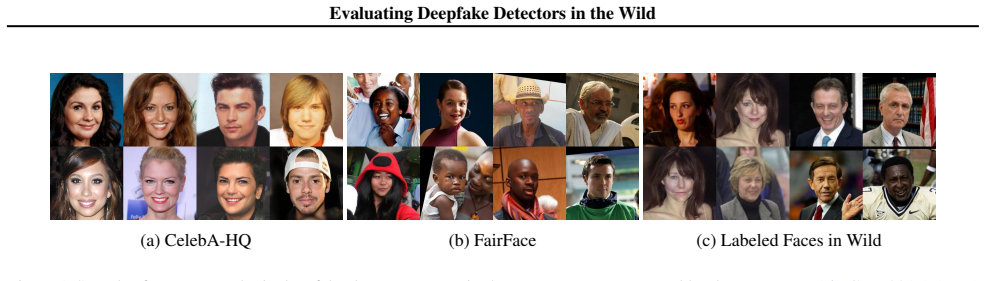
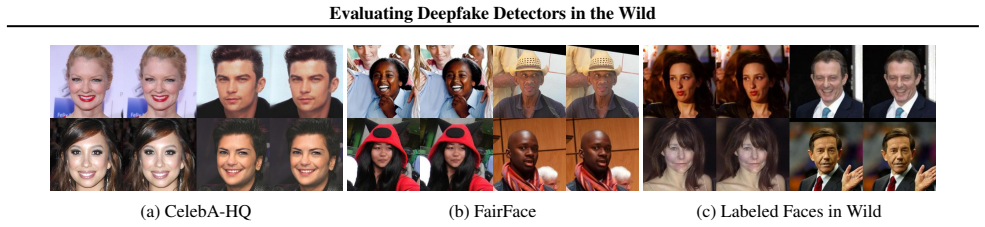
The load-bearing mechanism is the evaluation pipeline rather than a single theorem or model. It combines two zero-shot face-swap generators, SimSwap at 224 or 512 pixels and Inswapper at 128 pixels, with three real-face datasets, CelebA-HQ, LFW, and FairFace, to produce synthetic fake images under the default face cropping and alignment an attacker would use, then feeds them to each detector through its official preprocessing. Three attacker-style augmentations, JPEG compression at five quality levels, downscaling to 128 pixels, and GPEN restoration, perturb those images, and ROC-AUC is used as the primary score because it is threshold-independent and comparable across detectors with different output scales. The pipeline's job is to expose whether a detector is separating real from fake for the right reasons, such as generic forgery artifacts, or relying on dataset- and generator-specific cues that do not survive simple image transformations.
What would settle it
A concrete check would be to rerun the released pipeline with a different, equally standard face alignment or detector preprocessing: if a detector's AUC jumps from near 50% to above 90% under that change, the reported failures are an artifact of the test setup rather than of deepfake detection. Alternatively, collecting real face-swap images from public apps and showing that detectors score above 90% AUC on them would directly contradict the paper's generalization claim.
Extended reading notes
Core claim
The paper claims that modern open-source deepfake detectors do not generalize to current zero-shot face-swap attacks, despite near-perfect performance on the benchmarks they were trained or tuned on. The authors construct a test set of more than 500,000 images by swapping faces with SimSwap and Inswapper, using default cropping and alignment, across CelebA-HQ, LFW, and FairFace. Six detectors are run through their official code and weights: FaceForensics++, MAT, M2TR, RECCE, CADDM, and SBI. On the unmodified swaps, fewer than half of the tested detectors reach an ROC-AUC above 60%, and the weakest sits at 50%, no better than chance; SBI is the clear leader at 95.5% AUC on SimSwap and 75.9% on Inswapper. The paper further shows that basic manipulations used in real attacks degrade performance unevenly: downscaling to 128 pixels craters SBI into the 30s, JPEG compression moves some models up and others down, and GPEN enhancement pushes several models below 50% AUC, meaning they label deepfakes as real. The authors conclude that detecting deepfakes remains challenging and that published benchmark results mask the gap.
Load-bearing premise
The evaluation assumes that the way the authors generated the test images, using SimSwap and Inswapper with their default face cropping and alignment on three public face datasets, then running each detector's official preprocessing, matches what real-world deepfake attacks look like to a deployed detector.
Editorial extensions
If this is right
- Published AUC figures on older benchmarks such as DFDC, FaceForensics++, and Celeb-DF should not be treated as deployment-ready performance for current zero-shot face-swap tools.
- A single, visually undetectable JPEG re-compression at quality around 75, or a downscale to 128 pixels, can move an otherwise strong detector toward chance, which matters for identity verification and moderation pipelines.
- No tested detector maintains high ROC-AUC across original, compressed, downscaled, and enhanced inputs; the strongest overall model, SBI, collapses specifically under downscaling.
- Evaluation protocols for deepfake detectors should include attacker-style augmentations and out-of-distribution face datasets instead of relying on clean benchmark splits.
- Models that learn generic artifacts, such as blending boundaries, color mismatch, and frequency inconsistency, generalize better than models that memorize training-domain cues, as the paper argues SBI demonstrates.
Reading between the lines
- Because the failures appear at JPEG quality levels a social network or messaging app would apply by default, deployed detectors may be substantially weaker than their benchmark cards suggest; this is an inference about deployment, not a claim the paper directly tests.
- The same protocol could be extended to video and audio deepfakes, or to diffusion-based face swappers, to see whether the generalization gap widens with newer generators.
- A detector trained on the released dataset would presumably score high on this benchmark, so the result is evidence about zero-shot generalization of existing detectors, not about the impossibility of detection.
- The different failure signatures of SimSwap, with 512-pixel blending, and Inswapper, with 128-pixel upsampling, suggest detectors may latch onto generator-specific artifacts; varying generator versions and resolutions in the benchmark would test that directly.
Editorial analysis
A structured set of objections, weighed in public.
Referee Report
Summary. The paper evaluates six open-source deepfake detectors (FaceForensics++, MAT, M2TR, RECCE, CADDM, and SBI) against a new synthetic benchmark built by swapping faces with SimSwap and Inswapper using CelebA-HQ, LFW, and FairFace as source datasets. It reports ROC-AUC, PR-AUC, logloss, F1, and accuracy, and it probes robustness by applying JPEG compression, downscaling, and GPEN enhancement to the deepfake images. The authors conclude that modern detectors are brittle on out-of-distribution face swaps and that common image manipulations substantially reduce performance; they release the code and a dataset of over 500,000 deepfake images.
Significance. If the technical issues are resolved, this is a potentially valuable empirical contribution: it provides a large released benchmark, runs six detectors from official code, and adds evidence that published AUC figures on standard deepfake benchmarks may overstate out-of-domain robustness. The dataset and code release are concrete strengths, and the core qualitative finding that zero-shot face-swap detectors do not all generalize to new generators is plausible and worth reporting. However, the paper's headline statistic is imprecise, no uncertainty quantification is reported, and the robustness experiments use a one-sided manipulation protocol, so the quantitative conclusions are not yet reliably supported.
major comments (5)
- [§4.3–§4.4, Table 2] The quality manipulations are applied only to the synthetic (fake) images, while the real comparison images are not compressed, downscaled, or enhanced. The paper describes the protocol as 'subjecting each image in the synthetic datasets to JPEG compression' (§4.3) and 'downscaled our synthetic dataset images' (§4.4), and Table 2 is therefore a comparison between manipulated fakes and untouched real images. The reported AUC changes conflate detector failure with a one-sided distribution shift: the fake class acquires compression, resolution, or enhancement artifacts that the real class lacks, and a detector can change its AUC simply by exploiting that new covariate difference. The paper's own observation that FF and MAT score all compressed images as fakes is consistent with this artifact. Because real-world deployments such as KYC, social-media uploads, and liveness checks also expose legitimate images to compression and resizing, the matched-quality condition is the relevant one. Please report matched-quality controls in which the same transformations are applied to both classes, or explicitly reframe the experiments as an attacker-only evasion model and justify that threat model.
- [Abstract and Table 1] The headline sentence 'in fewer than half of the deepfake detectors tested achieved an AUC score greater than 60%, with the lowest being 50%' is ambiguous and numerically inaccurate. Taking the overall rows in Table 1 as the unit, exactly three of the six detectors exceed 60% AUC for SimSwap (MAT, CADDM, SBI), i.e., half, not fewer than half; the statement is only true for Inswapper (two of six) or for detector–generator combinations in aggregate. Moreover, Table 1 contains values well below 50%—for example FF/LFW/Inswapper at 49.2, MAT/CelebA-HQ/SimSwap at 49.0, and RECCE/CelebA-HQ/SimSwap at 46.9—so 'the lowest being 50%' is false. Define the unit of analysis (detector, detector×dataset, or detector×generator) explicitly and correct the statement to match Table 1.
- [§4.2, Table 1] No sample sizes or confidence intervals are reported for any cell. The paper draws categorical conclusions from small AUC differences around the 60% boundary—for example CADDM/Inswapper/FairFace at 56.6 and M2TR/Inswapper/LFW at 53.9—but without per-cell N and uncertainty it is impossible to determine whether these differences are meaningful or whether a given value is statistically distinguishable from 50%. Please report the number of real and fake images per cell and provide confidence intervals or standard errors (e.g., via bootstrapping), especially for values near chance.
- [§3.2 and §4] The generalization claim rests on two preprocessing assumptions that are asserted but not verified in the manuscript: that the default SimSwap/Inswapper face-cropping and alignment settings match realistic attacks, and that all six detectors' official preprocessing pipelines are correctly reproduced on the new images. The statement that official repositories, weights, and fixed library versions were used is helpful, but the paper does not show the preprocessed inputs to each detector, give the exact commits used, or discuss how representative this zero-shot still-image protocol is of the 'wild' scenarios named in the title and abstract. Please document the preprocessing per detector, show sample preprocessed inputs, and discuss the scope and limitations of the protocol as a model of real-world attacks.
- [§4.2, Table 1] The sentence 'from all selected models only MAT, SBI, and CADDM models are showing high enough quality in detecting deepfakes from SimSwap and Inswapper on all three datasets' is not supported by Table 1. MAT scores 49.0/49.8 on CelebA-HQ for SimSwap/Inswapper, and CADDM scores 56.6 on FairFace for Inswapper, which are not high-quality results. Please correct or substantially soften this claim, since it directly informs the paper's takeaway about which detectors are usable.
minor comments (7)
- [§3.1] The paper says FairFace's attributes can be used 'to assess how each detector performs on a separate ethnic, age, and gender subset,' but no demographic-stratified results appear in §4. Either add that analysis, which would substantially strengthen the fairness claim, or explicitly state that it is left to future work.
- [§2.2 and Figure 2] GPEN is attributed to (Yin et al., 2023) in the text and figure caption, but the reference list identifies Yin et al. (2023) as DAGP-Face Restorer, while the actual GPEN paper is Yang et al. (2021), which is also cited. The attribution should be corrected.
- [§5, final paragraph] The text says 'no single model consistently maintains high performance metrics such as ROC-AUC, across all variations' and then immediately says 'One notable exception to this is the SBI model.' This is self-contradictory; decide whether SBI is an exception and rephrase accordingly.
- [Abstract and §1] The sentence beginning 'in fewer than half of the deepfake detectors tested achieved' is grammatically incomplete, and in §1 'the second, method is to take two photos' contains an awkward comma. Both should be cleaned up.
- [§3.3.1 and Figure 5] The values 95, 75, 50, 30, and 10 are JPEG quality levels, not 'coefficients'; please use consistent terminology.
- [§4.4] The phrase 'the ability of the detectors to discriminate between original and downscaled deepfakes' is imprecise: the actual comparison is between manipulated fake images and untouched real images. State the comparison explicitly.
- [Throughout] There are repeated typos and inconsistencies, including 'FaceForentics' instead of 'FaceForensics', 'CelebaHQ' instead of 'CelebA-HQ', and 'it's collection' instead of 'its collection'. A careful proofreading pass is needed.
Circularity Check
No significant circularity: the paper is an external benchmark with no fitted parameters and no load-bearing self-citation chain.
full rationale
The paper's central claim is an empirical evaluation: six open-source deepfake detectors were run, using their official code and weights, on a newly generated set of SimSwap and Inswapper face swaps drawn from CelebA-HQ, LFW, and FairFace, and their ROC-AUC scores were reported. No parameter is fitted to the test data, no detector is trained or fine-tuned on the synthetic dataset, and no 'prediction' is derived from a model whose inputs already contain the output. The reported AUC values are computed from held-out real and fake images with standard classification metrics, so the conclusion that 'detecting deepfakes still remains a challenging task' is a direct measurement rather than a tautology. The robustness experiments in Sections 4.3 and 4.4 apply JPEG compression, downscaling, and GPEN enhancement only to the fake images while leaving real images untouched; this is a legitimate concern about whether the attack model matches real-world conditions, and it could bias the reported AUC comparisons, but it is a soundness or protocol-validity issue rather than circular reasoning. The paper does not invoke a uniqueness theorem, does not rely on self-citations by the present authors as load-bearing evidence, and does not rename a known result as a new derivation. The authors' affiliations and the public GitHub repository do not create circularity because the benchmark results are externally checkable against the released code and data. Accordingly, no specific circular step can be quoted and exhibited, and the appropriate finding is no significant circularity.
Assumptions & free parameters
assumptions (3)
- domain assumption The two generators (SimSwap and Inswapper) and the three face datasets (CelebA-HQ, LFW, FairFace) are representative of real-world deepfake attacks and identities.
- domain assumption JPEG compression, downscaling to 128px, and GPEN enhancement are the key real-world image manipulations fraudsters apply.
- domain assumption Official detector implementations with their disclosed weights and preprocessing are deployed correctly in the evaluation pipeline.
Cite this review
Pith. "Pith review of Evaluating Deepfake Detectors in the Wild." pith.science (2026). https://pith.science/paper/6DARLJDH
@misc{pith2026250721905,
  author       = {Pith},
  title        = {Pith review of: Evaluating Deepfake Detectors in the Wild},
  year         = {2026},
  howpublished = {\url{https://pith.science/paper/6DARLJDH}},
  note         = {Machine review of arXiv:2507.21905}
}
read the original abstract
Deepfakes powered by advanced machine learning models present a significant and evolving threat to identity verification and the authenticity of digital media. Although numerous detectors have been developed to address this problem, their effectiveness has yet to be tested when applied to real-world data. In this work we evaluate modern deepfake detectors, introducing a novel testing procedure designed to mimic real-world scenarios for deepfake detection. Using state-of-the-art deepfake generation methods, we create a comprehensive dataset containing more than 500,000 high-quality deepfake images. Our analysis shows that detecting deepfakes still remains a challenging task. The evaluation shows that in fewer than half of the deepfake detectors tested achieved an AUC score greater than 60%, with the lowest being 50%. We demonstrate that basic image manipulations, such as JPEG compression or image enhancement, can significantly reduce model performance. All code and data are publicly available at https://github.com/SumSubstance/Deepfake-Detectors-in-the-Wild.
Figures


Figures from the paper (4 more)


Forward citations
Cited by 2 Pith papers
-
Continuously Evolving Deepfake Detection: An Architecture and Public-Benchmark Evaluation of a Dynamic Detection System
A continuously refreshed, incentive-driven deepfake detector beats static detectors on in-the-wild benchmarks and improves on post-export AI-generated media.
-
Visual Language Models as Zero-Shot Deepfake Detectors
Zero-shot VLMs scored by normalized yes/no token probabilities beat most trained deepfake detectors on a new SimSwap dataset, and a lightly fine-tuned InstructBLIP is near-perfect on DFDC-P.
Reference graph
Works this paper leans on
-
[1]
write newline
" write newline "" before.all 'output.state := FUNCTION n.dashify 't := "" t empty not t #1 #1 substring "-" = t #1 #2 substring "--" = not "--" * t #2 global.max substring 't := t #1 #1 substring "-" = "-" * t #2 global.max substring 't := while if t #1 #1 substring * t #2 global.max substring 't := if while FUNCTION format.date year duplicate empty "emp...
-
[2]
Large scale GAN training for high fidelity natural image synthesis
Brock, A., Donahue, J., and Simonyan, K. Large scale GAN training for high fidelity natural image synthesis. In 7th International Conference on Learning Representations, ICLR 2019, New Orleans, LA, USA, May 6-9, 2019 . OpenReview.net, 2019. URL https://openreview.net/forum?id=B1xsqj09Fm
work page 2019
-
[3]
Bulat, A. and Tzimiropoulos, G. Super-fan: Integrated facial landmark localization and super-resolution of real-world low resolution faces in arbitrary poses with gans. 2018 IEEE/CVF Conference on Computer Vision and Pattern Recognition, pp.\ 109--117, 2017. URL https://api.semanticscholar.org/CorpusID:4319595
work page 2018
-
[4]
C0untFloyd. Roop unleashed. https://github.com/C0untFloyd/roop-unleashed, 2023
work page 2023
-
[5]
End-to-end reconstruction-classification learning for face forgery detection
Cao, J., Ma, C., Yao, T., Chen, S., Ding, S., and Yang, X. End-to-end reconstruction-classification learning for face forgery detection. In 2022 IEEE/CVF Conference on Computer Vision and Pattern Recognition (CVPR), pp.\ 4103--4112, 2022. doi:10.1109/CVPR52688.2022.00408
arXiv 2022
-
[6]
Cao, Q., Shen, L., Xie, W., Parkhi, O. M., and Zisserman, A. Vggface2: A dataset for recognising faces across pose and age. In 13th IEEE International Conference on Automatic Face & Gesture Recognition, FG 2018, Xi'an, China, May 15-19, 2018 , pp.\ 67--74. IEEE Computer Society, 2018. doi:10.1109/FG.2018.00020. URL https://doi.org/10.1109/FG.2018.00020
arXiv 2018
-
[7]
Simswap: An efficient framework for high fidelity face swapping
Chen, R., Chen, X., Ni, B., and Ge, Y. Simswap: An efficient framework for high fidelity face swapping. In Proceedings of the 28th ACM International Conference on Multimedia, MM '20, pp.\ 2003–2011, New York, NY, USA, 2020. Association for Computing Machinery. ISBN 9781450379885. doi:10.1145/3394171.3413630. URL https://doi.org/10.1145/3394171.3413630
arXiv 2003
-
[8]
Xception: Deep learning with depthwise separable convolutions
Chollet, F. Xception: Deep learning with depthwise separable convolutions. In Proceedings of the IEEE conference on computer vision and pattern recognition, pp.\ 1251--1258, 2017
work page 2017
Show all 71 references
-
[9]
Arcface: Additive angular margin loss for deep face recognition
Deng, J., Guo, J., Xue, N., and Zafeiriou, S. Arcface: Additive angular margin loss for deep face recognition. In IEEE Conference on Computer Vision and Pattern Recognition, CVPR 2019, Long Beach, CA, USA, June 16-20, 2019 , pp.\ 4690--4699. Computer Vision Foundation / IEEE ,...
2019
-
[10]
Exemplar guided face image super-resolution without facial landmarks
Dogan, B., Gu, S., and Timofte, R. Exemplar guided face image super-resolution without facial landmarks. In 2019 IEEE/CVF Conference on Computer Vision and Pattern Recognition Workshops (CVPRW), pp.\ 1814--1823, 2019. doi:10.1109/CVPRW.2019.00232
2019
-
[11]
Dolhansky, B., Bitton, J., Pflaum, B., Lu, J., Howes, R., Wang, M., and Ferrer, C. C. The deepfake detection challenge (dfdc) dataset. arXiv preprint arXiv:2006.07397, 2020
2006 arXiv
-
[12]
Implicit identity leakage: The stumbling block to improving deepfake detection generalization
Dong, S., Wang, J., Ji, R., Liang, J., Fan, H., and Ge, Z. Implicit identity leakage: The stumbling block to improving deepfake detection generalization. In Proceedings of the IEEE/CVF Conference on Computer Vision and Pattern Recognition, pp.\ 3994--4004, 2023
2023
-
[13]
An image is worth 16x16 words: Transformers for image recognition at scale
Dosovitskiy, A., Beyer, L., Kolesnikov, A., Weissenborn, D., Zhai, X., Unterthiner, T., Dehghani, M., Minderer, M., Heigold, G., Gelly, S., et al. An image is worth 16x16 words: Transformers for image recognition at scale. arXiv preprint arXiv:2010.11929, 2020
2010 arXiv
-
[14]
Faceswapper.ai
Faceswapper.ai. Faceswapper.ai. https://faceswapper.ai/swapper. Accessed: 2024-06-17
2024
-
[15]
Gecer, B., Ploumpis, S., Kotsia, I., and Zafeiriou, S. P. Fast-ganfit: Generative adversarial network for high fidelity 3d face reconstruction. IEEE Transactions on Pattern Analysis and Machine Intelligence, pp.\ 1–1, 2021. ISSN 1939-3539. doi:10.1109/tpami.2021.3084524. URL h...
2021
-
[16]
J., Pouget - Abadie, J., Mirza, M., Xu, B., Warde - Farley, D., Ozair, S., Courville, A
Goodfellow, I. J., Pouget - Abadie, J., Mirza, M., Xu, B., Warde - Farley, D., Ozair, S., Courville, A. C., and Bengio, Y. Generative adversarial nets. In Ghahramani, Z., Welling, M., Cortes, C., Lawrence, N. D., and Weinberger, K. Q. (eds.), Advances in Neural Information Pro...
2014
-
[17]
Google colab
Google LLC . Google colab. https://colab.research.google.com/. Accessed: 2024-06-17
2024
-
[18]
Gulrajani, I., Ahmed, F., Arjovsky, M., Dumoulin, V., and Courville, A. C. Improved training of wasserstein gans. In Guyon, I., von Luxburg, U., Bengio, S., Wallach, H. M., Fergus, R., Vishwanathan, S. V. N., and Garnett, R. (eds.), Advances in Neural Information Processing Sy...
2017
-
[19]
Deepfake detection using deep learning methods: A systematic and comprehensive review
Heidari, A., Jafari Navimipour, N., Dag, H., and Unal, M. Deepfake detection using deep learning methods: A systematic and comprehensive review. Wiley Interdisciplinary Reviews: Data Mining and Knowledge Discovery, 14 0 (2): 0 e1520, 2024
2024
-
[20]
Denoising diffusion probabilistic models
Ho, J., Jain, A., and Abbeel, P. Denoising diffusion probabilistic models. Advances in neural information processing systems, 33: 0 6840--6851, 2020
2020
-
[21]
Feat: Face editing with attention, 2022
Hou, X., Shen, L., Patashnik, O., Cohen-Or, D., and Huang, H. Feat: Face editing with attention, 2022
2022
-
[22]
B., Ramesh, M., Berg, T., and Learned-Miller, E
Huang, G. B., Ramesh, M., Berg, T., and Learned-Miller, E. Labeled faces in the wild: A database for studying face recognition in unconstrained environments. Technical Report 07-49, University of Massachusetts, Amherst, October 2007
2007
-
[23]
Faking fake news for real fake news detection: Propaganda-loaded training data generation, 2023
Huang, K.-H., McKeown, K., Nakov, P., Choi, Y., and Ji, H. Faking fake news for real fake news detection: Propaganda-loaded training data generation, 2023
2023
-
[24]
and Belongie, S
Huang, X. and Belongie, S. J. Arbitrary style transfer in real-time with adaptive instance normalization. In IEEE International Conference on Computer Vision, ICCV 2017, Venice, Italy, October 22-29, 2017 , pp.\ 1510--1519. IEEE Computer Society, 2017. doi:10.1109/ICCV.2017.16...
2017 doi
-
[25]
Isola, P., Zhu, J., Zhou, T., and Efros, A. A. Image-to-image translation with conditional adversarial networks. In 2017 IEEE Conference on Computer Vision and Pattern Recognition, CVPR 2017, Honolulu, HI, USA, July 21-26, 2017 , pp.\ 5967--5976. IEEE Computer Society, 2017. d...
2017 doi
-
[26]
Jia Guo, J. D. Insightface: 2d and 3d face analysis project. https://github.com/deepinsight/insightface, 2017
2017
-
[27]
and Joo, J
Karkkainen, K. and Joo, J. Fairface: Face attribute dataset for balanced race, gender, and age for bias measurement and mitigation. In Proceedings of the IEEE/CVF Winter Conference on Applications of Computer Vision, pp.\ 1548--1558, 2021
2021
-
[28]
Progressive growing of GAN s for improved quality, stability, and variation
Karras, T., Aila, T., Laine, S., and Lehtinen, J. Progressive growing of GAN s for improved quality, stability, and variation. In International Conference on Learning Representations, 2018. URL https://openreview.net/forum?id=Hk99zCeAb
2018
-
[29]
A style-based generator architecture for generative adversarial networks
Karras, T., Laine, S., and Aila, T. A style-based generator architecture for generative adversarial networks. In IEEE Conference on Computer Vision and Pattern Recognition, CVPR 2019, Long Beach, CA, USA, June 16-20, 2019 , pp.\ 4401--4410. Computer Vision Foundation / IEEE , ...
2019
-
[30]
Diffface: Diffusion-based face swapping with facial guidance, 2022
Kim, K., Kim, Y., Cho, S., Seo, J., Nam, J., Lee, K., Kim, S., and Lee, K. Diffface: Diffusion-based face swapping with facial guidance, 2022
2022
-
[31]
Why do facial deepfake detectors fail? In Proceedings of the 2nd Workshop on Security Implications of Deepfakes and Cheapfakes, pp.\ 24--28, 2023
Le, B., Tariq, S., Abuadbba, A., Moore, K., and Woo, S. Why do facial deepfake detectors fail? In Proceedings of the 2nd Workshop on Security Implications of Deepfakes and Cheapfakes, pp.\ 24--28, 2023
2023
-
[32]
Faceshifter: Towards high fidelity and occlusion aware face swapping
Li, L., Bao, J., Yang, H., Chen, D., and Wen, F. Faceshifter: Towards high fidelity and occlusion aware face swapping. arXiv preprint arXiv:1912.13457, 2019
1912 arXiv
-
[33]
V., Roy-Chowdhury, A
Li, S., Khalil, K., Panda, R., Song, C., Krishnamurthy, S. V., Roy-Chowdhury, A. K., and Swami, A. Measurement-driven security analysis of imperceptible impersonation attacks, 2020 a
2020
-
[34]
Learning warped guidance for blind face restoration
Li, X., Liu, M., Ye, Y., Zuo, W., Lin, L., and Yang, R. Learning warped guidance for blind face restoration. In The European Conference on Computer Vision (ECCV), September 2018
2018
-
[35]
Celeb-df: A large-scale challenging dataset for deepfake forensics
Li, Y., Yang, X., Sun, P., Qi, H., and Lyu, S. Celeb-df: A large-scale challenging dataset for deepfake forensics. In Proceedings of the IEEE/CVF conference on computer vision and pattern recognition, pp.\ 3207--3216, 2020 b
2020
-
[36]
Few-shot unsupervised image-to-image translation
Liu, M., Huang, X., Mallya, A., Karras, T., Aila, T., Lehtinen, J., and Kautz, J. Few-shot unsupervised image-to-image translation. In 2019 IEEE/CVF International Conference on Computer Vision, ICCV 2019, Seoul, Korea (South), October 27 - November 2, 2019 , pp.\ 10550--10559....
2019
-
[37]
Blendgan: Implicitly gan blending for arbitrary stylized face generation
Liu, M., Li, Q., Qin, Z., Zhang, G., Wan, P., and Zheng, W. Blendgan: Implicitly gan blending for arbitrary stylized face generation. Advances in Neural Information Processing Systems, 34: 0 29710--29722, 2021
2021
-
[38]
Liu, P., Tao, Q., and Zhou, J. T. Evolving from single-modal to multi-modal facial deepfake detection: A survey. arXiv preprint arXiv:2406.06965, 2024
2024 arXiv
-
[39]
Fooocus-inswapper
machineminded. Fooocus-inswapper. https://github.com/machineminded/Fooocus-inswapper, 2024
2024
-
[40]
Dragondiffusion: Enabling drag-style manipulation on diffusion models, 2023
Mou, C., Wang, X., Song, J., Shan, Y., and Zhang, J. Dragondiffusion: Enabling drag-style manipulation on diffusion models, 2023
2023
-
[41]
FSGAN : Subject agnostic face swapping and reenactment
Nirkin, Y., Keller, Y., and Hassner, T. FSGAN : Subject agnostic face swapping and reenactment. In Proceedings of the IEEE International Conference on Computer Vision, pp.\ 7184--7193, 2019
2019
-
[42]
Fsganv2: Improved subject agnostic face swapping and reenactment
Nirkin, Y., Keller, Y., and Hassner, T. Fsganv2: Improved subject agnostic face swapping and reenactment. IEEE Transactions on Pattern Analysis and Machine Intelligence, 2022
2022
-
[43]
A., Jodas, D., da Costa, K
Passos, L. A., Jodas, D., da Costa, K. A. P., Júnior, L. A. S., Rodrigues, D., Ser, J. D., Camacho, D., and Papa, J. P. A review of deep learning-based approaches for deepfake content detection, 2023
2023
-
[44]
S., RP, L., Jiang, J., et al
Perov, I., Gao, D., Chervoniy, N., Liu, K., Marangonda, S., Um \'e , C., Dpfks, M., Facenheim, C. S., RP, L., Jiang, J., et al. Deepfacelab: Integrated, flexible and extensible face-swapping framework. arXiv preprint arXiv:2005.05535, 2020
2005 arXiv
-
[45]
Pixble. Pixble. https://pixble.com. Accessed: 2024-06-17
2024
-
[46]
Hierarchical text-conditional image generation with clip latents, 2022
Ramesh, A., Dhariwal, P., Nichol, A., Chu, C., and Chen, M. Hierarchical text-conditional image generation with clip latents, 2022
2022
-
[47]
Reface. Reface. https://reface.ai/. Accessed: 2024-06-17
2024
-
[48]
Towards the detection of diffusion model deepfakes
Ricker, J., Damm, S., Holz, T., and Fischer, A. Towards the detection of diffusion model deepfakes. arXiv preprint arXiv:2210.14571, 2022
2022 arXiv
-
[49]
High-resolution image synthesis with latent diffusion models
Rombach, R., Blattmann, A., Lorenz, D., Esser, P., and Ommer, B. High-resolution image synthesis with latent diffusion models. In Proceedings of the IEEE/CVF conference on computer vision and pattern recognition, pp.\ 10684--10695, 2022
2022
-
[50]
Faceforensics++: Learning to detect manipulated facial images
Rossler, A., Cozzolino, D., Verdoliva, L., Riess, C., Thies, J., and Nie ner, M. Faceforensics++: Learning to detect manipulated facial images. In Proceedings of the IEEE/CVF international conference on computer vision, pp.\ 1--11, 2019
2019
-
[51]
Deep learning meets liveness detection: Recent advancements and challenges, 2021
Sabaghi, A., Oghbaie, M., Hashemifard, K., and Akbari, M. Deep learning meets liveness detection: Recent advancements and challenges, 2021
2021
-
[52]
Saharia, C., Chan, W., Saxena, S., Li, L., Whang, J., Denton, E., Ghasemipour, S. K. S., Ayan, B. K., Mahdavi, S. S., Lopes, R. G., Salimans, T., Ho, J., Fleet, D. J., and Norouzi, M. Photorealistic text-to-image diffusion models with deep language understanding, 2022
2022
-
[53]
Sangwan, S. Roop. https://github.com/s0md3v/roop, 2023 a
2023
-
[54]
Roop for stablediffusion
Sangwan, S. Roop for stablediffusion. https://github.com/s0md3v/sd-webui-roop, 2023 b
2023
-
[55]
and Yamasaki, T
Shiohara, K. and Yamasaki, T. Detecting deepfakes with self-blended images. In Proceedings of the IEEE/CVF Conference on Computer Vision and Pattern Recognition, pp.\ 18720--18729, 2022
2022
-
[56]
Deep unsupervised learning using nonequilibrium thermodynamics
Sohl-Dickstein, J., Weiss, E., Maheswaranathan, N., and Ganguli, S. Deep unsupervised learning using nonequilibrium thermodynamics. In International conference on machine learning, pp.\ 2256--2265. PMLR, 2015
2015
-
[57]
Swapface
Swapface. Swapface. https://www.swapface.org/. Accessed: 2024-06-17
2024
-
[58]
and Le, Q
Tan, M. and Le, Q. Efficientnet: Rethinking model scaling for convolutional neural networks. In International conference on machine learning, pp.\ 6105--6114. PMLR, 2019
2019
-
[59]
dali lives: museum brings artist back to life with ai
thedali.org. dali lives: museum brings artist back to life with ai. https://thedali.org/press-room/dali-lives-museum-brings-artists-back-to-life-with-ai/. Accessed: 2024-06-17
2024
-
[60]
N., Kaiser, ., and Polosukhin, I
Vaswani, A., Shazeer, N., Parmar, N., Uszkoreit, J., Jones, L., Gomez, A. N., Kaiser, ., and Polosukhin, I. Attention is all you need. Advances in neural information processing systems, 30, 2017
2017
-
[61]
Vidnoz. Vidnoz. https://www.vidnoz.com. Accessed: 2024-06-17
2024
-
[62]
M2tr: Multi-modal multi-scale transformers for deepfake detection
Wang, J., Wu, Z., Ouyang, W., Han, X., Chen, J., Jiang, Y.-G., and Li, S.-N. M2tr: Multi-modal multi-scale transformers for deepfake detection. In Proceedings of the 2022 international conference on multimedia retrieval, pp.\ 615--623, 2022
2022
-
[63]
High-resolution image synthesis and semantic manipulation with conditional gans
Wang, T., Liu, M., Zhu, J., Tao, A., Kautz, J., and Catanzaro, B. High-resolution image synthesis and semantic manipulation with conditional gans. In 2018 IEEE Conference on Computer Vision and Pattern Recognition, CVPR 2018, Salt Lake City, UT, USA, June 18-22, 2018 , pp.\ 87...
2018
-
[64]
Few-shot classification with feature map reconstruction networks
Wertheimer, D., Tang, L., and Hariharan, B. Few-shot classification with feature map reconstruction networks. In Proceedings of the IEEE/CVF conference on computer vision and pattern recognition, pp.\ 8012--8021, 2021
2021
-
[65]
High-fidelity 3d face generation from natural language descriptions
Wu, M., Zhu, H., Huang, L., Zhuang, Y., Lu, Y., and Cao, X. High-fidelity 3d face generation from natural language descriptions. In Proceedings of the IEEE/CVF Conference on Computer Vision and Pattern Recognition, pp.\ 4521--4530, 2023
2023
-
[66]
Gan prior embedded network for blind face restoration in the wild
Yang, T., Ren, P., Xie, X., and Zhang, L. Gan prior embedded network for blind face restoration in the wild. In Proceedings of the IEEE/CVF Conference on Computer Vision and Pattern Recognition, pp.\ 672--681, 2021
2021
-
[67]
Y., and Zhao, Y
Yi, J., Wang, C., Tao, J., Zhang, X., Zhang, C. Y., and Zhao, Y. Audio deepfake detection: A survey, 2023
2023
-
[68]
Dagp-face restorer: Blind face restoration network with domain-aligned generative prior
Yin, Y., Li, L., Guan, J., and Li, Z. Dagp-face restorer: Blind face restoration network with domain-aligned generative prior. In Proceedings of the 2023 9th International Conference on Computing and Artificial Intelligence, ICCAI '23, pp.\ 222–229, New York, NY, USA, 2023. As...
2023
-
[69]
Multi-attentional deepfake detection
Zhao, H., Zhou, W., Chen, D., Wei, T., Zhang, W., and Yu, N. Multi-attentional deepfake detection. In Proceedings of the IEEE/CVF conference on computer vision and pattern recognition, pp.\ 2185--2194, 2021
2021
-
[70]
Zhou, S., Chan, K., Li, C., and Loy, C. C. Towards robust blind face restoration with codebook lookup transformer. Advances in Neural Information Processing Systems, 35: 0 30599--30611, 2022
2022
-
[71]
V., and Zafarani, R
Zhou, X., Jain, A., Phoha, V. V., and Zafarani, R. Fake news early detection: An interdisciplinary study, 2020
2020
Reviewed August 6, 2026 · model on record in the stance chip above.
Discussion (0). Sign in to comment.