REVIEW 4 major objections 6 minor 34 references
What is the topological dual of the XXZ spin Chain?
T0 review · 4 major / 6 minor · reviewed 2026-08-06 · deepseek-v4-flash
Pith's one-line read A modified Jordan-Wigner transformation maps the XXZ spin chain to a fermionic Hamiltonian with two distinct topological phases and a gapless Luttinger liquid between them.
desk verdict A genuinely useful duality construction with an exact Delta<-1 ground state; the Delta>1 topological phase claim is under-supported and needs verification. read the letter →
The pith
A machine-rendered reading of the paper's core claim, the machinery that carries it, and where it could break.
The reading
What carries the argument
The central object is the modified Jordan-Wigner transformation of Eq. (3), which uses $\sigma^x$ strings and maps $\sigma^z$ to fermion parity: $c_k^\dagger = \frac12 \prod_{j<k}\sigma^x_j(\sigma^y_k+i\sigma^z_k)$. Unlike the standard Jordan-Wigner transform, this one makes the fermionic Hamiltonian pair fermions, producing Eq. (4) with hopping $1+\Delta$, pairing $1-\Delta$, and a density-density interaction. The transform carries the argument: it is a non-local unitary, so the spectrum is identical to that of the original XXZ chain, but the entanglement structure is computed in a basis where topological edge modes become explicit. In the $\Delta<-1$ phase the argument is made exact by a Majorana-dimer ground state; in the $\Delta>1$ phase the topological signature is carried by the strong zero mode of Eq. (9) and by the numerical entanglement spectrum.
What would settle it
Compute the commutator $[H,\Psi]$ of Eq. (4) with the strong zero mode of Eq. (9) at several $\Delta>1$ values; if its norm is not exponentially small in chain length, the analytic backbone of the $\Delta>1$ phase fails. Alternatively, run DMRG at $\Delta=1.5$ and $\Delta=5$ with a tight cutoff and find any entanglement level with odd degeneracy, which would falsify the claim of exact even degeneracy.
Extended reading notes
Core claim
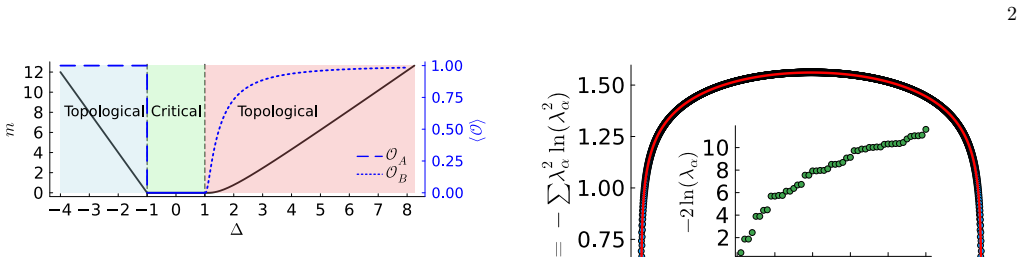
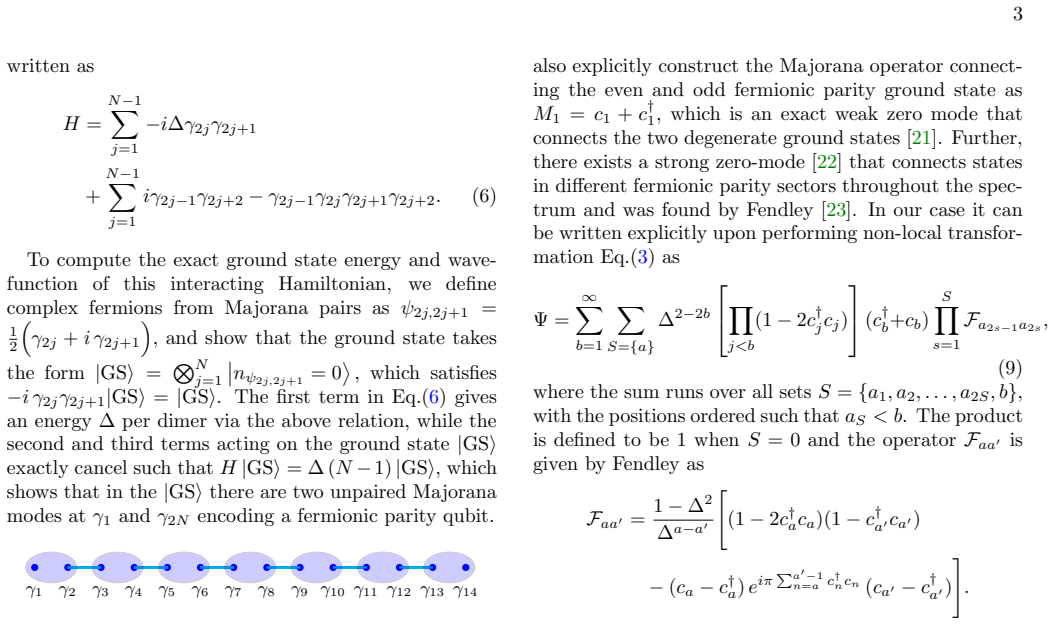
Under the modified Jordan-Wigner transformation $c_k^\dagger = \frac12(\prod_{j<k}\sigma^x_j)(\sigma^y_k + i\sigma^z_k)$, the XXZ Hamiltonian becomes $H = \sum_i [(1+\Delta)(c_{i+1}^\dagger c_i + \mathrm{h.c.}) + (1-\Delta)(c_i c_{i+1} + \mathrm{h.c.}) + (2n_i^c-1)(2n_{i+1}^c-1)]$, a local fermionic model conserving fermion parity but not fermion number. The paper argues that for $\Delta<-1$ the ground state is exactly a product of dimers with two unpaired Majorana modes, entanglement spectrum exactly $\ln 2$ per cut, and string order $O_B=1$; for $\Delta>1$ the model is a distinct SPT phase with string order $O_A=\sigma$ (the staggered magnetization) and an entanglement spectrum whose lowest 50 levels are exactly even-degenerate in a density-matrix renormalization group run at $\Delta=3$, $N=1000$. Both phases support a strong zero mode connecting parity sectors, and the $|\Delta|<1$ regime remains a gapless topologically trivial Luttinger liquid with central charge $c=1$.
Load-bearing premise
The $\Delta>1$ topological claim rests on an imported exact strong zero mode that the paper does not verify in-text for this Hamiltonian, together with a single DMRG run at $\Delta=3$, $N=1000$ from which exact even degeneracy of the entanglement spectrum is extrapolated to the whole regime.
Editorial extensions
If this is right
- For $\Delta<-1$, the dual fermionic Hamiltonian realizes a topological-superconductor-like phase whose ground state contains two unpaired Majorana modes at the ends, providing a protected fermionic-parity qubit.
- For $\Delta>1$, the model realizes a distinct SPT phase with string order $O_A=\sigma$, so the two gapped XXZ phases are topologically inequivalent to each other rather than merely having different magnetic order.
- In both topological regimes, the entanglement spectrum of the dual model is exactly (or numerically exactly) even-fold degenerate at every level, a sharp diagnostic of SPT order.
- The gapless regime $|\Delta|<1$ maps to a topologically trivial Luttinger liquid with central charge $c=1$, so the duality leaves the critical physics unchanged while changing the gapped phases' classification.
Reading between the lines
- The one-parameter family of non-local transformations in Appendix B suggests that the same spin chain admits a continuum of dual fermionic descriptions interpolating between a trivial charge-density-wave insulator and the SPT phases; adding local perturbations may break the duality, making it a property of the exact integrable point rather than of a broad phase.
- If the strong zero mode is exact throughout $\Delta>1$, the model should exhibit dynamical signatures such as non-decaying edge autocorrelations at infinite temperature in the fermionic basis; time-dependent DMRG or cold-atom emulation could test this beyond ground-state data.
- The same transformation strategy could be tried on other exactly solvable spin chains, such as XYZ or higher-spin Heisenberg models, to look for a general duality between spontaneous symmetry breaking and symmetry-protected topology.
Editorial analysis
A structured set of objections, weighed in public.
Referee Report
Summary. The paper constructs a modified Jordan-Wigner transformation (Eq. (3)) that maps the spin-1/2 XXZ chain to a local parity-conserving fermionic Hamiltonian (Eq. (4)). It claims that for |Δ|>1 this fermionic chain realizes two distinct symmetry-protected topological (SPT) phases, while the critical regime |Δ|<1 maps to a topologically trivial Luttinger liquid. The supporting evidence includes an exact dimerized ground state for Δ<-1 with two unpaired Majorana modes and an exactly twofold-degenerate entanglement spectrum, string order parameters O_B=1 and O_A=σ, a Fendley-type strong zero mode (Eq. (9)), and DMRG data at Δ=3, N=1000 showing even entanglement-spectrum degeneracy. The paper also constructs a family of interpolating Hamiltonians H(θ) in Appendix B.
Significance. The exact analysis of the Δ<-1 regime and the explicit nonlocal duality are valuable and appear correct: the product dimer state is an exact ground state of Eq. (6), the two unpaired Majoranas are manifest, and the entanglement spectrum is exactly ln 2. If the Δ>1 claims were rigorously established, the paper would provide an instructive SPT-SSB correspondence for a paradigmatic model. However, the Δ>1 SPT claim currently rests on an imported strong-zero-mode formula that is not verified for the present couplings, on a single DMRG run, and on a string order parameter whose value is inherited from the Bethe-ansatz staggered magnetization. The paper also does not specify the protecting symmetry or an invariant that distinguishes the two claimed SPT phases. These are load-bearing gaps for the headline claim.
major comments (4)
- [Sec. on Δ>1 regime, Eq. (9)] The strong zero mode Ψ in Eq. (9) is introduced as 'found by Fendley' [23], but the paper does not verify that Fendley's theorem applies to the Hamiltonian of Eq. (6) with couplings J1=Δ, J2=1, J3=1 for all Δ>1, nor does it prove convergence of the infinite sum, [H,Ψ]=0, or anticommutation with fermion parity. Since the quadratic part of Eq. (4) is in the trivial Kitaev regime for Δ>1 (|1+Δ|>|1-Δ|), this imported operator is the only analytic evidence for the Δ>1 SPT phase. The authors should either supply the verification, including the precise parameter range in which Fendley's construction applies, or explicitly restrict the claim to a regime that is actually established.
- [Summary and Sec. on two topological phases] The claim that the Δ<-1 and Δ>1 phases are distinct SPT phases is not supported by any specified protecting symmetry or topological invariant. The paper shows different entanglement-spectrum degeneracies and different string order parameter values, but these do not by themselves distinguish two SPT phases. The authors should specify the symmetry group respected by Eq. (4), compute the corresponding projective representation or the appropriate Z2 invariant, and show that the two phases cannot be connected by a symmetry-respecting finite-depth local circuit.
- [Eq. (11) and Appendix A] The string order parameter O_A for Δ>1 is identified with the staggered magnetization σ imported from earlier Bethe-ansatz results (Eq. (A1)). This is not circular because the duality is exact, but it means that the Δ>1 'topological order parameter' is not computed independently in the fermionic representation. Moreover, a nonzero string order parameter alone does not establish nontrivial SPT order without a symmetry classification. The dependence on the external Bethe-ansatz value and the logical role of O_A in proving SPT order should be stated explicitly.
- [Fig. 4 and accompanying text] The numerical evidence for the Δ>1 phase is a single DMRG calculation at Δ=3, N=1000, with a truncation cutoff of 10^-16 and the lowest 50 entanglement levels. This single run is extrapolated to the entire Δ>1 regime. A finite truncation cutoff cannot establish 'exact even degeneracy at every level'; the authors should present several anisotropies and system sizes, and quantify the deviation from degeneracy and the finite-size effects, or else base the claim on an analytic argument.
minor comments (6)
- [Fig. 2 caption] The caption contains the placeholder 'inset of Fig. X', which should be replaced by a proper reference to the inset figure.
- [After Eq. (9)] The sentence 'When b = 0, the exact strong zero mode reduces to the weak zero mode c1 + c†' is inconsistent with the sum in Eq. (9), which starts at b=1 and would involve an undefined operator c0 for b=0; please clarify the intended b=0 term.
- [Reference [17]] Reference [17] contains a broken citation '[25 ?]' that must be completed before publication.
- [Appendix B] Appendix B introduces U(θ) as a 2x2 matrix but calls it a non-local transformation; the connection between U(θ), the operators d_i, and the θ=2π case of Eq. (3) is not derived, making the interpolation claim difficult to verify.
- [Definitions of zero modes] The terms 'weak zero mode' and 'strong zero mode' are used without precise definitions; please give the exact commuting/anticommuting conditions or cite the specific equations in Refs. [21,22].
- [Caption of Fig. 1] The caption of Fig. 1 does not specify which curve corresponds to O_B and which to O_A, nor how the Bethe-ansatz values were evaluated in the thermodynamic limit.
Circularity Check
The duality map and the Δ<−1 phase are derived in-paper, but the Δ>1 SPT characterization is partially circular: O_A reduces by Eq. (11) to the known staggered magnetization σ, and the strong zero mode is imported unverified from Fendley.
-
renaming known result
[Eqs. (10)-(11) in the topological-phase section; cf. Eq. (A1) in Appendix A.]
"Moreover, we can construct a non-local string order parameter O2 A = lim |i−j|→∞ (−1)i−j(c† i +ci) exp(iπ P j−1 n=i c† ncn)(c† j+cj), (10) whose explicit computation is simpler in the spin basis upon performing the inverse transformation Eq.(3) such that OA = q ⟨O2 A⟩ = lim |i−j|→∞ q (−1)i−j⟨σz i σz j ⟩ = σ, (11) where σ is staggered magnetized of the XXZ chain in ∆ > 1 regime given by Eq. (A1)."
The string order parameter presented as the topological signature of the ∆>1 phase is, by Eq. (11), exactly the staggered magnetization σ of the input XXZ chain (Eq. A1), a Bethe-Ansatz result imported from Baxter/Izergin rather than derived from the fermionic Hamiltonian. The equalities run through the inverse of the defining map Eq. (3), so the value O_A = σ is the known spin-model order parameter expressed in new coordinates: the 'derived' topological order parameter is equivalent to the input by construction. It therefore supplies no independent fermionic-side evidence for an SPT phase, and its nonzeroness in ∆>1 is inherited from the spin chain's antiferromagnetic order, not established within Eq. (4), whose non-interacting part lies in the trivial Kitaev regime for ∆>1.
full rationale
The construction chain is self-contained algebra: the modified Jordan-Wigner map Eq. (3) is the θ=2π case of the nonlocal unitary U(θ) in Appendix B, and Eq. (4) follows by direct evaluation, so spectra coincide by unitary equivalence; nothing circular there. The ∆<−1 topological phase is genuinely derived in-paper: the exact ground state |GS⟩=⊗_j|n_{ψ_{2j,2j+1}}=0⟩ satisfies H|GS⟩=∆(N−1)|GS⟩ with two unpaired Majoranas γ1, γ2N, giving an exactly doubly degenerate entanglement spectrum ln 2 and the explicit weak zero mode M1=c1+c†1; this is independent of fits and self-citations. The partial circularity is concentrated on the ∆>1 side: by Eq. (11), the non-local string order parameter O_A is, through the inverse of the defining transformation, exactly the staggered magnetization σ of the input XXZ model (Eq. A1, imported from Baxter and Izergin), so the analytic topological order parameter reduces by construction to a known input expressed in new coordinates, and its nonzeroness in ∆>1 is inherited from the spin chain's antiferromagnetic order rather than derived within the fermionic model. The strong zero mode Eq. (9) is asserted to be 'found by Fendley [23]' and is quoted without in-text verification of [H,Ψ]=0, parity anticommutation, convergence, or the hypotheses of Fendley's construction at J1=∆, J2=J3=1 for all |∆|>1; since Fendley is an independent source this is an unverified import (a correctness risk) rather than circularity. The extrapolation of a single DMRG run (∆=3, N=1000) to 'the entire ∆>1 regime' is under-support, not circularity. Self-citations [12]-[14] only back the gap formula in Appendix A and are not load-bearing for the topological claims. Because the duality map and the ∆<−1 analysis carry independent content, the paper is only partially circular.
Assumptions & free parameters
free parameters (1)
- central charge c =
0.99
assumptions (4)
- domain assumption The staggered magnetization formula σ of Eq. (A1), imported from Baxter [29] and Izergin et al. [30], is correct.
- domain assumption Fendley's strong zero mode construction [23] applies to Eq. (4) at the XXZ point; the operator in Eq. (9) exactly commutes with H on the full spectrum and anticommutes with fermion parity for all |∆| > 1.
- standard math The modified Jordan-Wigner transformation Eq. (3) and the θ-family in Appendix B produce canonical fermionic operators.
- domain assumption The DMRG run at ∆ = 3, N = 1000 with truncation cutoff 10^-16 represents the thermodynamic-limit entanglement spectrum of the ∆ > 1 phase.
Cite this review
Pith. "Pith review of What is the topological dual of the XXZ spin Chain?." pith.science (2026). https://pith.science/paper/IJP65EC7
@misc{pith2026250722119,
  author       = {Pith},
  title        = {Pith review of: What is the topological dual of the XXZ spin Chain?},
  year         = {2026},
  howpublished = {\url{https://pith.science/paper/IJP65EC7}},
  note         = {Machine review of arXiv:2507.22119}
}
abstract
We construct a dual symmetry-protected topological (SPT) Hamiltonian for the $U(1)$ symmetric anisotropic spin-$\frac{1}{2}$ Heisenberg chain-a model that has traditionally been used to study spontaneous symmetry breaking (SSB) in both ferromagnetic and antiferromagnetic phases, with an intervening extended Luttinger liquid phase. By performing a non-local unitary transformation, we explicitly construct a local fermionic Hamiltonian that exhibits two nontrivial topological phases separated by an extended Luttinger liquid regime. We demonstrate the topological nature of these phases by analyzing the entanglement structure, deriving a non-local string order parameter, and constructing an exact zero mode operator that connects states in different fermionic parity sectors.
Figures

Reference graph
Works this paper leans on
-
[23]
P. Fendley, Strong zero modes and eigenstate phase tran- sitions in the xyz/interacting majorana chain, Journal of Physics A: Mathematical and Theoretical 49, 30LT01 (2016)
work page 2016
-
[1]
L. D. Landau et al., On the theory of phase transitions, Zh. eksp. teor. Fiz 7, 926 (1937)
work page 1937
-
[2]
V. L. Ginzburg and L. D. Landau, On the Theory of superconductivity, Zh. Eksp. Teor. Fiz. 20, 1064 (1950)
work page 1950
-
[3]
F. Pollmann, E. Berg, A. M. Turner, and M. Os- hikawa, Symmetry protection of topological phases in one-dimensional quantum spin systems, Physical Review B—Condensed Matter and Materials Physics 85, 075125 (2012)
work page 2012
-
[4]
X. Chen, Z.-C. Gu, and X.-G. Wen, Classification of gapped symmetric phases in one-dimensional spin sys- tems, Physical Review B—Condensed Matter and Mate- rials Physics 83, 035107 (2011)
work page 2011
-
[5]
T. Kennedy and H. Tasaki, Hidden symmetry breaking and the haldane phase in s= 1 quantum spin chains, Com- munications in mathematical physics 147, 431 (1992)
work page 1992
-
[6]
T. Kennedy and H. Tasaki, Hidden z 2 × z 2 symme- try breaking in haldane-gap antiferromagnets, Physical review b 45, 304 (1992)
work page 1992
-
[7]
M. Oshikawa, Hidden z2* z2 symmetry in quantum spin chains with arbitrary integer spin, Journal of Physics: Condensed Matter 4, 7469 (1992)
work page 1992
Show all 34 references
-
[8]
L. Li, M. Oshikawa, and Y. Zheng, Noninvertible dual- ity transformation between symmetry-protected topolog- ical and spontaneous symmetry breaking phases, Physi- cal Review B 108, 214429 (2023)
2023
-
[9]
A. Y. Kitaev, Unpaired majorana fermions in quan- tumwires, Physics-uspekhi 44, 131 (2001)
2001
-
[10]
Orbach, Linear antiferromagnetic chain with anisotropic coupling, Physical Review 112, 309 (1958)
R. Orbach, Linear antiferromagnetic chain with anisotropic coupling, Physical Review 112, 309 (1958)
1958
-
[11]
Bethe, Zur theorie der metalle: I
H. Bethe, Zur theorie der metalle: I. eigenwerte und eigenfunktionen der linearen atomkette, Zeitschrift f¨ ur Physik 71, 205 (1931)
1931
-
[12]
Pasnoori, Y
P. Pasnoori, Y. Tang, J. Lee, J. Pixley, N. Andrei, and P. Azaria, Spin fractionalization and zero modes in the spin- 1 2 xxz chain with boundary fields, arXiv preprint arXiv:2312.05970 (2023)
2023 arXiv
-
[13]
Kattel, P
P. Kattel, P. R. Pasnoori, J. Pixley, and N. Andrei, Edge modes and boundary impurities in the anisotropic heisen- berg spin chain, arXiv preprint arXiv:2412.00194 (2024)
2024 arXiv
-
[14]
Kattel, Y
P. Kattel, Y. Tang, J. H. Pixley, and N. Andrei, Edge spin fractionalization in open one-dimensional spin-s quantum antiferromagnets, Phys. Rev. B 111, L220402 (2025)
2025
-
[15]
Zvyagin, Majorana zero modes in the interacting fermion chain without pairing, Low Temperature Physics 47, 401 (2021)
A. Zvyagin, Majorana zero modes in the interacting fermion chain without pairing, Low Temperature Physics 47, 401 (2021)
2021
-
[16]
Zvyagin, Strong zero modes and edge states in the interacting fermion chain without pairing, Low Temper- ature Physics 50, 316 (2024)
A. Zvyagin, Strong zero modes and edge states in the interacting fermion chain without pairing, Low Temper- ature Physics 50, 316 (2024)
2024
-
[17]
However, tak- ing their XXZ limit recovers precisely the trivial Hamil- tonian of Eq
We note that the XYZ chain and its SPT dual have been extensively analyzed [23, 25 ? ]. However, tak- ing their XXZ limit recovers precisely the trivial Hamil- tonian of Eq. (2) with no topological phases. In con- trast, by employing a modified Jordan–Wigner trans- form (Eq. (...
-
[18]
Giamarchi, Quantum Physics in One Dimension (Ox- ford University Press, 2003)
T. Giamarchi, Quantum Physics in One Dimension (Ox- ford University Press, 2003)
2003
-
[19]
F. D. M. Haldane, ’luttinger liquid theory’of one- dimensional quantum fluids. i. properties of the luttinger model and their extension to the general 1d interact- ing spinless fermi gas, Journal of Physics C: Solid State Physics 14, 2585 (1981)
1981
-
[20]
Voit, One-dimensional fermi liquids, Reports on Progress in Physics 58, 977 (1995)
J. Voit, One-dimensional fermi liquids, Reports on Progress in Physics 58, 977 (1995)
1995
-
[21]
Alicea and P
J. Alicea and P. Fendley, Topological phases with parafermions: theory and blueprints, Annual Review of Condensed Matter Physics 7, 119 (2016). 5
2016
-
[22]
Fendley, Parafermionic edge zero modes in zn-invariant spin chains, Journal of Statistical Mechanics: Theory and Experiment 2012, P11020 (2012)
P. Fendley, Parafermionic edge zero modes in zn-invariant spin chains, Journal of Statistical Mechanics: Theory and Experiment 2012, P11020 (2012)
2012
-
[24]
K. Wada, T. Sugimoto, and T. Tohyama, Coexistence of strong and weak majorana zero modes in an anisotropic xy spin chain with second-neighbor interactions, Physical Review B 104, 075119 (2021)
2021
-
[25]
Katsura, D
H. Katsura, D. Schuricht, and M. Takahashi, Exact ground states and topological order in interacting ki- taev/majorana chains, Physical Review B 92, 115137 (2015)
2015
-
[26]
O. F. Sylju ˚ asen, Entanglement and spontaneous symme- try breaking in quantum spin models, Physical Review A 68, 060301 (2003)
2003
-
[27]
Takahashi, Thermodynamics of one-dimensional solv- able models (1999)
M. Takahashi, Thermodynamics of one-dimensional solv- able models (1999)
1999
-
[28]
Franchini et al., An introduction to integrable tech- niques for one-dimensional quantum systems (2017)
F. Franchini et al., An introduction to integrable tech- niques for one-dimensional quantum systems (2017)
2017
-
[29]
R. J. Baxter, Spontaneous staggered polarization of the f-model, Journal of Statistical Physics 9, 145 (1973)
1973
-
[30]
Izergin, N
A. Izergin, N. Kitanine, J. M. Maillet, and V. Terras, Spontaneous magnetization of the xxz heisenberg spin- 12 chain, Nuclear Physics B 554, 679 (1999)
1999
-
[31]
E. W. Weisstein, q-pochhammer symbol, https://mathworld. wolfram. com/ (2008)
2008
-
[32]
Affleck and F
I. Affleck and F. Haldane, Critical theory of quantum spin chains, Physical Review B 36, 5291 (1987)
1987
-
[33]
I. K. Affleck, Field theory methods and quantum critical phenomena (1988). Appendix A: The XXZ model - Summary of results We summarize some of the well known results of the model. When the anisotropy parameter ∆ > 1, the model has a spontaneously broken Z2 symmetry generated b...
1988
-
[645]
In the inset of Fig
The resulting entropy profile is well described by the Cardy–Calabrese formula, S(j) = c 6 ln " 2N πa sin πj N # , from which we extract a central charge c = 0 .99 ≈ 1. In the inset of Fig. X, the lowest 50 entanglement levels are shown, defined by Eα = −2 lnλα, where λ2 α are...
Reviewed August 6, 2026 · model on record in the stance chip above.
Discussion (0). Continue with ORCID to comment.