Vortex Refraction at Tilted Superconductor-Normal Metal Interfaces
Pith reviewed 2026-05-19 03:15 UTC · model grok-4.3
The pith
Superconducting vortices follow a refraction law at tilted superconductor-normal metal interfaces.
A machine-rendered reading of the paper's core claim, the machinery that carries it, and where it could break.
Core claim
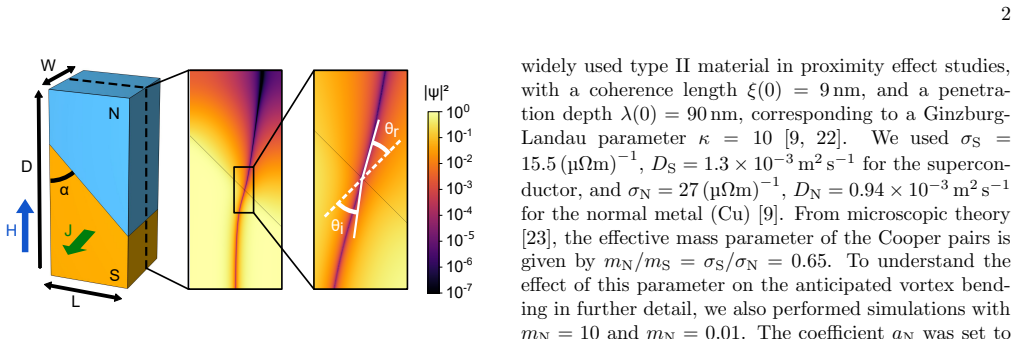
We derive a refraction law for superconducting vortices at superconductor/normal metal interfaces. Simulations of the proximity effect under tilted geometries confirm this law and reveal vortex trapping for low effective mass. Under transport currents, we find core displacements due to differing vortex viscosities in the superconductor and normal metal.
What carries the argument
The refraction law for vortex trajectories across the interface, obtained by considering the tilt angle and material-dependent vortex properties.
If this is right
- Vortex paths at interfaces can be predicted from the refraction law and the tilt angle.
- Vortices become trapped when their effective mass is low.
- Transport currents produce measurable core displacements from the viscosity contrast.
- The dynamics supply concrete rules for engineering proximity-coupled devices that carry high currents.
Where Pith is reading between the lines
- Similar refraction may appear in other hybrid structures where superconductivity is induced across an interface.
- Imaging techniques that track individual vortex positions could directly test the angle relation.
- The viscosity-driven displacement effect could be used to steer flux in thin-film devices.
- The same force-balance approach might apply to other line-like defects in condensed-matter systems.
Load-bearing premise
The proximity-effect model and the difference in vortex viscosity between materials are sufficient to capture the core displacements and confirm the refraction law.
What would settle it
Direct measurement of the entry and exit angles of a vortex crossing a tilted interface to check whether the angles satisfy the derived refraction relation.
Figures


read the original abstract
We derive a refraction law for superconducting vortices at superconductor/normal metal interfaces. Simulations of the proximity effect under tilted geometries confirm this law and reveal vortex trapping for low effective mass. Under transport currents, we find core displacements due to differing vortex viscosities in the superconductor and normal metal. These results clarify vortex dynamics in proximity-coupled systems and offer design principles for high-current coated superconducting devices.
Editorial analysis
A structured set of objections, weighed in public.
Referee Report
Summary. The paper derives an analytical refraction law for superconducting vortices crossing tilted superconductor-normal metal (SN) interfaces. Numerical simulations of the proximity effect in tilted geometries are used to confirm the law, additionally reporting vortex trapping at low effective mass and core displacements under applied transport currents that are attributed to a viscosity contrast between the superconducting and normal-metal regions.
Significance. If the derivation is rigorous and the simulations properly isolate the claimed mechanism, the work would provide a useful framework for understanding vortex motion in hybrid SN systems. This could inform design strategies for coated conductors and other high-current superconducting devices where controlling vortex refraction and trapping is relevant. The combination of an analytical law with numerical confirmation in tilted geometries adds concrete value beyond purely phenomenological descriptions.
major comments (2)
- Simulations section: The confirmation that core displacements satisfy the derived refraction law is attributed to the viscosity difference between SC and NM regions, yet no control simulation is described in which viscosity contrast is varied independently while holding proximity-induced supercurrent redistribution and pinning fixed. Without such a test, it remains possible that other proximity effects produce similar displacements, weakening the claim that the simulations confirm the law via the stated mechanism.
- Simulation details and validation: The abstract states that simulations confirm the refraction law, but quantitative metrics (e.g., measured refraction angles versus predicted values, error bars, or data-selection criteria for vortex-core positions) are not provided. This gap makes it difficult to assess how closely the numerics support the analytical result and whether the agreement holds across the reported tilt angles and effective-mass values.
minor comments (2)
- Abstract: The phrase 'low effective mass' for vortex trapping should be accompanied by the specific range or threshold value used in the simulations.
- Notation: Ensure consistent use of symbols for viscosity (e.g., η_SC versus η_NM) between the derivation and the simulation parameter tables.
Simulated Author's Rebuttal
We thank the referee for the constructive review and for recognizing the potential utility of the derived refraction law for vortex dynamics in hybrid SN systems. We address each major comment below and have revised the manuscript to strengthen the simulation validation and presentation of results.
read point-by-point responses
-
Referee: Simulations section: The confirmation that core displacements satisfy the derived refraction law is attributed to the viscosity difference between SC and NM regions, yet no control simulation is described in which viscosity contrast is varied independently while holding proximity-induced supercurrent redistribution and pinning fixed. Without such a test, it remains possible that other proximity effects produce similar displacements, weakening the claim that the simulations confirm the law via the stated mechanism.
Authors: We agree that an explicit control simulation isolating the viscosity contrast would provide stronger mechanistic evidence. Our current simulations incorporate the viscosity difference as an intrinsic material parameter between the SC and NM regions within the time-dependent Ginzburg-Landau framework, with proximity effects and pinning held consistent across runs. To directly address the concern, we will add a dedicated control study in the revised Simulations section in which the viscosity in the normal-metal region is varied independently while fixing the proximity-induced supercurrent redistribution and pinning landscape. The results of these additional runs will be presented to confirm that the observed core displacements track the viscosity contrast as claimed. revision: yes
-
Referee: Simulation details and validation: The abstract states that simulations confirm the refraction law, but quantitative metrics (e.g., measured refraction angles versus predicted values, error bars, or data-selection criteria for vortex-core positions) are not provided. This gap makes it difficult to assess how closely the numerics support the analytical result and whether the agreement holds across the reported tilt angles and effective-mass values.
Authors: We acknowledge that quantitative comparison metrics were not included in the original submission. In the revised manuscript we have added a new table in the Simulations section that reports measured refraction angles (extracted from vortex-core trajectories) against the analytically predicted values for each tilt angle and effective-mass parameter studied. Standard deviations from multiple independent runs are provided as error bars, and the data-selection criteria for identifying vortex-core positions (based on local minima in the order-parameter magnitude with a specified threshold) are now explicitly described in the Methods. These additions allow direct evaluation of the agreement across the parameter range. revision: yes
Circularity Check
No circularity: refraction law derived independently and confirmed by separate simulations
full rationale
The paper states it derives a refraction law for superconducting vortices at SN interfaces from first principles and then uses separate proximity-effect simulations under tilted geometries to confirm the law and observe additional effects like trapping and core displacements. No quoted equation or step shows the law being defined in terms of simulation outputs, a fitted parameter renamed as a prediction, or a self-citation chain that reduces the central result to its own inputs. The derivation chain remains self-contained against external benchmarks, with simulations serving as validation rather than construction of the result.
Axiom & Free-Parameter Ledger
Lean theorems connected to this paper
-
IndisputableMonolith/Cost/FunctionalEquation.leanwashburn_uniqueness_aczel unclear?
unclearRelation between the paper passage and the cited Recognition theorem.
time-dependent Ginzburg-Landau simulations... proximity effect under tilted geometries
What do these tags mean?
- matches
- The paper's claim is directly supported by a theorem in the formal canon.
- supports
- The theorem supports part of the paper's argument, but the paper may add assumptions or extra steps.
- extends
- The paper goes beyond the formal theorem; the theorem is a base layer rather than the whole result.
- uses
- The paper appears to rely on the theorem as machinery.
- contradicts
- The paper's claim conflicts with a theorem or certificate in the canon.
- unclear
- Pith found a possible connection, but the passage is too broad, indirect, or ambiguous to say the theorem truly supports the claim.
Reference graph
Works this paper leans on
-
[1]
de Gennes, Superconductivity Of Metals And Al- loys, 1st ed
P.-G. de Gennes, Superconductivity Of Metals And Al- loys, 1st ed. (CRC Press, Boca Raton, 1999)
work page 1999
-
[2]
Clarke, Le Journal de Physique Colloques 29, C2 (1968), publisher: EDP Sciences
J. Clarke, Le Journal de Physique Colloques 29, C2 (1968), publisher: EDP Sciences
work page 1968
-
[3]
A. I. Buzdin, Reviews of Modern Physics 77, 935 (2005), publisher: American Physical Society (APS)
work page 2005
-
[4]
J. Linder and J. W. A. Robinson, Nature Physics 11, 307 (2015), publisher: Nature Publishing Group
work page 2015
-
[5]
L. Fu and C. L. Kane, Physical Review Letters 100, 10.1103/physrevlett.100.096407 (2008), publisher: American Physical Society (APS)
- [6]
-
[7]
J. C. Cuevas and F. S. Bergeret, Physical Review Let- ters 99, 10.1103/physrevlett.99.217002 (2007), publisher: American Physical Society (APS)
-
[8]
M. Amundsen, J. A. Ouassou, and J. Linder, Physi- cal Review Letters 120, 10.1103/physrevlett.120.207001 (2018), publisher: American Physical Society (APS)
-
[9]
V. S. Stolyarov, T. Cren, C. Brun, I. A. Golovchanskiy, O. V. Skryabina, D. I. Kasatonov, M. M. Khapaev, M. Y. Kupriyanov, A. A. Golubov, and D. Roditchev, Nature Communications 9, 2277 (2018)
work page 2018
-
[10]
R. Panghotra, M. Timmermans, C. Xue, B. Raes, V. Moshchalkov, and J. Van De Vondel, Physical Review B 100, 054519 (2019)
work page 2019
-
[11]
D. Y. Vodolazov, Physical Review B 110, 014517 (2024)
work page 2024
-
[12]
G. Blatter, M. V. Feigel’man, V. B. Geshkenbein, A. I. Larkin, and V. M. Vinokur, Reviews of Modern Physics 66, 1125 (1994), publisher: American Physical Society (APS)
work page 1994
-
[13]
W.-K. Kwok, U. Welp, A. Glatz, A. E. Koshelev, K. J. Kihlstrom, and G. W. Crabtree, Reports on Progress in Physics 79, 116501 (2016)
work page 2016
-
[14]
H. J. Lugt, Physics of Fluids A: Fluid Dynamics 1, 1424 (1989), publisher: AIP Publishing
work page 1989
-
[15]
P. Lorrain, D. R. Corson, and F. Lorrain, Electromag- netic fields and waves: including electric circuits , 3rd ed. (Freeman, New York, 1996)
work page 1996
-
[16]
S. J. Chapman, Q. Du, and M. D. Gunzburger, European Journal of Applied Mathematics 6, 97 (1995)
work page 1995
-
[17]
See Supplemental Material at [URL will be inserted by publisher] for details on the treatment of magnetic field screening, the validation of its neglect in our system, and additional analysis of the role of the two dissipation mechanisms on vortex viscosity
- [18]
- [19]
-
[20]
A. J. M. Deenen and D. Grundler, ACS Nanosci. Au XYZ, xyz (2025)
work page 2025
- [21]
-
[22]
V. Krasnov, V. Oboznov, and V. Ryazanov, Physica C: Superconductivity and its Applications 196, 335 (1992)
work page 1992
-
[23]
T. Giorgi and H. Jadallah, European Journal of Applied Mathematics 17, 633–650 (2006)
work page 2006
-
[24]
Tinkham, Introduction to Superconductivity , second edition ed
M. Tinkham, Introduction to Superconductivity , second edition ed. (McGraw-Hill, 1996)
work page 1996
-
[25]
L.-G. Wang, H. Chen, and S.-Y. Zhu, Optics Letters 30, 2936 (2005)
work page 2005
-
[26]
C. P. Bean and J. D. Livingston, Physical Review Let- ters 12, 14 (1964), publisher: American Physical Society (APS)
work page 1964
-
[27]
Schmid, Physik der kondensierten Materie 5, 302 (1966)
A. Schmid, Physik der kondensierten Materie 5, 302 (1966)
work page 1966
-
[28]
P. J. Moll, Communications Materials 6, 10.1038/s43246- 025-00788-1 (2025), publisher: Springer Science and Business Media LLC
- [29]
-
[30]
Sieniutycz, International Journal of Heat and Mass Transfer 50, 1278 (2007), publisher: Elsevier BV
S. Sieniutycz, International Journal of Heat and Mass Transfer 50, 1278 (2007), publisher: Elsevier BV
work page 2007
-
[31]
D. Makarov, O. M. Volkov, A. K´ akay, O. V. Pylypovskyi, B. Budinsk´ a, and O. V. Dobrovolskiy, Advanced Materi- als 34, 2101758 (2022)
work page 2022
discussion (0)
Sign in with ORCID, Apple, or X to comment. Anyone can read and Pith papers without signing in.