REVIEW 4 major objections 4 minor 38 references
On the Sustainability of AI Inferences in the Edge
T0 review · 4 major / 4 minor · reviewed 2026-08-06 · deepseek-v4-flash
Pith's one-line read Benchmarking four edge devices across ML, deep learning, and LLM inference, this paper claims the NVIDIA Jetson Nano with TensorRT optimizations offers the best speed and energy balance, and that parameter tuning matters as much as…
desk verdict A useful benchmarking ambition undone by internally inconsistent numbers that make the central ranking unsupported. read the letter →
The pith
A machine-rendered reading of the paper's core claim, the machinery that carries it, and where it could break.
The reading
What carries the argument
The load-bearing mechanism is the unified measurement scheme: a Python harness that samples USB power-meter readings at 16 Hz, subtracts a three-second idle baseline, and logs wall-clock time, psutil-reported memory, and inference outputs, so that every device reports the same four metrics. On top of this sits the device-specific optimization stack — TensorRT on Jetson, OpenVINO IR on the Neural Compute Stick, EdgeTPU on Coral, and LiteRT elsewhere — which is what the paper credits for the speed and memory differences. The scheme is what allows cross-device rankings to exist at all.
What would settle it
Run phi-2-orange inference on a Jetson Nano while logging DC input power with a calibrated bench meter and process-level memory with cgroup counters; readings far below the reported 93 W and 5,376 MB would show those figures are measurement artifacts, not inference-specific consumption.
Extended reading notes
Core claim
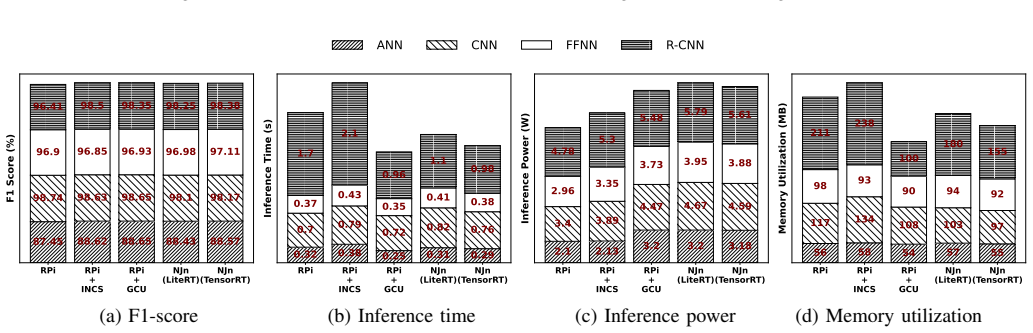
The paper's discovery is a measured performance-energy landscape for edge AI inference rather than a single winner. Across the twelve models tested, F1 scores are nearly flat across devices, so accuracy is not the differentiator. The trade-offs appear in inference time, power, and memory: the Jetson Nano with TensorRT delivers the lowest inference time and memory use across deep learning models and LLMs while keeping power competitive; the Raspberry Pi draws the least power but is the slowest and most memory-hungry; the Coral USB and Neural Compute Stick sit in between, with Coral generally faster and the Stick often more power-efficient per model. The paper also shows that tuning input resolution, batch size, token length, and token window can change inference power and time by multiples, with Jetson Nano tolerating the widest ranges (up to 2048 tokens and batch sizes 16–32), while the Pi is limited to batch size 1 and 500–1000 tokens. TinyBERT consistently beats phi-2-orange on resource use, which the paper attributes to its distillation-based architecture. The implied answer to RQ1 is yes: domain-specific hardware and software design do boost edge AI, but mostly in resource use rather than accuracy.
Load-bearing premise
The rankings all rest on one premise: that a USB power meter sampling at 16 Hz with an idle baseline subtracted, paired with psutil's memory reading, captures the inference-specific power and memory of each device, so that if either reading is contaminated the cross-device rankings shift.
Editorial extensions
If this is right
- For complex vision and language workloads, Jetson Nano with TensorRT is the recommended configuration: it achieves the fastest inference and lowest memory use while keeping power competitive across deep models and LLMs.
- Raspberry Pi remains viable only for simple models and latency-tolerant tasks; it draws the least power but is the slowest and most memory-pressured, with batch size 1 as the only workable setting.
- Coral USB and Neural Compute Stick occupy the middle ground, with Coral generally faster and the Stick often more power-efficient per model, making the choice between them model-dependent.
- Increasing image resolution from the native size to 512×512 raises F1 but multiplies power and time, sharply on the Pi and roughly twofold on Coral and the Stick; input size should therefore be tuned against the application's accuracy target.
- For LLMs, TinyBERT is the safer edge choice than phi-2-orange across all devices, and Jetson Nano's ability to handle up to 2048 tokens means longer-context NLP is only practical there.
Reading between the lines
- Going beyond the paper: if the flat-F1 pattern holds generally, accuracy is set by training and data rather than by inference hardware, so hardware procurement for edge AI should be driven by energy and latency budgets, not by expected model quality.
- Going beyond the paper: the device-specific batch-size sweet spots suggest a transferable rule — pick the largest batch that fits in memory without paging — that could be tested on newer edge accelerators without re-running the full battery.
- Going beyond the paper: because the paper itself notes inference power does not always scale with runtime for lightweight models, per-inference energy figures measured at the USB input include fixed platform overhead; extending the scheme with device-internal power sensors would let future work separate compute power from idle draw.
Editorial analysis
A structured set of objections, weighed in public.
Referee Report
Summary. This paper is an empirical measurement study of AI inference on four edge hardware configurations: Raspberry Pi, Raspberry Pi with Intel Neural Compute Stick, Raspberry Pi with Google Coral USB, and NVIDIA Jetson Nano (with both LiteRT and TensorRT). It reports F1 score, inference time, inference power, and memory utilization for traditional ML models, neural networks, deep CNNs, and two LLMs, and it also studies the effect of input resolution, batch size, token length, and token window size. The authors claim to fill a gap by providing a unified measurement scheme and conclude in Section VIII that the Jetson Nano with TensorRT is the most efficient platform for edge AI inference.
Significance. The contribution is intended to be a reproducible, hardware-in-the-loop benchmark that would help practitioners choose device-model-framework-parameter combinations. If the measurements were trustworthy, the heterogeneous device set and the breadth of model categories would be useful. However, the paper's value rests entirely on the accuracy and internal consistency of the reported numbers. The manuscript contains multiple large internal contradictions in the primary data, including factor-of-ten discrepancies between figures for identical configurations and physical values that exceed the hardware's RAM and power budgets. Because these issues undermine the central cross-device ranking and every RQ1-RQ3 conclusion, the claimed gap-filling contribution is not currently supported. The measurement scheme and replication intent are worthwhile, but the data would need to be regenerated before the claims can be assessed.
major comments (4)
- [§VI-A, Figure 5 vs. Figures 7-8] The same nominal configuration is reported with wildly different values in different figures. For Raspberry Pi + ResNet-50 at 224x224, Figure 5 reports 2.62 s, 14.91 W, and 334 MB, while Figure 7 reports 0.18 s and 1.2 W for the same resolution. For Raspberry Pi + MobileSSD at 300x300, Figure 5 reports 1.86 s and 20.21 W, while Figure 8 reports 0.25 s and 1.5 W. No change in batch size, measurement protocol, or hardware configuration is stated between these figures. A difference of roughly an order of magnitude in inference time and power for identical configurations cannot be attributed to noise or confidence intervals, and it invalidates the cross-device comparisons that are the basis for RQ1 and RQ3.
- [§VI-A, Figure 6 and Tables V-VI] Several reported memory and power values are physically implausible for the hardware described in Section IV-A.2. Figure 6 reports phi-2-orange memory utilization of 5,376 MB on a Raspberry Pi with 4 GB RAM and 4,930 MB on a Jetson Nano with 4 GB RAM; Table V lists 5,250 MB and Table VI lists 5,100 MB on the Raspberry Pi. If psutil-reported virtual memory including swap is meant, then the values do not match the Section V-C definition of 'total memory consumed during inference'; if physical RAM is meant, the values exceed the hardware limit. Similarly, Figure 6 reports 93.12 W inference power for the Jetson Nano, and 62.4 W for the Raspberry Pi, both far above the official power supplies for these boards. These results contradict the described USB power meter methodology and make the LLM comparisons in Tables V-VI unsupported.
- [§V-B and §V-C, Power Consumption definition] The definition and computation of inference power are internally inconsistent. Section V-C says inference power is 'the total power (in watts) consumed per input sample during the inference phase,' but then states that 'the total power is then computed by summing the recorded values over the entire inference duration.' Summing power samples over time yields energy (or watt-sample counts), not watts. Section V-B separately says that an idle baseline is subtracted to isolate inference-specific power, but Section V-C's definition does not mention baseline subtraction. Because power is a central metric in every RQ1-RQ3 conclusion, the units and computation must be stated precisely and consistently; as written, the reported power values cannot be interpreted.
- [§VI-C.1, Batch size impact] The batch-size claims are not backed by any reported measurements. The text asserts that Raspberry Pi supports only batch size 1, Intel NCS works with batch sizes 4-8, Google Coral with 8-16, and Jetson Nano with 16-32, and that Jetson Nano achieves up to 20% lower per-sample inference time, but no figure, table, or raw data for batch-size experiments is provided. Since batch-size tuning is one of the main conclusions of RQ3, the supporting data must be shown rather than asserted.
minor comments (4)
- [§I, C4 and footnote 1] Contribution C4 states that scripts, data, and experiment configurations are available in the replication package, but footnote 1 says the package is 'to be released in GitHub upon paper acceptance'; the referenced repository was not available for verification at review time.
- [References, [16]] Reference [16] is labeled 'Edgeai sustainability code repository' but the URL points to the Perf wiki; the citation appears to be for the wrong artifact.
- [§IV-A.1, Large Language Models] The model name 'Phi-2-orange' is not a standard public model identifier, and no base model, repository, or version is given; this makes the LLM experiments difficult to reproduce.
- [§VI-A, LLM discussion] The phrase 'Respberry Pi is the slowest device' contains a typo, and the surrounding paragraph would benefit from pointing to specific subplots in Figure 6.
Circularity Check
No meaningful circularity: the paper is a direct empirical measurement study whose conclusions are self-contained observations, not derivations from fitted inputs or self-citation chains.
full rationale
This paper is an empirical benchmarking study. It defines operational metrics (F1 score, inference time, memory utilization, power consumption), measures them on edge devices with a described hardware/software pipeline, and reports the resulting values in tables and figures. The central claims—e.g., that the Jetson Nano with TensorRT is often fastest, that Raspberry Pi is energy-efficient but slower, and that parameter tuning (input size, batch size, token length) affects resource usage—are stated as direct observations of the reported measurements. No equation in the paper is fitted to the results, no prediction is derived from a fitted parameter and then compared back to the same data, and no load-bearing premise is justified solely by a self-citation. The one minor self-citation is reference [5] (Georgiou et al., co-authored by Tushar Sharma), used only as background/related work and explicitly critiqued for lacking comprehensive measurement; it does not support any of this paper's conclusions. The skeptic's concerns about implausible values (e.g., 5,376 MB on a 4 GB Raspberry Pi, 93.12 W on a Jetson Nano) and cross-figure inconsistencies are serious validity threats, but they concern data integrity and measurement methodology, not circularity. A flawed or inconsistent measurement is not the same as a derivation that assumes what it concludes. Therefore, no circular step can be identified under the required evidence standard, and the circularity score is 0.
Assumptions & free parameters
assumptions (4)
- domain assumption USB power meter samples (16 Hz), minus idle baseline, represent the inference-specific power draw of the device.
- domain assumption psutil memory utilization captures total memory consumed by the inference on the device, including attached accelerators.
- domain assumption The trained models and their conversions (LiteRT, TensorRT, OpenVINO, EdgeTPU) are comparable representatives of their respective categories.
- domain assumption The performance metrics (F1, time, power, memory) are stable across runs and 95% confidence intervals are meaningful.
invented entities (1)
-
phi-2-orange
Cite this review
Pith. "Pith review of On the Sustainability of AI Inferences in the Edge." pith.science (2026). https://pith.science/paper/CXL7OCAY
@misc{pith2026250723093,
  author       = {Pith},
  title        = {Pith review of: On the Sustainability of AI Inferences in the Edge},
  year         = {2026},
  howpublished = {\url{https://pith.science/paper/CXL7OCAY}},
  note         = {Machine review of arXiv:2507.23093}
}
read the original abstract
The proliferation of the Internet of Things (IoT) and its cutting-edge AI-enabled applications (e.g., autonomous vehicles and smart industries) combine two paradigms: data-driven systems and their deployment on the edge. Usually, edge devices perform inferences to support latency-critical applications. In addition to the performance of these resource-constrained edge devices, their energy usage is a critical factor in adopting and deploying edge applications. Examples of such devices include Raspberry Pi (RPi), Intel Neural Compute Stick (INCS), NVIDIA Jetson nano (NJn), and Google Coral USB (GCU). Despite their adoption in edge deployment for AI inferences, there is no study on their performance and energy usage for informed decision-making on the device and model selection to meet the demands of applications. This study fills the gap by rigorously characterizing the performance of traditional, neural networks, and large language models on the above-edge devices. Specifically, we analyze trade-offs among model F1 score, inference time, inference power, and memory usage. Hardware and framework optimization, along with external parameter tuning of AI models, can balance between model performance and resource usage to realize practical edge AI deployments.
Figures


Figures from the paper (5 more)


Reference graph
Works this paper leans on
-
[1]
pcamp: Performance comparison of machine learning packages on the edges,
X. Zhang, Y . Wang, and W. Shi, “pcamp: Performance comparison of machine learning packages on the edges,” 07 2018
work page 2018
-
[2]
Deep learning for edge computing applications: A state-of-the-art survey,
F. Wang, M. Zhang, X. Wang, X. Ma, and J. Liu, “Deep learning for edge computing applications: A state-of-the-art survey,” IEEE Access , vol. 8, pp. 58 322–58 336, 2020
work page 2020
-
[3]
Green edge ai: A contemporary survey,
Y . Mao, X. Yu, K. Huang, Y .-J. A. Zhang, and J. Zhang, “Green edge ai: A contemporary survey,” Proceedings of the IEEE , 2024
work page 2024
-
[4]
Edgellm: A highly efficient cpu-fpga heterogeneous edge accelerator for large language models,
M. Huang, A. Shen, K. Li, H. Peng, B. Li, Y . Su, and H. Yu, “Edgellm: A highly efficient cpu-fpga heterogeneous edge accelerator for large language models,” IEEE Transactions on Circuits and Systems I: Regular Papers, 2025. 14
work page 2025
-
[5]
Green ai: do deep learning frameworks have different costs?
S. Georgiou, M. Kechagia, T. Sharma, F. Sarro, and Y . Zou, “Green ai: do deep learning frameworks have different costs?” in Proceedings of the 44th International Conference on Software Engineering, ser. ICSE ’22. New York, NY , USA: Association for Computing Machinery, 2022, p. 1082–1094. [Online]. Available: https://doi.org/10.1145/3510003.3510221
arXiv 2022
-
[6]
Edge devices inference performance comparison,
T. Rafal, W. Grzegorz, G. Piotr, C. Nikodem, and L. Sebastian, “Edge devices inference performance comparison,” Journal of Computing Science and Engineering , vol. 17, no. 2, p. 51–59, Jun. 2023. [Online]. Available: http://dx.doi.org/10.5626/JCSE.2023.17.2.51
-
[7]
Edgeai sustainability code repository. Accessed: 2025-07-15. [Online]. Available: https://github.com/PINetDalhousie/EdgeAI-Sustainability
work page 2025
-
[8]
N. N. Alajlan and D. M. Ibrahim, “Tinyml: Enabling of inference deep learning models on ultra-low-power iot edge devices for ai applications,” Micromachines, vol. 13, no. 6, 2022. [Online]. Available: https://www.mdpi.com/2072-666X/13/6/851
work page 2022
Show all 38 references
-
[9]
Optimizing large language models for edge devices: A comparative study on reputation analysis,
M. W. U. Rahman, “Optimizing large language models for edge devices: A comparative study on reputation analysis,” 2023. [Online]. Available: http://hdl.handle.net/10150/670250
2023
-
[10]
Enabling deep learning on iot edge: Approaches and evaluation,
X. Qi and C. Liu, “Enabling deep learning on iot edge: Approaches and evaluation,” in 2018 IEEE/ACM Symposium on Edge Computing (SEC) , 2018, pp. 367–372
2018
-
[11]
Large language models: A survey,
S. Minaee, T. Mikolov, N. Nikzad, M. Chenaghlu, R. Socher, X. Amatriain, and J. Gao, “Large language models: A survey,” 2024. [Online]. Available: https://arxiv.org/abs/2402.06196
2024 arXiv
-
[12]
A survey of federated learning for edge computing: Research problems and solutions,
Q. Xia, W. Ye, Z. Tao, J. Wu, and Q. Li, “A survey of federated learning for edge computing: Research problems and solutions,” High-Confidence Computing, vol. 1, no. 1, p. 100008, 2021. [Online]. Available: https://www.sciencedirect.com/science/article/pii/S266729522100009X
2021
-
[13]
Litert overview | google ai edge | google ai for developers,
google, “Litert overview | google ai edge | google ai for developers,” https://www.tensorflow.org/lite, 2025
2025
-
[14]
Accessed: 2025-07-15
Welcome to the executorch documentation — executorch 0.6 documentation. Accessed: 2025-07-15. [Online]. Available: https: //docs.pytorch.org/executorch/stable/index.html
2025
-
[15]
Accessed: 2025-07-15
Onnx runtime | home. Accessed: 2025-07-15. [Online]. Available: https://onnxruntime.ai/
2025
-
[16]
Accessed: 2025-07-15
Edgeai sustainability code repository. Accessed: 2025-07-15. [Online]. Available: https://perfwiki.github.io/main/
2025
-
[17]
Accessed: 2025-07-15
Nvidia-smi documentation. Accessed: 2025-07-15. [Online]. Available: https://docs.nvidia.com/deploy/nvidia-smi/index.html
2025
-
[18]
The carbon footprint of machine learning training will plateau, then shrink,
D. Patterson, J. Gonzalez, U. Hölzle, Q. Le, C. Liang, L.-M. Munguia, D. Rothchild, D. R. So, M. Texier, and J. Dean, “The carbon footprint of machine learning training will plateau, then shrink,” Computer, vol. 55, no. 7, pp. 18–28, 2022
2022
-
[19]
Deep learning: Edge-cloud data analytics for iot,
A. M. Ghosh and K. Grolinger, “Deep learning: Edge-cloud data analytics for iot,” in 2019 IEEE Canadian Conference of Electrical and Computer Engineering (CCECE) , 2019, pp. 1–7
2019
-
[20]
Dynasplit: A hardware- software co-design framework for energy-aware inference on edge,
D. May, A. Tundo, S. Ilager, and I. Brandic, “Dynasplit: A hardware- software co-design framework for energy-aware inference on edge,” arXiv preprint arXiv:2410.23881 , 2024
2024 arXiv
-
[21]
Understanding the performance and power of llm inferencing on edge accelerators,
M. Arya and Y . Simmhan, “Understanding the performance and power of llm inferencing on edge accelerators,” arXiv preprint arXiv:2506.09554, 2025
2025 arXiv
-
[22]
Raspberry Pi,
“Raspberry Pi,” https://www.raspberrypi.com/documentation/computers/ getting-started.html, 2024
2024
-
[23]
Enhanced visual intelligence at the network edge,
Intel, “Enhanced visual intelligence at the network edge,” https://www.intel.com/content/dam/www/public/us/en/documents/ product-briefs/myriad-x-product-brief.pdf, 2025
2025
-
[24]
Intel Neural Compute Stick 2,
“Intel Neural Compute Stick 2,” https://www.intel.com/content/www/us/ en/developer/articles/tool/neural-compute-stick.html, 2024
2024
-
[25]
USB Accelerator,
coral, “USB Accelerator,” https://coral.ai/products/accelerator/, 2024
2024
-
[26]
NVIDIA Jetson Nano,
“NVIDIA Jetson Nano,” https://www.nvidia.com/en-us/ autonomous-machines/embedded-systems/jetson-nano/ product-development/, 2024
2024
-
[27]
Accessed: 2025-07-15
Apache mxnet | a flexible and efficient library for deep learning. Accessed: 2025-07-15. [Online]. Available: https://mxnet.apache.org/ versions/1.9.1/
2025
-
[28]
Accessed: 2025-07-15
Quantization aware training | tensorflow model optimization. Accessed: 2025-07-15. [Online]. Available: https://www.tensorflow.org/model_ optimization/guide/quantization/training?utm_source=chatgpt.com
2025
-
[29]
NVIDIA TensorRT,
Nvidia, “NVIDIA TensorRT,” https://developer.nvidia.com/tensorrt# section-what-is-nvidia-tensorrt, 2024
2024
-
[30]
Openvino ir format,
Intel, “Openvino ir format,” https://docs.openvino.ai/2023.3/openvino_ir. html, 2025
2023
-
[31]
“mnist,” https://www.tensorflow.org/datasets/catalog/mnist, 2024
2024
-
[32]
imagenet,
“imagenet,” https://www.tensorflow.org/datasets/catalog/imagenet2012, 2024
2024
-
[33]
Glue: A multi-task benchmark and analysis platform for natural lan- guage understanding,
A. Wang, A. Singh, J. Michael, F. Hill, O. Levy, and S. R. Bowman, “Glue: A multi-task benchmark and analysis platform for natural lan- guage understanding,” 2019
2019
-
[34]
Openassistant conversations – democra- tizing large language model alignment,
A. Köpf, Y . Kilcher, D. von Rütte, S. Anagnostidis, Z.-R. Tam, K. Stevens, A. Barhoum, N. M. Duc, O. Stanley, R. Nagyfi, S. ES, S. Suri, D. Glushkov, A. Dantuluri, A. Maguire, C. Schuhmann, H. Nguyen, and A. Mattick, “Openassistant conversations – democra- tizing large langua...
2023
-
[35]
Ac- cessed: 2025-07-17
Usb power meter, usb tester 4-24v 0-6.5a usb voltmeter ammeter. Ac- cessed: 2025-07-17. [Online]. Available: https://tinyurl.com/ypk2txm8
2025
-
[36]
Save and load models | tensorflow core,
TensorFlow, “Save and load models | tensorflow core,” https://www. tensorflow.org/tutorials/keras/save_and_load, 2025
2025
-
[37]
TinyBERT: Distilling BERT for natural language understanding,
X. Jiao, Y . Yin, L. Shang, X. Jiang, X. Chen, L. Li, F. Wang, and Q. Liu, “TinyBERT: Distilling BERT for natural language understanding,” in Findings of the Association for Computational Linguistics: EMNLP 2020 . Online: Association for Computational Linguistics, Nov. 2020, p...
2020
-
[38]
Llm-inference- bench: Inference benchmarking of large language models on ai acceler- ators,
K. T. Chitty-Venkata, S. Raskar, B. Kale, F. Ferdaus, A. Tanikanti, K. Raffenetti, V . Taylor, M. Emani, and V . Vishwanath, “Llm-inference- bench: Inference benchmarking of large language models on ai acceler- ators,” in SC24-W: Workshops of the International Conference for H...
2024
Reviewed August 6, 2026 · model on record in the stance chip above.
Discussion (0). Continue with ORCID to comment.