Quantum-Corrected Thermodynamics of Conformal Weyl Gravity Black Holes: GUP Effects and Phase Transitions
Pith reviewed 2026-05-19 01:16 UTC · model grok-4.3
The pith
Quantum corrections from GUP and modified entropy change the thermodynamic phase structure of Mannheim-Kazanas black holes in conformal Weyl gravity.
A machine-rendered reading of the paper's core claim, the machinery that carries it, and where it could break.
Core claim
In the Mannheim-Kazanas geometry of conformal Weyl gravity, the combination of GUP-modified tunneling and exponentially corrected entropy produces a Hawking temperature with explicit conformal-parameter dependence, systematic suppression of radiation in the near-Planckian regime, diverging heat capacity that separates thermodynamic phases, and Joule-Thomson inversion points that shift with gamma, none of which occur for the Schwarzschild solution.
What carries the argument
GUP-modified Hamilton-Jacobi tunneling for temperature together with the exponentially corrected entropy model applied to the Mannheim-Kazanas black-hole solution.
If this is right
- Heat capacity diverges at radii set by gamma, separating stable and unstable thermodynamic regions.
- Joule-Thomson expansion exhibits distinct cooling and heating regimes whose inversion points move with the conformal parameters.
- Thermal radiation is suppressed relative to the classical case once the black-hole mass approaches the Planck scale.
- Gravitational redshift acquires a more complex radial profile than in the Schwarzschild geometry.
Where Pith is reading between the lines
- The same correction scheme could be applied to rotating or charged solutions in conformal gravity to check whether the phase-transition pattern persists.
- If the suppression of radiation survives in a more complete quantum treatment, it would affect estimates of black-hole lifetimes in any modified-gravity setting.
- The absence of direct observational signals noted in the paper implies that the main value lies in providing controlled theoretical laboratories for quantum-gravity effects rather than in immediate astrophysical tests.
Load-bearing premise
The exponentially corrected entropy together with the GUP-modified Hamilton-Jacobi tunneling method correctly captures the leading quantum-gravitational corrections to Mannheim-Kazanas black-hole thermodynamics.
What would settle it
A recomputation of heat capacity or Joule-Thomson coefficient that yields no divergence or no parameter-dependent inversion points when the exponential entropy correction is removed would falsify the claimed modification of phase structure.
Figures


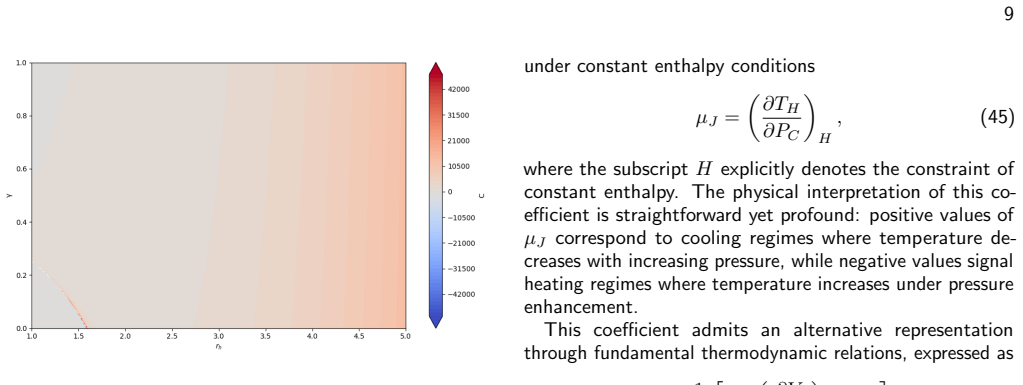


read the original abstract
We investigate the thermodynamic properties of black holes in Conformal Weyl Gravity (CWG) using the Mannheim-Kazanas solution, with particular emphasis on quantum corrections that become significant near the Planck scale. Our analysis employs the Hamilton-Jacobi tunneling formalism to derive the Hawking temperature, revealing explicit contributions from the conformal parameters $\beta$, $\gamma$, and $k$ that lead to substantial deviations from the behavior of a Schwarzschild black hole. We incorporate quantum gravitational effects through the Generalized Uncertainty Principle, demonstrating systematic suppression of thermal radiation in the near-Planckian regime. Using an exponentially corrected entropy model, we compute the complete spectrum of QC thermodynamic potentials, including internal energy, pressure, heat capacity, and free energies. Our heat capacity analysis shows divergence behavior that separates stable and unstable regions, indicating possible thermodynamic transitions controlled by the scale-dependent parameter $\gamma$. The Joule-Thomson expansion analysis shows distinct cooling and heating regimes with inversion points that shift systematically with CWG parameters, capturing QC phase transitions absent in general relativity. We also examine gravitational redshift in CWG geometry, finding complex radial dependence that highlights modifications compared to the Schwarzschild case, although redshift alone cannot observationally distinguish CWG from Einstein's theory. Our results demonstrate that CWG offers a consistent framework for studying black hole thermodynamics beyond general relativity, with quantum corrections modifying phase structures in the near-Planckian regime, though these effects are not expected to yield direct observational consequences.
Editorial analysis
A structured set of objections, weighed in public.
Referee Report
Summary. The paper investigates thermodynamic properties of Mannheim-Kazanas black holes in Conformal Weyl Gravity, deriving a GUP-corrected Hawking temperature that includes explicit dependence on conformal parameters β, γ, and k. It adopts an exponentially corrected entropy model to compute internal energy, pressure, heat capacity, and free energies, reporting divergences in heat capacity that separate stable and unstable phases and Joule-Thomson inversion points that shift with the CWG parameters. Gravitational redshift is also examined, with the overall claim that quantum corrections modify phase structures in the near-Planckian regime within a consistent framework beyond general relativity.
Significance. If the central derivations hold after addressing the foundational assumptions, the work would extend black-hole thermodynamics to conformal gravity with controlled quantum corrections, providing concrete expressions for how scale-dependent parameters alter stability and expansion behavior near the Planck scale. The explicit inclusion of GUP suppression and parameter-dependent inversion points offers falsifiable predictions within the model, though the paper itself notes the absence of direct observational signatures.
major comments (2)
- [Abstract / entropy model] Abstract and the section introducing the entropy model: the exponentially corrected entropy S = A/4 + exp(−A/4) together with the GUP-modified Hamilton-Jacobi temperature are inserted directly into the thermodynamic potentials for the Mannheim-Kazanas metric. No re-derivation from the Wald Noether charge of the Weyl-squared action is provided; such a charge generally yields additional terms proportional to β and γ that would shift the locations of heat-capacity divergences and Joule-Thomson points, making this assumption load-bearing for the reported phase-transition structure.
- [Heat capacity and Joule-Thomson analysis] Heat-capacity and Joule-Thomson sections: the temperature formula already contains β, γ, k and the GUP parameter; the subsequent divergences and inversion points are then expressed in terms of the same parameters. This raises the possibility that the claimed 'phase transitions' largely re-express the input parameter dependence rather than constituting independent emergent phenomena, which must be clarified by explicit limiting-case checks against the Schwarzschild or pure Mannheim-Kazanas thermodynamics.
minor comments (1)
- [Redshift discussion] The abstract states that redshift 'cannot observationally distinguish CWG from Einstein's theory' yet reports 'complex radial dependence'; a brief quantitative comparison of the redshift factor to the Schwarzschild case would improve clarity without altering the central claim.
Simulated Author's Rebuttal
We thank the referee for the careful reading and constructive comments on our manuscript. We address each major comment point by point below, indicating the revisions we will incorporate.
read point-by-point responses
-
Referee: [Abstract / entropy model] Abstract and the section introducing the entropy model: the exponentially corrected entropy S = A/4 + exp(−A/4) together with the GUP-modified Hamilton-Jacobi temperature are inserted directly into the thermodynamic potentials for the Mannheim-Kazanas metric. No re-derivation from the Wald Noether charge of the Weyl-squared action is provided; such a charge generally yields additional terms proportional to β and γ that would shift the locations of heat-capacity divergences and Joule-Thomson points, making this assumption load-bearing for the reported phase-transition structure.
Authors: We appreciate the referee highlighting this foundational point. The exponentially corrected entropy is employed as a phenomenological model to capture quantum effects in the near-Planckian regime, consistent with prior literature on GUP-corrected thermodynamics. We acknowledge that a complete Wald Noether charge derivation for the Weyl-squared action would generally produce additional contributions involving β and γ. Our focus remains on the application of GUP and exponential corrections to the given Mannheim-Kazanas metric. In the revised manuscript we will add a clarifying discussion of this modeling choice, its scope, and relevant references to modified-gravity entropy calculations, while noting that the reported phase features result from the interplay of the metric parameters and the correction terms. revision: partial
-
Referee: [Heat capacity and Joule-Thomson analysis] Heat-capacity and Joule-Thomson sections: the temperature formula already contains β, γ, k and the GUP parameter; the subsequent divergences and inversion points are then expressed in terms of the same parameters. This raises the possibility that the claimed 'phase transitions' largely re-express the input parameter dependence rather than constituting independent emergent phenomena, which must be clarified by explicit limiting-case checks against the Schwarzschild or pure Mannheim-Kazanas thermodynamics.
Authors: We thank the referee for this observation. To establish that the divergences and inversion points reflect genuine emergent behavior arising from the quantum corrections rather than direct re-expression of the input parameters, we will include explicit limiting-case analyses in the revised manuscript. These will recover the Schwarzschild limit and the pure Mannheim-Kazanas thermodynamics (with and without GUP) and demonstrate the corresponding shifts or disappearance of the heat-capacity divergences and Joule-Thomson points, thereby clarifying the independent role of the quantum corrections. revision: yes
Circularity Check
No significant circularity; standard application of assumed corrections to given metric
full rationale
The paper takes the Mannheim-Kazanas solution as input, applies the GUP-modified Hamilton-Jacobi method to obtain temperature (with explicit β, γ, k dependence), adopts an exponentially corrected entropy model, and computes thermodynamic potentials and their derivatives to locate heat-capacity divergences and Joule-Thomson points. These calculations produce results that depend on the input parameters and assumed forms but are not equivalent to the inputs by construction. No self-definitional steps, fitted inputs renamed as predictions, or load-bearing self-citations are exhibited in the abstract or described chain. The study of how conformal parameters control phase structure is the intended content rather than a tautology.
Axiom & Free-Parameter Ledger
free parameters (2)
- conformal parameters β, γ, k
- GUP deformation parameter
axioms (2)
- domain assumption The Mannheim-Kazanas metric solves the field equations of conformal Weyl gravity.
- domain assumption The Hamilton-Jacobi tunneling formalism remains valid when supplemented by the generalized uncertainty principle.
Lean theorems connected to this paper
-
IndisputableMonolith/Cost/FunctionalEquation.leanwashburn_uniqueness_aczel unclear?
unclearRelation between the paper passage and the cited Recognition theorem.
We employ the Hamilton-Jacobi tunneling formalism to derive the Hawking temperature... incorporate quantum gravitational effects through the Generalized Uncertainty Principle... Using an exponentially corrected entropy model S = S0 + e^{-S0}
-
IndisputableMonolith/Foundation/BranchSelection.leanbranch_selection unclear?
unclearRelation between the paper passage and the cited Recognition theorem.
heat capacity analysis shows divergence behavior that separates stable and unstable regions... Joule-Thomson expansion analysis shows distinct cooling and heating regimes with inversion points
What do these tags mean?
- matches
- The paper's claim is directly supported by a theorem in the formal canon.
- supports
- The theorem supports part of the paper's argument, but the paper may add assumptions or extra steps.
- extends
- The paper goes beyond the formal theorem; the theorem is a base layer rather than the whole result.
- uses
- The paper appears to rely on the theorem as machinery.
- contradicts
- The paper's claim conflicts with a theorem or certificate in the canon.
- unclear
- Pith found a possible connection, but the passage is too broad, indirect, or ambiguous to say the theorem truly supports the claim.
Reference graph
Works this paper leans on
-
[1]
S. Shankaranarayanan and Joseph P. Johnson, “Modified theories of gravity: Why, how and what?” Gen. Rel. Grav. 54, 44 (2022), arXiv:2204.06533 [gr-qc]
-
[2]
Revisiting the black hole entropy and the information paradox
Ovidiu Cristinel Stoica, “Revisiting the black hole entropy and the information paradox,” Adv. High Energy Phys. 2018, 4130417 (2018), arXiv:1807.05864 [gr-qc]
work page internal anchor Pith review Pith/arXiv arXiv 2018
-
[3]
Exact Vacuum Solution to Conformal Weyl Gravity and Galactic Rotation Curves,
Philip D. Mannheim and Demosthenes Kazanas, “Exact Vacuum Solution to Conformal Weyl Gravity and Galactic Rotation Curves,” Astrophys. J. 342, 635–638 (1989)
work page 1989
-
[4]
Making the Case for Conformal Gravity
Philip D. Mannheim, “Making the Case for Conformal Grav- ity,” Found. Phys. 42, 388–420 (2012), arXiv:1101.2186 [hep-th]
work page internal anchor Pith review Pith/arXiv arXiv 2012
-
[5]
Attractive and repulsive gravity,
Philip D. Mannheim, “Attractive and repulsive gravity,” Found. Phys. 30, 709–746 (2000), arXiv:gr-qc/0001011
-
[6]
Conformal Cosmology With No Cos- mological Constant,
Philip D. Mannheim, “Conformal Cosmology With No Cos- mological Constant,” Gen. Rel. Grav. 22, 289–298 (1990)
work page 1990
-
[7]
Solution to the ghost problem in fourth order derivative theories
Philip D. Mannheim, “Solution to the ghost problem in fourth order derivative theories,” Found. Phys. 37, 532–571 (2007), arXiv:hep-th/0608154
work page internal anchor Pith review Pith/arXiv arXiv 2007
-
[8]
Alternatives to Dark Matter and Dark Energy
Philip D. Mannheim, “Alternatives to dark matter and dark energy,” Prog. Part. Nucl. Phys. 56, 340–445 (2006), arXiv:astro-ph/0505266
work page internal anchor Pith review Pith/arXiv arXiv 2006
-
[9]
Fitting galactic rotation curves with conformal gravity and a global quadratic potential
Philip D. Mannheim and James G. O’Brien, “Fitting galactic rotation curves with conformal gravity and a global quadratic 13 potential,” Phys. Rev. D 85, 124020 (2012), arXiv:1011.3495 [astro-ph.CO]
work page internal anchor Pith review Pith/arXiv arXiv 2012
-
[10]
AdS black strings in a cosmic web: geodesics, shadows, and thermodynamics,
Faizuddin Ahmed, Ahmad Al-Badawi, and Izzet Sakallı, “AdS black strings in a cosmic web: geodesics, shadows, and thermodynamics,” Eur. Phys. J. C 85, 554 (2025), arXiv:2505.13833 [gr-qc]
-
[11]
Faizuddin Ahmed, Ahmad Al-Badawi, and ˙Izzet Sakallı, “Some observable physical properties of Finslerian Hayward- like black hole with global monopole charge and quintessence field,” Eur. Phys. J. C 85, 668 (2025)
work page 2025
-
[12]
Dunkl black hole with phantom global monopoles: geodesic analysis, thermodynamics and shadow,
Ahmad Al-Badawi, Faizuddin Ahmed, and ˙Izzet Sakallı, “Dunkl black hole with phantom global monopoles: geodesic analysis, thermodynamics and shadow,” Eur. Phys. J. C 85, 660 (2025)
work page 2025
-
[13]
Faizuddin Ahmed, Ahmad Al-Badawi, and Izzet Sakallı, “Geodesics Analysis, Perturbations and Deflection Angle of Photon Ray in Finslerian Bardeen-Like Black Hole with a GM Surrounded by a Quintessence Field,” Annalen der Physik (2025), 10.1002/andp.202500087, article number: 2500087
-
[14]
Effective quantum gravity black hole with cloud of strings surrounded by quintessence field,
Ahmad Al-Badawi, Faizuddin Ahmed, and ˙Izzet Sakallı, “Effective quantum gravity black hole with cloud of strings surrounded by quintessence field,” Nucl. Phys. B 1017, 116961 (2025)
work page 2025
-
[15]
Thermodynamics of the Weyl geometric gravity black holes,
Muhammad F. A. R. Sakti, Piyabut Burikham, and Tiberiu Harko, “Thermodynamics of the Weyl geometric gravity black holes,” Phys. Rev. D 110, 064012 (2024), arXiv:2401.10410 [gr-qc]
-
[16]
Black hole thermodynamics and heat engines in conformal gravity
Hao Xu, Yuan Sun, and Liu Zhao, “Black hole thermody- namics and heat engines in conformal gravity,” Int. J. Mod. Phys. D 26, 1750151 (2017), arXiv:1706.06442 [gr-qc]
work page internal anchor Pith review Pith/arXiv arXiv 2017
-
[17]
Quantum gravitational corrections to the entropy of a Schwarzschild black hole,
Xavier Calmet and Folkert Kuipers, “Quantum gravitational corrections to the entropy of a Schwarzschild black hole,” Phys. Rev. D 104, 066012 (2021), arXiv:2108.06824 [hep- th]
-
[18]
Quantum gravitational corrections to the entropy of a Reissner–Nordstr¨ om black hole,
Ruben Campos Delgado, “Quantum gravitational corrections to the entropy of a Reissner–Nordstr¨ om black hole,” Eur. Phys. J. C 82, 272 (2022), [Erratum: Eur.Phys.J.C 83, 468 (2023)], arXiv:2201.08293 [hep-th]
-
[19]
Quantum gravity effect on the Hawking radiation of spinning dilaton black hole,
Ganim Gecim and Yusuf Sucu, “Quantum gravity effect on the Hawking radiation of spinning dilaton black hole,” Eur. Phys. J. C 79, 882 (2019)
work page 2019
-
[20]
GUP-reinforced Hawking radiation in rotating linear dilaton black hole spacetime,
E. Sucu and ˙I Sakallı, “GUP-reinforced Hawking radiation in rotating linear dilaton black hole spacetime,” Phys. Scripta 98, 105201 (2023)
work page 2023
-
[21]
Behnam Pourhassan, Ali ¨Ovg¨ un, and ˙Izzet Sakallı, “PV criticality of Achucarro-Ortiz black hole in the presence of higher order quantum and GUP corrections,” Int. J. Geom. Meth. Mod. Phys. 17, 2050156 (2020), arXiv:1811.02193 [gr-qc]
-
[22]
Quantum gravity effect on the tunneling particles from Warped-AdS 3 black hole,
Ganim Gecim and Yusuf Sucu, “Quantum gravity effect on the tunneling particles from Warped-AdS 3 black hole,” Mod. Phys. Lett. A 33, 1850164 (2018)
work page 2018
-
[23]
Erdem Sucu and ˙Izzet Sakallı, “Nonlinear electrodynamics effects on the geometry, thermodynamics, and quantum dynamics of (2+1)-dimensional black holes,” Nucl. Phys. B 1015, 116894 (2025)
work page 2025
-
[24]
GUP Modified Hawking Ra- diation in Bumblebee Gravity,
Sara Kanzi and ˙Izzet Sakallı, “GUP Modified Hawking Ra- diation in Bumblebee Gravity,” Nucl. Phys. B 946, 114703 (2019), arXiv:1905.00477 [hep-th]
-
[25]
Hawking radiation of Euler–Heisenberg-adS black hole under the GUP effect,
Mustafa Dernek, Cavit Tekincay, Ganim Gecim, Yusuf Kucukakca, and Yusuf Sucu, “Hawking radiation of Euler–Heisenberg-adS black hole under the GUP effect,” Eur. Phys. J. Plus 138, 369 (2023)
work page 2023
-
[26]
Pouria Pedram, Kourosh Nozari, and S. H. Taheri, “The effects of minimal length and maximal momentum on the transition rate of ultra cold neutrons in gravitational field,” JHEP 03, 093 (2011), arXiv:1103.1015 [hep-th]
work page internal anchor Pith review Pith/arXiv arXiv 2011
-
[27]
The GUP effect on Hawking Radiation of the 2+1 dimensional Black Hole
Ganim Gecim and Yusuf Sucu, “The GUP effect on Hawking radiation of the 2 + 1 dimensional black hole,” Phys. Lett. B 773, 391–394 (2017), arXiv:1704.03536 [gr-qc]
work page internal anchor Pith review Pith/arXiv arXiv 2017
-
[28]
Minimal Length and Bouncing Particle Spectrum
K. Nozari and P. Pedram, “Minimal Length and Bouncing Particle Spectrum,” EPL 92, 50013 (2010), arXiv:1011.5673 [hep-th]
work page internal anchor Pith review Pith/arXiv arXiv 2010
-
[29]
Quantum gravity effect on the Hawking radiation of charged rotating BTZ black hole
Ganim Gecim and Yusuf Sucu, “Quantum gravity effect on the Hawking radiation of charged rotating BTZ black hole,” Gen. Rel. Grav. 50, 152 (2018), arXiv:1804.10551 [gr-qc]
work page internal anchor Pith review Pith/arXiv arXiv 2018
-
[30]
Minimal length, maximal momentum and Hilbert space representation of quantum mechanics
Kourosh Nozari and Amir Etemadi, “Minimal length, maximal momentum and Hilbert space representation of quantum mechanics,” Phys. Rev. D 85, 104029 (2012), arXiv:1205.0158 [hep-th]
work page internal anchor Pith review Pith/arXiv arXiv 2012
-
[31]
Quantum Gravity Cor- rection to Hawking Radiation of the 2 + 1-Dimensional Wormhole,
Ganim Gecim and Yusuf Sucu, “Quantum Gravity Cor- rection to Hawking Radiation of the 2 + 1-Dimensional Wormhole,” Adv. High Energy Phys. 2020, 7516789 (2020), arXiv:2002.03699 [hep-th]
-
[32]
Sunny Vagnozzi et al., “Horizon-scale tests of gravity theories and fundamental physics from the Event Horizon Telescope image of Sagittarius A,” Class. Quant. Grav. 40, 165007 (2023), arXiv:2205.07787 [gr-qc]
work page internal anchor Pith review Pith/arXiv arXiv 2023
-
[33]
First Sagittarius A* Event Horizon Telescope Results. VI. Testing the Black Hole Metric,
Kazunori Akiyama et al. (Event Horizon Telescope), “First Sagittarius A* Event Horizon Telescope Results. VI. Testing the Black Hole Metric,” Astrophys. J. Lett. 930, L17 (2022), arXiv:2311.09484 [astro-ph.HE]
-
[34]
Joule-Thomson expansion of $d$-dimensional charged AdS black holes
Jie-Xiong Mo, Gu-Qiang Li, Shan-Quan Lan, and Xiao-Bao Xu, “Joule-Thomson expansion of d-dimensional charged AdS black holes,” Phys. Rev. D 98, 124032 (2018), arXiv:1804.02650 [gr-qc]
work page internal anchor Pith review Pith/arXiv arXiv 2018
-
[35]
Joule-Thomson Expansion of Charged AdS Black Holes
¨Ozg¨ ur¨Okc¨ u and Ekrem Aydıner, “Joule–Thomson expansion of the charged AdS black holes,” Eur. Phys. J. C 77, 24 (2017), arXiv:1611.06327 [gr-qc]
work page internal anchor Pith review Pith/arXiv arXiv 2017
-
[36]
Joule-Thomson expansion in AdS black holes with mo- mentum relaxation,
Adolfo Cisterna, Shi-Qian Hu, and Xiao-Mei Kuang, “Joule-Thomson expansion in AdS black holes with mo- mentum relaxation,” Phys. Lett. B 797, 134883 (2019), arXiv:1808.07392 [gr-qc]
-
[37]
Joule-Thomson Expansion of Kerr-AdS Black Holes
¨Ozg¨ ur¨Okc¨ u and Ekrem Aydıner, “Joule–Thomson expansion of Kerr–AdS black holes,” Eur. Phys. J. C 78, 123 (2018), arXiv:1709.06426 [gr-qc]
work page internal anchor Pith review Pith/arXiv arXiv 2018
-
[38]
Joule-Thomson effect of AdS black holes in conformal gravity,
Yang Guo, Hao Xie, and Yan-Gang Miao, “Joule-Thomson effect of AdS black holes in conformal gravity,” Nucl. Phys. B 993, 116280 (2023), arXiv:2301.03004 [gr-qc]
-
[39]
On the thermodynamic phase structure of conformal gravity
Hao Xu and Man-Hong Yung, “On the thermodynamic phase structure of conformal gravity,” Phys. Lett. B 783, 36–42 (2018), arXiv:1804.10446 [gr-qc]
work page internal anchor Pith review Pith/arXiv arXiv 2018
-
[40]
Hawking Radiation as Tunneling
Maulik K. Parikh and Frank Wilczek, “Hawking radiation as tunneling,” Phys. Rev. Lett. 85, 5042–5045 (2000), arXiv:hep-th/9907001
work page internal anchor Pith review Pith/arXiv arXiv 2000
-
[41]
Quantum tunneling and aschenbach effect in nonlinear einstein-power-yang-mills ads black holes,
Erdem Sucu and ˙Izzet SAKALLI, “Quantum tunneling and aschenbach effect in nonlinear einstein-power-yang-mills ads black holes,” Chinese Physics C (2025)
work page 2025
-
[42]
The Generalized Uncertainty Principle and Black Hole Remnants
Ronald J. Adler, Pisin Chen, and David I. Santiago, “The Generalized uncertainty principle and black hole remnants,” Gen. Rel. Grav. 33, 2101–2108 (2001), arXiv:gr-qc/0106080
work page internal anchor Pith review Pith/arXiv arXiv 2001
-
[43]
Hawking Radiation as Quantum Tunneling from Noncommutative Schwarzschild Black Hole
Kourosh Nozari and S. Hamid Mehdipour, “Hawking Ra- diation as Quantum Tunneling from Noncommutative Schwarzschild Black Hole,” Class. Quant. Grav. 25, 175015 (2008), arXiv:0801.4074 [gr-qc]. 14
work page internal anchor Pith review Pith/arXiv arXiv 2008
-
[44]
Counting black hole microscopic states in loop quantum gravity
A. Ghosh and P. Mitra, “Counting black hole microscopic states in loop quantum gravity,” Phys. Rev. D 74, 064026 (2006), arXiv:hep-th/0605125
work page internal anchor Pith review Pith/arXiv arXiv 2006
-
[45]
On Quantum Statistical Mechanics of a Schwarzschild Black Hole
Kirill V. Krasnov, “On Quantum statistical mechanics of Schwarzschild black hole,” Gen. Rel. Grav. 30, 53–68 (1998), arXiv:gr-qc/9605047
work page internal anchor Pith review Pith/arXiv arXiv 1998
-
[46]
Exponential Corrections to Black Hole Entropy,
Ayan Chatterjee and Amit Ghosh, “Exponential Corrections to Black Hole Entropy,” Phys. Rev. Lett. 125, 041302 (2020), arXiv:2007.15401 [gr-qc]
-
[47]
Black Holes in Gravity with Conformal Anomaly and Logarithmic Term in Black Hole Entropy
Rong-Gen Cai, Li-Ming Cao, and Nobuyoshi Ohta, “Black Holes in Gravity with Conformal Anomaly and Logarith- mic Term in Black Hole Entropy,” JHEP 04, 082 (2010), arXiv:0911.4379 [hep-th]
work page internal anchor Pith review Pith/arXiv arXiv 2010
-
[48]
Minimal Length Scale Scenarios for Quantum Gravity
Sabine Hossenfelder, “Minimal Length Scale Scenarios for Quantum Gravity,” Living Rev. Rel. 16, 2 (2013), arXiv:1203.6191 [gr-qc]
work page internal anchor Pith review Pith/arXiv arXiv 2013
-
[49]
Erdem Sucu, Izzet Sakalli, and Behnam Pourhassan, “Quan- tum corrections in thermodynamics of black holes modified by nonlinear electrodynamics and their observational sig- natures,” International Journal of Geometric Methods in Modern Physics (2025)
work page 2025
-
[50]
Black holes, gravitational waves and fundamental physics: a roadmap
Leor Barack et al. , “Black holes, gravitational waves and fundamental physics: a roadmap,” Class. Quant. Grav. 36, 143001 (2019), arXiv:1806.05195 [gr-qc]
work page internal anchor Pith review Pith/arXiv arXiv 2019
-
[51]
A. Addazi et al. , “Quantum gravity phenomenology at the dawn of the multi-messenger era—A review,” Prog. Part. Nucl. Phys. 125, 103948 (2022), arXiv:2111.05659 [hep-ph]
-
[52]
Hermann Weyl, “Reine Infinitesimalgeometrie,” Math. Z. 2, 384–411 (1918)
work page 1918
-
[53]
Zur Weylschen Relativit¨ atstheorie und der Weylschen Erweiterung des Kr¨ ummungstensorbegriffs,
Rudolf Bach, “Zur Weylschen Relativit¨ atstheorie und der Weylschen Erweiterung des Kr¨ ummungstensorbegriffs,” Math. Z. 9, 110–135 (1921)
work page 1921
-
[54]
Birkhoff’s Theorem in Conformal Grav- ity,
Ronald J. Riegert, “Birkhoff’s Theorem in Conformal Grav- ity,” Phys. Rev. Lett. 53, 315–318 (1984)
work page 1984
-
[55]
Classical Gravity with Higher Derivatives,
K. S. Stelle, “Classical Gravity with Higher Derivatives,” Gen. Rel. Grav. 9, 353–371 (1978)
work page 1978
-
[56]
Cosmic acceleration as the solution to the cosmological constant problem
Philip D. Mannheim, “Cosmic acceleration as the solution to the cosmological constant problem,” Astrophys. J. 561, 1–12 (2001), arXiv:astro-ph/9910093
work page internal anchor Pith review Pith/arXiv arXiv 2001
-
[57]
Weyl-Invariant Higher Curvature Gravity Theories in n Dimensions
M. Reza Tanhayi, Suat Dengiz, and Bayram Tekin, “Weyl- Invariant Higher Curvature Gravity Theories in n Dimensions,” Phys. Rev. D 85, 064016 (2012), arXiv:1201.5068 [hep-th]
work page internal anchor Pith review Pith/arXiv arXiv 2012
-
[58]
Weyl-Einsteinian-Cubic Gravity,
Suat Dengiz, “Weyl-Einsteinian-Cubic Gravity,” (2024), arXiv:2408.04282 [hep-th]
-
[59]
Local Conformal Symmetry: the Missing Symmetry Component for Space and Time
Gerard ’t Hooft, “Local Conformal Symmetry: the Miss- ing Symmetry Component for Space and Time,” (2014), arXiv:1410.6675 [gr-qc]
work page internal anchor Pith review Pith/arXiv arXiv 2014
-
[60]
Standard Model in Weyl conformal ge- ometry,
D. M. Ghilencea, “Standard Model in Weyl conformal ge- ometry,” Eur. Phys. J. C 82, 23 (2022), arXiv:2104.15118 [hep-ph]
-
[61]
A unified confor- mal model for fundamental interactions without dynamical Higgs field,
Marek Pawlowski and Ryszard Raczka, “A unified confor- mal model for fundamental interactions without dynamical Higgs field,” Found. Phys. 24, 1305–1327 (1994), arXiv:hep- th/9407137
-
[62]
A Noncompact Weyl-Einstein-Yang-Mills Model: A Semiclassical Quantum Gravity
Suat Dengiz, “A noncompact Weyl–Einstein–Yang–Mills model: A semiclassical quantum gravity,” Annals Phys. 383, 560–578 (2017), arXiv:1609.02475 [hep-th]
work page internal anchor Pith review Pith/arXiv arXiv 2017
-
[63]
Weyl-gauging of Topologically Massive Gravity
Suat Dengiz, Ercan Kilicarslan, and Bayram Tekin, “Weyl- gauging of Topologically Massive Gravity,” Phys. Rev. D 86, 104014 (2012), arXiv:1209.1251 [hep-th]
work page internal anchor Pith review Pith/arXiv arXiv 2012
-
[64]
Lee-Wald Charge and Asymptotic Behaviors of the Weyl- invariant Topologically Massive Gravity,
Suat Dengiz, Ercan Kilicarslan, and Mohammad Reza Setare, “Lee-Wald Charge and Asymptotic Behaviors of the Weyl- invariant Topologically Massive Gravity,” Class. Quant. Grav. 37, 215016 (2020), arXiv:2002.00345 [hep-th]
-
[65]
Conformal Weyl gravity and perihelion preces- sion,
Joseph Sultana, Demosthenes Kazanas, and Jackson Levi Said, “Conformal Weyl gravity and perihelion preces- sion,” Phys. Rev. D 86, 084008 (2012), arXiv:1910.06118 [gr-qc]
-
[66]
Quasinormal ringing and shadows of black holes and wormholes in dark matter-inspired Weyl gravity,
Roman A. Konoplya, Andrii Khrabustovskyi, Jan Kˇ r ´ ıˇ z, and Alexander Zhidenko, “Quasinormal ringing and shadows of black holes and wormholes in dark matter-inspired Weyl gravity,” JCAP 04, 062 (2025), arXiv:2501.16134 [gr-qc]
-
[67]
Newman-Penrose formal- ism and exact vacuum solutions to conformal Weyl gravity,
Petr Jizba and Kamil Mudruˇ nka, “Newman-Penrose formal- ism and exact vacuum solutions to conformal Weyl gravity,” Phys. Rev. D 110, 124006 (2024), arXiv:2409.08344 [gr-qc]
-
[68]
Li-Xue Yue and Da-Ming Chen, “Test of Conformal Gravity as an Alternative to Dark Matter from the Observations of Elliptical Galaxies,” Res. Astron. Astrophys. 25, 065015 (2025), arXiv:2506.03955 [astro-ph.GA]
-
[69]
Statistical Strong Lensing as a Test of Conformal Gravity,
Li-Xue Yue and Da-Ming Chen, “Statistical Strong Lensing as a Test of Conformal Gravity,” Universe 11, 178 (2025), arXiv:2506.21019 [astro-ph.CO]
-
[70]
Gravity at cosmological distances: Explain- ing the accelerating expansion without dark energy,
Junpei Harada, “Gravity at cosmological distances: Explain- ing the accelerating expansion without dark energy,” Phys. Rev. D 108, 044031 (2023), arXiv:2308.02115 [gr-qc]
-
[71]
Dark matter as a Weyl geometric effect,
Piyabut Burikham, Tiberiu Harko, Kulapant Pimsamarn, and Shahab Shahidi, “Dark matter as a Weyl geometric effect,” Phys. Rev. D 107, 064008 (2023), arXiv:2302.08289 [gr-qc]
-
[72]
General class of wormhole geometries in conformal Weyl gravity
Francisco S. N. Lobo, “General class of wormhole geometries in conformal Weyl gravity,” Class. Quant. Grav. 25, 175006 (2008), arXiv:0801.4401 [gr-qc]
work page internal anchor Pith review Pith/arXiv arXiv 2008
-
[73]
Exact Static Cylindrical Solution to Conformal Weyl Gravity
Jackson Levi Said, Joseph Sultana, and Kristian Zarb Adami, “Exact Static Cylindrical Solution to Conformal Weyl Gravity,” Phys. Rev. D 85, 104054 (2012), arXiv:1201.0860 [gr-qc]
work page internal anchor Pith review Pith/arXiv arXiv 2012
-
[74]
Besse, Einstein Manifolds (Springer-Verlag, Berlin, Heidelberg, New York, 1987)
Arthur L. Besse, Einstein Manifolds (Springer-Verlag, Berlin, Heidelberg, New York, 1987)
work page 1987
-
[75]
Particle production and complex path analysis
K. Srinivasan and T. Padmanabhan, “Particle production and complex path analysis,” Phys. Rev. D 60, 024007 (1999), arXiv:gr-qc/9812028
work page internal anchor Pith review Pith/arXiv arXiv 1999
-
[76]
Constraints on the Generalized Uncertainty Principle from Black Hole Thermodynamics
Sunandan Gangopadhyay, Abhijit Dutta, and Mir Faizal, “Constraints on the Generalized Uncertainty Principle from Black Hole Thermodynamics,” EPL 112, 20006 (2015), arXiv:1501.01482 [gr-qc]
work page internal anchor Pith review Pith/arXiv arXiv 2015
-
[77]
A. Tawfik, “Impacts of Generalized Uncertainty Principle on Black Hole Thermodynamics and Salecker-Wigner Inequali- ties,” JCAP 07, 040 (2013), arXiv:1307.1894 [gr-qc]
work page internal anchor Pith review Pith/arXiv arXiv 2013
-
[78]
Comparison of ap- proaches to quantum correction of black hole thermody- namics,
Kourosh Nozari and A. S. Sefiedgar, “Comparison of ap- proaches to quantum correction of black hole thermody- namics,” Phys. Lett. B 635, 156–160 (2006), arXiv:gr- qc/0601116
-
[79]
Generalized Uncertainty Principle: Approaches and Applications
Abdel Nasser Tawfik and Abdel Magied Diab, “Generalized Uncertainty Principle: Approaches and Applications,” Int. J. Mod. Phys. D 23, 1430025 (2014), arXiv:1410.0206 [gr-qc]
work page internal anchor Pith review Pith/arXiv arXiv 2014
-
[80]
The algebraic structure of the generalized uncertainty principle
Michele Maggiore, “The Algebraic structure of the general- ized uncertainty principle,” Phys. Lett. B 319, 83–86 (1993), arXiv:hep-th/9309034
work page internal anchor Pith review Pith/arXiv arXiv 1993
discussion (0)
Sign in with ORCID, Apple, or X to comment. Anyone can read and Pith papers without signing in.