REVIEW 3 major objections 5 minor 47 references
FECT: Factuality Evaluation of Interpretive AI-Generated Claims in Contact Center Conversation Transcripts
T0 review · 3 major / 5 minor · reviewed 2026-08-06 · deepseek-v4-flash
Pith's one-line read Factuality of interpretive AI claims about contact center calls can be judged automatically with a 3D prompt, reaching mean F1 0.86 without fine-tuning.
desk verdict Useful, narrowly scoped benchmark for interpretive factuality in contact center transcripts, but the 0.82 human agreement was measured after removing ambiguous cases, so the headline 0.86 F1 rests on labels whose independent reliability is not established. read the letter →
The pith
A machine-rendered reading of the paper's core claim, the machinery that carries it, and where it could break.
The reading
What carries the argument
The load-bearing object is the 3D paradigm, a four-step evaluation routine: (1) Decompose the claim into minimal informational units; (2) Decouple those units into concrete words and subjective-interpretation words; (3) verify each unit against explicit mentions or minimal implicit evidence; (4) Detach the relation between words from their meanings and verify the relation—who did what to whom, and why—using explicit or implicit evidence. The same routine is encoded in a human annotation guideline and in the LLM-judge prompt, so that the human labels and the model judgments are aligned on the same granular steps rather than on an unstated notion of "factual." The paradigm is what converts an inherently subjective judgment into a checkable procedure, and it is the component that the paper varies (3D vs. BASIC prompts) to isolate the effect of structuring the evaluation process.
What would settle it
A second, independent annotation team could label all 410 conversation-claim pairs using the published 3D guideline without pre-filtering any items, then compare their majority labels and pairwise agreement to the published labels; if their agreement with the published labels is well below 0.82, or if their own agreement on the final 410 is low, the benchmark's ground truth—and the F1 scores derived from it—would not be reliable.
Extended reading notes
Core claim
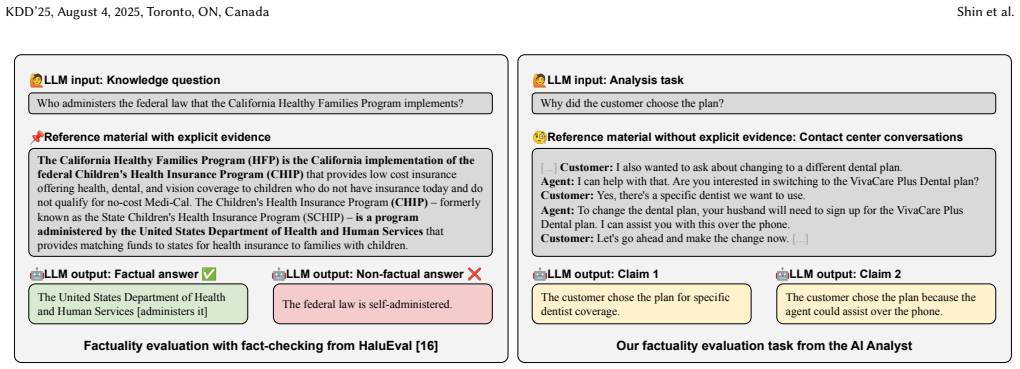
The paper's central claim is that factuality of interpretive claims can be grounded in a shared, linguistically-informed evaluation routine, and that aligning both human annotators and LLM judges on that routine is enough to get usable automatic evaluation. The routine is the 3D paradigm: decompose a claim into atomic claims; decouple words with concrete meanings from words expressing subjective interpretation; detach the relation between words from their meanings; and verify each component with explicit mentions or, where needed, minimal implicit evidence. Applying the 3D guideline to human annotation raised pairwise inter-annotator agreement from 0.28 in unguided labeling to 0.58, and the final FECT benchmark of 410 pairs (345 factual, 65 non-factual) reports inter-annotator agreement of 0.82 after ambiguous pairs were excluded. On that benchmark, the best configuration—the o1 reasoning model with the 3D prompt that requests intermediate reasoning tokens—achieves mean F1 0.86 (std 0.02) over 10 runs, and the paper argues that no fine-tuning or extensive prompt optimization was needed to get there. The paper also finds that reasoning models generally outperform non-reasoning models, that adding test-time compute helps frontier non-reasoning models approach reasoning models, and that small models are often hurt by test-time compute.
Load-bearing premise
The load-bearing premise is that the reported 0.82 inter-annotator agreement, measured after removing conversation-claim pairs where raters disagreed, actually validates the factuality labels in the final 410-pair benchmark; if agreement on the excluded items was low and those items are the hard cases, the benchmark's ground truth is a survivorship-selected subset whose reliability remains unmeasured.
Editorial extensions
If this is right
- If the 3D paradigm works as reported, an off-the-shelf reasoning LLM can audit contact-center AI claims at mean F1 0.86 with no fine-tuning, making automated factuality checks practical for enterprise deployment.
- Structuring the prompt with granular 3D steps plus test-time compute lets frontier non-reasoning models such as GPT-4.1 and GPT-4o reach F1 0.84–0.85, nearly matching the best reasoning-model score.
- The FECT benchmark deliberately contains only conversation-claim pairs whose factuality humans could agree on; model performance is therefore a measure of evidence-driven judgment, not of handling genuinely ambiguous interpretations.
- Because the 3D prompt was format-optimized only for the o1 model, other reasoning models' scores (0.80–0.83 with BASIC prompts) may understate what the same recipe could achieve with model-specific formatting.
- Factuality in this evaluation is groundedness of the claim in the referenced conversation alone; whether the claim actually answers the user's analysis task is treated as an orthogonal requirement outside the benchmark.
Reading between the lines
- Because ambiguous pairs are excluded from FECT, the benchmark measures agreement-selected tasks; an explicit report of pre-vote agreement on the final 410 pairs would directly quantify label reliability.
- FECT uses synthetic conversations that mimic real contact-center patterns, so the headline F1 should be re-measured on real transcripts; the paper argues the distributions are similar but does not test that transfer.
- The 3D recipe is not tied to contact centers: the same decompose–decouple–detach routine could be applied to interpretive claims in medical, legal, or financial summarization, where ground truth is likewise absent.
- The smaller-model finding—test-time compute can hurt—is a caution for practitioners: adding reasoning tokens helps only if the model has capacity to do the multi-step verification, so the 3D prompt should be paired with TTC selectively.
Editorial analysis
A structured set of objections, weighed in public.
Referee Report
Summary. The paper introduces FECT, a benchmark for evaluating the factuality of interpretive, single-sentence claims generated by LLMs about contact center conversation transcripts. To create reliable labels, the authors propose a 3D (Decompose, Decouple, Detach) annotation paradigm and apply the same paradigm in the prompts of LLM judges. They exclude conversation-claim pairs on which human annotators cannot agree, leaving 410 pairs (345 factual, 65 non-factual), and report an inter-annotator agreement of 0.82 after this exclusion. In the main experiment, 17 LLMs are evaluated under four prompt variants, each run 10 times; the best mean F1 is 0.86, achieved by o1 with the 3D_WITH_TTC prompt. The paper concludes that aligning LLM judges with the 3D paradigm yields strong factuality-detection performance without fine-tuning or extensive prompt optimization.
Significance. If the ground-truth labels on the final 410 pairs are reliable, this is a valuable contribution: it addresses an under-studied setting where claims are interpretive rather than directly extractable, and it provides a public benchmark for that setting. The experimental reporting is a notable strength: 10 runs per condition, means and standard deviations, and a prompt ablation are all clearly presented. The 3D rubric is concrete and linguistically motivated, and the paper honestly acknowledges that ambiguous cases are left out. The main unresolved risk is that the reliability evidence for the benchmark labels is incomplete, because the reported agreement is computed only on the subset that survived ambiguity exclusion, and no agreement is reported on the final 410 pairs themselves.
major comments (3)
- [Section 2.4, Table 1] The reliability of the benchmark's ground-truth labels is not established by the reported 0.82. Section 2.4 explicitly says this score was achieved after excluding ambiguous tasks, and Table 1 shows that 84 pairs were excluded (31 sentiment, 53 relation). The paper does not report any agreement statistic computed on the final 410 pairs, nor does it specify how many annotators labeled each final pair, whether the 0.82 is Cohen's kappa or percent agreement, or whether final labels were produced by voting, adjudication, or discussion. Because the headline F1 of 0.86 is measured against those very labels, a reader cannot tell whether FECT is a well-grounded benchmark or an easy residue of the original 510 pairs whose reliability was never measured. Please compute and report agreement on the final 410 pairs before any reconciliation, and describe the labeling protocol for those pairs in detail.
- [Section 2.3, Table 1, Section 4] The exclusion process removes precisely the subjective dimensions the 3D paradigm is designed to handle: 31 sentiment pairs and 53 relation pairs. The demonstrated agreement is therefore partly built into the construction of the benchmark, and the F1 result is scoped to the remaining unambiguous subset. This is acknowledged as future work, but the abstract and Section 1 present the 0.82 agreement and the 0.86 F1 without that caveat. Please add an explicit statement that both numbers apply only to the non-ambiguous subset, and report the LLM judges' predictions on the 84 excluded pairs as a diagnostic of where the 3D paradigm fails; otherwise the claim that the 3D paradigm grounds factuality labels overstates what is currently shown.
- [Section 3.1, Section 3.2] Because the 3D prompt was optimized in structure and formatting for the o1 model, the result that o1 achieves the best F1 is not an unbiased comparison across models. The paper discloses this, but the central claim that 'aligning LLM-judges on the 3D paradigm can achieve a mean F1 of 0.86 without extensive prompt optimizations' should be qualified with the fact that the prompt was specifically tuned for one model, and the other 16 models were evaluated with that same o1-optimized prompt. Please either report results with a prompt that is not tuned to any model, or explicitly frame the experiment as a transfer test of an o1-optimized prompt.
minor comments (5)
- [Abstract and Section 1] The abstract and the contributions list state the inter-annotator agreement of 0.82 without noting that it was computed after excluding ambiguous tasks; please add the exclusion caveat in both places, as it is essential for interpreting the number.
- [Table 1] The table header is confusing: the columns under 'Agreement achieved / Agreement not achieved' are labeled 'FECT', 'Sentiment', and 'Relation', but the numeric entries for the latter two are exclusion counts. Please use explicit column names such as 'Final benchmark', 'Excluded: sentiment', and 'Excluded: relation', and add a row for the total number of excluded pairs.
- [Section 2.1] The paper states that the synthetic conversations 'exhibit the same properties and challenges' as the real ones, but no quantitative evidence is given; please add a brief comparison of label distributions or claim characteristics between the synthetic and real sets.
- [Footnote 4] Footnote 4 contains a duplicated article: 'the the synthetic conversation dataset'; please correct the typo.
- [Section 4] The phrase 'c.f.' should be 'cf.' or 'see', and the references to 'Claude-Sonnet' are ambiguous because there are multiple Claude-Sonnet models; please specify which model or model family is meant.
Circularity Check
No significant circularity: the F1 scores are measured against human labels, and the disclosed post-hoc exclusions and prompt tuning are validity concerns, not input-output equivalences.
full rationale
The paper contains no derivation chain that reduces a claimed prediction to its own inputs. The headline F1 of 0.86 (Table 2) is an empirical measurement of 17 LLMs against 410 human-labeled conversation-claim pairs; the labels were produced by human annotators following a written guideline, and each LLM is evaluated by comparing its generated label with those human labels. The 3D prompt shares its decomposition rubric with the human annotation guideline, so the evaluation can be read as measuring how well an LLM follows the authors' rubric; however, this does not make the F1 score equal to the input by construction, because the model must still apply the steps to unseen conversations and can fail at any sub-step. The reported inter-annotator agreement of 0.82 is explicitly described as having been achieved after excluding ambiguous tasks (Section 2.4), which is a transparently reported selected-data statistic and a legitimate reliability concern, but not a logical circularity. Similarly, the statement that the 3D prompt was optimized for o1's structure and formatting (Section 3.1) indicates possible test-set selection or overfitting, yet the paper discloses this and does not relabel a fitted parameter as an independent prediction. No load-bearing self-citations, imported uniqueness theorems, or ansatz-by-citation steps were found. Therefore, under the hard rule requiring a specific reduction for a circularity finding, no circular step can be exhibited.
Assumptions & free parameters
assumptions (4)
- domain assumption Synthetic conversations in FECT exhibit the same properties and challenges as real contact center conversations.
- domain assumption Excluding ambiguous conversation-claim pairs yields a set of labels that can serve as ground truth for evaluating LLM-judges.
- domain assumption The 3D linguistic rubric (decompose, decouple, detach) is a valid and consistently applicable standard for factuality.
- domain assumption The factuality of a claim can be determined solely from the conversation, independent of whether the claim answers the analysis task.
Cite this review
Pith. "Pith review of FECT: Factuality Evaluation of Interpretive AI-Generated Claims in Contact Center Conversation Transcripts." pith.science (2026). https://pith.science/paper/GQUZA7RJ
@misc{pith2026250800889,
  author       = {Pith},
  title        = {Pith review of: FECT: Factuality Evaluation of Interpretive AI-Generated Claims in Contact Center Conversation Transcripts},
  year         = {2026},
  howpublished = {\url{https://pith.science/paper/GQUZA7RJ}},
  note         = {Machine review of arXiv:2508.00889}
}
read the original abstract
Large language models (LLMs) are known to hallucinate, producing natural language outputs that are not grounded in the input, reference materials, or real-world knowledge. In enterprise applications where AI features support business decisions, such hallucinations can be particularly detrimental. LLMs that analyze and summarize contact center conversations introduce a unique set of challenges for factuality evaluation, because ground-truth labels often do not exist for analytical interpretations about sentiments captured in the conversation and root causes of the business problems. To remedy this, we first introduce a \textbf{3D} -- \textbf{Decompose, Decouple, Detach} -- paradigm in the human annotation guideline and the LLM-judges' prompt to ground the factuality labels in linguistically-informed evaluation criteria. We then introduce \textbf{FECT}, a novel benchmark dataset for \textbf{F}actuality \textbf{E}valuation of Interpretive AI-Generated \textbf{C}laims in Contact Center Conversation \textbf{T}ranscripts, labeled under our 3D paradigm. Lastly, we report our findings from aligning LLM-judges on the 3D paradigm. Overall, our findings contribute a new approach for automatically evaluating the factuality of outputs generated by an AI system for analyzing contact center conversations.
Figures


Figures from the paper (5 more)


Reference graph
Works this paper leans on
-
[1]
Eunice Akani, Benoit Favre, Frederic Bechet, and Romain Gemignani. 2024. In- creasing faithfulness in human-human dialog summarization with Spoken Lan- guage Understanding tasks. doi:10.48550/arXiv.2409.10070 arXiv:2409.10070
-
[2]
Anthropic. 2024. Claude 3.5 Sonnet Model Card Addendum. https://www- cdn.anthropic.com/fed9cc193a14b84131812372d8d5857f8f304c52/Model_Card_ Claude_3_Addendum.pdf
work page 2024
-
[3]
Anthropic. 2025. Claude 3.7 Sonnet System Card. https://assets.anthropic.com/ m/785e231869ea8b3b/original/claude-3-7-sonnet-system-card.pdf
work page 2025
-
[4]
Anthropic. 2025. System Card: Claude Opus 4 & Claude Sonnet 4. https://www- cdn.anthropic.com/6be99a52cb68eb70eb9572b4cafad13df32ed995.pdf
work page 2025
-
[5]
Lora Aroyo and Chris Welty. 2015. Truth Is a Lie: Crowd Truth and the Seven Myths of Human Annotation. AI Magazine 36, 1 (March 2015), 15–24. doi:10. 1609/aimag.v36i1.2564
work page 2015
-
[6]
Forrest Sheng Bao, Miaoran Li, Renyi Qu, Ge Luo, Erana Wan, Yujia Tang, Weisi Fan, Manveer Singh Tamber, Suleman Kazi, Vivek Sourabh, Mike Qi, Ruixuan Tu, Chenyu Xu, Matthew Gonzales, Ofer Mendelevitch, and Amin Ahmad. 2024. FaithBench: A Diverse Hallucination Benchmark for Summarization by Modern LLMs. doi:10.48550/arXiv.2410.13210 arXiv:2410.13210
work page Pith review arXiv doi:10.48550/arxiv.2410.13210 2024
-
[7]
Anna Bavaresco, Raffaella Bernardi, Leonardo Bertolazzi, Desmond Elliott, Raquel Fernández, Albert Gatt, Esam Ghaleb, Mario Giulianelli, Michael Hanna, Alexan- der Koller, André F. T. Martins, Philipp Mondorf, Vera Neplenbroek, Sandro Pezzelle, Barbara Plank, David Schlangen, Alessandro Suglia, Aditya K. Surikuchi, Ece Takmaz, and Alberto Testoni. 2024. L...
-
[8]
Cheng-Han Chiang and Hung-yi Lee. 2023. A Closer Look into Automatic Evaluation Using Large Language Models. doi:10.48550/arXiv.2310.05657 arXiv:2310.05657 [cs]
Show all 47 references
-
[9]
DeepSeek. 2025. DeepSeek-R1 Release. https://api-docs.deepseek.com/news/ news250120
2025
-
[10]
Google. 2025. Gemini 2.5 Flash Preview Model Card. https://storage.googleapis. com/model-cards/documents/gemini-2.5-flash-preview.pdf
2025
-
[11]
Google. 2025. Gemini 2.5 Pro Preview Model Card. https://storage.googleapis. com/model-cards/documents/gemini-2.5-pro-preview.pdf
2025
-
[12]
Gordon, Michelle S
Mitchell L. Gordon, Michelle S. Lam, Joon Sung Park, Kayur Patel, Jeff Hancock, Tatsunori Hashimoto, and Michael S. Bernstein. 2022. Jury Learning: Integrating Dissenting Voices into Machine Learning Models. In CHI Conference on Human Factors in Computing Systems . ACM, New Or...
2022
-
[13]
Hasan Iqbal, Yuxia Wang, Minghan Wang, Georgi Nenkov Georgiev, Jiahui Geng, Iryna Gurevych, and Preslav Nakov. 2024. OpenFactCheck: A Unified Framework for Factuality Evaluation of LLMs. In Proceedings of the 2024 Confer- ence on Empirical Methods in Natural Language Processin...
2024 doi
-
[14]
Jeremy Greer, Manos Koukoumidis, Konstantinos Aisopos, and Michael Schuler
-
[15]
Seungone Kim, Jamin Shin, Yejin Cho, Joel Jang, Shayne Longpre, Hwaran Lee, Sangdoo Yun, Seongjin Shin, Sungdong Kim, James Thorne, and Minjoon Seo
-
[16]
Junyi Li, Xiaoxue Cheng, Wayne Xin Zhao, Jian-Yun Nie, and Ji-Rong Wen
-
[17]
Stephanie Lin, Jacob Hilton, and Owain Evans. 2021. TruthfulQA: Measuring How Models Mimic Human Falsehoods. https://arxiv.org/abs/2109.07958v2
2021 arXiv
-
[18]
Yang Liu, Dan Iter, Yichong Xu, Shuohang Wang, Ruochen Xu, and Chenguang Zhu. 2023. G-Eval: NLG Evaluation using Gpt-4 with Better Human Alignment. In Proceedings of the 2023 Conference on Empirical Methods in Natural Language Processing. Association for Computational Linguist...
2023 doi
- [19]
-
[20]
Meta. 2025. Llama 4. https://github.com/meta-llama/llama-models/blob/main/ models/llama4/MODEL_CARD.md
2025
- [21]
-
[22]
Cohen, and Mirella Lapata
Shashi Narayan, Shay B. Cohen, and Mirella Lapata. 2018. Don’t Give Me the Details, Just the Summary! Topic-Aware Convolutional Neural Networks for Extreme Summarization. In Proceedings of the 2018 Conference on Empirical Meth- ods in Natural Language Processing . Association ...
2018 doi
-
[23]
OpenAI. 2024. GPT-4.1 nano. https://platform.openai.com/docs/models/gpt-4.1- nano
2024
-
[24]
OpenAI. 2024. GPT-4o mini: advancing cost-efficient intelligence. https://openai. com/index/gpt-4o-mini-advancing-cost-efficient-intelligence/
2024
-
[25]
OpenAI. 2024. GPT-4o System Card. https://cdn.openai.com/gpt-4o-system- card.pdf
2024
-
[26]
OpenAI. 2024. OpenAI o1 System Card. https://cdn.openai.com/o1-system-card- 20241205.pdf FECT: Factuality Evaluation of Interpretive AI-Generated Claims in Contact Center Conversation Transcripts KDD’25, August 4, 2025, Toronto, ON, Canada
2024
-
[27]
OpenAI. 2025. GPT-4.1. https://platform.openai.com/docs/models/gpt-4.1
2025
-
[28]
OpenAI. 2025. GPT-4.1 mini. https://platform.openai.com/docs/models/gpt-4.1- mini
2025
-
[29]
OpenAI. 2025. OpenAI o3 and o4-mini System Card. https://cdn.openai.com/ pdf/2221c875-02dc-4789-800b-e7758f3722c1/o3-and-o4-mini-system-card.pdf
2025
-
[30]
Oumi Community. 2025. Oumi: an Open, End-to-end Platform for Building Large Foundation Models. https://github.com/oumi-ai/oumi
2025
-
[31]
Panos Achlioptas, Jeremy Greer, Konstantinos Aisopos, Michael Schuler, Ous- sama Elachqar, and Emmanouil Koukoumidis. 2025. HallOumi-8B-classifier. https://huggingface.co/oumi-ai/HallOumi-8B-classifier
2025
-
[32]
Mike Schaekermann, Graeme Beaton, Elaheh Sanoubari, Andrew Lim, Kate Lar- son, and Edith Law. 2020. Ambiguity-aware AI Assistants for Medical Data Analysis. In Proceedings of the 2020 CHI Conference on Human Factors in Comput- ing Systems. ACM, Honolulu HI USA, 1–14. doi:10.11...
2020
-
[33]
Smith, and Yejin Choi
Swabha Swayamdipta, Roy Schwartz, Nicholas Lourie, Yizhong Wang, Han- naneh Hajishirzi, Noah A. Smith, and Yejin Choi. 2020. Dataset Cartogra- phy: Mapping and Diagnosing Datasets with Training Dynamics. In Proceed- ings of the 2020 Conference on Empirical Methods in Natural L...
2020 doi
-
[34]
Zoltán Gendler Szabó. 2020. Compositionality. https://plato.stanford.edu/ archives/fall2024/entries/compositionality/
2020
-
[35]
Liyan Tang, Philippe Laban, and Greg Durrett. 2024. MiniCheck: Efficient Fact- Checking of LLMs on Grounding Documents. InProceedings of the 2024 Conference on Empirical Methods in Natural Language Processing . Association for Computa- tional Linguistics, Miami, Florida, USA, ...
2024 doi
-
[36]
Xiangru Tang, Arjun Nair, Borui Wang, Bingyao Wang, Jai Desai, Aaron Wade, Haoran Li, Asli Celikyilmaz, Yashar Mehdad, and Dragomir Radev. 2021. CON- FIT: Toward Faithful Dialogue Summarization with Linguistically-Informed Con- trastive Fine-tuning. doi:10.18653/v1/2022.naacl-main.415
2021 doi
-
[37]
Alex Wang, Kyunghyun Cho, and Mike Lewis. 2020. Asking and Answering Questions to Evaluate the Factual Consistency of Summaries. InProceedings of the 58th Annual Meeting of the Association for Computational Linguistics . Association for Computational Linguistics, Online, 5008–...
2020 doi
- [38]
-
[39]
Jason Wei, Zhiqing Sun, Spencer Papay, Scott McKinney, Jeffrey Han, Isa Fulford, Hyung Won Chung, Alex Tachard Passos, William Fedus, and Amelia Glaese
- [40]
- [41]
-
[42]
Kivlichan, Vinodkumar Prabhakaran, Davis Yadav, and Amulya Yadav
Wenbo Zhang, Hangzhi Guo, Ian D. Kivlichan, Vinodkumar Prabhakaran, Davis Yadav, and Amulya Yadav. 2023. A Taxonomy of Rater Disagreements: Surveying Challenges & Opportunities from the Perspective of Annotating Online Toxicity. doi:10.48550/arXiv.2311.04345 arXiv:2311.04345 [cs]
- [43]
-
[47]
What did the customer call about?
Lianmin Zheng, Wei-Lin Chiang, Ying Sheng, Siyuan Zhuang, Zhanghao Wu, Yonghao Zhuang, Zi Lin, Zhuohan Li, Dacheng Li, Eric P. Xing, Hao Zhang, Joseph E. Gonzalez, and Ion Stoica. 2023. Judging LLM-as-a-Judge with MT- Bench and Chatbot Arena. doi:10.48550/arXiv.2306.05685 arXi...
- [2023]
- [2024]
-
[2025]
https: //oumi.ai/blog/posts/introducing-halloumi
Introducing HallOumi: A State-of-the-Art Claim-Verification Model. https: //oumi.ai/blog/posts/introducing-halloumi
Reviewed August 6, 2026 · model on record in the stance chip above.
Discussion (0). Sign in to comment.