Force and geometric signatures of the creep-to-failure transition in a granular pile
Pith reviewed 2026-05-19 01:40 UTC · model grok-4.3
The pith
Force chain networks in granular piles keep rearranging even without visible particle motion, foreshadowing failure through changes in void geometry.
A machine-rendered reading of the paper's core claim, the machinery that carries it, and where it could break.
Core claim
The authors establish that even in the absence of observable particle motion, the force chain structure in a granular pile remains dynamic, with shifts in these force chains providing indications of larger avalanche-scale disruptions, and these force signatures are connected to the geometry of the voids in the pile.
What carries the argument
The force chain network, whose dynamic evolution is quantified through photoelastic imaging and linked to void geometry changes.
If this is right
- Shifts in force chains can indicate impending larger disruptions in granular piles.
- The geometry of voids changes in correlation with force network shifts during the creep phase.
- Controlled external disturbances can be used to study the emergence of failure signatures.
- This approach deepens understanding of mechanical stability in disordered granular systems.
Where Pith is reading between the lines
- The observed force dynamics may apply to predicting failures in real-world granular structures like sand piles or soil slopes.
- Analyzing void geometry alongside forces could offer a dual signature for monitoring creep in other disordered materials.
- Future work might test if these signatures persist under different loading conditions or in three dimensions.
Load-bearing premise
The quasi-two-dimensional photoelastic disk setup with controlled external disturbances faithfully reproduces the force and geometric signatures of creep-to-failure in three-dimensional natural granular piles.
What would settle it
Finding that force chains remain static during creep phases without any shifts before visible motion or failure in similar setups would contradict the central claim.
Figures


read the original abstract
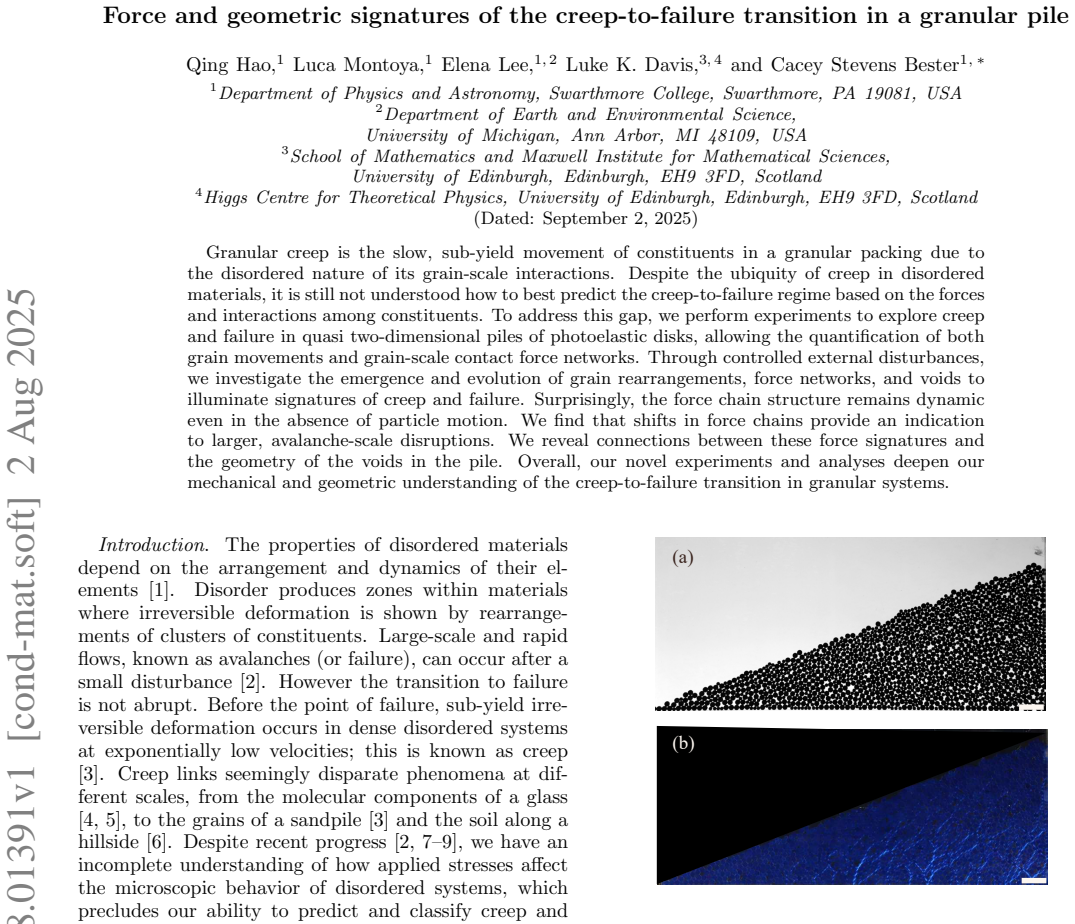
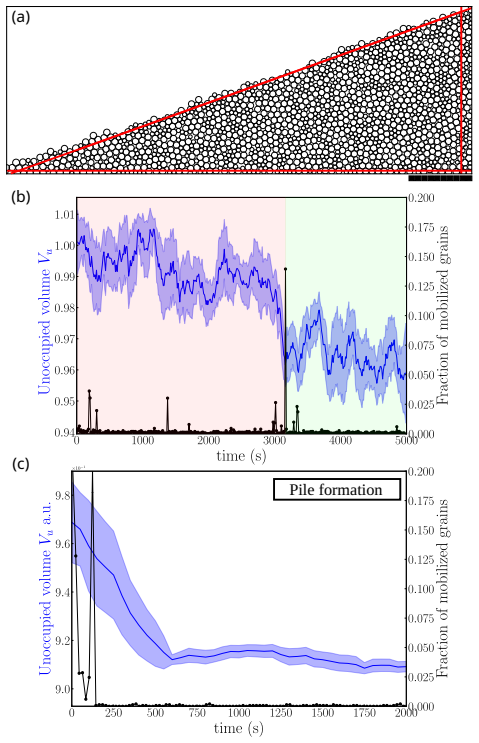
Granular creep is the slow, sub-yield movement of constituents in a granular packing due to the disordered nature of its grain-scale interactions. Despite the ubiquity of creep in disordered materials, it is still not understood how to best predict the creep-to-failure regime based on the forces and interactions among constituents. To address this gap, we perform experiments to explore creep and failure in quasi two-dimensional piles of photoelastic disks, allowing the quantification of both grain movements and grain-scale contact force networks. Through controlled external disturbances, we investigate the emergence and evolution of grain rearrangements, force networks, and voids to illuminate signatures of creep and failure. Surprisingly, the force chain structure remains dynamic even in the absence of observable particle motion. We find that shifts in force chains provide an indication to larger, avalanche-scale disruptions. We connect these force signatures with the geometry of the voids in the pile. Overall, our novel experiments and analyses deepen our mechanical and geometric understanding of the creep-to-failure transition in granular systems.
Editorial analysis
A structured set of objections, weighed in public.
Referee Report
Summary. The manuscript reports experiments on quasi-two-dimensional piles of photoelastic disks subjected to controlled external disturbances. The central claims are that force-chain structures remain dynamic even without observable particle motion, that shifts in these force chains precede avalanche-scale disruptions, and that the force signatures correlate with the geometry of voids in the pile.
Significance. If the observations are robust, the work supplies direct visualization of force-network dynamics as mechanical precursors to failure in granular media. The photoelastic technique provides a clear experimental advantage for linking force rearrangements to geometric features, which could inform predictive models for creep-to-failure in both laboratory and natural granular systems.
major comments (2)
- [Discussion] Discussion section: The extrapolation from the quasi-2D photoelastic-disk setup to three-dimensional natural granular piles is load-bearing for the stated applicability yet receives no comparative analysis, scaling arguments, or discussion of dimensionality effects on coordination number, out-of-plane buckling, or void evolution.
- [Results] Results section: The claims of dynamic force chains without detectable particle motion and of correlations with void geometry are presented without quantitative metrics, error bars, statistical tests, or data-exclusion criteria, leaving the strength of the evidence difficult to evaluate.
minor comments (1)
- [Figures] Figure captions should explicitly state the number of independent realizations and the typical system size (number of disks) to allow readers to assess statistical power.
Simulated Author's Rebuttal
We thank the referee for their constructive review and for recognizing the potential significance of our experimental observations on force-network dynamics in granular creep. We address each major comment in turn and describe the revisions we will implement.
read point-by-point responses
-
Referee: [Discussion] Discussion section: The extrapolation from the quasi-2D photoelastic-disk setup to three-dimensional natural granular piles is load-bearing for the stated applicability yet receives no comparative analysis, scaling arguments, or discussion of dimensionality effects on coordination number, out-of-plane buckling, or void evolution.
Authors: We agree that the manuscript would be strengthened by a more explicit treatment of dimensionality. In the revised Discussion we will add a dedicated paragraph that (i) compares our quasi-2D coordination numbers and force-chain statistics with published 3D photoelastic and X-ray tomography results, (ii) provides scaling arguments for how the observed force-chain rearrangement rates might translate to 3D (accounting for the additional degree of freedom), (iii) discusses the absence of out-of-plane buckling in our 2D geometry and its possible stabilizing or destabilizing role in 3D piles, and (iv) contrasts 2D void evolution with 3D pore-space connectivity. These additions will clarify both the applicability and the limitations of the quasi-2D findings for natural granular systems. revision: yes
-
Referee: [Results] Results section: The claims of dynamic force chains without detectable particle motion and of correlations with void geometry are presented without quantitative metrics, error bars, statistical tests, or data-exclusion criteria, leaving the strength of the evidence difficult to evaluate.
Authors: We acknowledge that the current presentation would benefit from greater quantitative rigor. In the revised Results section we will report (i) the fraction of force-chain reconfigurations that occur without measurable particle displacement (with standard error across independent runs), (ii) Pearson or Spearman correlation coefficients between force-signature metrics and void geometric descriptors together with 95 % confidence intervals and p-values, and (iii) explicit data-exclusion criteria (e.g., minimum force threshold, particle-tracking uncertainty, and criteria for discarding frames with excessive illumination artifacts). These quantitative elements will allow readers to assess the robustness of the reported signatures. revision: yes
Circularity Check
No circularity: purely observational experimental study
full rationale
The paper reports direct experimental observations in a quasi-2D photoelastic disk pile under controlled disturbances. It quantifies grain movements, contact force networks, and void geometry without any mathematical derivations, parameter fitting, or predictive models that could reduce to inputs by construction. Claims such as dynamic force chains without observable motion and their correlation with voids are presented as empirical findings from measurements, not as outputs of a derivation chain. No self-citations are invoked as load-bearing uniqueness theorems or ansatzes. The analysis is therefore self-contained against external benchmarks and receives the default non-finding.
Axiom & Free-Parameter Ledger
axioms (1)
- domain assumption Photoelastic disks transmit contact forces that can be quantitatively imaged via optical fringes
Reference graph
Works this paper leans on
-
[1]
R. P. Behringer and B. Chakraborty, Reports on Progress in Physics 82, 012601 (2018)
work page 2018
-
[2]
A. Amon, R. Bertoni, and J. Crassous, Physical Review E 87 (2013)
work page 2013
-
[3]
T. S. Komatsu, S. Inagaki, N. Nakagawa, and S. Nasuno, Physical Review Letters 86, 1757–1760 (2001)
work page 2001
-
[4]
R. G. Larson, The Structure and Rheology of Complex Fluids (Oxford University Press, 1999)
work page 1999
-
[5]
M. L. Falk and J. S. Langer, Phys. Rev. E Stat. Phys. Plasmas Fluids Relat. Interdiscip. Topics 57, 7192 (1998)
work page 1998
-
[6]
D. J. Jerolmack and K. E. Daniels, Nature Reviews Physics 1:12, (2019)
work page 2019
-
[7]
A. Nicolas, E. E. Ferrero, K. Martens, and J.-L. Barrat, Rev. Mod. Phys. 90 (2018)
work page 2018
-
[8]
N. Deshpande, D. J. Furbish, P. E. Arratia, and D. J. Jerolmack, Nature Communications 12:1 (2021)
work page 2021
-
[9]
B. Ferdowsi, C. P. Ortiz, and D. J. Jerolmack, Proceed- ings of the National Academy of Sciences 115 (2018)
work page 2018
-
[10]
Y. Forterre and O. Pouliquen, Annual Review of Fluid Mechanics 40, 1–24 (2008)
work page 2008
-
[12]
M. E. Cates, J. P. Wittmer, J. P. Bouchard, and P. Claudin, Physical Review Letters 81:9 (1998)
work page 1998
-
[13]
H. M. Jaeger, S. R. Nagel, and R. P. Behringer, Reviews of Modern Physics 68 (1996)
work page 1996
-
[14]
D. L. Henann and K. Kamrin, Physical Review Letters 113:17 (2014)
work page 2014
-
[15]
M. Houssais, C. P. Ortiz, D. J. Durian, and D. J. Jerol- mack, Nature Communications 6:1 (2015)
work page 2015
- [16]
- [17]
-
[18]
Y. Yuan, Z. Zeng, Y. Xing, H. Yuan, S. Zhang, W. Kob, and Y. Wang, Nat. Commun. 15, 3866 (2024)
work page 2024
-
[19]
K. E. Daniels, J. E. Kollmer, and J. G. Puckett, Rev. Sci. Instrum. 88, 051808 (2017)
work page 2017
-
[20]
Hecht, Optics (Addison-Wesley Professional, 2002)
E. Hecht, Optics (Addison-Wesley Professional, 2002)
work page 2002
-
[21]
A. Abed Zadeh, J. Bar´ es, T. A. Brzinski, K. E. Daniels, J. Dijksman, N. Docquier, H. O. Everitt, J. E. Kollmer, O. Lantsoght, D. Wang, M. Workamp, Y. Zhao, and H. Zheng, Granul. Matter 21 (2019)
work page 2019
-
[22]
A. L. Thomas and N. M. Vriend, Phys. Rev. E. 100, 012902 (2019)
work page 2019
-
[23]
D. Amon, T. Niculescu, and B. Utter, Physical Review E 88(1), 012203 (2013)
work page 2013
-
[24]
T. S. Majmudar and R. P. Behringer, Nature 435, 1079 (2005)
work page 2005
-
[25]
E. D. Cubuk, R. J. S. Ivancic, S. S. Schoenholz, D. J. Strickland, A. Basu, Z. S. Davidson, J. Fontaine, J. L. Hor, Y.-R. Huang, Y. Jiang, N. C. Keim, K. D. Koshi- gan, J. A. Lefever, T. Liu, X.-G. Ma, D. J. Magagnosc, E. Morrow, C. P. Ortiz, J. M. Rieser, A. Shavit, T. Still, Y. Xu, Y. Zhang, K. N. Nordstrom, P. E. Arratia, R. W. Carpick, D. J. Durian, Z...
work page 2017
-
[26]
J. B. Knight, C. G. Fandrich, C. N. Lau, H. M. Jaeger, and S. R. Nagel, Physical Review E 51, 3957–3963 (1995)
work page 1995
-
[27]
T. Boutreux and P. de Geennes, Physica A: Statistical Mechanics and its Applications 244, 59–67 (1997)
work page 1997
- [28]
-
[29]
A. Lema ˆ ıtre, Phys. Rev. Lett. 89, 195503 (2002). Supplemental material: Force and geometric signatures of the creep-to-failure transition in a granular medium Qing Hao, 1 Luca Montoya,1 Elena Lee, 1, 2 Luke K. Davis, 3, 4 and Cacey Stevens Bester 1, ∗ 1Department of Physics and Astronomy, Swarthmore College, Swarthmore, PA 19081, USA 2Department of Ear...
work page 2002
-
[30]
I. Zuriguel, T. Mullin, and J. Rotter, Physical Review Letters 98, 028001 (2007)
work page 2007
- [31]
-
[32]
N. Deshpande, D. J. Furbish, P. E. Arratia, and D. J. Jerolmack, Nature Communications 12:1 (2021). 11
work page 2021
discussion (0)
Sign in with ORCID, Apple, or X to comment. Anyone can read and Pith papers without signing in.