REVIEW 4 major objections 5 minor 10 cited by
A comprehensive taxonomy of hallucinations in Large Language Models
T0 review · 4 major / 5 minor · reviewed 2026-08-06 · deepseek-v4-flash
Pith's one-line read A wide-ranging taxonomy of LLM hallucination argues, on the strength of a diagonalization argument, that any computable language model will inevitably produce outputs that diverge from a computable ground truth, no matter how it is…
desk verdict A useful but non-novel survey of LLM hallucination taxonomy that borrows its inevitability theorem from prior work and then overstates what that theorem actually proves. read the letter →
The pith
A machine-rendered reading of the paper's core claim, the machinery that carries it, and where it could break.
The reading
What carries the argument
The load-bearing object is the formal world $G_f = \{(s,f(s)) : s \in S\}$ for a computable ground-truth function $f$, together with the hallucination condition $\forall i \in \mathbb{N}, \exists s \in S$ such that $h^{(i)}(s) \neq f(s)$. The argument is carried by diagonalization: one enumerates the states of all LLMs in a computably enumerable set and constructs $f$ so that at every stage it differs from each model on some input. This is what converts a list of failure examples into a proof that the failures cannot be trained or engineered away.
What would settle it
Run a deployed model on the same prompt one hundred times with nonzero sampling temperature: if the outputs differ, the system is not a total computable function of the prompt, directly breaking the premise on which the inevitability theorem is transferred to practice. Alternatively, find an agreed-upon hallucination that no computable ground-truth function could encode, such as a purely conventional or aesthetic error, which would show the formal definition does not cover all real hallucinations.
Extended reading notes
Core claim
The report sets out to show that hallucination is an innate limitation of computable LLMs, not a correctable defect. It adopts the formal setup of a ground-truth function $f$ over all finite strings and a model $h$ that is trained on samples from $f$; hallucination is defined by $\forall i \in \mathbb{N}, \exists s \in S$ with $h^{(i)}(s) \neq f(s)$. Using diagonalization, it presents three theorems: computably enumerable families of LLMs hallucinate, they hallucinate on infinitely many inputs, and any individual computable LLM has some computable $f$ on which every training stage errs, plus a corollary that no LLM can self-eliminate hallucination. Around this formal core, the paper organizes the phenomena: intrinsic versus extrinsic errors, factuality versus faithfulness, concrete manifestations from factual fabrications to code and multimodal errors, causes in data, model, and prompt, evaluation benchmarks and metrics, and mitigation through retrieval, tools, guardrails, and human oversight.
Load-bearing premise
The chain of results depends on modeling 'correctness' as a single computable function $f$ defined on every finite string and on treating deployed LLMs as total computable functions; if either fails for a real system, the theorem's conclusion does not automatically apply.
Editorial extensions
If this is right
- Any computable LLM will hallucinate on at least one input at every training stage, so a perfectly hallucination-free model is not achievable by scaling, better data, or new architectures.
- Internal self-correction methods such as chain-of-thought or self-refinement cannot by themselves eliminate hallucination; external aids such as retrieval, tools, guardrails, and human oversight are required.
- Mathematical and logical outputs deserve special scrutiny because hard computational problems are exactly where hallucination is most likely.
- Safety-critical applications cannot be left to autonomous LLM decisions; human-in-the-loop validation remains necessary.
- Benchmarks and metrics must be taxonomy-aware and task-specific, because different hallucination types need different detectors and different mitigations.
Reading between the lines
- If the inevitability theorem is accepted, adding a deterministic post-processing or guardrail layer does not itself escape the result, because the composition of two computable functions is still a computable function; only genuinely external, non-computable oversight would change the formal picture.
- The report's overlapping taxonomies imply that reported hallucination rates are not comparable across benchmarks until the field agrees on one operational definition; the same error counted as intrinsic by one benchmark could be extrinsic or factual by another.
- A testable prediction follows: retrieval-augmented systems should hallucinate least on questions whose answers are literally inside the retrieved corpus and most on questions that require synthesizing beyond it, since the external oracle is silent in exactly the places the theorem says errors must appear.
Editorial analysis
A structured set of objections, weighed in public.
Referee Report
Summary. This manuscript is a broad survey of LLM hallucination phenomena. It opens with a formal definition and a set of theorems attributed to Xu et al. [100], claiming that hallucination is inevitable for any computable LLM, then presents taxonomies (intrinsic/extrinsic, factuality/faithfulness, and numerous specific categories), causes, human factors, benchmarks, mitigation strategies, and web resources. The practical conclusion is that complete elimination is impossible and that detection, mitigation, and human oversight are required.
Significance. The survey's encyclopedic scope is a strength: Table 2 and Table 3 organize a large literature, Section 7 covers benchmarks and metrics, Section 8 gives balanced mitigation strategies, and Section 9 documents monitoring resources. The manuscript is useful as a reference. However, the central 'inevitability' claim is presented as the intellectual anchor, and the interpretation of Theorem 3 in Section 2.2.2 is not justified by the theorem statement. The paper does not itself prove the theorems, so its credibility rests on faithful reporting; the over-reading of the quantifier structure and the citation errors weaken that anchor. The taxonomy and benchmark content remain valuable independently of the inevitability framing.
major comments (4)
- [2.2.2, 10.1] The theorem is reported as: for any individual computable LLM h, there exists a computable ground truth f such that every state of h hallucinates with respect to f. This is an existential statement over f (i.e., ∃f ∀i ∃s h[i](s)≠f(s)). The abstract, Section 2.2.2, and Section 10.1 read this as 'hallucination is an innate and inevitable limitation of any computable LLM regardless of architecture, training, prompting, or data' and 'complete elimination may be impossible regardless of architectural advancements or training refinements.' That inference is invalid: the existential quantifier over f is an adversarial witness chosen after h, not a fixed correctness criterion of a deployment. For any fixed computable ground truth f0, the program h0(s)=f0(s) is a total computable LLM that does not hallucinate with respect to f0 at any state. The theorem therefore shows only that no single model is correct for every computable f; it does not show that a model cannot be made correct for its actual target task. This is the load-bearing step for the paper's central claim and must be corrected.
- [2.2.1, 2.2.2] The formal model assumes a single computable ground-truth function f over all finite strings, and it treats real-world LLMs as total computable functions. Real-world correctness for open-ended tasks is not a single computable function, and deployed LLMs with stochastic sampling are not deterministic total functions. Consequently, the transfer of the theorem to 'general problem solvers', 'safety-critical decisions', and 'research and regulations' in Section 2.2.2 requires additional argument that the manuscript does not provide. At minimum, the practical implications should be explicitly conditioned on the formal world defined in Section 2.2.1.
- [5.4, 8] Section 5.4 attributes the theoretical inevitability of hallucination to [7] (HalluLens), and Section 8 attributes the same claim to [89] (Reflexion). Neither of these is the source of the theorems; Section 2.2.2 correctly cites [100] (Xu, Jain, and Kankanhalli). Since the inevitability claim is the paper's central thesis, the support must be cited consistently and correctly. These appear to be mechanical citation errors, but they matter for a claim that is used to justify the report's overall framing.
- [9.3.1] The text states that 'increased training compute leads to more accurate models, which are inherently less prone to hallucinate' and derives a 'direct implication for fighting hallucinations.' The Epoch AI dashboard reports accuracy on GPQA Diamond and MATH Level 5, not hallucination rates. Accuracy on these benchmarks is not a measure of hallucination, and the inference from benchmark accuracy to reduced hallucination propensity is not established in the cited data. Please rephrase this as a hypothesis for future validation or remove the direct causal claim.
minor comments (5)
- [Table 2] The table entries 'F actuality' and 'F aithfulness' contain spacing artifacts; they should read 'Factuality' and 'Faithfulness'.
- [9.3.2] The heading uses 'propietary'; this should be 'proprietary'.
- [7.1.3] The benchmark name is written as 'F ActScore' with an internal space; standard usage is 'FActScore'.
- [References] Reference [17] contains a duplicated author name ('ChenghaoZhu ChenghaoZhu'); the author list should be cleaned up.
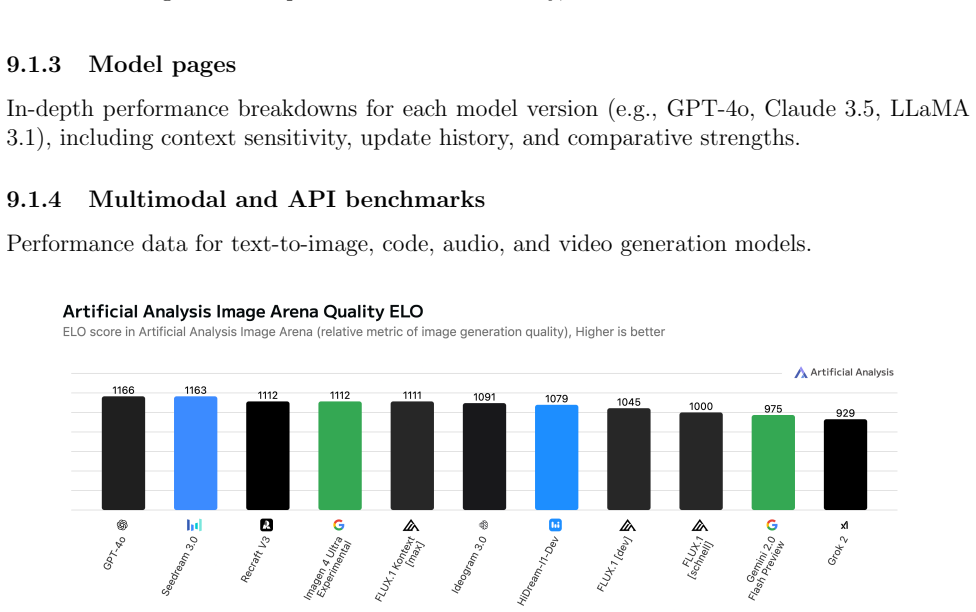
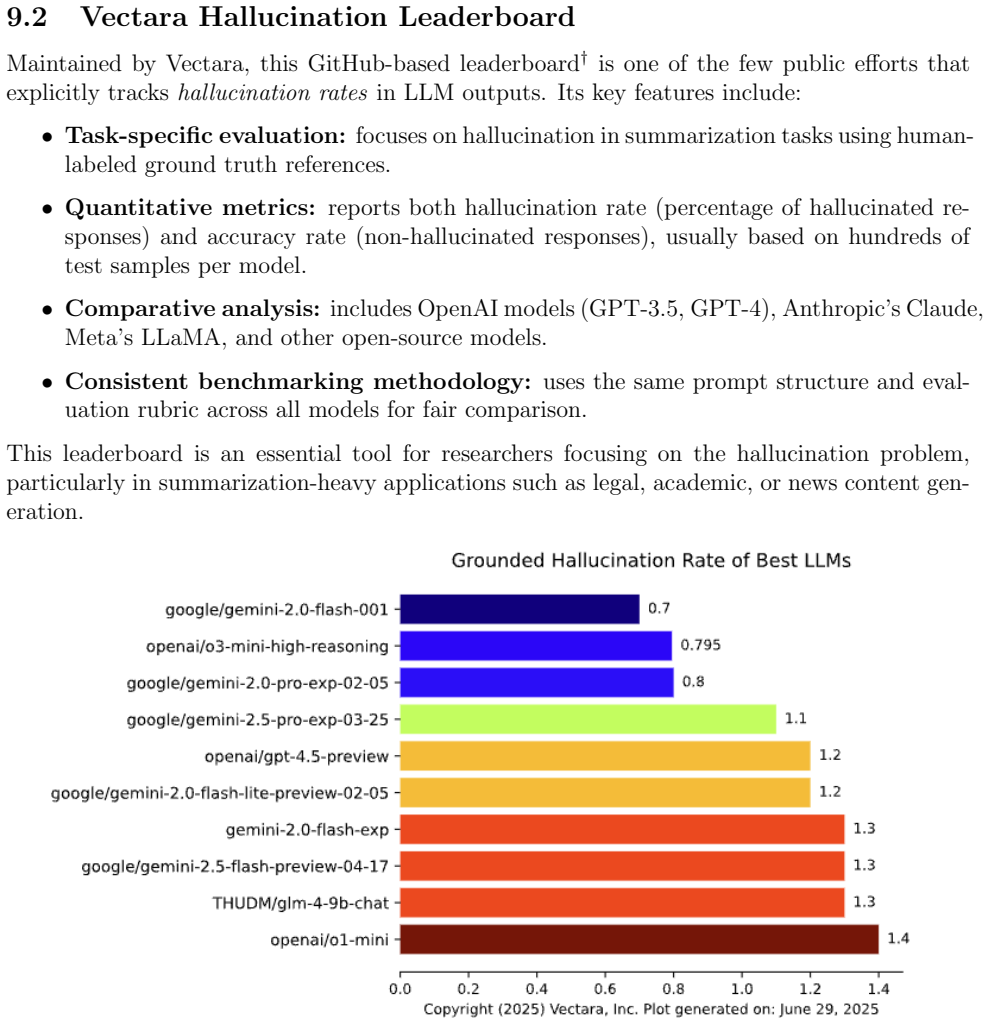
- [9.1-9.4] The sample figures from web resources lack source documentation and retrieval dates in the captions; adding the source URL and retrieval date for each figure would improve reproducibility.
Circularity Check
The report's central inevitability claim rests on Theorem 3, whose ground-truth witness is constructed after the model to force a mismatch; the 'inevitable' conclusion is true by construction of f, not by failure on any fixed real-world correctness criterion.
-
self definitional
[Section 2.2.2 (Theorem 3 and 'Practical implications of inevitability'); echoed in Section 10.1]
"Theorem 3: any computable LLM will hallucinate: this theorem generalizes the preceding findings. It asserts that for any individual computable LLM, there exists a computable ground truth function f such that every state of that LLM will hallucinate with respect to f. ... This is demonstrated by constructing a ground truth function f that is specifically designed to contradict the output of every LLM state along a diagonal enumeration of all LLM states and their outputs."
The witness f in Theorem 3 is chosen after h and is 'specifically designed to contradict' h's outputs. With that f, the defining condition ∀i ∃s h[i](s) ≠ f(s) is satisfied by construction, so 'h hallucinates w.r.t. f' is an artifact of choosing f rather than a finding about h on a fixed task. The report nevertheless converts this existence statement into the load-bearing conclusion that hallucination is 'an innate and inevitable limitation' of computable LLMs 'irrespective of architectural design, learning algorithms, prompting techniques, or the specific training data'. The practical inevitability thus reduces to the theorem's own definition of f: it shows every model has some adversarial truth function on which it errs, not that models err on the actual ground truth of deployed tasks.
full rationale
The paper is a taxonomy/survey and performs no fitting or numerical derivation; most sections are independent literature synthesis. The one load-bearing theoretical step is the inevitability claim imported from [100] and restated in Section 2.2.2 and Section 10.1. Because that theorem's f is adversarially constructed after the model, the 'hallucination' it guarantees is definitional, so the strong practical conclusion goes beyond what the construction supports. This is a single definitional circularity in the central theoretical claim; the rest of the taxonomy (types, causes, benchmarks, mitigations) stands independently of it and is benchmarked against external literature, so the overall circularity score is moderate, not extreme.
Assumptions & free parameters
assumptions (3)
- domain assumption A formal world with a single computable ground-truth function f over all finite strings captures correctness.
- domain assumption Real-world LLMs are total computable functions from prompts to outputs.
- standard math The inevitability theorems of Xu et al. [100] are correct and apply to the systems discussed.
Cite this review
Pith. "Pith review of A comprehensive taxonomy of hallucinations in Large Language Models." pith.science (2026). https://pith.science/paper/ZV3ZLKND
@misc{pith2026250801781,
  author       = {Pith},
  title        = {Pith review of: A comprehensive taxonomy of hallucinations in Large Language Models},
  year         = {2026},
  howpublished = {\url{https://pith.science/paper/ZV3ZLKND}},
  note         = {Machine review of arXiv:2508.01781}
}
read the original abstract
Large language models (LLMs) have revolutionized natural language processing, yet their propensity for hallucination, generating plausible but factually incorrect or fabricated content, remains a critical challenge. This report provides a comprehensive taxonomy of LLM hallucinations, beginning with a formal definition and a theoretical framework that posits its inherent inevitability in computable LLMs, irrespective of architecture or training. It explores core distinctions, differentiating between intrinsic (contradicting input context) and extrinsic (inconsistent with training data or reality), as well as factuality (absolute correctness) and faithfulness (adherence to input). The report then details specific manifestations, including factual errors, contextual and logical inconsistencies, temporal disorientation, ethical violations, and task-specific hallucinations across domains like code generation and multimodal applications. It analyzes the underlying causes, categorizing them into data-related issues, model-related factors, and prompt-related influences. Furthermore, the report examines cognitive and human factors influencing hallucination perception, surveys evaluation benchmarks and metrics for detection, and outlines architectural and systemic mitigation strategies. Finally, it introduces web-based resources for monitoring LLM releases and performance. This report underscores the complex, multifaceted nature of LLM hallucinations and emphasizes that, given their theoretical inevitability, future efforts must focus on robust detection, mitigation, and continuous human oversight for responsible and reliable deployment in critical applications.
Figures


Figures from the paper (11 more)




Forward citations
Cited by 10 Pith papers
-
When to Trust the Answer: Question-Aligned Semantic Nearest Neighbor Entropy for Safer Surgical VQA
QA-SNNE adds question-answer alignment via bilateral gating to semantic nearest neighbor entropy, yielding higher AUROC for uncertainty detection in surgical VQA models under both standard and rephrased questions.
-
PseudoBench: Measuring How Agentic Auto-Research Fuels Pseudoscience
PseudoBench shows current LLM agents produce persuasive pseudoscientific reports with near-zero refusal rates and at most 27.4% resistance.
-
Hypergraph Enterprise Agentic Reasoner over Heterogeneous Business Systems
HEAR uses a stratified hypergraph ontology to orchestrate evidence-driven multi-hop reasoning over heterogeneous business systems, reaching 94.7% accuracy on supply-chain root-cause tasks with open-weight models.
-
Multi-TAP: Multi-criteria Target Adaptive Persona Modeling for Cross-Domain Recommendation
Modeling intra-domain preference heterogeneity with multi-criteria LLM personas and target-adaptive doppelganger transfer beats prior CDR methods on Amazon domain pairs.
-
UCPO: Uncertainty-Aware Policy Optimization
UCPO uses decoupled advantage normalization and a dynamic uncertainty reward to train LLMs to express uncertainty, improving answer reliability (PAQ) but sometimes lowering F1.
-
Topic Identification in LLM Input-Output Pairs through the Lens of Information Bottleneck
UDIB, an upper-bounded Deterministic Information Bottleneck clustering algorithm, is applied to LLM prompt and response embeddings to produce topic spaces that sharpen semantic divergence metrics for hallucination analysis.
-
Divergent Recommendations, Convergent Diagnoses: Cross-Provider Failure-Mode Convergence in AI Commercial Recommendation
Two major AI providers diverge in which brands they recommend but converge on classifying the failure reasons, especially for low-prominence brands.
-
Rethinking Agentic Reinforcement Learning In Large Language Models
The paper reviews conceptual foundations, methodological innovations, effective designs, critical challenges, and future directions for LLM-based Agentic Reinforcement Learning.
-
Rethinking Agentic Reinforcement Learning In Large Language Models
The paper surveys the conceptual foundations, methodological innovations, challenges, and future directions of agentic reinforcement learning frameworks that embed cognitive capabilities like meta-reasoning and self-r...
-
Rethinking Agentic Reinforcement Learning In Large Language Models
This review synthesizes conceptual foundations, methods, challenges, and future directions for agentic reinforcement learning in large language models.
Reference graph
Works this paper leans on
-
[100]
Hallucination is inevitable: An innate limitation of large language models
Ziwei Xu, Sanjay Jain, and Mohan Kankanhalli. Hallucination is inevitable: An innate limitation of large language models. arXiv preprint arXiv:2401.11817 , 2024
arXiv 2024
-
[7]
Hallulens: Llm hallucination benchmark
Yejin Bang, Ziwei Ji, Alan Schelten, Anthony Hartshorn, Tara Fowler, Cheng Zhang, Nicola Cancedda, and Pascale Fung. Hallulens: Llm hallucination benchmark. arXiv preprint arXiv:2504.17550, 2025
arXiv 2025
-
[89]
Reflexion: Language agents with verbal reinforcement learning
Noah Shinn, Federico Cassano, Ashwin Gopinath, Karthik Narasimhan, and Shunyu Yao. Reflexion: Language agents with verbal reinforcement learning. Advances in Neural Information Processing Systems, 36:8634–8652, 2023
2023
-
[1]
Exploring rag solutions to reduce hallucinations in llms
Samar AboulEla, Paria Zabihitari, Nourhan Ibrahim, Majid Afshar, and Rasha Kashef. Exploring rag solutions to reduce hallucinations in llms. In 2025 IEEE International systems Conference (SysCon) , pages 1–8. IEEE, 2025. 46
2025
-
[2]
Codemirage: Hallucinations in code generated by large language models
Vibhor Agarwal, Yulong Pei, Salwa Alamir, and Xiaomo Liu. Codemirage: Hallucinations in code generated by large language models. arXiv preprint arXiv:2408.08333 , 2024
arXiv 2024
-
[3]
Improving llm mathematical reasoning capabilities using external tools
Jack Albright and Sheden Andemicael. Improving llm mathematical reasoning capabilities using external tools. Stanford CS224R, 2025
2025
-
[4]
Make your llm fully utilize the context
Shengnan An, Zexiong Ma, Zeqi Lin, Nanning Zheng, Jian-Guang Lou, and Weizhu Chen. Make your llm fully utilize the context. Advances in Neural Information Processing Systems, 37:62160–62188, 2024
2024
-
[5]
Agentharm: A benchmark for measuring harmfulness of llm agents
Maksym Andriushchenko, Alexandra Souly, Mateusz Dziemian, Derek Duenas, Maxwell Lin, Justin Wang, Dan Hendrycks, Andy Zou, Zico Kolter, Matt Fredrikson, et al. Agentharm: A benchmark for measuring harmfulness of llm agents. arXiv preprint arXiv:2410.09024, 2024
Show all 109 references
-
[6]
The internal state of an llm knows when it’s lying
Amos Azaria and Tom Mitchell. The internal state of an llm knows when it’s lying. arXiv preprint arXiv:2304.13734, 2023
2023 arXiv
-
[8]
Is incoherence surprising? targeted evaluation of coherence prediction from language models
Anne Beyer, Sharid Lo´ aiciga, and David Schlangen. Is incoherence surprising? targeted evaluation of coherence prediction from language models. arXiv preprint arXiv:2105.03495, 2021
2021 arXiv
-
[9]
’it’s reducing a human being to a percentage’ perceptions of justice in algorithmic decisions
Reuben Binns, Max Van Kleek, Michael Veale, Ulrik Lyngs, Jun Zhao, and Nigel Shad- bolt. ’it’s reducing a human being to a percentage’ perceptions of justice in algorithmic decisions. In Proceedings of the 2018 Chi conference on human factors in computing systems, pages 1–14, 2018
2018
-
[10]
Fact- controlled diagnosis of hallucinations in medical text summarization
Suhas BN, Han-Chin Shing, Lei Xu, Mitch Strong, Jon Burnsky, Jessica Ofor, Jor- dan R Mason, Susan Chen, Sundararajan Srinivasan, Chaitanya Shivade, et al. Fact- controlled diagnosis of hallucinations in medical text summarization. arXiv preprint arXiv:2506.00448, 2025
2025 arXiv
-
[11]
Sparks of artificial general intelligence: Early experiments with gpt-4, 2023
S´ ebastien Bubeck, Varun Chadrasekaran, Ronen Eldan, Johannes Gehrke, Eric Horvitz, Ece Kamar, Peter Lee, Yin Tat Lee, Yuanzhi Li, Scott Lundberg, et al. Sparks of artificial general intelligence: Early experiments with gpt-4, 2023
2023
-
[12]
This reference does not exist: an explo- ration of llm citation accuracy and relevance
Courtni Byun, Piper Vasicek, and Kevin Seppi. This reference does not exist: an explo- ration of llm citation accuracy and relevance. In Proceedings of the Third Workshop on Bridging Human–Computer Interaction and Natural Language Processing , pages 28–39, 2024
2024
-
[13]
Hallucinated but factual! in- specting the factuality of hallucinations in abstractive summarization
Meng Cao, Yue Dong, and Jackie Chi Kit Cheung. Hallucinated but factual! in- specting the factuality of hallucinations in abstractive summarization. arXiv preprint arXiv:2109.09784, 2021
2021 arXiv
-
[14]
Detecting errors through ensembling prompts (deep): an end-to-end llm framework for detecting factual errors
Alex Chandler, Devesh Surve, and Hui Su. Detecting errors through ensembling prompts (deep): an end-to-end llm framework for detecting factual errors. arXiv preprint arXiv:2406.13009, 2024. 47
2024 arXiv
-
[15]
Softmax bottleneck makes language models unable to represent multi-mode word distributions
Haw-Shiuan Chang and Andrew McCallum. Softmax bottleneck makes language models unable to represent multi-mode word distributions. In Proceedings of the 60th Annual Meeting of the Association for Computational Linguistics , volume 1, 2022
2022
-
[16]
Towards improving faithful- ness in abstractive summarization
Xiuying Chen, Mingzhe Li, Xin Gao, and Xiangliang Zhang. Towards improving faithful- ness in abstractive summarization. Advances in Neural Information Processing Systems , 35:24516–24528, 2022
2022
-
[17]
Is your llm outdated? a deep look at temporal generalization
ChenghaoZhu ChenghaoZhu, Nuo Chen, Yufei Gao, Yunyi Zhang, Prayag Tiwari, and Benyou Wang. Is your llm outdated? a deep look at temporal generalization. In Proceed- ings of the 2025 Conference of the Nations of the Americas Chapter of the Association for Computational Linguist...
2025
-
[18]
Envisioning legal mitigations for llm-based intentional and unintentional harms
Inyoung Cheong, Aylin Caliskan, and Tadayoshi Kohno. Envisioning legal mitigations for llm-based intentional and unintentional harms. Adm. Law J , 2022
2022
-
[19]
(a) i am not a lawyer, but...: engaging legal experts towards responsible llm policies for legal advice
Inyoung Cheong, King Xia, KJ Kevin Feng, Quan Ze Chen, and Amy X Zhang. (a) i am not a lawyer, but...: engaging legal experts towards responsible llm policies for legal advice. In Proceedings of the 2024 ACM Conference on Fairness, Accountability, and Transparency, pages 2454–...
2024
-
[20]
Mind the confidence gap: Overconfidence, calibration, and distractor effects in large language models
Prateek Chhikara. Mind the confidence gap: Overconfidence, calibration, and distractor effects in large language models. arXiv preprint arXiv:2502.11028 , 2025
2025
-
[21]
Automation bias in intelligent time critical decision support systems
Mary L Cummings. Automation bias in intelligent time critical decision support systems. In Decision making in aviation , pages 289–294. Routledge, 2017
2017
-
[22]
Bias and unfairness in information retrieval systems: New challenges in the llm era
Sunhao Dai, Chen Xu, Shicheng Xu, Liang Pang, Zhenhua Dong, and Jun Xu. Bias and unfairness in information retrieval systems: New challenges in the llm era. In Proceedings of the 30th ACM SIGKDD Conference on Knowledge Discovery and Data Mining , pages 6437–6447, 2024
2024
-
[23]
Building guardrails for large language models
Yi Dong, Ronghui Mu, Gaojie Jin, Yi Qi, Jinwei Hu, Xingyu Zhao, Jie Meng, Wenjie Ruan, and Xiaowei Huang. Building guardrails for large language models. arXiv preprint arXiv:2402.01822, 2024
2024 arXiv
-
[24]
Towards a rigorous science of interpretable machine learning
Finale Doshi-Velez and Been Kim. Towards a rigorous science of interpretable machine learning. arXiv preprint arXiv:1702.08608 , 2017
2017 arXiv
-
[25]
The role of trust in automation reliance
Mary T Dzindolet, Scott A Peterson, Regina A Pomranky, Linda G Pierce, and Hall P Beck. The role of trust in automation reliance. International journal of human-computer studies, 58(6):697–718, 2003
2003
-
[26]
On the origin of hallucinations in conversational models: Is it the datasets or the models? arXiv preprint arXiv:2204.07931, 2022
Nouha Dziri, Sivan Milton, Mo Yu, Osmar Zaiane, and Siva Reddy. On the origin of hallucinations in conversational models: Is it the datasets or the models? arXiv preprint arXiv:2204.07931, 2022
2022 arXiv
-
[27]
Span-level hallucination detection for llm- generated answers
Passant Elchafei and Mervet Abu-Elkheir. Span-level hallucination detection for llm- generated answers. arXiv preprint arXiv:2504.18639 , 2025. 48
2025 arXiv
-
[28]
Ragas: Automated evaluation of retrieval augmented generation
Shahul Es, Jithin James, Luis Espinosa Anke, and Steven Schockaert. Ragas: Automated evaluation of retrieval augmented generation. In Proceedings of the 18th Conference of the European Chapter of the Association for Computational Linguistics: System Demon- strations, pages 150...
2024
-
[29]
Enhancing criti- cal thinking in education by means of a socratic chatbot.arXiv preprint arXiv:2409.05511, 2024
Lucile Favero, Juan Antonio P´ erez-Ortiz, Tanja K¨ aser, and Nuria Oliver. Enhancing criti- cal thinking in education by means of a socratic chatbot.arXiv preprint arXiv:2409.05511, 2024
2024 arXiv
-
[30]
Don’t hallucinate, abstain: Identifying llm knowledge gaps via multi-llm collaboration
Shangbin Feng, Weijia Shi, Yike Wang, Wenxuan Ding, Vidhisha Balachandran, and Yulia Tsvetkov. Don’t hallucinate, abstain: Identifying llm knowledge gaps via multi-llm collaboration. arXiv preprint arXiv:2402.00367 , 2024
2024 arXiv
-
[31]
Navigating the risks: A survey of security, privacy, and ethics threats in llm-based agents
Yuyou Gan, Yong Yang, Zhe Ma, Ping He, Rui Zeng, Yiming Wang, Qingming Li, Chunyi Zhou, Songze Li, Ting Wang, et al. Navigating the risks: A survey of security, privacy, and ethics threats in llm-based agents. arXiv preprint arXiv:2411.09523 , 2024
2024 arXiv
-
[32]
Impact of high data quality on llm hallucinations
Ankush Ramprakash Gautam. Impact of high data quality on llm hallucinations. Inter- national Journal of Computer Applications , 975:8887, 2025
2025
-
[33]
Trueteacher: Learning factual consistency evaluation with large language models
Zorik Gekhman, Jonathan Herzig, Roee Aharoni, Chen Elkind, and Idan Szpektor. Trueteacher: Learning factual consistency evaluation with large language models. arXiv preprint arXiv:2305.11171, 2023
2023 arXiv
-
[34]
Logical consistency of large language models in fact-checking
Bishwamittra Ghosh, Sarah Hasan, Naheed Anjum Arafat, and Arijit Khan. Logical consistency of large language models in fact-checking. arXiv preprint arXiv:2412.16100 , 2024
2024 arXiv
-
[35]
Kenneth Holstein, Jennifer Wortman Vaughan, Hal Daum´ e III, Miro Dudik, and Hanna Wallach. Improving fairness in machine learning systems: What do industry practitioners need? In Proceedings of the 2019 CHI conference on human factors in computing systems, pages 1–16, 2019
2019
-
[36]
True: Re- evaluating factual consistency evaluation
Or Honovich, Roee Aharoni, Jonathan Herzig, Hagai Taitelbaum, Doron Kukliansy, Vered Cohen, Thomas Scialom, Idan Szpektor, Avinatan Hassidim, and Yossi Matias. True: Re- evaluating factual consistency evaluation. arXiv preprint arXiv:2204.04991 , 2022
2022 arXiv
-
[37]
q 2: Evaluating factual consistency in knowledge-grounded dialogues via question generation and question answering
Or Honovich, Leshem Choshen, Roee Aharoni, Ella Neeman, Idan Szpektor, and Omri Abend. q 2: Evaluating factual consistency in knowledge-grounded dialogues via question generation and question answering. arXiv preprint arXiv:2104.08202 , 2021
2021 arXiv
-
[38]
A survey on halluci- nation in large language models: Principles, taxonomy, challenges, and open questions
Lei Huang, Weijiang Yu, Weitao Ma, Weihong Zhong, Zhangyin Feng, Haotian Wang, Qianglong Chen, Weihua Peng, Xiaocheng Feng, Bing Qin, et al. A survey on halluci- nation in large language models: Principles, taxonomy, challenges, and open questions. ACM Transactions on Informat...
2025
-
[39]
Leveraging passage retrieval with generative models for open domain question answering
Gautier Izacard and Edouard Grave. Leveraging passage retrieval with generative models for open domain question answering. arXiv preprint arXiv:2007.01282 , 2020
2007 arXiv
-
[40]
Navigating llm ethics: Advancements, challenges, and future directions
Junfeng Jiao, Saleh Afroogh, Yiming Xu, and Connor Phillips. Navigating llm ethics: Advancements, challenges, and future directions. arXiv preprint arXiv:2406.18841, 2024. 49
2024 arXiv
-
[41]
Can large language models infer causation from correlation? arXiv preprint arXiv:2306.05836 , 2023
Zhijing Jin, Jiarui Liu, Zhiheng Lyu, Spencer Poff, Mrinmaya Sachan, Rada Mihalcea, Mona Diab, and Bernhard Sch¨ olkopf. Can large language models infer causation from correlation? arXiv preprint arXiv:2306.05836 , 2023
2023 arXiv
-
[42]
Mitigating llm hallucinations: A comprehensive review of techniques and architectures
Satyadhar Joshi. Mitigating llm hallucinations: A comprehensive review of techniques and architectures. preprints.org, 2025
2025
-
[43]
Understanding the effects of rlhf on llm generalisation and diversity
Robert Kirk, Ishita Mediratta, Christoforos Nalmpantis, Jelena Luketina, Eric Hambro, Edward Grefenstette, and Roberta Raileanu. Understanding the effects of rlhf on llm generalisation and diversity. arXiv preprint arXiv:2310.06452 , 2023
-
[44]
Evaluating the factual consistency of abstractive text summarization
Wojciech Kry´ sci´ nski, Bryan McCann, Caiming Xiong, and Richard Socher. Evaluating the factual consistency of abstractive text summarization. arXiv preprint arXiv:1910.12840 , 2019
1910 arXiv
-
[45]
Summac: Re- visiting nli-based models for inconsistency detection in summarization
Philippe Laban, Tobias Schnabel, Paul N Bennett, and Marti A Hearst. Summac: Re- visiting nli-based models for inconsistency detection in summarization. Transactions of the Association for Computational Linguistics , 10:163–177, 2022
2022
-
[46]
Adversarial filters of dataset biases
Ronan Le Bras, Swabha Swayamdipta, Chandra Bhagavatula, Rowan Zellers, Matthew Peters, Ashish Sabharwal, and Yejin Choi. Adversarial filters of dataset biases. In Inter- national conference on machine learning , pages 1078–1088. Pmlr, 2020
2020
-
[47]
Hallucination by code generation llms: Taxonomy, benchmarks, mitigation, and challenges
Yunseo Lee, John Youngeun Song, Dongsun Kim, Jindae Kim, Mijung Kim, and Jaechang Nam. Hallucination by code generation llms: Taxonomy, benchmarks, mitigation, and challenges. arXiv preprint arXiv:2504.20799 , 2025
2025 arXiv
-
[48]
Retrieval- augmented generation for knowledge-intensive nlp tasks
Patrick Lewis, Ethan Perez, Aleksandra Piktus, Fabio Petroni, Vladimir Karpukhin, Na- man Goyal, Heinrich K¨ uttler, Mike Lewis, Wen-tau Yih, Tim Rockt¨ aschel, et al. Retrieval- augmented generation for knowledge-intensive nlp tasks. Advances in neural information processing ...
2020
-
[49]
Drift: Dynamic rule-based defense with injection isolation for securing llm agents
Hao Li, Xiaogeng Liu, Hung-Chun Chiu, Dianqi Li, Ning Zhang, and Chaowei Xiao. Drift: Dynamic rule-based defense with injection isolation for securing llm agents. arXiv preprint arXiv:2506.12104, 2025
2025
-
[50]
The dawn after the dark: An empirical study on factuality hallucination in large language models
Junyi Li, Jie Chen, Ruiyang Ren, Xiaoxue Cheng, Wayne Xin Zhao, Jian-Yun Nie, and Ji-Rong Wen. The dawn after the dark: An empirical study on factuality hallucination in large language models. arXiv preprint arXiv:2401.03205 , 2024
2024 arXiv
-
[51]
Detecting llm fact-conflicting hallucinations enhanced by temporal-logic-based reasoning
Ningke Li, Yahui Song, Kailong Wang, Yuekang Li, Ling Shi, Yi Liu, and Haoyu Wang. Detecting llm fact-conflicting hallucinations enhanced by temporal-logic-based reasoning. arXiv preprint arXiv:2502.13416 , 2025
2025 arXiv
-
[52]
Rouge: A package for automatic evaluation of summaries
Chin-Yew Lin. Rouge: A package for automatic evaluation of summaries. In Text sum- marization branches out , pages 74–81, 2004
2004
-
[53]
Truthfulqa: Measuring how models mimic human falsehoods
Stephanie Lin, Jacob Hilton, and Owain Evans. Truthfulqa: Measuring how models mimic human falsehoods. arXiv preprint arXiv:2109.07958 , 2021
2021 arXiv
-
[54]
Teaching models to express their uncer- tainty in words
Stephanie Lin, Jacob Hilton, and Owain Evans. Teaching models to express their uncer- tainty in words. arXiv preprint arXiv:2205.14334 , 2022. 50
2022 arXiv
-
[55]
Mitigating the alignment tax of rlhf
Yong Lin, Hangyu Lin, Wei Xiong, Shizhe Diao, Jianmeng Liu, Jipeng Zhang, Rui Pan, Haoxiang Wang, Wenbin Hu, Hanning Zhang, et al. Mitigating the alignment tax of rlhf. arXiv preprint arXiv:2309.06256 , 2023
2023 arXiv
-
[56]
Bias unveiled: Investigating so- cial bias in llm-generated code
Lin Ling, Fazle Rabbi, Song Wang, and Jinqiu Yang. Bias unveiled: Investigating so- cial bias in llm-generated code. In Proceedings of the AAAI Conference on Artificial Intelligence, volume 39, pages 27491–27499, 2025
2025
-
[57]
Exploring and evaluating hallucinations in llm-powered code generation
Fang Liu, Yang Liu, Lin Shi, Houkun Huang, Ruifeng Wang, Zhen Yang, Li Zhang, Zhongqi Li, and Yuchi Ma. Exploring and evaluating hallucinations in llm-powered code generation. arXiv preprint arXiv:2404.00971 , 2024
2024
-
[58]
Trustworthy llms: a survey and guideline for evaluating large language models’ alignment
Yang Liu, Yuanshun Yao, Jean-Francois Ton, Xiaoying Zhang, Ruocheng Guo, Hao Cheng, Yegor Klochkov, Muhammad Faaiz Taufiq, and Hang Li. Trustworthy llms: a survey and guideline for evaluating large language models’ alignment. arXiv preprint arXiv:2308.05374, 2023
2023 arXiv
-
[59]
Maximum hallucination standards for domain-specific large language models
Tingmingke Lu. Maximum hallucination standards for domain-specific large language models. arXiv preprint arXiv:2503.05481 , 2025
2025 arXiv
-
[60]
” like having a really bad pa” the gulf between user expectation and experience of conversational agents
Ewa Luger and Abigail Sellen. ” like having a really bad pa” the gulf between user expectation and experience of conversational agents. In Proceedings of the 2016 CHI conference on human factors in computing systems , pages 5286–5297, 2016
2016
-
[61]
A review of faithfulness metrics for hallucination assessment in large language models
Ben Malin, Tatiana Kalganova, and Nikolaos Boulgouris. A review of faithfulness metrics for hallucination assessment in large language models. IEEE Journal of Selected Topics in Signal Processing, 2025
2025
-
[62]
Coherence boosting: When your pre- trained language model is not paying enough attention
Nikolay Malkin, Zhen Wang, and Nebojsa Jojic. Coherence boosting: When your pre- trained language model is not paying enough attention. arXiv preprint arXiv:2110.08294, 2021
2021 arXiv
-
[63]
The neuro-symbolic concept learner: Interpreting scenes, words, and sentences from natural supervision
Jiayuan Mao, Chuang Gan, Pushmeet Kohli, Joshua B Tenenbaum, and Jiajun Wu. The neuro-symbolic concept learner: Interpreting scenes, words, and sentences from natural supervision. arXiv preprint arXiv:1904.12584 , 2019
1904 arXiv
-
[64]
On faithfulness and factuality in abstractive summarization
Joshua Maynez, Shashi Narayan, Bernd Bohnet, and Ryan McDonald. On faithfulness and factuality in abstractive summarization. arXiv preprint arXiv:2005.00661 , 2020
2005 arXiv
-
[65]
Embracing the illusion of explanatory depth: a strategic framework for using iterative prompting for integrating large language models in health- care education
Seysha Mehta and Neil Mehta. Embracing the illusion of explanatory depth: a strategic framework for using iterative prompting for integrating large language models in health- care education. Medical Teacher, 47(2):208–211, 2025
2025
-
[66]
Factscore: Fine-grained atomic eval- uation of factual precision in long form text generation
Sewon Min, Kalpesh Krishna, Xinxi Lyu, Mike Lewis, Wen-tau Yih, Pang Wei Koh, Mohit Iyyer, Luke Zettlemoyer, and Hannaneh Hajishirzi. Factscore: Fine-grained atomic eval- uation of factual precision in long form text generation. arXiv preprint arXiv:2305.14251, 2023
2023 arXiv
-
[67]
Confirmation bias: A ubiquitous phenomenon in many guises
Raymond S Nickerson. Confirmation bias: A ubiquitous phenomenon in many guises. Review of general psychology , 2(2):175–220, 1998. 51
1998
-
[68]
Prevalence of hallucinations and their pathological associations in the general population
Maurice M Ohayon. Prevalence of hallucinations and their pathological associations in the general population. Psychiatry research, 97(2-3):153–164, 2000
2000
-
[69]
Benchmarking the confidence of large language models in answering clinical ques- tions: cross-sectional evaluation study
Mahmud Omar, Reem Agbareia, Benjamin S Glicksberg, Girish N Nadkarni, and Eyal Klang. Benchmarking the confidence of large language models in answering clinical ques- tions: cross-sectional evaluation study. JMIR Medical Informatics , 13:e66917, 2025
2025
-
[70]
Llms know more than they show: On the intrinsic representation of llm hallucinations
Hadas Orgad, Michael Toker, Zorik Gekhman, Roi Reichart, Idan Szpektor, Hadas Kotek, and Yonatan Belinkov. Llms know more than they show: On the intrinsic representation of llm hallucinations. arXiv preprint arXiv:2410.02707 , 2024
-
[71]
Confirmation and specificity biases in large language models: An explorative study
Daniel E O’Leary. Confirmation and specificity biases in large language models: An explorative study. IEEE Intelligent Systems , 40(1):63–68, 2025
2025
-
[72]
To what extent have llms reshaped the legal domain so far? a scoping literature review
Bogdan Padiu, Radu Iacob, Traian Rebedea, and Mihai Dascalu. To what extent have llms reshaped the legal domain so far? a scoping literature review. Information, 15(11):662, 2024
2024
-
[73]
Med-halt: Medical domain hallucination test for large language models
Ankit Pal, Logesh Kumar Umapathi, and Malaikannan Sankarasubbu. Med-halt: Medical domain hallucination test for large language models. arXiv preprint arXiv:2307.15343 , 2023
2023 arXiv
-
[74]
Medhallu: A comprehensive benchmark for detecting medical hallucina- tions in large language models
Shrey Pandit, Jiawei Xu, Junyuan Hong, Zhangyang Wang, Tianlong Chen, Kaidi Xu, and Ying Ding. Medhallu: A comprehensive benchmark for detecting medical hallucina- tions in large language models. arXiv preprint arXiv:2502.14302 , 2025
2025 arXiv
-
[75]
Bleu: a method for automatic evaluation of machine translation
Kishore Papineni, Salim Roukos, Todd Ward, and Wei-Jing Zhu. Bleu: a method for automatic evaluation of machine translation. In Proceedings of the 40th annual meeting of the Association for Computational Linguistics , pages 311–318, 2002
2002
-
[76]
Towards enhancing coherence in extractive summarization: Dataset and experiments with llms
Mihir Parmar, Hanieh Deilamsalehy, Franck Dernoncourt, Seunghyun Yoon, Ryan A Rossi, and Trung Bui. Towards enhancing coherence in extractive summarization: Dataset and experiments with llms. arXiv preprint arXiv:2407.04855 , 2024
2024 arXiv
-
[77]
Kilt: a benchmark for knowledge intensive language tasks
Fabio Petroni, Aleksandra Piktus, Angela Fan, Patrick Lewis, Majid Yazdani, Nicola De Cao, James Thorne, Yacine Jernite, Vladimir Karpukhin, Jean Maillard, et al. Kilt: a benchmark for knowledge intensive language tasks. arXiv preprint arXiv:2009.02252 , 2020
2009 arXiv
-
[78]
Mitigating exposure bias in large language model distillation: an imitation learning approach
Andrea Pozzi, Alessandro Incremona, Daniele Tessera, and Daniele Toti. Mitigating exposure bias in large language model distillation: an imitation learning approach. Neural Computing and Applications , pages 1–17, 2025
2025
-
[79]
Reducing extrinsic hallucination in mul- timodal abstractive summaries with post-processing technique
Shaik Rafi, Lenin Laitonjam, and Ranjita Das. Reducing extrinsic hallucination in mul- timodal abstractive summaries with post-processing technique. Neural Computing and Applications, pages 1–21, 2025
2025
-
[80]
Effects of perceptual fluency on judgments of truth
Rolf Reber and Norbert Schwarz. Effects of perceptual fluency on judgments of truth. Consciousness and cognition , 8(3):338–342, 1999
1999
-
[81]
Investigating the factual knowledge boundary of large language models with retrieval augmentation
Ruiyang Ren, Yuhao Wang, Yingqi Qu, Wayne Xin Zhao, Jing Liu, Hao Tian, Hua Wu, Ji-Rong Wen, and Haifeng Wang. Investigating the factual knowledge boundary of large language models with retrieval augmentation. arXiv preprint arXiv:2307.11019 , 2023. 52
2023 arXiv
-
[82]
The clinicians’ guide to large language mod- els: A general perspective with a focus on hallucinations
Dimitri Roustan, Fran¸ cois Bastardot, et al. The clinicians’ guide to large language mod- els: A general perspective with a focus on hallucinations. Interactive journal of medical research, 14(1):e59823, 2025
2025
-
[83]
The misunderstood limits of folk science: An illusion of explanatory depth
Leonid Rozenblit and Frank Keil. The misunderstood limits of folk science: An illusion of explanatory depth. Cognitive science, 26(5):521–562, 2002
2002
-
[84]
Ares: An auto- mated evaluation framework for retrieval-augmented generation systems
Jon Saad-Falcon, Omar Khattab, Christopher Potts, and Matei Zaharia. Ares: An auto- mated evaluation framework for retrieval-augmented generation systems. arXiv preprint arXiv:2311.09476, 2023
2023 arXiv
-
[85]
Evaluating retrieval quality in retrieval-augmented generation
Alireza Salemi and Hamed Zamani. Evaluating retrieval quality in retrieval-augmented generation. In Proceedings of the 47th International ACM SIGIR Conference on Research and Development in Information Retrieval , pages 2395–2400, 2024
2024
-
[86]
Toolformer: Lan- guage models can teach themselves to use tools
Timo Schick, Jane Dwivedi-Yu, Roberto Dess ` ı, Roberta Raileanu, Maria Lomeli, Eric Hambro, Luke Zettlemoyer, Nicola Cancedda, and Thomas Scialom. Toolformer: Lan- guage models can teach themselves to use tools. Advances in Neural Information Pro- cessing Systems, 36:68539–68...
2023
-
[87]
Questeval: Summarization asks for fact-based evaluation
Thomas Scialom, Paul-Alexis Dray, Patrick Gallinari, Sylvain Lamprier, Benjamin Pi- wowarski, Jacopo Staiano, and Alex Wang. Questeval: Summarization asks for fact-based evaluation. arXiv preprint arXiv:2103.12693 , 2021
2021 arXiv
-
[88]
Hallucinogen: A benchmark for evaluating object hallucination in large visual-language models
Ashish Seth, Dinesh Manocha, and Chirag Agarwal. Hallucinogen: A benchmark for evaluating object hallucination in large visual-language models. arXiv preprint arXiv:2412.20622, 2024
2024 arXiv
-
[90]
Retrieval augmentation reduces hallucination in conversation
Kurt Shuster, Spencer Poff, Moya Chen, Douwe Kiela, and Jason Weston. Retrieval augmentation reduces hallucination in conversation. arXiv preprint arXiv:2104.07567 , 2021
2021 arXiv
-
[91]
Large language models encode clinical knowledge
Karan Singhal, Shekoofeh Azizi, Tao Tu, S Sara Mahdavi, Jason Wei, Hyung Won Chung, Nathan Scales, Ajay Tanwani, Heather Cole-Lewis, Stephen Pfohl, et al. Large language models encode clinical knowledge. Nature, 620(7972):172–180, 2023
2023
-
[92]
On early detection of hal- lucinations in factual question answering
Ben Snyder, Marius Moisescu, and Muhammad Bilal Zafar. On early detection of hal- lucinations in factual question answering. In Proceedings of the 30th ACM SIGKDD Conference on Knowledge Discovery and Data Mining , pages 2721–2732, 2024
2024
-
[93]
Systematic biases in llm simulations of debates
Amir Taubenfeld, Yaniv Dover, Roi Reichart, and Ariel Goldstein. Systematic biases in llm simulations of debates. arXiv preprint arXiv:2402.04049 , 2024
2024 arXiv
-
[94]
Codehalu: Investigating code hallucinations in llms via execution-based verification
Yuchen Tian, Weixiang Yan, Qian Yang, Xuandong Zhao, Qian Chen, Wen Wang, Ziyang Luo, Lei Ma, and Dawn Song. Codehalu: Investigating code hallucinations in llms via execution-based verification. In Proceedings of the AAAI Conference on Artificial Intel- ligence, volume 39, pag...
2025
-
[95]
Reasoning about concepts with llms: Inconsistencies abound
Rosario Uceda-Sosa, Karthikeyan Natesan Ramamurthy, Maria Chang, and Moninder Singh. Reasoning about concepts with llms: Inconsistencies abound. arXiv preprint arXiv:2405.20163, 2024
2024 arXiv
-
[96]
Faithfulness hallucination detection in healthcare ai
Prathiksha Rumale Vishwanath, Simran Tiwari, Tejas Ganesh Naik, Sahil Gupta, Dung Ngoc Thai, Wenlong Zhao, SUNJAE KWON, Victor Ardulov, Karim Tarabishy, Andrew McCallum, et al. Faithfulness hallucination detection in healthcare ai. In Artifi- cial Intelligence and Data Science...
2024
-
[97]
Videohal- lucer: Evaluating intrinsic and extrinsic hallucinations in large video-language models
Yuxuan Wang, Yueqian Wang, Dongyan Zhao, Cihang Xie, and Zilong Zheng. Videohal- lucer: Evaluating intrinsic and extrinsic hallucinations in large video-language models. arXiv preprint arXiv:2406.16338 , 2024
2024 arXiv
-
[98]
Combating multimodal llm hallucination via bottom-up holistic reasoning
Shengqiong Wu, Hao Fei, Liangming Pan, William Yang Wang, Shuicheng Yan, and Tat- Seng Chua. Combating multimodal llm hallucination via bottom-up holistic reasoning. In Proceedings of the AAAI Conference on Artificial Intelligence, volume 39, pages 8460– 8468, 2025
2025
-
[99]
An llm can fool itself: A prompt-based adversarial attack
Xilie Xu, Keyi Kong, Ning Liu, Lizhen Cui, Di Wang, Jingfeng Zhang, and Mohan Kankanhalli. An llm can fool itself: A prompt-based adversarial attack. arXiv preprint arXiv:2310.13345, 2023
2023 arXiv
-
[101]
Llm-driven instruction following: Progresses and concerns
Wenpeng Yin, Qinyuan Ye, Pengfei Liu, Xiang Ren, and Hinrich Sch¨ utze. Llm-driven instruction following: Progresses and concerns. In Proceedings of the 2023 Conference on Empirical Methods in Natural Language Processing: Tutorial Abstracts , pages 19–25, 2023
2023
-
[102]
How much should we trust llm-based measures for accounting and finance research? Available at SSRN , 2024
Minji Yoo. How much should we trust llm-based measures for accounting and finance research? Available at SSRN , 2024
2024
-
[103]
Justilm: Few-shot justification generation for explainable fact-checking of real-world claims
Fengzhu Zeng and Wei Gao. Justilm: Few-shot justification generation for explainable fact-checking of real-world claims. Transactions of the Association for Computational Linguistics, 12:334–354, 2024
2024
-
[104]
Bertscore: Evaluating text generation with bert
Tianyi Zhang, Varsha Kishore, Felix Wu, Kilian Q Weinberger, and Yoav Artzi. Bertscore: Evaluating text generation with bert. arXiv preprint arXiv:1904.09675 , 2019
1904 arXiv
-
[105]
Knowledge overshadowing causes amalgamated hallucination in large language models
Yuji Zhang, Sha Li, Jiateng Liu, Pengfei Yu, Yi R Fung, Jing Li, Manling Li, and Heng Ji. Knowledge overshadowing causes amalgamated hallucination in large language models. arXiv preprint arXiv:2407.08039 , 2024
2024 arXiv
-
[106]
The law of knowledge overshadowing: Towards understanding, predicting, and preventing llm hallucination
Yuji Zhang, Sha Li, Cheng Qian, Jiateng Liu, Pengfei Yu, Chi Han, Yi R Fung, Kathleen McKeown, Chengxiang Zhai, Manling Li, et al. The law of knowledge overshadowing: Towards understanding, predicting, and preventing llm hallucination. arXiv preprint arXiv:2502.16143, 2025
2025 arXiv
-
[107]
Making harmful behaviors unlearnable for large language models
Xin Zhou, Yi Lu, Ruotian Ma, Tao Gui, Qi Zhang, and Xuanjing Huang. Making harmful behaviors unlearnable for large language models. arXiv preprint arXiv:2311.02105, 2023. 54
2023 arXiv
-
[108]
Universal and transferable adversarial attacks on aligned language models
Andy Zou, Zifan Wang, Nicholas Carlini, Milad Nasr, J Zico Kolter, and Matt Fredrikson. Universal and transferable adversarial attacks on aligned language models. arXiv preprint arXiv:2307.15043, 2023
2023 arXiv
-
[109]
Medhallbench: A new benchmark for assessing hallucination in medical large language models
Kaiwen Zuo and Yirui Jiang. Medhallbench: A new benchmark for assessing hallucination in medical large language models. arXiv preprint arXiv:2412.18947 , 2024. 55
2024 arXiv
Reviewed August 6, 2026 · model on record in the stance chip above.
Discussion (0). Sign in to comment.