REVIEW 4 major objections 5 minor 2 cited by
GeRe: Towards Efficient Anti-Forgetting in Continual Learning of LLM via General Samples Replay
T0 review · 4 major / 5 minor · reviewed 2026-08-05 · deepseek-v4-flash
Pith's one-line read A fixed, pre-collected set of 1,000 general pretraining texts, replayed with a threshold-based margin loss on activation states, is enough to retain an LLM's general capabilities and improve average performance across 15 sequential downstre
desk verdict A well-controlled empirical comparison of replay objectives for continual LLM finetuning, with a genuinely new margin loss, but the headline 'one fixed 1K replay set suffices' goes beyond what a single draw and one task order can support. read the letter →
The pith
A machine-rendered reading of the paper's core claim, the machinery that carries it, and where it could break.
The reading
What carries the argument
The central object is the threshold-based margin (TM) loss on the last-layer hidden states. Before any finetuning, the base model processes the 1K general replay texts once; for each hidden dimension the paper computes mean $m_k$ and standard deviation $\sigma_k$ over all replay tokens, sets positive and negative thresholds $\tau_k^+ = m_k + \sigma_k$, $\tau_k^- = m_k - \sigma_k$, and labels a value as positively activated, negatively activated, or non-activated. During continual finetuning, the TM loss pushes the current hidden value $\hat{h}_{j,k}$ to stay on the correct side of the frozen thresholds relative to the distilled target $\bar{h}_{j,k}$ (Eq. 6), instead of forcing exact L1/L2 e
What would settle it
Re-run the same 15-task continual-learning protocol with thresholds recomputed from the current model at the start of each task, keeping everything else identical; if the dynamic-threshold version raises final MMLU or average task accuracy by a clear margin over the frozen-threshold version, the paper's once-for-all threshold assumption is falsified. Alternatively, track the fraction of replay-token hidden states that drift outside the frozen thresholds over tasks; a steep rise would show the reference is decaying.
Extended reading notes
Core claim
The paper's central discovery is that a small, fixed set of general replay samples—ordinary pretraining sentences, randomly selected and never updated—is sufficient for continual learning over a long sequence of downstream tasks, provided the replay is guided by an activation-state consistency constraint rather than by label fitting or exact-value fitting. Concretely, the TM loss categorizes each last-layer hidden-state dimension relative to thresholds computed once from the untuned base model: mean plus/minus one standard deviation over the 1K replay tokens, yielding positively activated, negatively activated, or non-activated states. During joint training with downstream data, the loss app
Load-bearing premise
The load-bearing premise is that activation thresholds measured once on the untuned base model's 1K replay texts remain valid reference points throughout all 15 finetuning steps, with a one-standard-deviation band taken to mark the non-activated state.
Editorial extensions
If this is right
- If the claim holds, continual finetuning of an LLM no longer requires collecting or curating replay samples from every old task; one fixed 1K general-text set can be reused indefinitely.
- Retaining general capability becomes a first-class anti-forgetting objective, and methods that keep MMLU high should also keep old-task accuracy high.
- Feature-state imitation (discrete activation states with margins) is a more efficient and robust replay target than logit KL or exact L1/L2 feature fitting, so future replay methods can focus on state consistency rather than value matching.
- The approach is stable under learning-rate changes and optimization overshooting in the measured configurations, reducing the need for per-task hyperparameter tuning.
- Under LoRA, the method reaches MMLU scores close to the original base model, suggesting lightweight adapters can preserve general knowledge while learning new tasks.
Reading between the lines
- The paper leaves untested whether thresholds recomputed after each task would change results; if dynamic thresholds improve performance, the once-for-all assumption is the fragile part of the method.
- The 68.27% non-activated claim rests on a Gaussian assumption about hidden-state values that the paper does not verify; checking the empirical distribution of last-layer hidden states across replay tokens would settle whether the one-standard-deviation threshold choice is principled.
- The causal reading that retaining general capability inherently promotes old-task retention is inferred from correlations across methods; a more direct test would hold downstream learning fixed and vary only the replay constraint's strength.
- The method is demonstrated on one base model and one 15-task order; applying it to longer task sequences or to models with different pretraining distributions would show whether the fixed 1K replay set remains sufficient.
Editorial analysis
A structured set of objections, weighed in public.
Referee Report
Summary. The paper proposes GeRe, a continual-finetuning framework for LLMs that uses a small, fixed set of general pretraining texts (1K samples from SlimPajama) as replay data. The authors compare several replay strategies under this framework—vanilla label fitting, logit imitation via KL divergence, feature imitation via L1/L2 losses, and their proposed threshold-based margin (TM) loss. The TM loss distills the base model's last-layer hidden states and associated activation thresholds, then constrains the model to keep the current hidden states on the correct side of the thresholds. Experiments on Llama-3.1-8B across 15 sequential downstream tasks, under both full-parameter and LoRA finetuning, report MMLU retention, average downstream performance (AP), and F1 average. The central claim is that a single fixed set of general replay samples suffices both to retain general capabilities and to promote overall downstream-task performance, and that TM consistently outperforms the compared replay losses. The paper includes task-wise tables, robustness sweeps over learning rate, and optimization-landscape visualizations.
Significance. If the central claim holds, the practical contribution is significant: practitioners would not need to collect or curate task-specific replay buffers, and a single 1K-text set plus a simple feature-consistency loss could mitigate catastrophic forgetting. The experimental design is a genuine strength: all replay strategies use the identical replay set, the same hyperparameters, 3-run averages, full-parameter and LoRA regimes, and an MTL upper bound; task-wise results are provided. However, the advertised universality ('a fixed set is sufficient', 'TM consistently improves') is supported by only one replay draw and one task ordering, and the retention effect is partly by construction because the loss pulls the model back toward the frozen base model states. These issues make the strong conclusions provisional rather than demonstrative.
major comments (4)
- [§4.1 and Appendix A.1] The load-bearing claim that a single fixed 1K replay set is 'sufficient' and 'robust and universal' rests on one draw: the first 1000 entries of one SlimPajama-6B chunk. The appendix calls this 'arbitrary rather than deliberately curated' and treats that as evidence of universality, but a single draw gives no distribution over replay-set composition. All methods share this same set, so the controlled comparison is conditioned on that particular 1K selection; a different equally random set could shift MMLU/AP by several points or alter method ordering. To support the central conclusion, the authors should run at least several replay-set draws (and, ideally, task-order permutations) and report variance.
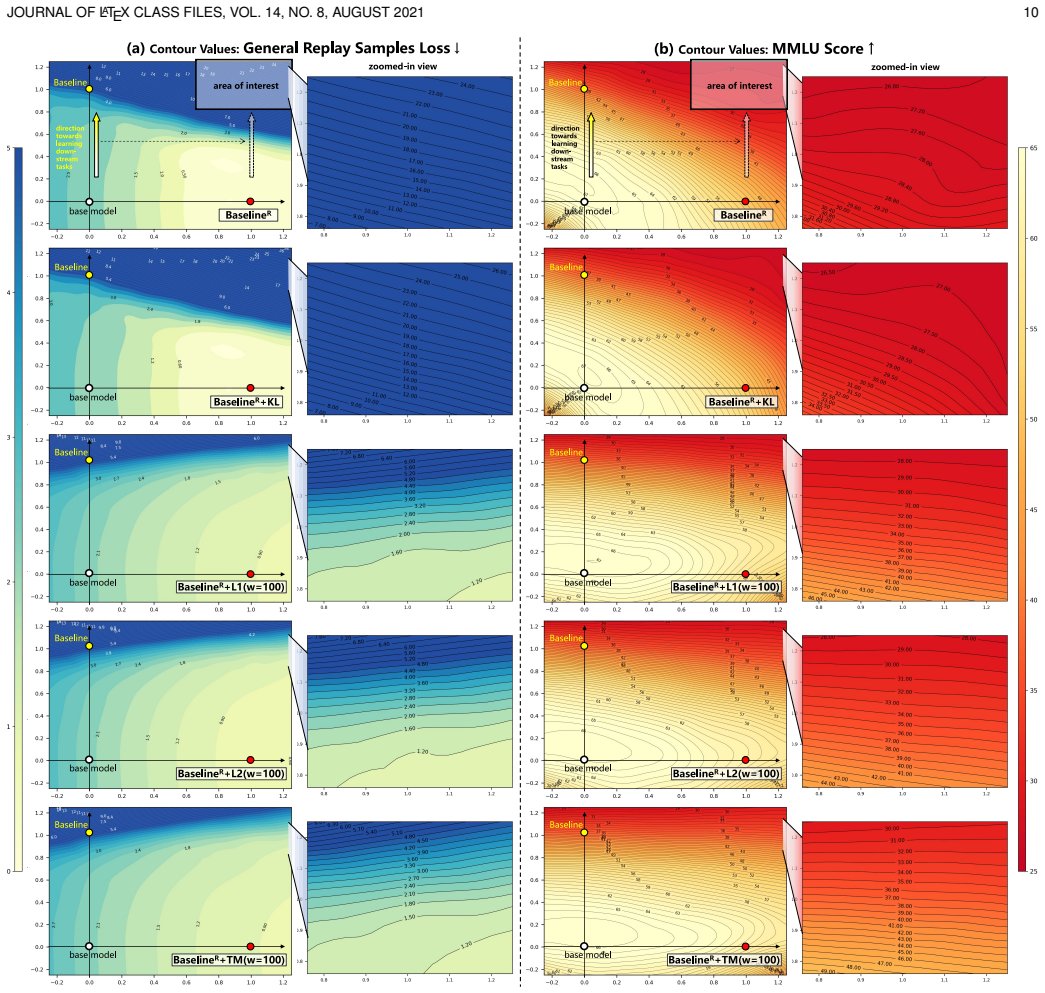
- [§3.1.2, §3.2.2, Figs. 5–7] The thresholds and distilled target states are computed once from the untuned base model and then applied unchanged through all 15 tasks. The method therefore assumes that the base model's last-layer activation distribution remains a valid reference throughout finetuning. This is not tested: Figs. 5–7 vary learning rate and interpolation direction, not task order or hidden-state drift. Moreover, the MMLU retention is partly a by-construction consequence of pulling activations back to the frozen base-model states; the non-circular part is whether this also helps AP. The paper should either measure distribution shift of the last-layer hidden states over the task sequence or compare against an adaptive-threshold baseline to substantiate that the frozen targets remain meaningful.
- [§4.5.3, Tables 2–3] The claim that TM 'consistently improves' relies on per-setting weight selection after seeing the results: w=100 for full-parameter and w=1 for LoRA are chosen for TM, and the same weight is then applied to L1/L2 'for fair comparison'. This is not a fair comparison of best achievable performance, since L1/L2 were not given their own tuned weights. Additionally, all results are 3-run averages with no error bars or significance tests, so the magnitude differences in several table entries (e.g., LoRA TM vs L2, Table 3) may not be stable. The authors should pre-specify the weight-selection rule or report confidence intervals and per-weight sweeps for all methods.
- [Eq. (5) vs Eq. (6)] Equation (5) defines the state labels inconsistently with the loss in Eq. (6): it labels values below τ− as 'positively activated' and values above τ+ as 'negatively activated', but Eq. (6) pushes predictions below τ− when the target is low and above τ+ when the target is high. This reversal makes the prose description of activation states unreliable. Additionally, the claim that the ±1σ bandwidth yields 'about 68.27%' non-activated relies on a Gaussian assumption that is never verified on the actual hidden-state distribution. Both points should be corrected or empirically checked.
minor comments (5)
- [Abstract] Language errors: 'framework that use usual pretraining texts' should be 'framework that uses', and 'a enhanced activation states constrained optimization' should be 'an enhanced activation-state-constrained optimization'.
- [§4.4] The replay samples are truncated to a 'maximum length of summation 562'; this is presumably 512 source + 50 target, but the notation is unclear and should be stated explicitly for each field.
- [§4.5.5 / Fig. 5] The term '3× LR increase' and '10× increase' are used without stating the base LR values in the figure or caption; please list the LR values tested so the sweep is reproducible.
- [§5 Conclusion] The conclusion states that 'only a fixed set of general replay samples is sufficient' without acknowledging that the evidence is a single replay draw and one task order; a caveat should be added or the claim softened to match the experimental scope.
- [Appendix A.1] The phrase 'using the following code' with a code snippet is helpful for reproducibility; a direct link to the released jsonl and the exact chunk/timestamp of the SlimPajama-6B download would further improve reproducibility.
Circularity Check
No significant circularity; central claims are empirically validated against external benchmarks.
full rationale
The paper's central claims are empirical rather than formal derivations. The replay targets are built from a one-time forward pass of the untuned base model (Eq. 1) and thresholds from the mean/std of those hidden states (Eqs. 2-4); the TM loss (Eq. 6) is explicitly a constraint pulling the current model toward the base model's last-layer activation states. This makes MMLU retention a designed objective, but the paper does not derive its headline MMLU/AP numbers from the loss definition—it measures them on held-out MMLU and 15 downstream tasks after sequential finetuning, and it compares all replay variants on the identical fixed 1K replay set. The non-trivial content is that this fixed 1K set plus TM achieves the reported F1 averages (66.94 full-parameter, 69.86 LoRA) without task replay data. No load-bearing equation reduces to its own input: the thresholds are not fitted to MMLU or AP; the dynamic loss weight is a hyperparameter, not a predicted quantity; and there is no self-citation chain—references to SlimPajama, GLUE, SuperGLUE, O-LoRA, and task arithmetic are external. Concerns such as the unverified Gaussian assumption behind the '68.27%' claim and the appendix's overstatement that one arbitrary 1K draw substantiates replay-data robustness are experimental-design/robustness limitations, not circularity. No specific reduction of the kind required by the circularity criteria can be exhibited, so the appropriate finding is no significant circularity.
Assumptions & free parameters
free parameters (5)
- Replay loss weight w (TM/L1/L2) =
100 (full-parameter), 1 (LoRA); dynamic in some runs
- Activation threshold bandwidth coefficient =
1.0 (one standard deviation)
- Batch insertion ratio rho_BI =
4/64
- Replay set size N =
1,000
- Epochs per task =
15 (full-parameter), 8 (LoRA)
assumptions (5)
- domain assumption Activation values are approximately Gaussian, so mean +/- 1 std captures about 68.27% as 'non-activated'
- domain assumption The last-layer hidden state encodes the majority of semantic information relevant to general capabilities
- domain assumption Sparse activation in biological neurons transfers to transformer FFN activations
- ad hoc to paper Frozen thresholds and pre-distilled states from the untuned base model remain valid replay targets throughout all 15 tasks
- standard math Standard operations on real-valued vectors (mean, std, max, zero) and AdamW optimization behave as expected
invented entities (1)
-
Ternary activation states (positively activated, non-activated, negatively activated)
Cite this review
Pith. "Pith review of GeRe: Towards Efficient Anti-Forgetting in Continual Learning of LLM via General Samples Replay." pith.science (2026). https://pith.science/paper/22LRURP4
@misc{pith2026250804676,
  author       = {Pith},
  title        = {Pith review of: GeRe: Towards Efficient Anti-Forgetting in Continual Learning of LLM via General Samples Replay},
  year         = {2026},
  howpublished = {\url{https://pith.science/paper/22LRURP4}},
  note         = {Machine review of arXiv:2508.04676}
}
read the original abstract
The continual learning capability of large language models (LLMs) is crucial for advancing artificial general intelligence. However, continual fine-tuning LLMs across various domains often suffers from catastrophic forgetting, characterized by: 1) significant forgetting of their general capabilities, and 2) sharp performance declines in previously learned tasks. To simultaneously address both issues in a simple yet stable manner, we propose General Sample Replay (GeRe), a framework that use usual pretraining texts for efficient anti-forgetting. Beyond revisiting the most prevalent replay-based practices under GeRe, we further leverage neural states to introduce a enhanced activation states constrained optimization method using threshold-based margin (TM) loss, which maintains activation state consistency during replay learning. We are the first to validate that a small, fixed set of pre-collected general replay samples is sufficient to resolve both concerns--retaining general capabilities while promoting overall performance across sequential tasks. Indeed, the former can inherently facilitate the latter. Through controlled experiments, we systematically compare TM with different replay strategies under the GeRe framework, including vanilla label fitting, logit imitation via KL divergence and feature imitation via L1/L2 losses. Results demonstrate that TM consistently improves performance and exhibits better robustness. Our work paves the way for efficient replay of LLMs for the future. Our code and data are available at https://github.com/Qznan/GeRe.
Figures


Figures from the paper (4 more)



Forward citations
Cited by 2 Pith papers
-
On-Policy Replay for Continual Supervised Fine-Tuning
On-Policy Replay filters model rollouts on historical prompts by task reward and replays them as ordinary SFT examples, reducing backward transfer degradation on the TRACE benchmark across three 7-8B models.
-
Geometry Conflict: Explaining and Controlling Forgetting in LLM Continual Post-Training
Forgetting in LLM continual post-training is a geometry conflict between task-induced covariance structures and the evolving model state, controlled by gating Wasserstein barycenter merging on measured conflict.
Reference graph
Works this paper leans on
-
[1]
Y. Luo, Z. Yang, F. Meng, Y. Li, J. Zhou, and Y. Zhang, “An empirical study of catastrophic forgetting in large language mod- els during continual fine-tuning,” arXiv preprint arXiv:2308.08747 ,
-
[2]
Concept-1k: A novel benchmark for instance incremental learning,
J. Zheng, S. Qiu, and Q. Ma, “Concept-1k: A novel benchmark for instance incremental learning,” arXiv e-prints , pp. arXiv–2402,
-
[3]
Continual learning of large language models: A comprehensive survey,
H. Shi, Z. Xu, H. Wang, W. Qin, W. Wang, Y. Wang, Z. Wang, S. Ebrahimi, and H. Wang, “Continual learning of large language models: A comprehensive survey,”arXiv preprint arXiv:2404.16789,
-
[4]
Llama 2: Open foundation and fine-tuned chat models,
H. Touvron, L. Martin, K. Stone, P . Albert, A. Almahairi, Y. Babaei, N. Bashlykov, S. Batra, P . Bhargava, S. Bhosale et al. , “Llama 2: Open foundation and fine-tuned chat models,” arXiv preprint arXiv:2307.09288, 2023. 2
arXiv 2023
-
[5]
A. Yang, B. Yang, B. Zhang, B. Hui, B. Zheng, B. Yu, C. Li, D. Liu, F. Huang, H. Wei et al., “Qwen2. 5 technical report,” arXiv preprint arXiv:2412.15115, 2024. 2
arXiv 2024
-
[6]
Emergence of simple-cell recep- tive field properties by learning a sparse code for natural images,
B. A. Olshausen and D. J. Field, “Emergence of simple-cell recep- tive field properties by learning a sparse code for natural images,” Nature, vol. 381, no. 6583, pp. 607–609, 1996. 2
work page 1996
-
[7]
Sparse and powerful cortical spikes,
J. Wolfe, A. R. Houweling, and M. Brecht, “Sparse and powerful cortical spikes,” Current opinion in neurobiology , vol. 20, no. 3, pp. 306–312, 2010. 2
work page 2010
-
[8]
Continual lifelong learning with neural networks: A review,
G. I. Parisi, R. Kemker, J. L. Part, C. Kanan, and S. Wermter, “Continual lifelong learning with neural networks: A review,” Neural networks, vol. 113, pp. 54–71, 2019. 2
work page 2019
Show all 44 references
-
[9]
Catastrophic forgetting in connectionist networks,
R. M. French, “Catastrophic forgetting in connectionist networks,” T rends in cognitive sciences, vol. 3, no. 4, pp. 128–135, 1999. 2 JOURNAL OF LATEX CLASS FILES, VOL. 14, NO. 8, AUGUST 2021 13
1999
-
[10]
Experience replay for continual learning,
D. Rolnick, A. Ahuja, J. Schwarz, T. Lillicrap, and G. Wayne, “Experience replay for continual learning,” Advances in neural information processing systems , vol. 32, 2019. 2
2019
-
[11]
Overcoming catastrophic forgetting in neural networks,
J. Kirkpatrick, R. Pascanu, N. Rabinowitz, J. Veness, G. Desjardins, A. A. Rusu, K. Milan, J. Quan, T. Ramalho, A. Grabska-Barwinska et al. , “Overcoming catastrophic forgetting in neural networks,” Proceedings of the national academy of sciences , vol. 114, no. 13, pp. 3521–3...
2017
-
[12]
Learning without forgetting,
Z. Li and D. Hoiem, “Learning without forgetting,” IEEE transac- tions on pattern analysis and machine intelligence , vol. 40, no. 12, pp. 2935–2947, 2017. 3
2017
-
[13]
Progressive neural networks,
A. A. Rusu, N. C. Rabinowitz, G. Desjardins, H. Soyer, J. Kirk- patrick, K. Kavukcuoglu, R. Pascanu, and R. Hadsell, “Progressive neural networks,” arXiv preprint arXiv:1606.04671 , 2016. 3
2016 arXiv
-
[14]
Piggyback: Adapting a single network to multiple tasks by learning to mask weights,
A. Mallya, D. Davis, and S. Lazebnik, “Piggyback: Adapting a single network to multiple tasks by learning to mask weights,” in Proceedings of the European conference on computer vision (ECCV) , 2018, pp. 67–82. 3
2018
-
[15]
Lora: Low-rank adaptation of large language models
E. J. Hu, Y. Shen, P . Wallis, Z. Allen-Zhu, Y. Li, S. Wang, L. Wang, W. Chen et al. , “Lora: Low-rank adaptation of large language models.” ICLR, vol. 1, no. 2, p. 3, 2022. 3
2022
-
[16]
Distilling the knowledge in a neural network,
G. Hinton, O. Vinyals, and J. Dean, “Distilling the knowledge in a neural network,” arXiv preprint arXiv:1503.02531 , 2015. 3
2015 arXiv
-
[17]
Distilbert, a distilled version of bert: smaller, faster, cheaper and lighter,
V . Sanh, L. Debut, J. Chaumond, and T. Wolf, “Distilbert, a distilled version of bert: smaller, faster, cheaper and lighter,” arXiv preprint arXiv:1910.01108, 2019. 3
1910 arXiv
-
[18]
Tinybert: Distilling bert for natural language understand- ing,
X. Jiao, Y. Yin, L. Shang, X. Jiang, H. Chen, L. Li, F. Wang, and Q. Liu, “Tinybert: Distilling bert for natural language understand- ing,” arXiv preprint arXiv:1909.10351 , 2020. 3
1909 arXiv
-
[19]
Distilling task- specific knowledge from large pre-trained models,
Y. Zhou, Y. Wang, J. Zhang, and X. Li, “Distilling task- specific knowledge from large pre-trained models,” arXiv preprint arXiv:2203.12345, 2022. 3
2022 arXiv
-
[20]
Localizationdistillationforobjectdetection,
Z. Zhengetal, “Localizationdistillationforobjectdetection,” IEEE T rans. Pattern Anal. Mach. Intell , vol. 45, no. 8, pp. 10 070–10 083,
-
[21]
Self-distillation for large language models,
L. Wang, M. Zhang, and Y. Liu, “Self-distillation for large language models,” arXiv preprint arXiv:2301.04567 , 2023. 3
2023 arXiv
-
[22]
A survey on knowledge distillation of large language models,
X. Xu, M. Li, C. Tao, T. Shen, R. Cheng, J. Li, C. Xu, D. Tao, and T. Zhou, “A survey on knowledge distillation of large language models,” arXiv preprint arXiv:2402.13116 , 2024. 3
2024 arXiv
-
[23]
The llama 3 herd of models,
A. Grattafiori, A. Dubey, A. Jauhri, A. Pandey, A. Kadian, A. Al- Dahle, A. Letman, A. Mathur, A. Schelten, A. Vaughan et al., “The llama 3 herd of models,” arXiv preprint arXiv:2407.21783 , 2024. 5
2024 arXiv
-
[24]
Visualizing the loss landscape of neural nets,
H. Li, Z. Xu, G. Taylor, C. Studer, and T. Goldstein, “Visualizing the loss landscape of neural nets,” Advances in neural information processing systems, vol. 31, 2018. 5
2018
-
[25]
A comprehensive survey of continual learning: Theory, method and application,
L. Wang, X. Zhang, H. Su, and J. Zhu, “A comprehensive survey of continual learning: Theory, method and application,” IEEE T ransactions on Pattern Analysis and Machine Intelligence , 2024. 5
2024
-
[26]
Slimpajama: A 627b token cleaned and deduplicated version of redpajama,
D. Soboleva, F. Al-Khateeb, R. Myers, J. R. Steeves, J. Hestness, and N. Dey, “Slimpajama: A 627b token cleaned and deduplicated version of redpajama,” 2023. [Online]. Available: https://huggingface.co/datasets/cerebras/SlimPajama-627B 5
2023
-
[27]
Redpajama: an open dataset for training large language models,
M. Weber, D. Y. Fu, Q. Anthony, Y. Oren, S. Adams, A. Alexandrov, X. Lyu, H. Nguyen, X. Yao, V . Adams, B. Athiwaratkun, R. Chala- mala, K. Chen, M. Ryabinin, T. Dao, P . Liang, C. R ´e, I. Rish, and C. Zhang, “Redpajama: an open dataset for training large language models,” Ne...
2023
-
[28]
Progressive prompts: Continual learning for lan- guage models,
A. Razdaibiedina, Y. Mao, R. Hou, M. Khabsa, M. Lewis, and A. Almahairi, “Progressive prompts: Continual learning for lan- guage models,” in The Eleventh International Conference on Learning Representations, 2023. 5, 7
2023
-
[29]
Character-level convolutional networks for text classification,
X. Zhang, J. Zhao, and Y. LeCun, “Character-level convolutional networks for text classification,” Advances in neural information processing systems, vol. 28, 2015. 5
2015
-
[30]
Lfpt5: A unified framework for lifelong few- shot language learning based on prompt tuning of t5,
C. Qin and S. Joty, “Lfpt5: A unified framework for lifelong few- shot language learning based on prompt tuning of t5,” arXiv preprint arXiv:2110.07298, 2021. 5
2021 arXiv
-
[31]
Glue: A multi-task benchmark and analysis platform for natural language understanding,
A. Wang, A. Singh, J. Michael, F. Hill, O. Levy, and S. R. Bowman, “Glue: A multi-task benchmark and analysis platform for natural language understanding,” arXiv preprint arXiv:1804.07461 , 2018. 5
2018 arXiv
-
[32]
Superglue: A stickier benchmark for general-purpose language understanding systems,
A. Wang, Y. Pruksachatkun, N. Nangia, A. Singh, J. Michael, F. Hill, O. Levy, and S. Bowman, “Superglue: A stickier benchmark for general-purpose language understanding systems,” Advances in neural information processing systems , vol. 32, 2019. 5
2019
-
[33]
Learning word vectors for sentiment analysis,
A. Maas, R. E. Daly, P . T. Pham, D. Huang, A. Y. Ng, and C. Potts, “Learning word vectors for sentiment analysis,” in Proceedings of the 49th annual meeting of the association for computational linguistics: Human language technologies , 2011, pp. 142–150. 5
2011
-
[34]
Measuring massive multitask language under- standing,
D. Hendrycks, C. Burns, S. Basart, A. Zou, M. Mazeika, D. Song, and J. Steinhardt, “Measuring massive multitask language under- standing,” arXiv preprint arXiv:2009.03300 , 2020. 6
2009 arXiv
-
[35]
Rieman- nian walk for incremental learning: Understanding forgetting and intransigence,
A. Chaudhry, P . K. Dokania, T. Ajanthan, and P . H. Torr, “Rieman- nian walk for incremental learning: Understanding forgetting and intransigence,” in Proceedings of the European conference on computer vision (ECCV), 2018, pp. 532–547. 6
2018
-
[36]
Logit standardization in knowledge distillation,
S. Sun, W. Ren, J. Li, R. Wang, and X. Cao, “Logit standardization in knowledge distillation,” in Proceedings of the IEEE/CVF confer- ence on computer vision and pattern recognition , 2024, pp. 15 731– 15 740. 6
2024
-
[37]
Orthogonal subspace learning for language model continual learning,
X. Wang, T. Chen, Q. Ge, H. Xia, R. Bao, R. Zheng, Q. Zhang, T. Gui, and X. Huang, “Orthogonal subspace learning for language model continual learning,” arXiv preprint arXiv:2310.14152, 2023. 7, 8
2023 arXiv
-
[38]
Transformers: State-of-the-art natural language processing,
T. Wolf, L. Debut, V . Sanh, J. Chaumond, C. Delangue, A. Moi, P . Cistac, T. Rault, R. Louf, M. Funtowicz et al. , “Transformers: State-of-the-art natural language processing,” in Proceedings of the 2020 conference on empirical methods in natural language processing: system d...
2020
-
[39]
Zero: Memory optimizations toward training trillion parameter models,
S. Rajbhandari, J. Rasley, O. Ruwase, and Y. He, “Zero: Memory optimizations toward training trillion parameter models,” inSC20: International Conference for High Performance Computing, Networking, Storage and Analysis . IEEE, 2020, pp. 1–16. 7
2020
-
[40]
Decoupled weight decay regulariza- tion,
I. Loshchilov and F. Hutter, “Decoupled weight decay regulariza- tion,” arXiv preprint arXiv:1711.05101 , 2017. 7
2017 arXiv
-
[41]
Lora learns less and forgets less,
D. Biderman, J. Portes, J. J. G. Ortiz, M. Paul, P . Greengard, C. Jennings, D. King, S. Havens, V . Chiley, J. Frankle et al. , “Lora learns less and forgets less,” arXiv preprint arXiv:2405.09673 , 2024. 8
2024 arXiv
-
[42]
Loss of plasticity in deep continual learning,
S. Dohare, J. F. Hernandez-Garcia, Q. Lan, P . Rahman, A. R. Mahmood, and R. S. Sutton, “Loss of plasticity in deep continual learning,” Nature, vol. 632, no. 8026, pp. 768–774, 2024. 8
2024
-
[43]
Spurious forgetting in continual learning of language models,
J. Zheng, X. Cai, S. Qiu, and Q. Ma, “Spurious forgetting in continual learning of language models,” in The Thirteenth International Conference on Learning Representations , 2025. [Online]. Available: https://openreview.net/forum?id=ScI7IlKGdI 9
2025
-
[44]
Editing models with task arithmetic,
G. Ilharco, M. T. Ribeiro, M. Wortsman, L. Schmidt, H. Hajishirzi, and A. Farhadi, “Editing models with task arithmetic,” in The Eleventh International Conference on Learning Representations , 2023. [Online]. Available: https://openreview.net/forum?id=6t0Kwf8- jrj 11 APPENDIX ...
2023
Reviewed August 5, 2026 · model on record in the stance chip above.
Discussion (0). Sign in to comment.