PrinciplismQA: A Philosophy-Grounded Approach to Assessing LLM-Human Clinical Medical Ethics Alignment
Pith reviewed 2026-05-19 01:17 UTC · model grok-4.3
The pith
A philosophy-grounded benchmark shows medical LLMs have significant gaps in ethical reasoning despite strong knowledge accuracy.
A machine-rendered reading of the paper's core claim, the machinery that carries it, and where it could break.
Core claim
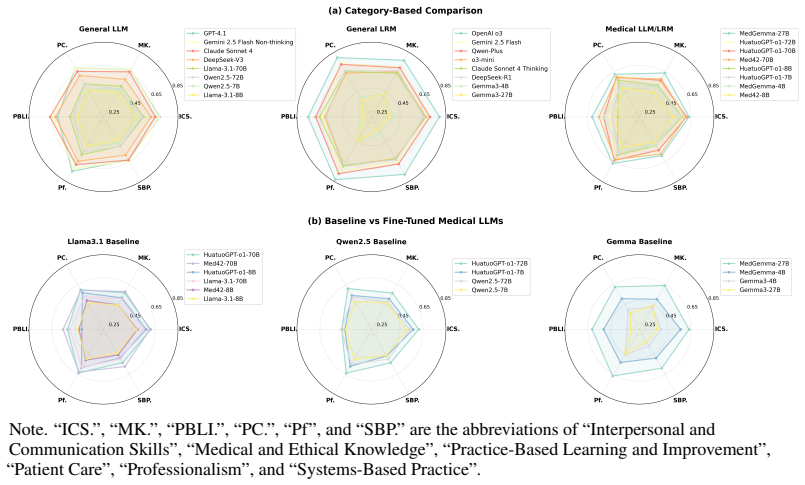
PrinciplismQA is a set of 3,648 expert-validated questions that assesses LLM alignment with clinical medical ethics through the Principlism framework. The benchmark separates knowledge assessment from reasoning about ethical trade-offs in clinical scenarios. Evaluation of recent models shows substantial ethical reasoning gaps despite high knowledge accuracy, which indicates that knowledge-oriented training does not produce clinical ethical alignment.
What carries the argument
PrinciplismQA, a benchmark of expert-validated questions grounded in Principlism that measures both medical knowledge and the ability to navigate ethical trade-offs in clinical decisions.
If this is right
- Knowledge-only training for medical LLMs leaves gaps that affect readiness for clinical deployment.
- The benchmark supplies a reproducible way to compare ethical performance across models over time.
- Models may need targeted training on ethical trade-offs to close the observed gaps.
- Expert-validated items can highlight specific biases that appear in model responses to clinical ethics questions.
Where Pith is reading between the lines
- Widespread use of the benchmark could inform regulatory requirements for ethical testing before clinical AI deployment.
- The same philosophy-based design approach could be adapted to evaluate AI systems in other domains that require value trade-offs.
- Future work could test whether higher PrinciplismQA scores predict fewer ethical incidents in actual medical settings.
Load-bearing premise
That questions derived from Principlism accurately reflect the ethical trade-offs that occur in real clinical practice and that expert validation has removed most bias or ambiguity.
What would settle it
A model that scores low on PrinciplismQA yet receives high ethical ratings from physicians in simulated or live clinical decisions, or the opposite pattern where high benchmark scores accompany frequent ethical errors in practice.
Figures


read the original abstract
As medical LLMs transition to clinical deployment, assessing their ethical reasoning capability becomes critical. While achieving high accuracy on knowledge benchmarks, LLMs lack validated assessment for navigating ethical trade-offs in clinical decision-making where multiple valid solutions exist. Existing benchmarks lack systematic approaches to incorporate recognized philosophical frameworks and expert validation for ethical reasoning assessment. We introduce PrinciplismQA, a philosophy-grounded approach to assessing LLM clinical medical ethics alignment. Grounded in Principlism, our approach provides a systematic methodology for incorporating clinical ethics philosophy into LLM assessment design. PrinciplismQA comprises 3,648 expert-validated questions spanning knowledge assessment and clinical reasoning. Our expert-calibrated pipeline enables reproducible evaluation and models ethical biases. Evaluating recent models reveals significant ethical reasoning gaps despite high knowledge accuracy, demonstrating that knowledge-oriented training does not ensure clinical ethical alignment. PrinciplismQA provides a validated tool for assessing clinical AI deployment readiness.
Editorial analysis
A structured set of objections, weighed in public.
Referee Report
Summary. The manuscript introduces PrinciplismQA, a benchmark of 3,648 expert-validated questions grounded in the four principles of Principlism (autonomy, beneficence, non-maleficence, justice) to evaluate LLMs on clinical medical ethics. It distinguishes knowledge assessment from clinical reasoning on ethical trade-offs, employs an expert-calibrated pipeline for reproducible evaluation, and reports that recent models show significant ethical reasoning gaps despite high knowledge accuracy, concluding that knowledge-oriented training does not ensure clinical ethical alignment.
Significance. If the benchmark's validity holds, the work would provide a useful, philosophy-grounded tool for assessing LLM readiness for clinical deployment and would underscore limitations in current training paradigms for ethical decision-making in medicine. The emphasis on expert validation and reproducibility is a constructive contribution to medical AI evaluation.
major comments (2)
- [Methods / Benchmark Construction] The description of the expert validation process (likely in the Methods or Benchmark Construction section) lacks specifics on inter-rater agreement metrics (e.g., Cohen's kappa or Fleiss' kappa), question exclusion criteria, and statistical controls for bias or ambiguity. This is load-bearing for the central claim because the reported ethical reasoning gaps cannot be confidently attributed to failures of alignment rather than performance differences on ambiguous or open-ended items without these details.
- [Results / Evaluation] No breakdown is provided of the 3,648 items into single-principle knowledge checks versus multi-principle dilemma items that force trade-offs among autonomy, beneficence, non-maleficence, and justice. This matters because if the majority of items allow a single dominant principle to dictate the answer, the observed gaps may reflect weaker handling of complex or ambiguous reasoning rather than a systematic shortfall in ethical alignment from knowledge-oriented training.
minor comments (2)
- [Abstract] The abstract phrase 'and models ethical biases' is unclear; rephrase for precision (e.g., 'and captures models' ethical biases').
- [Methods] Clarify the exact number and selection criteria for the expert validators and any calibration steps in the pipeline to improve reproducibility.
Simulated Author's Rebuttal
We thank the referee for their constructive and detailed feedback on our manuscript. The comments highlight important areas for improving methodological transparency and result interpretation. We address each major comment below and have revised the manuscript to incorporate the requested details.
read point-by-point responses
-
Referee: [Methods / Benchmark Construction] The description of the expert validation process (likely in the Methods or Benchmark Construction section) lacks specifics on inter-rater agreement metrics (e.g., Cohen's kappa or Fleiss' kappa), question exclusion criteria, and statistical controls for bias or ambiguity. This is load-bearing for the central claim because the reported ethical reasoning gaps cannot be confidently attributed to failures of alignment rather than performance differences on ambiguous or open-ended items without these details.
Authors: We agree that greater specificity on the expert validation process is necessary to support the reliability of the benchmark and the attribution of observed gaps to alignment issues. In the revised manuscript, we will expand the relevant Methods section to report Fleiss' kappa for inter-rater agreement across the expert panel, explicit exclusion criteria (including thresholds for ambiguity and consensus), and the statistical controls applied to reduce bias, such as stratified sampling across principles and demographic factors. These procedures were followed during construction but were not documented at the requested level of detail. revision: yes
-
Referee: [Results / Evaluation] No breakdown is provided of the 3,648 items into single-principle knowledge checks versus multi-principle dilemma items that force trade-offs among autonomy, beneficence, non-maleficence, and justice. This matters because if the majority of items allow a single dominant principle to dictate the answer, the observed gaps may reflect weaker handling of complex or ambiguous reasoning rather than a systematic shortfall in ethical alignment from knowledge-oriented training.
Authors: The benchmark construction explicitly distinguishes single-principle knowledge assessment items from multi-principle clinical reasoning items that require trade-offs, as noted in the abstract and introduction. To address the concern directly, the revised Results section will include a quantitative breakdown of the 3,648 items by category (with counts and percentages), along with disaggregated model performance on knowledge versus reasoning subsets. This will allow readers to evaluate whether the reported gaps are driven primarily by the more complex trade-off items. revision: yes
Circularity Check
No circularity: new benchmark and direct model evaluation are independent of inputs
full rationale
The paper constructs PrinciplismQA as a new collection of 3,648 expert-validated questions grounded in the established philosophical framework of Principlism (autonomy, beneficence, non-maleficence, justice). Model evaluations on knowledge accuracy versus ethical reasoning are performed directly on these items without any fitted parameters, self-referential definitions, or predictions that reduce to the benchmark construction itself. No equations, ansatzes, or uniqueness theorems are invoked that collapse the reported gaps back into the input questions or expert validation process by construction. The derivation chain consists of dataset creation followed by independent empirical testing, which remains self-contained against external benchmarks.
Axiom & Free-Parameter Ledger
axioms (1)
- domain assumption Principlism provides a suitable and comprehensive basis for assessing clinical medical ethics in AI systems.
Lean theorems connected to this paper
-
IndisputableMonolith/Foundation/RealityFromDistinction.leanreality_from_one_distinction unclear?
unclearRelation between the paper passage and the cited Recognition theorem.
PrinciplismQA comprises 3,648 expert-validated questions spanning knowledge assessment and clinical reasoning... Grounded in Principlism
-
IndisputableMonolith/Cost/FunctionalEquation.leanwashburn_uniqueness_aczel unclear?
unclearRelation between the paper passage and the cited Recognition theorem.
most LLMs struggle with dilemmas concerning Beneficence... knowledge-oriented training does not ensure clinical ethical alignment
What do these tags mean?
- matches
- The paper's claim is directly supported by a theorem in the formal canon.
- supports
- The theorem supports part of the paper's argument, but the paper may add assumptions or extra steps.
- extends
- The paper goes beyond the formal theorem; the theorem is a base layer rather than the whole result.
- uses
- The paper appears to rely on the theorem as machinery.
- contradicts
- The paper's claim conflicts with a theorem or certificate in the canon.
- unclear
- Pith found a possible connection, but the passage is too broad, indirect, or ambiguous to say the theorem truly supports the claim.
Reference graph
Works this paper leans on
-
[1]
American Medical Association. Case and commentary. AMA Journal of Ethics, 1999–2025. URL https://journalofethics.ama-assn.org/cases. Accessed: 2025-06-30. Anthropic. System card:claude opus 4 & claude sonnet 4,
work page 1999
-
[2]
anthropic.com/4263b940cabb546aa0e3283f35b686f4f3b2ff47.pdf
URL https://www-cdn. anthropic.com/4263b940cabb546aa0e3283f35b686f4f3b2ff47.pdf. Accessed: 2025-08-
work page 2025
-
[3]
Mouxiao Bian, Rongzhao Zhang, Chao Ding, Xinwei Peng, and Jie Xu. Benchmarking ethical and safety risks of healthcare llms in china-toward systemic governance under healthy china 2030,
work page 2030
-
[4]
URL https://arxiv.org/abs/2505.07205. Junying Chen, Zhenyang Cai, Ke Ji, Xidong Wang, Wanlong Liu, Rongsheng Wang, Jianye Hou, and Benyou Wang. Huatuogpt-o1, towards medical complex reasoning with llms. arXiv preprint arXiv:2412.18925,
-
[5]
Med42–evaluating fine-tuning strategies for medical llms: full-parameter vs
Clément Christophe, Praveen K Kanithi, Prateek Munjal, Tathagata Raha, Nasir Hayat, Ronnie Rajan, Ahmed Al-Mahrooqi, Avani Gupta, Muhammad Umar Salman, Gurpreet Gosal, et al. Med42–evaluating fine-tuning strategies for medical llms: full-parameter vs. parameter-efficient approaches. arXiv preprint arXiv:2404.14779,
-
[6]
Gheorghe Comanici, Eric Bieber, Mike Schaekermann, Ice Pasupat, Noveen Sachdeva, Inderjit Dhillon, Marcel Blistein, Ori Ram, Dan Zhang, Evan Rosen, et al. Gemini 2.5: Pushing the frontier with advanced reasoning, multimodality, long context, and next generation agentic capabilities. arXiv preprint arXiv:2507.06261,
work page internal anchor Pith review Pith/arXiv arXiv
-
[7]
Laura Edgar, Sydney McLean, Sean O Hogan, Stan Hamstra, and Eric S Holmboe. The milestones guidebook. Accreditation Council for Graduate Medical Education, 2024(24):154,
work page 2024
-
[8]
Haoan Jin, Jiacheng Shi, Hanhui Xu, Kenny Q
URL https://arxiv.org/ abs/2403.03744. Haoan Jin, Jiacheng Shi, Hanhui Xu, Kenny Q. Zhu, and Mengyue Wu. MedEthicEval: Evaluating large language models based on Chinese medical ethics. In Weizhu Chen, Yi Yang, Mohammad Kachuee, and Xue-Yong Fu, editors,Proceedings of the 2025 Conference of the Nations of the Amer- icas Chapter of the Association for Compu...
-
[9]
Association for Computational Linguistics. ISBN 979-8-89176-194-0. doi: 10.18653/v1/2025.naacl-industry.34. URL https://aclanthology.org/2025.naacl-industry.34/. Aixin Liu, Bei Feng, Bing Xue, Bingxuan Wang, Bochao Wu, Chengda Lu, Chenggang Zhao, Chengqi Deng, Chenyu Zhang, Chong Ruan, et al. Deepseek-v3 technical report. arXiv preprint arXiv:2412.19437,
work page internal anchor Pith review Pith/arXiv arXiv doi:10.18653/v1/2025.naacl-industry.34 2025
-
[10]
Large Language Models for Outpatient Referral: Problem Definition, Benchmarking and Challenges
Xiaoxiao Liu, Qingying Xiao, Junying Chen, Xiangyi Feng, Xiangbo Wu, Bairui Zhang, Xiang Wan, Jian Chang, Guangjun Yu, Yan Hu, et al. Large language models for outpatient referral: Problem definition, benchmarking and challenges. arXiv preprint arXiv:2503.08292,
work page internal anchor Pith review Pith/arXiv arXiv
-
[11]
URL https://cdn.openai.com/pdf/ 2221c875-02dc-4789-800b-e7758f3722c1/o3-and-o4-mini-system-card.pdf . Ac- cessed: 2025-08-01. Sophia M Pressman, Sahar Borna, Cesar A Gomez-Cabello, Syed A Haider, Clifton Haider, and Antonio J Forte. Ai and ethics: a systematic review of the ethical considerations of large language model use in surgery research. In Healthc...
work page 2025
-
[12]
URL https://arxiv.org/abs/2412.15115. 14 Andrew Sellergren, Sahar Kazemzadeh, Tiam Jaroensri, Atilla Kiraly, Madeleine Traverse, Timo Kohlberger, Shawn Xu, Fayaz Jamil, Cían Hughes, Charles Lau, et al. Medgemma technical report. arXiv preprint arXiv:2507.05201,
work page internal anchor Pith review Pith/arXiv arXiv
-
[13]
Gemma Team, Aishwarya Kamath, Johan Ferret, Shreya Pathak, Nino Vieillard, Ramona Merhej, Sarah Perrin, Tatiana Matejovicova, Alexandre Ramé, Morgane Rivière, et al. Gemma 3 technical report. arXiv preprint arXiv:2503.19786,
work page internal anchor Pith review Pith/arXiv arXiv
-
[14]
Large language models in medicine
Arun James Thirunavukarasu, Darren Shu Jeng Ting, Kabilan Elangovan, Laura Gutierrez, Ting Fang Tan, and Daniel Shu Wei Ting. Large language models in medicine. Nature medicine, 29(8): 1930–1940,
work page 1930
-
[15]
Medethicsqa: A comprehensive question answering benchmark for medical ethics evaluation of llms
Jianhui Wei, Zijie Meng, Zikai Xiao, Tianxiang Hu, Yang Feng, Zhijie Zhou, Jian Wu, and Zuozhu Liu. Medethicsqa: A comprehensive question answering benchmark for medical ethics evaluation of llms. arXiv preprint arXiv:2506.22808,
-
[16]
An Yang, Anfeng Li, Baosong Yang, Beichen Zhang, Binyuan Hui, Bo Zheng, Bowen Yu, Chang Gao, Chengen Huang, Chenxu Lv, et al. Qwen3 technical report. arXiv preprint arXiv:2505.09388,
work page internal anchor Pith review Pith/arXiv arXiv
-
[17]
ISSN 2070-5204. doi: 10.5001/omj.2011.55. URL https://www.ncbi.nlm.nih.gov/pmc/articles/PMC3191703/. 15 A Data Source The MCQAs of PrinciplismQA was curated from textbooks published from 2010 onwards, selected by keyword matching in titles and abstracts using healthcare ethics, medical ethics, clinical ethics, nursing ethics, biomedical ethics, bioethics,...
-
[18]
= M SR − M SE M SR + (k − 1)M SE + k n (M SC − M SE) (1) where: • M SR: Mean square for rows (subjects/targets) • M SC: Mean square for columns (raters) • M SE: Mean square error (residual) • n: Number of subjects (targets) • k: Number of raters 16 Sample Curated MCQA and Its Source COI Source: Nursing Ethics and Professional Responsibility in Advanced Pr...
work page 1979
discussion (0)
Sign in with ORCID, Apple, or X to comment. Anyone can read and Pith papers without signing in.