Production of π⁺π⁻ pairs in diffractive photon-proton and in proton-proton collisions revisited, in particular concerning the Drell-S\"oding contribution
Pith reviewed 2026-05-19 00:10 UTC · model grok-4.3
The pith
A revised gauge-invariant treatment of the Drell-Söding term with separate subenergies for π⁺p and π⁻p systems produces larger cross sections and stronger skewing of the ρ⁰ shape in diffractive pion-pair production.
A machine-rendered reading of the paper's core claim, the machinery that carries it, and where it could break.
Core claim
Within the tensor-pomeron framework, the Drell-Söding amplitude for diffractive π⁺π⁻ production must be constructed with distinct subenergies for the π⁺p and π⁻p channels. The paper supplies an explicit method that maintains electromagnetic gauge invariance under this asymmetry. The resulting photoproduction and electroproduction amplitudes are then folded into the calculation of pp → pp π⁺π⁻ via single-photon emission from one proton. The revised amplitudes yield higher cross sections and a more pronounced skewing of the ρ⁰ spectral function compared with the earlier treatment.
What carries the argument
A gauge-invariance preserving prescription for the Drell-Söding contribution that assigns unequal subenergies to the π⁺p and π⁻p subsystems inside the tensor-pomeron model.
If this is right
- Differential cross sections for pp → pp π⁺π⁻ increase as functions of two-pion mass, pion transverse momentum, and pseudorapidity.
- The ρ⁰ resonance shape in the two-pion spectrum exhibits stronger skewing than in previous calculations.
- The same amplitudes provide an improved description of real photoproduction and low-Q² electroproduction of π⁺π⁻ pairs.
- The results serve as a basis for modeling coherent pion-pair production in ultra-peripheral pA and AA collisions.
Where Pith is reading between the lines
- The increased skewing may help experiments separate the Drell-Söding background from resonant contributions more cleanly.
- Predictions can be confronted with existing or forthcoming data from ALICE, ATLAS, CMS, and LHCb on exclusive pion pairs.
- Similar subenergy handling could be tested in other diffractive channels that involve unequal final-state masses.
- Extension to higher virtualities would reveal whether the gauge-invariance fix remains adequate beyond the stated Q² range.
Load-bearing premise
The proposed prescription continues to enforce gauge invariance when the π⁺p and π⁻p systems are assigned different subenergies in the Drell-Söding term.
What would settle it
A direct comparison of the predicted two-pion invariant-mass spectrum, especially the degree of ρ⁰ skewing, against measured differential cross sections in pp collisions at LHC energies.
Figures




read the original abstract
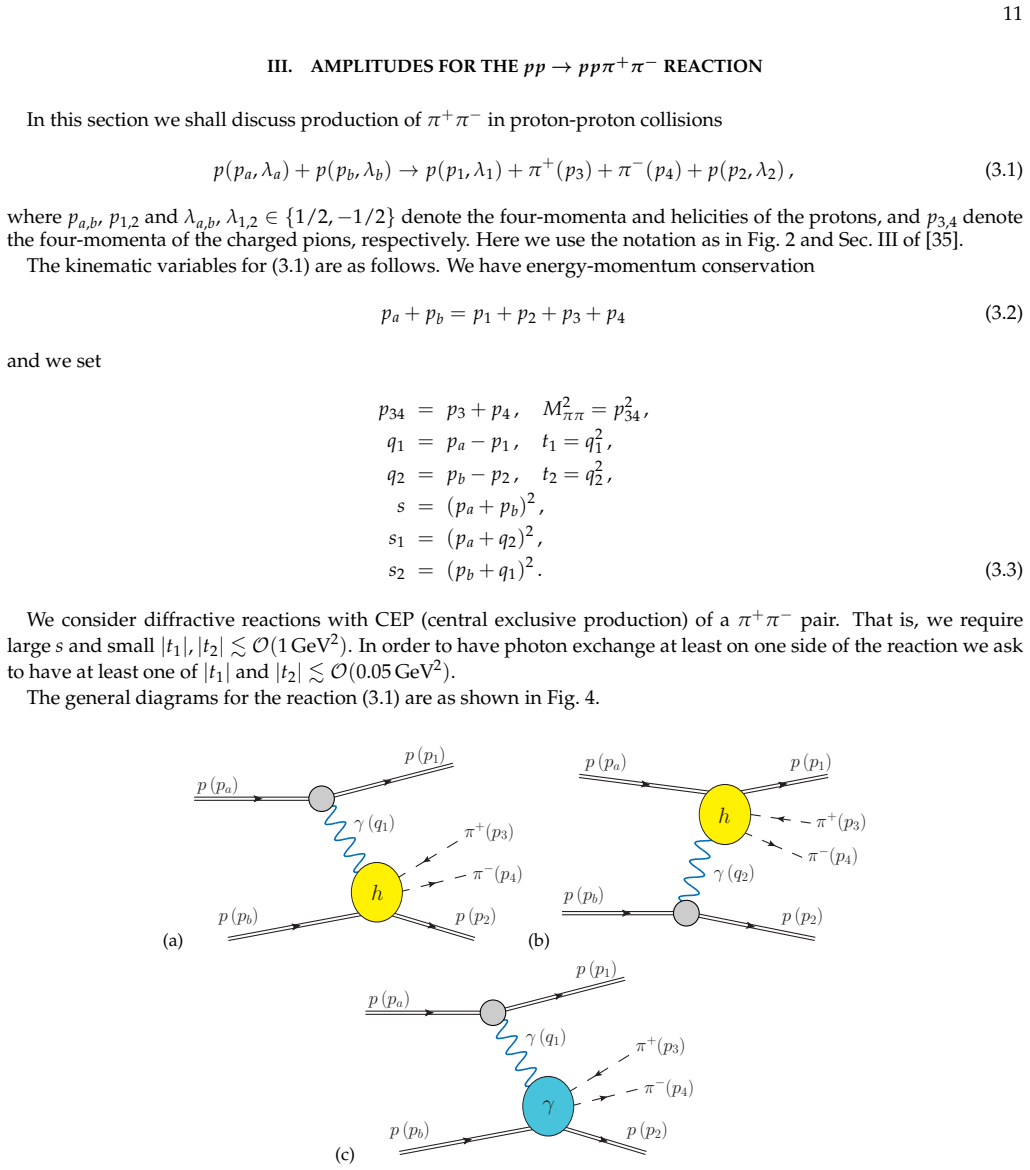
We discuss the exclusive photoproduction of $\pi^{+}\pi^{-}$ pairs in photon-proton and in proton-proton collisions at high energies. The $\rho^{0}$, $\omega$, $f_{2}(1270)$, and non-resonant (Drell-S\"oding) contributions are considered. The calculation is based on the tensor-pomeron model. In the Drell-S\"oding contribution we have different subenergies for the $\pi^{+}p$ and $\pi^{-}p$ systems. In the method which we propose now we take this into account. Respecting the gauge-invariance constraints is then a nontrivial problem for which, however, we present a solution here. In the present paper we give in this way a substantial improvement of the calculations for real photoproduction of $\pi^{+}\pi^{-}$ from JHEP 01, 151 (2015), and we extend the calculations to low $Q^{2}$ electroproduction, $0 \leqslant Q^{2} \leqslant 0.5$ GeV$^{2}$. The photo- and electroproduction amplitudes are then the basis for the calculation of central exclusive production (CEP) of $\pi^{+}\pi^{-}$ pairs in $pp$ collisions, where at least one proton participates in the CEP via a virtual-photon emission. The revised model leads to enhanced cross sections and gives an increased skewing of the $\rho^{0}$ spectral shape. For the $pp \to pp \pi^{+}\pi^{-}$ reaction, we calculate differential cross sections as function of the two-pion invariant mass, pion transverse momentum and pion pseudorapidity. This research is relevant in the context of ALICE, ATLAS, CMS, and LHCb measurements in $pp$ collisions. Our results can also serve as basis for the description of coherent $\pi^{+}\pi^{-}$ production in ultra-peripheral $p$A and AA collisions at the LHC. The formulas given in our paper can be used for the analysis of photoproduction and small-$Q^{2}$ electroproduction in $ep$ collisions at high energies. Such data exist from the HERA experiments and will be obtained in the future at the electron-ion colliders.
Editorial analysis
A structured set of objections, weighed in public.
Referee Report
Summary. The manuscript revisits exclusive photoproduction of π⁺π⁻ pairs in photon-proton and proton-proton collisions within the tensor-pomeron model. It includes resonant contributions from ρ⁰, ω, and f₂(1270) together with the non-resonant Drell-Söding term. The key technical advance is a prescription that accounts for unequal subenergies s(π⁺p) ≠ s(π⁻p) while restoring gauge invariance; the resulting amplitudes are extended to low-Q² electroproduction and then used to compute central exclusive production (CEP) in pp collisions. The revised model yields larger cross sections and stronger skewing of the ρ⁰ spectral shape, with direct relevance to LHC measurements and future EIC data.
Significance. If the gauge-invariance construction is shown to be robust, the work would supply a more consistent treatment of the non-resonant background in diffractive two-pion production. This would improve the separation of resonance signals in high-energy data and provide a unified framework linking real photoproduction, low-Q² electroproduction, and CEP processes relevant to ALICE, ATLAS, CMS, LHCb, and HERA/EIC analyses.
major comments (1)
- [Section describing the Drell-Söding contribution and gauge-invariance fix] The central claim of enhanced cross sections and increased ρ⁰ skewing rests on the new treatment of the Drell-Söding amplitude with unequal subenergies. The manuscript states that a solution to the gauge-invariance problem is presented, yet the explicit construction of the modified tensor amplitude, the verification that q^μ M_μ = 0 holds off-shell, and any numerical tests of the longitudinal components are not supplied. Without these details the support for the reported enhancements cannot be assessed.
minor comments (1)
- [Abstract and introduction] The abstract and introduction would benefit from a concise quantitative comparison (e.g., percentage increase in cross section or change in skewing parameter) between the present results and those of the 2015 JHEP reference to make the improvement more transparent.
Simulated Author's Rebuttal
We thank the referee for the careful reading of our manuscript and the constructive comments. We appreciate the positive assessment of the work's significance for LHC and EIC analyses. Below we respond point by point to the major comment and indicate the revisions we will make.
read point-by-point responses
-
Referee: [Section describing the Drell-Söding contribution and gauge-invariance fix] The central claim of enhanced cross sections and increased ρ⁰ skewing rests on the new treatment of the Drell-Söding amplitude with unequal subenergies. The manuscript states that a solution to the gauge-invariance problem is presented, yet the explicit construction of the modified tensor amplitude, the verification that q^μ M_μ = 0 holds off-shell, and any numerical tests of the longitudinal components are not supplied. Without these details the support for the reported enhancements cannot be assessed.
Authors: We agree that the current presentation would be strengthened by a more explicit and self-contained description of the gauge-invariance construction. While the manuscript outlines the approach that restores gauge invariance for unequal subenergies s(π⁺p) ≠ s(π⁻p), we acknowledge that the explicit tensor form of the modified amplitude, the direct verification of q^μ M_μ = 0 off-shell, and numerical checks of the longitudinal components are not given in sufficient detail. In the revised manuscript we will add a dedicated subsection (or appendix) that supplies the full expression for the modified Drell-Söding tensor amplitude, demonstrates analytically that the gauge condition holds for off-shell pions, and includes numerical illustrations of the longitudinal-component suppression. These additions will make the origin of the larger cross sections and the increased ρ⁰ skewing fully transparent and directly address the referee's concern. revision: yes
Circularity Check
Gauge-invariance fix for Drell-Söding with unequal subenergies is internal extension of authors' tensor-pomeron model
specific steps
-
self citation load bearing
[Abstract]
"The calculation is based on the tensor-pomeron model. In the Drell-Söding contribution we have different subenergies for the π⁺p and π⁻p systems. In the method which we propose now we take this into account. Respecting the gauge-invariance constraints is then a nontrivial problem for which, however, we present a solution here. ... The revised model leads to enhanced cross sections and gives an increased skewing of the ρ⁰ spectral shape."
The load-bearing improvement (enhanced rates and spectral distortion) is obtained by the newly proposed method for unequal subenergies. Because the underlying tensor-pomeron framework and its gauge-invariance properties originate in the authors' earlier papers, the 'solution' functions as an internal extension rather than an independent constraint; the predicted enhancement is therefore constructed from the same model family that supplies the starting amplitude.
full rationale
The paper's central results (enhanced cross sections, increased ρ⁰ skewing) rest on a revised Drell-Söding amplitude that handles s(π⁺p) ≠ s(π⁻p) while preserving gauge invariance. This revision is presented as a new solution within the tensor-pomeron framework that the same author group has developed across multiple prior publications. No independent derivation or external benchmark is supplied for the fix itself; the amplitude construction therefore reduces to an internal adjustment of the authors' own model. This qualifies as self-citation load-bearing for the headline claims.
Axiom & Free-Parameter Ledger
free parameters (1)
- tensor-pomeron coupling parameters
axioms (1)
- domain assumption Tensor-pomeron model describes diffractive vector-meson and continuum production
Lean theorems connected to this paper
-
IndisputableMonolith/Cost/FunctionalEquation.leanwashburn_uniqueness_aczel unclear?
unclearRelation between the paper passage and the cited Recognition theorem.
In the Drell-Söding contribution we have different subenergies for the π⁺p and π⁻p systems. ... we present a solution here.
-
IndisputableMonolith/Foundation/RealityFromDistinction.leanreality_from_one_distinction unclear?
unclearRelation between the paper passage and the cited Recognition theorem.
The revised model leads to enhanced cross sections and gives an increased skewing of the ρ⁰ spectral shape
What do these tags mean?
- matches
- The paper's claim is directly supported by a theorem in the formal canon.
- supports
- The theorem supports part of the paper's argument, but the paper may add assumptions or extra steps.
- extends
- The paper goes beyond the formal theorem; the theorem is a base layer rather than the whole result.
- uses
- The paper appears to rely on the theorem as machinery.
- contradicts
- The paper's claim conflicts with a theorem or certificate in the canon.
- unclear
- Pith found a possible connection, but the passage is too broad, indirect, or ambiguous to say the theorem truly supports the claim.
Reference graph
Works this paper leans on
-
[1]
Vector-meson production V ector-meson production by real photons is treated extensively in Subsec. 2.1 of [32]. The corresponding diagram for ρ and ω production by real and virtual photons in the initial state i s shown in Fig. 2. This amplitude is denoted 7 I P, f2I R, a2I R γ(∗)(q) p (p) p (p′) ρ, ω ρ, ω π+(k1) π− (k2) FIG. 2. Diagram for resonant π +π ...
-
[2]
Production of f 2 by reggeon, photon, and odderon exchange Here we consider the production of f2 by ρ R, ω R, photon, and odderon (O) exchange, with the f2 decaying to π +π − ; see Fig. 3. ρI R, ωI R, γ, O γ(∗)(q) p (p) p (p′) ρ, ω f2(k) π+(k1) π− (k2) FIG. 3. Production of f2 by ρ R, ω R, γ , and O exchange. The corresponding matrix elements for the sum ...
-
[3]
Non-resonant production of π +π − by pomeron and f 2R exchange Here we have the reactions for which we give an improved resul t in the present paper. The pomeron-exchange contribution is given in (2.21)–(2.23): M(DS) µ ,s′,s(k1, k2, p′, q, p)|P = M(a+b+c) µ ,s′,s (k1, k2, p′, q, p)|P . (2.38) Also for the other exchanges the complete result is the sum of ...
-
[4]
Non-resonant production of π +π − by ρ R and photon exchange The photon-exchange contribution to Mµ ,s′,s (2.3), M(DS) µ ,s′,s(k1, k2, p′, q, p)|γ , can be taken over directly from (2.27) of [32]. In detail: the result given in (2.27) of [32] corresp onds to the production of pointlike pions. In reality pions are extended objects and a simple way to take ...
-
[5]
(A5) Note that ν 2 1 and ν 2 2 differ only in the sign of the term which is linear in q
, κ = 2(q, p + p′)( p + p′, k1 − k2) 16 ¯ν 2 . (A5) Note that ν 2 1 and ν 2 2 differ only in the sign of the term which is linear in q. This is important for our calculations. From (A2) and (A3) we find ν 1 = 1 2 (p + p′, k1) ⩾ mpmπ > 0 , ν 2 = 1 2 (p + p′, k2) ⩾ mpmπ > 0 . (A6) W e have |κ| ⩽ 1 , (A7) 16ν 2 1 = 16 ¯ν 2(1 + κ) , 16ν 2 2 = 16 ¯ν 2(1 − κ) . ...
-
[6]
(A60) 25 For our study here we shall assume β Opp = 0.2 GeV − 1; see (A23) and Fig
and (B.103) of [32]: p O p′ p p µ iΓ(Opp ) µ (p′, p) = − i3β Opp M0F1[( p′− p)2]γ µ . (A60) 25 For our study here we shall assume β Opp = 0.2 GeV − 1; see (A23) and Fig. 6 of [69]. The form factor F1(.) is as in (A33). The Oγ f2 vertex is taken from (B.104) and (B.105) of [32]: k1 O k′ γ, µ ν f2, κλ k2 iΓ(Oγ f2) µνκλ (k′, k1) = ie ˜F( f2γ O)(k′2, k2 1, k2...
-
[7]
= F( f2γγ )(k′2) FM(k2
-
[8]
(A62) with FM(k2 1), FM(k2
-
[9]
as in (A31) and F( f2γγ )(k′2) as in (2.33)
-
[10]
S. D. Drell, Production of particle beams at very high energies, Phys.Rev .Lett.5 (1960) 278
work page 1960
-
[11]
S. D. Drell, Peripheral contributions to high-energy interaction proc esses, Rev .Mod.Phys.33 (1961) 458
work page 1961
-
[12]
Söding, On the apparent shift of the ρ meson mass in photoproduction, Phys.Lett
P . Söding, On the apparent shift of the ρ meson mass in photoproduction, Phys.Lett. 19 (1966) 702
work page 1966
-
[13]
T. H. Bauer, R. D. Spital, D. R. Yennie, and F. M. Pipkin, The Hadronic Properties of the Photon in High-Energy Intera ctions, Rev . Mod. Phys.50 (1978) 261. [Erratum: Rev .Mod.Phys. 51, 407 (1979)]
work page 1978
-
[14]
A. Donnachie, H. G. Dosch, P . V . Landshoff, and O. Nachtmann, Pomeron physics and QCD . Cambridge Monographs on Particle Physics, Nuclear Physics and Cosmology , volume 19, Cambridge University Press, Cambridge U.K., 2002
work page 2002
-
[15]
F. E. Close, A. Donnachie, and G. Shaw , Electromagnetic interactions and hadronic structure . Cambridge Monographs on Particle Physics, Nuclear Physics and Cosmology , volume 25, Cambridge University Press, Cambridge U.K., 2007
work page 2007
-
[16]
The Pomeron In Exclusive Vector Meson Production
R. Fiore, L. L. Jenkovszky , F. Paccanoni, and A. Prokudin , The pomeron in exclusive vector meson production, Phys. Rev . D68 (2003) 014005, arXiv:hep-ph/0302195
work page internal anchor Pith review Pith/arXiv arXiv 2003
-
[17]
Diffractive photoproduction of opposite-charge pseudoscalar meson pairs at high energies
A. Szczurek and A. P . Szczepaniak, Diffractive photoproduction of opposite-charge pseudosc alar meson pairs at high energies, Phys.Rev .D71 (2005) 054005, arXiv:hep-ph/0410083 [hep-ph]
work page internal anchor Pith review Pith/arXiv arXiv 2005
-
[18]
J. R. Forshaw and R. Sandapen, An AdS/QCD holographic wavefunction for the rho meson and di ffractive rho meson electroproduction, Phys. Rev . Lett.109 (2012) 081601, arXiv:1203.6088 [hep-ph]
work page internal anchor Pith review Pith/arXiv arXiv 2012
- [19]
-
[20]
Eisenberg et al., Study of High-Energy Photoproduction with Positron-Annih ilation Radiation: I
Y . Eisenberg et al., Study of High-Energy Photoproduction with Positron-Annih ilation Radiation: I. Three-Prong Events, Phys. Rev . D5 (1972) 15
work page 1972
-
[21]
J. Park, M. Davier, I. Derado, D. E. C. Fries, F. F. Liu, R. F. Mozley , A. Odian, W. P . Swanson, F. Villa, and D. Yount,The reaction γ p → ρ 0 p at 5.5 to 18 GeV, Nucl. Phys. B 36 (1972) 404
work page 1972
-
[22]
Ballam et al., Bubble-Chamber Study of Photoproduction by 2.8- and 4.7-Ge V Polarized Photons
J. Ballam et al., Bubble-Chamber Study of Photoproduction by 2.8- and 4.7-Ge V Polarized Photons. I. Cross-Section Determinations and Production of ρ 0 and ∆++ in the Reaction γ p → pπ +π − , Phys. Rev . D5 (1972) 545
work page 1972
-
[23]
Ballam et al., Vector-Meson Production by Polarized Photons at 2.8, 4.7, a nd 9.3-GeV, Phys
J. Ballam et al., Vector-Meson Production by Polarized Photons at 2.8, 4.7, a nd 9.3-GeV, Phys. Rev . D7 (1973) 3150
work page 1973
-
[24]
G. E. Gladding, J. J. Russell, M. J. Tannenbaum, J. M. Wei ss, and G. B. Thomson, Measurement of Photoproduction of ω 0 and ρ 0 Mesons in Hydrogen, Phys. Rev . D8 (1973) 3721
work page 1973
-
[25]
W. Struczinski et al., (Aachen-Hamburg-Heidelberg-Munich Collaboration), Study of Photoproduction on Hydrogen in a Streamer Chamber with T agged Photons for 1.6 GeV < Eγ < 6.3 GeV: T opological and Reaction Cross Sections, Nucl. Phys. B 108 (1976) 45
work page 1976
-
[26]
R. M. Egloff et al., Measurements of Elastic ρ and φ Meson Photoproduction Cross Sections on Protons from 30 to 1 80 GeV, Phys. Rev . Lett.43 (1979) 657
work page 1979
-
[27]
Aston et al., Photoproduction of ρ 0 and ω on Hydrogen at Photon Energies of 20 to 70 GeV, Nucl
D. Aston et al., Photoproduction of ρ 0 and ω on Hydrogen at Photon Energies of 20 to 70 GeV, Nucl. Phys. B 209 (1982) 56
work page 1982
-
[28]
Measurement of Elastic $\rho^0$ Photoproduction at HERA
M. Derrick et al., (ZEUS Collaboration), Measurement of elastic ρ 0 photoproduction at HERA, Z. Phys. C 69 (1995) 39, arXiv:hep-ex/9507011. 26
work page internal anchor Pith review Pith/arXiv arXiv 1995
-
[29]
Elastic Photoproduction of $\rho^{0}$ Mesons at HERA
S. Aid et al., (H1 Collaboration), Elastic photoproduction of ρ 0 mesons at HERA, Nucl. Phys. B 463 (1996) 3, arXiv:hep-ex/9601004
work page internal anchor Pith review Pith/arXiv arXiv 1996
-
[30]
Elastic and Proton-Dissociative rho0 Photoproduction at HERA
J. Breitweg et al., (ZEUS Collaboration), Elastic and proton dissociative ρ 0 photoproduction at HERA, Eur. Phys. J. C 2 (1998) 247, arXiv:hep-ex/9712020
work page internal anchor Pith review Pith/arXiv arXiv 1998
-
[31]
G. Baur, K. Hencken, D. Trautmann, S. Sadovsky , and Y . Kharlov ,Coherent γγ and γ A interactions in very peripheral collisions at relativistic ion colliders, Phys. Rept. 364 (2002) 359, arXiv:hep-ph/0112211
work page internal anchor Pith review Pith/arXiv arXiv 2002
-
[32]
C. A. Bertulani, S. R. Klein, and J. Nystrand, Physics of ultra-peripheral nuclear collisions, Ann. Rev . Nucl. Part. Sci. 55 (2005) 271, arXiv:nucl-ex/0502005
work page internal anchor Pith review Pith/arXiv arXiv 2005
-
[33]
A. J. Baltz et al., The physics of ultraperipheral collisions at the LHC, Phys. Rept. 458 (2008) 1, arXiv:0706.3356 [nucl-ex]
work page internal anchor Pith review Pith/arXiv arXiv 2008
-
[34]
Exclusive $\pi^+\pi^-$ Production at the LHC with Forward Proton Tagging
R. Staszewski, P . Lebiedowicz, M. Trzebi ´ nski, J. Chwastowski, and A. Szczurek, Exclusive π +π − Production at the LHC with Forward Proton T agging,Acta Phys.Polon. B42 (2011) 1861, arXiv:1104.3568 [hep-ex]
work page internal anchor Pith review Pith/arXiv arXiv 2011
-
[35]
Coherent rho^0 Production in Ultra-Peripheral Heavy Ion Collisions
C. Adler et al., (STAR Collaboration), Coherent ρ 0 Production in Ultraperipheral Heavy Ion Collisions, Phys.Rev .Lett.89 (2002) 272302, arXiv:nucl-ex/0206004 [nucl-ex]
work page internal anchor Pith review Pith/arXiv arXiv 2002
-
[36]
B. I. Abelev et al., (STAR Collaboration), ρ 0 photoproduction in ultraperipheral relativistic heavy io n collisions at √ sN N = 200 GeV, Phys. Rev . C77 (2008) 034910, arXiv:0712.3320 [nucl-ex]
work page internal anchor Pith review Pith/arXiv arXiv 2008
-
[37]
B. I. Abelev et al., (STAR Collaboration), Observation of Two-Source Interference in the Photoproduc tion Reaction AuAu → AuAu ρ 0, Phys.Rev .Lett.102 (2009) 112301, arXiv:0812.1063 [nucl-ex]
work page internal anchor Pith review Pith/arXiv arXiv 2009
-
[38]
G. Agakishiev et al., (STAR Collaboration), ρ 0 Photoproduction in AuAu Collisions at √ sN N = 62.4 GeV with STAR, Phys.Rev .C85 (2012) 014910, arXiv:1107.4630 [nucl-ex]
-
[39]
J. Nystrand, (ALICE Collaboration), Photonuclear production of vector mesons in ultra-periphe ral Pb-Pb collisions at the LHC, Nucl. Phys. A 931 (2014) 298, arXiv:1408.0811 [nucl-ex]
-
[40]
A Model for Soft High-Energy Scattering: Tensor Pomeron and Vector Odderon
C. Ewerz, M. Maniatis, and O. Nachtmann, A Model for Soft High-Energy Scattering: T ensor Pomeron and Vector Odderon, Annals Phys. 342 (2014) 31, arXiv:1309.3478 [hep-ph]
work page internal anchor Pith review Pith/arXiv arXiv 2014
-
[41]
A. Bolz, C. Ewerz, M. Maniatis, O. Nachtmann, M. Sauter, and A. Schöning, Photoproduction of π +π − pairs in a model with tensor-pomeron and vector-odderon exchange, JHEP 1501 (2015) 151, arXiv:1409.8483 [hep-ph]
work page internal anchor Pith review Pith/arXiv arXiv 2015
-
[42]
V . Andreev et al., (H1 Collaboration), Measurement of exclusive π +π − and ρ 0 meson photoproduction at HERA, Eur. Phys. J. C 80 no. 12, (2020) 1189, arXiv:2005.14471 [hep-ex]
-
[43]
A. Bolz, a talk: Exclusive π +π − and ρ (770) meson photoproduction at HERA , MESON 2021, 17-20 May 2021, Cracow , Poland, https://indico.meson.if.uj.edu.pl/event/1/contributions/78/attachments/17/21/2021_MESON_RhoXPhotoAtH1.pdf
work page 2021
-
[44]
P . Lebiedowicz, O. Nachtmann, and A. Szczurek, ρ 0 and Drell-Söding contributions to central exclusive produ ction of π +π − pairs in proton-proton collisions at high energies, Phys. Rev . D91 (2015) 074023, arXiv:1412.3677 [hep-ph]
work page internal anchor Pith review Pith/arXiv arXiv 2015
-
[45]
P . Lebiedowicz, O. Nachtmann, and A. Szczurek, Central production of ρ 0 in pp collisions with single proton diffractive dissociation at the LHC, Phys. Rev . D95 no. 3, (2017) 034036, arXiv:1612.06294 [hep-ph]
work page internal anchor Pith review Pith/arXiv arXiv 2017
- [46]
-
[47]
Schicker, (ALICE Collaboration), Central Meson Production in ALICE, arXiv:1110.3693 [hep-ex]
R. Schicker, (ALICE Collaboration), Central Meson Production in ALICE, arXiv:1110.3693 [hep-ex]
-
[48]
P . Lebiedowicz, O. Nachtmann, and A. Szczurek, Central exclusive diffractive production of the π +π − continuum, scalar, and tensor resonances in pp and p ¯p scattering within the tensor Pomeron approach, Phys. Rev .D93 (2016) 054015, arXiv:1601.04537 [hep-ph]
work page internal anchor Pith review Pith/arXiv arXiv 2016
-
[49]
P . Lebiedowicz, O. Nachtmann, and A. Szczurek, Extracting the Pomeron-Pomeron- f2(1270) coupling in the pp → ppπ +π − reaction through the angular distribution of the pions, Phys. Rev .D101 no. 3, (2020) 034008, arXiv:1901.07788 [hep-ph]
-
[50]
P . Lebiedowicz, a talk: Exclusive processes in proton-proton collisions at the EMMI RRTF Workshop on Next Generation Facility for Forward Physics at the LHC , February 17-21 2025, Heidelberg, Germany , https://indico.physi.uni-heidelberg.de/event/1033/contributions/2934/attachments/1344/2008/Lebiedowicz_EMMI_2025.pdf
work page 2025
-
[51]
L. Adamczyk et al., (STAR Collaboration), Coherent diffractive photoproduction of ρ 0 mesons on gold nuclei at 200 GeV/nucleon-pair at the Relativistic Heavy Ion Collider, Phys. Rev . C96 no. 5, (2017) 054904, arXiv:1702.07705 [nucl-ex]
- [52]
-
[53]
S. Acharya et al., (ALICE Collaboration), First measurement of coherent ρ 0 photoproduction in ultra-peripheral Xe-Xe collisions at√ sNN = 5.44 T eV,Phys. Lett. B 820 (2021) 136481, arXiv:2101.02581 [nucl-ex]
- [54]
-
[55]
Central Exclusive Production at LHCb
R. McNulty , (LHCb Collaboration), Central Exclusive Production at LHCb, arXiv:1711.06668 [hep-ex]. Presented at EDS Blois, Prague, Czech Republic, June 26-30, 2017
work page internal anchor Pith review Pith/arXiv arXiv 2017
- [56]
-
[57]
Electron Ion Collider: The Next QCD Frontier - Understanding the glue that binds us all
A. Accardi et al., Electron-Ion Collider: The Next QCD Frontier: Understandi ng the glue that binds us all, Eur. Phys. J. A 52 no. 9, (2016) 268, arXiv:1212.1701 [nucl-ex]
work page internal anchor Pith review Pith/arXiv arXiv 2016
-
[58]
E. C. Aschenauer, S. Fazio, J. H. Lee, H. Mantysaari, B. S . Page, B. Schenke, T. Ullrich, R. V enugopalan, and P . Zurita, The electron–ion collider: assessing the energy dependence of key measurements, Rept. Prog. Phys. 82 no. 2, (2019) 024301, arXiv:1708.01527 [nucl-ex]
work page internal anchor Pith review Pith/arXiv arXiv 2019
-
[59]
Science Requirements and Detector Concepts for the Electron-Ion Collider: EIC Yellow Report
R. Abdul Khalek et al., Science Requirements and Detector Concepts for the Electro n-Ion Collider: EIC Y ellow Report, 27 Nucl. Phys. A 1026 (2022) 122447, arXiv:2103.05419 [physics.ins-det]
work page internal anchor Pith review Pith/arXiv arXiv 2022
- [60]
-
[61]
J. L. Abelleira Fernandez et al., (LHeC Study Group), A Large Hadron Electron Collider at CERN: Report on the Physi cs and Design Concepts for Machine and Detector, J. Phys. G 39 (2012) 075001, arXiv:1206.2913 [physics.acc-ph]
work page internal anchor Pith review Pith/arXiv arXiv 2012
-
[62]
Machine Parameters and Projected Luminosity Performance of Proposed Future Colliders at CERN
F. Bordry , M. Benedikt, O. Brüning, J. Jowett, L. Rossi, D. Schulte, S. Stapnes, and F. Zimmermann, Machine Parameters and Projected Luminosity Performance of Proposed Future Colli ders at CERN, CERN-ACC-2018-0037, arXiv:1810.13022 [physics.acc-ph]
work page internal anchor Pith review Pith/arXiv arXiv 2018
-
[63]
D. Britzger, C. Ewerz, S. Glazov , O. Nachtmann, and S. Sc hmitt, T ensor Pomeron and low-x deep inelastic scattering, Phys. Rev .D100 no. 11, (2019) 114007, arXiv:1901.08524 [hep-ph]
-
[64]
P . Lebiedowicz, O. Nachtmann, and A. Szczurek, Deeply virtual Compton scattering in the tensor-pomeron ap proach, Phys. Lett. B 835 (2022) 137497, arXiv:2208.12693 [hep-ph]
-
[65]
D. Melikhov , O. Nachtmann, V . Nikonov , and T. Paulus,Masses and couplings of vector mesons from the pion electrom agnetic, weak, and πγ transition form factors, Eur.Phys.J. C34 (2004) 345, arXiv:hep-ph/0311213 [hep-ph]
work page internal anchor Pith review Pith/arXiv arXiv 2004
-
[66]
T. Mori et al., (Belle Collaboration), High Statistics Measurement of the Cross Sections of γγ → π +π − Production, J. Phys. Soc. Jap. 76 (2007) 074102, arXiv:0704.3538 [hep-ex]
-
[67]
L. Łukaszuk and B. Nicolescu, A possible interpretation of pp rising total cross-section s, Lett. Nuovo Cim. 8 (1973) 405
work page 1973
-
[68]
D. Joynson, E. Leader, B. Nicolescu, and C. Lopez, Non-regge and hyper-regge effects in pion-nucleon charge e xchange scattering at high energies, Nuovo Cim. A30 (1975) 345
work page 1975
-
[69]
G. Antchev et al., (TOTEM Collaboration), Measurement of elastic pp scattering at √ s = 8 T eV in the Coulomb–nuclear interference region: determination of the ρ -parameter and the total cross-section, Eur. Phys. J. C 76 no. 12, (2016) 661, arXiv:1610.00603 [nucl-ex]
work page internal anchor Pith review Pith/arXiv arXiv 2016
-
[70]
G. Antchev et al., (TOTEM Collaboration), First determination of the ρ parameter at √ s = 13 T eV: probing the existence of a colourless C-odd three-gluon compound state, Eur. Phys. J. C 79 no. 9, (2019) 785, arXiv:1812.04732 [hep-ex]
work page internal anchor Pith review Pith/arXiv arXiv 2019
-
[71]
G. Antchev et al., (TOTEM Collaboration), Elastic differential cross-section measurement at √ s = 13 T eV by TOTEM, Eur. Phys. J. C 79 no. 10, (2019) 861, arXiv:1812.08283 [hep-ex]
- [72]
-
[73]
A. Donnachie and P . V . Landshoff,Small t elastic scattering and the ρ parameter, Phys. Lett. B 798 (2019) 135008, arXiv:1904.11218 [hep-ph]
-
[74]
A. Donnachie and P . V . Landshoff,Lack of evidence for an odderon at small t, Phys. Lett. B 831 (2022) 137199, arXiv:2203.00290 [hep-ph]
-
[75]
A. Schäfer, L. Mankiewicz, and O. Nachtmann, Diffractive η c, η ′, J /ψ and ψ ′ production in electron-proton collisions at HERA energies. in the proceedings of the workshop Physics at HERA , Hamburg, Germany (1991) volume 1, p.243
work page 1991
-
[76]
V . V . Barakhovsky , I. R. Zhitnitsky , and A. N. Shelkovenko, Odderon - a sharp signal at HERA, Phys. Lett. B 267 (1991) 532
work page 1991
-
[77]
E. R. Berger, A. Donnachie, H. G. Dosch, and O. Nachtmann , Observing the odderon: T ensor meson photoproduction, Eur.Phys.J. C14 (2000) 673, arXiv:hep-ph/0001270 [hep-ph]
work page internal anchor Pith review Pith/arXiv arXiv 2000
-
[78]
P . Lebiedowicz, O. Nachtmann, and A. Szczurek, Soft-photon radiation in high-energy proton-proton colli sions within the tensor-Pomeron approach: Bremsstrahlung, Phys. Rev . D106 no. 3, (2022) 034023, arXiv:2206.03411 [hep-ph]
-
[79]
Boyer et al., Two-photon production of pion pairs, Phys
J. Boyer et al., Two-photon production of pion pairs, Phys. Rev .D42 (1990) 1350
work page 1990
-
[80]
H. J. Behrend et al., (CELLO Collaboration), An experimental study of the process γγ → π +π − , Z. Phys. C56 (1992) 381
work page 1992
discussion (0)
Sign in with ORCID, Apple, or X to comment. Anyone can read and Pith papers without signing in.