REVIEW 2 major objections 3 minor 7 cited by
D3P: Dynamic Denoising Diffusion Policy via Reinforcement Learning
T0 review · 2 major / 3 minor · reviewed 2026-08-05 · deepseek-v4-flash
Pith's one-line read This paper shows that diffusion policies can cut inference cost 2.2× by allocating denoising steps to crucial actions only.
desk verdict A sensible adaptive-step diffusion policy with a thorough eight-task evaluation; the headline 2.2x speed-up is an NFE ratio that overstates wall-clock gains, but the core idea survives. read the letter →
The pith
A machine-rendered reading of the paper's core claim, the machinery that carries it, and where it could break.
The reading
What carries the argument
The two-layer POMDP that nests the denoising chain inside the environment: at each noise level $i$, adaptor $K_\omega$ outputs a stride $k$, and base policy $\pi_\theta$ produces the next denoised action chunk. The adaptor reward (Eq. 7) combines a slightly biased advantage estimate of the fully denoised action with the success flag and an exponential penalty on chain length, and the three-stage training schedule (warm-up, joint training, conservative fine-tuning) stabilizes optimization.
What would settle it
Compare the learned advantage estimate used in Eq. (6) with the true Monte-Carlo advantage $J_{\pi_\theta}(X^0_t, o_t) - V_\Theta(o_t)$ on held-out rollouts; if the estimation error is large relative to the spread of advantages across actions, the reward signal in Eq. (7) is too noisy to support the claimed Pareto improvement.
Extended reading notes
Core claim
D3P establishes that adaptive per-action denoising, rather than uniform acceleration, is the right efficiency lever for diffusion policies in sequential manipulation. The central claim is that a lightweight adaptor, observing the current observation and partially denoised action chunk, can predict how many noise levels to skip; the adaptor and base policy are jointly optimized with RL, so the policy spends more denoising steps exactly where the task is sensitive and fewer elsewhere. The paper reports matching or exceeding the peak performance of a fixed 10-step DPPO policy on Robomimic and Franka Kitchen benchmarks while cutting inference cost by an average factor of 2.2, and 1.9× on a physi
Load-bearing premise
The reward that trains the adaptor relies on an advantage estimate the authors themselves call 'slightly biased', and that estimate must be reliable enough to distinguish crucial from routine actions; if its bias is large, the adaptor could systematically pick the wrong number of denoising steps.
Editorial extensions
If this is right
- A fixed denoising budget wastes computation on routine actions; dynamic allocation recovers that compute without loss of success.
- D3P establishes a better Pareto frontier than fixed-step DPPO, distillation-based Consistency Policy, and streaming Falcon on the tested tasks.
- The adaptor is small (less than 1/15 the base policy parameters), so per-action overhead is negligible relative to the denoising savings.
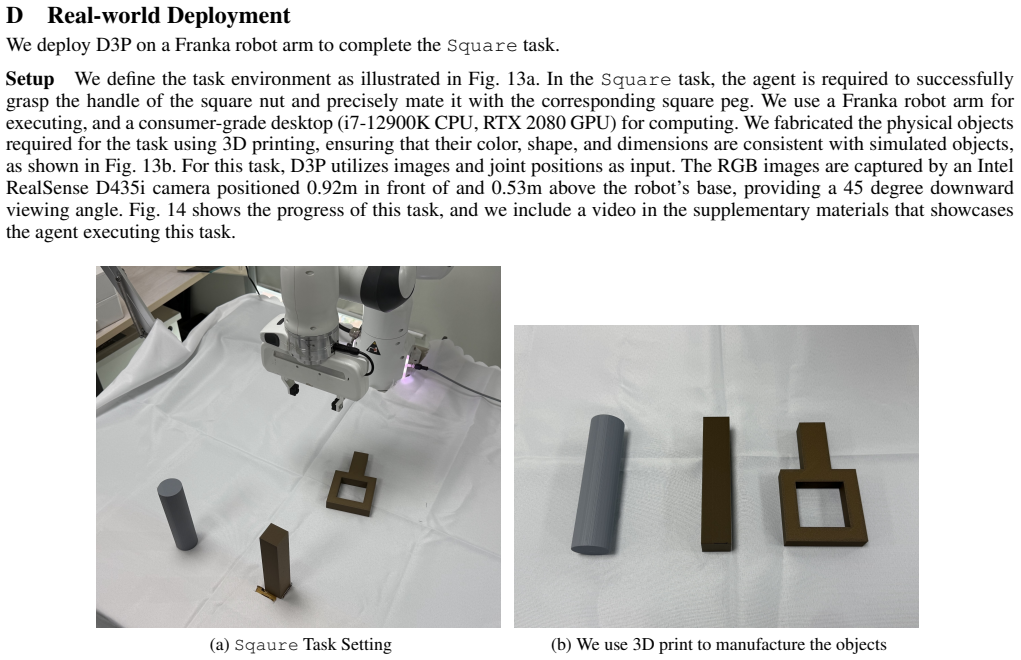
- On the physical Square task D3P runs at 33.68 Hz versus 17.59 Hz for a fixed 10-step policy, bringing diffusion policies closer to real-time control.
Reading between the lines
- The same adaptor principle extends beyond denoising: any iterative inference process whose intermediate steps differ in task value (e.g., chain-of-thought tokens, diffusion image refinement) could allocate compute through a learned per-step stride.
- A testable extension: replace the advantage-based reward with a calibrated success-probability estimate to remove the acknowledged bias, then measure whether D3P's speed-up and success hold on the same benchmarks.
- The perturbed-return criticality predictor could be used offline to precompute a fixed schedule and avoid RL; D3P's learned adaptor likely outperforms such a schedule because it conditions on the partially denoised action, not just the observation.
- If the criticality finding generalizes, environments with continuous balancing—where every action is equally crucial—should show little or no speed-up from D3P, providing a sharp boundary condition.
Editorial analysis
A structured set of objections, weighed in public.
Referee Report
Summary. The paper proposes D3P, a diffusion policy that uses a lightweight, state-aware adaptor to dynamically choose the number of denoising steps per action. The dynamic denoising problem is formulated as a two-layer POMDP, and the base policy and adaptor are trained jointly via RL (DPPO for the base policy, PPO for the adaptor). A three-stage training scheme stabilizes learning. The paper reports experiments on eight simulated manipulation tasks in Robomimic and Franka Kitchen, plus a real-world Square task, claiming an average 2.2× inference speed-up over fixed-step baselines without degrading success, and a 1.9× acceleration on the physical robot.
Significance. The central idea—allocating denoising effort according to action criticality—is well motivated and timely. The empirical study of action criticality is a useful observation, and the two-layer POMDP formulation with joint RL training is a principled approach. If the reported speed-up is robust, D3P offers a practical way to make diffusion policies suitable for real-time control. The method builds on existing RL-for-diffusion and acceleration techniques (DPPO, Consistency Policy, Falcon) and demonstrates strong Pareto improvements on multiple benchmarks, which is a valuable contribution. However, the headline quantitative claim relies on a metric (NFE) that excludes the adaptor's cost, and the paper contains an internal inconsistency about the number of random seeds.
major comments (2)
- [Experiments, Metrics; Appendix C.1, Fig. 12, Tab. 8] The main text states 'All results are averaged over three random seeds' while Appendix C.1 says 'All results are averaged over 5 seeds' (also Fig. 12 caption). This discrepancy directly affects the reported means and standard deviations in Tab. 8, which are the evidence for the claim of 'without degrading success.' Please clarify the correct number of seeds and recompute the statistics accordingly. If the main text is wrong, the error bars and significance claims need to be re-evaluated; if the appendix is wrong, the discrepancy must be corrected.
- [Experiments, Metrics; Eq. (15)] The headline '2.2× inference speed-up' is computed as a ratio of total denoising steps (NFE) using Eq. (15), and the NFE metric explicitly excludes the adaptor's forward passes. NFE is a proxy for inference cost, not wall-clock time. The adaptor runs at every denoising step and, although it has <1/15 the parameters of the base policy, it adds non-negligible latency. The paper's own real-world Square deployment reports a 1.92× wall-clock speed-up, whereas the corresponding simulation Square (Image) NFE ratio is about 2.53× (Tab. 8). This gap suggests the true wall-clock speed-up is lower than the NFE ratio. The authors should either report wall-clock timings in simulation or qualify the abstract claim as 'NFE speed-up' rather than 'inference speed-up.'
minor comments (3)
- [Throughout] Several typos and inconsistencies: 'Sqaure' in Fig. 13, 'PODMP' in the Problem Formulation, 'mrnt' in Appendix B.1, 'fomulated' in the Tab. 8 caption. Please proofread carefully.
- [Method, Dynamic Denoising; Eq. (7)] The advantage estimate A_hat in Eq. (6) is described as 'slightly biased,' but the bias is not quantified or discussed. Since this advantage is used as a dense reward for the adaptor, a brief analysis of the bias's potential impact on adaptor allocation would strengthen the method's justification.
- [Empirical Study, Experiment Design] The return predictor D_phi is trained on (o_t, a_t) with labels from perturbed rollouts. Because the perturbation is applied to the action, low predicted returns may reflect state criticality rather than action criticality. A discussion of this possible confound would improve the clarity of the motivation.
Circularity Check
No significant circularity: D3P's adaptor is trained with a standard RL objective; the reported speed-up is an empirical outcome, not an input to the derivation.
full rationale
The paper's derivation chain is self-contained and does not reduce to its own inputs. The adaptor reward (Eq. 7) uses the advantage estimate (Eq. 6) as a dense performance signal, but this is a standard actor-critic construction, not a definitional circularity: the advantage is a function of the current base policy and critic, while the adaptor is optimized separately with PPO. The reported 2.2x speed-up is measured as an NFE ratio (Eq. 15) using the denoising-step counts that the adaptor's reward penalizes via the discount factor gamma_s; however, the reward does not specify the numerical speed-up, and the central claim that success rate is maintained at fewer steps is an empirical Pareto result, not an identity. The empirical criticality study uses a fitted return predictor D_phi only for motivation; D_phi is not used in the adaptor's training or in the final claim. Baselines and cited methods (DPPO, DDIM, Diffusion Policy, Falcon, Consistency Policy) are external works by non-overlapping authors; there are no load-bearing self-citations, imported uniqueness theorems, or ansatz-by-citation steps. The paper's own caveats—that A_hat is 'slightly biased' and that NFE excludes the lightweight adaptor's cost—are legitimate validity/efficiency limitations, but they are not circularity because the quantitative claim does not depend on assuming the adaptor is cost-free in the derivation; it is a measurement choice. Overall, no equation or fitted parameter is renamed as a prediction, and no central result is forced by definition.
Assumptions & free parameters
free parameters (5)
- Adaptor reward weight beta =
per-task: 0.2, 0.2, 0.06, 0.1, 0.4, 0.4
- Denoising-step discount gamma_s =
0.95
- Stage thresholds zeta1, zeta2 =
e.g., 100/170/210/310 and 4/5/7.5
- Warm-up denoising steps c =
not specified numerically
- Adaptor initial variance v^2 =
not specified
assumptions (4)
- standard math DDIM reverse process with stride k produces valid action samples.
- domain assumption The two-layer POMDP formulation correctly nests the denoising process inside the environment.
- domain assumption Action criticality is non-uniform across timesteps and transferable across tasks.
- domain assumption The advantage estimate in Eq. (6) is a sufficiently unbiased proxy for action quality.
Cite this review
Pith. "Pith review of D3P: Dynamic Denoising Diffusion Policy via Reinforcement Learning." pith.science (2026). https://pith.science/paper/47LWLVJS
@misc{pith2026250806804,
  author       = {Pith},
  title        = {Pith review of: D3P: Dynamic Denoising Diffusion Policy via Reinforcement Learning},
  year         = {2026},
  howpublished = {\url{https://pith.science/paper/47LWLVJS}},
  note         = {Machine review of arXiv:2508.06804}
}
abstract
Diffusion policies excel at learning complex action distributions for robotic visuomotor tasks, yet their iterative denoising process poses a major bottleneck for real-time deployment. Existing acceleration methods apply a fixed number of denoising steps per action, implicitly treating all actions as equally important. However, our experiments reveal that robotic tasks often contain a mix of \emph{crucial} and \emph{routine} actions, which differ in their impact on task success. Motivated by this finding, we propose \textbf{D}ynamic \textbf{D}enoising \textbf{D}iffusion \textbf{P}olicy \textbf{(D3P)}, a diffusion-based policy that adaptively allocates denoising steps across actions at test time. D3P uses a lightweight, state-aware adaptor to allocate the optimal number of denoising steps for each action. We jointly optimize the adaptor and base diffusion policy via reinforcement learning to balance task performance and inference efficiency. On simulated tasks, D3P achieves an averaged 2.2$\times$ inference speed-up over baselines without degrading success. Furthermore, we demonstrate D3P's effectiveness on a physical robot, achieving a 1.9$\times$ acceleration over the baseline.
Figures


Figures from the paper (12 more)




Forward citations
Cited by 7 Pith papers
-
Generative Actor-Critic with Soft Bridge Policies
SoftGAC defines a stochastic bridge from base to action latent that converts the MaxEnt objective into a tractable relative-entropy term reducible to control energy, achieving competitive returns with one-pass sampling.
-
Learning When to Stop: Prefix-Optimal Dynamic Diffusion Policies for Continuous Control
POGP trains a prefix value function over the diffusion denoising chain, giving a learned early-stopping rule that cuts average denoising steps about 2.7x with 98-99% of full-chain return and a small gain in final task...
-
ELASTIC: Efficiently Learning to Adaptively Scale Test-Time Compute for Generative Control Policies
ELASTIC learns a state-dependent meta-policy that allocates sequential and parallel test-time compute for generative control policies, outperforming fixed baselines in simulation and reducing real-robot latency by 34%...
-
SANTS: A State-Adaptive Scheduler for World Action Models
A state-adaptive noise-trajectory scheduler selects intermediate video conditions for action generation, matching or beating full-denoising WAMs at far lower latency.
-
L-SDPPO: Policy Optimization of Spiking Diffusion Policy for Intra-vehicular Robotic Manipulation
L-SDPPO optimizes a spiking diffusion policy with RL and adds SDLI to handle microgravity dynamics, reporting higher success rates and lower energy use than prior methods on five intra-vehicular tasks.
-
SANTS: A State-Adaptive Scheduler for World Action Models
SANTS adaptively chooses denoising depth in video-based robot action diffusion policies using a state-dependent stopping hazard and noise ratio, trained via downstream action reward to reduce latency.
-
On-Device Robotic Planning: Eliminating Inference Redundancy for Efficient Decision-Making
REIS reduces inference redundancy in embodied robotic planning via lightweight gating and routing while preserving task performance on ALFRED and real robots.
Reference graph
Works this paper leans on
-
[1]
Robomimic (Mandlekar et al. 2021). We evaluate our method on manipulation tasks from the Robomimic suite, including the simple pick-and-place tasks Lift and Can, the assembly task Square, and the bimanual handover task Transport. Fig. 9 demonstrate the four manipulation tasks
work page 2021
-
[2]
Franka Kitchen (Gupta et al. 2019). We also use the Franka Kitchen environment, a benchmark for challenging long- horizon, multi-stage manipulation. As illustrated in Fig. 10, the robot need to complete 4 subtasks in sequence: open the microwave, move the kettle, flip the light switch, and slide open the cabinet door. We use two settings in this environ- ...
work page 2019
-
[2020]
Communications of the ACM, 63(11): 139–144
Generative adversarial networks. Communications of the ACM, 63(11): 139–144. Gupta, A.; Kumar, V .; Lynch, C.; Levine, S.; and Hausman, K. 2019. Relay policy learning: Solving long-horizon tasks via imitation and reinforcement learning. arXiv preprint arXiv:1910.11956. Hansen-Estruch, P.; Kostrikov, I.; Janner, M.; Kuba, J. G.; and Levine, S. 2023. Idql: ...
arXiv 2019
-
[2022]
Advances in neural information processing systems , 35: 22955–22968
Behavior transformers: Cloning k modes with one stone. Advances in neural information processing systems , 35: 22955–22968. Sohl-Dickstein, J.; Weiss, E.; Maheswaranathan, N.; and Ganguli, S. 2015. Deep unsupervised learning using nonequilibrium thermodynamics. In International confer- ence on machine learning, 2256–2265. pmlr. Song, J.; Meng, C.; and Erm...
arXiv 2015
Reviewed August 5, 2026 · model on record in the stance chip above.
Discussion (0). Sign in to comment.