REVIEW 4 major objections 4 minor 1 cited by
The paper claims that planning a DLO's motion in a three-dimensional force space, then executing via MPC with a learned graph-attention dynamics model, makes large-deformation cable shaping reliable where position-only planning fails.
Reviewed by Pith at T0; open to challenge. T0 means a machine referee read the full paper against a public rubric. the ladder, T0–T4 →
A hybrid force-position controller with a GAT-based learned dynamics model achieves high success rates in DLO shape control, but the force-space planning advantage is not isolated from waypoint decomposition.
T0 review reviewed 2026-08-05 challenge →
load-bearing objection A useful hybrid force-position MPC for DLO shape control with a genuinely strong learned dynamics model, but the headline claim lacks a position-space waypoint ablation and the statistics are thin. the 4 major comments →
A Hybrid Force-Position Strategy for Shape Control of Deformable Linear Objects With Graph Attention Networks
The pith
A machine-rendered reading of the paper's core claim, the machinery that carries it, and where it could break.
The reading
Core claim
The central claim is that a deformable linear object's equilibrium shape is adequately summarized by the three-component wrench at its fixed end, so a straight-line path in that force space corresponds to a sequence of physically reachable shapes, even when the equivalent path in position space crosses local optima. The authors implement this with two learned MLP transformers: P2FT maps keypoint positions to the wrench, and F2PT maps a wrench back to keypoint positions. A trajectory planner linearly interpolates between the initial and target wrenches, and the MPC controller follows the resulting position waypoints. The controller uses the EA-PE-GAT dynamics model, which encodes the robot ac
What carries the argument
The hybrid force-position representation. The DLO's shape is a graph of keypoint nodes and distance-based edges; its force state is the wrench $W_e = [F_x, F_y, M_z]$ at the fixed end. Two MLP transformers, P2FT and F2PT, convert between graphs and wrenches. The planner linearly interpolates in wrench space, and the MPC uses the learned EA-PE-GAT dynamics model, whose explicit action encoder updates the grasped node's neighbors by a rigid-body transform, whose GRU-based property extractor infers node properties from history, and whose graph processor aggregates local interactions with multi-head attention. This pair of representations is what lets a large deformation be split into small, loc
Load-bearing premise
Linear interpolation between the initial and target fixed-end wrenches yields a sequence of force waypoints that, when mapped back to positions, are shapes the robot can actually reach; this requires the learned force-to-position transformer to act as a reliable inverse and the wrench to identify a shape almost uniquely.
What would settle it
Take two shapes that a robot can demonstrably reach but whose fixed-end wrenches are nearly identical (or identical), and ask the planner to move between them. If the force-space interpolation produces position waypoints that the MPC cannot track to the switching threshold, while direct position-mode MPC succeeds on the same pair, then the force representation is not carrying the information the strategy needs. A second, quantitative check: replace the interpolated force waypoints with the same number of randomly sampled wrenches of similar magnitude; if random waypoints succeed equally often,
If this is right
- Large-deformation DLO shape control can be decomposed into small-deformation subproblems by planning in force space, avoiding the local optima that stall position-only MPC and RL.
- The EA-PE-GAT dynamics model, with explicit action encoding and a property extractor, yields multi-step prediction errors roughly an order of magnitude lower than MLP and visibly lower than GAT baselines, making it useful for model-based control.
- The learned P2FT/F2PT transformers are fast enough (under half a millisecond) for real-time control, and simple MLPs outperform more complex transformer-based alternatives for this low-dimensional conversion.
- A single framework with the same trained models transfers from simulation to real metal-strip and cable shaping, completing all trials without abrupt shape changes.
- Small-deformation tasks can run slower than direct position-mode control because force-space planning can introduce unnecessary detours, pointing to adaptive waypoint selection as the natural next step.
Where Pith is reading between the lines
- If the fixed-end wrench is nearly a complete coordinate for quasi-static elastic-rod equilibria, then this approach is effectively path-planning on a low-dimensional equilibrium manifold; that predicts performance should degrade gracefully as tasks move toward 3-D or buckling regimes where the wrench is no longer injective.
- The force-space interpolation is only as good as the P2FT/F2PT inverse consistency; a stricter test would be to close the loop by checking that converting a waypoint to positions and back yields the same wrench, and to use that residual as a waypoint-quality filter.
- The small-deformation 'detour' suggests that the benefit of force-space planning is concentrated in large-deformation regimes, so a practical system would switch between force-mode and position-mode control based on the wrench distance or predicted shape error.
- Because the dynamics model explicitly embeds the robot action as a rigid motion of the grasped neighborhood, the same architecture may transfer to other underactuated soft objects, such as cloth or rope in 3-D, with minimal changes.
Editorial analysis
A structured set of objections, weighed in public.
Referee Report
Summary. The paper proposes a hybrid force-position strategy for shape control of deformable linear objects (DLOs). It combines state trajectory planning in a 3D force space (end wrench) with MPC in position space, using learned MLP transformers (P2FT/F2PT) to convert between representations and a GAT-based dynamics model (EA-PE-GAT) for prediction. The authors report simulation results showing that the hybrid strategy achieves 100% success on eight large-deformation tasks, while position-only MPC and RL achieve only 12.5% and 25%, respectively, and they validate the approach on two real DLOs. The dynamics model is also compared against MLP and GAT baselines on multi-step prediction.
Significance. If the claims hold, the paper makes a useful contribution: a multimodal DLO state representation, an improved learned graph dynamics model, and a practical waypoint-based MPC scheme that outperforms position-only MPC and RL on large deformations. The dynamics-model comparison is informative and the availability of code/videos is a plus. However, the central claim that planning in force space is the cause of the improved success is not yet isolated by the experiments, and the statistical support is thin. The paper is likely of interest to the DLO manipulation community, but the main comparison needs strengthening before the claim is fully supported.
major comments (4)
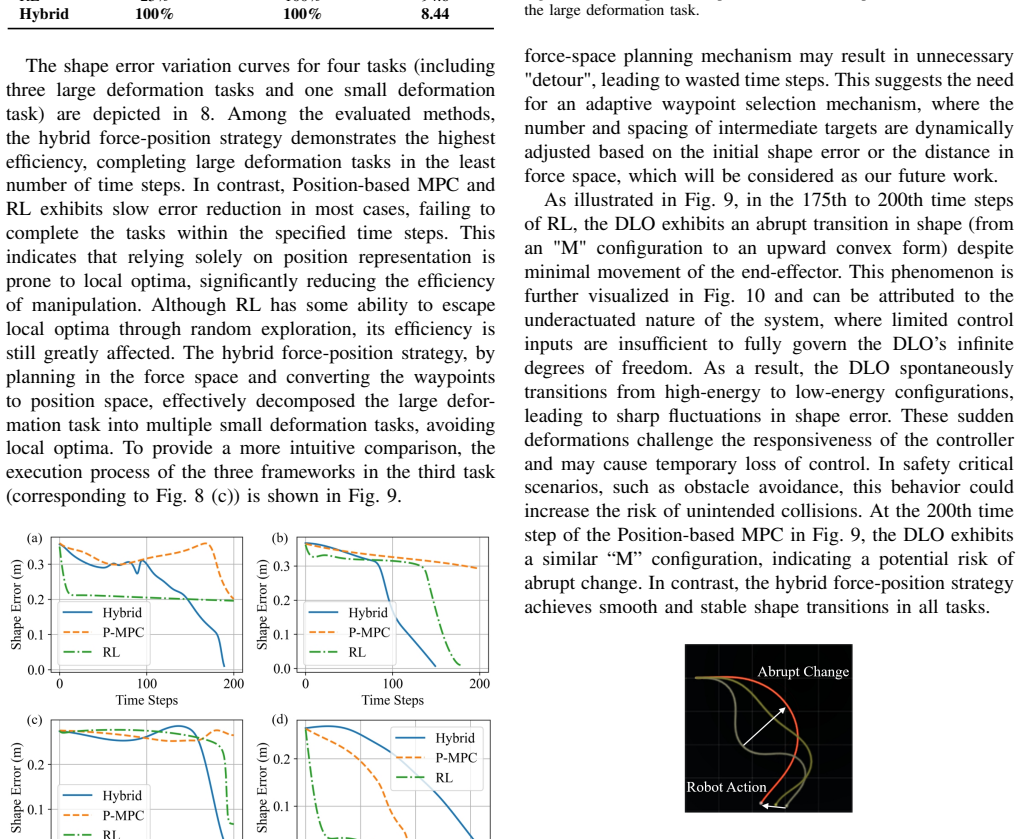
- [§V-C3, Table I] The central claim that force-space planning causes the success improvement is confounded. Hybrid is compared only with P-MPC, which uses the same MPC but no waypoints, and with RL. Any waypoint decomposition—e.g., linear interpolation in 2m-dimensional keypoint position space—would also break a large deformation into smaller subgoals and could avoid the local optima that stall P-MPC. Without a position-space waypoint MPC using the same dynamics model and hyperparameters, the results only show that adding waypoints helps; they do not isolate the force-space mechanism. Please add this ablation.
- [§V-C3] The statistical basis is very thin. Large-deformation success rates are computed from only 8 tasks (12.5% = 1/8, 25% = 2/8, 100% = 8/8), and small-deformation from only 2 tasks. No repeated trials, confidence intervals, or error bars are reported. The RMSE values in Table I (189 mm, 94.6 mm, 8.44 mm) are single numbers without variance. The contrast between 12.5% and 100% is a difference of one successful trial in eight. Please report per-task results, confidence intervals, or more tasks.
- [§V-C1 and §IV-C1] The force-space planner assumes that P2FT and F2PT are accurate and consistent inverses, and that the force representation is sufficiently injective for the DLO. Yet the F2PT average prediction error is 9.72 mm, while the success threshold in §V-C3 is 0.01 m (10 mm). Thus the converted waypoints are, on average, almost at the success threshold and may not correspond to reachable intermediate shapes. The paper does not verify that different DLO shapes with the same end wrench are absent, nor that linear interpolation in force space maps to feasible shapes. Please add an explicit consistency/injectivity check and report the error distribution.
- [§V-C3 and §V-D] The real-world validation is qualitative: four large-deformation experiments per object are shown, with no quantitative errors or comparison to baselines. The statement that models 'demonstrate consistent performance' is not supported by reported numbers. Please provide quantitative real-world errors or clearly label this as a demonstration.
minor comments (4)
- [§III] Typographical issues: 'a serious of keypoints' should be 'a series of keypoints'; 'represent by' should be 'represented by'; 'F orce Representation' has a spacing error.
- [§V-A] The simulation environment reports 'bending stiffness of 107' without units; please specify units (likely N·m² or similar).
- [§V-A and §V-D] The real-world force sensor is described as attached to the UR5 flange to measure the fixed-end constraint force indirectly, while Fig. 2 shows the fixed end attached to a force sensor. Please clarify the measurement setup.
- [§V-B] The paper says the dataset is split 8:1:1 but does not state whether the 3000 simulation trajectories are split before or after shuffling; please clarify to avoid temporally correlated splits.
Circularity Check
No significant circularity: central claims are supported by held-out evaluation and independent modeling choices.
full rationale
I walked the paper's derivation chain. The dynamics model EA-PE-GAT is trained on a separately collected random-trajectory dataset and evaluated on a held-out test split; its multi-step prediction errors are RMSE against ground truth, so the 'consistently superior performance' claim is not forced by construction. The P2FT/F2PT transformers are also trained on the same split and tested on held-out position-force pairs, and the reported errors are genuine. The force-space trajectory planner linearly interpolates between the measured initial force and a target force produced by P2FT, then converts each waypoint back with F2PT. This relies on an untested feasibility assumption (that linear interpolation in 3D force space yields physically reachable shapes when mapped by F2PT), but that is a modeling assumption, not a circular definition: no equation defines the planned waypoints in terms of the final success metric. The MPC cost is the position-space L2 distance to target waypoints, and success is measured independently by RMSE to the target shape. The paper's self-citations ([18] for real-world setup, [20] listed with force-representation inspiration) are not load-bearing for the main claims; they do not supply a uniqueness theorem or a forbidden alternative. The missing baseline of interpolating waypoints directly in position space is a genuine experimental confound when attributing the success to force-space planning, because any waypoint decomposition could help avoid local optima; however, this is a question of ablation design and causal attribution, not circularity under the review's definition. No quoted equation or fitted parameter is renamed as a prediction, and no claim reduces to its own input by construction. Therefore the appropriate circularity score is 0.
Axiom & Free-Parameter Ledger
free parameters (3)
- Number of waypoints =
4
- Waypoint switching error threshold =
0.03 m (sim), 0.02 m (real)
- Graph connection radius rc =
not specified
axioms (4)
- domain assumption The DLO is quasi-static; dynamic effects are negligible during manipulation
- ad hoc to paper Small local regions near the grasped node move as rigid bodies
- domain assumption The fixed-end wrench We uniquely (or sufficiently) characterizes the DLO shape for planning
- ad hoc to paper P2FT and F2PT are accurate and consistent inverses
invented entities (1)
-
latent physical property vector from Property Extractor
no independent evidence
Cite this review
Pith. "Pith review of A Hybrid Force-Position Strategy for Shape Control of Deformable Linear Objects With Graph Attention Networks." pith.science (2026). https://pith.science/paper/SYNHA4SE
@misc{pith2026250807319,
  author       = {Pith},
  title        = {Pith review of: A Hybrid Force-Position Strategy for Shape Control of Deformable Linear Objects With Graph Attention Networks},
  year         = {2026},
  howpublished = {\url{https://pith.science/paper/SYNHA4SE}},
  note         = {Machine review of arXiv:2508.07319}
}
read the original abstract
Manipulating deformable linear objects (DLOs) such as wires and cables is crucial in various applications like electronics assembly and medical surgeries. However, it faces challenges due to DLOs' infinite degrees of freedom, complex nonlinear dynamics, and the underactuated nature of the system. To address these issues, this paper proposes a hybrid force-position strategy for DLO shape control. The framework, combining both force and position representations of DLO, integrates state trajectory planning in the force space and Model Predictive Control (MPC) in the position space. We present a dynamics model with an explicit action encoder, a property extractor and a graph processor based on Graph Attention Networks. The model is used in the MPC to enhance prediction accuracy. Results from both simulations and real-world experiments demonstrate the effectiveness of our approach in achieving efficient and stable shape control of DLOs. Codes and videos are available at https://sites.google.com/view/dlom.
Figures



Forward citations
Cited by 1 Pith paper
-
RopeDreamer: A Kinematic Recurrent State Space Model for Dynamics of Flexible Deformable Linear Objects
RopeDreamer uses quaternionic kinematic chains in a recurrent state space model with a dual decoder to cut open-loop prediction error by 40.52% over 50 steps on simulated DLO trajectories while preserving physical con...
Reference graph
Works this paper leans on
-
[1]
D. Seita, P. Florence, J. Tompson, E. Coumans, V . Sindhwani, K. Goldberg, and A. Zeng, “Learning to rearrange deformable cables, fabrics, and bags with goal-conditioned transporter networks,” in 2021 IEEE International Conference on Robotics and Automation (ICRA) , pp. 4568–4575, IEEE, 2021
work page 2021
-
[2]
Folds- former: Learning sequential multi-step cloth manipulation with space- time attention,
K. Mo, C. Xia, X. Wang, Y . Deng, X. Gao, and B. Liang, “Folds- former: Learning sequential multi-step cloth manipulation with space- time attention,” IEEE Robotics and Automation Letters , vol. 8, no. 2, pp. 760–767, 2022
work page 2022
-
[3]
M. Yu, K. Lv, H. Zhong, S. Song, and X. Li, “Global model learning for large deformation control of elastic deformable linear objects: An efficient and adaptive approach,” IEEE Transactions on Robotics , vol. 39, no. 1, pp. 417–436, 2022
work page 2022
-
[4]
Offline Goal-Conditioned Reinforcement Learning for Shape Control of Deformable Linear Objects
R. Laezza, M. Shetab-Bushehri, G. A. Waltersson, E. Özgür, Y . Mezouar, and Y . Karayiannidis, “Offline goal-conditioned reinforce- ment learning for shape control of deformable linear objects,” arXiv preprint arXiv:2403.10290, 2024
work page internal anchor Pith review Pith/arXiv arXiv 2024
-
[5]
Offline-online learning of deformation model for cable manipulation with graph neural networks,
C. Wang, Y . Zhang, X. Zhang, Z. Wu, X. Zhu, S. Jin, T. Tang, and M. Tomizuka, “Offline-online learning of deformation model for cable manipulation with graph neural networks,” IEEE Robotics and Automation Letters, vol. 7, no. 2, pp. 5544–5551, 2022
work page 2022
-
[6]
T. Bretl and Z. McCarthy, “Quasi-static manipulation of a kirchhoff elastic rod based on a geometric analysis of equilibrium configura- tions,” The International Journal of Robotics Research , vol. 33, no. 1, pp. 48–68, 2014
work page 2014
-
[7]
Cable manipulation with a tactile-reactive gripper,
Y . She, S. Wang, S. Dong, N. Sunil, A. Rodriguez, and E. Adelson, “Cable manipulation with a tactile-reactive gripper,” The International Journal of Robotics Research , vol. 40, no. 12-14, pp. 1385–1401, 2021
work page 2021
-
[8]
Optimal model-based path planning for the robotic manipulation of deformable linear objects,
A. Monguzzi, T. Dotti, L. Fattorelli, A. M. Zanchettin, and P. Rocco, “Optimal model-based path planning for the robotic manipulation of deformable linear objects,” Robotics and Computer-Integrated Manu- facturing, vol. 92, p. 102891, 2025
work page 2025
-
[9]
Xpbd: position-based simulation of compliant constrained dynamics,
M. Macklin, M. Müller, and N. Chentanez, “Xpbd: position-based simulation of compliant constrained dynamics,” in Proceedings of the 9th International Conference on Motion in Games , pp. 49–54, 2016
work page 2016
-
[10]
A. Koessler, N. R. Filella, B.-C. Bouzgarrou, L. Lequièvre, and J.- A. C. Ramon, “An efficient approach to closed-loop shape control of deformable objects using finite element models,” in 2021 IEEE Inter- national conference on robotics and automation (ICRA) , pp. 1637– 1643, IEEE, 2021
work page 2021
-
[11]
Automatic shape control of deformable wires based on model-free visual servoing,
R. Lagneau, A. Krupa, and M. Marchal, “Automatic shape control of deformable wires based on model-free visual servoing,” IEEE Robotics and Automation Letters , vol. 5, no. 4, pp. 5252–5259, 2020
work page 2020
-
[12]
In- teraction networks for learning about objects, relations and physics,
P. Battaglia, R. Pascanu, M. Lai, D. Jimenez Rezende, et al. , “In- teraction networks for learning about objects, relations and physics,” Advances in neural information processing systems , vol. 29, 2016
work page 2016
-
[13]
Propagation networks for model-based control under partial observa- tion,
Y . Li, J. Wu, J.-Y . Zhu, J. B. Tenenbaum, A. Torralba, and R. Tedrake, “Propagation networks for model-based control under partial observa- tion,” in 2019 International Conference on Robotics and Automation (ICRA), pp. 1205–1211, IEEE, 2019
work page 2019
-
[14]
F. Gu, H. Sang, Y . Zhou, J. Ma, R. Jiang, Z. Wang, and B. He, “Learning graph dynamics with interaction effects propagation for deformable linear objects shape control,” IEEE Transactions on Au- tomation Science and Engineering , 2025
work page 2025
-
[15]
M. Daniel, A. Magassouba, M. Aranda, L. Lequièvre, J. A. C. Ramón, R. I. Rodriguez, and Y . Mezouar, “Multi actor-critic ddpg for robot action space decomposition: A framework to control large 3d deformation of soft linear objects,” IEEE Robotics and Automation Letters, vol. 9, no. 2, pp. 1318–1325, 2023
work page 2023
-
[16]
In-air knotting of rope by a dual-arm multi-finger robot,
S. Kudoh, T. Gomi, R. Katano, T. Tomizawa, and T. Suehiro, “In-air knotting of rope by a dual-arm multi-finger robot,” in 2015 IEEE/RSJ International Conference on Intelligent Robots and Systems (IROS) , pp. 6202–6207, IEEE, 2015
work page 2015
-
[17]
Robocraft: Learning to see, simulate, and shape elasto-plastic objects in 3d with graph networks,
H. Shi, H. Xu, Z. Huang, Y . Li, and J. Wu, “Robocraft: Learning to see, simulate, and shape elasto-plastic objects in 3d with graph networks,” The International Journal of Robotics Research , vol. 43, no. 4, pp. 533–549, 2024
work page 2024
-
[18]
Learning graph dynamics with external contact for deformable linear objects shape control,
Y . Huang, C. Xia, X. Wang, and B. Liang, “Learning graph dynamics with external contact for deformable linear objects shape control,” IEEE Robotics and Automation Letters , vol. 8, no. 6, pp. 3892–3899, 2023
work page 2023
-
[19]
Motion planning for dual-arm manipulation of elastic rods,
A. Sintov, S. Macenski, A. Borum, and T. Bretl, “Motion planning for dual-arm manipulation of elastic rods,” IEEE Robotics and Automation Letters, vol. 5, no. 4, pp. 6065–6072, 2020
work page 2020
-
[20]
Quadruped guidance robot for the visually impaired: A comfort-based approach,
Y . Chen, Z. Xu, Z. Jian, G. Tang, L. Yang, A. Xiao, X. Wang, and B. Liang, “Quadruped guidance robot for the visually impaired: A comfort-based approach,” arXiv preprint arXiv:2203.03927 , 2023
Pith/arXiv arXiv 2023
-
[21]
Mujoco: A physics engine for model-based control,
E. Todorov, T. Erez, and Y . Tassa, “Mujoco: A physics engine for model-based control,” in 2012 IEEE/RSJ international conference on intelligent robots and systems , pp. 5026–5033, IEEE, 2012
work page 2012
This paper was first reviewed by deepseek-v4-flash on August 5, 2026.
discussion (0)
Sign in with ORCID, Apple, or X to comment. Anyone can read and Pith papers without signing in.