REVIEW 2 major objections 4 minor 49 references
Nonequilibrium steady state in Lindblad dynamics for infinite quantum spin systems
T0 review · 2 major / 4 minor · reviewed 2026-08-05 · deepseek-v4-flash
Pith's one-line read A uniform condition-number bound makes thermodynamic and long-time limits commute for infinite open quantum spin systems.
desk verdict Solid operator-algebraic definition and sufficient condition for NESS/TANESS commutation, with an exact noncommutation example; the condition-number claim in §5.4 is under-supported but the counterexample itself stands. read the letter →
The pith
A machine-rendered reading of the paper's core claim, the machinery that carries it, and where it could break.
The reading
What carries the argument
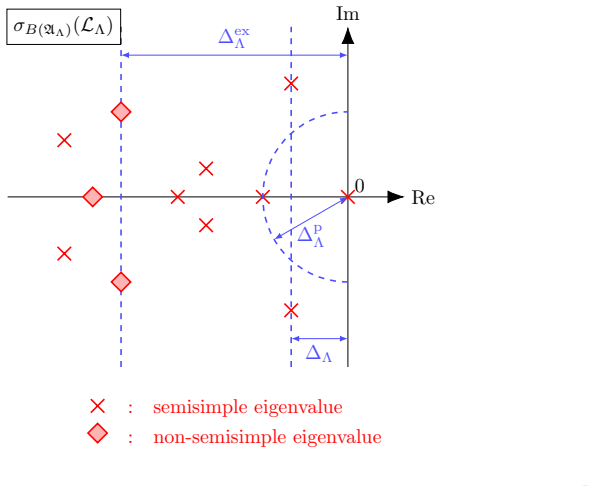
The central object is the condition number $\kappa_\Lambda(V^\epsilon_\Lambda) = \|V^\epsilon_\Lambda\|\,\|(V^\epsilon_\Lambda)^{-1}\|$ of an invertible linear map $V^\epsilon_\Lambda$ that carries the normalized Liouvillian $(\Delta_{\rm ex}-\epsilon)^{-1}L_\Lambda$ into Jordan canonical form. This number quantifies how far each finite-system Liouvillian is from being normal, i.e., how strongly its defective (non-semisimple) eigenvalues deform the time evolution. Together with three spectral gaps — the line gap $\Delta_\Lambda$, the point gap $\Delta^p_\Lambda$, and the exceptional gap $\Delta^{\rm ex}_\Lambda$ — the uniform boundedness of $\kappa_\Lambda$ controls the prefactor in the fini
What would settle it
Construct a local Lindblad family satisfying Assumption 2 whose finite subsystems have uniform line/point gaps and a uniform exceptional gap, and exhibit Jordanizing maps $V^\epsilon_\Lambda$ with uniformly bounded condition numbers; if for some initial state the thermodynamic-then-long-time limit differs from the long-time-then-thermodynamic limit, Theorems 8 and 10 are false. Conversely, in the paper's example one only needs to verify the lower bound $\kappa_{\Lambda_n} \ge (1-\epsilon)^{-2n}/2$ and the noncommutation (expectation value $1/2$ versus $0$) to confirm that dropping the $\kappa$
Extended reading notes
Core claim
On the paper's own terms: for a family of local Lindblad generators $L_\Lambda$ acting on finite subsystems of a quasi-local $C^*$-algebra, define the finite-system steady state by projecting onto the zero-eigenvalue spectral subspace $\Pi_\Lambda$. The main theorem states that, under the three uniform bounds, for any initial state $\omega$ the weak-$*$ limit over $\Lambda$ of $\omega \circ \Pi_\Lambda$ exists, is independent of the chosen subnet, and equals every NESS and TANESS of the infinite-system dynamics. The proof derives a $\Lambda$-independent exponential bound $|\omega \circ \gamma^\Lambda_t(A) - \omega \circ \Pi_\Lambda(A)| \le \kappa\|A\| e^{-\min\{\Delta,\epsilon\}t}$, obtained
Load-bearing premise
The load-bearing premise is Assumptions (A2)/(B2): there is a single finite constant $\kappa$ such that every finite subsystem's Liouvillian can be put into Jordan form by a linear map with condition number at most $\kappa$; if this uniform bound fails, even perfectly uniform spectral gaps do not guarantee that the thermodynamic and long-time limits commute.
Editorial extensions
If this is right
- If the uniform condition-number bound holds, finite-system NESS/TANESS data (the spectral projection $\Pi_\Lambda$) converge weak-$*$ to the unique infinite-system NESS/TANESS, so the infinite-system steady state can be computed algebraically from finite Liouvillians.
- The convergence to the steady state is exponential with rate $\min\{\Delta,\epsilon\}$, uniformly in system size, making finite-cluster calculations quantitatively reliable whenever the sufficient condition is verified.
- For diagonalizable Liouvillians, the line-gap assumption plus a uniform diagonalizer condition number suffices (Corollary 9); the exceptional-gap assumption is then automatic.
- When the condition-number bound fails, uniform spectral gaps alone can still guarantee a well-defined infinite dynamics, yet the two orders of limits irreversibly change expectation values, as shown by the paper's example.
- The result applies to every initial state, not only stationary or low-energy states, and yields uniqueness of the NESS/TANESS for that initial state.
Reading between the lines
- Editorial inference: because $V^\epsilon_\Lambda$ is non-unique, the theorem is really about the best possible diagonalizing map; a model might satisfy the uniform condition-number assumption via an adapted Jordanization even when a naive basis has exponentially large $\kappa$, so the practical test is to search for a well-conditioned $V^\epsilon_\Lambda$ rather than to compute $\kappa$ in one fix
- Editorial inference: the exponential lower bound $\kappa_{\Lambda_n} \ge (1-\epsilon)^{-2n}/2$ connects the growth of Jordan-block size to the breakdown of commutativity; one could test whether other driven dissipative chains with non-Hermitian skin-like sensitivity also have size-dependent condition numbers and hence ambiguous infinite-system steady states.
- Editorial inference: for closed (unitary) dynamics the Liouvillian is normal, so the condition-number assumption holds automatically; the theorem thus contains, as a special case, the familiar statement that a uniformly gapped unitary dynamics has a unique thermodynamic-limit steady state.
Editorial analysis
A structured set of objections, weighed in public.
Referee Report
Summary. The paper studies Lindblad dynamics for quantum spin systems on infinite lattices. It defines NESS and TANESS as weak-* cluster points of long-time limits and long-time averages of an initial state evolved under the infinite-system dynamics, and observes that the thermodynamic limit and the long-time limit do not generally commute. The main results, Theorems 8 and 10, give sufficient conditions for commutativity: uniform finite-volume line/point spectral gaps, a uniform exceptional gap, and a uniform upper bound on the condition number of a Jordanizing map for the normalized Liouvillian. Under these assumptions the paper proves that the thermodynamic limit of finite-system NESS/TANESS exists, is independent of subnet choices, and equals the unique infinite-system NESS/TANESS for any initial state. The proof uses a finite-volume spectral projection and uniform exponential decay controlled by the spectral gaps and the condition number. The paper then constructs an explicit finite-range model on Γ=N for which the spectral gaps are uniformly nonvanishing (Δ=Δ_p=1/2, Δ_ex=1) but the two limits do not commute: for an explicitly chosen initial state, the infinite-system expectation of a local observable converges to 1/2 in the long-time limit, whereas the thermodynamic limit of finite-system long-time limits is 0. The noncommutation is established by exact computation, and the paper attributes the failure to the unboundedness of the condition number.
Significance. If correct, the paper provides a useful operator-algebraic framework for NESSs of infinite Lindblad systems and a concrete, checkable sufficient condition for when finite-volume steady states converge to infinite-volume ones. The result is nonempty: it covers systems with finite-volume Liouvillians that are sufficiently close to normal, uniformly in the volume, and it sharpens the known fact that spectral gaps alone are insufficient. The example is valuable: it is exactly solvable, with explicit spectra, generalized eigenspaces, and a transparent noncommutation mechanism. A notable strength is that the main theorems are proved in detail and the crucial finite-volume estimates are written out; the example's expectation values are computed explicitly rather than argued heuristically. The paper also honestly acknowledges the non-uniqueness of the Jordanizing map after Theorem 8, although, as discussed below, Section 5.4 does not fully follow through on that acknowledgment.
major comments (2)
- [§5.4 (concluding inequality before the final paragraph)] The direct verification that assumptions (A2)/(B2) fail is incomplete. The paper itself notes after Theorem 8 that V^ϵ_Λ is non-unique: replacing V^ϵ_Λ by A∘V^ϵ_Λ, where A commutes with the Jordan form, changes the condition number. Therefore the lower bound κ_{Λ_n}(V^ϵ_{Λ_n}) ≥ (1/2)(1−ϵ)^{2n−2} for the particular V^ϵ_{Λ_n} constructed in Eq. (38) does not prove that no Jordanizing map with uniformly bounded condition number exists. Since (A2)/(B2) are existential conditions, this is a genuine gap. The advertised conclusion is recoverable: the exact noncommutation in §5.2 (1/2 versus 0) together with Theorem 8 and Corollary 17 (uniform gaps) implies by contradiction that no uniformly bounded V^ϵ_Λ can exist. This argument should be stated explicitly in §5.4, and the text should distinguish the lower bound for the constructed V from the nonexistence of any bounded choice.
- [§4.3, proof of Theorem 8, estimate after Eq. (16)] In the non-semisimple case the displayed equation writes "e^{t Re λ_h} e^{(∆−ϵ)t∥N_h∥}" but the preceding line uses Re λ_h ≤ −∆ex_Λ ≤ −∆ex. The exponent should be ∆ex, not ∆; otherwise the inequality e^{t Re λ_h} e^{(∆−ϵ)t} ≤ e^{−ϵt} is not justified. The final e^{−ϵt} decay is correct once ∆ex is used, so this is a local typo, but it should be fixed.
minor comments (4)
- [Definition 6] The text says "a subnet of (t)_{t>0}" for the TANESS; it should be "a subnet of (T)_{T>0}" or, equivalently, of the net indexed by T.
- [Appendix A, Definition 19] Typo: "witten" should be "written".
- [Section 5.2, discussion after Eq. (24)] The notation for the initial state ω0 specifies expectations only on the operators D_{2j−1}, D_{2j}; it would help the reader to note that this extends to a genuine state (e.g., a product state with odd sites in |↑⟩ and even sites maximally mixed), since the subsequent computations use evaluation on combinations of the D_m.
- [Throughout] Several minor typos: "complex plain" (p. 10), "parpicular" (p. 16), "fields" formatting issues in equations. These do not affect the mathematics but should be cleaned up.
Circularity Check
No circularity: the main theorems are conditional proofs with explicit assumptions; the self-citations are not load-bearing.
full rationale
Theorems 8 and 10 are genuine conditional statements: assumptions (A1)/(A2) and (B1)/(B2) are stated explicitly and used in the proofs, while the conclusions (commutation of thermodynamic and long-time limits, uniqueness of NESS/TANESS) are derived rather than assumed. In particular, the uniform bound κΛ(V^ϵ_Λ) ≤ κ is used directly to obtain the Λ-independent exponential decay e^{-min{Δ,ϵ}t} in the proof of Theorem 8; this is a normal use of an assumption, not a fitted parameter renamed as a prediction. No quantity is calibrated to the target NESS values. The example is also self-contained: Section 5.2 computes exact time evolution and obtains an infinite-system NESS expectation 1/2 versus the finite-system long-time limit 0, and the failure of (A2)/(B2) is then forced by the contrapositive of Theorem 8 together with (A1), not by assuming the conclusion. Section 5.4's explicit lower bound κΛn(V^ϵ_Λn) ≥ (1/2)(1−ϵ)^{2n−2} is computed for the particular Jordanizer V^ϵ_Λn given by Eq. (38); because (A2) is existential over V, that lower bound alone would not by itself rule out a better choice, but the noncommutation result from Section 5.2 already establishes the failure, so this is at most a presentational incompleteness, not circularity. The self-citations are minor and non-load-bearing: [44] is an in-preparation follow-up paper, and [45] is cited only for background on non-Hermitian condition numbers and a standard choice of V; neither supplies the main theorem. The external citation [34] for the Lieb-Robinson bound and thermodynamic-limit existence is an independent result with explicit assumptions and is not used to smuggle in the paper's conclusions. Overall, no step reduces by construction to its input, and the derivation chain is self-contained; the score of 1 reflects only harmless self-citations, not circular reasoning.
Assumptions & free parameters
assumptions (5)
- domain assumption Assumption 2 (locality of Liouvillian) with the decay function F and exponential factor Fμ
- domain assumption Theorem 3 of Nachtergaele, Vershynina and Zagrebnov [34]: existence of the thermodynamic limit for Lindblad dynamics
- standard math Weak-* compactness of the state space and standard net compactness (Banach-Alaoglu, Kelley Theorem 20)
- standard math For a finite-dimensional C*-algebra, unital completely positive maps have norm 1, and the spectral properties of Liouvillians in Lemma 11
- domain assumption The hypotheses (A1) plus (A2), or (B1) plus (B2), of Theorems 8 and 10
Cite this review
Pith. "Pith review of Nonequilibrium steady state in Lindblad dynamics for infinite quantum spin systems." pith.science (2026). https://pith.science/paper/KE4NQY6Q
@misc{pith2026250807448,
  author       = {Pith},
  title        = {Pith review of: Nonequilibrium steady state in Lindblad dynamics for infinite quantum spin systems},
  year         = {2026},
  howpublished = {\url{https://pith.science/paper/KE4NQY6Q}},
  note         = {Machine review of arXiv:2508.07448}
}
abstract
We consider Lindblad dynamics of quantum spin systems on infinite lattices and define a nonequilibrium steady state (NESS) and a time-averaged nonequilibrium steady state (TANESS) on the basis of $C^*$-algebraic formalism. Generically, the NESS on an infinite system does not equal the thermodynamic limit of NESSs on finite systems. We give a sufficient condition that they coincide with each other, in terms of both a condition number, which quantifies the normality of a Liouvillian, and some spectral gaps on finite subsystems. To appreciate the importance of the condition number, we provide an example in which the spectral gaps have nonzero lower bounds uniformly for any finite subsystems but a thermodynamic limit and a long-time limit (or a long-time average) do not commute with each other.
Figures
Reference graph
Works this paper leans on
-
[34]
B. Nachtergaele, A. Vershynina, and V. A. Zagrebnov. “Lieb-Robinson bounds and existence of the thermodynamic limit for a class of irreversible quantum dynamics”. In: AMS Contemporary Mathematics 552 (2011), pp. 161–175
work page 2011
- [44]
-
[1]
Valence bond ground states in isotropic quantum antiferromag- nets
I. Affleck et al. “Valence bond ground states in isotropic quantum antiferromag- nets”. In: Communications in Mathematical Physics 115.3 (1988), pp. 477–528
work page 1988
- [2]
- [3]
- [4]
-
[5]
Automorphic Equivalence within Gapped Phases of Quan- tum Lattice Systems
S. Bachmann et al. “Automorphic Equivalence within Gapped Phases of Quan- tum Lattice Systems”. In:Communications in Mathematical Physics 309.3 (2012), pp. 835–871
work page 2012
-
[6]
A Many-Body Index for Quantum Charge Transport
S. Bachmann et al. “A Many-Body Index for Quantum Charge Transport”. In: Communications in Mathematical Physics 375.2 (2020), pp. 1249–1272
work page 2020
Show all 49 references
-
[7]
Exclusion Processes with Degenerate Rates: Con- vergence to Equilibrium and Tagged Particle
L. Bertini and C. Toninelli. “Exclusion Processes with Degenerate Rates: Con- vergence to Equilibrium and Tagged Particle”. In: Journal of Statistical Physics 117.3 (Nov. 2004), pp. 549–580
2004
-
[8]
How and Why to Solve the Operator Equation AX − XB = Y
R. Bhatia and P. Rosenthal. “How and Why to Solve the Operator Equation AX − XB = Y ”. In: Bulletin of the London Mathematical Society 29.1 (Jan. 1997), pp. 1–21. eprint: https://academic.oup.com/blms/article-pdf/29/ 1/1/729672/29-1-1.pdf
1997
-
[9]
Bratteli and D
O. Bratteli and D. Robinson. Operator Algebras and Quantum Statistical Me- chanics 1: C*- and W*-Algebras. Symmetry Groups. Decomposition of States . Springer, 1987
1987
-
[10]
Bratteli and D
O. Bratteli and D. Robinson. Operator Algebras and Quantum Statistical Me- chanics 2: Equilibrium States. Models in Quantum Statistical Mechanics. Springer, 1997
1997
-
[11]
Breuer and F
H. Breuer and F. Petruccione. The Theory of Open Quantum Systems . Oxford University Press, 2002
2002
-
[12]
A note on symmetry reductions of the Lindblad equa- tion: transport in constrained open spin chains
B. Buˇ ca and T. Prosen. “A note on symmetry reductions of the Lindblad equa- tion: transport in constrained open spin chains”. In: New Journal of Physics 14.7 (July 2012), p. 073007. 37
2012
-
[13]
Completely positive dy- namical semigroups of N-level systems
V. Gorini, A. Kossakowski, and E. C. G. Sudarshan. “Completely positive dy- namical semigroups of N-level systems”. In: Journal of Mathematical Physics 17.5 (May 1976), pp. 821–825. eprint: https : / / pubs . aip . org / aip / jmp / article-pdf/17/5/821/19090720/821\_1\_online.pdf
1976
-
[14]
Spectral Gap and Exponential Decay of Corre- lations
M. B. Hastings and T. Koma. “Spectral Gap and Exponential Decay of Corre- lations”. In: Communications in Mathematical Physics 265.3 (2006), pp. 781– 804
2006
-
[15]
Quantization of Hall Conductance for In- teracting Electrons on a Torus
M. B. Hastings and S. Michalakis. “Quantization of Hall Conductance for In- teracting Electrons on a Torus”. In: Communications in Mathematical Physics 334.1 (2015), pp. 433–471
2015
-
[16]
Logarithmic Sobolev inequalities and stochastic Ising models
R. Holley and D. Stroock. “Logarithmic Sobolev inequalities and stochastic Ising models”. In: Journal of Statistical Physics 46.5 (Mar. 1987), pp. 1159–1194
1987
-
[17]
On Entropy Production in Quantum Statistical Mechanics
V. Jakˇ si´ c and C.-A. Pillet. “On Entropy Production in Quantum Statistical Mechanics”. In: Communications in Mathematical Physics 217.2 (Mar. 2001), pp. 285–293
2001
-
[18]
Mathematical Theory of Non-Equilibrium Quan- tum Statistical Mechanics
V. Jakˇ si´ c and C.-A. Pillet. “Mathematical Theory of Non-Equilibrium Quan- tum Statistical Mechanics”. In: Journal of Statistical Physics 108.5 (Sept. 2002), pp. 787–829
2002
-
[19]
Non-Equilibrium Steady States of Finite¶Quantum Systems Coupled to Thermal Reservoirs
V. Jakˇ si´ c and C.-A. Pillet. “Non-Equilibrium Steady States of Finite¶Quantum Systems Coupled to Thermal Reservoirs”. In: Communications in Mathematical Physics 226.1 (Mar. 2002), pp. 131–162
2002
-
[20]
Local Noether theorem for quantum lattice sys- tems and topological invariants of gapped states
A. Kapustin and N. Sopenko. “Local Noether theorem for quantum lattice sys- tems and topological invariants of gapped states”. In: JOURNAL OF MATHE- MATICAL PHYSICS 63.9 (2022)
2022
-
[21]
Quantum logarithmic Sobolev inequalities and rapid mixing
M. J. Kastoryano and K. Temme. “Quantum logarithmic Sobolev inequalities and rapid mixing”. In:Journal of Mathematical Physics 54.5 (May 2013), p. 052202. eprint: https : / / pubs . aip . org / aip / jmp / article - pdf / doi / 10 . 1063 / 1 . 4804995/13369764/052202\_1\_online.pdf
2013
-
[22]
T. Kato. Perturbation Theory for Linear Operators . Classics in Mathematics. Springer Berlin Heidelberg, 1995
1995
-
[23]
Symmetry and Topology in Non-Hermitian Physics
K. Kawabata et al. “Symmetry and Topology in Non-Hermitian Physics”. In: Phys. Rev. X 9 (4 Oct. 2019), p. 041015
2019
-
[24]
J. Kelley. General Topology. University series in higher mathematics. Van Nos- trand, 1955
1955
-
[25]
Levin and Y
D. Levin and Y. Peres. Markov Chains and Mixing Times . MBK. American Mathematical Society, 2017
2017
-
[26]
On the generators of quantum dynamical semigroups
G. Lindblad. “On the generators of quantum dynamical semigroups”. In: Com- munications in Mathematical Physics 48.2 (1976), pp. 119–130
1976
-
[27]
Dissipative operators and cohomology of operator algebras
G. Lindblad. “Dissipative operators and cohomology of operator algebras”. In: Letters in Mathematical Physics 1.3 (May 1976), pp. 219–224. 38
1976
-
[28]
The Split Property and the Symmetry Breaking of the Quantum Spin Chain
T. Matsui. “The Split Property and the Symmetry Breaking of the Quantum Spin Chain”. In: Communications in Mathematical Physics 218.2 (2001), pp. 393– 416
2001
-
[29]
Boundedness of Entanglement Entropy and Split Property Of Quan- tum Spin Chains
T. Matsui. “Boundedness of Entanglement Entropy and Split Property Of Quan- tum Spin Chains”. In: Reviews in Mathematical Physics 25.09 (2013), p. 1350017. eprint: https://doi.org/10.1142/S0129055X13500177
2013 doi
-
[30]
Spectral theory of Liouvillians for dissipative phase transi- tions
F. Minganti et al. “Spectral theory of Liouvillians for dissipative phase transi- tions”. In: Phys. Rev. A 98 (4 2018), p. 042118
2018
-
[31]
Naaijkens
P. Naaijkens. Quantum Spin Systems on Infinite Lattices: A Concise Introduc- tion. Springer International Publishing, 2017
2017
-
[32]
Quasi-locality bounds for quantum lattice systems. I. Lieb-Robinson bounds, quasi-local maps, and spectral flow automorphisms
B. Nachtergaele, R. Sims, and A. Young. “Quasi-locality bounds for quantum lattice systems. I. Lieb-Robinson bounds, quasi-local maps, and spectral flow automorphisms”. In: JOURNAL OF MATHEMATICAL PHYSICS 60.6 (2019)
2019
-
[33]
Quasi-Locality Bounds for Quantum Lattice Systems. Part II. Perturbations of Frustration-Free Spin Models with Gapped Ground States
B. Nachtergaele, R. Sims, and A. Young. “Quasi-Locality Bounds for Quantum Lattice Systems. Part II. Perturbations of Frustration-Free Spin Models with Gapped Ground States”. In: Annales Henri Poincar´ e23.2 (2022), pp. 393–511
2022
-
[35]
Topological enhancement of nonnormality in non-Hermitian skin effects
Y. O. Nakai et al. “Topological enhancement of nonnormality in non-Hermitian skin effects”. In: Phys. Rev. B 109 (14 Apr. 2024), p. 144203
2024
-
[36]
Classification of gapped ground state phases in quantum spin sys- tems
Y. Ogata. “Classification of gapped ground state phases in quantum spin sys- tems”. In: International Congress of Mathematicians (Dec. 2023), pp. 4142– 4161
2023
-
[37]
V. Paulsen. Completely Bounded Maps and Operator Algebras. Cambridge Stud- ies in Advanced Mathematics. Cambridge University Press, 2003
2003
-
[38]
Prodan and H
E. Prodan and H. Schulz-Baldes. Bulk and Boundary Invariants for Complex Topological Insulators: From K-Theory to Physics . Mathematical Physics Stud- ies. Springer International Publishing, 2016
2016
-
[39]
Rivas and S
´A. Rivas and S. Huelga.Open Quantum Systems: An Introduction. SpringerBriefs in Physics. Springer Berlin Heidelberg, 2011
2011
-
[40]
On the operator equation $BX-XA=Q$
M. Rosenblum. “On the operator equation $BX-XA=Q$”. In: Duke Mathemat- ical Journal 23 (1956), pp. 263–269
1956
-
[41]
Natural Nonequilibrium States in Quantum Statistical Mechanics
D. Ruelle. “Natural Nonequilibrium States in Quantum Statistical Mechanics”. In: Journal of Statistical Physics 98.1 (Jan. 2000), pp. 57–75
2000
-
[42]
Entropy Production in Quantum Spin Systems
D. Ruelle. “Entropy Production in Quantum Spin Systems”. In: Communications in Mathematical Physics 224.1 (Nov. 2001), pp. 3–16
2001
-
[43]
Y. Saad. Numerical Methods for Large Eigenvalue Problems: Revised Edition . Classics in Applied Mathematics. Society for Industrial and Applied Mathemat- ics, 2011. 39
2011
-
[45]
General Criterion for Non-Hermitian Skin Effects and Application: Fock Space Skin Effects in Many-Body Systems
K. Shimomura and M. Sato. “General Criterion for Non-Hermitian Skin Effects and Application: Fock Space Skin Effects in Many-Body Systems”. In: Phys. Rev. Lett. 133 (13 Sept. 2024), p. 136502
2024
-
[46]
Condition numbers and equilibration of matrices
A. van der Sluis. “Condition numbers and equilibration of matrices”. In: Nu- merische Mathematik 14.1 (Dec. 1969), pp. 14–23
1969
-
[47]
The logarithmic sobolev inequality for dis- crete spin systems on a lattice
D. W. Stroock and B. Zegarlinski. “The logarithmic sobolev inequality for dis- crete spin systems on a lattice”. In: Communications in Mathematical Physics 149.1 (Sept. 1992), pp. 175–193
1992
-
[48]
Trefethen and M
L. Trefethen and M. Embree. Spectra and Pseudospectra: The Behavior of Non- normal Matrices and Operators . Princeton University Press, 2005
2005
-
[49]
S. Willard. General Topology. Addison-Wesley series in mathematics. Addison- Wesley Publishing Company, Inc., 1970. 40
1970
Reviewed August 5, 2026 · model on record in the stance chip above.
Discussion (0). Continue with ORCID to comment.