Memory Effects and Entanglement Dynamics of Finite time Acceleration
Pith reviewed 2026-05-18 23:47 UTC · model grok-4.3
The pith
Finite-duration acceleration induces a memory effect in Unruh-DeWitt detectors that is quantified by Fisher information while allowing harvested entanglement to return smoothly to initial values.
A machine-rendered reading of the paper's core claim, the machinery that carries it, and where it could break.
Core claim
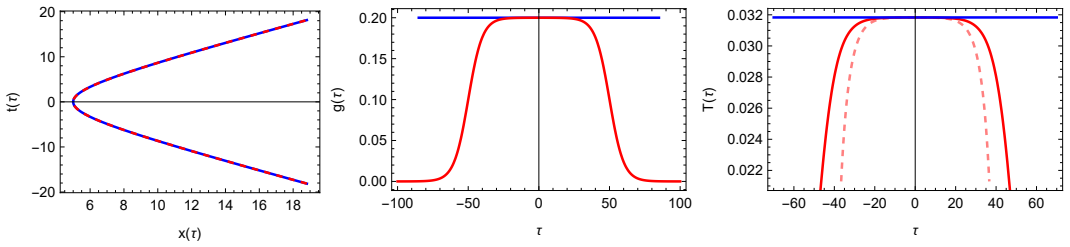
We construct a smooth trajectory in Minkowski spacetime that is inertial in the asymptotic past and future but undergoes approximately uniform acceleration for a finite duration. In a suitable limit this trajectory reduces to the standard Rindler trajectory, reproducing the expected Bogoliubov transformations and results consistent with the thermal time hypothesis. Analysis of an Unruh-DeWitt detector on this path shows a memory effect due to the finite duration of acceleration, quantified by the Fisher information. For two detectors along various trajectory combinations, unlike the transition rate, both the total correlation and the entanglement harvested return smoothly to their initial值值值
What carries the argument
The smooth finite-time acceleration trajectory in Minkowski spacetime that approximates the Rindler trajectory for a controlled interval and permits comparison with eternal acceleration results.
If this is right
- Complete positivity divisibility of the detector evolution depends on frequency, acceleration strength, and acceleration duration.
- The memory effect appears in the detector response and is independently quantified by Fisher information.
- Harvested entanglement and total correlations between detector pairs are restored after the finite acceleration ends.
- Correlation measures exhibit the same behavior in accelerating and decelerating segments.
- The sign of the flux of acceleration-induced radiation carries physical significance for the energy accounting.
Where Pith is reading between the lines
- The finite-time construction provides a controlled way to interpolate between inertial and accelerated regimes, which may help isolate transient effects in other quantum-field settings.
- Absence of memory imprint on negativity while it appears in Fisher information suggests that different correlation quantifiers probe distinct aspects of the finite-duration dynamics.
- The smooth return of entanglement after deceleration raises the possibility that information carried by field correlations is preserved across the entire inertial-to-accelerated-to-inertial sequence.
Load-bearing premise
The chosen smooth trajectory reduces in the appropriate limit to the standard Rindler trajectory while remaining inertial in the asymptotic past and future.
What would settle it
A calculation in which two Unruh-DeWitt detectors on these finite-acceleration trajectories fail to show harvested entanglement returning to its initial value after the acceleration phase would falsify the smooth-recovery claim.
Figures


read the original abstract
We construct a smooth trajectory in Minkowski spacetime that is inertial in the asymptotic past and future but undergoes approximately uniform acceleration for a finite duration. In a suitable limit, this trajectory reduces to the standard Rindler trajectory, reproducing the expected Bogoliubov transformations and results consistent with the thermal time hypothesis. We analyze the behavior of an Unruh-DeWitt (UDW) detector following such a trajectory and explore the dependence of complete positivity (CP) divisibility on the detector's frequency, acceleration, and the duration of acceleration. Notably, we find that the detector exhibits a memory effect due to the finite duration of acceleration, which is also quantified by the Fisher information. We further examine two UDW detectors along various trajectory combinations and show that, unlike the transition rate, both the total correlation and the entanglement harvested return smoothly to their initial values after the acceleration/deceleration phase. These correlation measures behave similarly in both accelerating and decelerating segments. Interestingly, we do not observe any measurable effect of the memory effect on negativity or mutual information. We also discuss the physical significance of the sign of the flux of acceleration-induced radiation.
Editorial analysis
A structured set of objections, weighed in public.
Referee Report
Summary. The manuscript constructs a smooth trajectory in Minkowski spacetime that is inertial in the asymptotic past and future but undergoes approximately uniform acceleration for a finite duration. In a suitable limit this reduces to the standard Rindler trajectory, reproducing expected Bogoliubov transformations. The authors analyze a single Unruh-DeWitt detector along this trajectory, reporting a memory effect due to finite acceleration duration that is quantified by the Fisher information, and examining the dependence of complete positivity divisibility on detector frequency, acceleration parameter, and duration. For two detectors they show that, unlike the transition rate, both total correlation and harvested entanglement return smoothly to their initial values after the acceleration/deceleration phase, with similar behavior in accelerating and decelerating segments; they also discuss the physical significance of the sign of the flux of acceleration-induced radiation.
Significance. If the results are robust to the details of the smoothing procedure, the work provides a controlled setting for studying finite-time Unruh effects and non-Markovian detector dynamics. The contrast between the non-recovery of the transition rate and the smooth recovery of entanglement and total correlation is a potentially useful observation, and the use of Fisher information supplies a concrete quantifier of memory. The explicit reduction to the eternal Rindler case and the exploration of multiple trajectory combinations are strengths that allow direct comparison with known results.
major comments (2)
- [Trajectory construction] Trajectory construction section: the central claim that the memory effect and the smooth return of correlations/entanglement are generic features of finite-duration acceleration (rather than artifacts of the chosen smoothing) requires explicit checks that the long-time behavior of the Wightman function integrals is independent of the ramp-up/ramp-down profile. Different smoothing functions should be compared, or an argument given that residual correlations from the matching to asymptotic inertial segments vanish in the relevant limits.
- [Two-detector analysis] Two-detector analysis: the statement that total correlation and entanglement return smoothly (unlike the transition rate) must be shown to hold for the full range of trajectory combinations examined; the manuscript should clarify whether this recovery persists when the two detectors follow qualitatively different finite-acceleration profiles.
minor comments (2)
- [Abstract] Abstract: the phrase 'we do not observe any measurable effect of the memory effect on negativity or mutual information' should be accompanied by quantitative bounds or a statement of the precision with which these quantities were evaluated.
- [Notation and equations] Notation: ensure the acceleration parameter a and the finite duration parameter are introduced with consistent symbols and units in all equations and figures.
Simulated Author's Rebuttal
We thank the referee for the careful reading of our manuscript and the constructive comments. We address the major points below and will revise the manuscript to incorporate clarifications and additional arguments where appropriate.
read point-by-point responses
-
Referee: [Trajectory construction] Trajectory construction section: the central claim that the memory effect and the smooth return of correlations/entanglement are generic features of finite-duration acceleration (rather than artifacts of the chosen smoothing) requires explicit checks that the long-time behavior of the Wightman function integrals is independent of the ramp-up/ramp-down profile. Different smoothing functions should be compared, or an argument given that residual correlations from the matching to asymptotic inertial segments vanish in the relevant limits.
Authors: We agree that strengthening the genericity claim is valuable. In the revised manuscript we will add an analytic argument showing that the long-time asymptotics of the relevant Wightman integrals are controlled by the identical inertial segments at early and late times; the finite-duration acceleration phase contributes only transient terms that decay due to rapid phase oscillations for large time separations. We will also include a short numerical comparison with an alternative smoothing profile (a C^infty bump function) confirming that the Fisher information and the asymptotic values of the correlation measures remain unchanged within numerical precision. revision: yes
-
Referee: [Two-detector analysis] Two-detector analysis: the statement that total correlation and entanglement return smoothly (unlike the transition rate) must be shown to hold for the full range of trajectory combinations examined; the manuscript should clarify whether this recovery persists when the two detectors follow qualitatively different finite-acceleration profiles.
Authors: The manuscript already examines several combinations, including symmetric finite-acceleration trajectories, one detector accelerating while the other remains inertial, and trajectories with mismatched durations. The smooth recovery of total correlation and harvested entanglement is observed in all these cases. We will revise the text to state explicitly that the recovery persists for qualitatively different profiles and briefly explain that this follows from the structure of the two-point functions: the correlation measures integrate over the full history in a manner insensitive to the precise ramp details once the detectors return to inertial motion, in contrast to the irreversible excitation captured by the transition rate. revision: yes
Circularity Check
No significant circularity; derivation is self-contained
full rationale
The paper defines an explicit smooth trajectory that is inertial at early and late times and approximates uniform acceleration over finite duration, with a controlled limit recovering the standard Rindler case and its Bogoliubov coefficients. All subsequent detector observables (transition rates, Fisher information, total correlations, negativity, mutual information) are obtained from direct integration of the Wightman function along this worldline using the standard Unruh-DeWitt coupling. These quantities are not fitted to data within the paper, nor are they renamed versions of the trajectory definition itself; the memory effect and the smooth return of correlations appear as computed outcomes that can be varied by changing the acceleration duration or profile. No load-bearing self-citation or uniqueness theorem from the same authors is invoked to force the results.
Axiom & Free-Parameter Ledger
free parameters (2)
- finite acceleration duration
- acceleration parameter a
axioms (2)
- domain assumption Existence of a smooth trajectory that is asymptotically inertial yet approximates Rindler motion for finite time
- domain assumption Validity of the Unruh-DeWitt detector as a probe of field correlations
Lean theorems connected to this paper
-
IndisputableMonolith/Cost/FunctionalEquation.leanwashburn_uniqueness_aczel unclear?
unclearRelation between the paper passage and the cited Recognition theorem.
We construct a smooth trajectory in Minkowski spacetime that is inertial in the asymptotic past and future but undergoes approximately uniform acceleration for a finite duration... the detector exhibits a memory effect due to the finite duration of acceleration, which is also quantified by the Fisher information.
-
IndisputableMonolith/Foundation/AbsoluteFloorClosure.leanreality_from_one_distinction unclear?
unclearRelation between the paper passage and the cited Recognition theorem.
Unlike the transition rate, both the total correlation and the entanglement harvested return smoothly to their initial values after the acceleration/deceleration phase.
What do these tags mean?
- matches
- The paper's claim is directly supported by a theorem in the formal canon.
- supports
- The theorem supports part of the paper's argument, but the paper may add assumptions or extra steps.
- extends
- The paper goes beyond the formal theorem; the theorem is a base layer rather than the whole result.
- uses
- The paper appears to rely on the theorem as machinery.
- contradicts
- The paper's claim conflicts with a theorem or certificate in the canon.
- unclear
- Pith found a possible connection, but the passage is too broad, indirect, or ambiguous to say the theorem truly supports the claim.
Reference graph
Works this paper leans on
-
[1]
Particle creation by black holes
Stephen William Hawking. Particle creation by black holes. Communications in Mathematical Physics, 43:199–220, 1975
work page 1975
-
[2]
W. G. Unruh. Notes on black-hole evaporation. Phys. Rev. D , 14:870–892, Aug 1976
work page 1976
-
[3]
Lessons from the information paradox
Suvrat Raju. Lessons from the information paradox. Phys. Rept., 943:1–80, 2022
work page 2022
-
[4]
Jerusalem Lectures on Black Holes and Quantum Information
Daniel Harlow. Jerusalem Lectures on Black Holes and Quantum Information. Rev. Mod. Phys., 88:015002, 2016
work page 2016
- [5]
-
[6]
Subhajit Barman, Dipankar Barman, and Bibhas Ranjan Majhi. Entanglement harvesting from conformal vacuums between two Unruh-DeWitt detectors moving along null paths. JHEP, 09:106, 2022
work page 2022
-
[7]
Morley, Hendrik Ulbricht, Marko Toroˇ s, Mauro Paternostro, An- drew A
Sougato Bose, Anupam Mazumdar, Gavin W. Morley, Hendrik Ulbricht, Marko Toroˇ s, Mauro Paternostro, An- drew A. Geraci, Peter F. Barker, M. S. Kim, and Gerard Milburn. Spin entanglement witness for quantum gravity. Phys. Rev. Lett., 119:240401, Dec 2017
work page 2017
-
[8]
C. Marletto and V. Vedral. Gravitationally induced entanglement between two massive particles is sufficient evidence of quantum effects in gravity. Phys. Rev. Lett., 119:240402, Dec 2017
work page 2017
-
[9]
Marshman, Anupam Mazumdar, and Sougato Bose
Ryan J. Marshman, Anupam Mazumdar, and Sougato Bose. Locality and entanglement in table-top testing of the quantum nature of linearized gravity. Phys. Rev. A , 101:052110, May 2020
work page 2020
-
[10]
Mechanism for the quantum natured gravitons to entangle masses
Sougato Bose, Anupam Mazumdar, Martine Schut, and Marko Toroˇ s. Mechanism for the quantum natured gravitons to entangle masses. Phys. Rev. D , 105:106028, May 2022
work page 2022
-
[11]
Newton, entanglement, and the graviton
Daniel Carney. Newton, entanglement, and the graviton. Phys. Rev. D , 105:024029, Jan 2022
work page 2022
-
[12]
Distinguishing jordan and einstein frames in gravity through entanglement
Sumanta Chakraborty, Anupam Mazumdar, and Ritapriya Pradhan. Distinguishing jordan and einstein frames in gravity through entanglement. Phys. Rev. D , 108:L121505, Dec 2023
work page 2023
-
[14]
Xuanhua Wang, Kun Zhang, and Jin Wang. Entanglement islands, fire walls and state paradox from quantum teleportation and entanglement swapping. Class. Quant. Grav. , 40(9):095012, 2023
work page 2023
-
[15]
S. Parvizi and M. Shahbazi. Analogue gravity and the island prescription. European Physical Journal C , 83:705, 2023
work page 2023
-
[16]
Ken K. W. Ma and Kun Yang. Simple analog of the black-hole information paradox in quantum hall interfaces. Phys. Rev. B , 105:045306, Jan 2022
work page 2022
-
[17]
Braunstein, Mir Faizal, Lawrence M
Samuel L. Braunstein, Mir Faizal, Lawrence M. Krauss, Francesco Marino, and Naveed A. Shah. Analogue simula- tions of quantum gravity with fluids. Nature Rev. Phys., 5(10):612–622, 2023. 32
work page 2023
-
[18]
K. S. Kumar and J. Marto. Revisiting quantum field theory in rindler spacetime with superselection rules. Universe, 10:320, 2024
work page 2024
-
[19]
Generalized unruh effect: A potential resolution to the black hole information paradox
Angela Chen. Generalized unruh effect: A potential resolution to the black hole information paradox. Phys. Rev. D, 107:056014, Mar 2023
work page 2023
-
[20]
Atsushi Higuchi, Satoshi Iso, Kazushige Ueda, and Kazuhiro Yamamoto. Entanglement of the vacuum between left, right, future, and past: The origin of entanglement-induced quantum radiation. Phys. Rev. D, 96:083531, Oct 2017
work page 2017
-
[21]
Spatio-temporal entanglement of the vacuum
Pravin Kumar Dahal and Kieran Hymas. Spatio-temporal entanglement of the vacuum. 4 2025
work page 2025
-
[22]
Edward Witten. Aps medal for exceptional achievement in research: Invited article on entanglement properties of quantum field theory. Rev. Mod. Phys., 90:045003, Oct 2018
work page 2018
-
[23]
Stephen J. Summers and Reinhard Werner. Maximal violation of bell’s inequalities for algebras of observables in tangent spacetime regions. Annales de l’I.H.P. Physique th´ eorique, 49(2):215–243, 1988
work page 1988
-
[24]
Peter D. Hislop. Conformal covariance, modular structure, and duality for local algebras in free massless quantum field theories. Annals of Physics , 185(2):193–230, 1988
work page 1988
-
[25]
Benni Reznik. Entanglement from the vacuum. Found. Phys., 33:167–176, 2003
work page 2003
-
[26]
Unruh effect and information flow
Boris Sokolov, Jorma Louko, Sabrina Maniscalco, and Iiro Vilja. Unruh effect and information flow. Phys. Rev. D , 101:024047, Jan 2020
work page 2020
-
[27]
Entanglement harvesting for different gravitational wave burst profiles with and without memory
Subhajit Barman, Indranil Chakraborty, and Sajal Mukherjee. Entanglement harvesting for different gravitational wave burst profiles with and without memory. JHEP, 09:180, 2023
work page 2023
-
[28]
Information backflow as a resource for entanglement.Phys
Nicol´ as Mirkin, Pablo Poggi, and Diego Wisniacki. Information backflow as a resource for entanglement.Phys. Rev. A, 99:062327, Jun 2019
work page 2019
-
[29]
C. H. Fleming, N. I. Cummings, Charis Anastopoulos, and B. L. Hu. Non-Markovian dynamics and entanglement of two-level atoms in a common field. Journal of Physics A Mathematical General , 45(6):065301, February 2012
work page 2012
-
[30]
Huelga, ´Angel Rivas, and Martin B
Susana F. Huelga, ´Angel Rivas, and Martin B. Plenio. Non-markovianity-assisted steady state entanglement. Phys. Rev. Lett., 108:160402, Apr 2012
work page 2012
-
[31]
Non-Markovianity and entanglement detection
Sourav Chanduka, Bihalan Bhattacharya, Rounak Mundra, Samyadeb Bhattacharya, and Indranil Chakrabarty. Non-Markovianity and entanglement detection. Int. J. Quant. Inf. , 21(05):2350025, 2023
work page 2023
-
[32]
´Angel Rivas, Susana F. Huelga, and Martin B. Plenio. Entanglement and non-markovianity of quantum evolutions. Phys. Rev. Lett., 105:050403, Jul 2010
work page 2010
-
[33]
Chandrashekhar Gaikwad, Daria Kowsari, Carson Brame, Xingrui Song, Haimeng Zhang, Martina Esposito, Arpit Ranadive, Giulio Cappelli, Nicolas Roch, Eli M. Levenson-Falk, and Kater W. Murch. Entanglement assisted probe of the non-markovian to markovian transition in open quantum system dynamics. Phys. Rev. Lett. , 132:200401, May 2024
work page 2024
-
[34]
Detlev Buchholz, Olaf Dreyer, Martin Florig, and Stephen J. Summers. Geometric modular action and space-time symmetry groups. Rev. Math. Phys. , 12:475–560, 2000. 33
work page 2000
-
[35]
Black Holes as Conformal Field Theories on Horizons
Edi Halyo. Black Holes as Conformal Field Theories on Horizons. 2 2015
work page 2015
- [36]
-
[37]
P. Candelas and J. S. Dowker. Field theories on conformally related space-times: Some global considerations. Phys. Rev. D, 19:2902–2907, May 1979
work page 1979
-
[38]
T. Padmanabhan. Gravity and Quantum Theory: Domains of Conflict and Contact. Int. J. Mod. Phys. D , 29(01):2030001, 2019
work page 2019
-
[39]
D. Ahn and M.S. Kim. Hawking–unruh effect and the entanglement of two-mode squeezed states in riemannian space–time. Physics Letters A , 366(3):202–205, 2007
work page 2007
-
[40]
Quantum Fisher information as a probe for Unruh thermality
Jun Feng and Jing-Jun Zhang. Quantum Fisher information as a probe for Unruh thermality. Phys. Lett. B , 827:136992, 2022
work page 2022
-
[41]
Everett Patterson and Robert B. Mann. Fisher information of a black hole spacetime. JHEP, 06:214, 2023
work page 2023
-
[42]
Does anti-Unruh effect assist quantum entanglement and coherence? New J
Shu-Min Wu, Xiao-Wei Teng, Jin-Xuan Li, Hao-Sheng Zeng, and Tonghua Liu. Does anti-Unruh effect assist quantum entanglement and coherence? New J. Phys. , 26(4):043016, 2024
work page 2024
-
[43]
Diamonds’s temperature: Unruh effect for bounded trajectories and thermal time hypothesis
Pierre Martinetti and Carlo Rovelli. Diamonds’s temperature: Unruh effect for bounded trajectories and thermal time hypothesis. Class. Quant. Grav. , 20:4919–4932, 2003
work page 2003
-
[44]
Gravitation: Foundations and frontiers
Thanu Padmanabhan. Gravitation: Foundations and frontiers . Cambridge University Press, 12 2014
work page 2014
-
[45]
L. Sriramkumar and T. Padmanabhan. Probes of the vacuum structure of quantum fields in classical backgrounds. Int. J. Mod. Phys. D , 11:1–34, 2002
work page 2002
-
[46]
N. D. Birrell and P. C. W. Davies. Frontmatter, page i–iv. Cambridge Monographs on Mathematical Physics. Cambridge University Press, 1982
work page 1982
-
[47]
Shin Takagi. Vacuum noise and stress induced by uniform acceleration: Hawking-unruh effect in rindler manifold of arbitrary dimension. Progress of Theoretical Physics Supplement, 88:1–142, 03 1986
work page 1986
-
[48]
Nitesh K. Dubey and Sanved Kolekar. Wigner distributions in rindler spacetime and nonvacuum minkowski states. Phys. Rev. D , 111:065004, Mar 2025
work page 2025
-
[49]
How often does the Unruh-DeWitt detector click? Regularisation by a spatial profile
Jorma Louko and Alejandro Satz. How often does the Unruh-DeWitt detector click? Regularisation by a spatial profile. Class. Quant. Grav. , 23:6321–6344, 2006
work page 2006
-
[50]
Measure for the degree of non-markovian behavior of quantum processes in open systems
Heinz-Peter Breuer, Elsi-Mari Laine, and Jyrki Piilo. Measure for the degree of non-markovian behavior of quantum processes in open systems. Phys. Rev. Lett., 103:210401, Nov 2009
work page 2009
-
[51]
Entropic and trace-distance-based measures of non- Markovianity
Federico Settimo, Heinz-Peter Breuer, and Bassano Vacchini. Entropic and trace-distance-based measures of non- Markovianity. Phys. Rev. A , 106(4):042212, 2022
work page 2022
-
[52]
S. C. Hou, X. X. Yi, S. X. Yu, and C. H. Oh. Alternative non-markovianity measure by divisibility of dynamical maps. Phys. Rev. A , 83:062115, Jun 2011. 34
work page 2011
-
[53]
Quantifying non-markovianity via correlations
Shunlong Luo, Shuangshuang Fu, and Hongting Song. Quantifying non-markovianity via correlations. Phys. Rev. A, 86:044101, Oct 2012
work page 2012
-
[54]
Juho Lankinen, Henri Lyyra, Boris Sokolov, Jose Teittinen, Babak Ziaei, and Sabrina Maniscalco. Complete positivity, finite-temperature effects, and additivity of noise for time-local qubit dynamics. Phys. Rev. A, 93:052103, May 2016
work page 2016
-
[55]
Luis C. Barbado and Matt Visser. Unruh-DeWitt detector event rate for trajectories with time-dependent acceler- ation. Phys. Rev. D , 86:084011, 2012
work page 2012
-
[56]
Then again, how often does the Unruh-DeWitt detector click if we switch it carefully? Class
Alejandro Satz. Then again, how often does the Unruh-DeWitt detector click if we switch it carefully? Class. Quant. Grav., 24:1719–1732, 2007
work page 2007
-
[57]
Transition rate of the Unruh-DeWitt detector in curved spacetime
Jorma Louko and Alejandro Satz. Transition rate of the Unruh-DeWitt detector in curved spacetime. Class. Quant. Grav., 25:055012, 2008
work page 2008
-
[58]
Connecting Fisher information to bulk entanglement in holography
Souvik Banerjee, Johanna Erdmenger, and Debajyoti Sarkar. Connecting Fisher information to bulk entanglement in holography. JHEP, 08:001, 2018
work page 2018
-
[59]
The information of the information paradox: On the quantum information meaning of Page curve
Cesar Gomez. The information of the information paradox: On the quantum information meaning of Page curve. unpublished, 7 2020
work page 2020
-
[60]
B. Roy Frieden. Physics from Fisher Information: A Unification . Cambridge University Press, 1998
work page 1998
-
[61]
Does relativistic motion always degrade quantum Fisher information? Phys
Xiaobao Liu, Jiliang Jing, Zehua Tian, and Weiping Yao. Does relativistic motion always degrade quantum Fisher information? Phys. Rev. D , 103(12):125025, 2021
work page 2021
-
[62]
Xiao-Ming Lu, Xiaoguang Wang, and C. P. Sun. Quantum fisher information flow and non-markovian processes of open systems. Phys. Rev. A , 82:042103, Oct 2010
work page 2010
-
[63]
Relative entropy of states of von neumann algebras
Huzihiro Araki. Relative entropy of states of von neumann algebras. Publ. Res. Inst. Math. Sci. , 11(3):809–833, 1975
work page 1975
-
[64]
When entanglement harvesting is not really harvesting
Erickson Tjoa and Eduardo Mart´ ın-Mart´ ınez. When entanglement harvesting is not really harvesting. Phys. Rev. D, 104:125005, Dec 2021
work page 2021
-
[65]
Kensuke Gallock-Yoshimura, Erickson Tjoa, and Robert B. Mann. Harvesting entanglement with detectors freely falling into a black hole. Phys. Rev. D , 104:025001, Jul 2021
work page 2021
-
[66]
Harvesting correlations from the quantum vacuum
Alejandro Pozas-Kerstjens and Eduardo Martin-Martinez. Harvesting correlations from the quantum vacuum. Phys. Rev. D, 92(6):064042, 2015
work page 2015
-
[67]
Erickson Tjoa and Robert B. Mann. Harvesting correlations in Schwarzschild and collapsing shell spacetimes. JHEP, 08:155, 2020
work page 2020
-
[68]
Quantum correlations through event horizons: Fermionic versus bosonic entanglement
Eduardo Mart´ ın-Mart´ ınez and Juan Le´ on. Quantum correlations through event horizons: Fermionic versus bosonic entanglement. Phys. Rev. A , 81:032320, Mar 2010
work page 2010
-
[69]
Michael Horodecki, Peter W. Shor, and Mary Beth Ruskai. Entanglement Breaking Channels. Reviews in Mathe- matical Physics, 15(6):629–641, January 2003. 35
work page 2003
-
[70]
Vieira, Huan-Yu Ku, and Costantino Budroni
Lucas B. Vieira, Huan-Yu Ku, and Costantino Budroni. Entanglement-breaking channels are a quantum memory resource. unpublished, 2 2024
work page 2024
-
[71]
Ibrahim Akal, Yuya Kusuki, Noburo Shiba, Tadashi Takayanagi, and Zixia Wei. Holographic moving mirrors. Class. Quant. Grav., 38(22):224001, 2021
work page 2021
-
[72]
Entanglement Entropy in a Holographic Moving Mirror and the Page Curve
Ibrahim Akal, Yuya Kusuki, Noburo Shiba, Tadashi Takayanagi, and Zixia Wei. Entanglement Entropy in a Holographic Moving Mirror and the Page Curve. Phys. Rev. Lett., 126(6):061604, 2021
work page 2021
-
[73]
Wan Cong, Erickson Tjoa, and Robert B. Mann. Entanglement Harvesting with Moving Mirrors. JHEP, 06:021,
-
[74]
[Erratum: JHEP 07, 051 (2019)]. 36
work page 2019
discussion (0)
Sign in with ORCID, Apple, or X to comment. Anyone can read and Pith papers without signing in.