REVIEW 4 major objections 5 minor 242 references
Classifying Cool Dwarfs: Comprehensive Spectral Typing of Field and Peculiar Dwarfs Using Machine Learning
T0 review · 4 major / 5 minor · reviewed 2026-08-05 · deepseek-v4-flash
Pith's one-line read Low-resolution near-infrared spectra of M0–T9 dwarfs can be automatically typed to within one subtype 95.5% of the time, and to the right gravity/metallicity class 89.5% of the time, using a K-nearest-neighbor model trained on synthetic spe
desk verdict A competent ML spectral-typing pipeline with a partly circular benchmark; the headline accuracies overstate external skill, but the methods and ablations are worth refereeing. read the letter →
The pith
A machine-rendered reading of the paper's core claim, the machinery that carries it, and where it could break.
The reading
What carries the argument
The load-bearing object is the synthetic training set: for each of 70 spectral standards, 1,000 spectra are drawn by adding Gaussian noise to every flux point, with the noise set to the larger of the standard's own uncertainty and a tuned 5% fractional floor. This inflates the 70 standards to 70,000 training spectra and gives a plain distance-based classifier enough within-class variation to generalize. The model itself is a multi-output KNN (k = 29, Euclidean distance) that predicts spectral type and peculiarity class in parallel from 67 mean-flux features in 0.02 µm bins; the same binned-flux representation is what makes the method independent of hand-measured spectral indices.
What would settle it
Take a blinded sample of a few hundred prism spectra spanning M0–T9, have several experienced classifiers independently assign spectral types and peculiarity classes, and compare the KNN predictions to that independent human consensus. If within-one-subtype agreement falls substantially below 95.5%, the headline accuracy is partly an artifact of sharing the same standard grid between training and ground-truth labels.
Extended reading notes
Core claim
Stated on the paper's own terms: a multi-output K-nearest-neighbor classifier (k = 29, Euclidean distance) operating on 67 mean-flux bins between 0.89 and 2.45 µm recovers adopted spectral subtypes M0–T9 within ±1 subtype for 95.5 ± 0.6% of 1,300 held-out spectra and gets the six gravity/metallicity classes right 89.5 ± 0.9% of the time. The classifier is trained on 70,000 synthetic spectra built from 70 standards by adding Gaussian noise with a tuned 5% floor. The same model keeps a 97% lower-percentile accuracy at SNR ≈ 60 and ≈90% average accuracy below SNR 40. Random-forest feature attribution puts the strongest discriminative weight in the zy-band (0.89–0.91 µm, secondary at ~1.0 µm), t
Load-bearing premise
The accuracy numbers depend on 'adopted' spectral types that were obtained by chi-square fitting to the very same 70 standards used to generate the synthetic training spectra, so the test measures consistency with that reference grid rather than agreement with an independent human classification.
Editorial extensions
If this is right
- Large low-resolution NIR surveys can be typed automatically with no human inspection: a simple KNN on binned flux reproduces adopted M0–T9 subtypes at 95% accuracy.
- Observers can budget exposure times to reach SNR ≈ 60; beyond that, added integration time buys little classification accuracy.
- Because zy-band flux carries most of the discriminative signal, future instruments or reduced spectral coverage can retain most of the classification power even if H- and K-band data are limited.
- K-band features are the main gravity diagnostic within this model: removing the K band drops int-g and vl-g classification accuracy by roughly 10–14%, while metallicity classification falls only about 3%.
- The binned-flux-plus-synthetic-augmentation procedure carries over to other low-resolution NIR spectrographs, but the paper cautions that the model must be retrained on that instrument's standards and noise characteristics rather than applied directly.
Reading between the lines
- The small independent literature checks in Sections 5.1 and 5.5 (15 low-gravity and 15 subdwarf sources) are my best estimate of how the model would fare against human classifiers; because the adopted labels share the training standards' grid, the headline 95.5% likely overstates skill against fully independent human typing by a few points.
- The same recipe of synthetic augmentation around a small trusted standard set could be applied to other classification ladders with scarce labels, such as white dwarfs or Y dwarfs.
- The zy-band dominance suggests that extending coverage bluer than 0.89 µm would improve the model's weakest classes—early M dwarfs, whose flux peaks shortward of the current range—more cheaply than adding more standards at existing wavelengths.
- The concentration of confusion among very-low-gravity L dwarfs implies that the limiting factor for gravity classification is the scarcity and variability of young standards, not classifier choice.
Editorial analysis
A structured set of objections, weighed in public.
Referee Report
Summary. The paper trains three supervised classifiers (Random Forest, SVM, KNN) on 70,000 synthetic near-infrared spectra generated by adding Gaussian noise to 70 spectral standards from Table 1, using binned fluxes as features. The models are evaluated on 1,300 SpeX prism spectra whose adopted labels were themselves obtained by chi-square fitting against the same Table 1 standards (Section 3.1.1, Eq. 1). The authors report a best KNN accuracy of 95.5 ± 0.6% within ±1 spectral subtype and 89.5 ± 0.9% class (gravity/metallicity) accuracy, investigate SNR dependence, and perform ablation studies removing the K-band and H-band continuum. The central methodological concern is that the test labels and the training set share the same reference grid, so the headline accuracies largely measure agreement between two estimators anchored to identical standards rather than external spectral-typing skill.
Significance. If the headline accuracies represent genuine external classification skill, the paper would provide a useful tool for automated cool-dwarf typing in large low-resolution NIR surveys, with practical guidance on binning, SNR, and feature importance. The manuscript has clear strengths: it releases models and preprocessed data, documents a reproducible workflow, compares three algorithms under a common preprocessing chain, and provides informative ablations of K-band and H-band continuum contributions. The main weakness is benchmark validity: the 'ground truth' labels are generated by chi-square matching to the same standards that seed the synthetic training set, and the only external checks are 15 low-gravity and 15 subdwarf sources. As a result, the aggregate accuracy figures overstate what is currently demonstrated about classification of unseen objects, and per-class accuracies for the peculiar classes that motivate the paper are substantially lower than the weighted headline number.
major comments (4)
- [§3.1.1, Eq. (1) and §3.1.4] The test labels are the adopted spectral types from a chi-square fit against the Table 1 standards, and the synthetic training set is generated from those same standards. The KNN model learns the distance structure of the standard grid, while the test labels are the best-fit positions on that same grid. The reported 95.5 ± 0.6% ±1-SpT accuracy therefore quantifies agreement between KNN and the chi-square labeler on a shared reference manifold, not external skill against human classification. The external checks in Sections 5.1 and 5.5 cover only 15 + 15 sources, too small to anchor aggregate accuracies. Please reframe the headline as 'label-reproduction accuracy' and validate against independent literature classifications for a larger sample, or use a leave-one-standard-out scheme in which test spectra are labeled without the corresponding standard.
- [§2.2 and §3.1] The manuscript never states that the 70 Table 1 standards are excluded from the 1,548 SPL-based validation/test spectra. Since the standards are drawn from SPL/SPLAT and the training set contains 1,000 synthetic copies of each, any standard present in the test set can be recovered essentially exactly by KNN, inflating accuracy. Please state explicitly whether standards were removed from the test and validation sets, and if not, repeat the benchmark with them excluded.
- [§3.1.2 and §3.1.3] The evaluation set is cleaned by removing approximately 3% of the sample as normalization outliers (Table 4) and 43 CMD outliers (Figure 4) before computing accuracies. These cuts are based on the same normalization/chi-square machinery used to define labels, so they can preferentially remove hard-to-classify objects. Report the headline accuracies with and without these cuts, and justify that the removals are not label-selective.
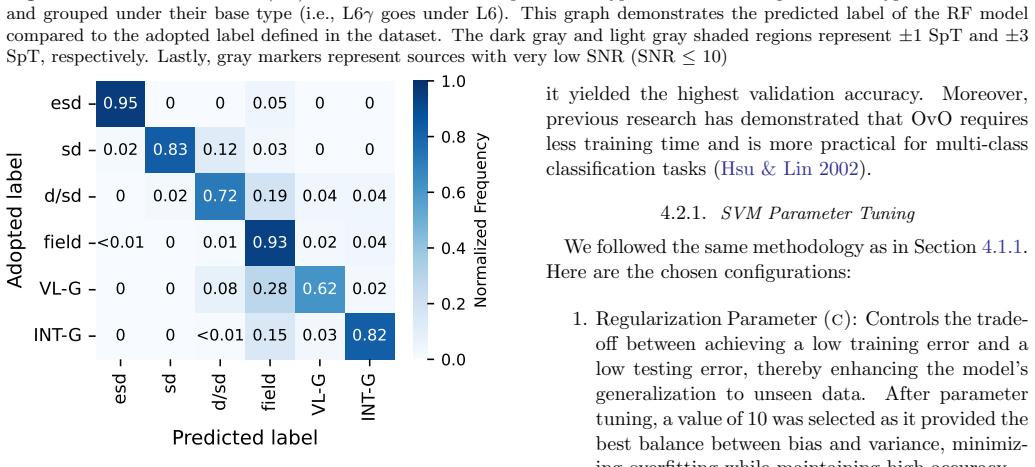
- [Abstract and §4.3/Fig. 15] The claim of 89.5 ± 0.9% class accuracy is a class-imbalance-weighted number. The confusion matrix shows per-class accuracies of only 64% for vl-g, 78% for sd, and 87% for d/sd, while field dwarfs (the majority class) are at 94%. Because the paper's stated goal is peculiar-object classification, reporting a single weighted accuracy overstates performance for the peculiar classes. Report macro-averaged or per-class metrics and qualify the abstract accordingly.
minor comments (5)
- [§1] Typo: 'decribes' should be 'describes'.
- [§3.1 vs §3.1.6] Section 3.1 says all data are constrained to a fit range of [0.87, 2.39] µm, but Section 3.1.6 and Figure 3 use a feature range of 0.89–2.45 µm. Please harmonize these numbers.
- [§4.2] The sentence 'the classifier classifies metallicity class ... at 82.7 ± 1.0% accuracy, shown in Figure 11' should refer to Figure 13, which is the SVM class confusion matrix; Figure 11 is the RF matrix.
- [§6, summary point 6] The sentence 'with replaced5 out of 98 out of 13 vl-g sources and 2 out of 2 int-g sources' is garbled. From Table 8 it should read '5 of 13 vl-g sources and 2 of 2 int-g sources'.
- [§4.4] The SNR analysis adds Gaussian noise to test spectra and classifies the noisy copies with the same KNN model. This probes resistance to random noise only. The text should state this limitation explicitly, since real observations at a given SNR also include systematics, telluric residuals, and calibration errors.
Circularity Check
Circular benchmark: adopted test labels are χ² matches to the same standards that seed the synthetic training set, so headline accuracies certify consistency with the labeler, not external spectral-typing skill.
-
fitted input called prediction
[Section 3.1.1 (Eq. 1), Section 3.1.4, Abstract/Table 6]
"The primary labels for our sample are the spectral classifications based on the NIR data. To ensure a common set of labels, we followed the methods described in Cushing et al. (2008) and reclassified all of the sources by minimizing the chi-square residual to our spectral standards. ... We expanded our initial sample of 70 spectral standards by generating 1,000 synthetic spectra from each one. ... Our best-performing model (using KNN) classifies 95.5 ± 0.6% of sources to within ±1 SpT, and assigns surface gravity and metallicity subclasses with 89.5 ± 0.9% accuracy."
The 'adopted spectral type' used as ground truth for the 1,300 test spectra is assigned by minimizing χ² (Eq. 1) against the 70 Table 1 standards, and the 70,000 synthetic training spectra are generated by adding Gaussian noise to those same 70 standards (Section 3.1.4). KNN therefore learns the distance structure of the standard set, and the test labels are the best-fit positions on that same grid. The reported 95.5% ±1 SpT and 89.5% class accuracies measure agreement between two estimators (KNN and χ² matching) anchored to identical references, not skill against external human classification. External checks cover only 15 low-gravity sources (Section 5.1) and 15 subdwarfs (Section 5.5), too small to validate the aggregate claims.
full rationale
The paper's headline numbers are not benchmarked against an independent ground truth: the test-set labels are derived by χ² fitting to the same 70-standard grid from which the synthetic training set is generated. This is a benchmark-validity circularity rather than a strict mathematical identity—KNN and χ² matching could in principle disagree—but the high accuracies certify that KNN reproduces the χ² labeler's mapping onto the standard grid, not that either estimator is externally accurate. The paper's own Section 1 limitation statement ('it inherently carries the subjectivity of the “ground truth” defined by the human-classified training set') and its small external checks (15+15 sources) support this reading. No load-bearing self-citation chain or imported uniqueness theorem is present; the standards are drawn from established literature. The feature-importance, SNR, and K-band/H-band ablation results are independent of this circularity and retain value. Overall, the central classification-accuracy claim is partially circular.
Assumptions & free parameters
free parameters (8)
- noise_scale (synthetic training noise) =
0.05 (5%)
- number of synthetic spectra per standard =
1000 (70,000 total)
- wavelength bin width =
0.02 µm
- outlier rejection threshold =
beyond 1.5σ (≈3% of sample removed)
- KNN number of neighbors =
k = 29
- Random Forest hyperparameters =
n_estimators = 700, min_samples_split = 5, max_features = sqrt
- SVM hyperparameters =
C = 10, kernel = rbf, gamma = scale
- normalization window =
1.27-1.28 µm (J-band peak)
assumptions (5)
- domain assumption The 70 spectral standards in Table 1 correctly represent their subtypes and peculiar classes, and the chi-square-minimization labels (Eq. 1) adopted for all sources are correct ground truth.
- ad hoc to paper Gaussian perturbations of single-epoch standards adequately span real within-class spectral variance.
- domain assumption The 70 standards cover the M0-T9 and peculiar-class feature space with no unrepresented subtypes undermining the benchmark.
- standard math Scikit-learn implementations of RandomForest, SVC, and KNN with MultiOutputClassifier behave as documented, and Euclidean distance in binned-flux space is a valid spectral similarity metric.
- domain assumption Telluric masking (1.35-1.42, 1.80-1.95 µm) and the 0.89-2.45 µm feature range exclude no information required for subtype or class discrimination.
Cite this review
Pith. "Pith review of Classifying Cool Dwarfs: Comprehensive Spectral Typing of Field and Peculiar Dwarfs Using Machine Learning." pith.science (2026). https://pith.science/paper/6SOBRXZK
@misc{pith2026250809370,
  author       = {Pith},
  title        = {Pith review of: Classifying Cool Dwarfs: Comprehensive Spectral Typing of Field and Peculiar Dwarfs Using Machine Learning},
  year         = {2026},
  howpublished = {\url{https://pith.science/paper/6SOBRXZK}},
  note         = {Machine review of arXiv:2508.09370}
}
abstract
Low-mass stars and brown dwarfs -- spectral types (SpTs) M0 and later -- play a significant role in studying stellar and substellar processes and demographics, reaching down to planetary-mass objects. Currently, the classification of these sources remains heavily reliant on visual inspection of spectral features, equivalent width measurements, or narrow-/wide-band spectral indices. Recent advances in machine learning (ML) methods offer automated approaches for spectral typing, which are becoming increasingly important as large spectroscopic surveys such as Gaia, SDSS, and SPHEREx generate datasets containing millions of spectra. We investigate the application of ML in spectral type classification on low-resolution (R $\sim$ 120) near-infrared spectra of M0--T9 dwarfs obtained with the SpeX instrument on the NASA Infrared Telescope Facility. We specifically aim to classify the gravity- and metallicity-dependent subclasses for late-type dwarfs. We used binned fluxes as input features and compared the efficacy of spectral type estimators built using Random Forest (RF), Support Vector Machine (SVM), and K-Nearest Neighbor (KNN) models. We tested the influence of different normalizations and analyzed the relative importance of different spectral regions for surface gravity and metallicity subclass classification. Our best-performing model (using KNN) classifies 95.5 $\pm$ 0.6% of sources to within $\pm$1 SpT, and assigns surface gravity and metallicity subclasses with 89.5 $\pm$ 0.9% accuracy. We test the dependence of signal-to-noise ratio on classification accuracy and find sources with SNR $\gtrsim$ 60 have $\gtrsim$ 95% accuracy. We also find that zy-band plays the most prominent role in the RF model, with FeH and TiO having the highest feature importance.
Figures


Figures from the paper (20 more)




Reference graph
Works this paper leans on
-
[1]
, " * write output.state after.block = add.period write newline
ENTRY address archivePrefix author booktitle chapter doi edition editor eprint howpublished institution journal key month number organization pages publisher school series title misctitle type volume year version url label extra.label sort.label short.list INTEGERS output.state before.all mid.sentence after.sentence after.block FUNCTION init.state.consts ...
-
[2]
write newline
" write newline "" before.all 'output.state := FUNCTION format.url url empty "" new.block "" url * "" * if FUNCTION format.eprint eprint empty "" archivePrefix empty "" archivePrefix "arXiv" = new.block " " eprint * " " * new.block " " eprint * " " * if if if FUNCTION format.doi doi empty "" " " doi * " " * if FUNCTION format.pid doi empty eprint empty ur...
-
[3]
t b K >f WG_-Fn O sKt] m q_٫u.|lKt ݥb ۟ Rc >V _yۻcn N?ւ z+ٕ| In--e 6 םZ ] r>e|둉گ5 C/E1cc 1 ZE (C[k8l&NW =]CzWyc[ a˒sb-uw ٣ iZ] V d kOj jmr+Ђ ^ ?8i v Mw d(z ro )mٞ+g 9 K݊cnm@,ʽ蛇
thebibliography [1] 20pt to REFERENCES 6pt =0pt -12pt 10pt plus 3pt =0pt =0pt =1pt plus 1pt =0pt =0pt -12pt =13pt plus 1pt =20pt =13pt plus 1pt \@M =10000 =-1.0em =0pt =0pt 0pt =0pt =1.0em @enumiv\@empty 10000 10000 `\.\@m \@noitemerr \@latex@warning Empty `thebibliography' environment \@ifnextchar \@reference \@latexerr Missing key on reference command E...
2021
-
[4]
Aganze , C., Burgasser , A. J., Faherty , J. K., et al. 2016, , 151, 46, 10.3847/0004-6256/151/2/46
-
[5]
Aganze , C., Burgasser , A. J., Malkan , M., et al. 2022, , 924, 114, 10.3847/1538-4357/ac35ea
-
[6]
Alden , H. L. 1951, , 56, 34, 10.1086/106580
-
[7]
Allen , P. R., Burgasser , A. J., Faherty , J. K., & Kirkpatrick , J. D. 2012, , 144, 62, 10.1088/0004-6256/144/2/62
-
[8]
Allen , P. R., Koerner , D. W., McElwain , M. W., Cruz , K. L., & Reid , I. N. 2007, , 133, 971, 10.1086/510346
Show all 242 references
-
[9]
R., & Reid , I
Allen , P. R., & Reid , I. N. 2008, , 135, 2024, 10.1088/0004-6256/135/6/2024
2008 doi
- [10]
-
[11]
N., Liu , M
Allers , K. N., Liu , M. C., Dupuy , T. J., & Cushing , M. C. 2010, , 715, 561, 10.1088/0004-637X/715/1/561
2010 doi
-
[12]
2022, , 657, A129, 10.1051/0004-6361/202142050
Almendros-Abad , V., Mu z i \'c , K., Moitinho , A., Krone-Martins , A., & Kubiak , K. 2022, , 657, A129, 10.1051/0004-6361/202142050
2022 doi
-
[13]
C., Manjavacas , E., et al
Ashraf , A., Bardalez Gagliuffi , D. C., Manjavacas , E., et al. 2022, , 934, 178, 10.3847/1538-4357/ac7aab
2022 doi
-
[14]
P., Tollerud , E
Astropy Collaboration , Robitaille , T. P., Tollerud , E. J., et al. 2013, , 558, A33, 10.1051/0004-6361/201322068
2013 doi
-
[15]
M., Sip o cz , B
Astropy Collaboration , Price-Whelan , A. M., Sip o cz , B. M., et al. 2018, , 156, 123, 10.3847/1538-3881/aabc4f
2018 doi
-
[16]
M., Lim , P
Astropy Collaboration , Price-Whelan , A. M., Lim , P. L., et al. 2022, , 935, 167, 10.3847/1538-4357/ac7c74
2022 doi
-
[17]
F., Rocha, A
Azevedo, B. F., Rocha, A. M. A. C., & Pereira, A. I. 2024, Machine Learning, 113, 4055, 10.1007/s10994-023-06467-x
2024 doi
-
[18]
Ballard , S., & Johnson , J. A. 2016, , 816, 66, 10.3847/0004-637X/816/2/66
2016 doi
-
[19]
S., Allard , F., & Hauschildt , P
Baraffe , I., Chabrier , G., Barman , T. S., Allard , F., & Hauschildt , P. H. 2003, , 402, 701, 10.1051/0004-6361:20030252
2003 doi
-
[20]
C., Burgasser , A
Bardalez Gagliuffi , D. C., Burgasser , A. J., Gelino , C. R., et al. 2014, , 794, 143, 10.1088/0004-637X/794/2/143
2014 doi
-
[21]
C., Burgasser , A
Bardalez Gagliuffi , D. C., Burgasser , A. J., Schmidt , S. J., et al. 2019, , 883, 205, 10.3847/1538-4357/ab253d
2019 doi
-
[22]
Best , W. M. J., Liu , M. C., Magnier , E. A., et al. 2013, , 777, 84, 10.1088/0004-637X/777/2/84
2013 doi
-
[23]
2015, , 814, 118, 10.1088/0004-637X/814/2/118
---. 2015, , 814, 118, 10.1088/0004-637X/814/2/118
2015 doi
-
[24]
R., B \'e jar , V
Bihain , G., Rebolo , R., Zapatero Osorio , M. R., B \'e jar , V. J. S., & Caballero , J. A. 2010, , 519, A93, 10.1051/0004-6361/200913676
2010 doi
-
[25]
D., Storm , J., & Schnurr , O
Bihain , G., Scholz , R. D., Storm , J., & Schnurr , O. 2013, , 557, A43, 10.1051/0004-6361/201322141
2013 doi
-
[26]
J., Hawley , S
Bochanski , J. J., Hawley , S. L., Covey , K. R., et al. 2010, , 139, 2679, 10.1088/0004-6256/139/6/2679
2010 doi
-
[27]
L., et al
Bouy , H., Brandner , W., Mart \' n , E. L., et al. 2003, , 126, 1526, 10.1086/377343
2003 doi
-
[28]
2022, , 664, A111, 10.1051/0004-6361/202243850
Bouy , H., Tamura , M., Barrado , D., et al. 2022, , 664, A111, 10.1051/0004-6361/202243850
2022 doi
-
[29]
P., Liu , M
Bowler , B. P., Liu , M. C., & Cushing , M. C. 2009, , 706, 1114, 10.1088/0004-637X/706/2/1114
2009 doi
-
[30]
P., Liu , M
Bowler , B. P., Liu , M. C., Shkolnik , E. L., et al. 2012, , 753, 142, 10.1088/0004-637X/753/2/142
2012 doi
- [32]
- [33]
- [34]
-
[35]
J., Bardalez-Gagliuffi , D
Burgasser , A. J., Bardalez-Gagliuffi , D. C., & Gizis , J. E. 2011, , 141, 70, 10.1088/0004-6256/141/3/70
2011 doi
- [37]
-
[38]
J., Cruz , K
Burgasser , A. J., Cruz , K. L., Cushing , M., et al. 2010 a , , 710, 1142, 10.1088/0004-637X/710/2/1142
2010 doi
-
[39]
J., Cruz , K
Burgasser , A. J., Cruz , K. L., & Kirkpatrick , J. D. 2007 a , , 657, 494, 10.1086/510148
2007 doi
-
[40]
J., Geballe , T
Burgasser , A. J., Geballe , T. R., Leggett , S. K., Kirkpatrick , J. D., & Golimowski , D. A. 2006 c , , 637, 1067, 10.1086/498563
2006 doi
- [42]
- [44]
-
[45]
J., Looper , D., & Rayner , J
Burgasser , A. J., Looper , D., & Rayner , J. T. 2010 b , , 139, 2448, 10.1088/0004-6256/139/6/2448
2010 doi
-
[46]
J., Looper , D
Burgasser , A. J., Looper , D. L., Kirkpatrick , J. D., Cruz , K. L., & Swift , B. J. 2008 c , , 674, 451, 10.1086/524726
2008 doi
-
[47]
J., Looper , D
Burgasser , A. J., Looper , D. L., Kirkpatrick , J. D., & Liu , M. C. 2007 b , , 658, 557, 10.1086/511518
2007 doi
-
[48]
J., & Mamajek , E
Burgasser , A. J., & Mamajek , E. E. 2017, , 845, 110, 10.3847/1538-4357/aa7fea
2017 doi
- [49]
-
[50]
J., McElwain , M
Burgasser , A. J., McElwain , M. W., & Kirkpatrick , J. D. 2003, , 126, 2487, 10.1086/378608
2003 doi
- [52]
- [53]
-
[54]
J., Witte , S., Helling , C., et al
Burgasser , A. J., Witte , S., Helling , C., et al. 2009, , 697, 148, 10.1088/0004-637X/697/1/148
2009 doi
- [55]
-
[56]
J., Bezanson , R., Labbe , I., et al
Burgasser , A. J., Bezanson , R., Labbe , I., et al. 2024 b , , 962, 177, 10.3847/1538-4357/ad206f
2024 doi
-
[57]
B., Lunine , J
Burrows , A., Hubbard , W. B., Lunine , J. I., & Liebert , J. 2001, Reviews of Modern Physics, 73, 719, 10.1103/RevModPhys.73.719
2001 doi
-
[58]
A., Mart \' n , E
Caballero , J. A., Mart \' n , E. L., Dobbie , P. D., & Barrado Y Navascu \'e s , D. 2006, , 460, 635, 10.1051/0004-6361:20066162
2006 doi
-
[59]
J., & Pickering , E
Cannon , A. J., & Pickering , E. C. 1918, Annals of Harvard College Observatory, 91, 1
1918
-
[60]
J., Gizis , J
Castro , P. J., Gizis , J. E., Harris , H. C., et al. 2013, , 776, 126, 10.1088/0004-637X/776/2/126
2013 doi
-
[61]
2014, , 437, 968, 10.1093/mnras/stt1961
Cavuoti , S., Brescia , M., D'Abrusco , R., Longo , G., & Paolillo , M. 2014, , 437, 968, 10.1093/mnras/stt1961
2014 doi
-
[62]
2000, , 38, 337, 10.1146/annurev.astro.38.1.337
Chabrier , G., & Baraffe , I. 2000, , 38, 337, 10.1146/annurev.astro.38.1.337
2000 doi
- [63]
- [65]
-
[66]
L., Kirkpatrick , J
Cruz , K. L., Kirkpatrick , J. D., & Burgasser , A. J. 2009, , 137, 3345, 10.1088/0004-6256/137/2/3345
2009 doi
-
[67]
L., N \'u \ n ez , A., Burgasser , A
Cruz , K. L., N \'u \ n ez , A., Burgasser , A. J., et al. 2018, , 155, 34, 10.3847/1538-3881/aa9d8a
2018 doi
-
[68]
L., Reid , I
Cruz , K. L., Reid , I. N., Liebert , J., Kirkpatrick , J. D., & Lowrance , P. J. 2003, , 126, 2421, 10.1086/378607
2003 doi
-
[69]
L., Reid , I
Cruz , K. L., Reid , I. N., Kirkpatrick , J. D., et al. 2007, , 133, 439, 10.1086/510132
2007 doi
-
[70]
C., Looper , D., Burgasser , A
Cushing , M. C., Looper , D., Burgasser , A. J., et al. 2009, , 696, 986, 10.1088/0004-637X/696/1/986
2009 doi
-
[71]
C., Rayner , J
Cushing , M. C., Rayner , J. T., & Vacca , W. D. 2005, , 623, 1115, 10.1086/428040
2005 doi
-
[72]
C., Marley , M
Cushing , M. C., Marley , M. S., Saumon , D., et al. 2008, , 678, 1372, 10.1086/526489
2008 doi
-
[73]
C., Kirkpatrick , J
Cushing , M. C., Kirkpatrick , J. D., Gelino , C. R., et al. 2011, , 743, 50, 10.1088/0004-637X/743/1/50
2011 doi
-
[74]
C., Harris , H
Dahn , C. C., Harris , H. C., Vrba , F. J., et al. 2002, , 124, 1170, 10.1086/341646
2002 doi
-
[75]
P., et al
Dawson , P., Scholz , A., Ray , T. P., et al. 2014, , 442, 1586, 10.1093/mnras/stu973
2014 doi
-
[76]
C., Marocco , F., Pinfield , D
Day-Jones , A. C., Marocco , F., Pinfield , D. J., et al. 2013, , 430, 1171, 10.1093/mnras/sts685
2013 doi
-
[77]
R., & Hambly , N
Deacon , N. R., & Hambly , N. C. 2007, , 468, 163, 10.1051/0004-6361:20066844
2007 doi
-
[78]
R., Liu , M
Deacon , N. R., Liu , M. C., Magnier , E. A., et al. 2011, , 142, 77, 10.1088/0004-6256/142/3/77
2011 doi
-
[79]
2012 a , , 755, 94, 10.1088/0004-637X/755/2/94
---. 2012 a , , 755, 94, 10.1088/0004-637X/755/2/94
2012 doi
-
[80]
2012 b , , 757, 100, 10.1088/0004-637X/757/1/100
---. 2012 b , , 757, 100, 10.1088/0004-637X/757/1/100
2012 doi
-
[81]
2014, , 792, 119, 10.1088/0004-637X/792/2/119
---. 2014, , 792, 119, 10.1088/0004-637X/792/2/119
2014 doi
-
[82]
D., Dunning , C., et al
Desai , M., Draxl Giannoni , J. D., Dunning , C., et al. 2023, Research Notes of the American Astronomical Society, 7, 13, 10.3847/2515-5172/acb54a
2023 doi
-
[83]
L., Montgomery , M
Deshpande , R., Mart \' n , E. L., Montgomery , M. M., et al. 2012, , 144, 99, 10.1088/0004-6256/144/4/99
2012 doi
-
[84]
2010, , 725, L186, 10.1088/2041-8205/725/2/L186
Dierickx , M., Klement , R., Rix , H.-W., & Liu , C. 2010, , 725, L186, 10.1088/2041-8205/725/2/L186
2010 doi
-
[85]
D., & Charbonneau , D
Dressing , C. D., & Charbonneau , D. 2015, , 807, 45, 10.1088/0004-637X/807/1/45
2015 doi
- [86]
- [87]
-
[88]
L., & Luhman , K
Esplin , T. L., & Luhman , K. L. 2020, , 159, 282, 10.3847/1538-3881/ab8dbd
2020 doi
-
[89]
L., Luhman , K
Esplin , T. L., Luhman , K. L., & Mamajek , E. E. 2014, , 784, 126, 10.1088/0004-637X/784/2/126
2014 doi
-
[90]
K., Burgasser , A
Faherty , J. K., Burgasser , A. J., Bochanski , J. J., et al. 2011, , 141, 71, 10.1088/0004-6256/141/3/71
2011 doi
-
[91]
K., Burgasser , A
Faherty , J. K., Burgasser , A. J., Cruz , K. L., et al. 2009, , 137, 1, 10.1088/0004-6256/137/1/1
2009 doi
-
[92]
K., Burgasser , A
Faherty , J. K., Burgasser , A. J., West , A. A., et al. 2010, , 139, 176, 10.1088/0004-6256/139/1/176
2010 doi
-
[93]
K., Riedel , A
Faherty , J. K., Riedel , A. R., Cruz , K. L., et al. 2016, , 225, 10, 10.3847/0067-0049/225/1/10
2016 doi
- [94]
-
[95]
1998, , 298, L34, 10.1046/j.1365-8711.1998.01847.x
Festin , L. 1998, , 298, L34, 10.1046/j.1365-8711.1998.01847.x
1998
-
[96]
L., Pinfield , D
Folkes , S. L., Pinfield , D. J., Jones , H. R. A., et al. 2012, , 427, 3280, 10.1111/j.1365-2966.2012.21132.x
2012
-
[97]
K., Cruz , K., et al
Gagn \'e , J., Faherty , J. K., Cruz , K., et al. 2014 a , , 785, L14, 10.1088/2041-8205/785/1/L14
2014 doi
-
[98]
2014 b , , 792, L17, 10.1088/2041-8205/792/1/L17
Gagn \'e , J., Lafreni \`e re , D., Doyon , R., et al. 2014 b , , 792, L17, 10.1088/2041-8205/792/1/L17
2014 doi
-
[99]
2015 a , , 798, 73, 10.1088/0004-637X/798/2/73
Gagn \'e , J., Lafreni \`e re , D., Doyon , R., Malo , L., & Artigau , \'E . 2015 a , , 798, 73, 10.1088/0004-637X/798/2/73
2015 doi
-
[100]
K., Cruz , K
Gagn \'e , J., Faherty , J. K., Cruz , K. L., et al. 2015 b , , 219, 33, 10.1088/0067-0049/219/2/33
2015 doi
-
[101]
K., Mamajek , E
Gagn \'e , J., Faherty , J. K., Mamajek , E. E., et al. 2017, , 228, 18, 10.3847/1538-4365/228/2/18
2017 doi
-
[102]
2018, , 616, A10, 10.1051/0004-6361/201832843
Gaia Collaboration , Babusiaux , C., van Leeuwen , F., et al. 2018, , 616, A10, 10.1051/0004-6361/201832843
2018 doi
-
[103]
L., Sarro , L
Gaia Collaboration , Smart , R. L., Sarro , L. M., et al. 2021, , 649, A6, 10.1051/0004-6361/202039498
2021 doi
-
[104]
C., Kuznetsov , M., Clarke , J
G \'a lvez-Ortiz , M. C., Kuznetsov , M., Clarke , J. R. A., et al. 2014, , 439, 3890, 10.1093/mnras/stu241
2014 doi
-
[105]
D., Berriman , G
Gei ler , K., Metchev , S., Kirkpatrick , J. D., Berriman , G. B., & Looper , D. 2011, , 732, 56, 10.1088/0004-637X/732/1/56
2011 doi
-
[106]
M., et al
Gillon , M., Jehin , E., Lederer , S. M., et al. 2016, , 533, 221, 10.1038/nature17448
2016 doi
-
[107]
Gillon , M., Triaud , A. H. M. J., Demory , B.-O., et al. 2017, , 542, 456, 10.1038/nature21360
2017 doi
-
[108]
Gizis , J. E. 1997, , 113, 806, 10.1086/118302
1997 doi
- [109]
-
[110]
E., Burgasser , A
Gizis , J. E., Burgasser , A. J., Faherty , J. K., Castro , P. J., & Shara , M. M. 2011, , 142, 171, 10.1088/0004-6256/142/5/171
2011 doi
-
[111]
E., Monet , D
Gizis , J. E., Monet , D. G., Reid , I. N., et al. 2000, , 120, 1085, 10.1086/301456
2000 doi
-
[112]
E., Reid , I
Gizis , J. E., Reid , I. N., Knapp , G. R., et al. 2003, , 125, 3302, 10.1086/374991
2003 doi
-
[113]
E., Faherty , J
Gizis , J. E., Faherty , J. K., Liu , M. C., et al. 2012, , 144, 94, 10.1088/0004-6256/144/4/94
2012 doi
-
[114]
C., Faherty , J
Gonzales , E. C., Faherty , J. K., Gagn \'e , J., et al. 2019, , 886, 131, 10.3847/1538-4357/ab48fc
2019 doi
-
[115]
I., Meyer , M
Gorlova , N. I., Meyer , M. R., Rieke , G. H., & Liebert , J. 2003, , 593, 1074, 10.1086/376730
2003 doi
-
[116]
J., Schneider , A
Greco , J. J., Schneider , A. C., Cushing , M. C., Kirkpatrick , J. D., & Burgasser , A. J. 2019, , 158, 182, 10.3847/1538-3881/ab3ebe
2019 doi
-
[117]
B., & Rutledge , R
Haakonsen , C. B., & Rutledge , R. E. 2009, , 184, 138, 10.1088/0067-0049/184/1/138
2009 doi
-
[118]
R., Millman, K
Harris, C. R., Millman, K. J., van der Walt, S. J., et al. 2020, Nature, 585, 357, 10.1038/s41586-020-2649-2
2020 doi
-
[119]
L., Covey , K
Hawley , S. L., Covey , K. R., Knapp , G. R., et al. 2002, , 123, 3409, 10.1086/340697
2002 doi
-
[120]
2022, , 927, 122, 10.3847/1538-4357/ac4e16
Hejazi , N., L \'e pine , S., & Nordlander , T. 2022, , 927, 122, 10.3847/1538-4357/ac4e16
2022 doi
-
[121]
J., Jao , W.-C., Subasavage , J
Henry , T. J., Jao , W.-C., Subasavage , J. P., et al. 2006, , 132, 2360, 10.1086/508233
2006 doi
-
[122]
J., Jao , W.-C., Winters , J
Henry , T. J., Jao , W.-C., Winters , J. G., et al. 2018, , 155, 265, 10.3847/1538-3881/aac262
2018 doi
-
[123]
Ho, T. K. 1995, in Proceedings of 3rd International Conference on Document Analysis and Recognition, Vol. 1, 278--282 vol.1, 10.1109/ICDAR.1995.598994
1995
-
[124]
J., Theissen , C
Hsu , C.-C., Burgasser , A. J., Theissen , C. A., et al. 2021, , 257, 45, 10.3847/1538-4365/ac1c7d
2021 doi
-
[125]
2002, IEEE Transactions on Neural Networks, 13, 415, 10.1109/72.991427
Hsu, C.-W., & Lin, C.-J. 2002, IEEE Transactions on Neural Networks, 13, 415, 10.1109/72.991427
2002 doi
-
[126]
Hunter, J. D. 2007, Computing in Science & Engineering, 9, 90, 10.1109/MCSE.2007.55
2007 doi
-
[127]
J., et al
Karalidi , T., Marley , M., Fortney , J. J., et al. 2021, , 923, 269, 10.3847/1538-4357/ac3140
2021 doi
-
[128]
2015, , 150, 182, 10.1088/0004-6256/150/6/182
Kellogg , K., Metchev , S., Gei ler , K., et al. 2015, , 150, 182, 10.1088/0004-6256/150/6/182
2015 doi
-
[129]
A., & Tannock , M
Kellogg , K., Metchev , S., Miles-P \'a ez , P. A., & Tannock , M. E. 2017, , 154, 112, 10.3847/1538-3881/aa83b0
2017 doi
-
[131]
V., Khovritchev , M
Khrutskaya , E. V., Khovritchev , M. Y., & Bronnikova , N. M. 2004, , 418, 357, 10.1051/0004-6361:20034232
2004 doi
-
[132]
J., Angus , R., et al
Kiman , R., Schmidt , S. J., Angus , R., et al. 2019, , 157, 231, 10.3847/1538-3881/ab1753
2019 doi
-
[133]
Kirkpatrick , J. D. 2005, , 43, 195, 10.1146/annurev.astro.42.053102.134017
2005
-
[134]
D., Barman , T
Kirkpatrick , J. D., Barman , T. S., Burgasser , A. J., et al. 2006, , 639, 1120, 10.1086/499622
2006 doi
-
[135]
D., Dahn , C
Kirkpatrick , J. D., Dahn , C. C., Monet , D. G., et al. 2001, , 121, 3235, 10.1086/321085
2001 doi
-
[136]
D., Henry , T
Kirkpatrick , J. D., Henry , T. J., & McCarthy , Donald W., J. 1991, , 77, 417, 10.1086/191611
1991 doi
-
[137]
D., Reid , I
Kirkpatrick , J. D., Reid , I. N., Liebert , J., et al. 1999, , 519, 802, 10.1086/307414
1999 doi
- [138]
-
[139]
D., Cruz , K
Kirkpatrick , J. D., Cruz , K. L., Barman , T. S., et al. 2008, , 689, 1295, 10.1086/592768
2008 doi
-
[140]
D., Looper , D
Kirkpatrick , J. D., Looper , D. L., Burgasser , A. J., et al. 2010, , 190, 100, 10.1088/0067-0049/190/1/100
2010 doi
-
[141]
D., Cushing , M
Kirkpatrick , J. D., Cushing , M. C., Gelino , C. R., et al. 2011, , 197, 19, 10.1088/0067-0049/197/2/19
2011 doi
-
[143]
2014 b , , 783, 122, 10.1088/0004-637X/783/2/122
---. 2014 b , , 783, 122, 10.1088/0004-637X/783/2/122
2014 doi
-
[144]
D., Kellogg , K., Schneider , A
Kirkpatrick , J. D., Kellogg , K., Schneider , A. C., et al. 2016, , 224, 36, 10.3847/0067-0049/224/2/36
2016 doi
-
[145]
D., Gelino , C
Kirkpatrick , J. D., Gelino , C. R., Faherty , J. K., et al. 2021, , 253, 7, 10.3847/1538-4365/abd107
2021 doi
-
[146]
R., Leggett , S
Knapp , G. R., Leggett , S. K., Fan , X., et al. 2004, , 127, 3553, 10.1086/420707
2004 doi
- [147]
-
[149]
M., & Shara , M
L \'e pine , S., Rich , R. M., & Shara , M. M. 2003, , 125, 1598, 10.1086/345972
2003 doi
- [150]
-
[151]
L \'e pine , S., & Shara , M. M. 2005, , 129, 1483, 10.1086/427854
2005 doi
-
[152]
2020, , 901, 49, 10.3847/1538-4357/abaef3
Li , L., Shao , Z., Li , Z.-Z., et al. 2020, , 901, 49, 10.3847/1538-4357/abaef3
2020 doi
-
[153]
Liebert , J., & Burgasser , A. J. 2007, , 655, 522, 10.1086/509882
2007 doi
-
[154]
C., Dupuy , T
Liu , M. C., Dupuy , T. J., & Allers , K. N. 2016, , 833, 96, 10.3847/1538-4357/833/1/96
2016 doi
-
[155]
R., et al
Lodieu , N., Espinoza Contreras , M., Zapatero Osorio , M. R., et al. 2017, , 598, A92, 10.1051/0004-6361/201629410
2017 doi
-
[156]
D., McCaughrean , M
Lodieu , N., Scholz , R. D., McCaughrean , M. J., et al. 2005, , 440, 1061, 10.1051/0004-6361:20042456
2005 doi
- [158]
-
[159]
L., Kirkpatrick , J
Looper , D. L., Kirkpatrick , J. D., & Burgasser , A. J. 2007 c , , 134, 1162, 10.1086/520645
2007 doi
- [161]
-
[162]
W., Tinney , C
Lucas , P. W., Tinney , C. G., Burningham , B., et al. 2010, , 408, L56, 10.1111/j.1745-3933.2010.00927.x
2010
-
[163]
P., et al
Lueber , A., Heng , K., Bowler , B. P., et al. 2024, , 690, A357, 10.1051/0004-6361/202451301
2024 doi
-
[164]
E., et al
Lueber , A., Kitzmann , D., Fisher , C. E., et al. 2023, , 954, 22, 10.3847/1538-4357/ace530
2023 doi
-
[165]
Luhman , K. L. 2006, , 645, 676, 10.1086/504073
2006 doi
- [166]
-
[167]
L., Allen , P
Luhman , K. L., Allen , P. R., Espaillat , C., Hartmann , L., & Calvet , N. 2010, , 186, 111, 10.1088/0067-0049/186/1/111
2010 doi
-
[168]
L., Esplin , T
Luhman , K. L., Esplin , T. L., & Loutrel , N. P. 2016, , 827, 52, 10.3847/0004-637X/827/1/52
2016 doi
-
[169]
L., Herrmann , K
Luhman , K. L., Herrmann , K. A., Mamajek , E. E., Esplin , T. L., & Pecaut , M. J. 2018, , 156, 76, 10.3847/1538-3881/aacc6d
2018 doi
-
[170]
L., Mamajek , E
Luhman , K. L., Mamajek , E. E., Shukla , S. J., & Loutrel , N. P. 2017, , 153, 46, 10.3847/1538-3881/153/1/46
2017 doi
-
[171]
L., & Sheppard , S
Luhman , K. L., & Sheppard , S. S. 2014, , 787, 126, 10.1088/0004-637X/787/2/126
2014 doi
-
[172]
L., Patten , B
Luhman , K. L., Patten , B. M., Marengo , M., et al. 2007, , 654, 570, 10.1086/509073
2007 doi
-
[173]
L., Loutrel , N
Luhman , K. L., Loutrel , N. P., McCurdy , N. S., et al. 2012, , 760, 152, 10.1088/0004-637X/760/2/152
2012 doi
-
[174]
C., Henry , T
Lurie , J. C., Henry , T. J., Jao , W.-C., et al. 2014, , 148, 91, 10.1088/0004-6256/148/5/91
2014 doi
-
[175]
Luyten , W. J. 1979, New Luyten catalogue of stars with proper motions larger than two tenths of an arcsecond; and first supplement; NLTT. (Minneapolis (1979)); Label 12 = short description; Label 13 = documentation by Warren; Label 14 = catalogue
1979
-
[176]
N., Kirkpatrick , J
Mace , G. N., Kirkpatrick , J. D., Cushing , M. C., et al. 2013, , 205, 6, 10.1088/0067-0049/205/1/6
2013 doi
-
[177]
W., Feiden , G
Mann , A. W., Feiden , G. A., Gaidos , E., Boyajian , T., & von Braun , K. 2016, , 819, 87, 10.3847/0004-637X/819/1/87
2016 doi
-
[178]
S., Saumon , D., Visscher , C., et al
Marley , M. S., Saumon , D., Visscher , C., et al. 2021, , 920, 85, 10.3847/1538-4357/ac141d
2021 doi
-
[179]
H., Smart , R
Marocco , F., Andrei , A. H., Smart , R. L., et al. 2013, , 146, 161, 10.1088/0004-6256/146/6/161
2013 doi
-
[180]
C., Mace , G
Martin , E. C., Mace , G. N., McLean , I. S., et al. 2017, , 838, 73, 10.3847/1538-4357/aa6338
2017 doi
-
[181]
L., Basri , G., Delfosse , X., & Forveille , T
Martin , E. L., Basri , G., Delfosse , X., & Forveille , T. 1997, , 327, L29
1997
-
[182]
L., Phan-Bao , N., Bessell , M., et al
Mart \' n , E. L., Phan-Bao , N., Bessell , M., et al. 2010, , 517, A53, 10.1051/0004-6361/201014202
2010 doi
-
[183]
W., & Burgasser , A
McElwain , M. W., & Burgasser , A. J. 2006, , 132, 2074, 10.1086/508199
2006 doi
-
[184]
R., Kirkpatrick , J
McGovern , M. R., Kirkpatrick , J. D., McLean , I. S., et al. 2004, , 600, 1020, 10.1086/379849
2004 doi
-
[185]
S., McGovern , M
McLean , I. S., McGovern , M. R., Burgasser , A. J., et al. 2003, , 596, 561, 10.1086/377636
2003 doi
-
[186]
M., Faherty , J
Meisner , A. M., Faherty , J. K., Kirkpatrick , J. D., et al. 2020, , 899, 123, 10.3847/1538-4357/aba633
2020 doi
-
[187]
A., Kirkpatrick , J
Metchev , S. A., Kirkpatrick , J. D., Berriman , G. B., & Looper , D. 2008, , 676, 1281, 10.1086/524721
2008 doi
-
[188]
E., Mamajek , E
Moolekamp , F. E., Mamajek , E. E., James , D. J., et al. 2019, , 484, 5049, 10.1093/mnras/stz183
2019 doi
-
[189]
W., Keenan , P
Morgan , W. W., Keenan , P. C., & Kellman , E. 1943, An atlas of stellar spectra, with an outline of spectral classification
1943
- [190]
-
[191]
A., Lada , C
Muench , A. A., Lada , C. J., Luhman , K. L., Muzerolle , J., & Young , E. 2007, , 134, 411, 10.1086/518560
2007 doi
-
[192]
J., Morley , C
Mukherjee , S., Fortney , J. J., Morley , C. V., et al. 2024, , 963, 73, 10.3847/1538-4357/ad18c2
2024 doi
-
[193]
R., Charbonneau , D., Irwin , J., et al
Newton , E. R., Charbonneau , D., Irwin , J., et al. 2014, , 147, 20, 10.1088/0004-6256/147/1/20
2014 doi
-
[194]
2011, Journal of Machine Learning Research, 12, 2825
Pedregosa, F., Varoquaux, G., Gramfort, A., et al. 2011, Journal of Machine Learning Research, 12, 2825
2011
-
[195]
P \'e rez Garrido , A., Lodieu , N., B \'e jar , V. J. S., et al. 2014, , 567, A6, 10.1051/0004-6361/201423615
2014 doi
-
[196]
S., Mart \' n , E
Phan-Bao , N., Bessell , M. S., Mart \' n , E. L., et al. 2008, , 383, 831, 10.1111/j.1365-2966.2007.12564.x
2008
-
[197]
W., Tremblin , P., Baraffe , I., et al
Phillips , M. W., Tremblin , P., Baraffe , I., et al. 2020, , 637, A38, 10.1051/0004-6361/201937381
2020 doi
-
[198]
J., Jones , H
Pinfield , D. J., Jones , H. R. A., Lucas , P. W., et al. 2006, , 368, 1281, 10.1111/j.1365-2966.2006.10213.x
2006
-
[199]
S., Jones , H
Pokorny , R. S., Jones , H. R. A., & Hambly , N. C. 2003, , 397, 575, 10.1051/0004-6361:20021385
2003 doi
-
[200]
S., Jones , H
Pokorny , R. S., Jones , H. R. A., Hambly , N. C., & Pinfield , D. J. 2004, , 421, 763, 10.1051/0004-6361:20047009
2004 doi
-
[201]
2014, , 793, 75, 10.1088/0004-637X/793/2/75
Radigan , J., Lafreni \`e re , D., Jayawardhana , R., & Artigau , E. 2014, , 793, 75, 10.1088/0004-637X/793/2/75
2014 doi
-
[202]
2024, , 685, A6, 10.1051/0004-6361/202347954
Ravinet , T., Reyl \'e , C., Lagarde , N., et al. 2024, , 685, A6, 10.1051/0004-6361/202347954
2024 doi
-
[203]
T., Toomey , D
Rayner , J. T., Toomey , D. W., Onaka , P. M., et al. 2003, , 115, 362, 10.1086/367745
2003 doi
- [204]
-
[205]
N., Cruz , K
Reid , I. N., Cruz , K. L., Burgasser , A. J., & Liu , M. C. 2008 a , , 135, 580, 10.1088/0004-6256/135/2/580
2008 doi
-
[206]
N., Cruz , K
Reid , I. N., Cruz , K. L., Kirkpatrick , J. D., et al. 2008 b , , 136, 1290, 10.1088/0004-6256/136/3/1290
2008 doi
- [207]
-
[208]
N., Lewitus , E., Allen , P
Reid , I. N., Lewitus , E., Allen , P. R., Cruz , K. L., & Burgasser , A. J. 2006 a , , 132, 891, 10.1086/505626
2006 doi
-
[209]
N., Lewitus , E., Burgasser , A
Reid , I. N., Lewitus , E., Burgasser , A. J., & Cruz , K. L. 2006 b , , 639, 1114, 10.1086/499484
2006 doi
-
[210]
2018, , 619, L8, 10.1051/0004-6361/201834082
Reyl \'e , C. 2018, , 619, L8, 10.1051/0004-6361/201834082
2018 doi
-
[211]
2021, , 650, A201, 10.1051/0004-6361/202140985
Reyl \'e , C., Jardine , K., Fouqu \'e , P., et al. 2021, , 650, A201, 10.1051/0004-6361/202140985
2021 doi
-
[212]
2016, , 830, 144, 10.3847/0004-637X/830/2/144
Robert , J., Gagn \'e , J., Artigau , \'E ., et al. 2016, , 830, 144, 10.3847/0004-637X/830/2/144
2016 doi
-
[213]
R., van der Plas , G., Kastner , J
Rodriguez , D. R., van der Plas , G., Kastner , J. H., et al. 2015, , 582, L5, 10.1051/0004-6361/201527031
2015 doi
-
[214]
J., Cruz , K
Schmidt , S. J., Cruz , K. L., Bongiorno , B. J., Liebert , J., & Reid , I. N. 2007, , 133, 2258, 10.1086/512158
2007 doi
-
[215]
J., Hawley , S
Schmidt , S. J., Hawley , S. L., West , A. A., et al. 2015, , 149, 158, 10.1088/0004-6256/149/5/158
2015 doi
-
[216]
J., West , A
Schmidt , S. J., West , A. A., Bochanski , J. J., Hawley , S. L., & Kielty , C. 2014, , 126, 642, 10.1086/677403
2014 doi
-
[217]
J., West , A
Schmidt , S. J., West , A. A., Hawley , S. L., & Pineda , J. S. 2010, , 139, 1808, 10.1088/0004-6256/139/5/1808
2010 doi
-
[218]
C., Cushing , M
Schneider , A. C., Cushing , M. C., Kirkpatrick , J. D., et al. 2014, , 147, 34, 10.1088/0004-6256/147/2/34
2014 doi
-
[219]
C., Greco , J., Cushing , M
Schneider , A. C., Greco , J., Cushing , M. C., et al. 2016, , 817, 112, 10.3847/0004-637X/817/2/112
2016 doi
-
[220]
C., Windsor , J., Cushing , M
Schneider , A. C., Windsor , J., Cushing , M. C., Kirkpatrick , J. D., & Shkolnik , E. L. 2017, , 153, 196, 10.3847/1538-3881/aa6624
2017 doi
-
[221]
C., Burgasser , A
Schneider , A. C., Burgasser , A. J., Gerasimov , R., et al. 2020, , 898, 77, 10.3847/1538-4357/ab9a40
2020 doi
-
[222]
Scholz , R. D. 2010, , 515, A92, 10.1051/0004-6361/201014264
2010 doi
-
[223]
D., Lehmann , I., Matute , I., & Zinnecker , H
Scholz , R. D., Lehmann , I., Matute , I., & Zinnecker , H. 2004 a , , 425, 519, 10.1051/0004-6361:20041059
2004 doi
-
[224]
D., Lodieu , N., & McCaughrean , M
Scholz , R. D., Lodieu , N., & McCaughrean , M. J. 2004 b , , 428, L25, 10.1051/0004-6361:200400098
2004 doi
-
[225]
2021, , 645, A100, 10.1051/0004-6361/202038827
Sebastian , D., Gillon , M., Ducrot , E., et al. 2021, , 645, A100, 10.1051/0004-6361/202038827
2021 doi
-
[226]
S., & Cushing , M
Sheppard , S. S., & Cushing , M. C. 2009, , 137, 304, 10.1088/0004-6256/137/1/304
2009 doi
-
[227]
C., & Reid , I
Shkolnik , E., Liu , M. C., & Reid , I. N. 2009, , 699, 649, 10.1088/0004-637X/699/1/649
2009 doi
-
[228]
M., Burgasser , A
Siegler , N., Close , L. M., Burgasser , A. J., et al. 2007, , 133, 2320, 10.1086/513273
2007 doi
-
[229]
2023, , 135, 044502, 10.1088/1538-3873/acc974
Sithajan , S., & Meethong , S. 2023, , 135, 044502, 10.1088/1538-3873/acc974
2023 doi
-
[230]
F., Cutri , R
Skrutskie , M. F., Cutri , R. M., Stiening , R., et al. 2006, , 131, 1163, 10.1086/498708
2006 doi
-
[231]
J., & Faherty , J
Skrzypek , N., Warren , S. J., & Faherty , J. K. 2016, , 589, A49, 10.1051/0004-6361/201527359
2016 doi
-
[232]
L., Hillenbrand , L
Slesnick , C. L., Hillenbrand , L. A., & Carpenter , J. M. 2004, , 610, 1045, 10.1086/421898
2004 doi
-
[233]
W., Burningham , B., et al
Smith , L., Lucas , P. W., Burningham , B., et al. 2014, , 437, 3603, 10.1093/mnras/stt2156
2014 doi
-
[234]
R., Barrado y Navascu \'e s , D., Bouvier , J., et al
Stauffer , J. R., Barrado y Navascu \'e s , D., Bouvier , J., et al. 1999, , 527, 219, 10.1086/308069
1999 doi
-
[235]
2012, , 537, A94, 10.1051/0004-6361/201118097
Stelzer , B., Alcal \'a , J., Biazzo , K., et al. 2012, , 537, A94, 10.1051/0004-6361/201118097
2012 doi
- [236]
-
[237]
2009, , 503, 639, 10.1051/0004-6361/200810699
Testi , L. 2009, , 503, 639, 10.1051/0004-6361/200810699
2009 doi
-
[238]
A., Burgasser , A
Theissen , C. A., Burgasser , A. J., Bardalez Gagliuffi , D. C., et al. 2018, , 853, 75, 10.3847/1538-4357/aaa0cf
2018 doi
-
[239]
A., Kirkpatrick , J
Thompson , M. A., Kirkpatrick , J. D., Mace , G. N., et al. 2013, , 125, 809, 10.1086/671426
2013 doi
-
[240]
Veilleux , S., & Osterbrock , D. E. 1987, , 63, 295, 10.1086/191166
1987 doi
-
[241]
E., et al
Virtanen, P., Gommers, R., Oliphant, T. E., et al. 2020, Nature Methods, 17, 261, 10.1038/s41592-019-0686-2
2020 doi
- [242]
-
[243]
A., Hawley , S
West , A. A., Hawley , S. L., Bochanski , J. J., et al. 2008, , 135, 785, 10.1088/0004-6256/135/3/785
2008 doi
-
[244]
A., Hawley , S
West , A. A., Hawley , S. L., Walkowicz , L. M., et al. 2004, , 128, 426, 10.1086/421364
2004 doi
-
[245]
A., Morgan , D
West , A. A., Morgan , D. P., Bochanski , J. J., et al. 2011, , 141, 97, 10.1088/0004-6256/141/3/97
2011 doi
-
[246]
C., Miller , N
Wilson , J. C., Miller , N. A., Gizis , J. E., et al. 2003, in IAU Symposium, Vol. 211, Brown Dwarfs, ed. E. Mart \' n , 197
2003
-
[247]
L., Eisenhardt , P
Wright , E. L., Eisenhardt , P. R. M., Mainzer , A. K., et al. 2010, , 140, 1868, 10.1088/0004-6256/140/6/1868
2010 doi
-
[248]
J., Newton , E
Wright , N. J., Newton , E. R., Williams , P. K. G., Drake , J. J., & Yadav , R. K. 2018, , 479, 2351, 10.1093/mnras/sty1670
2018 doi
-
[249]
G., Adelman , J., Anderson , John E., J., et al
York , D. G., Adelman , J., Anderson , John E., J., et al. 2000, , 120, 1579, 10.1086/301513
2000 doi
-
[250]
H., Burgasser , A
Zhang , Z. H., Burgasser , A. J., G \'a lvez-Ortiz , M. C., et al. 2019, , 486, 1260, 10.1093/mnras/stz777
2019 doi
-
[251]
H., Pokorny , R
Zhang , Z. H., Pokorny , R. S., Jones , H. R. A., et al. 2009, , 497, 619, 10.1051/0004-6361/200810314
2009 doi
-
[252]
H., Pinfield , D
Zhang , Z. H., Pinfield , D. J., Day-Jones , A. C., et al. 2010, , 404, 1817, 10.1111/j.1365-2966.2010.16394.x
2010
-
[253]
H., Pinfield , D
Zhang , Z. H., Pinfield , D. J., Burningham , B., et al. 2013, , 434, 1005, 10.1093/mnras/stt1030
2013 doi
Reviewed August 5, 2026 · model on record in the stance chip above.
Discussion (0). Continue with ORCID to comment.