REVIEW 5 major objections 5 minor 8 cited by
Story2Board: A Training-Free Approach for Expressive Storyboard Generation
T0 review · 5 major / 5 minor · reviewed 2026-08-05 · deepseek-v4-flash
Pith's one-line read Story2Board claims that coherent, expressive storyboards can be generated from plain text by anchoring every panel to a shared latent reference and softly mixing attention values, with no training or architecture changes.
desk verdict A genuinely novel training-free mechanism for storyboard consistency, but the quantitative evidence is weaker than the claims and the DS-500 generalization result is not apples-to-apples. read the letter →
The pith
A machine-rendered reading of the paper's core claim, the machinery that carries it, and where it could break.
The reading
What carries the argument
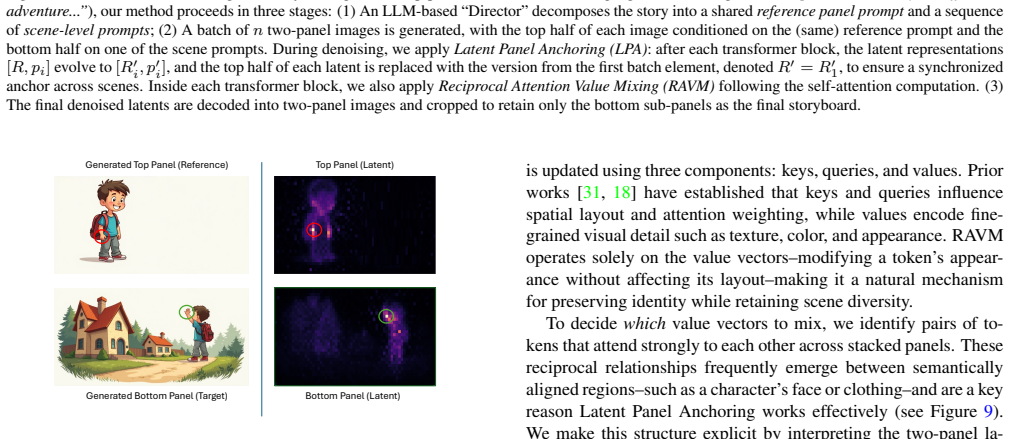
The central object is the reciprocal attention matrix M, computed as the elementwise minimum of the bottom-to-top and transposed top-to-bottom cross-panel attention blocks, M := min(A_bt, A_tb^T). It scores how strongly each reference token and scene token attend to each other in both directions, so high-scoring pairs are treated as semantically corresponding features such as a face, hand, or clothing. The selection step applies Otsu thresholding to M and, for each chosen scene token, finds the reference token with the highest reciprocal score, then applies the value update V'_v = λ V_v + (1 - λ) V_{u*}. Because only value vectors change while keys and queries stay untouched, the mechanism c
What would settle it
Render a two-panel storyboard in which the character's face is small and the background contains a strongly textured object of similar color; if the reciprocal-attention argmax for the face lands on the background object, value mixing will smear background texture onto the character, and the output will show it. A focused test: take 50 panels with large pose changes, annotate the true face and hand correspondences, and measure how often the argmax of the reciprocal attention matrix selects the annotated token; if agreement is no better than chance on pose-variant panels, the mechanism's premis
Extended reading notes
Core claim
On its own terms, the core discovery is that reciprocal attention between stacked reference and scene panels is a reliable token-level correspondence signal, and that mixing value vectors along those correspondences reinforces identity without disturbing layout. The pipeline renders n two-panel latent grids, each with the same reference prompt on top and a scene prompt below; after each transformer block the top latents are overwritten with the first batch element's top latent, and inside each block cross-panel attention maps are thresholded with Otsu's method to select strongly mutually attending token pairs whose value vectors are blended with weight λ=0.5. The paper claims this yields a b
Load-bearing premise
The method assumes that when two tokens in the reference and scene panels pay strong mutual attention, those tokens really are the same visual feature, such as a face or a hand, so that blending their value vectors carries identity rather than noise.
Editorial extensions
If this is right
- Any diffusion-transformer image model can be turned into a storyboard generator with inference-time code only, without new training runs, adapters, or architecture edits.
- Storyboards can vary character scale, pose, and framing across panels while keeping identity, so narrative beats like “dwarfed by a tower” or “the character is absent” become representable.
- The reciprocal-attention signal is likely reusable for other value-only editing tasks where layout must be frozen, such as style transfer, object swapping, or multi-view consistency.
- The Scene Diversity metric gives a quantitative axis for layout and pose variation that identity-focused benchmarks miss, enabling future methods to be compared on expressiveness rather than only fidelity.
Reading between the lines
- Editorial inference: the correspondence assumption is directly testable—perturb the reference panel (change hair color, remove an object) and measure whether value mixing propagates that change to the same semantic region in the scene panel; if it does, the correspondences are semantic, not merely textural.
- Editorial inference: because the paper's acknowledged failure mode is attention entanglement in the base model, a natural extension is to gate value mixing with an entanglement detector (for example, where mutual attention is high but key-cluster separation is low), turning the method from a propagator into a corrector of misassigned features.
- Editorial inference: the Flux baseline's high consistency score from near-identical frames suggests that DreamSim alone rewards repetition; a paired metric that divides consistency by scene diversity would sharpen the benchmark's conclusions and better match the paper's own narrative goals.
Editorial analysis
A structured set of objections, weighed in public.
Referee Report
Summary. The paper proposes Story2Board, a training-free storyboard generation framework for DiT-based text-to-image models such as Flux. Given a natural-language story, an off-the-shelf LLM decomposes it into a shared reference prompt and per-panel scene prompts. The method then generates a batch of stacked reference/target latent grids, synchronizes the reference latents across panels (Latent Panel Anchoring, LPA), and mixes value vectors for token pairs with strong reciprocal attention across the two panels (Reciprocal Attention Value Mixing, RAVM). The authors also introduce the Rich Storyboard Benchmark (100 open-domain stories) and a Scene Diversity metric based on bounding-box and pose variation. The paper reports qualitative comparisons, scatter-plot quantitative results for consistency/alignment/diversity, a DS-500 generalization table, and a Mechanical Turk user study. The claimed contribution is a training-free mechanism that improves inter-panel coherence and narrative expressiveness without changing the base model's architecture or weights.
Significance. If the empirical claims hold, the method is practically significant: it is training-free, compatible with state-of-the-art DiT models, and addresses a real gap in storyboard generation—maintaining character identity while allowing compositional diversity, background evolution, and narrative pacing. The proposed benchmark and Scene Diversity metric target an understudied evaluation axis, and the user study (100 stories, 500 pairwise tasks, 3 judgments per task) is a meaningful independent signal. The authors are also transparent about attention entanglement limitations in Section 4.6. However, the central empirical support is currently weakened by the absence of numerical values and error bars in the main quantitative results, an incomplete and protocol-mismatched DS-500 comparison, and an unresolved tension between the proposed Scene Diversity metric and the user-study outcome. These issues prevent the paper from supporting the abstract's broad claim of state-of-the-art storyboard generation.
major comments (5)
- [Section 4.4, Table A.1] The DS-500 generalization claim is not supported by the presented evidence. Table A.1 compares Story2Board only against DreamStory, and the DreamStory scores are quoted from the original DreamStory paper rather than recomputed under identical conditions (same prompts, LLM decomposition, seeds, sampling parameters, and preprocessing). The main baselines from the paper's own evaluation—StoryDiffusion, IC-LoRA variants, and OminiControl—are absent from the DS-500 table. Without a unified evaluation protocol, the reported DreamSim difference (0.7018 vs. 0.6714) cannot be interpreted. Please either run all baselines on DS-500 under a controlled protocol or explicitly scope the claim to the authors' own benchmark.
- [Section 4.4, Figure 6] The quantitative results are presented only as scatter plots with no numeric means, no error bars, and no confidence intervals. The claim that Story2Board 'dominates the Pareto front' in prompt alignment and character consistency, and that it achieves 'significantly more layout variation' than competing methods, cannot be assessed without knowing the variance across the 100 benchmark stories. Report per-metric means and standard deviations (or CIs) and, where appropriate, statistical significance tests for the pairwise comparisons between methods.
- [Section 4.5 vs. Section A.2, Figure 6] There is a direct conflict between the proposed Scene Diversity metric and the user study. Section 4.5 states that OminiControl outperforms Story2Board on human-judged 'scene diversity,' while Figure 6 (right) reports that Story2Board achieves substantially higher Scene Diversity than all competing methods. Since the metric in Section A.2 is computed from bounding-box standard deviation and pose variance—i.e., it directly rewards the layout variation that RAVM is designed to preserve—the metric risks being circular and, in any case, is not validated against human judgments. Please validate the metric against the user-study data, report both the metric and the human preference numbers, and reconcile the discrepancy. If the metric and the human notion of scene diversity diverge, the metric's name and claims should be revised.
- [Section 3.2, Eq. (7)] The statement that RAVM preserves spatial layout 'since keys and queries remain unchanged' is not strictly correct. In a transformer block, modifying value vectors changes the layer output, which—after residual connections and normalization—becomes the input to the next block. The keys and queries of subsequent layers are therefore computed from altered representations, so spatial layout and attention dynamics can change across the denoising trajectory. The invariance may hold approximately or per-layer, but it does not follow from the equation as written. Please clarify the scope of the claim and provide an analysis or ablation showing that attention maps and spatial layouts are not materially altered over the full 28-step denoising process.
- [Section 4.1 / 4.2] The comparison protocol for baselines is underspecified. It is unclear whether StoryDiffusion, IC-LoRA, OminiControl, and StoryGen all receive the same LLM-decomposed scene prompts, the same reference/conditioning images, and the same 4- or 7-panel formats. Since the LLM decomposition and reference-panel selection are part of the proposed pipeline, differences in input prompts or reference selection across methods can dominate method effects. Please document the exact inputs, settings, and any per-method adaptations used in the comparison, and ideally release the exact prompt and conditioning setup for reproducibility.
minor comments (5)
- [Figure 8 caption] The caption refers to 'Mutual Attention (MA)', but the method is called 'Reciprocal Attention Value Mixing (RAVM)' in the text. Unify the terminology to avoid confusion.
- [Section 4.4 and Table A.1] The DS-500 dataset is cited inconsistently: Section 4.4 cites it as [12], while Table A.1 and Appendix A.4 cite DreamStory's scores as [13]. The reference numbering should be corrected and verified.
- [Figure 6] Axes labels and legends are missing numeric scale values in the PDF version; please add clear axis labels, point markers, and a legend that distinguishes baselines from ablations.
- [Section 4.5 / A.5] The user study reports aggregate win rates but no confidence intervals, inter-annotator agreement, or significance tests. With 3 workers per comparison and 20 stories per baseline, the differences may be within noise. Reporting Wilson intervals or a simple significance test would strengthen the claims.
- [Section 3.2, Eq. (7)] The paper describes a 'soft value update' for selected bottom tokens, but Figure 4 visualizes reciprocal attention for both top and bottom tokens. Clarify why only the bottom (target) panel tokens are updated and whether symmetric updates were considered.
Circularity Check
No significant circularity: the consistency mechanisms are implemented interventions, the evaluation metric is not fitted to the method, and self-citations are background only.
full rationale
The core derivation (Sections 3.1–3.2) is an algorithmic intervention on value vectors using reciprocal attention scores; it does not define its output in terms of its input, fit a parameter to the target metric, or invoke a uniqueness theorem. LPA/RAVM are implemented at inference time on Flux and can fail (Section 4.6), which shows the mechanism is not tautologically successful. The Scene Diversity metric is a new evaluation instrument, but no parameter of the method is fitted to it and the method does not optimize it; using a purpose-designed metric is a validity concern, not a circular reduction. Self-citations [3,4] are used only as background for attention behavior and related work, not as the load-bearing justification. The DS-500 comparison quotes DreamStory's scores from its own paper (Table A.1), and the paper explicitly discloses this; that is an experimental comparability limitation, not a circularity. No step in the paper exhibits a reduction of a predicted quantity to a fitted input or to a self-citation chain.
Assumptions & free parameters
free parameters (2)
- Mixing weight lambda =
0.5
- Exponential moving average momentum =
0.8
assumptions (5)
- domain assumption Keys and queries encode spatial layout, while value vectors encode appearance details
- domain assumption Reciprocal attention scores (min of bidirectional attention) identify semantically aligned token pairs across panels
- domain assumption Overwriting top-half latents with the first batch item's top latent provides a valid shared reference for all panels
- domain assumption GPT-4o decomposes arbitrary stories into a reference prompt and grounded scene prompts
- ad hoc to paper The Rich Storyboard Benchmark and Scene Diversity metric measure narrative expressiveness as intended
Cite this review
Pith. "Pith review of Story2Board: A Training-Free Approach for Expressive Storyboard Generation." pith.science (2026). https://pith.science/paper/FT4VIPNW
@misc{pith2026250809983,
  author       = {Pith},
  title        = {Pith review of: Story2Board: A Training-Free Approach for Expressive Storyboard Generation},
  year         = {2026},
  howpublished = {\url{https://pith.science/paper/FT4VIPNW}},
  note         = {Machine review of arXiv:2508.09983}
}
read the original abstract
We present Story2Board, a training-free framework for expressive storyboard generation from natural language. Existing methods narrowly focus on subject identity, overlooking key aspects of visual storytelling such as spatial composition, background evolution, and narrative pacing. To address this, we introduce a lightweight consistency framework composed of two components: Latent Panel Anchoring, which preserves a shared character reference across panels, and Reciprocal Attention Value Mixing, which softly blends visual features between token pairs with strong reciprocal attention. Together, these mechanisms enhance coherence without architectural changes or fine-tuning, enabling state-of-the-art diffusion models to generate visually diverse yet consistent storyboards. To structure generation, we use an off-the-shelf language model to convert free-form stories into grounded panel-level prompts. To evaluate, we propose the Rich Storyboard Benchmark, a suite of open-domain narratives designed to assess layout diversity and background-grounded storytelling, in addition to consistency. We also introduce a new Scene Diversity metric that quantifies spatial and pose variation across storyboards. Our qualitative and quantitative results, as well as a user study, show that Story2Board produces more dynamic, coherent, and narratively engaging storyboards than existing baselines.
Figures


Figures from the paper (9 more)


Forward citations
Cited by 8 Pith papers
-
KathaTrace: Diagnosing Semantic Trajectory Collapse in Generated Visual Narratives
Introduces KathaTrace protocol and KathaBench-25K benchmark to quantify Semantic Trajectory Gap (STG) as the loss of transition meaning in visualized narratives, reporting STG of 23.5 +/- 1.3 across generators.
-
Can Image Models Imagine Time? ImageTime: A Novel Benchmark for Probing Visual World Modeling Through Spatiotemporal Consistency
ImageTime is a benchmark that probes image generation models' visual world modeling by requiring coherent four-state sequences in single images, scored via VLM judge.
-
Investigating Social Bias in Narrative Image Generation
Across six text-to-image models, stereotyped outputs rise from 25.9% of single photos to about 36% of storyboards and 44% of four-panel comics, with bias expressed through plot, character placement, and dialogue.
-
DynaVieW: Schema-Guided World Modeling for Understanding Hierarchical Visual Dynamics
Schema-guided interleaved state-transition pretraining with selective attention and reweighted loss improves hierarchical visual dynamics modeling for narrative generation and world simulation.
-
DreamShot: Personalized Storyboard Synthesis with Video Diffusion Prior
DreamShot uses video diffusion priors and a role-attention consistency loss to produce coherent, personalized storyboards with better character and scene continuity than text-to-image methods.
-
StoryBlender: Inter-Shot Consistent and Editable 3D Storyboard with Spatial-temporal Dynamics
StoryBlender generates inter-shot consistent editable 3D storyboards using a three-stage pipeline of semantic-spatial grounding, canonical asset materialization, and spatial-temporal dynamics with agent-based verification.
-
ETPDesigner: Multi-Agent Orchestration for Interactive Multimodal Electronic Theater Program
ETPDesigner automatically generates multi-page electronic theater programs from scripts using a multi-agent LLM pipeline with a global style anchor and interactive character chat.
-
DreamShot: Personalized Storyboard Synthesis with Video Diffusion Prior
DreamShot generates controllable multi-shot storyboards from text or character references by exploiting video diffusion priors and a Role-Attention Consistency Loss.
Reference graph
Works this paper leans on
-
[12]
Dreamstory: Open-domain story visualiza- tion by llm-guided multi-subject consistent diffusion
Huiguo He, Huan Yang, Zixi Tuo, Yuan Zhou, Qiuyue Wang, Yuhang Zhang, Zeyu Liu, Wenhao Huang, Hongyang Chao, and Jian Yin. Dreamstory: Open-domain story visualiza- tion by llm-guided multi-subject consistent diffusion. arXiv preprint arXiv:2407.12899, 2024
arXiv 2024
-
[13]
Anystory: Towards unified single and multiple subject personalization in text-to-image generation
Junjie He, Yuxiang Tuo, Binghui Chen, Chongyang Zhong, Yifeng Geng, and Liefeng Bo. Anystory: Towards unified single and multiple subject personalization in text-to-image generation. arXiv preprint arXiv:2501.09503, 2025
arXiv 2025
-
[1]
Amazon Mechanical Turk. Amazon mechanical turk. https://www.mturk.com/, 2025. Accessed: 2025-05- 20
work page 2025
-
[2]
Animator Island. Composition: What is breathing room? https://www.animatorisland.com/ composition-what-is-breathing-room/ , 2014. Accessed: 2025-05-12
work page 2014
-
[3]
Diffuhaul: A training-free method for object dragging in images
Omri Avrahami, Rinon Gal, Gal Chechik, Ohad Fried, Dani Lischinski, Arash Vahdat, and Weili Nie. Diffuhaul: A training-free method for object dragging in images. In SIG- GRAPH Asia 2024 Conference Papers , SA ’24, New York, NY , USA, 2024. Association for Computing Machinery
work page 2024
-
[4]
The chosen one: Consistent characters in text- to-image diffusion models
Omri Avrahami, Amir Hertz, Yael Vinker, Moab Arar, Shlomi Fruchter, Ohad Fried, Daniel Cohen-Or, and Dani Lischinski. The chosen one: Consistent characters in text- to-image diffusion models. In ACM SIGGRAPH 2024 Con- ference Papers, SIGGRAPH ’24, New York, NY , USA, 2024. Association for Computing Machinery
work page 2024
-
[5]
Black Forest Labs. Flux. https://github.com/ black-forest-labs/flux, 2024
2024
-
[6]
The Visual Story: Creating the Visual Struc- ture of Film, TV , and Digital Media
Bruce Block. The Visual Story: Creating the Visual Struc- ture of Film, TV , and Digital Media. Focal Press, 3rd edition, 2020
work page 2020
Show all 49 references
-
[7]
Be yourself: Bounded attention for multi-subject text-to-image generation
Omer Dahary, Or Patashnik, Kfir Aberman, and Daniel Cohen-Or. Be yourself: Bounded attention for multi-subject text-to-image generation. In European Conference on Com- puter Vision, pages 432–448. Springer, 2024
2024
-
[8]
Patrick Esser, Sumith Kulal, A. Blattmann, Rahim Entezari, Jonas Muller, Harry Saini, Yam Levi, Dominik Lorenz, Axel Sauer, Frederic Boesel, Dustin Podell, Tim Dockhorn, Zion English, Kyle Lacey, Alex Goodwin, Yannik Marek, and Robin Rombach. Scaling rectified flow transformer...
2024 arXiv
-
[9]
Negative space: Film composition guide
Filmmakers Academy. Negative space: Film composition guide. https://www.filmmakersacademy.com/ blog-negative-space-film/ , 2025. Accessed: 2025-05-12
2025
-
[10]
Tamir, Shobhita Sundaram, Lucy Chai, Richard Zhang, Tali Dekel, and Phillip Isola
Stephanie Fu, Netanel Y . Tamir, Shobhita Sundaram, Lucy Chai, Richard Zhang, Tali Dekel, and Phillip Isola. Dream- sim: Learning new dimensions of human visual similarity us- ing synthetic data. ArXiv, abs/2306.09344, 2023
2023 arXiv
-
[11]
Tokenflow: Consistent diffusion features for consistent video editing
Michal Geyer, Omer Bar-Tal, Shai Bagon, and Tali Dekel. Tokenflow: Consistent diffusion features for consistent video editing. arXiv preprint arXiv:2307.10373, 2023
2023 arXiv
-
[14]
Denoising diffu- sion probabilistic models
Jonathan Ho, Ajay Jain, and Pieter Abbeel. Denoising diffu- sion probabilistic models. In Proc. NeurIPS, 2020
2020
-
[15]
In-context lora for diffusion transformers
Lianghua Huang, Wei Wang, Zhigang Wu, Yupeng Shi, Huanzhang Dou, Chen Liang, Yutong Feng, Yu Liu, and Jin- gren Zhou. In-context lora for diffusion transformers. ArXiv, abs/2410.23775, 2024
2024 arXiv
-
[16]
OpenCLIP, July 2021
Gabriel Ilharco, Mitchell Wortsman, Ross Wightman, Cade Gordon, Nicholas Carlini, Rohan Taori, Achal Dave, Vaishaal Shankar, Hongseok Namkoong, John Miller, Hannaneh Ha- jishirzi, Ali Farhadi, and Ludwig Schmidt. OpenCLIP, July 2021
2021
-
[17]
Berg, Wan-Yen Lo, Piotr Doll´ar, and Ross Girshick
Alexander Kirillov, Eric Mintun, Nikhila Ravi, Hanzi Mao, Chloe Rolland, Laura Gustafson, Tete Xiao, Spencer White- head, Alexander C. Berg, Wan-Yen Lo, Piotr Doll´ar, and Ross Girshick. Segment anything, 2023
2023
-
[18]
Multi-concept customization of text- to-image diffusion
Nupur Kumari, Bingliang Zhang, Richard Zhang, Eli Shecht- man, and Jun-Yan Zhu. Multi-concept customization of text- to-image diffusion. In Proceedings of the IEEE/CVF Con- ference on Computer Vision and Pattern Recognition , pages 1931–1941, 2023
1931
-
[19]
Evaluating text-to-visual generation with image-to-text gen- eration
Zhiqiu Lin, Deepak Pathak, Baiqi Li, Jiayao Li, Xide Xia, Graham Neubig, Pengchuan Zhang, and Deva Ramanan. Evaluating text-to-visual generation with image-to-text gen- eration. In European Conference on Computer Vision, 2024
2024
-
[20]
Intelligent grimm – open-ended visual storytelling via latent diffusion models, 2024
Chang Liu, Haoning Wu, Yujie Zhong, Xiaoyun Zhang, Yan- feng Wang, and Weidi Xie. Intelligent grimm – open-ended visual storytelling via latent diffusion models, 2024
2024
-
[21]
Video-p2p: Video editing with cross-attention control
Shaoteng Liu, Yuechen Zhang, Wenbo Li, Zhe Lin, and Jiaya Jia. Video-p2p: Video editing with cross-attention control. arXiv preprint arXiv:2303.04761, 2023
2023 arXiv
-
[22]
OpenAI, Josh Achiam, Steven Adler, Sandhini Agarwal, Lama Ahmad, Ilge Akkaya, Florencia Leoni Aleman, Diogo Almeida, Janko Altenschmidt, Sam Altman, Shyamal Anad- kat, Red Avila, Igor Babuschkin, Suchir Balaji, Valerie Bal- com, Paul Baltescu, Haiming Bao, Mohammad Bavarian, J...
2024
-
[23]
Maxime Oquab, Timoth ´ee Darcet, Th´eo Moutakanni, Huy Q. V o, Marc Szafraniec, Vasil Khalidov, Pierre Fernandez, Daniel Haziza, Francisco Massa, Alaaeldin El-Nouby, Mah- moud Assran, Nicolas Ballas, Wojciech Galuba, Russ Howes, Po-Yao (Bernie) Huang, Shang-Wen Li, Ishan Misra...
2023 arXiv
-
[24]
A threshold selection method from gray- level histograms
Nobuyuki Otsu et al. A threshold selection method from gray- level histograms. Automatica, 11(285-296):23–27, 1975
1975
-
[25]
Blattmann, Tim Dockhorn, Jonas Muller, Joe Penna, and Robin Rombach
Dustin Podell, Zion English, Kyle Lacey, A. Blattmann, Tim Dockhorn, Jonas Muller, Joe Penna, and Robin Rombach. SDXL: Improving latent diffusion models for high-resolution image synthesis. ArXiv, abs/2307.01952, 2023
2023 arXiv
-
[26]
Hierarchical text-conditional image gener- ation with CLIP latents
Aditya Ramesh, Prafulla Dhariwal, Alex Nichol, Casey Chu, and Mark Chen. Hierarchical text-conditional image gener- ation with CLIP latents. arXiv preprint arXiv:2204.06125 , 2022
2022 arXiv
-
[27]
Blattmann, Dominik Lorenz, Patrick Esser, and Bj ¨orn Ommer
Robin Rombach, A. Blattmann, Dominik Lorenz, Patrick Esser, and Bj ¨orn Ommer. High-resolution image synthesis with latent diffusion models. 2022 IEEE/CVF Conference on Computer Vision and Pattern Recognition (CVPR) , pages 10674–10685, 2021
2022
-
[28]
Photorealistic text-to-image diffusion models with deep lan- guage understanding
Chitwan Saharia, William Chan, Saurabh Saxena, Lala Li, Jay Whang, Emily L Denton, Kamyar Ghasemipour, Raphael Gontijo Lopes, Burcu Karagol Ayan, Tim Salimans, et al. Photorealistic text-to-image diffusion models with deep lan- guage understanding. Advances in Neural Informati...
2022
-
[29]
Stable diffusion 3: Next-generation text-to- image generation
Stability AI. Stable diffusion 3: Next-generation text-to- image generation. urlhttps://stability.ai/news/stable-diffusion-3, 2024
2024
-
[30]
Ominicontrol: Minimal and uni- versal control for diffusion transformer
Zhenxiong Tan, Songhua Liu, Xingyi Yang, Qiaochu Xue, and Xinchao Wang. Ominicontrol: Minimal and uni- versal control for diffusion transformer. arXiv preprint arXiv:2411.15098, 2024
2024 arXiv
-
[31]
Key-locked rank one editing for text-to-image personaliza- tion
Yoad Tewel, Rinon Gal, Gal Chechik, and Yuval Atzmon. Key-locked rank one editing for text-to-image personaliza- tion. In ACM SIGGRAPH 2023 Conference Proceedings , SIGGRAPH ’23, 2023
2023
-
[32]
Training-free consis- tent text-to-image generation
Yoad Tewel, Omri Kaduri, Rinon Gal, Yoni Kasten, Lior Wolf, Gal Chechik, and Yuval Atzmon. Training-free consis- tent text-to-image generation. ACM Transactions on Graph- ics (TOG), 43(4):1–18, 2024
2024
-
[33]
Training-free consis- tent text-to-image generation
Yoad Tewel, Omri Kaduri, Rinon Gal, Yoni Kasten, Lior Wolf, Gal Chechik, and Yuval Atzmon. Training-free consis- tent text-to-image generation. ArXiv, abs/2402.03286, 2024
2024 arXiv
-
[34]
Plug-and-play diffusion features for text-driven image-to- image translation
Narek Tumanyan, Michal Geyer, Shai Bagon, and Tali Dekel. Plug-and-play diffusion features for text-driven image-to- image translation. In Proceedings of the IEEE/CVF Con- ference on Computer Vision and Pattern Recognition , pages 1921–1930, 2023
1921
-
[35]
Attention is all you need
Ashish Vaswani, Noam Shazeer, Niki Parmar, Jakob Uszko- reit, Llion Jones, Aidan N Gomez, Łukasz Kaiser, and Illia Polosukhin. Attention is all you need. Advances in neural information processing systems, 30, 2017
2017
-
[36]
ELITE: Encoding visual con- cepts into textual embeddings for customized text-to-image generation
Yuxiang Wei, Yabo Zhang, Zhilong Ji, Jinfeng Bai, Lei Zhang, and Wangmeng Zuo. ELITE: Encoding visual con- cepts into textual embeddings for customized text-to-image generation. ArXiv, abs/2302.13848, 2023
2023 arXiv
-
[37]
Seed-story: Multimodal long story generation with large language model
Shuai Yang, Yuying Ge, Yang Li, Yukang Chen, Yixiao Ge, Ying Shan, and Yingcong Chen. Seed-story: Multimodal long story generation with large language model. arXiv preprint arXiv:2407.08683, 2024
2024 arXiv
-
[38]
IP- Adapter: Text compatible image prompt adapter for text-to- image diffusion models
Hu Ye, Jun Zhang, Sibo Liu, Xiao Han, and Wei Yang. IP- Adapter: Text compatible image prompt adapter for text-to- image diffusion models. arXiv, abs/2308.06721, 2023
2023 arXiv
-
[39]
Magicbrush: A manually annotated dataset for instruction- guided image editing
Kai Zhang, Lingbo Mo, Wenhu Chen, Huan Sun, and Yu Su. Magicbrush: A manually annotated dataset for instruction- guided image editing. In Advances in Neural Information Processing Systems, 2023. 12
2023
-
[40]
Storydiffusion: Consistent self- attention for long-range image and video generation
Yupeng Zhou, Daquan Zhou, Ming-Ming Cheng, Jiashi Feng, and Qibin Hou. Storydiffusion: Consistent self- attention for long-range image and video generation. ArXiv, abs/2405.01434, 2024. 13 A Appendix A.1 Rich Storyboard Benchmark To evaluate expressive visual storytelling, we ...
2024 arXiv
-
[41]
A lone sailor in a wool cap and dark coat standing calmly at the bow of a wooden ship in golden morning fog
-
[42]
A lone sailor in a wool cap and dark coat sitting on a crate beneath coiled ropes as gulls circle overhead
-
[43]
A lone sailor in a wool cap and dark coat gazing at the open sea, with lanterns swaying gently from the rigging
-
[44]
A lone sailor in a wool cap and dark coat standing on the deck smiling as the ship approaches a massive arch of stone rising from the water
-
[45]
A lone sailor in a wool cap and dark coat resting beside the ship’s steering wheel, moonlight shimmering on the sea
-
[46]
A lone sailor in a wool cap and dark coat guiding the ship through towering jade waves as bioluminescent whales breach alongside
-
[47]
The Rich Storyboard Benchmark allows us to systematically test a model’s ability to maintain identity while navigating scene transitions and visual storytelling demands
A lone sailor in a wool cap and dark coat playing a low whis- tle tune on the bow beneath a sky ablaze with meteoric shards This structured prompt ensures that GPT-4o generates visually grounded, narratively coherent storyboards–each with a central character, evolving setting,...
-
[48]
Character Consistency
-
[49]
Overall Preference
Scene Diversity To ensure consistent comparison coverage across baselines, we divided the 100 stories into five disjoint groups of 20 stories. Each group was assigned to a different baseline, resulting in one set of storyboards per competitor for evaluation against Story2Board...
Reviewed August 5, 2026 · model on record in the stance chip above.
Discussion (0). Sign in to comment.