REVIEW 4 major objections 5 minor 182 references
The paper claims that perturbing SAE-identified hidden features in prompts can raise jailbreak success to 95 percent against a 32-billion-parameter aligned model.
Reviewed by Pith at T0; open to challenge. T0 means a machine referee read the full paper against a public rubric. the ladder, T0–T4 →
Sparse autoencoder activation perturbation (SFPF) applied on top of existing jailbreak prompts raises attack success rate on Qwen3-32B, but with no defense evaluation and weak reproducibility.
T0 review reviewed 2026-08-05 challenge →
load-bearing objection Plausible new SAE-based attack pipeline, but the abstract's defense-bypass claim is untested; treat as a method proposal until it confronts real defenses. the 4 major comments →
Layer-Wise Perturbations via Sparse Autoencoders for Adversarial Text Generation
The pith
A machine-rendered reading of the paper's core claim, the machinery that carries it, and where it could break.
The reading
Core claim
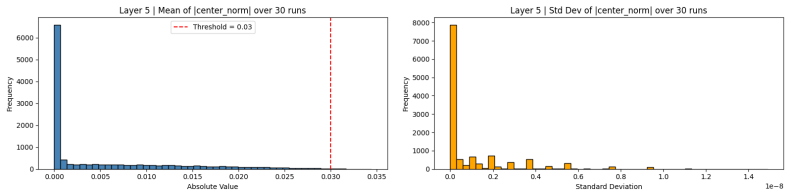
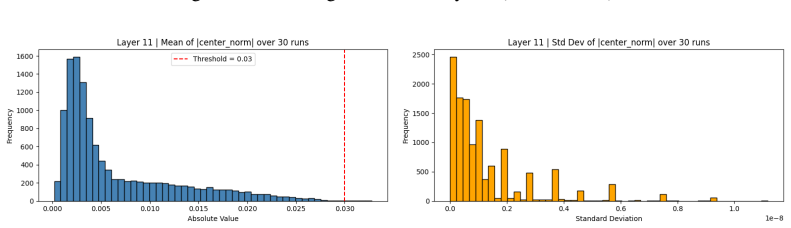
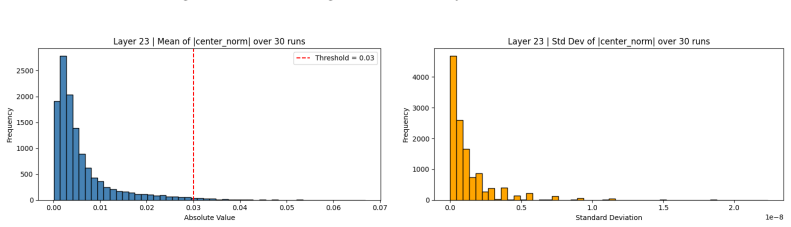
SFPF identifies dangerous dimensions in SAE latent space by averaging the SAE encodings of prompts that already elicited unsafe completions, normalizing the resulting centroid, and thresholding it to obtain a binary mask ($\tau = 0.03$). During inference a forward hook perturbs the MLP hidden state as $z' = z + \alpha m$ with $\alpha = 0.3$, decodes the modified state through the SAE decoder, and reconstructs a prompt token-by-token by cosine similarity between the perturbed hidden vectors and token embeddings, using either a top-1 or top-10 semantic search. On AdvBench and HarmBench this pipeline lifts the attack success rate of an adaptive baseline from 0.77 to 0.95 and of DRA from 0.73 to
What carries the argument
The central object is the danger mask $m \in \{0,1\}^d$, built from the $\ell_2$-normalized centroid $\tilde{c} = c/\|c\|_2$ of SAE encodings of successful attack prompts, thresholded dimension-wise by $\tau$. A forward hook adds $\alpha m$ to the SAE-encoded hidden state at a chosen MLP layer, and the perturbed state is decoded back through the SAE and mapped to tokens by embedding similarity search. The mask and the injection hook carry the argument: they translate a statistical feature of past successful attacks into a targeted activation shift that is claimed to transfer across models.
Load-bearing premise
The method assumes the hidden feature direction found in one chat model's internal representations reappears in a different, larger model's representations, and that the reconstructed wording still conveys the original harmful request; if either part fails, the reported gains vanish.
What would settle it
Replace the centroid-derived binary mask with a random binary mask of the same density at the same layer; if ASR on the validation set does not drop substantially, the clustering-derived mask carries no information and the observed effect is due to perturbing hidden states at scale or to the embedding-search decoding, not to targeted feature selection. Alternatively, feed the reconstructed prompts to the target model with the mask direction flipped; if ASR remains high, the specific chosen features are not the causal driver.
If this is right
- If SFPF is correct, SAE-derived features of successful attacks can be plugged into existing jailbreak methods to boost their success rates: DRA rises from 0.73 to 0.79 ASR and Adaptive from 0.77 to 0.95.
- The method works without token-level optimization or access to target weights, suggesting hidden-state steering is a viable black-box attack avenue.
- Middle layers (around layer 17) are far more effective perturbation targets than lower layers, with layers 9, 11, and 17 showing consistently adversarial-sensitive activation patterns.
- Reconstructed prompts remain recognizable enough to preserve intent, with semantic similarity 0.46 for Adaptive+SFPF, even when the surface text is partially corrupted.
- The paper's own limitation statements concede that effectiveness varies across prompts and layers and that generalizability to other architectures and larger scales is not yet shown.
Where Pith is reading between the lines
- The high ASR achieved with visibly corrupted reconstructed text hints that safety-aligned models may respond to specific latent directions regardless of surface token form, which could be tested by measuring whether even fixed random directions of similar magnitude trigger refusals.
- If masks are stable across random seeds and training runs, the centroid direction could be treated as an interpretable safety feature; that same direction could be used for defense, e.g., by subtracting the mask from activations to harden models.
- The cross-model transfer (Llama-2-7b to Qwen3-32B) suggests shared feature directions across architectures; a natural extension is to test whether masks computed from one model family generalize to non-overlapping tokenizers and training data.
- The paper's binary-threshold masking could be replaced by a continuous or learned mask; comparing ASR and semantic similarity against such variants would clarify how much of the effect comes from the specific thresholded features versus the mere injection of extra activation energy.
Editorial analysis
A structured set of objections, weighed in public.
Referee Report
Summary. The paper proposes SFPF, a black-box jailbreak method. Sparse autoencoders are trained on Llama-2-7b-chat hidden states; a binary 'danger mask' is computed from the mean SAE encoding of successful attack prompts (Eqs. 7-8); hidden states are perturbed (Eqs. 9-10); and prompts are reconstructed by embedding similarity search (Eqs. 11-12). On AdvBench/HarmBench, the paper reports that SFPF raises ASR from 0.10 to 0.29 and that SFPF applied to an Adaptive attack raises ASR from 0.77 to 0.95 on an undefended Qwen3-32B. The abstract and introduction claim that this demonstrates the ability to bypass state-of-the-art defense mechanisms.
Significance. If the results held, the paper would offer a novel red-teaming tool: SAE-derived feature masks could be transferred across model families to amplify existing jailbreak prompts. The SAE equations are standard and clearly written, and the KMeans stability analysis (SD around 1e-8) is a useful sanity check. However, the central claim is not tested, the main quantitative results are in-sample fitted values, and the reconstructed prompts shown in the appendix undercut the claimed text quality. No code or exact hyperparameter settings are provided, which limits reproducibility and falsifiability.
major comments (4)
- [§4.5, Table 1] No defense mechanism is evaluated. ASR is computed via a Claude judge safety score below 0.7 (Section 4.3), which measures whether the response is unsafe, not whether an input filter or defense is bypassed. The abstract and Section 1 claim that SFPF can bypass state-of-the-art defense mechanisms, but the experiments are run on undefended Qwen3-32B with default decoding parameters. No perplexity filter, SmoothLLM, RA-LLM, Llama Guard, or any other defense is instantiated. Table 1 therefore supports only the weaker statement that SFPF increases ASR on an undefended model; the headline claim is unsupported.
- [§4.5, §3.3] Layer 17 was selected after computing ASR on the validation set ('layer 17 had the most significant impact, achieving a 29% ASR on the validation set'). The Table 1 results are therefore in-sample fitted values, not out-of-sample predictions. The mask threshold tau (Eq. 8), perturbation scale alpha (Eq. 9), and sparsity coefficient lambda (Eq. 6) are set empirically, and no sensitivity analysis or cross-validation is reported. ASR is reported as a point estimate without variance or paired significance testing, so the 0.95 vs 0.77 gap is not statistically grounded.
- [§3.5, Appendix A.2] The reconstructed prompts shown in Appendix A.2 are heavily corrupted: repeated fragments, placeholder tokens, and non-word strings, yet they yield coherent harmful responses. This undercuts the claim in Sections 1 and 6 that SFPF maintains high text quality and coherence. BLEU=0.006 and similarity=0.460 for Adaptive+SFPF. The mechanism by which such degenerate prompts produce detailed, topically aligned plans is unexplained; a randomized-perturbation control and human evaluation of prompt quality are needed to rule out judge artifacts or accidental inclusion of the original prompt.
- [§3.3–§3.5] The transferability assumption is untested. The mask is derived from SAEs trained on Llama-2-7b-chat, but the target is Qwen3-32B. The pipeline implies that sparse feature directions identified in one model's MLP activations are meaningful in a different architecture. No experiments use a Qwen3 SAE, no source-model ASR is reported, and no comparison with random masks is given. Without these, the Adaptive+SFPF improvement over Adaptive could be due to prompt-length effects, judge threshold artifacts, or the Adaptive prompt itself, not to the SAE-derived mask.
minor comments (5)
- [§4] Typo: 'Sparse Autodecoder' should be 'Sparse Autoencoder'.
- [§3.3] The text calls KMeans with k=1 'clustering', but Eq. (7) is simply an arithmetic mean. The wording should say averaging, not clustering.
- [§4.4] Training data includes 'proprietary, non-public data' with no details on size, source, or contamination risk. This limits reproducibility and makes the benchmark comparison hard to interpret.
- [§3.2] The footnote about layer indices ('actual layer numbers should have 1 added') is confusing when the list includes layer 31; it is unclear whether pre- or post-embedding layers are intended.
- [Table 1] The baseline row reports BLEU and Similarity as '-', so no text-quality baseline is available. ASR is reported without confidence intervals, and DRA/Adaptive prompt lengths differ by orders of magnitude.
Circularity Check
Layer/threshold/scale are selected on the same validation set that is later reported as the result, and the danger mask is by definition the mean encoding of successful attacks; no defense mechanism is actually evaluated.
specific steps
-
fitted input called prediction
[Section 3.3 (Eq. 8), Section 3.4 (Eq. 9), Section 4.5 (Figure 3), Table 1]
""Here, τ is set empirically (e.g., τ = 0.03) based on the distribution of ˜c’s absolute values. ... where α is a tunable scaling factor (e.g., α = 0.3)." "Experiments revealed that layer 17 had the most significant impact, achieving a 29% ASR on the validation set, the results are shown in figure3.""
The layer index, threshold τ, and scaling α are selected by inspecting the same AdvBench/HarmBench validation ASR that is then presented as the method's performance. After layer 17 is chosen because it gives 29% ASR on the validation set, Table 1 reports that same selected value (and the Adaptive+SFPF value) as the headline result. This is model selection on the evaluation metric, not an out-of-sample prediction; the reported numbers are fitted to the set they are supposed to test.
-
self definitional
[Section 3.3 (Eqs. 7–8) and Section 4.3]
""To identify adversarial-sensitive features, we gather a dataset of known attack prompts with low safety scores and compute their SAE-encoded vectors {z(i)}N i=1. These vectors are clustered using KMeans with k = 1: c = 1/N Σ z(i). ... This mask captures the most salient latent dimensions associated with adversarial behavior." "responses with a safety score <0.7 indicate a successful adversarial jailbreak.""
The danger mask is, by construction, the normalized mean of the SAE encodings of prompts that already have low safety scores, i.e. prompts that already satisfy the same <0.7 criterion later used to define a successful attack. Calling the dimensions selected by this mask 'adversarial-sensitive' and then adding them to new prompts is definitionally moving new prompts toward the average of previously successful attacks; the claim that these features 'preserve malicious intent' and 'increase the potential to evade defenses' is true by construction for the defining set, while genuine transfer to new prompts/models is not separated from this definitional component.
full rationale
The core pipeline—training an SAE on Llama-2 activations, forming a centroid of attack encodings, perturbing hidden states, and reconstructing tokens by embedding search—is concrete and not tautological, and the transfer to Qwen3-32B is an independent empirical test. There is no load-bearing self-citation chain, no imported uniqueness theorem, and no ansatz smuggled in via prior work. However, the evaluation loop is partially circular: the layer, τ, and α are chosen by inspecting ASR on the same AdvBench/HarmBench validation set that later appears as the reported result, so the headline numbers are in-sample selected statistics rather than out-of-sample predictions. In addition, the 'danger mask' is defined as the mean encoding of already-successful attacks, so the asserted causal role of those features is partly definitional. Separately, the abstract's claim of bypassing state-of-the-art defense mechanisms is not supported by the experiments: Section 4.4 targets an undefended Qwen3-32B with no defense filter instantiated, but this is an evidential gap rather than a circularity. Weighing these, the central ASR improvements have independent empirical content but are inflated and partly defined by the evaluation data, giving score 6.
Axiom & Free-Parameter Ledger
free parameters (5)
- tau (mask threshold) =
0.03
- alpha (perturbation scale) =
0.3
- lambda (sparsity coefficient) =
0.0003
- Layer selection =
layer 17
- KMeans runs =
30
axioms (4)
- domain assumption The mean SAE encoding of successful attack prompts defines a transferable danger direction for other prompts and other models.
- domain assumption Cosine similarity between MLP output vectors and token embedding vectors is a valid way to reconstruct a textual prompt.
- domain assumption The judge model (claude-3-7-sonnet) provides reliable and unbiased safety scores.
- standard math Standard autoencoder and clustering mathematics behave as expected on LLM hidden states.
Cite this review
Pith. "Pith review of Layer-Wise Perturbations via Sparse Autoencoders for Adversarial Text Generation." pith.science (2026). https://pith.science/paper/V2LGA2F5
@misc{pith2026250810404,
  author       = {Pith},
  title        = {Pith review of: Layer-Wise Perturbations via Sparse Autoencoders for Adversarial Text Generation},
  year         = {2026},
  howpublished = {\url{https://pith.science/paper/V2LGA2F5}},
  note         = {Machine review of arXiv:2508.10404}
}
read the original abstract
With the rapid proliferation of Natural Language Processing (NLP), especially Large Language Models (LLMs), generating adversarial examples to jailbreak LLMs remains a key challenge for understanding model vulnerabilities and improving robustness. In this context, we propose a new black-box attack method that leverages the interpretability of large models. We introduce the Sparse Feature Perturbation Framework (SFPF), a novel approach for adversarial text generation that utilizes sparse autoencoders to identify and manipulate critical features in text. After using the SAE model to reconstruct hidden layer representations, we perform feature clustering on the successfully attacked texts to identify features with higher activations. These highly activated features are then perturbed to generate new adversarial texts. This selective perturbation preserves the malicious intent while amplifying safety signals, thereby increasing their potential to evade existing defenses. Our method enables a new red-teaming strategy that balances adversarial effectiveness with safety alignment. Experimental results demonstrate that adversarial texts generated by SFPF can bypass state-of-the-art defense mechanisms, revealing persistent vulnerabilities in current NLP systems.However, the method's effectiveness varies across prompts and layers, and its generalizability to other architectures and larger models remains to be validated.
Figures








Reference graph
Works this paper leans on
-
[1]
Feature-level insights into artificial text detection with sparse autoencoders
Kristian Kuznetsov, Laida Kushnareva, Polina Druzhinina, Anton Razzhigaev, Anastasia V oznyuk, Irina Piontkovskaya, Evgeny Burnaev, and Serguei Barannikov. Feature-level insights into artificial text detection with sparse autoencoders. arXiv preprint arXiv:2503.03601, 2025
Pith/arXiv arXiv 2025
-
[2]
Rogov, Elena Tutubalina, and Ivan Oseledets
Andrey Galichin, Alexey Dontsov, Polina Druzhinina, Anton Razzhigaev, Oleg Y . Rogov, Elena Tutubalina, and Ivan Oseledets. I have covered all the bases here: Interpreting reasoning features in large language models via sparse autoencoders. arXiv preprint arXiv:2503.18878, 2025
Pith/arXiv arXiv 2025
-
[3]
Applying sparse autoencoders to unlearn knowledge in language models
Eoin Farrell, Yeu-Tong Lau, and Arthur Conmy. Applying sparse autoencoders to unlearn knowledge in language models. arXiv preprint arXiv:2410.19278, 2024
Pith/arXiv arXiv 2024
-
[4]
Don’t forget it! conditional sparse autoencoder clamping works for unlearning
Matthew Khoriaty, Andrii Shportko, Gustavo Mercier, and Zach Wood-Doughty. Don’t forget it! conditional sparse autoencoder clamping works for unlearning. arXiv preprint arXiv:2503.11127, 2025
Pith/arXiv arXiv 2025
-
[5]
Steering language model refusal with sparse autoencoders
Kyle O’Brien, David Majercak, Xavier Fernandes, Richard Edgar, Jingya Chen, Harsha Nori, Dean Carignan, Eric Horvitz, and Forough Poursabzi-Sangde. Steering language model refusal with sparse autoencoders. arXiv preprint arXiv:2411.11296, 2024
Pith/arXiv arXiv 2024
-
[6]
Scaling monosemanticity: Extracting interpretable features from large language models
Anthropic Team. Scaling monosemanticity: Extracting interpretable features from large language models. 2023. URL: https://transformer-circuits.pub/2023/ monosemantic-features/
2023
-
[7]
Understanding the decisions of large models
Anthropic Team. Understanding the decisions of large models. In Proceedings of the 40th International Conference on Machine Learning, volume PMLR 126, pages 1224–1236, 2023
2023
-
[8]
Improved techniques for optimization-based jailbreaking on large language models
Xiaojun Jia, Tianyu Pang, Chao Du, Yihao Huang, Jindong Gu, Yang Liu, Xiaochun Cao, and Min Lin. Improved techniques for optimization-based jailbreaking on large language models. arXiv preprint arXiv:2405.21018, 2024
Pith/arXiv arXiv 2024
-
[9]
Spml: A dsl for defending language models against prompt attacks
Reshabh K Sharma, Vinayak Gupta, and Dan Grossman. Spml: A dsl for defending language models against prompt attacks. arXiv preprint arXiv:2402.11755, 2024
Pith/arXiv arXiv 2024
-
[10]
Mantas Mazeika, Long Phan, Xuwang Yin, Andy Zou, Zifan Wang, Norman Mu, Elham Sakhaee, Nathaniel Li, Steven Basart, Bo Li, and others. Harmbench: A standardized evalua- tion framework for automated red teaming and robust refusal.arXiv preprint arXiv:2402.04249, 2024
Pith/arXiv arXiv 2024
-
[11]
Zico Kolter, and Matt Fredrikson
Andy Zou, Zifan Wang, Nicholas Carlini, Milad Nasr, J. Zico Kolter, and Matt Fredrikson. Universal and transferable adversarial attacks on aligned language models. arXiv preprint arXiv:2307.15043, 2023
Pith/arXiv arXiv 2023
-
[12]
Adversarial examples are not bugs, they are features
Andrew Ilyas, Shibani Santurkar, Dimitris Tsipras, Logan Engstrom, Brandon Tran, and Aleksander Madry. Adversarial examples are not bugs, they are features. arXiv preprint arXiv:1905.02175, 2019
Pith/arXiv arXiv 1905
-
[13]
Trenton Bricken, Adly Templeton, Joshua Batson, Brian Chen, Adam Jermyn, Tom Conerly, Nicholas L. Turner, Cem Anil, Carson Denison, Amanda Askell, Robert Lasenby, Yifan Wu, Shauna Kravec, Nicholas Schiefer, Tim Maxwell, Nicholas Joseph, Alex Tamkin, Karina Nguyen, Brayden McLean, Josiah E. Burke, Tristan Hume, Shan Carter, Tom Henighan, and Chris Olah. To...
2023
-
[14]
Ddsa: A defense against adversarial attacks using deep denoising sparse autoencoder
Yassine Bakhti, Sid Ahmed Fezza, Wassim Hamidouche, and Olivier Déforges. Ddsa: A defense against adversarial attacks using deep denoising sparse autoencoder. IEEE Access, 7:160397–160407, 2019
2019
-
[15]
Sparse autoencoders enable scalable and reliable circuit identification in language models
Charles O’Neill and Thang Bui. Sparse autoencoders enable scalable and reliable circuit identification in language models. arXiv preprint arXiv:2405.12522, 2024. 11
Pith/arXiv arXiv 2024
-
[16]
Sparse autoencoders find highly interpretable features in language models
Hoagy Cunningham, Aidan Ewart, Logan Riggs, Robert Huben, and Lee Sharkey. Sparse autoencoders find highly interpretable features in language models. arXiv preprint arXiv:2309.08600, 2023
Pith/arXiv arXiv 2023
-
[17]
Scaling and evaluating sparse autoencoders
Leo Gao, Tom Dupré la Tour, Henk Tillman, Gabriel Goh, Rajan Troll, Alec Radford, Ilya Sutskever, Jan Leike, and Jeffrey Wu. Scaling and evaluating sparse autoencoders. arXiv preprint arXiv:2406.04093, 2024
Pith/arXiv arXiv 2024
-
[18]
Route sparse autoencoder to interpret large language models.arXiv preprint arXiv:2503.08200, 2025
Wei Shi, Sihang Li, Tao Liang, Mingyang Wan, Gojun Ma, Xiang Wang, and Xiangnan He. Route sparse autoencoder to interpret large language models.arXiv preprint arXiv:2503.08200, 2025
Pith/arXiv arXiv 2025
-
[19]
Towards principled evaluations of sparse autoencoders for interpretability and control
Aleksandar Makelov, George Lange, and Neel Nanda. Towards principled evaluations of sparse autoencoders for interpretability and control. arXiv preprint arXiv:2405.08366, 2024
Pith/arXiv arXiv 2024
-
[20]
Sparsegan: Sparse generative adversarial network for text generation
Liping Yuan, Jiehang Zeng, and Xiaoqing Zheng. Sparsegan: Sparse generative adversarial network for text generation. arXiv preprint arXiv:2103.00000, 2021
arXiv 2021
-
[21]
Real-time segmentation of on-line handwritten arabic script
George Kour and Raid Saabne. Real-time segmentation of on-line handwritten arabic script. In Frontiers in Handwriting Recognition (ICFHR), 2014 14th International Conference on, pages 417–422. IEEE, 2014
2014
-
[22]
Fast classification of handwritten on-line arabic characters
George Kour and Raid Saabne. Fast classification of handwritten on-line arabic characters. In Soft Computing and Pattern Recognition (SoCPaR), 2014 6th International Conference of, pages 312–318. IEEE, 2014
2014
-
[23]
Guy Hadash, Einat Kermany, Boaz Carmeli, Ofer Lavi, George Kour, and Alon Jacovi. Estimate and replace: A novel approach to integrating deep neural networks with existing applications. arXiv preprint arXiv:1804.09028, 2018
Pith/arXiv arXiv 2018
-
[24]
Boosting jailbreak attack with momentum
Yihao Zhang and Zeming Wei. Boosting jailbreak attack with momentum. arXiv preprint arXiv:2405.01229, 2024
Pith/arXiv arXiv 2024
-
[25]
Efficient llm jailbreak via adaptive dense-to-sparse constrained optimization
Kai Hu, Weichen Yu, Tianjun Yao, Xiang Li, Wenhe Liu, Lijun Yu, Yining Li, Kai Chen, Zhiqiang Shen, and Matt Fredrikson. Efficient llm jailbreak via adaptive dense-to-sparse constrained optimization. arXiv preprint arXiv:2405.09113, 2024
Pith/arXiv arXiv 2024
-
[26]
Simon Geisler, Tom Wollschläger, M. H. I. Abdalla, Johannes Gasteiger, and Stephan Gün- nemann. Attacking large language models with projected gradient descent. arXiv preprint arXiv:2402.09154, 2024
Pith/arXiv arXiv 2024
-
[27]
Autodan: Generating stealthy jailbreak prompts on aligned large language models
Xiaogeng Liu, Nan Xu, Muhao Chen, and Chaowei Xiao. Autodan: Generating stealthy jailbreak prompts on aligned large language models. arXiv preprint arXiv:2310.04451, 2024
Pith/arXiv arXiv 2024
-
[28]
Hijacking large language models via adversarial in-context learning
Yao Qiang, Xiangyu Zhou, and Dongxiao Zhu. Hijacking large language models via adversarial in-context learning. arXiv preprint arXiv:2311.09948, 2024
Pith/arXiv arXiv 2024
-
[29]
Prp: Propagating universal perturbations to attack large language model guard-rails
Neal Mangaokar, Ashish Hooda, Jihye Choi, Shreyas Chandrashekaran, Kassem Fawaz, Somesh Jha, and Atul Prakash. Prp: Propagating universal perturbations to attack large language model guard-rails. arXiv preprint arXiv:2402.15911, 2024
Pith/arXiv arXiv 2024
-
[30]
Asetf: A novel method for jailbreak attack on llms through translate suffix embeddings
Hao Wang, Hao Li, Minlie Huang, and Lei Sha. Asetf: A novel method for jailbreak attack on llms through translate suffix embeddings. arXiv preprint arXiv:2402.16006, 2024
Pith/arXiv arXiv 2024
-
[31]
Automatic and universal prompt injection attacks against large language models
Xiaogeng Liu, Zhiyuan Yu, Yizhe Zhang, Ning Zhang, and Chaowei Xiao. Automatic and universal prompt injection attacks against large language models. arXiv preprint arXiv:2403.04957, 2024
Pith/arXiv arXiv 2024
-
[32]
Improved generation of adversarial examples against safety-aligned llms
Qizhang Li, Yiwen Guo, Wangmeng Zuo, and Hao Chen. Improved generation of adversarial examples against safety-aligned llms. arXiv preprint arXiv:2405.20778, 2024
Pith/arXiv arXiv 2024
-
[33]
Weak-to-strong jailbreaking on large language models
Xuandong Zhao, Xianjun Yang, Tianyu Pang, Chao Du, Lei Li, Yu-Xiang Wang, and William Yang Wang. Weak-to-strong jailbreaking on large language models. arXiv preprint arXiv:2401.17256, 2024. 12
Pith/arXiv arXiv 2024
-
[34]
Analyzing the inher- ent response tendency of llms: Real-world instructions-driven jailbreak
Yanrui Du, Sendong Zhao, Ming Ma, Yuhan Chen, and Bing Qin. Analyzing the inher- ent response tendency of llms: Real-world instructions-driven jailbreak. arXiv preprint arXiv:2312.04127, 2024
Pith/arXiv arXiv 2024
-
[35]
Don’t say no: Jailbreaking llm by suppressing refusal
Yukai Zhou and Wenjie Wang. Don’t say no: Jailbreaking llm by suppressing refusal. arXiv preprint arXiv:2404.16369, 2024
Pith/arXiv arXiv 2024
-
[36]
Lockpicking llms: A logit-based jailbreak using token-level manipulation
Yuxi Li, Yi Liu, Yuekang Li, Ling Shi, Gelei Deng, Shengquan Chen, and Kailong Wang. Lockpicking llms: A logit-based jailbreak using token-level manipulation. arXiv preprint arXiv:2405.13068, 2024
Pith/arXiv arXiv 2024
-
[37]
Make them spill the beans! coercive knowledge extraction from (production) llms
Zhuo Zhang, Guangyu Shen, Guanhong Tao, Siyuan Cheng, and Xiangyu Zhang. Make them spill the beans! coercive knowledge extraction from (production) llms. arXiv preprint arXiv:2312.04782, 2023
Pith/arXiv arXiv 2023
-
[38]
Cold-attack: Jailbreaking llms with stealthiness and controllability
Xingang Guo, Fangxu Yu, Huan Zhang, Lianhui Qin, and Bin Hu. Cold-attack: Jailbreaking llms with stealthiness and controllability. arXiv preprint arXiv:2402.08679, 2024
Pith/arXiv arXiv 2024
-
[39]
Fast adversarial attacks on language models in one gpu minute
Vinu Sankar Sadasivan, Shoumik Saha, Gaurang Sriramanan, Priyatham Kattakinda, Atoosa Chegini, and Soheil Feizi. Fast adversarial attacks on language models in one gpu minute. arXiv preprint arXiv:2402.15570, 2024
Pith/arXiv arXiv 2024
-
[40]
Jailbreaking leading safety-aligned llms with simple adaptive attacks
Maksym Andriushchenko, Francesco Croce, and Nicolas Flammarion. Jailbreaking leading safety-aligned llms with simple adaptive attacks. arXiv preprint arXiv:2404.02151, 2024
Pith/arXiv arXiv 2024
-
[41]
Shadow alignment: The ease of subverting safely-aligned language models
Xianjun Yang, Xiao Wang, Qi Zhang, Linda Petzold, William Yang Wang, Xun Zhao, and Dahua Lin. Shadow alignment: The ease of subverting safely-aligned language models. arXiv preprint arXiv:2310.02949, 2023
Pith/arXiv arXiv 2023
-
[42]
Xiangyu Qi, Yi Zeng, Tinghao Xie, Pin-Yu Chen, Ruoxi Jia, Prateek Mittal, and Peter Henderson. Fine-tuning aligned language models compromises safety, even when users do not intend to! arXiv preprint arXiv:2310.03693, 2023
Pith/arXiv arXiv 2023
-
[43]
Lora fine-tuning efficiently undoes safety training in llama 2-chat 70b
Simon Lermen, Charlie Rogers-Smith, and Jeffrey Ladish. Lora fine-tuning efficiently undoes safety training in llama 2-chat 70b. arXiv preprint arXiv:2310.20624, 2024
Pith/arXiv arXiv 2024
-
[44]
Removing rlhf protections in gpt-4 via fine-tuning
Qiusi Zhan, Richard Fang, Rohan Bindu, Akul Gupta, Tatsunori Hashimoto, and Daniel Kang. Removing rlhf protections in gpt-4 via fine-tuning. arXiv preprint arXiv:2311.05553, 2024
Pith/arXiv arXiv 2024
-
[45]
Learning diverse attacks on large language models for robust red-teaming and safety tuning
Seanie Lee, Minsu Kim, Lynn Cherif, David Dobre, Juho Lee, Sung Ju Hwang, Kenji Kawaguchi, Gauthier Gidel, Yoshua Bengio, Nikolay Malkin, and Moksh Jain. Learning diverse attacks on large language models for robust red-teaming and safety tuning. arXiv preprint arXiv:2405.18540, 2024
Pith/arXiv arXiv 2024
-
[46]
Kellin Pelrine, Mohammad Taufeeque, Michał Zaj ˛ ac, Euan McLean, and Adam Gleave. Exploiting novel gpt-4 apis. arXiv preprint arXiv:2312.14302, 2024
Pith/arXiv arXiv 2024
-
[47]
Vazquez, Ulisse Mini, and Monte MacDiarmid
Alexander Matt Turner, Lisa Thiergart, Gavin Leech, David Udell, Juan J. Vazquez, Ulisse Mini, and Monte MacDiarmid. Steering language models with activation engineering. arXiv preprint arXiv:2308.10248, 2024
Pith/arXiv arXiv 2024
-
[48]
Haoran Wang and Kai Shu. Trojan activation attack: Red-teaming large language models using activation steering for safety-alignment. arXiv preprint arXiv:2311.09433, 2024
Pith/arXiv arXiv 2024
-
[49]
Leo Schwinn, David Dobre, Sophie Xhonneux, Gauthier Gidel, and Stephan Gunnemann. Soft prompt threats: Attacking safety alignment and unlearning in open-source llms through the embedding space. arXiv preprint arXiv:2402.09063, 2024
Pith/arXiv arXiv 2024
-
[50]
Muhammad Ahmed Shah, Roshan Sharma, Hira Dhamyal, Raphael Olivier, Ankit Shah, Joseph Konan, Dareen Alharthi, Hazim T Bukhari, Massa Baali, Soham Deshmukh, Michael Kuhlmann, Bhiksha Raj, and Rita Singh. Loft: Local proxy fine-tuning for improving transfer- ability of adversarial attacks against large language model. arXiv preprint arXiv:2310.04445, 2023. 13
Pith/arXiv arXiv 2023
-
[51]
McCabe, Tanay Wakhare, Yejin Kim, H
Rimon Melamed, Lucas H. McCabe, Tanay Wakhare, Yejin Kim, H. Howie Huang, and Enric Boix-Adsera. Prompts have evil twins. arXiv preprint arXiv:2311.07064, 2024
Pith/arXiv arXiv 2024
-
[52]
Pal: Proxy-guided black-box attack on large language models
Chawin Sitawarin, Norman Mu, David Wagner, and Alexandre Araujo. Pal: Proxy-guided black-box attack on large language models. arXiv preprint arXiv:2402.09674, 2024
Pith/arXiv arXiv 2024
-
[53]
Advprompter: Fast adaptive adversarial prompting for llms
Anselm Paulus, Arman Zharmagambetov, Chuan Guo, Brandon Amos, and Yuandong Tian. Advprompter: Fast adaptive adversarial prompting for llms. arXiv preprint arXiv:2404.16873, 2024
Pith/arXiv arXiv 2024
-
[54]
Uncovering safety risks of large language models through concept activation vector
Zhihao Xu, Ruixuan Huang, Changyu Chen, Shuai Wang, and Xiting Wang. Uncovering safety risks of large language models through concept activation vector. arXiv preprint arXiv:2404.12038, 2024
Pith/arXiv arXiv 2024
-
[55]
arXiv preprint arXiv:2403.16432, 2024
Yue Xu and Wenjie Wang.linkprompt: Natural and universal adversarial attacks on prompt- based language models. arXiv preprint arXiv:2403.16432, 2024
Pith/arXiv arXiv 2024
-
[56]
Zheng-Xin Yong, Cristina Menghini, and Stephen H. Bach. Low-resource languages jailbreak gpt-4. arXiv preprint arXiv:2310.02446, 2024
Pith/arXiv arXiv 2024
-
[57]
Multilingual jailbreak challenges in large language models
Yue Deng, Wenxuan Zhang, Sinno Jialin Pan, and Lidong Bing. Multilingual jailbreak challenges in large language models. arXiv preprint arXiv:2310.06474, 2024
Pith/arXiv arXiv 2024
-
[58]
Cognitive overload: Jailbreaking large language models with overloaded logical thinking
Nan Xu, Fei Wang, Ben Zhou, Bang Zheng Li, Chaowei Xiao, and Muhao Chen. Cognitive overload: Jailbreaking large language models with overloaded logical thinking. arXiv preprint arXiv:2311.09827, 2024
Pith/arXiv arXiv 2024
-
[59]
A cross-language investigation into jailbreak attacks in large language models
Jie Li, Yi Liu, Chongyang Liu, Ling Shi, Xiaoning Ren, Yaowen Zheng, Yang Liu, and Yinxing Xue. A cross-language investigation into jailbreak attacks in large language models. arXiv preprint arXiv:2401.16765, 2024
Pith/arXiv arXiv 2024
-
[60]
Does refusal training in llms generalize to the past tense? arXiv preprint arXiv:2407.11969, 2024
Maksym Andriushchenko and Nicolas Flammarion. Does refusal training in llms generalize to the past tense? arXiv preprint arXiv:2407.11969, 2024
Pith/arXiv arXiv 2024
-
[61]
Patrick Chao, Alexander Robey, Edgar Dobriban, Hamed Hassani, George J. Pappas, and Eric Wong. Jailbreaking black box large language models in twenty queries. arXiv preprint arXiv:2310.08419, 2024
Pith/arXiv arXiv 2024
-
[62]
Tree of attacks: Jailbreaking black-box llms automatically
Anay Mehrotra, Manolis Zampetakis, Paul Kassianik, Blaine Nelson, Hyrum Anderson, Yaron Singer, and Amin Karbasi. Tree of attacks: Jailbreaking black-box llms automatically. arXiv preprint arXiv:2312.02119, 2024
Pith/arXiv arXiv 2024
-
[63]
Distract large language models for automatic jailbreak attack
Zeguan Xiao, Yan Yang, Guanhua Chen, and Yun Chen. Distract large language models for automatic jailbreak attack. arXiv preprint arXiv:2403.08424, 2024
Pith/arXiv arXiv 2024
-
[64]
Gpt-4 jailbreaks itself with near-perfect success using self-explanation
Govind Ramesh, Yao Dou, and Wei Xu. Gpt-4 jailbreaks itself with near-perfect success using self-explanation. arXiv preprint arXiv:2405.13077, 2024
Pith/arXiv arXiv 2024
-
[65]
Yixin Cheng, Markos Georgopoulos, V olkan Cevher, and Grigorios G. Chrysos. Leverag- ing the context through multi-round interactions for jailbreaking attacks. arXiv preprint arXiv:2402.09177, 2024
Pith/arXiv arXiv 2024
-
[66]
Large language models are vulnerable to bait-and-switch attacks for generating harmful content
Federico Bianchi and James Zou. Large language models are vulnerable to bait-and-switch attacks for generating harmful content. arXiv preprint arXiv:2402.13926, 2024
Pith/arXiv arXiv 2024
-
[67]
Foot in the door: Understanding large language model jailbreaking via cognitive psychology
Zhenhua Wang, Wei Xie, Baosheng Wang, Enze Wang, Zhiwen Gui, Shuoyoucheng Ma, and Kai Chen. Foot in the door: Understanding large language model jailbreaking via cognitive psychology. arXiv preprint arXiv:2402.15690, 2024
Pith/arXiv arXiv 2024
-
[68]
Speak out of turn: Safety vulnerability of large language models in multi-turn dialogue
Zhenhong Zhou, Jiuyang Xiang, Haopeng Chen, Quan Liu, Zherui Li, and Sen Su. Speak out of turn: Safety vulnerability of large language models in multi-turn dialogue. arXiv preprint arXiv:2402.17262, 2024
Pith/arXiv arXiv 2024
-
[69]
Great, now write an article about that: The crescendo multi-turn llm jailbreak attack
Mark Russinovich, Ahmed Salem, and Ronen Eldan. Great, now write an article about that: The crescendo multi-turn llm jailbreak attack. arXiv preprint arXiv:2404.01833, 2024. 14
Pith/arXiv arXiv 2024
-
[70]
Chain of attack: a semantic-driven contextual multi-turn attacker for llm
Xikang Yang, Xuehai Tang, Songlin Hu, and Jizhong Han. Chain of attack: a semantic-driven contextual multi-turn attacker for llm. arXiv preprint arXiv:2405.05610, 2024
Pith/arXiv arXiv 2024
-
[71]
Yi Zeng, Hongpeng Lin, Jingwen Zhang, Diyi Yang, Ruoxi Jia, and Weiyan Shi. How johnny can persuade llms to jailbreak them: Rethinking persuasion to challenge ai safety by humanizing llms. arXiv preprint arXiv:2401.06373, 2024
Pith/arXiv arXiv 2024
-
[72]
Gpt-4 is too smart to be safe: Stealthy chat with llms via cipher
Youliang Yuan, Wenxiang Jiao, Wenxuan Wang, Jen-tse Huang, Pinjia He, Shuming Shi, and Zhaopeng Tu. Gpt-4 is too smart to be safe: Stealthy chat with llms via cipher. arXiv preprint arXiv:2308.06463, 2024
Pith/arXiv arXiv 2024
-
[73]
Jailbreaking proprietary large language models using word substitution cipher
Divij Handa, Advait Chirmule, Bimal Gajera, and Chitta Baral. Jailbreaking proprietary large language models using word substitution cipher. arXiv preprint arXiv:2402.10601, 2024
arXiv 2024
-
[74]
Brian R. Y . Huang, Maximilian Li, and Leonard Tang. Endless jailbreaks with bijection learning. arXiv preprint arXiv:2410.01294, 2024
Pith/arXiv arXiv 2024
-
[75]
Artprompt: Ascii art-based jailbreak attacks against aligned llms
Fengqing Jiang, Zhangchen Xu, Luyao Niu, Zhen Xiang, Bhaskar Ramasubramanian, Bo Li, and Radha Poovendran. Artprompt: Ascii art-based jailbreak attacks against aligned llms. arXiv preprint arXiv:2402.11753, 2024
Pith/arXiv arXiv 2024
-
[76]
Enhancing jailbreak attack against large language models through silent tokens
Jiahao Yu, Haozheng Luo, Jerry Yao-Chieh Hu, Wenbo Guo, Han Liu, and Xinyu Xing. Enhancing jailbreak attack against large language models through silent tokens. arXiv preprint arXiv:2405.20653, 2024
Pith/arXiv arXiv 2024
-
[77]
Improved few-shot jailbreaking can circumvent aligned language models and their defenses
Xiaosen Zheng, Tianyu Pang, Chao Du, Qian Liu, Jing Jiang, and Min Lin. Improved few-shot jailbreaking can circumvent aligned language models and their defenses. arXiv preprint arXiv:2406.01288, 2024
Pith/arXiv arXiv 2024
-
[78]
Autobreach: Universal and adaptive jailbreaking with efficient wordplay-guided optimization
Jiawei Chen, Xiao Yang, Zhengwei Fang, Yu Tian, Yinpeng Dong, Zhaoxia Yin, and Hang Su. Autobreach: Universal and adaptive jailbreaking with efficient wordplay-guided optimization. arXiv preprint arXiv:2405.19668, 2024
Pith/arXiv arXiv 2024
-
[79]
Play guessing game with llm: Indirect jailbreak attack with implicit clues
Zhiyuan Chang, Mingyang Li, Yi Liu, Junjie Wang, Qing Wang, and Yang Liu. Play guessing game with llm: Indirect jailbreak attack with implicit clues. arXiv preprint arXiv:2402.09091, 2024
Pith/arXiv arXiv 2024
-
[80]
Drattack: Prompt decomposition and reconstruction makes powerful llm jailbreakers
Xirui Li, Ruochen Wang, Minhao Cheng, Tianyi Zhou, and Cho-Jui Hsieh. Drattack: Prompt decomposition and reconstruction makes powerful llm jailbreakers. arXiv preprint arXiv:2402.16914, 2024
Pith/arXiv arXiv 2024
This paper was first reviewed by deepseek-v4-flash on August 5, 2026.
discussion (0)
Sign in with ORCID, Apple, or X to comment. Anyone can read and Pith papers without signing in.