REVIEW 3 major objections 6 minor 1 cited by
An open benchmarking framework claims that a fully optimized classical configuration-interaction solver, SHCI, solves essentially all current test instances, while DMRG handles low-entanglement systems and DF QPE remains resource-limited.
Reviewed by Pith at T0; open to challenge. T0 means a machine referee read the full paper against a public rubric. the ladder, T0–T4 →
A new ground-state energy estimation benchmark rates SHCI, DMRG, and double-factorized QPE, reporting near-universal SHCI solvability from an ML extrapolation that its own empirical table only partially supports.
T0 review reviewed 2026-08-05 challenge →
load-bearing objection The benchmark framework is a real contribution and the paper is honest about its limits, but the 'near-universal solvability' headline rests on an unvalidated ML extrapolation that contradicts the paper's own empirical counts. the 3 major comments →
QB Ground State Energy Estimation Benchmark
The pith
A machine-rendered reading of the paper's core claim, the machinery that carries it, and where it could break.
The reading
Core claim
The central claim is the QB-GSEE benchmark itself plus the first solvability landscape it produces. On the paper's own terms, solvability is the fraction of a 10,000-point synthetic latent space where a trained classifier predicts more than a 50% chance that the solver returns the ground-state energy within chemical accuracy and within the instance's runtime requirement. Using that measure, SHCI with optimized orbitals and perturbative corrections reaches 1.0000, the only evaluated solver to cover the full problem space; DMRG scores 0.4126, succeeding on low-entanglement systems with a sharp boundary; and DF QPE scores 0.0716, solving only 4 of 131 attempted tasks because estimated runtimes
What carries the argument
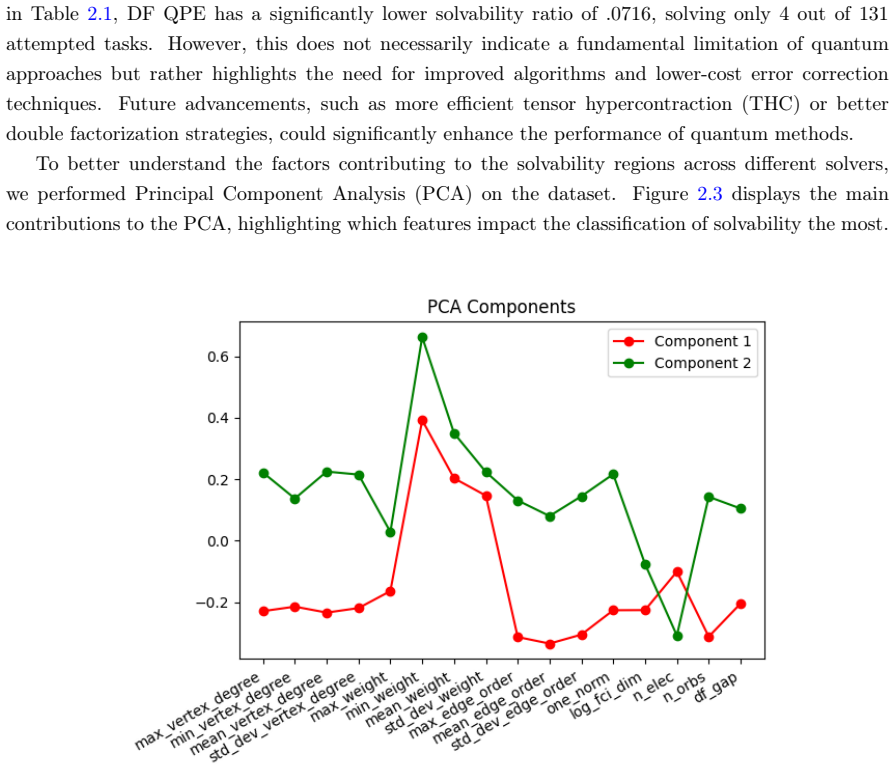
The central machinery is the solvability-ratio pipeline: polynomial-time Hamiltonian features (electron count, log FCI dimension, double-factorization rank and eigenvalue gap, Pauli one-norm, Pauli-string count, and interaction-hypergraph statistics) projected by principal component analysis into a low-dimensional latent space; a support-vector machine trained on observed solver successes and failures; and generation of 10,000 new latent points whose inverse-transformed features are scored by the trained model. The solvability ratio is the fraction of those points with predicted success probability above 0.5, and this ratio is the paper's headline measure of how much of the GSEE problem spac
Load-bearing premise
The whole ranking rests on the assumption that the machine-learning estimate of what fraction of the problem space a solver can handle matches how often the solver would actually succeed on real chemistry problems, even though the generated test points are not checked for physical plausibility.
What would settle it
Take a random sample of the 10,000 synthetic latent points, inverse-transform them into Hamiltonian features, construct actual Hamiltonians with those features, and run optimized SHCI on them; if the solved fraction falls well below 1.0000 — for example near the 65% empirical rate in the paper's table — the near-universal solvability claim would be refuted. A cheaper check: hold out a random subset of the 228 benchmark instances, retrain the classifier without them, and compare predicted solvability with the actually solved fraction.
If this is right
- Fully optimized SHCI (SHCI+PT with orbital optimization) is the only evaluated solver with solvability ratio 1.0000; if the machine-learning extrapolation is trusted, no current benchmark instance class defeats it.
- Merely lowering the SHCI variational threshold is not enough: the paper's numbers show a modest gain in tasks solved, while the jump to full latent-space coverage comes from orbital optimization and perturbative corrections.
- DMRG's sharper solvability boundary identifies low-entanglement systems as its reliable territory, so DMRG-based reference energies are safest for those instances.
- DF QPE resource estimates exceed the runtime budget on 127 of 131 attempted tasks, meaning fault-tolerant quantum phase estimation at current double-factorization costs and hardware assumptions is not competitive on this benchmark set.
- Because the current dataset is SHCI-biased, the benchmark's rankings cannot yet be read as a general statement about quantum versus classical advantage; the paper proposes adding strongly correlated, multi-reference systems to correct this.
Where Pith is reading between the lines
- The paper's own table reports only 148 of 226 empirical successes for optimized SHCI, so the 1.0000 solvability ratio is an extrapolation; a reader should not interpret it as a measured success rate, and the gap suggests the classifier's decision boundary may be optimistic.
- If the synthetic latent points do not correspond to physically plausible Hamiltonians — the paper states no such validity filter exists yet — the solvability ratio could overstate coverage by sampling regions no real chemistry occupies; adding a validity filter or a held-out empirical check would settle this.
- The same feature-plus-classifier pipeline could be used to actively select new benchmark instances near the current decision boundaries, sharpening the solvability maps and reducing the SHCI bias faster than adding random molecules.
- For quantum solvers, the framework could pre-register algorithmic improvements (for example, tensor hypercontraction or symmetry-shift preprocessing) as new solver entries, giving a quantitative target for when QPE becomes competitive on existing classical instances.
Editorial analysis
A structured set of objections, weighed in public.
Referee Report
Summary. The paper introduces QB-GSEE, an open benchmarking framework for Ground State Energy Estimation (GSEE), with a standardized problem-instance database, polynomial-time Hamiltonian features, and machine-learning-based solvability analysis. It presents case studies for three solver families: SHCI variants, DMRG, and DF QPE resource estimates. The paper's central claim, stated in the abstract and Section 2.2, is that fully optimized SHCI achieves near-universal solvability on the benchmark set, DMRG is competitive for low-entanglement systems, and DF QPE is currently limited by runtime and hardware constraints. The authors also explicitly acknowledge in Section 3 that the current dataset is biased toward SHCI-related instances, and they propose future expansion to more strongly correlated systems.
Significance. If the quantitative claims were supported, this would be a useful open infrastructure for comparing GSEE solvers: the repository is public, the schema is standardized, and the inclusion of DMRG and DF QPE resource estimates provides a broader view than most existing benchmarks. The paper's strength is its modular design and its explicit admission of dataset bias. However, the headline 'near-universal solvability' rests on an unvalidated machine-learning extrapolation over synthetic latent-space points, and the paper's own empirical counts contradict that headline. With validation and reframing, the benchmark could still make a solid contribution; as written, the central claim is not supported.
major comments (3)
- [Table 2.1, §2.2, Algorithm 1, Appendix B.2] The '1.0000 solvability' for SHCI Opt is not an empirical result. It is the fraction of 10,000 synthetic latent-space points for which an SVM predicts a probability greater than 0.5 (Algorithm 1, §4.4). Appendix B.2 explicitly states that 'we do not yet have a filter for true physical validity for the generated points,' and no calibration or held-out validation of the SVM probabilities is reported. The same table reports 148/226 tasks solved (65%), while the prose in §2.2 says SHCI Opt 'achieves universal solvability' and 'very few problem instances remain unsolved.' This contradiction is load-bearing because the abstract's central claim rests on the ML-derived 1.0000, not on the empirical pass count.
- [Table 2.1] The reported solvability ratios are not monotone in the empirical task counts. SHCI 2e-4 has ratio 0.8125 with 83/228 solved; SHCI 1e-4 has ratio 0.6562 with 91/228 solved; SHCI 2e-5 has ratio 0.6486 with 128/228 solved; SHCI Opt has ratio 1.0000 with 148/226 solved. A metric intended to measure solver capability should track empirical success rates more closely. Without calibration, held-out validation, or at least reporting both empirical fractions and ML ratios side by side, the ML-derived ratios cannot be interpreted as 'solvability.' The paper should either validate the SVM probabilities on held-out instances or restrict the headline claims to empirical pass rates.
- [§3, §4.4] The dataset-composition circularity is a correctness risk for the central claim. Section 3 admits that many Hamiltonians are drawn from prior SHCI-centric studies, and the pass/fail labels are produced by running SHCI-type solvers on those instances. The ML model is then trained on those labels, and the solvability ratio is computed over synthetic points in the bounding box of the observed data. This makes the 'near-universal solvability' claim largely an echo of the benchmark's construction. I am not claiming the authors are being disingenuous; rather, the paper needs a concrete test of generalization, e.g., held-out instances from independent sources or an explicit demonstration that the ML decision boundary is stable when the training set is resampled. Without such a test, the headline is not about GSEE solvability in general but about this particular curated set.
minor comments (6)
- [Abstract] Typo: 'ighlighting' should be 'highlighting'.
- [§4.4 and Algorithm 1] There is an inconsistency: §4.4 says PCA was ultimately chosen, while Algorithm 1 step 4 specifies Non-Negative Matrix Factorization (NNMF), and Appendix B.2 also discusses NNMF. Please clarify which latent-space method was used for the results in Table 2.1 and Figures 2.1–2.2.
- [§4.4] The phrase 'principle component analysis' appears; it should be 'principal component analysis.'
- [Table 2.1] SHCI Opt reports 226 tasks attempted while all other rows report 228. The discrepancy should be explained in the text, especially since it affects the empirical 65% figure.
- [§2.2] The sentence 'Lowering ε_var increases the number of tasks solved, but it only results in a 17% improvement over SHCI 2e-5' is unclear; the relative increase from 128 to 148 is approximately 15.6%, not 17%, and it would help to state the comparison explicitly.
- [Appendix C.2] The paper notes that for DF QPE, 'solved' means resource estimates are below a runtime threshold, not that the DF-QPE answer was checked against the reference energy. This is an important distinction; consider making it more prominent in the main text, not only in Section 2.3.
Circularity Check
The headline SHCI solvability is an unvalidated ML extrapolation: Table 2.1's 'Solvability' column is the SVM's predicted fraction over synthetic latent points, not the empirical 148/226, so the central claim is a fitted-model output called a prediction.
specific steps
-
fitted input called prediction
[Section 4.4 (Algorithm 1, steps 3, 5-8) and Table 2.1; Appendix B.2]
"A Support Vector Machine (SVM) classifier is trained on benchmark data to distinguish between solvable and unsolvable problem instances. Once trained, the model is used to generate 10,000 novel test points in the latent space and predict their probability of being solvable. The solvability ratio is then computed as the fraction of points exceeding a predefined probability threshold of 0.5. ... we do not yet have a filter for true physical validity for the generated points."
The Table 2.1 'Solvability' value for SHCI Opt (1.0000) is not the measured pass rate on the 226 attempted tasks (148/226 = 65%); it is the fraction of 10,000 synthetic latent-space points that the SVM—trained on the same solver's pass/fail labels—labels as >50% likely solvable. The synthetic points are generated in the latent bounding box and inverse-transformed without a physical-validity filter (App. B.2), so the number is a property of the fitted model, not an independent result. The ratio is non-monotonic in empirical solved counts (SHCI 2e-4: 0.8125 with 83 solved; SHCI 2e-5: 0.6486 with 128 solved), confirming it tracks the model/latent space rather than solver performance. The headline 'near-universal solvability' is thus a fitted-model output, presented as a benchmark measurement.
full rationale
The paper's core empirical contribution—the open QB-GSEE repository and the feature/solvability pipeline—is not circular in itself. However, the central claim that 'fully optimized SHCI achieves near-universal solvability on the benchmark set' rests on the ML solvability ratio in Table 2.1, which is computed by Algorithm 1 as the SVM's predicted fraction over 10,000 synthetic latent points. Appendix B.2 explicitly states there is no filter for true physical validity of generated points, and no calibration or held-out validation of the SVM probabilities is reported. The table's own empirical count (148/226) contradicts the 1.0000 value, and the ratio is non-monotonic in the number of tasks solved, so the ratio is not a proxy for empirical success. The dataset composition also amplifies the self-referential character: Section 3 admits 'many of the Hamiltonians in the current dataset originate from prior studies evaluating SHCI and related algorithms, creating a bias in its favor.' Taken together, the headline result is a fitted-model output and an echo of the benchmark's SHCI-centric construction, rather than an independent, validated measurement. The DMRG and DF QPE comparisons are largely empirical/resource-estimate results and do not exhibit the same circularity; the framework's infrastructure value is independent of the unsupported solvability extrapolation.
Axiom & Free-Parameter Ledger
free parameters (5)
- Solvability probability threshold =
0.5
- Latent-space bounding box and sampling resolution =
min-max of latent W, resolution r (unstated), 10,000 points
- Per-instance runtime requirement ('solved' threshold) =
unstated
- DF QPE truncation threshold =
1 mHa
- DMRG bond-dimension ramp protocol =
initial bond dimension 4, +10% steps, 23.5 h cap, 5e-5 Ha convergence
axioms (6)
- domain assumption GSEE promise-problem structure (Eq. 2): an easy-to-prepare state with overlap xi and spectral gap Delta exist for every benchmark instance.
- domain assumption Reference energies in the instance database are accurate to within chemical accuracy.
- ad hoc to paper The PCA/NNMF latent space bounded by the observed data's min-max spans the space of GSEE problems, so the solvability ratio over 10,000 synthetic points estimates the true solvable fraction.
- domain assumption The double-factorization truncation error at 1 mHa is negligible for all 131 DF QPE instances.
- domain assumption Pauli-string features are comparable across instances despite dependence on the Jordan-Wigner encoding.
- ad hoc to paper SVM probability outputs are calibrated enough to threshold at 0.5 and interpret as solvability probabilities.
Cite this review
Pith. "Pith review of QB Ground State Energy Estimation Benchmark." pith.science (2026). https://pith.science/paper/HRS4WQ3F
@misc{pith2026250810873,
  author       = {Pith},
  title        = {Pith review of: QB Ground State Energy Estimation Benchmark},
  year         = {2026},
  howpublished = {\url{https://pith.science/paper/HRS4WQ3F}},
  note         = {Machine review of arXiv:2508.10873}
}
read the original abstract
Ground State Energy Estimation (GSEE) is a central problem in quantum chemistry and condensed matter physics, demanding efficient algorithms to solve complex electronic structure calculations. This work introduces a structured benchmarking framework for evaluating the performance of both classical and quantum solvers on diverse GSEE problem instances. We assess three prominent methods -- Semistochastic Heat-Bath Configuration Interaction (SHCI), Density Matrix Renormalization Group (DMRG), and Double-Factorized Quantum Phase Estimation (DF QPE) -- ighlighting their respective strengths and limitations. Our results show that fully optimized SHCI achieves near-universal solvability on the benchmark set, DMRG excels for low-entanglement systems, and DF QPE is currently constrained by hardware and algorithmic limitations. However, we observe that many benchmark Hamiltonians are drawn from datasets tailored to SHCI and related approaches, introducing a bias that favors classical solvers. To mitigate this, we propose expanding the benchmark suite to include more challenging, strongly correlated systems to enable a more balanced and forward-looking evaluation of solver capabilities. As quantum hardware and algorithms improve, this benchmarking framework will serve as a vital tool for tracking progress and identifying domains where quantum methods may surpass classical techniques. The QB-GSEE benchmark repository is openly available at https://github.com/isi-usc-edu/qb-gsee-benchmark [1]. By maintaining a scalable and open resource, we aim to accelerate innovation in computational quantum chemistry and quantum computing.
Figures




Forward citations
Cited by 1 Pith paper
-
Distribution Complexity of Electronic Structure Simulations on Quantum Supercomputers
An algorithm is presented for estimating distribution complexity of electronic structure Hamiltonians, with O(N^3) entanglement estimation per fragment and quadratic/exponential reductions in distribution cost for qua...
Reference graph
Works this paper leans on
-
[1]
QB-GSEE-Benchmark
John Penuel et al. QB-GSEE-Benchmark. https : / / github . com / isi - usc - edu / qb - gsee - benchmark. 2025
2025
-
[2]
Google Quantum Roadmap
Google. Google Quantum Roadmap. https://quantumai.google/roadmap. Accessed: 2024-12- 09
2024
-
[3]
Microsoft Quantum Roadmap
Microsoft. Microsoft Quantum Roadmap. https://quantum.microsoft.com/en- us/vision/ quantum-roadmap. Accessed: 2024-12-09
2024
-
[4]
IBM Quantum Roadmap
IBM. IBM Quantum Roadmap. https://www.ibm.com/roadmaps/quantum/ . Accessed: 2024- 12-09
2024
-
[6]
J Maxwell Silvester et al.varbench/varbench: v1.1.0. Version v1.1.0. Aug. 2024.doi: 10.5281/ zenodo.13377360. url: https://doi.org/10.5281/zenodo.13377360. 25
-
[7]
Larry A. Curtiss et al. “Assessment of Gaussian-2 and density functional theories for the com- putation of enthalpies of formation”. In:The Journal of Chemical Physics106.3 (Jan. 1997), pp. 1063–1079. issn: 0021-9606. doi: 10.1063/1.473182. eprint: https://pubs.aip.org/aip/ jcp/article-pdf/106/3/1063/19100768/1063\_1\_online.pdf. url: https://doi.org/10. ...
doi:10.1063/1.473182 1997
-
[8]
Larry A. Curtiss et al. “Assessment of Gaussian-2 and density functional theories for the com- putation of ionization potentials and electron affinities”. In:The Journal of Chemical Physics 109.1 (July 1998), pp. 42–55. issn: 0021-9606. doi: 10 . 1063 / 1 . 476538. eprint: https : / / pubs . aip . org / aip / jcp / article - pdf / 109 / 1 / 42 / 19137091 ...
doi:10.1063/1.476538 1998
-
[9]
Application-Oriented Performance Benchmarks for Quantum Comput- ing
Thomas Lubinski et al. “Application-Oriented Performance Benchmarks for Quantum Comput- ing”. In: IEEE Transactions on Quantum Engineering4 (2023), pp. 1–32.doi: 10.1109/TQE. 2023.3253761
arXiv 2023
-
[10]
url: https://arxiv.org/abs/2402.08985
Thomas Lubinski et al.Quantum Algorithm Exploration using Application-Oriented Performance Benchmarks.2024.arXiv: 2402.08985 [quant-ph]. url: https://arxiv.org/abs/2402.08985
Pith/arXiv arXiv 2024
-
[11]
Benchmarking a trapped-ion quantum computer with 30 qubits
Jwo-Sy Chen et al. “Benchmarking a trapped-ion quantum computer with 30 qubits”. In:Quan- tum 8 (Nov. 2024), p. 1516. issn: 2521-327X. doi: 10 . 22331 / q - 2024 - 11 - 07 - 1516. url: https://doi.org/10.22331/q-2024-11-07-1516
-
[12]
Etienne Granet and Henrik Dreyer.AppQSim: Application-oriented benchmarks for Hamiltonian simulation on a quantum computer. 2025. arXiv:2503.04298 [quant-ph]. url: https://arxiv. org/abs/2503.04298
arXiv 2025
-
[13]
Avimita Chatterjee et al.A Comprehensive Cross-Model Framework for Benchmarking the Per- formance of Quantum Hamiltonian Simulations. 2024. arXiv: 2409 . 06919 [quant-ph]. url: https://arxiv.org/abs/2409.06919
work page internal anchor Pith review Pith/arXiv arXiv 2024
-
[14]
SupermarQ: A Scalable Quantum Benchmark Suite
Teague Tomesh et al. “SupermarQ: A Scalable Quantum Benchmark Suite”. In: 2022 IEEE International Symposium on High-Performance Computer Architecture (HPCA). 2022, pp. 587–
2022
-
[15]
QASMBench: A Low-Level Quantum Benchmark Suite for NISQ Evaluation and Simulation
Ang Li et al. “QASMBench: A Low-Level Quantum Benchmark Suite for NISQ Evaluation and Simulation”. In: ACM Transactions on Quantum Computing4.2 (Feb. 2023). doi: 10 . 1145 / 3550488. url: https://doi.org/10.1145/3550488
doi:10.1145/3550488 2023
-
[16]
Oversimplifying quantum factoring
John A. Smolin, Graeme Smith, and Alexander Vargo. “Oversimplifying quantum factoring”. In: Nature 499.7457 (July 2013), pp. 163–165.issn: 1476-4687. doi: 10.1038/nature12290. url: http://dx.doi.org/10.1038/nature12290
-
[17]
Debunking Algorithmic Qubits
Quantinuum. Debunking Algorithmic Qubits. Accessed: 2025-03-13. 2024. url: https://www. quantinuum.com/blog/debunking-algorithmic-qubits
2025
-
[18]
Quantum Benchmarking Problem Instance File Schema
John Penuel et al. Quantum Benchmarking Problem Instance File Schema. https://github. com/isi-usc-edu/qb-gsee-benchmark/raw/refs/heads/main/schemas/problem_instance. schema.0.0.1.json
-
[19]
Support-VectorNetworks
CorinnaCortesandVladimirNaumovichVapnik.“Support-VectorNetworks”.In: Machine Learn- ing 20 (1995), pp. 273–297.url: https://api.semanticscholar.org/CorpusID:52874011
1995
-
[20]
The GSEE Benchmark Standard Report
John Penuel et al. The GSEE Benchmark Standard Report. Accessed: 2025-03-15. 2024. url: https://github.com/isi-usc-edu/qb-gsee-benchmark/tree/main/standard_report . 26
2025
-
[21]
isi-usc-edu/pyLIQTR: Release 1.1.1
rroodll et al. isi-usc-edu/pyLIQTR: Release 1.1.1. Version v1.1.1. Apr. 2024. doi: 10 . 5281 / zenodo.10913397. url: https://doi.org/10.5281/zenodo.10913397
-
[22]
Harrigan et al.Expressing and Analyzing Quantum Algorithms with Qualtran
Matthew P. Harrigan et al.Expressing and Analyzing Quantum Algorithms with Qualtran. 2024. arXiv: 2409.04643 [quant-ph]. url: https://arxiv.org/abs/2409.04643
Pith/arXiv arXiv 2024
-
[23]
OpenFermion:theelectronicstructurepackageforquantumcomputers
JarrodRMcCleanetal.“OpenFermion:theelectronicstructurepackageforquantumcomputers”. In: Quantum Science and Technology5.3 (June 2020), p. 034014.doi: 10.1088/2058- 9565/ ab8ebc. url: https://dx.doi.org/10.1088/2058-9565/ab8ebc
doi:10.1088/2058- 2020
-
[24]
Solvability Region using PCA embedding for SHCI with eps_var 2e-4.Accessed: 2025-03-15
JohnPenueletal. Solvability Region using PCA embedding for SHCI with eps_var 2e-4.Accessed: 2025-03-15. 2024. url: https://github.com/isi-usc-edu/qb-gsee-benchmark/blob/main/ standard_report/supporting_artifacts/PCA_embedding_plot_solver_0db183e3- a86d- 491b-9125-599556e37c7a.png
2025
-
[25]
Solvability Region using PCA embedding for SHCI with eps_var 1e-4.Accessed: 2025-03-15
JohnPenueletal. Solvability Region using PCA embedding for SHCI with eps_var 1e-4.Accessed: 2025-03-15. 2024. url: https://github.com/isi-usc-edu/qb-gsee-benchmark/blob/main/ standard_report/supporting_artifacts/PCA_embedding_plot_solver_7e730dfb- 57ee- 480b-a8a1-4b73f5f07c54.png
2025
-
[26]
Solvability Region using PCA embedding for SHCI with eps_var 2e-5.Accessed: 2025-03-15
JohnPenueletal. Solvability Region using PCA embedding for SHCI with eps_var 2e-5.Accessed: 2025-03-15. 2024. url: https://github.com/isi-usc-edu/qb-gsee-benchmark/blob/main/ standard_report/supporting_artifacts/PCA_embedding_plot_solver_86bfe50c- 9342- 4d54-bb68-abc8abd95688.png
2025
-
[27]
Solvability Region using PCA embedding for SHCI with optimized orbitals followed by SHCI+PT
John Penuel et al. Solvability Region using PCA embedding for SHCI with optimized orbitals followed by SHCI+PT. Accessed: 2025-03-15. 2024. url: https : / / github . com / isi - usc - edu / qb - gsee - benchmark / blob / main / standard _ report / supporting _ artifacts / PCA _ embedding_plot_solver_2dde727e-a881-44fa-aabf-bba6248e4baf.png
2025
-
[28]
Accessed: 2025-03-15
John Penuel et al.Solvability Region using PCA embedding for DMRG with the lowest variational energy. Accessed: 2025-03-15. 2024. url: https : / / github . com / isi - usc - edu / qb - gsee - benchmark / blob / main / standard _ report / supporting _ artifacts / PCA _ embedding _ plot _ solver_16537433-9f4c-4eae-a65d-787dc3b35b59.png
2025
-
[29]
Solvability Region using PCA embedding for double factorized QPE resource estimates
John Penuel et al. Solvability Region using PCA embedding for double factorized QPE resource estimates. Accessed: 2025-03-15. 2024. url: https://github.com/isi- usc- edu/qb- gsee- benchmark / blob / main / standard _ report / supporting _ artifacts / PCA _ embedding _ plot _ solver_2610d8de-bd3a-469e-9a80-473e8988755f.png
2025
-
[30]
Hamiltonian Features Correlation Matrix
John Penuel et al. Hamiltonian Features Correlation Matrix. Accessed: 2025-03-15. 2024.url: https://github.com/isi- usc- edu/qb- gsee- benchmark/blob/main/standard_report/ supporting_artifacts/hamiltonian_features_correlation_matrix_plot.png
2025
-
[31]
Linjun Wang et al. Planted Solutions in Quantum Chemistry: Generating Non-Trivial Hamilto- nians with Known Ground States. 2025. arXiv:2507.15166 [quant-ph]. url: http://arxiv. org/abs/2507.15166
arXiv 2025
-
[32]
Distributed implementation of full configuration interaction for one trillion determinants
Hong Gao et al. “Distributed implementation of full configuration interaction for one trillion determinants”. In:Journal of Chemical Theory and Computation20.3 (2024), pp. 1185–1192
work page 2024
-
[33]
The Ground State Electronic Energy of Benzene
Janus J. Eriksen et al. “The Ground State Electronic Energy of Benzene”. In:The Journal of Physical Chemistry Letters11.20 (2020). PMID: 33022176, pp. 8922–8929.doi: 10.1021/acs. jpclett.0c02621. eprint: https://doi.org/10.1021/acs.jpclett.0c02621 . url: https: //doi.org/10.1021/acs.jpclett.0c02621. 27
doi:10.1021/acs 2020
-
[34]
The Chromium Dimer: Closing a Chapter of Quantum Chemistry
Henrik R. Larsson et al. “The Chromium Dimer: Closing a Chapter of Quantum Chemistry”. In: Journal of the American Chemical Society144.35 (2022). PMID: 36001866, pp. 15932–15937. doi: 10 . 1021 / jacs . 2c06357. eprint: https : / / doi . org / 10 . 1021 / jacs . 2c06357. url: https://doi.org/10.1021/jacs.2c06357
-
[35]
Excited states of methylene, polyenes, and ozone from heat-bath configu- ration interaction
Alan D Chien et al. “Excited states of methylene, polyenes, and ozone from heat-bath configu- ration interaction”. In:The Journal of Physical Chemistry A122.10 (2018), pp. 2714–2722
work page 2018
-
[36]
Variational benchmarks for quantum many-body problems
Dian Wu et al. “Variational benchmarks for quantum many-body problems”. In:Science 386.6719 (Oct. 2024), pp. 296–301.issn: 1095-9203. doi: 10.1126/science.adg9774. url: http://dx. doi.org/10.1126/science.adg9774
-
[37]
Nicole Bellonzi et al.Feasibility of accelerating homogeneous catalyst discovery with fault-tolerant quantum computers. 2024. arXiv: 2406.06335v1 [quant-ph] . url: https://arxiv.org/abs/ 2406.06335v1
arXiv 2024
-
[38]
Nam Nguyen et al.Quantum computing for corrosion-resistant materials and anti-corrosive coat- ings design. 2024. arXiv:2406.18759 [quant-ph]. url: https://arxiv.org/abs/2406.18759
Pith/arXiv arXiv 2024
-
[39]
QuantumResourcesRequiredforBindingAffinityCalculationsofAmyloid beta
MatthewOttenetal.“QuantumResourcesRequiredforBindingAffinityCalculationsofAmyloid beta”. In:arXiv preprint arXiv:2406.18744(2024)
Pith/arXiv arXiv 2024
-
[40]
John Penuel et al. Number of Orbitals Histogram. Accessed: 2025-03-15. 2024.url: https:// github.com/isi-usc-edu/qb-gsee-benchmark/blob/main/standard_report/supporting_ artifacts/num_orbitals_histogram.png
work page 2025
-
[41]
Ian T. Jolliffe. Principal Component Analysis. 2nd. Springer Series in Statistics. Springer, 2002. isbn: 978-0-387-95442-4. doi: 10.1007/b98835
doi:10.1007/b98835 2002
-
[42]
Quantum Parameterized Complexity.2022.arXiv: 2203.08002 [quant-ph]
MichaelJ.Bremneretal. Quantum Parameterized Complexity.2022.arXiv: 2203.08002 [quant-ph]. url: https://arxiv.org/abs/2203.08002
Pith/arXiv arXiv 2022
-
[43]
Low-Depth Quantum Simulation of Materials
Ryan Babbush et al. “Low-Depth Quantum Simulation of Materials”. In:Physical Review X8 (2017), p. 011044.url: https://api.semanticscholar.org/CorpusID:4147326
work page 2017
-
[44]
Hybrid grid/basis set discretizations of the Schrödinger equation
Steven R. White. “Hybrid grid/basis set discretizations of the Schrödinger equation.” In:The Journal of chemical physics147 24 (2017), p. 244102.url: https://api.semanticscholar. org/CorpusID:35065533
work page 2017
-
[45]
Ostlund.Modern Quantum Chemistry: Introduction to Advanced Elec- tronic Structure Theory
Attila Szabó and Neil S. Ostlund.Modern Quantum Chemistry: Introduction to Advanced Elec- tronic Structure Theory. McGraw-Hill, 1982. url: https : / / api . semanticscholar . org / CorpusID:94743139
work page 1982
-
[46]
Low rank representations for quantum simulation of electronic structure
Mario Motta et al. “Low rank representations for quantum simulation of electronic structure”. In: npj Quantum Information7.1(May2021). issn:2056-6387. doi: 10.1038/s41534-021-00416-z. url: http://dx.doi.org/10.1038/s41534-021-00416-z
-
[47]
Encoding Electronic Spectra in Quantum Circuits with Linear T Complex- ity
Ryan Babbush et al. “Encoding Electronic Spectra in Quantum Circuits with Linear T Complex- ity”. In:Physical Review X8.4 (Oct. 2018).issn: 2160-3308.doi: 10.1103/physrevx.8.041015. url: http://dx.doi.org/10.1103/PhysRevX.8.041015
-
[48]
Even More Efficient Quantum Computations of Chemistry Through Ten- sor Hypercontraction
Joonho Lee et al. “Even More Efficient Quantum Computations of Chemistry Through Ten- sor Hypercontraction”. In: PRX Quantum 2.3 (July 2021). issn: 2691-3399. doi: 10 . 1103 / prxquantum.2.030305. url: http://dx.doi.org/10.1103/PRXQuantum.2.030305. 28
-
[49]
Thomas W. Watts et al.Fullerene-encapsulated Cyclic Ozone for the Next Generation of Nano- sized Propellants via Quantum Computation. 2024. arXiv:2408.13244 [quant-ph]. url: https: //arxiv.org/abs/2408.13244
Pith/arXiv arXiv 2024
-
[50]
Yulong Dong, Lin Lin, and Yu Tong. “Ground-State Preparation and Energy Estimation on Early Fault-Tolerant Quantum Computers via Quantum Eigenvalue Transformation of Unitary Matrices”. In: PRX Quantum 3.4 (Oct. 2022). issn: 2691-3399. doi: 10.1103/prxquantum.3. 040305. url: http://dx.doi.org/10.1103/PRXQuantum.3.040305
-
[51]
Heisenberg-Limited Ground-State Energy Estimation for Early Fault- TolerantQuantumComputers
Lin Lin and Yu Tong. “Heisenberg-Limited Ground-State Energy Estimation for Early Fault- TolerantQuantumComputers”.In: PRX Quantum(2021). url: https://api.semanticscholar. org/CorpusID:232013439
work page 2021
-
[53]
Laura Clinton et al.Quantum Phase Estimation without Controlled Unitaries. 2024. arXiv:2410. 21517 [quant-ph]. url: https://arxiv.org/abs/2410.21517
Pith/arXiv arXiv 2024
-
[54]
Efficient Strategies for Reducing Sampling Error in Quantum Krylov Subspace Diagonalization
GwonhakLeeetal. Efficient Strategies for Reducing Sampling Error in Quantum Krylov Subspace Diagonalization. 2024. arXiv: 2409.02504 [quant-ph] . url: https://arxiv.org/abs/2409. 02504
work page internal anchor Pith review Pith/arXiv arXiv 2024
-
[55]
Quantum Krylov subspace algorithms for ground- and excited-stateenergyestimation
Cristian L. Cortes and Stephen K. Gray. “Quantum Krylov subspace algorithms for ground- and excited-stateenergyestimation”.In: Physical Review A(2021). url: https://api.semanticscholar. org/CorpusID:237503498
work page 2021
-
[56]
Quantum Filter Diagonalization: Quantum Eigendecomposition without Full Quantum Phase Estimation
Robert M. Parrish and Peter Leonard McMahon. “Quantum Filter Diagonalization: Quantum Eigendecomposition without Full Quantum Phase Estimation”. In: arXiv: Quantum Physics (2019). url: https://api.semanticscholar.org/CorpusID:202677212
work page 2019
-
[57]
ÜberdasPaulischeÄquivalenzverbot
PaulJordanandEugenWigner. “ÜberdasPaulischeÄquivalenzverbot”. In: Zeitschrift für Physik 47 (1928), pp. 631–651.url: https://api.semanticscholar.org/CorpusID:126400679
work page 1928
-
[58]
Sergey Bravyi and Alexei Y. Kitaev. “Fermionic Quantum Computation”. In:Annals of Physics 298 (2000), pp. 210–226.url: https://api.semanticscholar.org/CorpusID:16532321
work page 2000
-
[59]
Zhang Jiang et al. “Optimal fermion-to-qubit mapping via ternary trees with applications to re- ducedquantumstateslearning”.In: Quantum 4(2019),p.276. url: https://api.semanticscholar. org/CorpusID:204852223
work page 2019
-
[60]
Superfast encodings for fermionic quantum simulation
Kanav Setia et al. “Superfast encodings for fermionic quantum simulation”. In:Physical Review Research (2018). url: https://api.semanticscholar.org/CorpusID:53593478
work page 2018
-
[61]
A Sierpinski Triangle Fermion-to-Qubit Transform
Brent Harrison et al. A Sierpinski Triangle Fermion-to-Qubit Transform. Preprint. 2024. url: https://api.semanticscholar.org/CorpusID:272463572
work page 2024
-
[62]
Compact fermion to qubit mappings
Charles Derby et al. “Compact fermion to qubit mappings”. In:Physical Review B104.3 (July 2021). issn: 2469-9969. doi: 10.1103/physrevb.104.035118 . url: http://dx.doi.org/10. 1103/PhysRevB.104.035118
-
[63]
A Compact Fermion to Qubit Mapping Part 2: Alternative Lattice Geometries
Charles Derby and Joel Klassen. A Compact Fermion to Qubit Mapping Part 2: Alternative Lattice Geometries. 2021. arXiv: 2101 . 10735 [quant-ph]. url: https : / / arxiv . org / abs / 2101.10735. 29
Pith/arXiv arXiv 2021
-
[65]
Brent Harrison et al. Reducing the qubit requirement of Jordan-Wigner encodings ofN-mode, K-fermion systems from N to ⌈log2 N K ⌉. 2023. arXiv: 2211.04501 [quant-ph] . url: https: //arxiv.org/abs/2211.04501
Pith/arXiv arXiv 2023
-
[66]
Qubit-efficient encoding scheme for quantum simulations of electronic structure
Yu Shee et al. “Qubit-efficient encoding scheme for quantum simulations of electronic structure”. In: Phys. Rev. Res.4 (2 May 2022), p. 023154.doi: 10.1103/PhysRevResearch.4.023154. url: https://link.aps.org/doi/10.1103/PhysRevResearch.4.023154
-
[67]
Nikolaj Moll et al. “Optimizing qubit resources for quantum chemistry simulations in second quantization on a quantum computer”. In:Journal of Physics A: Mathematical and Theoretical 49.29 (June 2016), p. 295301.doi: 10.1088/1751-8113/49/29/295301. url: https://dx.doi. org/10.1088/1751-8113/49/29/295301
-
[68]
Joseph Carolan and Luke Schaeffer.Succinct Fermion Data Structures. 2024. arXiv:2410.04015 [quant-ph]. url: https://arxiv.org/abs/2410.04015
Pith/arXiv arXiv 2024
-
[69]
Smik Patel et al. Guaranteed Global Minimum of Electronic Hamiltonian 1-Norm via Linear Programming in the Block Invariant Symmetry Shift (BLISS) Method. 2024. arXiv:2409.18277 [quant-ph]. url: https://arxiv.org/abs/2409.18277
work page internal anchor Pith review Pith/arXiv arXiv 2024
-
[70]
Emiel Koridon et al. “Orbital transformations to reduce the 1-norm of the electronic structure Hamiltonian for quantum computing applications”. In:Physical Review Research3.3 (Aug. 2021). issn: 2643-1564. doi: 10.1103/physrevresearch.3.033127 . url: http://dx.doi.org/10. 1103/PhysRevResearch.3.033127
-
[71]
ReducingmolecularelectronicHamiltoniansimulationcostforlinearcombi- nation of unitaries approaches
IgnacioLoaizaetal.“ReducingmolecularelectronicHamiltoniansimulationcostforlinearcombi- nation of unitaries approaches”. In:Quantum Science and Technology8.3 (May 2023), p. 035019. issn: 2058-9565. doi: 10.1088/2058-9565/acd577. url: http://dx.doi.org/10.1088/2058- 9565/acd577
-
[72]
Tzu-Ching Yen, Aadithya Ganeshram, and Artur F. Izmaylov.Deterministic improvements of quantum measurements with grouping of compatible operators, non-local transformations, and covariance estimates. 2022. arXiv: 2201.01471 [quant-ph] . url: https://arxiv.org/abs/ 2201.01471
work page internal anchor Pith review Pith/arXiv arXiv 2022
-
[73]
Low-Overhead Parallelisation of LCU via Commuting Operators
Gregory Boyd. Low-Overhead Parallelisation of LCU via Commuting Operators. 2024. arXiv: 2312.00696 [quant-ph]. url: https://arxiv.org/abs/2312.00696
work page internal anchor Pith review Pith/arXiv arXiv 2024
-
[74]
Theory of Trotter Error with Commutator Scaling
Andrew M. Childs et al. “Theory of Trotter Error with Commutator Scaling”. In:Physical Review X 11.1 (Feb. 2021). issn: 2160-3308. doi: 10.1103/physrevx.11.011020 . url: http://dx. doi.org/10.1103/PhysRevX.11.011020
-
[75]
Higher order interactions destroy phase transitions in Deffuant opinion dynamics model
Hendrik Schawe and Laura Hernández. “Higher order interactions destroy phase transitions in Deffuant opinion dynamics model”. In:Communications Physics5.1 (Jan. 2022).issn: 2399-3650. doi: 10.1038/s42005-022-00807-4. url: http://dx.doi.org/10.1038/s42005-022-00807- 4
-
[76]
Hamiltonian Simulation Using Linear Combinations of Unitary Operations
Andrew M. Childs and Nathan Wiebe. “Hamiltonian Simulation Using Linear Combinations of Unitary Operations”. In:Quantum Information and Computation12.11 & 12 (Nov. 2012).issn: 1533-7146. doi: 10.26421/qic12.11-12. url: http://dx.doi.org/10.26421/QIC12.11-12. 30
-
[77]
Double sparse quantum state preparation
Tiago M. L. de Veras, Leon D. da Silva, and Adenilton J. da Silva. “Double sparse quantum state preparation”. In:Quantum Information Processing21.6 (June 2022).issn: 1573-1332. doi: 10.1007/s11128-022-03549-y. url: http://dx.doi.org/10.1007/s11128-022-03549-y
-
[78]
Sparse Random Hamiltonians Are Quantumly Easy
Chi-Fang Chen et al. “Sparse Random Hamiltonians Are Quantumly Easy”. In:Physical Review X 14.1 (Feb. 2024). issn: 2160-3308. doi: 10.1103/physrevx.14.011014 . url: http://dx. doi.org/10.1103/PhysRevX.14.011014
-
[79]
Ryota Kojima, Masahiko Kamoshita, and Keita Kanno.Orbital-rotated Fermi-Hubbard model as a benchmarking problem for quantum chemistry with the exact solution. 2024. arXiv:2402.11869 [quant-ph]. url: https://arxiv.org/abs/2402.11869
work page internal anchor Pith review Pith/arXiv arXiv 2024
-
[80]
Andor Menczer et al. “Parallel Implementation of the Density Matrix Renormalization Group Method Achieving a Quarter petaFLOPS Performance on a Single DGX-H100 GPU Node”. In: Journal of Chemical Theory and Computation20.19(Sept.2024),pp.8397–8404. issn:1549-9626. doi: 10.1021/acs.jctc.4c00903. url: http://dx.doi.org/10.1021/acs.jctc.4c00903
-
[81]
url: https://scikit-learn.org/1.5/modules/model_evaluation.html
-
[82]
A Unified Approach to Interpreting Model Predictions
Scott M Lundberg and Su-In Lee. “A Unified Approach to Interpreting Model Predictions”. In: Advances in Neural Information Processing Systems 30(2017). Ed. by I. Guyon et al., pp. 4765–
work page 2017
-
[83]
SHAP (SHapley Additive exPlanations)
Scott M Lundberg and Su-In Lee. SHAP (SHapley Additive exPlanations). https://github. com/shap/shap. Accessed: 2024-12-03. 2017
work page 2024
This paper was first reviewed by deepseek-v4-flash on August 5, 2026.
discussion (0)
Sign in with ORCID, Apple, or X to comment. Anyone can read and Pith papers without signing in.