REVIEW 3 major objections 5 minor 16 references
Navigating the Exploration-Exploitation Tradeoff in Inference-Time Scaling of Diffusion Models
T0 review · 3 major / 5 minor · reviewed 2026-08-15 · deepseek-v4-flash
Pith's one-line read This paper claims that the exploration–exploitation tradeoff in diffusion-model inference-time scaling is best handled by a funnel-shaped particle schedule plus adaptive temperature, and shows this outperforms best-of-N and prior SMC…
desk verdict Plausible and potentially useful incremental method, but the paper's central fixed-NFE claim is unverifiable as written and needs a mandatory mapping before the results can be trusted. read the letter →
The pith
A machine-rendered reading of the paper's core claim, the machinery that carries it, and where it could break.
The reading
What carries the argument
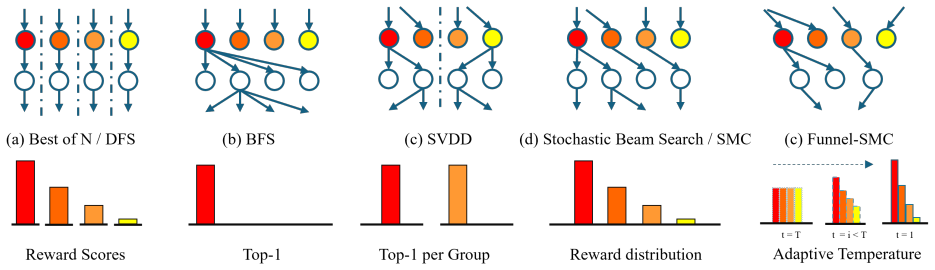
The machinery is a unified search framework that casts inference-time scaling as selection (resampling), transition (propagation), and scoring (weighting) over a particle population. Within this framework, F-SMC specifies a time-dependent particle schedule $\{N_t\}$ with $N_{t-1} < N_t$ (e.g., $[12,10,6,4,4]$ over the resampling steps), and SMC-A specifies a linearly increasing temperature $\lambda_t = \frac{T-t}{T}\lambda$ inside the potential function $G_t = \exp[\lambda_t r_t]$. The load-bearing identity is the telescoping product of potentials over time equaling $\exp(\lambda r(x_0,c))$, so the particle system provably targets the reward-tilted distribution; systematic resampling and Tweedie denoising estimates ($x_{0|t}$) supply the practical weighting.
What would settle it
Recompute the total NFE: with resampling at timesteps $\{10,15,20,25,29\}$ and particle counts $[12,10,6,4,4]$ assigned to the intervals between them, the sum over 30 steps must equal 240. If any natural assignment yields a different total, or if no assignment consistent with the paper's text sums to 240, the performance gain is attributable to a larger compute budget rather than the funnel schedule. Alongside this, re-run F-SMC-A(D) against SMC(D) with 8 particles and 30 steps, both at exactly 240 NFE, to confirm the gain persists under a verifiable budget.
Extended reading notes
Core claim
The central claim is that current SMC-based inference-time scaling for diffusion models is limited by a structural dilemma: reward models cannot reliably evaluate early-stage images despite their long-term importance, and once image structure solidifies in later stages, resampling interventions become largely ineffective. The paper proposes F-SMC-A, which combines a funnel-shaped, monotonically decreasing particle count with an adaptive temperature $\lambda_t = \frac{T-t}{T}\lambda$ that linearly increases the influence of reward over the denoising process, and proves that the method still converges to the reward-tilted distribution $p_{\text{tar}}(x_0,c) \propto p_{\text{pre}}(x_0,c)\exp(\lambda r(x_0,c))$ as the number of particles grows (under bounded-potential and particle-ratio conditions). Empirically, F-SMC-A(D)—the variant using the difference potential—achieves the highest ImageReward and GenEval scores across four Stable Diffusion models at a fixed NFE of 240, though its HPSv2 scores are generally lower than the Best-of-N baseline, a point the paper attributes to the reward-model generalization gap.
Load-bearing premise
The entire fixed-budget comparison rests on the claim that the funnel schedule $[12,10,6,4,4]$ sums to exactly 240 noise function evaluations over the 30 denoising steps; the paper never states which step intervals use which particle count, so the equal-compute claim is unverified.
Editorial extensions
If this is right
- At a fixed total NFE of 240, F-SMC-A(D) achieves the best ImageReward and GenEval scores across SD1.5, SD2.0, SD2.1, and SDXL, beating Best-of-N, SVDD, and standard SMC with both Max and Diff potentials.
- The two components each help on their own: the funnel schedule alone improves SMC(M) on three of four models, and adaptive temperature alone improves SMC(D) on all four models, so neither contribution is redundant.
- Scaling experiments show that F-SMC-A reaches ImageReward levels comparable to or better than Best-of-N while spending roughly half the NFE budget, which would make inference-time scaling more compute-efficient in practice.
- The convergence proof extends existing adaptive-SMC guarantees to the time-varying particle count and temperature schedule, so the method inherits principled convergence behavior rather than being a pure heuristic.
Reading between the lines
- If the NFE mapping of $[12,10,6,4,4]$ onto the 30 steps is verified, the funnel-plus-temperature principle likely transfers to other verifiers, but the optimal funnel shape should depend on how reliable the verifier is at early stages; with a reliable early verifier, front-loading would be less beneficial.
- The concave resampling-timing curve suggests a finer-grained schedule could do better than the hand-picked $[12,10,6,4,4]$; a testable extension is to learn the particle-count schedule from a validation set, e.g., by hill-climbing on the five interval counts.
- The early-stage reward correlation figures suggest that prompt categories with persistently low correlation (like position) may need category-specific temperatures; this is an implication the paper does not pursue.
- The HPSv2 deficit suggests ImageReward-guided search overfits its own metric; ensembling multiple reward models in the potential function would be a natural next step to test robustness.
Signed reviews
Editorial analysis
A structured set of objections, weighed in public.
Referee Report
Summary. The paper proposes two modifications to SMC-based inference-time scaling for text-to-image diffusion models. F-SMC uses a funnel-shaped particle-count schedule that reduces the number of maintained particles as denoising progresses, while SMC-A introduces a time-dependent temperature parameter that linearly increases the influence of early-stage rewards. Combining both, F-SMC-A is claimed to outperform best-of-N, SVDD, and prior SMC baselines on ImageReward and GenEval across SD1.5, SD2.0, SD2.1, and SDXL at a fixed NFE of 240. The authors also present a convergence theorem (Theorem 2) claiming that F-SMC-A converges to the reward-tilted distribution.
Significance. If the fixed-NFE claim holds, the contribution is practically valuable: it improves image-text alignment without increasing inference compute, and the two mechanisms are simple, model-agnostic, and well motivated by the empirical analyses of early-stage reward unreliability and late-stage loss of plasticity. The unified search framework in Table 1 is a useful organizing device, and the decision to tune the funnel schedule on DrawBench and then evaluate on the held-out GenEval benchmark is a methodological strength. The convergence result, however, is essentially a restatement of standard SMC theory and is not a major theoretical advance. The central empirical claim currently rests on an unverifiable NFE accounting and on single-run point estimates without uncertainty quantification.
major comments (3)
- [Section 5.2 and Appendix A.4] The fixed-NFE claim is unverifiable as written. The text states that the funnel schedule [12, 10, 6, 4, 4] 'maintains the same total NFE' as 8 particles for 30 steps (240), but it never specifies how the five schedule entries map onto the 30 denoising steps. If the five entries cover five blocks of 6 steps each, the total is 6*(12+10+6+4+4)=216; if the last block covers 10 steps, the total is 12*5+10*5+6*5+4*5+4*10=200. Neither equals 240. Appendix A.4 lists candidate schedules and resampling steps but still does not give the per-step particle counts. Please provide the explicit mapping from denoising step to particle count, and verify the NFE of every baseline and proposed method. If the funnel schedule in fact uses more than 240 network evaluations, the reported gains on ImageReward and GenEval would be attributable to additional compute rather than to the method, invalidating the headline result.
- [Section 5.2, Table 2] The reported results are single-run point estimates with no error bars, repeated seeds, or significance tests. For example, on SD1.5 the GenEval difference between Best-of-N (56.24) and F-SMC-A(D) (57.32) is about one point, and on SD2.0 the difference between SMC(M) (61.12) and F-SMC-A(M) (60.76) is negative; without repeated trials it is impossible to assess whether these differences are meaningful. The central claim that F-SMC-A 'consistently outperforms' all baselines therefore lacks statistical support. Please report means and standard deviations over at least three independent runs (or a clearly justified fixed-seed protocol), and state whether the GenEval and ImageReward evaluations are deterministic given the seed.
- [Theorem 2 and Appendix A.5] The convergence theorem as stated is not actually proven in the manuscript. The proof establishes that the telescoping product of potentials equals exp(lambda * r(x0, c)) (Eq. 14), which is the target-condition identity by construction, but the convergence of the particle system under time-varying particle counts and time-varying temperature is delegated to Beskos et al. without verifying their sufficient conditions. In particular, the manuscript does not show that the boundedness and smoothness conditions on Gt hold uniformly in t as lambda_t varies, and the relation of the condition N0/Nt > 0 to the Beskos conditions is not explained. Moreover, Appendix A.5 describes the schedule as 'non-increasing' while Section 4.2 defines N_{t-1} < N_t, which is increasing in t; this inconsistency needs to be resolved. Either provide a complete proof sketch that checks the Beskos conditions, or clearly state that Theorem 2 is a corollary of standard adaptive SMC theory and give the precise theorem to which it refers.
minor comments (5)
- [Abstract and Section 5.2] The abstract states that the approach 'outperforms previous baselines' without qualification, but Table 2 shows that HPSv2 scores for F-SMC-A are generally lower than Best-of-N. The main text acknowledges this limitation, so the abstract should be qualified to say 'outperforms on ImageReward and GenEval' to avoid overclaiming.
- [Table 1] The Diff potential entry is malformed: the formula reads 'exp[λ(rt−rt−1)]†' with a superscripted dagger and no closing bracket, and the footnote '†‡ Whent = 0 ort =T' is unclear. Please clean up the notation and define the boundary cases explicitly.
- [Section 5.2] The phrase 'All methods were evaluated at denoising steps {10, 15, 20, 25, 29}' is confusing: it is not clear whether these are the only timesteps at which resampling or scoring occurs, or whether these are evaluation timesteps. Please clarify the experimental protocol, especially how the 30-step Euler Ancestral sampling interacts with these five steps.
- [Section 5.3 and Figure 6] The scaling analysis in Figure 6 does not specify the NFE values corresponding to the x-axis points, and no error bars are provided. Please state which budgets were used (e.g., what is the baseline '1x' NFE?) and whether the curves are averages over multiple seeds.
- [General] No code or URL is provided for the implementation. Please release code and a detailed protocol (prompts, seeds, resampling steps, exact per-step particle counts) to make the fixed-NFE comparison reproducible.
Circularity Check
Funnel schedule is selected on DrawBench ImageReward, and the same DrawBench ImageReward is then reported as the headline IR result; the GenEval claim remains held out and independent.
-
fitted input called prediction
[Appendix A.4 and Section 5.2 (Table 2)]
"We find that selecting 12 particles,corresponding to Schedule 4, which we currently use, yields the best performance. Accordingly, this schedule will be used for subsequent experiments on the GenEval dataset. (A.4) … Results are summarized in Table 2. Our proposed F-SMC-A(D) consistently outperforms all the methods and achieves the highest ImageReward (IR) and GenEval scores. (5.2)"
The funnel schedule [12,10,6,4,4] is selected by comparing ImageReward on DrawBench across five candidate schedules, and Table 2 then reports ImageReward on the same DrawBench benchmark as evidence that F-SMC-A(D) achieves the highest IR. The experimental setup states that DrawBench and GenEval are the two datasets, with GenEval reported as its own column, so the IR column is the DrawBench metric used for schedule selection. The reported superiority of the chosen schedule on DrawBench IR is therefore a restatement of the selection criterion on the selection set, not an independent prediction. The GenEval results are genuinely held out and are not affected by this circular step.
full rationale
The main derivation chain is not circular: the convergence proof in Theorem 2 adopts standard SMC convergence theory from Singhal et al. and Beskos et al., and the potentials are explicitly constructed so that their product telescopes to exp(lambda r(x0)); satisfying the target-product condition by construction is the normal way SMC potentials are designed, not a concealment of the input as the output. The authors are not the originators of the cited SMC convergence framework, so there is no load-bearing self-citation. The GenEval comparison is a held-out evaluation, which gives the central empirical claim independent content. The one concrete circular step is limited to the ImageReward metric on DrawBench: Appendix A.4 selects the funnel schedule by maximizing ImageReward on DrawBench, and Section 5.2 then reports DrawBench ImageReward as a headline result. Because that metric was the selection criterion, the IR comparison to the uniform and alternative schedules is statistically forced on that benchmark. The equally important GenEval results are not forced, which keeps the overall circularity partial rather than total. Separately, the claim that the funnel schedule 'maintains the same total NFE' is not auditable from the paper, since no mapping of [12,10,6,4,4] onto the 30 denoising steps is provided; that is a correctness and accounting concern, not a circularity, and is noted here only to distinguish it from the scored step.
Assumptions & free parameters
free parameters (2)
- target temperature lambda =
10 (SD1.5, SD2.0, SD2.1), 6 (SDXL)
- funnel particle schedule =
[12, 10, 6, 4, 4]
assumptions (4)
- standard math Standard adaptive SMC convergence theory (BESKOS et al. 2016) applies to the time-varying particle count and temperature schedule.
- domain assumption The reward function r is bounded, so the potential functions are strictly positive and bounded uniformly in t.
- domain assumption Semantic commitment / phase transition makes late-stage resampling ineffective, so a monotone decreasing particle schedule is appropriate.
- domain assumption The Tweedie denoising estimate x0|t provides a valid input for the reward model at every timestep.
Cite this review
Pith. "Pith review of Navigating the Exploration-Exploitation Tradeoff in Inference-Time Scaling of Diffusion Models." pith.science (2026). https://pith.science/paper/BPEYYDR2
@misc{pith2026250812361,
  author       = {Pith},
  title        = {Pith review of: Navigating the Exploration-Exploitation Tradeoff in Inference-Time Scaling of Diffusion Models},
  year         = {2026},
  howpublished = {\url{https://pith.science/paper/BPEYYDR2}},
  note         = {Machine review of arXiv:2508.12361}
}
read the original abstract
Inference-time scaling has achieved remarkable success in language models, yet its adaptation to diffusion models remains underexplored. We observe that the efficacy of recent Sequential Monte Carlo (SMC)-based methods largely stems from globally fitting the The reward-tilted distribution, which inherently preserves diversity during multi-modal search. However, current applications of SMC to diffusion models face a fundamental dilemma: early-stage noise samples offer high potential for improvement but are difficult to evaluate accurately, whereas late-stage samples can be reliably assessed but are largely irreversible. To address this exploration-exploitation trade-off, we approach the problem from the perspective of the search algorithm and propose two strategies: Funnel Schedule and Adaptive Temperature. These simple yet effective methods are tailored to the unique generation dynamics and phase-transition behavior of diffusion models. By progressively reducing the number of maintained particles and down-weighting the influence of early-stage rewards, our methods significantly enhance sample quality without increasing the total number of Noise Function Evaluations. Experimental results on multiple benchmarks and state-of-the-art text-to-image diffusion models demonstrate that our approach outperforms previous baselines.
Figures


Figures from the paper (5 more)


Reference graph
Works this paper leans on
-
[4]
Reasoning with language model is planning with world model
Shibo Hao, Yi Gu, Haodi Ma, Joshua Jiahua Hong, Zhen Wang, Daisy Zhe Wang, and Zhiting Hu. Reasoning with language model is planning with world model. InThe 2023 Conference on Empirical Methods in Natural Language Processing,
work page 2023
-
[8]
Bai LiChen, Shitong Shao, Zipeng Qi, Haoyi Xiong, Zeke Xie, et al
URL https://arxiv.org/abs/2408.08252. Bai LiChen, Shitong Shao, Zipeng Qi, Haoyi Xiong, Zeke Xie, et al. Zigzag diffusion sampling: Diffusion models can self-improve via self-reflection. In The Thirteenth International Conference on Learning Representations,
-
[10]
Association for Computing Machinery. ISBN 9798400706868. doi: 10.1145/3664647.3680693. URL https://doi.org/10.1145/ 3664647.3680693. Nanye Ma, Shangyuan Tong, Haolin Jia, Hexiang Hu, Yu-Chuan Su, Mingda Zhang, Xuan Yang, Yandong Li, Tommi Jaakkola, Xuhui Jia, and Saining Xie. Scaling inference time compute for diffusion models. In Proceedings of the IEEE/...
-
[11]
URL https://arxiv.org/abs/2407.14041. Jiahao Qiu, Yifu Lu, Yifan Zeng, Jiacheng Guo, Jiayi Geng, Huazheng Wang, Kaixuan Huang, Yue Wu, and Mengdi Wang. Treebon: Enhancing inference-time alignment with speculative tree-search and best-of-n sampling. arXiv:2410.16033,
-
[12]
Self-consistency improves chain of thought reasoning in language models
Xuezhi Wang, Jason Wei, Dale Schuurmans, Quoc V Le, Ed H Chi, Sharan Narang, Aakanksha Chowdhery, and Denny Zhou. Self-consistency improves chain of thought reasoning in language models. In The Eleventh International Conference on Learning Representations, 2023a. Yinhuai Wang, Jiwen Yu, and Jian Zhang. Zero-shot image restoration using denoising diffusion...
-
[13]
Jiwen Yu, Yinhuai Wang, Chen Zhao, Bernard Ghanem, and Jian Zhang
URL https://proceedings.neurips.cc/paper_ files/paper/2023/file/271db9922b8d1f4dd7aaef84ed5ac703-Paper-Conference.pdf. Jiwen Yu, Yinhuai Wang, Chen Zhao, Bernard Ghanem, and Jian Zhang. Freedom: Training-free energy-guided conditional diffusion model. In Proceedings of the IEEE/CVF International Conference on Computer Vision, pages 23174–23184,
work page 2023
-
[14]
Zirui Zhao, Wee Sun Lee, and David Hsu
URL https://arxiv.org/abs/2505.23614. Zirui Zhao, Wee Sun Lee, and David Hsu. Large language models as commonsense knowledge for large-scale task planning. In RSS 2023 Workshop on Learning for Task and Motion Planning ,
arXiv 2023
-
[15]
URL https: //openreview.net/forum?id=tED747HURfX. 15 Figure 7: Comparison of multinomial resampling and systematic resampling A Appendix A.1 1: Illustration of Search Algorithms We consider a DM as a generative prior for producing blue squares on a checkerboard. As shown in Figure 2, a Gaussian mixture distribution is used as the reward distribution, assi...
work page 2005
Show all 16 references
-
[16]
Accordingly, this schedule will be used for sub- sequent experiments on the GenEval dataset
We find that selecting 12 particles,corresponding to Schedule 4, which we currently use, yields the best performance. Accordingly, this schedule will be used for sub- sequent experiments on the GenEval dataset. A.5 5: Convergence of F-SMC-A We have shown that, under the resamp...
2016
-
[2005]
Proceedings of the 4th International Symposium on Image and Signal Processing and Analysis, 2005., pages 64–69. Ieee,
2005
-
[2019]
Myeonghun Jeong, Hyeongju Kim, Sung Jun Cheon, Byoung Jin Choi, and Nam Soo Kim
doi: 10.1109/ICIP.2019.8803821. Myeonghun Jeong, Hyeongju Kim, Sung Jun Cheon, Byoung Jin Choi, and Nam Soo Kim. Diff-tts: A denoising diffu- sion model for text-to-speech. In 22nd Annual Conference of the International Speech Communication Association, INTERSPEECH 2021, pages...
2019
-
[2020]
org/abs/2001.08361
URLhttps://arxiv. org/abs/2001.08361. Jaihoon Kim, Taehoon Yoon, Jisung Hwang, and Minhyuk Sung. Inference-time scaling for flow models via stochastic generation and rollover budget forcing, 2025a. URL https://arxiv.org/abs/2503.19385. 12 Jeongsol Kim, Geon Yeong Park, Hyungji...
2001 arXiv
-
[2022]
Sinha, and Brian Guenter
Tom´aˇs Hoda ˇn, Vibhav Vineet, Ran Gal, Emanuel Shalev, Jon Hanzelka, Treb Connell, Pedro Urbina, Sudipta N. Sinha, and Brian Guenter. Photorealistic image synthesis for object instance detection. In 2019 IEEE International Conference on Image Processing (ICIP), pages 66–70,
2019
-
[2023]
Pixart- σ: Weak-to-strong training of diffusion transformer for 4k text-to-image generation
Junsong Chen, Chongjian Ge, Enze Xie, Yue Wu, Lewei Yao, Xiaozhe Ren, Zhongdao Wang, Ping Luo, Huchuan Lu, and Zhenguo Li. Pixart- σ: Weak-to-strong training of diffusion transformer for 4k text-to-image generation. In European Conference on Computer Vision, pages 74–91, 2024a...
-
[2024]
Yadolah Dodge
URL https://sander.ai/2024/09/02/ spectral-autoregression.html. Yadolah Dodge. The concise encyclopedia of statistics. Springer Science & Business Media,
2024
-
[2025]
URL https://arxiv.org/abs/ 2505.05470. Jo˜ao Loula, Benjamin LeBrun, Li Du, Ben Lipkin, Clemente Pasti, Gabriel Grand, Tianyu Liu, Yahya Emara, Mar- jorie Freedman, Jason Eisner, Ryan Cotterell, Vikash Mansinghka, Alexander K. Lew, Tim Vieira, and Timothy J. O’Donnell. Syntact...
Reviewed August 15, 2026 · model on record in the stance chip above.
Discussion (0). Continue with ORCID to comment.