REVIEW 5 major objections 6 minor 3 cited by
POML claims prompt formatting should be a separate, testable layer: on WikiTQ, style changes move GPT-3.5 Turbo accuracy from 6% to 62% and Phi-3 Medium by 4,450%.
Reviewed by Pith at T0; open to challenge. T0 means a machine referee read the full paper against a public rubric. the ladder, T0–T4 →
POML is a markup language that structures LLM prompts, embeds multimodal data, and decouples formatting via stylesheets, with case studies showing strong prompt format sensitivity.
T0 review reviewed 2026-08-05 challenge →
load-bearing objection A well-built prompt engineering artifact, but the TableQA study overstates what it proves: it shows format sensitivity, not that POML improves accuracy. the 5 major comments →
Prompt Orchestration Markup Language
The pith
A machine-rendered reading of the paper's core claim, the machinery that carries it, and where it could break.
The reading
Core claim
POML's core claim is that prompt presentation can be engineered as a first-class, content-independent layer. Using HTML-like components for intention (role, task, output-format) and data (document, table, image, folder, conversation), and a JSON stylesheet system controlling syntax (Markdown, JSON, XML, HTML), captions, list styles, chat-versus-block layout, and verbosity, a single POML source can be rendered into many presentation variants without touching the underlying content. The empirical heart is the TableQA case study: 100 randomly sampled styles applied to one base prompt on 283 WikiTQ samples produced accuracy swings of 16% to 4,450%, with optimal styles differing by model; some mo
What carries the argument
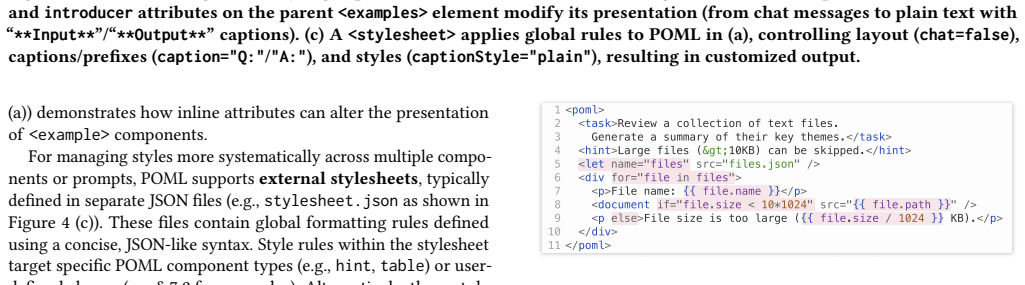
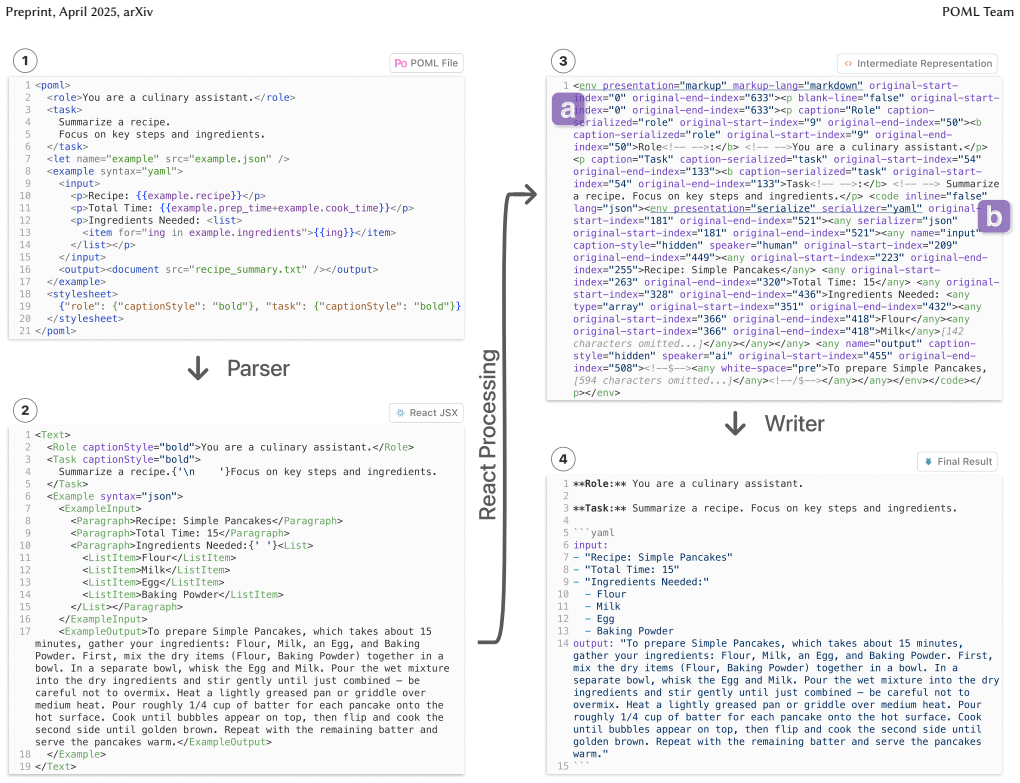
The load-bearing mechanism is POML's styling system: a CSS-like layer where a stylesheet (JSON or inline stylesheet tag) controls presentation attributes — overall syntax, table serialization format, caption style and visibility, example layout (chat vs introducer vs plain), list markers — independently of semantic markup. A three-pass rendering pipeline (parse into components, build an intermediate representation, serialize through a target writer) makes the decoupling operational, allowing one base prompt to be rendered into tens of thousands of styles and into different output formats (Markdown, JSON, plain text) from the same representation.
Load-bearing premise
The load-bearing premise is that changing a prompt's presentation never changes its meaning: POML assumes stylesheets can alter syntax, captions, and layout while the model still sees the same underlying content.
What would settle it
Render the same POML source under two stylesheets and record the exact final strings sent to the model. If two styles that produce identical strings nevertheless lead to different answers, the styling system is not the causal variable; if two styles that are meant to differ only in presentation change which content is visible (e.g., a hidden caption or a collapsed table drops a fact the model needs), the decoupling premise fails. A direct test would compare model accuracy on style pairs whose rendered strings differ only in whitespace or order versus pairs that delete or reorder content.
If this is right
- If styling is decoupled, a single prompt's content can be re-rendered for different target models, and the TableQA results indicate the optimal rendering is model-specific rather than universal.
- Prompt teams can treat formatting as a tunable search dimension: the paper demonstrates 73,926 styles generated from one 30-line base POML file, so systematic experiments can replace hand-maintained parallel copies.
- Format-sensitivity findings imply that published prompt-engineering results should specify or control presentation, since a style change can swing accuracy more than many content changes.
- The PomLink 'Auto' table format shows the same data can be serialized differently per backend model, making style adaptation a runtime deployment decision rather than a manual rewrite.
- Because POML files are text and modular, they fit standard version-control workflows, easing collaboration on prompt changes.
Where Pith is reading between the lines
- An implication the paper leaves implicit is that prompt-styling search can be automated: the stylesheet representation is machine-readable, so an optimizer could sample and score styles the way the paper did manually, and the model-specific rankings suggest the objective function differs per model.
- The decoupling premise implies a testable boundary: if a style change ever alters token order, emphasis, or which content is visible, it is no longer pure presentation. That boundary is worth probing because hidden captions and collapsed tables can delete information.
- A testable extension is to apply the same three-pass rendering idea beyond single-turn text prompts — for example, to agent system prompts or multimodal contexts, where the content tree stays stable but the target writer changes.
Editorial analysis
A structured set of objections, weighed in public.
Referee Report
Summary. The paper introduces POML (Prompt Orchestration Markup Language), an HTML-like markup language for authoring LLM prompts. POML provides structural components (<role>, <task>, <example>), data components for documents/tables/images, a CSS-inspired styling system that decouples content from presentation, and a templating engine. The authors also describe an IDE extension (VSCode IntelliSense, live preview, diagnostics) and Python/Node SDKs. Validation consists of two case studies: PomLink, an iOS agent prototype built in two days using POML, and TableQA, a study of 100 randomly sampled prompt styles applied to 283 WikiTQ samples across 8 LLMs. In addition, a user study with 7 participants assesses usability across five tasks. The paper claims that POML reduces formatting sensitivity and improves accuracy performance, and that its tooling improves developer workflow.
Significance. If the empirical claims were fully supported, POML would be a meaningful contribution to prompt-engineering tooling: the design is comprehensive, the implementation appears substantial (14.8k lines, 37 components, 115 test cases), and the detailed appendices (style search space, three-pass rendering architecture, IR specifications) are valuable. The PomLink case study and the qualitative user-study feedback suggest that POML's data components and live preview are genuinely useful in practice. However, the central quantitative claim—that POML's styling system improves accuracy or mitigates format sensitivity—is not established by the TableQA experiment as presented. The experiment shows, at best, that LLM performance is sensitive to prompt formatting, a known phenomenon, and that POML can generate many formatting variants. The paper overstates this as POML's impact on accuracy. The user study, while informative, is small and lacks a comparison baseline. With targeted revisions to the evaluation and a more measured interpretation, the paper could be a solid systems/HCI contribution.
major comments (5)
- [§7.2, Table 2] The TableQA experiment has no baseline. The reported 'accuracy improvements' of 929% and 4450% are relative differences between the worst and best of 100 randomly sampled styles, not improvements of POML over plain-text prompts or existing markup tools. The abstract and contribution (3) claim POML 'demonstrates its impact on accuracy performance,' but the design cannot support that. To support such a claim, the paper must include a baseline condition (e.g., the same TableQA task written as plain text or in an existing format such as ChatML/PromptML) and compare POML-rendered prompts against it. Without this, the paper should be reworded to claim only that styling variations affect LLM accuracy, not that POML improves it.
- [§7.2, Table 1 and §7.1 'Auto' option] The 'optimal' styles in Table 1 are selected post hoc on the same 283 samples used to compute all accuracy numbers. There is no held-out evaluation of the selected styles. This matters because the PomLink 'Auto' option (§7.1) consumes these fitted results to choose table formats for new prompts. The self-correlation metric (Table 2) is a split-half stability measure, not a validation of the top style. The authors should split the data, select styles on a training subset, and evaluate on a held-out subset; they should also report whether the 'Auto' choice outperforms a fixed default or random style on unseen data.
- [Table 2, Phi-3 Medium row] The extreme relative improvements are statistically fragile. Phi-3 Medium's minimum accuracy is 0.007, which on 283 samples corresponds to roughly 2 correct answers, so the denominator is indistinguishable from zero. Reporting a 4450% improvement from such a baseline is misleading. The paper should report absolute differences with confidence intervals (e.g., Wilson intervals) and should avoid presenting min/max extremes from 100 random draws as evidence of POML's benefit. Similarly, Table 6 performs many Mann-Whitney U tests without multiple-comparison correction; the p-values should be adjusted (e.g., Benjamini-Hochberg) and effect sizes reported.
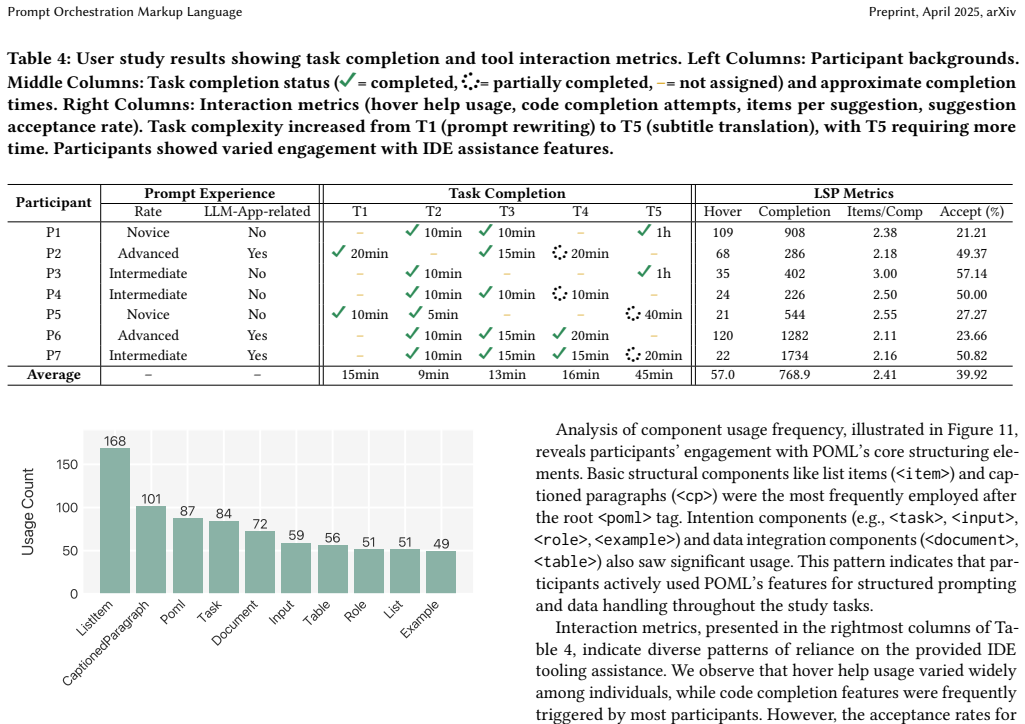
- [§8 and §9.2] The user study's central claims are limited by the acknowledged small sample (N=7), the restricted 90-minute sessions, and the authors' own admission that most participants 'did not deeply engage with complex stylesheets' (§9.2). The paper nevertheless describes the study as a 'formal user study' and uses it to support POML's effectiveness. I would ask the authors to either temper the language (e.g., 'pilot study') or add complementary evidence, such as a comparison task with plain-text prompts or with another markup tool. The current design cannot distinguish POML's effect from the Hawthorne effect of a new tool in a lab setting.
- [§4.3, DG3] The design goal DG3 assumes that prompt presentation can be decoupled from content without changing the underlying meaning the model sees. The paper operationalizes this through stylesheets, but does not verify content invariance: changing syntax, caption styles, or list styles also changes tokenization, ordering, and emphasis, which could alter semantics. This is not necessarily a fatal flaw, but it is a load-bearing assumption for the claim that POML 'reduces formatting sensitivity' rather than simply shifting it. The TableQA study could partially address this by comparing styles that differ only in presentation while holding the exact words constant, but the current analysis does not isolate this. I recommend adding an explicit test or at least a careful discussion of this limitation.
minor comments (6)
- [Table 2 caption] The term 'Self-corr.' is used without a definition in the main text. It is defined only later in Appendix E. Please define it in the caption or in §7.2.
- [Figure 6] In Figure 6, the diagnostic message shows 'captionStyle should be one of header, bold, plain, hidden, not "head"' but the list of valid values is inconsistent with the text in §4.3, which mentions 'header, bold, plain, hidden'. This is a small documentation inconsistency that could confuse users.
- [Figure 10] The style search space diagram (Figure 10) is dense and hard to read, especially the labels for options (a) through (e). A table listing the discrete choices with their cardinalities would improve reproducibility and clarity.
- [§7.2] The paper says 'we randomly sampled 100 styles without replacement for evaluation' but does not report the random seed or whether the same styles were used across all models. Please clarify whether the 100 styles are identical across models and provide the seed for reproducibility.
- [Appendix E, Table 6] Table 6 uses arrows (D, ✗, –) with p-values in cells. The notation is not intuitive; a legend would help. Also, the interaction-effect rows are valuable but are not discussed in the main text.
- [Throughout] The paper uses the phrase 'rigorous empirical evaluation' (e.g., §7 and §10). Given the limitations of the TableQA and user studies, I recommend a more measured description such as 'initial empirical exploration' or 'case-study-based evaluation.'
Circularity Check
No significant circularity: POML's claims rest on new implementations, a user study, and fresh accuracy measurements; the TableQA 'optimal style' lookups are descriptive fits, not predictions.
full rationale
The paper's central derivation is self-contained. The TableQA study (Section 7.2) samples 100 styles, measures accuracy on 283 WikiTQ examples, and reports min/max values; the 'optimal style' entries in Table 1 are the best among those samples, i.e., descriptive maxima, not predicted values. PomLink's 'Auto' table-format option then looks up those empirically determined best formats (Section 7.1), which is a fitted input used as a feature, not a prediction of unseen style performance. The other load-bearing evidence for POML's utility is the PomLink implementation, the seven-participant user study (Section 8), and the IDE/SDK toolkit description, none of which reduce by construction to the claims being validated. Self-citations (e.g., [18], [48], [103]) appear as background or as design motivation; the format-sensitivity premise is also supported by independent external citations [73,76,89] and by the paper's own fresh measurements, so these self-citations are not load-bearing. No equation, definition, or fitted parameter is renamed as a prediction. Statistical and validity weaknesses in TableQA (no baseline, extreme min/max without confidence intervals) concern experimental rigor, not circularity, and are left out of this score.
Axiom & Free-Parameter Ledger
free parameters (2)
- Model-specific optimal styling configurations (Table 1) =
e.g., GPT-3.5 Turbo: Overall Syntax=Markdown, Table Syntax=TSV, Instruction Header=Plain-Upper-Colon, Example Caption=He
- Style search space dimensionality (Figure 10) =
74k combinations from hand-chosen style options
axioms (4)
- domain assumption LLM prompt formatting sensitivity is a real, general phenomenon that can be measured on WikiTQ.
- domain assumption The 8 selected low-cost LLMs and the 283 WikiTQ samples are representative of LLM prompt behavior.
- domain assumption A single POML template combined with stylesheets can faithfully generate all 74k prompt variations without hidden interactions between content and styling.
- domain assumption The user study's think-aloud sessions and self-reported metrics capture real workflow benefits.
Cite this review
Pith. "Pith review of Prompt Orchestration Markup Language." pith.science (2026). https://pith.science/paper/QA37IJOR
@misc{pith2026250813948,
  author       = {Pith},
  title        = {Pith review of: Prompt Orchestration Markup Language},
  year         = {2026},
  howpublished = {\url{https://pith.science/paper/QA37IJOR}},
  note         = {Machine review of arXiv:2508.13948}
}
read the original abstract
Large Language Models (LLMs) require sophisticated prompting, yet current practices face challenges in structure, data integration, format sensitivity, and tooling. Existing methods lack comprehensive solutions for organizing complex prompts involving diverse data types (documents, tables, images) or managing presentation variations systematically. To address these gaps, we introduce POML (Prompt Orchestration Markup Language). POML employs component-based markup for logical structure (roles, tasks, examples), specialized tags for seamless data integration, and a CSS-like styling system to decouple content from presentation, reducing formatting sensitivity. It includes templating for dynamic prompts and a comprehensive developer toolkit (IDE support, SDKs) to improve version control and collaboration. We validate POML through two case studies demonstrating its impact on complex application integration (PomLink) and accuracy performance (TableQA), as well as a user study assessing its effectiveness in real-world development scenarios.
Figures






Forward citations
Cited by 3 Pith papers
-
A Language for Describing Agentic LLM Contexts
ACDL is a language for specifying the structure and dynamics of LLM input contexts in agent systems using constructs for roles, dynamic content, time references, and conditional structures.
-
A Prompt-Aware Structuring Framework for Reliable Reuse of AI-Generated Content in the Agentic Web
A framework structures AI-generated content with prompt-aware metadata and verifiable credentials to support reliable assessment and reuse by agents.
-
When the Code Autopilot Breaks: Why LLMs Falter in Embedded Machine Learning
LLM-based sketch generation for embedded ML is fragile, with success rates below 40%, and prompt structure alone can swing outcomes from 15% to 30%.
Reference graph
Works this paper leans on
-
[1]
Azure AI. 2024. Evaluate your Generative AI application locally with the Azure AI Evaluation SDK. https://learn.microsoft.com/en-us/azure/ai-foundry/how- to/develop/evaluate-sdk
2024
-
[2]
Cursor AI. 2025. Generate Cursor Project Rule (.mdc). https://cursor.directory/ generate
2025
-
[3]
LangChain AI. 2022. LangChain. https://www.langchain.com/
2022
-
[4]
LangChain AI. 2023. LangSmith. https://www.langchain.com/langsmith
2023
-
[5]
Angular. 2010. Introduction to components and templates. https://v17.angular. io/guide/architecture-components
2010
-
[6]
Anthropic. 2024. The Claude 3 Model Family: Opus, Sonnet, Haiku. https:// assets.anthropic.com/m/61e7d27f8c8f5919/original/Claude-3-Model-Card.pdf. Preprint, April 2025, arXiv POML Team
2024
-
[7]
Anthropic. 2024. Use XML tags to structure your prompts. https://docs.anthropic. com/en/docs/build-with-claude/prompt-engineering/use-xml-tags
2024
-
[8]
anysphere. 2024. priompt. https://github.com/anysphere/priompt
2024
-
[9]
Ian Arawjo, Chelse Swoopes, Priyan Vaithilingam, Martin Wattenberg, and Elena L Glassman. 2024. ChainForge: A Visual Toolkit for Prompt Engineering and LLM Hypothesis Testing. In Proceedings of the CHI Conference on Human Factors in Computing Systems . 1–18
2024
-
[10]
AutosseyAI. 2024. prxmpt. https://github.com/AutosseyAI/prxmpt
2024
-
[11]
Stephen H Bach, Victor Sanh, Zheng-Xin Yong, Albert Webson, Colin Raffel, Nihal V Nayak, Abheesht Sharma, Taewoon Kim, M Saiful Bari, Thibault Fevry, et al. 2022. Promptsource: An integrated development environment and reposi- tory for natural language prompts. arXiv preprint arXiv:2202.01279 (2022)
Pith/arXiv arXiv 2022
-
[12]
Tim Berners-Lee. 1991. Re: status. Re: X11 BROWSER for WWW. https://lists. w3.org/Archives/Public/www-talk/1991SepOct/0003.html
1991
-
[13]
Bradybry. 2023. ChatXML: A proposal for a structured LLM prompt method. https://github.com/Bradybry/chatXML
2023
-
[14]
Tom B Brown. 2020. Language models are few-shot learners. arXiv preprint arXiv:2005.14165 (2020)
Pith/arXiv arXiv 2020
-
[15]
Fernando Miguel Carvalho, Luis Duarte, and Julien Gouesse. 2020. Text web templates considered harmful. In Web Information Systems and Technologies: 15th International Conference, WEBIST 2019, Vienna, Austria, September 18–20, 2019, Revised Selected Papers 15 . Springer, 69–95
2020
-
[16]
ChatPDF. 2024. ChatPDF. https://www.chatpdf.com/
2024
-
[17]
Mark Chen, Jerry Tworek, Heewoo Jun, Qiming Yuan, Henrique Ponde De Oliveira Pinto, Jared Kaplan, Harri Edwards, Yuri Burda, Nicholas Joseph, Greg Brockman, et al. 2021. Evaluating large language models trained on code. arXiv preprint arXiv:2107.03374 (2021)
Pith/arXiv arXiv 2021
-
[18]
Nan Chen, Yuge Zhang, Jiahang Xu, Kan Ren, and Yuqing Yang. 2024. VisEval: A Benchmark for Data Visualization in the Era of Large Language Models. IEEE Transactions on Visualization and Computer Graphics (2024)
2024
-
[19]
Karl Cobbe, Vineet Kosaraju, Mohammad Bavarian, Mark Chen, Heewoo Jun, Lukasz Kaiser, Matthias Plappert, Jerry Tworek, Jacob Hilton, Reiichiro Nakano, et al. 2021. Training verifiers to solve math word problems. arXiv preprint arXiv:2110.14168 (2021)
Pith/arXiv arXiv 2021
-
[20]
Hai Dang, Lukas Mecke, Florian Lehmann, Sven Goller, and Daniel Buschek
-
[21]
Google Deepmind. 2024. Introducing Gemini 2.0: our new AI model for the agentic era. https://blog.google/technology/google-deepmind/google-gemini- ai-update-december-2024/
2024
-
[22]
DeepSeek-AI. 2024. DeepSeek-V3 Technical Report. arXiv:2412.19437 [cs.CL]
Pith/arXiv arXiv 2024
-
[23]
Ant Design. 2015. Ant Design. https://ant.design/
2015
-
[24]
Michael Desmond and Michelle Brachman. 2024. Exploring Prompt Engineering Practices in the Enterprise. arXiv preprint arXiv:2403.08950 (2024)
Pith/arXiv arXiv 2024
-
[25]
Shehzaad Dhuliawala, Mojtaba Komeili, Jing Xu, Roberta Raileanu, Xian Li, Asli Celikyilmaz, and Jason E Weston. [n. d.]. Chain-of-Verification Reduces Hallucination in Large Language Models. In ICLR 2024 Workshop on Reliable and Responsible Foundation Models
2024
-
[26]
MDN Web Docs. 2025. CSS: Cascading Style Sheets. https://developer.mozilla. org/en-US/docs/Web/CSS
2025
-
[27]
MDN Web Docs. 2025. HTML: HyperText Markup Language. https://developer. mozilla.org/en-US/docs/Web/HTML
2025
-
[28]
MDN Web Docs. 2025. JavaScript. https://developer.mozilla.org/en-US/docs/ Web/JavaScript
2025
-
[29]
Django documentation. 2024. Templates. https://docs.djangoproject.com/en/5. 1/topics/templates/
2024
-
[30]
edspencer. 2024. mdx-prompt. https://github.com/edspencer/mdx-prompt
2024
-
[31]
Bahare Fatemi, Jonathan Halcrow, and Bryan Perozzi. 2024. Talk like a Graph: Encoding Graphs for Large Language Models. In The Twelfth International Conference on Learning Representations
2024
-
[32]
fixie ai. 2024. AI.JSX — The AI Application Framework for Javascript. https: //github.com/fixie-ai/ai-jsx/
2024
-
[33]
gensx inc. 2024. gensx. https://github.com/gensx-inc/gensx
2024
-
[34]
Handlebars. 2011. Handlebars. https://handlebarsjs.com/
work page 2011
-
[35]
Jia He, Mukund Rungta, David Koleczek, Arshdeep Sekhon, Franklin X Wang, and Sadid Hasan. 2024. Does Prompt Formatting Have Any Impact on LLM Performance? arXiv preprint arXiv:2411.10541 (2024)
Pith/arXiv arXiv 2024
-
[36]
Xinyi He, Yihao Liu, Mengyu Zhou, Yeye He, Haoyu Dong, Shi Han, Zejian Yuan, and Dongmei Zhang. 2025. TableLoRA: Low-rank Adaptation on Table Structure Understanding for Large Language Models. arXiv:2503.04396 [cs.CL] https://arxiv.org/abs/2503.04396
Pith/arXiv arXiv 2025
-
[37]
Dan Hendrycks, Collin Burns, Steven Basart, Andy Zou, Mantas Mazeika, Dawn Song, and Jacob Steinhardt. 2021. Measuring Massive Multitask Language Understanding. In International Conference on Learning Representations
2021
-
[38]
Albert Q. Jiang, Alexandre Sablayrolles, Antoine Roux, Arthur Mensch, Blanche Savary, Chris Bamford, Devendra Singh Chaplot, Diego de las Casas, Emma Bou Hanna, Florian Bressand, Gianna Lengyel, Guillaume Bour, Guil- laume Lample, Lélio Renard Lavaud, Lucile Saulnier, Marie-Anne Lachaux, Pierre Stock, Sandeep Subramanian, Sophia Yang, Szymon Antoniak, Tev...
Pith/arXiv arXiv 2024
-
[39]
Carlos E Jimenez, John Yang, Alexander Wettig, Shunyu Yao, Kexin Pei, Ofir Press, and Karthik R Narasimhan. 2024. SWE-bench: Can Language Models Resolve Real-world Github Issues?. In The Twelfth International Conference on Learning Representations. https://openreview.net/forum?id=VTF8yNQM66
work page 2024
-
[40]
Jinja. 2022. Jinja – Jinja documentation. https://jinja.palletsprojects.com/en/3.1. x/
work page 2022
-
[41]
latitude dev. 2024. latitude-llm. https://github.com/latitude-dev/latitude-llm
work page 2024
-
[42]
Avraham Leff and James T Rayfield. 2001. Web-application development using the model/view/controller design pattern. In Proceedings fifth ieee international enterprise distributed object computing conference . IEEE, 118–127
work page 2001
-
[43]
leforestier. 2016. yattag. https://github.com/leforestier/yattag
work page 2016
-
[44]
Zekun Li, Baolin Peng, Pengcheng He, Michel Galley, Jianfeng Gao, and Xifeng Yan. 2024. Guiding large language models via directional stimulus prompting. Advances in Neural Information Processing Systems 36 (2024)
work page 2024
-
[45]
Demiao Lin. 2024. Revolutionizing Retrieval-Augmented Generation with En- hanced PDF Structure Recognition. arXiv:2401.12599 [cs.AI] https://arxiv.org/ abs/2401.12599
Pith/arXiv arXiv 2024
-
[46]
Haotian Liu, Chunyuan Li, Qingyang Wu, and Yong Jae Lee. 2023. Visual Instruction Tuning. arXiv:2304.08485 [cs.CV] https://arxiv.org/abs/2304.08485
Pith/arXiv arXiv 2023
-
[47]
Xiao Liu, Hao Yu, Hanchen Zhang, Yifan Xu, Xuanyu Lei, Hanyu Lai, Yu Gu, Hangliang Ding, Kaiwen Men, Kejuan Yang, Shudan Zhang, Xiang Deng, Aohan Zeng, Zhengxiao Du, Chenhui Zhang, Sheng Shen, Tianjun Zhang, Yu Su, Huan Sun, Minlie Huang, Yuxiao Dong, and Jie Tang. 2023. AgentBench: Evaluating LLMs as Agents. arXiv preprint arXiv: 2308.03688 (2023)
Pith/arXiv arXiv 2023
-
[48]
Yuanye Liu, Jiahang Xu, Li Lyna Zhang, Qi Chen, Xuan Feng, Yang Chen, Zhongxin Guo, Yuqing Yang, and Peng Cheng. 2025. Beyond Prompt Content: Enhancing LLM Performance via Content-Format Integrated Prompt Optimiza- tion. arXiv:2502.04295 [cs.CL] https://arxiv.org/abs/2502.04295
Pith/arXiv arXiv 2025
-
[49]
Arvid Lunnemark. 2023. Prompt Design. https://arvid.xyz/posts/prompt- design/
work page 2023
-
[50]
mannaandpoem. 2025. Building OpenManus as a Service. https://openmanus. org/
work page 2025
-
[51]
mattnigh. 2023. ChatGPT3-Free-Prompt-List: A free guide for learning to create ChatGPT3 Prompts. https://github.com/mattnigh/ChatGPT3-Free-Prompt-List
work page 2023
-
[52]
Microsoft. 2016. Language Server Protocol. https://microsoft.github.io/language- server-protocol/
work page 2016
-
[53]
Microsoft. 2023. Guidance. https://github.com/guidance-ai/guidance
work page 2023
-
[54]
Microsoft. 2023. Semantic Kernel. https://github.com/microsoft/semantic- kernel
work page 2023
-
[55]
Microsoft. 2024. Phi-3 Technical Report: A Highly Capable Language Model Locally on Your Phone. arXiv:2404.14219 [cs.CL] https://arxiv.org/abs/2404. 14219
Pith/arXiv arXiv 2024
-
[56]
Yasuhiko Minamide. 2005. Static approximation of dynamically generated web pages. In Proceedings of the 14th international conference on World Wide Web . 432–441
work page 2005
-
[57]
Aditi Mishra, Utkarsh Soni, Anjana Arunkumar, Jinbin Huang, Bum Chul Kwon, and Chris Bryan. 2023. Promptaid: Prompt exploration, perturbation, testing and iteration using visual analytics for large language models. arXiv preprint arXiv:2304.01964 (2023)
Pith/arXiv arXiv 2023
-
[58]
MUI. 2014. Material UI. https://mui.com/
work page 2014
-
[59]
OpenAI. 2020. Playground. https://platform.openai.com/playground
work page 2020
-
[60]
OpenAI. 2023. ChatGPT. https://chatgpt.com/
2023
-
[61]
OpenAI. 2024. GPT-3.5 Turbo. https://platform.openai.com/docs/models/gpt- 3.5-turbo
work page 2024
-
[62]
OpenAI. 2024. GPT-4 Technical Report. arXiv:2303.08774 [cs.CL] https://arxiv. org/abs/2303.08774
Pith/arXiv arXiv 2024
-
[63]
OpenAI. 2024. GPT-4o System Card. https://cdn.openai.com/gpt-4o-system- card.pdf
work page 2024
-
[64]
Panupong Pasupat and Percy Liang. 2015. Compositional Semantic Parsing on Semi-Structured Tables. In Proceedings of the 53rd Annual Meeting of the Associ- ation for Computational Linguistics and the 7th International Joint Conference on Natural Language Processing (Volume 1: Long Papers) . 1470–1480
work page 2015
-
[65]
pezzolabs. 2024. pezzo. https://github.com/pezzolabs/pezzo
work page 2024
-
[66]
{Structured} Prompt. 2023. {Structured} Prompt. https://structuredprompt.com/
work page 2023
-
[67]
promptfoo. 2023. promptfoo. https://www.promptfoo.dev/
work page 2023
-
[68]
PromptML. 2023. PromptML (Prompt Markup Language). https://www. promptml.org/
work page 2023
-
[69]
React. 2013. Introducing JSX. https://legacy.reactjs.org/docs/introducing-jsx. html
work page 2013
-
[70]
React. 2013. React. https://react.dev/
work page 2013
-
[71]
React. 2024. Server Components. https://react.dev/reference/rsc/server- components. Prompt Orchestration Markup Language Preprint, April 2025, arXiv
work page 2024
-
[72]
Pranab Sahoo, Ayush Kumar Singh, Sriparna Saha, Vinija Jain, Samrat Mondal, and Aman Chadha. 2024. A systematic survey of prompt engineering in large language models: Techniques and applications. arXiv preprint arXiv:2402.07927 (2024)
Pith/arXiv arXiv 2024
-
[73]
Abel Salinas and Fred Morstatter. 2024. The butterfly effect of altering prompts: How small changes and jailbreaks affect large language model performance. arXiv preprint arXiv:2401.03729 (2024)
Pith/arXiv arXiv 2024
-
[75]
Tobias Schnabel and Jennifer Neville. 2024. Symbolic Prompt Program Search: A Structure-Aware Approach to Efficient Compile-Time Prompt Optimization. arXiv:2404.02319 [cs.CL] https://arxiv.org/abs/2404.02319
Pith/arXiv arXiv 2024
-
[76]
Melanie Sclar, Yejin Choi, Yulia Tsvetkov, and Alane Suhr. 2024. Quantifying Language Models’ Sensitivity to Spurious Features in Prompt Design or: How I learned to start worrying about prompt formatting. In The Twelfth International Conference on Learning Representations
work page 2024
-
[77]
Azure AI Services. 2024. Chat Markup Language ChatML (Preview). https://learn.microsoft.com/en-us/azure/ai-services/openai/how-to/chat- markup-language
work page 2024
-
[78]
Mohit Shridhar, Xingdi Yuan, Marc-Alexandre Côté, Yonatan Bisk, Adam Trischler, and Matthew Hausknecht. 2021. ALFWorld: Aligning Text and Em- bodied Environments for Interactive Learning. InProceedings of the International Conference on Learning Representations (ICLR) . https://arxiv.org/abs/2010.03768
Pith/arXiv arXiv 2021
-
[79]
Hendrik Strobelt, Albert Webson, Victor Sanh, Benjamin Hoover, Johanna Beyer, Hanspeter Pfister, and Alexander M Rush. 2022. Interactive and visual prompt engineering for ad-hoc task adaptation with large language models. IEEE transactions on visualization and computer graphics 29, 1 (2022), 1146–1156
work page 2022
-
[80]
Yuan Sui, Mengyu Zhou, Mingjie Zhou, Shi Han, and Dongmei Zhang. 2024. Table Meets LLM: Can Large Language Models Understand Structured Table Data? A Benchmark and Empirical Study. arXiv:2305.13062 [cs.CL] https: //arxiv.org/abs/2305.13062
Pith/arXiv arXiv 2024
-
[81]
Michiaki Tatsubori and Toyotaro Suzumura. 2009. HTML templates that fly: a template engine approach to automated offloading from server to client. In Proceedings of the 18th international conference on World wide web . 951–960
work page 2009
This paper was first reviewed by deepseek-v4-flash on August 5, 2026.
discussion (0)
Sign in with ORCID, Apple, or X to comment. Anyone can read and Pith papers without signing in.