Originality of resonance and locking phenomena in SFS φ₀ Josephson junction
Pith reviewed 2026-05-18 22:40 UTC · model grok-4.3
The pith
Two ferromagnetic resonances coexist and transform in one SFS φ₀ Josephson junction under microwave radiation.
A machine-rendered reading of the paper's core claim, the machinery that carries it, and where it could break.
Core claim
In an SFS φ₀ Josephson junction the spin-orbit interaction couples the Josephson phase with the magnetization of the ferromagnetic layer. This coupling produces the Kittel resonance when microwave radiation is applied and the Buzdin resonance through the interaction of the superconducting current with the magnetization. The resonances can transform into each other by varying the radiation or junction parameters, and a combined resonance displaying features of both can form. The same coupling causes double synchronization where both the magnetic precession and Josephson oscillations become synchronized to the external radiation.
What carries the argument
spin-orbit-induced coupling between the Josephson phase and ferromagnetic magnetization
If this is right
- Variation of external radiation and junction parameters switches the resonance from Kittel to Buzdin type or creates a combined resonance.
- Double synchronization allows external radiation to lock both magnetic precession and Josephson oscillations at once.
- The resonance transformations provide a direct route to manipulate both types in the same device.
Where Pith is reading between the lines
- Resonance switching might appear in other hybrid superconductor-ferromagnet structures that include spin-orbit effects.
- The double-locking behavior could support tunable microwave components that use resonance mode changes for signal control.
- Simulations with different ferromagnetic thicknesses or temperatures would map the full range where these synchronizations appear.
Load-bearing premise
The spin-orbit interaction is strong enough to produce a φ₀ junction whose parameters allow the Buzdin resonance to appear from superconducting-current–magnetization coupling and to transform under external radiation.
What would settle it
An experiment varying microwave frequency and power on an SFS φ₀ junction that finds no transformation between resonance types and no double synchronization would show the claimed interplay does not occur.
Figures


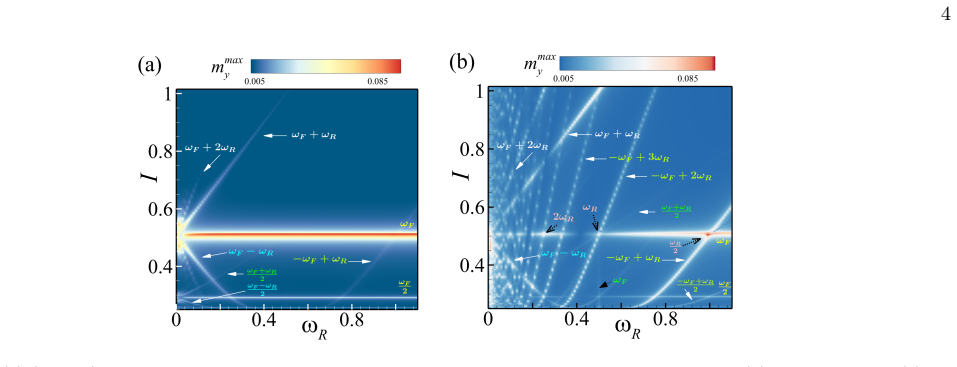

read the original abstract
We demonstrate the realization and interplay of two ferromagnetic resonances in one SFS $\varphi_0$ Josephson junction. First resonance that is realized under microwave radiation is the famous Kittel resonance. The other is Buzdin one appearing as a result of interaction of superconducting current and ferromagnetic interlayer magnetization. Transformations of one type of resonance to another under variation of external electromagnetic radiation and the $\varphi_0$ junction parameters open an interesting way to manipulation both of them. The combined ferromagnetic resonance that exhibits the features of both resonances is demonstrated too. The coupling of the Josephson phase with the magnetization of the ferromagnetic layer, caused by the spin-orbit interaction, leads to double synchronization, namely, synchronization of both magnetic precession and Josephson oscillations by external radiation. The obtained results demonstrate reach physics and unique opportunities for various applications.
Editorial analysis
A structured set of objections, weighed in public.
Referee Report
Summary. The manuscript numerically demonstrates the realization and interplay of Kittel and Buzdin ferromagnetic resonances in a single SFS φ₀ Josephson junction driven by microwave radiation. It reports transformations between these resonances upon varying external radiation and φ₀-junction parameters, the appearance of a combined resonance mode, and double synchronization in which both magnetic precession and Josephson oscillations lock to the external drive, all arising from the spin-orbit-induced coupling between Josephson phase and ferromagnetic magnetization.
Significance. If the numerical results hold under independent verification, the work illustrates how spin-orbit coupling in φ₀ junctions can produce controllable resonance interplay and locking within a single device. This adds concrete dynamical insight to the growing literature on hybrid superconducting-ferromagnetic systems and may inform applications in tunable Josephson electronics or magnonics. The use of standard LLG-Josephson equations with conventional numerics is a strength for reproducibility, though the absence of explicit parameter tables limits immediate falsifiability.
major comments (1)
- [Numerical results / parameter sweeps] The central claim of double synchronization and resonance transformation rests on the numerical spectra; however, the manuscript does not report the precise values or ranges of the φ₀ shift, damping, and radiation amplitude at which the locking occurs (see the parameter-sweep discussion). Without these, it is difficult to assess whether the observed locking is a robust prediction or sensitive to post-hoc tuning.
minor comments (3)
- [Abstract] The abstract contains the typographical error 'reach physics' which should read 'rich physics'.
- [Methods / numerical procedure] A table listing all fixed and varied parameters (including Gilbert damping, exchange field, and microwave amplitude) together with the integration timestep and convergence checks would greatly improve reproducibility.
- [Figures] Figure captions should explicitly state the frequency units and the definition of the plotted spectral density to avoid ambiguity when comparing Kittel and Buzdin peaks.
Simulated Author's Rebuttal
We thank the referee for the careful reading of our manuscript and the constructive comments. The feedback helps clarify how to strengthen the presentation of our numerical results. We address the major comment below and will revise the manuscript accordingly.
read point-by-point responses
-
Referee: [Numerical results / parameter sweeps] The central claim of double synchronization and resonance transformation rests on the numerical spectra; however, the manuscript does not report the precise values or ranges of the φ₀ shift, damping, and radiation amplitude at which the locking occurs (see the parameter-sweep discussion). Without these, it is difficult to assess whether the observed locking is a robust prediction or sensitive to post-hoc tuning.
Authors: We thank the referee for this observation. The parameter sweeps are shown in the figures, but we agree that explicit numerical ranges and representative values would improve reproducibility and allow readers to judge robustness directly. In the revised manuscript we will add a table (or expanded caption) that lists the intervals and specific values of the φ₀ shift, Gilbert damping, and microwave amplitude at which double synchronization and the resonance transformations are observed. These ranges are taken from the existing simulations and correspond to physically accessible regimes for SFS φ₀ junctions; the locking persists over finite intervals rather than isolated points, supporting robustness. We will also state the numerical tolerances used to identify locking. This addition addresses the concern without altering the conclusions or requiring new calculations. revision: yes
Circularity Check
No significant circularity; standard dynamical modeling
full rationale
The manuscript solves the conventional coupled LLG equation for the ferromagnetic layer magnetization together with the resistively-shunted Josephson junction equation that includes the spin-orbit-induced φ₀ shift. Kittel resonance appears at the expected uniform-precession frequency, Buzdin resonance emerges directly from the supercurrent–magnetization torque term, and double synchronization is observed in the numerical spectra under microwave drive. All reported transformations and locking phenomena are direct numerical outputs of these equations; no parameter is fitted to the target resonance ratios and then re-labeled as a prediction, and no uniqueness theorem is imported via self-citation to forbid alternatives. The derivation chain is therefore self-contained and externally falsifiable against established ferromagnetic-resonance and Josephson-junction benchmarks.
Axiom & Free-Parameter Ledger
free parameters (1)
- φ₀ junction parameters
axioms (1)
- domain assumption Spin-orbit interaction produces a φ₀ phase shift that couples Josephson phase to ferromagnetic magnetization.
Lean theorems connected to this paper
-
IndisputableMonolith/Cost/FunctionalEquation.leanwashburn_uniqueness_aczel unclear?
unclearRelation between the paper passage and the cited Recognition theorem.
The dynamics of the φ₀ junction is described by the Landau-Lifshitz-Gilbert (LLG), resistively and capacitively shunted junction, and the Josephson equations dm/dt = −ωF/(1+α²)(m×h_eff + α[m×(m×h_eff)]), V̇ = [I − V + r ṁ_y − sin(φ − φ₀)]/β_c, φ̇ = V
-
IndisputableMonolith/Foundation/RealityFromDistinction.leanreality_from_one_distinction unclear?
unclearRelation between the paper passage and the cited Recognition theorem.
We demonstrate the realization and interplay of two ferromagnetic resonances in one SFS φ₀ Josephson junction... synchronization of both magnetic precession and Josephson oscillations by external radiation.
What do these tags mean?
- matches
- The paper's claim is directly supported by a theorem in the formal canon.
- supports
- The theorem supports part of the paper's argument, but the paper may add assumptions or extra steps.
- extends
- The paper goes beyond the formal theorem; the theorem is a base layer rather than the whole result.
- uses
- The paper appears to rely on the theorem as machinery.
- contradicts
- The paper's claim conflicts with a theorem or certificate in the canon.
- unclear
- Pith found a possible connection, but the passage is too broad, indirect, or ambiguous to say the theorem truly supports the claim.
Reference graph
Works this paper leans on
-
[1]
Originality of resonance and locking phenomena in SFS $\varphi_0$ Josephson junction
The combination of electric and magnetic fields demonstrates a chimera step in the IV-curve that shows both features of the Shapiro and Buzdin steps [8, 9]. It was stressed that the width of the chimera step is not a trivial sum of the SS and BS. The coupling between the superconducting phase and magnetization in Josephson junctions is intensively discuss...
work page internal anchor Pith review Pith/arXiv arXiv 2025
-
[2]
A. Buzdin. Direct coupling between magnetism and superconducting current in the Josephson φ0 junction, Phys. Rev. Lett. 101, 107005 (2008)
work page 2008
-
[3]
T. Yokoyama, M. Eto, and Y. V. Nazarov. Anomalous Josephson effect induced by spin-orbit interaction and Zeeman effect in semiconductor nanowires, Phys. Rev. B 89, 195407 (2014)
work page 2014
-
[4]
F. m. c. Konschelle, I. V. Tokatly, and F. S. Bergeret. Theory of the spin-galvanic effect and the anomalous phase shift φ0 in superconductors and Josephson junctions with intrinsic spin-orbit coupling, Phys. Rev. B 92, 125443 (2015). 6
work page 2015
-
[5]
F. S. Bergeret, and I. V. Tokatly. Theory of diffusive φ0 Josephson junctions in the presence of spin-orbit coupling, EPL 110, 57005 (2015)
work page 2015
-
[6]
Yu. M. Shukrinov. Anomalous Josephson effect, Phys. Usp. 65, 317 (2022)
work page 2022
-
[7]
F. Konschelle and A. Buzdin. Magnetic Moment Manipulation by a Josephson Current, Phys. Rev. Lett. 102, 017001 (2009)
work page 2009
-
[8]
S. A. Abdelmoneim, Yu. M. Shukrinov, K. V. Kulikov, H. ElSamman, and M. Nashaat. Locking of magnetization and Josephson oscillations at ferromagnetic resonance in a φ0 junction under external radiation, Phys. Rev. B106, 014505 (2022)
work page 2022
-
[9]
Yu. M. Shukrinov, Yu. M., E. Kovalenko, J. Tekic, K. Kulikov, and M. Nashaat. Buzdin, Shapiro and chimera steps in φ0 Josephson junctions, Phys. Rev. B 109, 024511 (2024)
work page 2024
-
[10]
M. Nashaat, E. Kovalenko, and Yu. M. Shukrinov. Buzdin, Shapiro and chimera steps in φ0 Josephson Junctions. II. bifurcation, switching, and hysteresis, Phys. Rev. B 110, 024510 (2024)
work page 2024
-
[11]
A. A. Reynoso, G. Usaj, C. A. Balseiro, D. Feinberg, and M. Avignon, Anomalous Josephson current in junctions with spin polarizing quantum point contacts, Phys. Rev. Lett. 101, 107001 (2008)
work page 2008
-
[12]
A. Brunetti, A. Zazunov, A. Kundu, and R. Egger. Anomalous Josephson current, incipient time-reversal symmetry breaking, and Majorana bound states in interacting multilevel dots, Phys. Rev. B 88, 144515 (2013)
work page 2013
-
[13]
K. N. Nesterov, M. Houzet, and J. S. Meyer. Anomalous Josephson effect in semiconducting nanowires as a signature of the topologically nontrivial phase, Phys. Rev. B 93, 174502 (2016)
work page 2016
-
[14]
D. Kuzmanovski, J. Linder, and A. Black-Schaffer. Quantum ground state control in superconductor-silicene structures: 0 −π transitions, φ0 -junctions, and Majorana bound states, Phys. Rev. B 94, 180505 (2016)
work page 2016
-
[15]
A. Assouline, C. Feuillet-Palma, N. Bergeal, T. Zhang, A. Mottaghizadeh, A. Zimmers, E. Lhuillier, M. Eddrie, P. Atkinson, M. Aprili, and H. Aubin. Spin-Orbit induced phase-shift in Bi2Se3 Josephson junctions. Nature communications, 10(1), 126 (2019)
work page 2019
-
[16]
M. Alidoust, S. Chenghao, and Z. Igor. Cubic spin- orbit coupling and anomalous Josephson effect in planar junctions, Phys. Rev. B 103 (6) L060503 (2021)
work page 2021
- [17]
-
[18]
G. A. Bobkov, I. V. Bobkova, and A. M. Bobkov. Magnetic eigenmodes in chains of coupled φ0-Josephson junctions with ferromagnetic weak links. JETP Letters, 119(3), pp.251-260 (2024)
work page 2024
- [19]
-
[20]
B. Lu, K. Yada, A. A. Golubov, and Y. Tanaka. Anomalous Josephson effect in d-wave superconductor junctions on a topological insulator surface, Phys. Rev. B 92, 100503 (2015)
work page 2015
-
[21]
F. Dolcini, M. Houzet, and J. S. Meyer. Topological Josephson φ0 junctions, Phys. Rev. B 92, 035428 (2015)
work page 2015
- [22]
-
[23]
C. Schrade, S. Hoffman, S. and D. Loss. Detecting topological superconductivity with φ0 Josephson junctions, Phys. Rev. B 95, 195421 (2017)
work page 2017
- [24]
-
[25]
Yu M. Shukrinov, I. R. Rahmonov, K. Sengupta, and A. Buzdin. Magnetization reversal by superconducting current in φ Josephson junctions, Appl. Phys. Lett. 110, 18 (2017)
work page 2017
-
[26]
C. Guarcello, and F. S. Bergeret. Cryogenic memory element based on an anomalous Josephson junction, Phys. Rev. Appl. 13(3), 034012 (2020)
work page 2020
-
[27]
I. V. Bobkova, A. M. Bobkov, I. R. Rahmonov, A. A. Mazanik, K. Sengupta, and Yu. M. Shukrinov. Magnetization reversal in superconductor/insulating ferromagnet/superconductor Josephson junctions on a three-dimensional topological insulator, Phys. Rev. B 102, 134505 (2020)
work page 2020
-
[28]
M. Nashaat, I. V. Bobkova, A. M. Bobkov, Yu. M. Shukrinov, I. R. Rahmonov, and K. Sengupta, Electrical control of magnetization in superconductor/ferromagnet/superconductor junctions on a three-dimensional topological insulator, Phys. Rev. B 100, 054506 (2019)
work page 2019
-
[29]
G. A. Bobkov, I. V. Bobkova, and A. M. Bobkov, Controllable magnetic states in chains of coupled φ0 Josephson junctions with ferromagnetic weak links. Physical Review B 109(5), 054523 (2024)
work page 2024
-
[30]
G. A. Bobkov, A. M. Bobkov, and I. V. Bobkova. (2024).Voltage-driven dynamics of φ0 superconductor/ferromagnet/superconductor Josephson junction chains. Physical Review B, 110(13), 134522 (2024)
work page 2024
-
[31]
Yu. M. Shukrinov, I. R. Rahmonov, A. Janalizadeh and M. R. Kolahchi. Anomalous Gilbert damping and Duffing features of the superconductor-ferromagnet- superconductor φ0 Josephson junction, Physical Review B, 104(22), 224511 (2021)
work page 2021
-
[32]
S. E. Barnes, M. Aprili, I. Petkovic and S. Maekawa. Ferromagnetic resonance with a magnetic Josephson junction, Supercond. Sci. Technol. 24, 024020 (2011)
work page 2011
-
[33]
S. Mai, E. Kandelaki, A. F. Volkov, and K. B. Efetov. Interaction of Josephson and magnetic oscillations in Josephson tunnel junctions with a ferromagnetic layer, Phys. Rev.B 84, 144519 (2011)
work page 2011
- [34]
-
[35]
M. Nashaat, A. E. Botha, Yu. M. Shukrinov, Devil’s Staircases in SFS Josephson Junctions, Phys. Rev. B 97, 224514 (2018)
work page 2018
- [36]
- [37]
-
[38]
K.-R. Jeon, C. , H. Kurebayashi, L. F. Cohen, X. Montiel, M. Eschrig, T. Wagner, S. Komori, A. Srivastava, J. W. Robinson, and M. G. Blamire. Effect of Meissner screening and trapped magnetic flux on magnetization dynamics in thick Nb/Ni80Fe20/Nb trilayers, Phys. Rev. Appl. 11, 014061 (2019)
work page 2019
-
[39]
I. A. Golovchanskiy, N. N. Abramov, V. S. Stolyarov, V. I. Chichkov, M. Silaev, I. V. Shchetinin, A. A. Golubov, V. V. Ryazanov, A. V. Ustinov, and M. Y. Kupriyanov. Magnetization dynamics in proximity- coupled superconductor- ferromagnet-superconductor multilayers, Phys. Rev. Appl. 14, 024086 (2020)
work page 2020
-
[40]
I.A. Golovchanskiy, N.N. Abramov, O.V. Emelyanova, I.V. Shchetinin, V.V. Ryazanov, A.A. Golubov, and V.S. Stolyarov, Magnetization dynamics in proximity-coupled superconductor-ferromagnet- superconductor Multilayers. II. Thickness dependence of the superconducting torque, Phys. Rev. Appl.19, 034025 (2023)
work page 2023
-
[41]
S. V. Mironov and A. I. Buzdin, Giant demagnetization effects induced by superconducting films, Appl. Phys. Lett. 119, 102601 (2021)
work page 2021
-
[42]
Silaev, Anderson-Higgs mass of magnons in superconductor-ferromagnet-superconductor systems, Phys
M. Silaev, Anderson-Higgs mass of magnons in superconductor-ferromagnet-superconductor systems, Phys. Rev. Appl. 18, L061004 (2022)
work page 2022
-
[43]
X.-H. Zhou and T. Yu, Gating ferromagnetic resonance of magnetic insulators by superconductors via modulating electric field radiation, Phys. Rev. B 108, 144405 (2023)
work page 2023
-
[44]
J. Li, J. Zhang, G. Yang, and W. Zhao, Efficient shift of ferromagnetic resonance by superconductor gating, Appl. Phys. Rev. 12, 011419 (2025)
work page 2025
- [45]
-
[46]
R. W. Greening, D. A. Smith, Y. Lim, Z. Jiang, J. Barber, S. Dail, J. J. Heremans, and S. Emori. Current- induced spin–orbit field in permalloy interfaced with ultra thin ti and cu. Appl. Phys. Lett. 116(5), (2020)
work page 2020
-
[47]
A. Yu. Rusanov, M. Hesselberth, J. Aarts, and A. I. Buzdin. Enhancement of the superconducting transition temperature in Nb/permalloy bilayers by controlling the domain state of the ferromagnet. Phys. Rev. Lett., 93(5):057002, (2004)
work page 2004
-
[48]
K. Kulikov, J. Teki´ c, E. Kovalenko, M. Nashaat, T. A. Belgibayev, Yu. M. Shukrinov. The uniqueness of the driven φ0 Josephson junction: when steps are not Shapiro, arXiv:2505.07976
-
[49]
A. Janalizadeh, I. R. Rahmonov, S. A. Abdelmoneim, Yu. M. Shukrinov and M. R. Kolahchi, Nonlinear features of the superconductor–ferromagnet–superconductor φ0 Josephson junction in the ferromagnetic resonance region, Beilstein J. Nanotechnol. 13, 1155–1166, (2022)
work page 2022
- [50]
- [51]
discussion (0)
Sign in with ORCID, Apple, or X to comment. Anyone can read and Pith papers without signing in.