REVIEW 3 major objections 7 minor 1 cited by
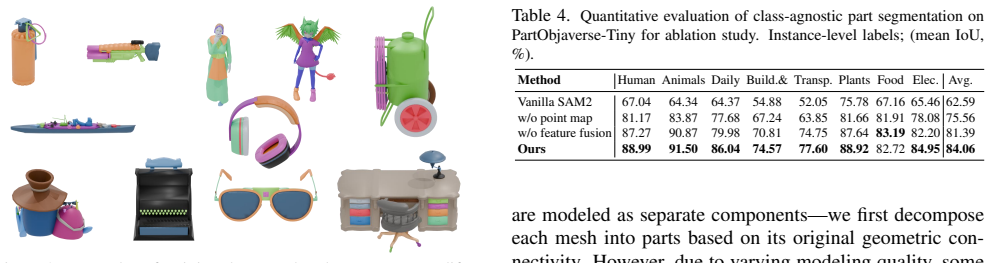
3D part segmentation can be solved as promptable multi-view 2D mask prediction: a click or box on any of 12 rendered views lifts SAM2 masks to consistent 3D parts, reaching 84.06 mIoU on PartObjaverse-Tiny and 74.42 on PartNetE.
Reviewed by Pith at T0; open to challenge. T0 means a machine referee read the full paper against a public rubric. the ladder, T0–T4 →
A prompt-controllable 3D part segmentation method that adapts SAM2 with LoRA and geometry fusion on rendered normal and point maps, then back-projects multi-view masks to the mesh.
T0 review reviewed 2026-08-05 challenge →
load-bearing objection Prompt-controllable 3D part segmentation by lifting SAM2 is a good idea with a solid ablation story, but the oracle view-selection protocol makes the SOTA claim unsupported as written. the 3 major comments →
GeoSAM2: Unleashing the Power of SAM2 for 3D Part Segmentation
The pith
A machine-rendered reading of the paper's core claim, the machinery that carries it, and where it could break.
The reading
Core claim
GeoSAM2 claims that 3D part segmentation of a textureless object can be solved as promptable multi-view 2D mask prediction. The object is rendered from twelve canonical viewpoints into normal maps and point maps, arranged as a video sequence. A user clicks or draws a box on any view to indicate a target part, and a shared SAM2 backbone—kept mostly frozen but tuned with LoRA adapters and residual geometry fusion—predicts 2D masks for every view. These masks are back-projected to the surface with visibility-aware voting and post-processed by mesh connectivity, yielding consistent 3D part labels. The paper reports state-of-the-art class-agnostic mean IoU of 84.06 on PartObjaverse-Tiny and 74.42
What carries the argument
The engine is SAM2's video-mask loop repurposed as a 12-frame 'video' of normal and point maps. LoRA adapters (low-rank weight updates on every transformer attention layer) let the frozen backbone read geometric inputs; zero-initialized residual convolutions at each feature-pyramid level fuse point-map geometry into normal-map features without initially disturbing pretrained statistics; and a full-view memory bank—bootstrapped by repeating the prompted first frame—keeps masks consistent across large viewpoint changes. Back-projection with depth-based visibility checks and k-NN smoothing turns the per-view 2D masks into a final 3D labeling.
Load-bearing premise
The training labels are produced automatically by decomposing meshes along geometric connectivity and merging or splitting parts with heuristics; the method's accuracy on human-annotated benchmarks depends on those auto-labels matching human part semantics.
What would settle it
Retrain GeoSAM2 on the same roughly 4,700 objects but with human-labeled part annotations instead of the mesh-connectivity auto-labels, and evaluate on PartObjaverse-Tiny; if the margin over PartField collapses, the reported accuracy depends on the auto-labeling distribution rather than the prompt-controllable mechanism. Alternatively, fix prompts to a single user-chosen view without the best-of-four-views selection and measure the mIoU drop.
If this is right
- A user can select an individual part—down to a patch like a leg or a beard—with a single click or box, and the selection propagates to a clean 3D mask, enabling fine-grained editing without text or scale tuning.
- Since no per-shape optimization is required, inference completes in about 30 seconds per object, compared with minutes for optimization-based pipelines.
- The method works on textureless meshes by fusing normal and point maps, so it applies to objects without RGB texture.
- On PartObjaverse-Tiny and PartNetE, the paper reports higher class-agnostic mean IoU than Find3D, SAMPart3D, SAMesh, and PartField.
- Because the backbone stays mostly frozen, future improvements to SAM2's mask quality can be absorbed by retraining only the small LoRA and fusion modules.
Where Pith is reading between the lines
- The paper's evaluation selects the best of four orthographic input views; a fixed-view protocol would be a stricter test of the prompt-control claim and might narrow the reported margin over PartField.
- Because the training signal comes from mesh connectivity, objects modeled as single continuous shells with no component boundaries may be systematically harder than artist-assembled objects; the method's ceiling is partly set by how CAD models are built.
- The same frozen-SAM2 plus LoRA plus full-view memory recipe could transfer to other multi-view 3D lifting tasks, such as part completion or part-level editing, wherever a 2D prompt can name the region of interest.
Editorial analysis
A structured set of objections, weighed in public.
Referee Report
Summary. GeoSAM2 casts 3D part segmentation of textureless objects as multi-view 2D mask prediction. It renders 12 normal and point maps from canonical viewpoints, feeds them through a frozen SAM2 backbone augmented with LoRA and zero-initialized residual fusion of geometric features, and uses a full-view memory bank with first-frame repetition to promote cross-view consistency. Predicted masks are back-projected and refined with mesh-aware post-processing. Training labels are generated automatically by mesh connectivity decomposition and heuristic merging/splitting. The paper claims state-of-the-art class-agnostic mIoU on PartObjaverse-Tiny and PartNetE, outperforming Find3D, SAMPart3D, SAMesh, and PartField, while running in about 30 seconds per object and requiring only 2D clicks or boxes.
Significance. If the empirical results are taken at face value, the paper makes a useful contribution: it replaces per-shape optimization and unintuitive global scale knobs with explicit 2D prompts, uses only automatically generated labels, and demonstrates consistent gains in the ablation study. The architecture design—LoRA on all attention projections, residual zero-conv fusion, and memory-bank redesign—is reasonable and well motivated. However, the central SOTA claim is currently not supported by the evaluation protocol. The comparison is weakened by the oracle selection of the best of four orthographic views using ground-truth mIoU, and the prompt-generation procedure for the quantitative benchmarks is not specified. These issues are load-bearing, not cosmetic, and must be fixed before the empirical claims can be accepted.
major comments (3)
- [§6.2, Tables 1 and 2] The paper states: "For our method, due to the object orientation uncertainty, we select 4 orthographics views as input respectively and adopt the highest mIoU." This is an oracle: the method is run four times with different starting views and the result with the highest ground-truth mIoU is reported. Baselines are evaluated once without an equivalent selection, so the comparison is not apples-to-apples and the reported margins (e.g., 84.06 vs. 79.18 on PartObjaverse-Tiny; 74.42 vs. 59.10 on PartNetE) are inflated. The paper should report a fixed-view protocol, the average over all four views, or a user-study-based protocol, and should clearly distinguish best-case from expected performance. In addition, the quantitative evaluation does not describe how 2D prompts are generated for each test object/part. If prompts are derived from ground-truth part locations, that is another form of test
- [§5.1 and Supplementary §8.1.2] The model is trained on labels produced by decomposing meshes according to connectivity and then merging/splitting parts with heuristics. The central claim of fine-grained, semantically meaningful part segmentation depends on these auto-labels aligning with human part semantics, but no quantitative validation of the auto-label quality is provided. I request a concrete check: compute agreement (e.g., mIoU or boundary accuracy) between the auto-decomposition and human ground-truth on a held-out subset, or show that a model trained on auto-labels transfers to human-annotated benchmarks without test-time fitting. Without such evidence, the semantic validity of the training signal remains an unsupported premise.
- [§6.2, Baselines] The text says both "For all methods, we follow their publicly released implementations and evaluate them on both datasets" and "The mIoU of the baselines is the same as reported in [15], as we adopt the same experimental setup." These statements are in tension. If baseline numbers are copied from [15], the paper must say so explicitly and verify that the metric, category grouping, and evaluation splits are identical. If they were re-run, the paper should report the actual numbers and any variation. This is needed for reproducibility and for a fair comparison, especially because the oracle view selection is applied only to GeoSAM2.
minor comments (7)
- [§5.2] Typo: "repectively" should be "respectively."
- [§6.2] Typo: "generatie" should be "generate."
- [§8] Typo: "Supplmentary" should be "Supplementary."
- [References] The SAMesh reference is cited inconsistently as [26], [27], and [28] with different years and titles. Please unify the citation and verify the bibliographic entry. Also, PartNetE is referenced as [14], which appears to be PartSLIP's arXiv entry; please cite the actual dataset source.
- [Tables 1 and 2] The table formatting is difficult to read: several category columns appear shifted or duplicated, and the per-category and average columns are not cleanly aligned. Please regenerate the tables with clear column separation.
- [§6.2] The sentence "we also automatically segments the unlabeled area of the view which lies opposite the input view" is vague. Please describe the mechanism and specify whether it uses any ground-truth information or is a fixed heuristic.
- [§6.4, Table 3] The ablation tables (Tables 3–5) report per-category results in the supplement, but the main text does not mention that the "w/o feature fusion" variant uses a 1x1 convolution while the full method uses a 3x3 kernel. This detail should be in the main text or clearly cross-referenced.
Circularity Check
Oracle 4-view mIoU selection turns the reported SOTA numbers into test-set-fitted upper bounds; the central comparison is partially circular.
specific steps
-
fitted input called prediction
[Section 6.2 (Comparision), evaluation protocol]
"For our method, due to the object orientation uncertainty, we select 4 orthographics views as input respectively and adopt the highest mIoU."
The reported mIoU for GeoSAM2 is not the output of a fixed prediction rule; it is the maximum mIoU over four input orientations, where the selection is made using the ground-truth mIoU itself. Thus the test labels are used to choose a method configuration, and the headline numbers in Tables 1 and 2 (84.06 and 74.42) are oracle upper bounds rather than expected interactive performance. Because baselines are evaluated without an equivalent oracle selection, the SOTA margins are inflated by construction. The claim 'we achieve state-of-the-art class-agnostic performance' therefore reduces, at the evaluation step, to a test-set-fitted maximum rather than a genuine prediction.
full rationale
The core learning pipeline is not circular: training labels are generated from mesh connectivity (§5.1, §8.1.2), separate from the human-annotated PartObjaverse-Tiny/PartNetE evaluation sets, and the LoRA/fusion/memory components are tested against external benchmarks. The auto-labeling concern raised by the reader is a validity issue (do connectivity-derived parts match human semantics?), not a circularity issue, because the evaluation uses independent human labels. No load-bearing self-citation or imported-uniqueness step was found; SAMPart3D and HoloPart citations are contextual or application-level. However, the central SOTA claim is partially circular due to §6.2's oracle view selection: the metric used to report success also selects which of four runs counts as 'the method'. This makes the reported numbers best-case upper bounds and the comparison to single-run baselines asymmetric. Score 6 reflects partial circularity in the evaluation claim, not in the architectural derivation.
Axiom & Free-Parameter Ledger
free parameters (7)
- Evaluation view selection (oracle) =
4 orthographic views, highest mIoU selected
- Number of views and elevations =
12 views, elevations 25/0/-25 degrees
- LoRA rank =
4
- Post-processing area threshold =
0.01 of total area
- Training epochs =
50
- Learning rate =
5e-5
- Part merging threshold =
15 parts
axioms (5)
- domain assumption Mesh connectivity decomposition yields semantically meaningful part labels
- domain assumption SAM2's pretrained RGB priors transfer to normal and point maps after LoRA adaptation
- domain assumption 12 canonical views provide sufficient geometric coverage
- domain assumption Full-view memory retention and frame repetition enable cross-view consistency
- standard math Standard pinhole rendering and back-projection equations
Cite this review
Pith. "Pith review of GeoSAM2: Unleashing the Power of SAM2 for 3D Part Segmentation." pith.science (2026). https://pith.science/paper/6XDW4JQB
@misc{pith2026250814036,
  author       = {Pith},
  title        = {Pith review of: GeoSAM2: Unleashing the Power of SAM2 for 3D Part Segmentation},
  year         = {2026},
  howpublished = {\url{https://pith.science/paper/6XDW4JQB}},
  note         = {Machine review of arXiv:2508.14036}
}
read the original abstract
We introduce GeoSAM2, a prompt-controllable framework for 3D part segmentation that casts the task as multi-view 2D mask prediction. Given a textureless object, we render normal and point maps from predefined viewpoints and accept simple 2D prompts - clicks or boxes - to guide part selection. These prompts are processed by a shared SAM2 backbone augmented with LoRA and residual geometry fusion, enabling view-specific reasoning while preserving pretrained priors. The predicted masks are back-projected to the object and aggregated across views. Our method enables fine-grained, part-specific control without requiring text prompts, per-shape optimization, or full 3D labels. In contrast to global clustering or scale-based methods, prompts are explicit, spatially grounded, and interpretable. We achieve state-of-the-art class-agnostic performance on PartObjaverse-Tiny and PartNetE, outperforming both slow optimization-based pipelines and fast but coarse feedforward approaches. Our results highlight a new paradigm: aligning the paradigm of 3D segmentation with SAM2, leveraging interactive 2D inputs to unlock controllability and precision in object-level part understanding.
Figures






Forward citations
Cited by 1 Pith paper
-
Part-Level 3D Gaussian Vehicle Generation with Joint and Hinge Axis Estimation
A new framework generates part-level animatable 3D Gaussian vehicles from images by adding modules for exclusive part ownership and kinematic joint/axis prediction.
Reference graph
Works this paper leans on
-
[1]
Satr: Zero-shot semantic segmentation of 3d shapes, 2023
Ahmed Abdelreheem, Ivan Skorokhodov, Maks Ovsjanikov, and Peter Wonka. Satr: Zero-shot semantic segmentation of 3d shapes, 2023. 3
work page 2023
-
[2]
Seg- ment anything in 3d with radiance fields, 2024
Jiazhong Cen, Jiemin Fang, Zanwei Zhou, Chen Yang, Lingxi Xie, Xiaopeng Zhang, Wei Shen, and Qi Tian. Seg- ment anything in 3d with radiance fields, 2024. 3
work page 2024
-
[3]
A benchmark for 3D mesh segmentation
Xiaobai Chen, Aleksey Golovinskiy, and Thomas Funkhouser. A benchmark for 3D mesh segmentation. ACM Transactions on Graphics (Proc. SIGGRAPH) , 28(3),
-
[4]
3d part seg- mentation via geometric aggregation of 2d visual features
Marco Garosi, Riccardo Tedoldi, Davide Boscaini, Massi- miliano Mancini, Nicu Sebe, and Fabio Poiesi. 3d part seg- mentation via geometric aggregation of 2d visual features. In 2025 IEEE/CVF Winter Conference on Applications of Com- puter Vision (WACV), pages 3257–3267. IEEE, 2025. 3
work page 2025
-
[5]
Meshcnn: a network with an edge
Rana Hanocka, Amir Hertz, Noa Fish, Raja Giryes, Shachar Fleishman, and Daniel Cohen-Or. Meshcnn: a network with an edge. ACM Transactions on Graphics, 38(4):1–12, 2019. 3
work page 2019
-
[6]
Segment3D: Learning Fine-Grained Class-Agnostic 3D Segmentation without Manual Labels
Rui Huang, Songyou Peng, Ayca Takmaz, Federico Tombari, Marc Pollefeys, Shiji Song, Gao Huang, and Francis En- gelmann. Segment3d: Learning fine-grained class-agnostic 3d segmentation without manual labels. arXiv preprint arXiv:2312.17232, 2023. 3
work page internal anchor Pith review Pith/arXiv arXiv 2023
-
[7]
Berg, Wan-Yen Lo, Piotr Doll ´ar, and Ross Girshick
Alexander Kirillov, Eric Mintun, Nikhila Ravi, Hanzi Mao, Chloe Rolland, Laura Gustafson, Tete Xiao, Spencer White- head, Alexander C. Berg, Wan-Yen Lo, Piotr Doll ´ar, and Ross Girshick. Segment anything, 2023. 3
2023
-
[9]
Grounded language-image pre-training
Liunian Harold Li, Pengchuan Zhang, Haotian Zhang, Jian- wei Yang, Chunyuan Li, Yiwu Zhong, Lijuan Wang, Lu Yuan, Lei Zhang, Jenq-Neng Hwang, et al. Grounded language-image pre-training. In CVPR, 2022. 3
work page 2022
-
[10]
Xiao-Juan Li, Jie Yang, and Fang-Lue Zhang. Laplacian mesh transformer: Dual attention and topology aware net- work for 3d mesh classification and segmentation. In Com- puter Vision – ECCV 2022 , pages 541–560, Cham, 2022. Springer Nature Switzerland. 3
work page 2022
-
[11]
Pointcnn: Convolution on x-transformed points
Yangyan Li, Rui Bu, Mingchao Sun, Wei Wu, Xinhan Di, and Baoquan Chen. Pointcnn: Convolution on x-transformed points. In NeurIPS, 2018. 2
work page 2018
-
[12]
Triposg: High- fidelity 3d shape synthesis using large-scale rectified flow models, 2025
Yangguang Li, Zi-Xin Zou, Zexiang Liu, Dehu Wang, Yuan Liang, Zhipeng Yu, Xingchao Liu, Yuan-Chen Guo, Ding Liang, Wanli Ouyang, and Yan-Pei Cao. Triposg: High- fidelity 3d shape synthesis using large-scale rectified flow models, 2025. 7
work page 2025
-
[13]
Partslip: Low-shot part seg- mentation for 3d point clouds via pretrained image-language models
Minghua Liu, Yinhao Zhu, Hong Cai, Shizhong Han, Zhan Ling, Fatih Porikli, and Hao Su. Partslip: Low-shot part seg- mentation for 3d point clouds via pretrained image-language models. In CVPR, 2023. 3
work page 2023
-
[14]
Minghua Liu, Yinhao Zhu, Hong Cai, Shizhong Han, Zhan Ling, Fatih Porikli, and Hao Su. Partslip: Low-shot part seg- mentation for 3d point clouds via pretrained image-language models, 2023. 6
work page 2023
-
[15]
Minghua Liu, Mikaela Angelina Uy, Donglai Xiang, Hao Su, Sanja Fidler, Nicholas Sharp, and Jun Gao. Partfield: Learn- ing 3d feature fields for part segmentation and beyond.arXiv preprint arXiv:2504.11451, 2025. 6, 7
Pith/arXiv arXiv 2025
-
[16]
SANeRF-HQ: Segment Anything for NeRF in High Quality
Yichen Liu, Benran Hu, Chi-Keung Tang, and Yu-Wing Tai. Sanerf-hq: Segment anything for nerf in high quality. arXiv preprint arXiv:2312.01531, 2023. 3
work page internal anchor Pith review Pith/arXiv arXiv 2023
-
[17]
Ziqi Ma, Yisong Yue, and Georgia Gkioxari. Find any part in 3d, 2025. 2, 6
work page 2025
-
[18]
Kaichun Mo, Shilin Zhu, Angel X Chang, Li Yi, Subarna Tripathi, Leonidas J Guibas, and Hao Su. Partnet: A large- scale benchmark for fine-grained and hierarchical part-level 3d object understanding. In CVPR, 2019. 3
work page 2019
-
[19]
Dinov2: Learning robust visual features without supervision
Maxime Oquab, Timoth ´ee Darcet, Th ´eo Moutakanni, Huy V o, Marc Szafraniec, Vasil Khalidov, Pierre Fernandez, Daniel Haziza, Francisco Massa, Alaaeldin El-Nouby, et al. Dinov2: Learning robust visual features without supervision. arXiv:2304.07193, 2023. 3
Pith/arXiv arXiv 2023
-
[20]
Better call sal: Towards learning to segment anything in lidar.arXiv preprint arXiv:2403.13129, 2024
Aljo ˇsa O ˇsep, Tim Meinhardt, Francesco Ferroni, Neehar Peri, Deva Ramanan, and Laura Leal-Taix ´e. Better call sal: Towards learning to segment anything in lidar.arXiv preprint arXiv:2403.13129, 2024. 3
Pith/arXiv arXiv 2024
-
[21]
Openscene: 3d scene understanding with open vocabularies
Songyou Peng, Kyle Genova, Chiyu Jiang, Andrea Tagliasacchi, Marc Pollefeys, Thomas Funkhouser, et al. Openscene: 3d scene understanding with open vocabularies. In Proceedings of the IEEE/CVF Conference on Computer Vision and Pattern Recognition, pages 815–824, 2023. 3
work page 2023
-
[22]
Pointnet: Deep learning on point sets for 3d classification and segmentation
Charles R Qi, Hao Su, Kaichun Mo, and Leonidas J Guibas. Pointnet: Deep learning on point sets for 3d classification and segmentation. In CVPR, 2017. 3
work page 2017
-
[23]
Learn- ing transferable visual models from natural language super- vision
Alec Radford, Jong Wook Kim, Chris Hallacy, Aditya Ramesh, Gabriel Goh, Sandhini Agarwal, Girish Sastry, Amanda Askell, Pamela Mishkin, Jack Clark, et al. Learn- ing transferable visual models from natural language super- vision. In ICML, 2021. 3
2021
-
[24]
Neural shape diameter function for efficient mesh segmentation
Bruno Roy. Neural shape diameter function for efficient mesh segmentation. In ACM SIGGRAPH 2023 Posters . ACM, 2023. 3
work page 2023
-
[25]
Consis- tent mesh partitioning and skeletonisation using the shape diameter function
Lior Shapira, Ariel Shamir, and Daniel Cohen-Or. Consis- tent mesh partitioning and skeletonisation using the shape diameter function. The Visual Computer, 24:249–259, 2008. 3
work page 2008
-
[26]
Segment any mesh: Zero-shot mesh part segmentation via lifting segment anything 2 to 3d
George Tang, William Zhao, Logan Ford, David Benhaim, and Paul Zhang. Segment any mesh: Zero-shot mesh part segmentation via lifting segment anything 2 to 3d. arXiv:2408.13679, 2024. 2
Pith/arXiv arXiv 2024
-
[27]
Segment any mesh: Zero-shot mesh part segmentation via lifting segment anything 2 to 3d, 2024
George Tang, William Zhao, Logan Ford, David Benhaim, and Paul Zhang. Segment any mesh: Zero-shot mesh part segmentation via lifting segment anything 2 to 3d, 2024. 6
work page 2024
-
[28]
George Tang, William Zhao, Logan Ford, David Benhaim, and Paul Zhang. Segment any mesh, 2025. 6
work page 2025
-
[29]
Generating part-aware editable 3d shapes without 3d supervision
Konstantinos Tertikas, Despoina Paschalidou, Boxiao Pan, Jeong Joon Park, Mikaela Angelina Uy, Ioannis Emiris, Yan- nis Avrithis, and Leonidas Guibas. Generating part-aware editable 3d shapes without 3d supervision. In CVPR, 2023. 2 16
work page 2023
-
[30]
PartDistill: 3D Shape Part Segmentation by Vision-Language Model Distillation
Ardian Umam, Cheng-Kun Yang, Min-Hung Chen, Jen- Hui Chuang, and Yen-Yu Lin. Partdistill: 3d shape part segmentation by vision-language model distillation. arXiv:2312.04016, 2023. 3
work page internal anchor Pith review Pith/arXiv arXiv 2023
-
[31]
Open-vocabulary part-based grasping
Tjeard van Oort, Dimity Miller, Will N Browne, Nico- las Marticorena, Jesse Haviland, and Niko Suenderhauf. Open-vocabulary part-based grasping. arXiv preprint arXiv:2406.05951, 2024. 2
arXiv 2024
-
[32]
Coseg: Cognitively inspired unsupervised generic event segmenta- tion
Xiao Wang, Jingen Liu, Tao Mei, and Jiebo Luo. Coseg: Cognitively inspired unsupervised generic event segmenta- tion. IEEE Transactions on Neural Networks and Learning Systems, 2023. 3
work page 2023
-
[33]
Sampro3d: Locating sam prompts in 3d for zero-shot scene segmentation
Mutian Xu, Xingyilang Yin, Lingteng Qiu, Yang Liu, Xin Tong, and Xiaoguang Han. Sampro3d: Locating sam prompts in 3d for zero-shot scene segmentation. arXiv preprint arXiv:2311.17707, 2023. 3
Pith/arXiv arXiv 2023
-
[34]
ZeroPS: High-quality Cross-modal Knowledge Transfer for Zero-Shot 3D Part Segmentation
Yuheng Xue, Nenglun Chen, Jun Liu, and Wenyun Sun. Ze- rops: High-quality cross-modal knowledge transfer for zero- shot 3d part segmentation. arXiv:2311.14262, 2023. 3
work page internal anchor Pith review Pith/arXiv arXiv 2023
-
[35]
Sam3d: Segment anything in 3d scenes
Yunhan Yang, Xiaoyang Wu, Tong He, Hengshuang Zhao, and Xihui Liu. Sam3d: Segment anything in 3d scenes. arXiv:2306.03908, 2023. 2, 3
Pith/arXiv arXiv 2023
-
[36]
Sampart3d: Segment any part in 3d objects
Yunhan Yang, Yukun Huang, Yuan-Chen Guo, Liangjun Lu, Xiaoyang Wu, Edmund Y Lam, Yan-Pei Cao, and Xihui Liu. Sampart3d: Segment any part in 3d objects. arXiv preprint arXiv:2411.07184, 2024. 3, 6
Pith/arXiv arXiv 2024
-
[37]
Holopart: Generative 3d part amodal segmentation, 2025
Yunhan Yang, Yuan-Chen Guo, Yukun Huang, Zi-Xin Zou, Zhipeng Yu, Yangguang Li, Yan-Pei Cao, and Xihui Liu. Holopart: Generative 3d part amodal segmentation, 2025. 1, 2
work page 2025
-
[38]
Hengshuang Zhao, Li Jiang, Jiaya Jia, Philip HS Torr, and Vladlen Koltun. Point transformer. In ICCV, 2021. 3
work page 2021
-
[39]
Meshsegmenter: Zero-shot mesh semantic segmentation via texture synthesis
Ziming Zhong, Yanyu Xu, Jing Li, Jiale Xu, Zhengxin Li, Chaohui Yu, and Shenghua Gao. Meshsegmenter: Zero-shot mesh semantic segmentation via texture synthesis. InECCV. Springer, 2024. 3
work page 2024
-
[40]
Serf: Fine-grained interactive 3d segmentation and editing with radiance fields, 2024
Kaichen Zhou, Lanqing Hong, Enze Xie, Yongxin Yang, Zhenguo Li, and Wei Zhang. Serf: Fine-grained interactive 3d segmentation and editing with radiance fields, 2024. 3
work page 2024
-
[41]
Yuchen Zhou, Jiayuan Gu, Xuanlin Li, Minghua Liu, Yun- hao Fang, and Hao Su. Partslip++: Enhancing low-shot 3d part segmentation via multi-view instance segmentation and maximum likelihood estimation. arXiv:2312.03015, 2023. 3
Pith/arXiv arXiv 2023
-
[42]
Point-sam: Promptable 3d segmentation model for point clouds
Yuchen Zhou, Jiayuan Gu, Tung Yen Chiang, Fanbo Xiang, and Hao Su. Point-sam: Promptable 3d segmentation model for point clouds. arXiv preprint arXiv:2406.17741, 2024. 3
Pith/arXiv arXiv 2024
-
[43]
Point- clip v2: Prompting clip and gpt for powerful 3d open-world learning
Xiangyang Zhu, Renrui Zhang, Bowei He, Ziyu Guo, Ziyao Zeng, Zipeng Qin, Shanghang Zhang, and Peng Gao. Point- clip v2: Prompting clip and gpt for powerful 3d open-world learning. In ICCV, 2023. 3 17
work page 2023
This paper was first reviewed by deepseek-v4-flash on August 5, 2026.
discussion (0)
Sign in with ORCID, Apple, or X to comment. Anyone can read and Pith papers without signing in.