REVIEW 2 major objections 4 minor 1 cited by
A search of 138 fb^-1 of LHC proton-proton collisions finds no evidence for Higgs boson production in association with a charm quark (cH) in the H→WW→eνμν final state, and sets the first cH limit in this decay channel.
Reviewed by Pith at T0; open to challenge. T0 means a machine referee read the full paper against a public rubric. the ladder, T0–T4 →
The first search for a Higgs boson produced with a charm quark and decaying to a W-boson pair sees no excess, and combined with the diphoton channel limits the Higgs-charm coupling to below 47 times the standard model value at 95% confidence.
T0 review reviewed 2026-08-05 challenge →
load-bearing objection First cH search in H->WW->e nu mu nu; competently done null result, but sensitivity is weak and the irreducible H+c-bkg modeling is the main soft spot. the 2 major comments →
Search for a Higgs boson produced in association with a charm quark and decaying to a W boson pair in proton-proton collisions at $\sqrt{s}$ = 13 TeV
The pith
A machine-rendered reading of the paper's core claim, the machinery that carries it, and where it could break.
The reading
Core claim
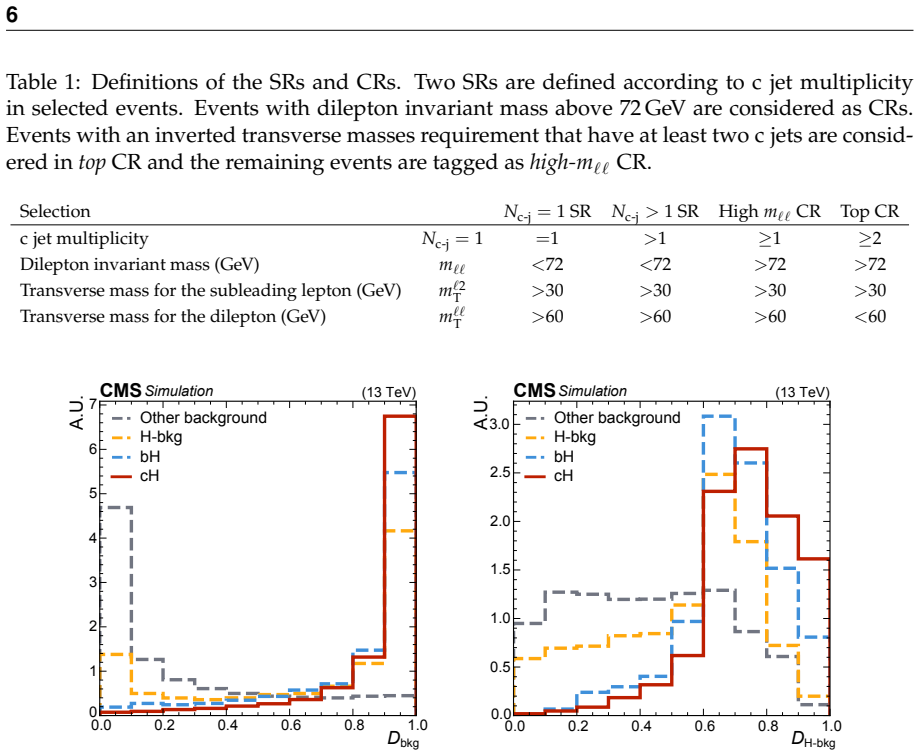
The central result is a 95% confidence-level upper limit on the cH production signal strength of 1065 (506 expected) times the standard model value when the normalization of the irreducible H+c-bkg background is fixed (1POI fit). When that background is floated (2POI fit), the limit loosens to 1804 (1097) because the two parameters are 87% anti-correlated. Combining the fixed-background fit with the previous CMS diphoton cH search yields |κc| < 47 (51 expected) at 95% CL, the tightest production-based constraint on the charm Yukawa coupling. The analysis separates the cH signal from the dominant top-quark background using one boosted decision tree (Dbkg) and from the kinematically similar H+
What carries the argument
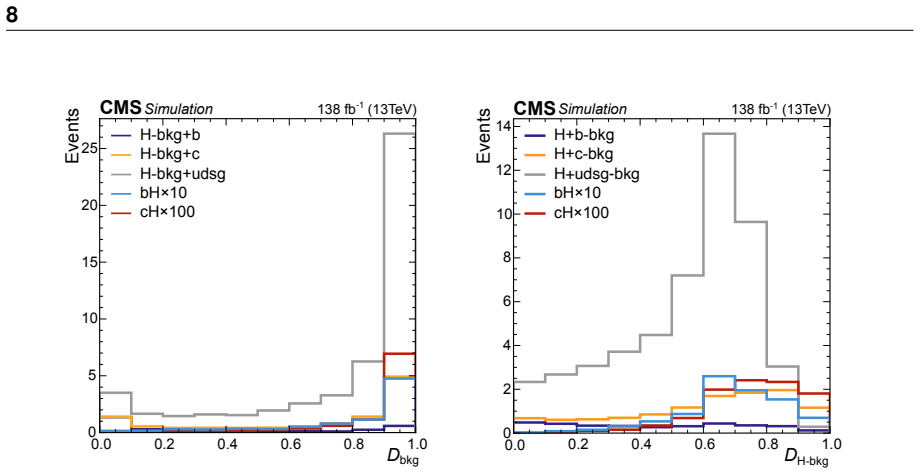
The analysis is carried by two boosted-decision-tree classifiers plus charm-jet tagging. Dbkg separates cH from the ~90% top-quark background; DH-bkg separates cH from the irreducible H+c-bkg background, which has the same final state but no direct charm-Yukawa vertex. The distinction between fixing versus floating the H+c-bkg normalization (the 1POI versus 2POI fits) sets the main limit, and the flat-direction assumption converts the cross-section limit into a bound on |κc|.
Load-bearing premise
The result rests on the assumption that the irreducible H+c-bkg background—a Higgs boson produced with a charm jet but without a direct charm-Yukawa vertex—is modeled well enough that the DH-bkg classifier separates it from the cH signal, with its normalization known to within the assigned 50% uncertainty when it is not floated.
What would settle it
Run the identical selection on the full Run 3 dataset (about 450 fb^-1 total): under this paper's background model the expected limit should improve from 506 by roughly sqrt(138/450), and no excess beyond 3 sigma should appear in the high-DH-bkg bins of the Nc-j=1 signal region. An excess there, or a sharply different observed limit, would indicate the H+c-bkg template is wrong.
If this is right
- The cH process in the WW→eνμν channel is not observed in 138 fb^-1; the expected standard-model rate is more than 500 times below the current sensitivity.
- Combined with the diphoton search, the production-based bound |κc| < 47 is the strongest from cH production, though it remains far above the direct H→cc decay bound of |κc| < 5.5.
- In the 2POI fit, H+c-bkg and cH are 87% anti-correlated, so letting the H+c-bkg normalization float degrades the limit by about 70%; separating the two processes is the constraining factor.
- The analysis is limited by statistical uncertainties today, but theoretical uncertainties from flavor-scheme choice and heavy-flavor modeling will dominate at the high-luminosity LHC.
Where Pith is reading between the lines
- A data-driven handle on H+c-bkg could come from bH events, which share the same heavy-flavor associated-production physics; calibrating DH-bkg on a bH-enriched region might reduce the 50% modeling uncertainty and sharpen the 2POI fit.
- The strong cH–bH correlation (observed at -89%) suggests that a joint cH+bH fit with a common heavy-flavor nuisance parameter could improve the cH limit.
- At the HL-LHC, the expected 506 limit at 95% CL should improve roughly as the square root of luminosity; reaching standard-model sensitivity will require both more data and a factor-of-~20 reduction in the flavor-scheme and H+c-bkg uncertainties.
Editorial analysis
A structured set of objections, weighed in public.
Referee Report
Summary. This paper reports a search for Higgs boson production in association with a charm quark (cH) in the H->WW->e nu mu nu final state using 138 fb^-1 of CMS Run 2 data. Events are selected with an e-mu pair, missing transverse momentum, and at least one charm-tagged jet, split into Nc-j=1 and Nc-j>1 signal regions plus high-m_ll and top control regions. Two BDT classifiers (Dbkg and DH-bkg) are combined with k-means binning, and a binned likelihood fit extracts the cH signal strength mu_cH. In the 1POI scenario, where the irreducible H+c-bkg background is constrained to the SM prediction with a 50% uncertainty, the observed (expected) 95% CL upper limit is mu_cH < 1065 (506). In the 2POI scenario, where H+c-bkg is floated, the limit is 1804 (1097) and is -87% anti-correlated with cH. Combined with the preceding diphoton cH search, the result is |kappa_c| < 47 (51) at 95% CL under the flat-direction assumption.
Significance. The analysis is competently executed and follows standard CMS practice: data-driven tt normalization, two control regions, a detailed systematic inventory (Table 3), and an explicit 2POI cross-check. The limit-setting is not circular: the signal predictions are defined by externally fixed SM cross sections, and the kappa_c interpretation uses a stated published assumption. The main contribution is the first cH search in the H->WW channel; its expected sensitivity improves the combined kappa_c constraint from the diphoton-only expected 72.5 to 51, although the observed combined limit (47) is not better than the diphoton-only observed limit (38.1). The key weakness is the modeling of the irreducible H+c-bkg background, which is load-bearing for the 1POI result.
major comments (2)
- [Sections 5-7] The 1POI limit depends on separating cH from the irreducible H+c-bkg background (Fig. 2). The DH-bkg AUC is only 73-78%, and the H+c-bkg template is taken from simulation with no dedicated validation; the 50% normalization uncertainty is borrowed from ggH+bb [43] and no shape uncertainty is assigned to this component. The 2POI fit demonstrates the degeneracy: H+c-bkg is -87% anti-correlated with cH, and the observed limit degrades from 1065 to 1804. Please add a robustness test using an alternative H+c-bkg template, a shape uncertainty, or a control region enriched in H+c-bkg, or promote the 2POI result to the primary result.
- [Sections 3 and 7] The bH contribution, which is about eight times larger than cH (sigma = 660 vs 90 fb) and enters through the 27% b-jet mistag rate, is reported to be -89% correlated with cH. bH carries the same borrowed 50% normalization uncertainty and no dedicated control region. A conservative check with a larger bH uncertainty or an alternative bH template should be shown to establish that the cH limit is not driven by bH modeling assumptions.
minor comments (4)
- [Reference [23]] The HEPData DOI is given as 10.17182/hepdata.123456, which appears to be a placeholder. Please update to the actual record.
- [Table 1] The first row is garbled ('Nc-j =1 =1'). It should read '=1' for the Nc-j=1 SR column and '>1' for the Nc-j>1 SR column.
- [Section 4] The sentence 'the invariant mass (the pT) of the dilepton pair must be greater than 12 (30) GeV' should be separated into two explicit requirements, e.g., m_ll > 12 GeV and pT_ll > 30 GeV.
- [Section 7 / Abstract] Please state explicitly that the observed combined limit |kappa_c| < 47 is not an improvement over the diphoton-only observed limit |kappa_c| < 38.1 [21]; the gain from adding the H->WW channel appears only in the expected limit (72.5 to 51).
Circularity Check
No significant circularity: limits are set against external SM predictions; the only self-citation is the previous CMS diphoton result, used for combination and as method reference, not as a load-bearing derivation.
full rationale
The paper's central result, the observed (expected) upper limit on the cH signal strength of 1065 (506) times the SM value, is obtained from a binned maximum likelihood fit of data to simulation templates. The predicted signal is defined externally: the cH cross section of 90 fb comes from MadGraph5_aMC@NLO with NNPDF3.1 PDFs, and the H boson production and decay uncertainties are taken from the LHC Higgs cross section handbook. No fitted parameter enters the definition of the SM prediction being tested; the fit only determines the signal strength modifier relative to that prediction. The translation to |kappa_c| uses the flat direction assumption from external theory papers [20,92], which is explicitly stated as an assumption rather than disguised as a derivation. The only self-citation is the previous CMS cH search in the diphoton channel [21], used for the combination and as a methodological precedent; this is an independent measurement, not an input that forces the H->WW result. The irreducible H+c-bkg background modeling, while a legitimate systematic concern (fixed to simulation with a borrowed 50% uncertainty in the 1POI fit and floated with -87% anti-correlation in the 2POI fit), is a modeling uncertainty and not a circular step: the 2POI fit explicitly cross-checks the sensitivity to this background, and the quoted 1POI limit is the stated result with that systematic included. No equation or claimed prediction reduces by construction to a fitted parameter or to a self-citation chain.
Axiom & Free-Parameter Ledger
free parameters (3)
- mu_cH (cH signal strength, 1POI) =
390 +380/-270 (best fit); 95% CL upper limit 1065 observed, 506 expected
- tt normalization factor =
not quoted in the paper
- mu_H+c-bkg (2POI scenario only) =
not quoted; -87% correlation with mu_cH
axioms (5)
- domain assumption SM kappa framework with the flat direction assumption: deviations in Higgs couplings are parameterized by kappa_c while other couplings scale to keep other Higgs rates at unity
- domain assumption Massless charm and bottom quarks in the matrix elements (4FS for cH, 5FS for bH)
- domain assumption Modeling of the irreducible H+c-bkg background and its binned templates
- domain assumption External SM predictions: NNPDF3.1 PDFs, generator cross sections, and Higgs branching fractions from the LHC Higgs cross section handbook [85]
- domain assumption Background template shapes from simulation for non-tt backgrounds (V+jets, diboson, single top, H-bkg)
Cite this review
Pith. "Pith review of Search for a Higgs boson produced in association with a charm quark and decaying to a W boson pair in proton-proton collisions at $\sqrt{s}$ = 13 TeV." pith.science (2026). https://pith.science/paper/L25SATSE
@misc{pith2026250814988,
  author       = {Pith},
  title        = {Pith review of: Search for a Higgs boson produced in association with a charm quark and decaying to a W boson pair in proton-proton collisions at $\sqrts$ = 13 TeV},
  year         = {2026},
  howpublished = {\url{https://pith.science/paper/L25SATSE}},
  note         = {Machine review of arXiv:2508.14988}
}
abstract
This paper presents a search for a Higgs boson produced in association with a charm quark (cH) which allows to probe the Higgs-charm Yukawa coupling strength modifier $\kappa_\mathrm{c}$. Higgs boson decays to a pair of W bosons are considered, where one W boson decays to an electron and a neutrino, and the other \PW boson decays to a muon and a neutrino. The data, corresponding to an integrated luminosity of 138 fb$^{-1}$, were collected between 2016 and 2018 with the CMS detector at the LHC at a center-of-mass energy of $\sqrt{s}$ = 13 TeV. Upper limits at the 95\% confidence level (CL) are set on the ratio of the measured yield to the standard model expectation for cH production. The observed (expected) upper limit is 1065 (506). When combined with the previous search for cH in the diphoton decay channel of the Higgs boson, the limits are interpreted as observed (expected) constraints at 95% CL on the value of $\kappa_\mathrm{c}$, $\lvert\kappa_\mathrm{c}\rvert$ $\lt$ 47 (51).
Figures




Forward citations
Cited by 1 Pith paper
-
Unveiling Light-Quark Yukawa Flavor Structure via Dihadron Fragmentation at Lepton Colliders
A dihadron fragmentation azimuthal asymmetry at e+e− colliders can probe light-quark Yukawa couplings linearly and separate y_u from y_d at the 10^-4 level.
Reference graph
Works this paper leans on
-
[1]
Observation of a new boson at a mass of 125 GeV with the CMS experiment at the LHC
CMS Collaboration, “Observation of a new boson at a mass of 125 GeV with the CMS experiment at the LHC”, Phys. Lett. B 716 (2012) 30, doi:10.1016/j.physletb.2012.08.021, arXiv:1207.7235
Pith/arXiv arXiv 2012
-
[2]
ATLAS Collaboration, “Observation of a new particle in the search for the standard model higgs boson with the ATLAS detector at the LHC”, Phys. Lett. B 716 (2012) 1, doi:10.1016/j.physletb.2012.08.020, arXiv:1207.7214
Pith/arXiv arXiv 2012
-
[3]
Observation of a new boson with mass near 125 GeV in pp collisions at √s = 7 and 8 TeV
CMS Collaboration, “Observation of a new boson with mass near 125 GeV in pp collisions at √s = 7 and 8 TeV”, JHEP 06 (2013) 081, doi:10.1007/JHEP06(2013)081, arXiv:1303.4571
Pith/arXiv arXiv 2013
-
[4]
A portrait of the Higgs boson by the CMS experiment ten years after the discovery
CMS Collaboration, “A portrait of the Higgs boson by the CMS experiment ten years after the discovery”, Nature 607 (2022) 60, doi:10.1038/s41586-022-04892-x , arXiv:2207.00043. [Erratum: Nature 623 (2023)]
Pith/arXiv arXiv 2022
-
[5]
A detailed map of Higgs boson interactions by the ATLAS experiment ten years after the discovery
ATLAS Collaboration, “A detailed map of Higgs boson interactions by the ATLAS experiment ten years after the discovery”, Nature 607 (2022) 52, doi:10.1038/s41586-022-04893-w , arXiv:2207.00092. [Erratum: Nature 612, E24 (2022)]
Pith/arXiv arXiv 2022
-
[6]
CMS Collaboration, “Measurement of simplified template cross sections of the Higgs boson produced in association with W or Z bosons in the H → bb decay channel in proton-proton collisions at √s = 13 TeV”, Phys. Rev. D 109 (2024) 092011, doi:10.1103/PhysRevD.109.092011, arXiv:2312.07562
Pith/arXiv arXiv 2024
-
[7]
ATLAS Collaboration, “Measurements of WH and ZH production in the H → bb decay channel in pp collisions at 13 TeV with the ATLAS detector”, Eur. Phys. J. C 81 (2021) 178, doi:10.1140/epjc/s10052-020-08677-2 , arXiv:2007.02873. References 17
Pith/arXiv arXiv 2021
-
[8]
ATLAS Collaboration, “Measurements of WH and ZH production with Higgs boson decays into bottom quarks and direct constraints on the charm Yukawa coupling in 13 TeV pp collisions with the ATLAS detector”, JHEP 04 (2025) 075, doi:10.1007/JHEP04(2025)075, arXiv:2410.19611
Pith/arXiv arXiv 2025
-
[9]
ATLAS Collaboration, “Measurements of Higgs boson production cross-sections in the H → τ+τ− decay channel in pp collisions at √s = 13 TeV with the ATLAS detector”, JHEP 08 (2022) 175, doi:10.1007/JHEP08(2022)175, arXiv:2201.08269
Pith/arXiv arXiv 2022
-
[10]
CMS Collaboration, “Measurements of Higgs boson production in the decay channel with a pair of τ leptons in proton–proton collisions at √s = 13 TeV”, Eur. Phys. J. C 83 (2023) 562, doi:10.1140/epjc/s10052-023-11452-8 , arXiv:2204.12957
Pith/arXiv arXiv 2023
-
[11]
Evidence for Higgs boson decay to a pair of muons
CMS Collaboration, “Evidence for Higgs boson decay to a pair of muons”, JHEP 01 (2021) 148, doi:10.1007/JHEP01(2021)148, arXiv:2009.04363
Pith/arXiv arXiv 2021
-
[12]
A search for the dimuon decay of the standard model Higgs boson with the ATLAS detector
ATLAS Collaboration, “A search for the dimuon decay of the standard model Higgs boson with the ATLAS detector”, Phys. Lett. B 812 (2021) 135980, doi:10.1016/j.physletb.2020.135980, arXiv:2007.07830
-
[13]
CMS Collaboration, “Search for Higgs boson and observation of Z boson through their decay into a charm quark-antiquark pair in boosted topologies in proton-proton collisions at √s = 13 TeV”, Phys. Rev. Lett. 131 (2023) 041801, doi:10.1103/PhysRevLett.131.041801, arXiv:2211.14181
Pith/arXiv arXiv 2023
-
[14]
ATLAS Collaboration, “Direct constraint on the Higgs-charm coupling from a search for Higgs boson decays into charm quarks with the ATLAS detector”, Eur. Phys. J. C 82 (2022) 717, doi:10.1140/epjc/s10052-022-10588-3 , arXiv:2201.11428
work page internal anchor Pith review Pith/arXiv arXiv 2022
-
[15]
CMS Collaboration, “Search for Higgs boson decay to a charm quark-antiquark pair in proton-proton collisions at √s = 13 TeV”, Phys. Rev. Lett. 131 (2023) 061801, doi:10.1103/PhysRevLett.131.061801, arXiv:2205.05550
work page internal anchor Pith review Pith/arXiv arXiv 2023
-
[16]
Jet Flavour Classification Using DeepJet
E. Bols et al., “Jet flavour classification using DeepJet”, JINST 15 (2020) P12012, doi:10.1088/1748-0221/15/12/P12012, arXiv:2008.10519
work page internal anchor Pith review Pith/arXiv arXiv 2020
-
[17]
CMS Collaboration, “A new calibration method for charm jet identification validated with proton-proton collision events at √s = 13 TeV”, JINST 17 (2022) P03014, doi:10.1088/1748-0221/17/03/P03014, arXiv:2111.03027
Pith/arXiv arXiv 2022
-
[18]
CMS Collaboration, “Combination and interpretation of differential Higgs boson production cross sections in proton-proton collisions at √s = 13 TeV”, 2025. arXiv:2504.13081. Submitted to JHEP, doi:10.48550/arXiv.2504.13081
-
[19]
N. M. Coyle, C. E. M. Wagner, and V . Wei, “Bounding the charm Yukawa coupling”, Phys. Rev. D 100 (2019) 073013, doi:10.1103/PhysRevD.100.073013, arXiv:1905.09360
work page internal anchor Pith review Pith/arXiv arXiv 2019
-
[20]
Probing the Charm Yukawa Coupling in Higgs + Charm Production
I. Brivio, F. Goertz, and G. Isidori, “Probing the charm quark Yukawa coupling in Higgs+Charm production”, Phys. Rev. Lett. 115 (2015) 211801, doi:10.1103/PhysRevLett.115.211801, arXiv:1507.02916
work page internal anchor Pith review Pith/arXiv arXiv 2015
-
[21]
CMS Collaboration, “Search for the associated production of a Higgs boson with a charm quark in the diphoton decay channel in pp collisions at √s = 13 TeV”, 2025. arXiv:2503.08797. Submitted to JHEP, doi:10.48550/arXiv.2503.08797. 18
-
[22]
ATLAS Collaboration, “Search for the associated production of charm quarks and a Higgs boson decaying into a photon pair with the ATLAS detector”, JHEP 02 (2025) 045, doi:10.1007/JHEP02(2025)045, arXiv:2407.15550
work page internal anchor Pith review Pith/arXiv arXiv 2025
-
[23]
HEPData record for this analysis, 2025. doi:10.17182/hepdata.123456
-
[24]
The CMS experiment at the CERN LHC
CMS Collaboration, “The CMS experiment at the CERN LHC”, JINST 3 (2008) S08004, doi:10.1088/1748-0221/3/08/S08004
-
[25]
Development of the CMS detector for the CERN LHC Run 3
CMS Collaboration, “Development of the CMS detector for the CERN LHC Run 3”, JINST 19 (2024) P05064, doi:10.1088/1748-0221/19/05/P05064, arXiv:2309.05466
Pith/arXiv arXiv 2024
-
[26]
Performance of the CMS Level-1 trigger in proton-proton collisions at √s = 13 TeV
CMS Collaboration, “Performance of the CMS Level-1 trigger in proton-proton collisions at √s = 13 TeV”, JINST 15 (2020) P10017, doi:10.1088/1748-0221/15/10/P10017, arXiv:2006.10165
Pith/arXiv arXiv 2020
-
[27]
CMS Collaboration, “The CMS trigger system”, JINST 12 (2017) P01020, doi:10.1088/1748-0221/12/01/P01020, arXiv:1609.02366
Pith/arXiv arXiv 2017
-
[28]
Performance of the CMS high-level trigger during LHC Run 2
CMS Collaboration, “Performance of the CMS high-level trigger during LHC Run 2”, JINST 19 (2024) P11021, doi:10.1088/1748-0221/19/11/P11021, arXiv:2410.17038
Pith/arXiv arXiv 2024
-
[29]
Precision luminosity measurement in proton-proton collisions at√s = 13 TeV in 2015 and 2016 at CMS
CMS Collaboration, “Precision luminosity measurement in proton-proton collisions at√s = 13 TeV in 2015 and 2016 at CMS”, Eur. Phys. J. C 81 (2021) 800, doi:10.1140/epjc/s10052-021-09538-2 , arXiv:2104.01927
Pith/arXiv arXiv 2015
-
[30]
CMS luminosity measurement for the 2017 data-taking period at√s = 13 TeV
CMS Collaboration, “CMS luminosity measurement for the 2017 data-taking period at√s = 13 TeV”, CMS Physics Analysis Summary CMS-PAS-LUM-17-004, 2018
2017
-
[31]
CMS luminosity measurement for the 2018 data-taking period at√s = 13 TeV
CMS Collaboration, “CMS luminosity measurement for the 2018 data-taking period at√s = 13 TeV”, CMS Physics Analysis Summary CMS-PAS-LUM-18-002, 2019
2018
-
[32]
J. Alwall et al., “The automated computation of tree-level and next-to-leading order differential cross sections, and their matching to parton shower simulations”, JHEP 07 (2014) 079, doi:10.1007/JHEP07(2014)079, arXiv:1405.0301
Pith/arXiv arXiv 2014
-
[33]
The automation of next-to-leading order electroweak calculations
R. Frederix et al., “The automation of next-to-leading order electroweak calculations”, JHEP 07 (2018) 185, doi:10.1007/JHEP11(2021)085, arXiv:1804.10017. [Erratum: doi:10.1007/JHEP11(2021)085]
Pith/arXiv arXiv 2018
-
[34]
Higgs production in association with bottom quarks
M. Wiesemann et al., “Higgs production in association with bottom quarks”, JHEP 02 (2015) 132, doi:10.1007/JHEP02(2015)132, arXiv:1409.5301
work page internal anchor Pith review Pith/arXiv arXiv 2015
-
[35]
Merging meets matching in MC@NLO
R. Frederix and S. Frixione, “Merging meets matching in MC@NLO”, JHEP 12 (2012) 061, doi:10.1007/JHEP12(2012)061, arXiv:1209.6215
Pith/arXiv arXiv 2012
-
[36]
A new method for combining NLO QCD with shower Monte Carlo algorithms
P . Nason, “A new method for combining NLO QCD with shower Monte Carlo algorithms”, JHEP 11 (2004) 040, doi:10.1088/1126-6708/2004/11/040, arXiv:hep-ph/0409146
Pith/arXiv arXiv 2004
-
[37]
NLO Higgs boson production via vector-boson fusion matched with shower in POWHEG
P . Nason and C. Oleari, “NLO Higgs boson production via vector-boson fusion matched with shower in POWHEG”, JHEP 02 (2010) 037, doi:10.1007/JHEP02(2010)037, arXiv:0911.5299. References 19
Pith/arXiv arXiv 2010
-
[38]
Matching NLO QCD computations with parton shower simulations: the POWHEG method
S. Frixione, P . Nason, and C. Oleari, “Matching NLO QCD computations with parton shower simulations: the POWHEG method”, JHEP 11 (2007) 070, doi:10.1088/1126-6708/2007/11/070, arXiv:0709.2092
Pith/arXiv arXiv 2007
-
[39]
A general framework for implementing NLO calculations in shower Monte Carlo programs: the POWHEG BOX
S. Alioli, P . Nason, C. Oleari, and E. Re, “A general framework for implementing NLO calculations in shower Monte Carlo programs: the POWHEG BOX”, JHEP 06 (2010) 043, doi:10.1007/JHEP06(2010)043, arXiv:1002.2581
Pith/arXiv arXiv 2010
-
[40]
Higgs production via gluon fusion in the POWHEG approach in the SM and in the MSSM
E. Bagnaschi, G. Degrassi, P . Slavich, and A. Vicini, “Higgs production via gluon fusion in the POWHEG approach in the SM and in the MSSM”, JHEP 02 (2012) 088, doi:10.1007/JHEP02(2012)088, arXiv:1111.2854
Pith/arXiv arXiv 2012
-
[41]
HW±/HZ+ 0 and 1 jet at NLO with the POWHEG BOX interfaced to GoSam and their merging within MiNLO
G. Luisoni, P . Nason, C. Oleari, and F. Tramontano, “HW±/HZ+ 0 and 1 jet at NLO with the POWHEG BOX interfaced to GoSam and their merging within MiNLO”, JHEP 10 (2013) 083, doi:10.1007/JHEP10(2013)083, arXiv:1306.2542
Pith/arXiv arXiv 2013
-
[42]
Higgs boson production in association with top quarks in the POWHEG BOX
H. B. Hartanto, B. Jager, L. Reina, and D. Wackeroth, “Higgs boson production in association with top quarks in the POWHEG BOX”, Phys. Rev. D 91 (2015) 094003, doi:10.1103/PhysRevD.91.094003, arXiv:1501.04498
Pith/arXiv arXiv 2015
-
[43]
S. Manzoni et al., “Taming a leading theoretical uncertainty in HH measurements via accurate simulations for bbH production”, JHEP 09 (2023) 179, doi:10.1007/JHEP09(2023)179, arXiv:2307.09992
work page internal anchor Pith review Pith/arXiv arXiv 2023
-
[44]
Event generation with Sherpa 2.2
Sherpa Collaboration, “Event generation with Sherpa 2.2”, SciPost Phys. 7 (2019) 034, doi:10.21468/SciPostPhys.7.3.034, arXiv:1905.09127
Pith/arXiv arXiv 2019
-
[45]
T. Sj ¨ostrand et al., “An introduction to PYTHIA 8.2”, Comput. Phys. Commun. 191 (2015) 159, doi:10.1016/j.cpc.2015.01.024, arXiv:1410.3012
Pith/arXiv arXiv 2015
-
[46]
Parton distributions from high-precision collider data
NNPDF Collaboration, “Parton distributions from high-precision collider data”, Eur. Phys. J. C 77 (2017) 663, doi:10.1140/epjc/s10052-017-5199-5 , arXiv:1706.00428
Pith/arXiv arXiv 2017
-
[47]
Extraction and validation of a new set of CMS PYTHIA8 tunes from underlying-event measurements
CMS Collaboration, “Extraction and validation of a new set of CMS PYTHIA8 tunes from underlying-event measurements”, Eur. Phys. J. C 80 (2020) 4, doi:10.1140/epjc/s10052-019-7499-4 , arXiv:1903.12179
Pith/arXiv arXiv 2020
-
[48]
GEANT4 Collaboration, “G EANT 4—a simulation toolkit”, Nucl. Instrum. Meth. A 506 (2003) 250, doi:10.1016/S0168-9002(03)01368-8
-
[49]
Technical proposal for the Phase-II upgrade of the Compact Muon Solenoid
CMS Collaboration, “Technical proposal for the Phase-II upgrade of the Compact Muon Solenoid”, CMS Technical Proposal CERN-LHCC-2015-010, CMS-TDR-15-02, 2015
2015
-
[50]
Particle-flow reconstruction and global event description with the CMS detector
CMS Collaboration, “Particle-flow reconstruction and global event description with the CMS detector”, JINST 12 (2017) P10003, doi:10.1088/1748-0221/12/10/P10003, arXiv:1706.04965
Pith/arXiv arXiv 2017
-
[51]
Electron and photon reconstruction and identification with the CMS experiment at the CERN LHC
CMS Collaboration, “Electron and photon reconstruction and identification with the CMS experiment at the CERN LHC”, JINST 16 (2021) P05014, doi:10.1088/1748-0221/16/05/P05014, arXiv:2012.06888
Pith/arXiv arXiv 2021
-
[52]
ECAL 2016 refined calibration and Run2 summary plots
CMS Collaboration, “ECAL 2016 refined calibration and Run2 summary plots”, CMS Detector Performance Note CMS-DP-2020-021, 2020. 20
2016
-
[53]
CMS Collaboration, “Performance of the CMS muon detector and muon reconstruction with proton-proton collisions at √s = 13 TeV”, JINST 13 (2018) P06015, doi:10.1088/1748-0221/13/06/P06015, arXiv:1804.04528
Pith/arXiv arXiv 2018
-
[54]
The anti-kT jet clustering algorithm
M. Cacciari, G. P . Salam, and G. Soyez, “The anti-kT jet clustering algorithm”, JHEP 04 (2008) 063, doi:10.1088/1126-6708/2008/04/063, arXiv:0802.1189
Pith/arXiv arXiv 2008
-
[55]
M. Cacciari, G. P . Salam, and G. Soyez, “FastJet user manual”, Eur. Phys. J. C 72 (2012) 1896, doi:10.1140/epjc/s10052-012-1896-2 , arXiv:1111.6097
Pith/arXiv arXiv 2012
-
[56]
Pileup mitigation at CMS in 13 TeV data
CMS Collaboration, “Pileup mitigation at CMS in 13 TeV data”, JINST 15 (2020) P09018, doi:10.1088/1748-0221/15/09/P09018, arXiv:2003.00503
Pith/arXiv arXiv 2020
-
[57]
Jet energy scale and resolution in the CMS experiment in pp collisions at 8 TeV
CMS Collaboration, “Jet energy scale and resolution in the CMS experiment in pp collisions at 8 TeV”, JINST 12 (2017) P02014, doi:10.1088/1748-0221/12/02/P02014, arXiv:1607.03663
Pith/arXiv arXiv 2017
-
[58]
Performance of the DeepJet b tagging algorithm using 41.9/fb of data from proton-proton collisions at 13 TeV with Phase 1 CMS detector
CMS Collaboration, “Performance of the DeepJet b tagging algorithm using 41.9/fb of data from proton-proton collisions at 13 TeV with Phase 1 CMS detector”, CMS Detector Performance Note CMS-DP-2018-058, 2018
2018
-
[59]
Performance summary of AK4 jet charm tagging with the CMS Run2 legacy dataset
CMS Collaboration, “Performance summary of AK4 jet charm tagging with the CMS Run2 legacy dataset”, CMS Detector Performance Note CMS-DP-2023-006, 2023
2023
-
[60]
CMS Collaboration, “Performance of missing transverse momentum reconstruction in proton-proton collisions at √s = 13 TeV using the CMS detector”, JINST 14 (2019) P07004, doi:10.1088/1748-0221/14/07/P07004, arXiv:1903.06078
Pith/arXiv arXiv 2019
-
[61]
XGBoost: A scalable tree boosting system
T. Chen and C. Guestrin, “XGBoost: A scalable tree boosting system”, in Proc. 22nd ACM SIGKDD Int. Conf. on Knowledge Discovery and Data Mining , KDD ’16, p. 785. ACM, 2016. doi:10.1145/2939672.2939785
arXiv 2016
-
[62]
Pileup subtraction using jet areas
M. Cacciari and G. P . Salam, “Pileup subtraction using jet areas”, Phys. Lett. B 659 (2008) 119, doi:10.1016/j.physletb.2007.09.077, arXiv:0707.1378
Pith/arXiv arXiv 2008
-
[63]
D. Sculley, “Web-scale k-means clustering”, in Proc. 19th Int. Conf. on World Wide Web , WWW ’10, p. 1177. Association for Computing Machinery, 2010. doi:10.1145/1772690.1772862
-
[64]
The CMS statistical analysis and combination tool: Combine
CMS Collaboration, “The CMS statistical analysis and combination tool: Combine”, Comput. Softw. Big Sci. 8 (2024) 19, doi:10.1007/s41781-024-00121-4 , arXiv:2404.06614
Pith/arXiv arXiv 2024
-
[65]
The ROOFIT toolkit for data modeling
W. Verkerke and D. Kirkby, “The ROOFIT toolkit for data modeling”, in Proc. 13th Int. Conf. on Computing in High Energy and Nuclear Physics (CHEP 2003): La Jolla CA, United States, March 24–28. 2003. arXiv:physics/0306116
Pith/arXiv arXiv 2003
-
[66]
L. Moneta et al., “The RooStats project”, PoS ACAT2010 (2010) 057, doi:10.22323/1.093.0057, arXiv:1009.1003
Pith/arXiv arXiv 2010
-
[67]
Robust locally weighted regression and smoothing scatterplots
W. S. Cleveland, “Robust locally weighted regression and smoothing scatterplots”, J. Am. Stat. Assoc. 74 (1979) 829, doi:10.1080/01621459.1979.10481038
arXiv 1979
-
[68]
Locally weighted regression: An approach to regression analysis by local fitting
W. S. Cleveland and S. J. Devlin, “Locally weighted regression: An approach to regression analysis by local fitting”, J. Am. Stat. Assoc. 83 (1988) 596, doi:10.1080/01621459.1988.10478639. References 21
arXiv 1988
-
[69]
Single-top-quark production in the t-channel at NNLO
J. Campbell, T. Neumann, and Z. Sullivan, “Single-top-quark production in the t-channel at NNLO”, JHEP 02 (2021) 040, doi:10.1007/JHEP02(2021)040, arXiv:2012.01574
Pith/arXiv arXiv 2021
-
[70]
The PDF4LHC21 combination of global PDF fits for the LHC Run III
PDF4LHC Working Group Collaboration, “The PDF4LHC21 combination of global PDF fits for the LHC Run III”, J. Phys. G 49 (2022) 080501, doi:10.1088/1361-6471/ac7216, arXiv:2203.05506
Pith/arXiv arXiv 2022
-
[71]
Higher-order corrections for tW production at high-energy hadron colliders
N. Kidonakis and N. Yamanaka, “Higher-order corrections for tW production at high-energy hadron colliders”, JHEP 05 (2021) 278, doi:10.1007/JHEP05(2021)278, arXiv:2102.11300
Pith/arXiv arXiv 2021
-
[72]
Electroweak gauge boson production at hadron colliders through o(α2 s )
K. Melnikov and F. Petriello, “Electroweak gauge boson production at hadron colliders through o(α2 s )”, Phys. Rev. D 74 (2006) 114017, doi:10.1103/PhysRevD.74.114017, arXiv:hep-ph/0609070
Pith/arXiv arXiv 2006
-
[73]
Vector boson production at hadron colliders: a fully exclusive QCD calculation at NNLO
S. Catani et al., “Vector boson production at hadron colliders: a fully exclusive QCD calculation at NNLO”, Phys. Rev. Lett. 103 (2009) 082001, doi:10.1103/PhysRevLett.103.082001, arXiv:0903.2120
Pith/arXiv arXiv 2009
-
[74]
Inclusive production cross sections at N3LO
J. Baglio, C. Duhr, B. Mistlberger, and R. Szafron, “Inclusive production cross sections at N3LO”, JHEP 12 (2022) 066, doi:10.1007/JHEP12(2022)066, arXiv:2209.06138
Pith/arXiv arXiv 2022
-
[75]
High precision QCD at hadron colliders: Electroweak gauge boson rapidity distributions at NNLO
C. Anastasiou, L. J. Dixon, K. Melnikov, and F. Petriello, “High precision QCD at hadron colliders: Electroweak gauge boson rapidity distributions at NNLO”, Phys. Rev. D 69 (2004) 094008, doi:10.1103/PhysRevD.69.094008, arXiv:hep-ph/0312266
Pith/arXiv arXiv 2004
-
[76]
S. Dittmaier, A. Huss, and C. Schwinn, “Mixed QCD-electroweak O(αsα) corrections to Drell-Yan processes in the resonance region: pole approximation and non-factorizable corrections”, Nucl. Phys. B 885 (2014) 318, doi:10.1016/j.nuclphysb.2014.05.027, arXiv:1403.3216
Pith/arXiv arXiv 2014
-
[77]
MCFM for the Tevatron and the LHC
J. M. Campbell and R. K. Ellis, “MCFM for the Tevatron and the LHC”, Nucl. Phys. B Proc. Suppl. 205-206 (2010) 10, doi:10.1016/j.nuclphysbps.2010.08.011, arXiv:1007.3492
Pith/arXiv arXiv 2010
-
[78]
QCD corrections to $W^+W^-$ production through gluon fusion
Caola, Fabrizio and Melnikov, Kirill and R ¨ontsch, Raoul and Tancredi, Lorenzo, “QCD corrections to W+W− production through gluon fusion”, Phys. Lett. B 754 (2016) 275, doi:10.1016/j.physletb.2016.01.046, arXiv:1511.08617
work page internal anchor Pith review Pith/arXiv arXiv 2016
-
[79]
W+W−, WZ and ZZ production in the POWHEG BOX
T. Melia, P . Nason, R. Rontsch, and G. Zanderighi, “W+W−, WZ and ZZ production in the POWHEG BOX”, JHEP 11 (2011) 078, doi:10.1007/JHEP11(2011)078, arXiv:1107.5051
Pith/arXiv arXiv 2011
-
[80]
Vector boson pair production at the LHC
J. M. Campbell, R. K. Ellis, and C. Williams, “Vector boson pair production at the LHC”, JHEP 07 (2011) 018, doi:10.1007/JHEP07(2011)018, arXiv:1105.0020
Pith/arXiv arXiv 2011
This paper was first reviewed by deepseek-v4-flash on August 5, 2026.
discussion (0)
Sign in with ORCID, Apple, or X to comment. Anyone can read and Pith papers without signing in.