REVIEW 5 major objections 5 minor 1 cited by
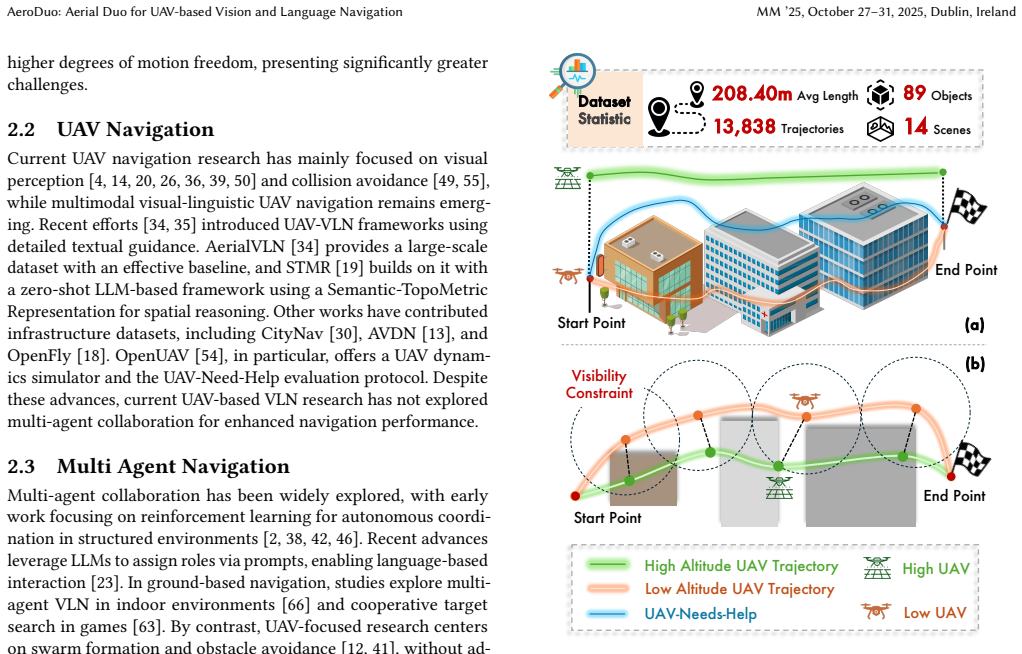
Aerial language navigation works by splitting the job between two drones: one reasons over the whole area, the other flies low and confirms the target.
Reviewed by Pith at T0; open to challenge. T0 means a machine referee read the full paper against a public rubric. the ladder, T0–T4 →
Two drones at different altitudes, one guided by a vision-language model and one by a local navigator, reach targets more often than single-drone baselines on a new UAV navigation benchmark.
T0 review reviewed 2026-08-05 challenge →
load-bearing objection A genuinely new task and dataset for dual-UAV VLN, but the paper's central claim that dual-altitude collaboration drives the gains is not tested because every ablation keeps both UAVs. the 5 major comments →
AeroDuo: Aerial Duo for UAV-based Vision and Language Navigation
The pith
A machine-rendered reading of the paper's core claim, the machinery that carries it, and where it could break.
The reading
Core claim
On its own terms, the paper establishes a new task and a new benchmark. DuAl-VLN removes the need for iterated human dialogue or step-by-step route descriptions: the two-UAV system receives a single target-oriented instruction and must locate the object. AeroDuo operationalizes a division of labor. The high-altitude UAV's Pilot-LLM takes a stitched orthographic map, the historical trajectory, and the instruction, and outputs a probability map over the terrain, which is converted into a centroid waypoint; the low-altitude UAV then executes the waypoint with an RL collision-avoidance controller and calls a grounded detector to stop once the target is found. The reported results show 16.57% suc
What carries the argument
The load-bearing mechanism is the target probability map predicted by Pilot-LLM over a global orthophoto map—a ground-plane image formed by reprojecting and stitching the high UAV's bird's-eye views using its trajectory and point clouds. The map converts a spatial-reasoning problem that large language models handle poorly (direct coordinate output) into a segmentation-like map prediction that can be pretrained with referring segmentation and depth estimation. On the low UAV, the Multi-Stage Pathfinder turns that map into a sub-goal centroid, computes collision-free waypoints with A* on an occupancy map, follows them with a point-cloud-based RL controller, and terminates with an open-vocabula
Load-bearing premise
The load-bearing premise is that the best single-UAV baseline is a fair counterfactual for the two-UAV system; since AeroDuo's advantages—a global orthophoto map and a multimodal language model—are bundled with the second drone, no experiment shows that the second drone itself, rather than those components, produces the 9.71-point gain.
What would settle it
Run AeroDuo with the high-altitude UAV's map and policy replaced by the low-altitude UAV's own onboard bird's-eye image while keeping the same Pilot-LLM: if success rate stays above roughly 15%, the second aircraft is unnecessary. Alternatively, keep the two-UAV setup but replace Pilot-LLM with a non-LLM segmentation-based map predictor: if success stays high, the language model is not the source of the gain. Either result would settle where the effect lives.
If this is right
- A target sentence like "red car near a T-intersection" can replace step-by-step route descriptions and real-time human assistance, reducing operator workload in aerial search.
- The learned probability-map interface lets a multimodal language model contribute to navigation without asking it to regress exact coordinates, a known weak point of LLMs.
- The dual-UAV design communicates only minimal coordinate information between agents, so the collaboration is bandwidth-efficient in principle.
- The HaL-13k dataset provides synchronized high-low trajectories with multi-modal sensor streams, enabling further work on altitude-dependent perception and joint planning.
- The method generalizes across both the unseen-map split and the unseen-object split of the benchmark, with the unseen-map split being the harder one on the reported numbers.
Where Pith is reading between the lines
- The reported gain is not fully isolated to the second aircraft: the high-altitude UAV brings both the global orthophoto map and the MLLM reasoning, so a single-UAV AeroDuo using the same map and model could be the actual driver. Running that variant is the missing experiment.
- Because all evaluation happens in simulation with a 20-metre success radius, transfer to real drones—where localization error, latency, and communication limits are larger—remains an open question the paper does not address.
- The closeness of the unseen-object and unseen-map success rates suggests that new layouts, not new object categories, are the harder generalization problem; future work could concentrate on map-level generalization.
- The probability-map design is a reusable trick for embodied tasks where large models are poor at direct coordinate output: turn regression into map prediction and pretrain with segmentation-style auxiliary tasks.
Editorial analysis
A structured set of objections, weighed in public.
Referee Report
Summary. The paper introduces a new task, Dual-Altitude UAV Collaborative VLN (DuAl-VLN), in which a high-altitude UAV performs broad environmental reasoning and a low-altitude UAV performs precise navigation. To support the task, the authors construct HaL-13k, a dataset of 13,838 paired high/low-altitude trajectories with target-oriented instructions, including held-out map and held-out object validation sets. The proposed framework, AeroDuo, couples a multimodal LLM (Pilot-LLM) on the high-altitude UAV, which predicts a target probability map from a stitched orthophoto, with a Multi-Stage Pathfinder (A*, RL-based collision avoidance, and GroundingDINO) on the low-altitude UAV. Experiments compare AeroDuo against single-UAV baselines (CMA, TravelUAV, TravelUAV-L1) and report higher success rates, e.g., 16.57% SR vs. 6.86% on unseen maps.
Significance. If the central claim were fully supported, this would be a meaningful contribution: it is, to my knowledge, one of the first UAV-VLN benchmarks with explicit dual-altitude collaboration, and the dataset scale (13,838 trajectories) plus held-out scene/object splits are useful assets for the community. The modular framework is also a strength: the high-altitude Pilot-LLM is pretrained on auxiliary tasks, and the low-altitude pathfinder is decomposed into clearly separated stages, with minimal coordinate-only communication between the UAVs. However, the paper's headline conclusion that dual-altitude collaboration causes the observed improvement is not established by the current experimental design, because no comparison removes the high-altitude UAV while keeping the rest of the stack fixed. The reported numbers also lack error bars, and several dataset-construction choices are underdescribed. These issues are fixable but require additional experiments and clarification.
major comments (5)
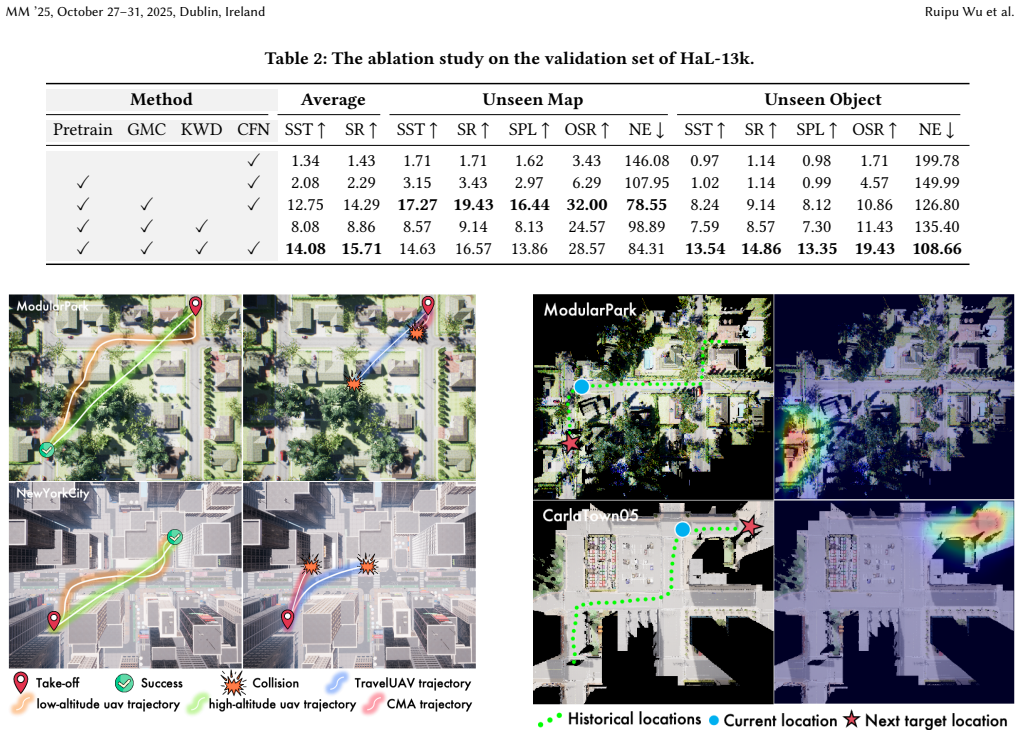
- [§5.2, Table 1; §5.3, Table 2] The central claim that dual-altitude collaboration improves navigation is not supported by the reported comparisons. AeroDuo differs from the TravelUAV/CMA baselines in several non-collaborative dimensions: the Pilot-LLM (Qwen2-VL) backbone, the stitched global orthophoto map, large-scale MLLM pretraining, and the modular Multi-Stage Pathfinder. Table 2 ablates Pretrain/GMC/KWD/CFN, but every row retains the high-altitude UAV; the 'no GMC' row still feeds the current BEV image from the high-altitude UAV, not the low-altitude UAV's forward view. Thus, the observed SR gain could come from the MLLM, the orthophoto map, or the pretraining, even if two-altitude collaboration contributed nothing. Please add a control that removes the high-altitude UAV (or replaces its BEV inputs with the low-altitude UAV's camera) while keeping the same perception/planning stack, and report SR/SST for that var
- [Abstract; §1] The phrase 'a significant improvement of 9.71% in navigation success rates' is misleading. The difference 16.57% - 6.86% is 9.71 percentage points, not a 9.71% relative improvement (which would be approximately 142%). Please correct the wording throughout to '9.71-point improvement' or state the relative improvement explicitly.
- [§5.1, Tables 1–2] No error bars, confidence intervals, or multiple-seed variance are reported. Each validation split contains 175 episodes, so a 16.57% versus 14.86% SR difference corresponds to 29 versus 26 successes, which may be within sampling noise. Please report results over at least three seeds or provide exact binomial confidence intervals for the main comparisons and ablations.
- [§3.2; §4.4] The HaL-13k dataset construction is underdescribed. The paper does not state how the 'target-oriented language instructions' were generated (e.g., template-based, human-written, or LLM-generated), whether they were filtered for resolvability, or what object/attribute distribution they cover. It also does not specify the split of the 14 scenes into training and unseen-map sets beyond '2 scenes', the number of trajectories per scene, or the criteria for selecting held-out object categories. These details are essential for assessing generalization claims and for reproducibility.
- [§4.3, Eq. (4)] The sub-goal is computed as a sum over M_tau(i,j)*[i,j] without normalization. Since M_tau is the output of a sigmoid (Eq. (3)), it is not a normalized probability distribution unless additional normalization is applied. As written, the 'centroid' is a weighted sum up to scale, which would bias the waypoint. Please either normalize M_tau before applying Eq. (4) or explicitly state the normalization step.
minor comments (5)
- [§5.1] Typo: 'Path Lengh' should be 'Path Length'.
- [§5.2] The Random baseline is described as selecting from 'four possible directions: forward, left, right, up, or down', which lists five actions.
- [§5.3, Table 2] The row labels in Table 2 are ambiguous: the positions of checkmarks under Pretrain/GMC/KWD/CFN do not unequivocally identify which components are active in each row. Please use explicit configuration names (e.g., 'Pretrain only', '+ GMC', '+ KWD', '+ CFN', 'Full') to make the ablation readable.
- [§4.4] The finetuning stage uses a Gaussian centered at the future position to generate ground-truth probability maps, but the choice of the Gaussian sigma and the future horizon k is not specified. These are free parameters that should be reported.
- [Figure 1] The annotations '1' and '2' in Figure 1 are not explained in the caption; please add a legend or clear referencing in the text.
Circularity Check
No significant circularity: the paper's gains are empirical comparisons, and the Pilot-LLM supervision is standard imitation learning rather than a self-fulfilling prediction.
full rationale
The closest candidate for circularity is the Pilot-LLM finetuning stage (Sec. 4.4), where ground-truth probability maps are generated from the future positions of the A*-planned low-altitude trajectories in HaL-13k. This is supervised imitation of the expert planner, not a prediction that is forced by construction: the evaluation metrics (SR, SST, SPL, OSR, NE) measure whether the low-altitude UAV reaches the true target within 20m on held-out unseen maps and unseen objects, and no metric compares the model's output to the training labels or to the A* path used to generate them. The model must generalize from BEV/orthophoto inputs and language instructions to new environments, so the reported success rates are not equivalent to re-displaying the training labels. The main comparison against CMA, TravelUAV, and TravelUAV(L1) is an empirical benchmark; although the absence of a single-UAV AeroDuo ablation means the 9.71% gain cannot be uniquely attributed to dual-altitude collaboration rather than to the MLLM, orthophoto map, pretraining, or modular pathfinder, that is an experimental-confound/validity limitation, not a circular reduction of the claim to its inputs. OpenUAV [54] is a same-group prior platform and baseline, but it is used as a simulator/dataset source and comparison point, not as load-bearing evidence for the dual-altitude collaboration claim. No self-citation chain, uniqueness theorem, or ansatz-smuggling is load-bearing. Therefore no circular step is identifiable by the standards required here.
Axiom & Free-Parameter Ledger
free parameters (3)
- Gaussian sigma for ground-truth probability maps =
not reported
- GroundingDINO detection confidence threshold =
not reported
- maximum number of stitched historical images =
5
axioms (4)
- domain assumption The orthographic projection pipeline in Eq. (1) yields an accurate global map from up to five stitched BEV images.
- domain assumption The RL navigator trained in Isaac Sim transfers to the OpenUAV simulator without a domain gap.
- domain assumption GroundingDINO can detect all target object categories from the language description in low-altitude views.
- domain assumption The expert trajectories in HaL-13k are optimal enough to serve as training labels for navigation.
Cite this review
Pith. "Pith review of AeroDuo: Aerial Duo for UAV-based Vision and Language Navigation." pith.science (2026). https://pith.science/paper/2SBRKMRM
@misc{pith2026250815232,
  author       = {Pith},
  title        = {Pith review of: AeroDuo: Aerial Duo for UAV-based Vision and Language Navigation},
  year         = {2026},
  howpublished = {\url{https://pith.science/paper/2SBRKMRM}},
  note         = {Machine review of arXiv:2508.15232}
}
read the original abstract
Aerial Vision-and-Language Navigation (VLN) is an emerging task that enables Unmanned Aerial Vehicles (UAVs) to navigate outdoor environments using natural language instructions and visual cues. However, due to the extended trajectories and complex maneuverability of UAVs, achieving reliable UAV-VLN performance is challenging and often requires human intervention or overly detailed instructions. To harness the advantages of UAVs' high mobility, which could provide multi-grained perspectives, while maintaining a manageable motion space for learning, we introduce a novel task called Dual-Altitude UAV Collaborative VLN (DuAl-VLN). In this task, two UAVs operate at distinct altitudes: a high-altitude UAV responsible for broad environmental reasoning, and a low-altitude UAV tasked with precise navigation. To support the training and evaluation of the DuAl-VLN, we construct the HaL-13k, a dataset comprising 13,838 collaborative high-low UAV demonstration trajectories, each paired with target-oriented language instructions. This dataset includes both unseen maps and an unseen object validation set to systematically evaluate the model's generalization capabilities across novel environments and unfamiliar targets. To consolidate their complementary strengths, we propose a dual-UAV collaborative VLN framework, AeroDuo, where the high-altitude UAV integrates a multimodal large language model (Pilot-LLM) for target reasoning, while the low-altitude UAV employs a lightweight multi-stage policy for navigation and target grounding. The two UAVs work collaboratively and only exchange minimal coordinate information to ensure efficiency.
Figures



Forward citations
Cited by 1 Pith paper
-
No Training, Better Flights: Test-Time Scaled VLMs for UAV Navigation
Test-time scaling—parallel candidate generation, iterative self-correction, and multi-criteria selection—improves a frozen UAV navigation VLM's success rate by about 2 percentage points on the TravelUAV benchmark.
Reference graph
Works this paper leans on
-
[1]
Peter Anderson, Qi Wu, Damien Teney, Jake Bruce, Mark Johnson, Niko Sünder- hauf, Ian Reid, Stephen Gould, and Anton Van Den Hengel. 2018. Vision-and- language navigation: Interpreting visually-grounded navigation instructions in real environments. In CVPR
work page 2018
-
[2]
Christopher Berner, Greg Brockman, Brooke Chan, Vicki Cheung, Przemysław Dębiak, Christy Dennison, David Farhi, Quirin Fischer, Shariq Hashme, Chris Hesse, et al. 2019. Dota 2 with large scale deep reinforcement learning. arXiv (2019)
work page 2019
-
[3]
Prabin Bhandari, Antonios Anastasopoulos, and Dieter Pfoser. 2023. Are large language models geospatially knowledgeable?. In Proceedings of the 31st ACM International Conference on Advances in Geographic Information Systems . 1–4
work page 2023
-
[4]
Ilker Bozcan and Erdal Kayacan. 2020. AU-AIR: A Multi-modal Unmanned Aerial Vehicle Dataset for Low Altitude Traffic Surveillance. arXiv preprint (2020)
work page 2020
-
[5]
Anthony Brohan, Noah Brown, Justice Carbajal, Yevgen Chebotar, Xi Chen, Krzysztof Choromanski, Tianli Ding, Danny Driess, Avinava Dubey, Chelsea Finn, et al. 2023. Rt-2: Vision-language-action models transfer web knowledge to robotic control. arXiv preprint arXiv:2307.15818 (2023)
Pith/arXiv arXiv 2023
-
[6]
Angel Chang, Angela Dai, Thomas Funkhouser, Maciej Halber, Matthias Niessner, Manolis Savva, Shuran Song, Andy Zeng, and Yinda Zhang. 2017. Matterport3D: Learning from RGB-D Data in Indoor Environments. 3DV (2017)
work page 2017
-
[7]
Howard Chen, Alane Suhr, Dipendra Misra, Noah Snavely, and Yoav Artzi. 2019. Touchdown: Natural language navigation and spatial reasoning in visual street environments. In CVPR
work page 2019
-
[8]
Jinyu Chen, Chen Gao, Erli Meng, Qiong Zhang, and Si Liu. 2022. Reinforced structured state-evolution for vision-language navigation. In CVPR
work page 2022
-
[9]
Jiaqi Chen, Bingqian Lin, Ran Xu, Zhenhua Chai, Xiaodan Liang, and Kwan-Yee K Wong. 2024. Mapgpt: Map-guided prompting for unified vision-and-language navigation. arXiv preprint arXiv:2401.07314 (2024)
Pith/arXiv arXiv 2024
-
[10]
Shizhe Chen, Pierre-Louis Guhur, Cordelia Schmid, and Ivan Laptev. 2021. History aware multimodal transformer for vision-and-language navigation. NeurIPS (2021)
work page 2021
-
[11]
Wei-Lin Chiang, Zhuohan Li, Zi Lin, Ying Sheng, Zhanghao Wu, Hao Zhang, Lianmin Zheng, Siyuan Zhuang, Yonghao Zhuang, Joseph E Gonzalez, et al. 2023. Vicuna: An open-source chatbot impressing gpt-4 with 90%* chatgpt quality. See https://vicuna. lmsys. org (accessed 14 April 2023) 2, 3 (2023), 6
2023
-
[12]
Stepan Dergachev and Konstantin Yakovlev. 2021. Distributed Multi-Agent Navigation Based on Reciprocal Collision Avoidance and Locally Confined Multi- Agent Path Finding. In CASE
work page 2021
-
[13]
Yue Fan, Winson Chen, Tongzhou Jiang, Chun Zhou, Yi Zhang, and Xin Eric Wang
-
[14]
Yue Fan, Shilei Chu, Wei Zhang, Ran Song, and Yibin Li. 2020. Learn by observa- tion: Imitation learning for drone patrolling from videos of a human navigator. In IROS
work page 2020
-
[15]
Daniel Fried, Ronghang Hu, Volkan Cirik, Anna Rohrbach, Jacob Andreas, Louis- Philippe Morency, Taylor Berg-Kirkpatrick, Kate Saenko, Dan Klein, and Trevor Darrell. 2018. Speaker-Follower Models for Vision-and-Language Navigation. NeurIPS (2018)
work page 2018
-
[16]
Chen Gao, Jinyu Chen, Si Liu, Luting Wang, Qiong Zhang, and Qi Wu. 2021. Room-and-object aware knowledge reasoning for remote embodied referring expression. In CVPR
work page 2021
-
[17]
Chen Gao, Si Liu, Jinyu Chen, Luting Wang, Qi Wu, Bo Li, and Qi Tian. 2023. Room-object entity prompting and reasoning for embodied referring expression. IEEE TPAMI (2023)
work page 2023
-
[18]
Yunpeng Gao, Chenhui Li, Zhongrui You, Junli Liu, Zhen Li, Pengan Chen, Qizhi Chen, Zhonghan Tang, Liansheng Wang, Penghui Yang, et al. 2025. OpenFly: A Versatile Toolchain and Large-scale Benchmark for Aerial Vision-Language Navigation. arXiv preprint arXiv:2502.18041 (2025)
arXiv 2025
-
[19]
Yunpeng Gao, Zhigang Wang, Linglin Jing, Dong Wang, Xuelong Li, and Bin Zhao. 2024. Aerial Vision-and-Language Navigation via Semantic-Topo-Metric Representation Guided LLM Reasoning. arXiv preprint arXiv:2410.08500 (2024)
Pith/arXiv arXiv 2024
-
[20]
Alessandro Giusti, Jérôme Guzzi, Dan C Cireşan, Fang-Lin He, Juan P Rodríguez, Flavio Fontana, Matthias Faessler, Christian Forster, Jürgen Schmidhuber, Gianni Di Caro, et al. 2015. A machine learning approach to visual perception of forest trails for mobile robots. IEEE RAL (2015)
work page 2015
-
[21]
Zonghao Guo, Ruyi Xu, Yuan Yao, Junbo Cui, Zanlin Ni, Chunjiang Ge, Tat-Seng Chua, Zhiyuan Liu, and Gao Huang. 2025. Llava-uhd: an lmm perceiving any aspect ratio and high-resolution images. In ECCV
work page 2025
-
[22]
Peter E Hart, Nils J Nilsson, and Bertram Raphael. 1968. A formal basis for the heuristic determination of minimum cost paths. IEEE transactions on Systems Science and Cybernetics 4, 2 (1968), 100–107
1968
-
[23]
Sirui Hong, Mingchen Zhuge, Jonathan Chen, Xiawu Zheng, Yuheng Cheng, Jinlin Wang, Ceyao Zhang, Zili Wang, Steven Ka Shing Yau, Zijuan Lin, et al
-
[24]
Yicong Hong, Qi Wu, Yuankai Qi, Cristian Rodriguez-Opazo, and Stephen Gould
-
[25]
Vihan Jain, Gabriel Magalhaes, Alexander Ku, Ashish Vaswani, Eugene Ie, and Jason Baldridge. 2019. Stay on the path: Instruction fidelity in vision-and-language navigation. arXiv preprint (2019)
work page 2019
-
[26]
Katie Kang, Suneel Belkhale, Gregory Kahn, Pieter Abbeel, and Sergey Levine
-
[27]
Xianghao Kong, Jinyu Chen, Wenguan Wang, Hang Su, Xiaolin Hu, Yi Yang, and Si Liu. 2024. Controllable navigation instruction generation with chain of thought prompting. In European Conference on Computer Vision. Springer, 37–54
work page 2024
-
[28]
Jacob Krantz, Erik Wijmans, Arjun Majumdar, Dhruv Batra, and Stefan Lee
-
[29]
Alexander Ku, Peter Anderson, Roma Patel, Eugene Ie, and Jason Baldridge. 2020. Room-Across-Room: Multilingual Vision-and-Language Navigation with Dense Spatiotemporal Grounding. In EMNLP
work page 2020
-
[30]
Jungdae Lee, Taiki Miyanishi, Shuhei Kurita, Koya Sakamoto, Daichi Azuma, Yutaka Matsuo, and Nakamasa Inoue. 2024. CityNav: Language-Goal Aerial Navigation Dataset with Geographic Information. arXiv preprint (2024)
work page 2024
-
[31]
Hongyu Li, Jinyu Chen, Ziyu Wei, Shaofei Huang, Tianrui Hui, Jialin Gao, Xiaom- ing Wei, and Si Liu. 2025. LLaVA-ST: A Multimodal Large Language Model for Fine-Grained Spatial-Temporal Understanding. arXiv preprint arXiv:2501.08282 (2025)
Pith/arXiv arXiv 2025
-
[32]
Jialu Li and Mohit Bansal. 2024. Panogen: Text-conditioned panoramic envi- ronment generation for vision-and-language navigation. Advances in Neural Information Processing Systems 36 (2024)
work page 2024
-
[33]
Shilong Liu, Zhaoyang Zeng, Tianhe Ren, Feng Li, Hao Zhang, Jie Yang, Chunyuan Li, Jianwei Yang, Hang Su, Jun Zhu, et al . 2023. Grounding dino: Marrying dino with grounded pre-training for open-set object detection. arXiv preprint arXiv:2303.05499 (2023)
Pith/arXiv arXiv 2023
-
[34]
Shubo Liu, Hongsheng Zhang, Yuankai Qi, Peng Wang, Yanning Zhang, and Qi Wu. 2023. Aerialvln: Vision-and-language navigation for uavs. In ICCV
work page 2023
-
[35]
Youzhi Liu, Fanglong Yao, Yuanchang Yue, Guangluan Xu, Xian Sun, and Kun Fu. 2024. NavAgent: Multi-scale Urban Street View Fusion For UAV Embodied Vision-and-Language Navigation. arXiv preprint (2024)
work page 2024
-
[36]
Antonio Loquercio, Ana I Maqueda, Carlos R Del-Blanco, and Davide Scaramuzza
-
[37]
Ilya Loshchilov and Frank Hutter. 2017. Decoupled weight decay regularization. arXiv preprint arXiv:1711.05101 (2017)
Pith/arXiv arXiv 2017
-
[38]
Ryan Lowe, Yi I Wu, Aviv Tamar, Jean Harb, OpenAI Pieter Abbeel, and Igor Mordatch. 2017. Multi-agent actor-critic for mixed cooperative-competitive environments. NeurIPS (2017)
work page 2017
-
[39]
András L Majdik, Charles Till, and Davide Scaramuzza. 2017. The Zurich urban micro aerial vehicle dataset. The IJRR (2017)
work page 2017
-
[40]
Viktor Makoviychuk, Lukasz Wawrzyniak, Yunrong Guo, Michelle Lu, Kier Storey, Miles Macklin, David Hoeller, Nikita Rudin, Arthur Allshire, Ankur Handa, et al
-
[41]
Yash Vardhan Pant, Houssam Abbas, Rhudii A Quaye, and Rahul Mangharam
-
[42]
Diego Perez-Liebana, Katja Hofmann, Sharada Prasanna Mohanty, Noburu Kuno, Andre Kramer, Sam Devlin, Raluca D Gaina, and Daniel Ionita. 2019. The multi- agent reinforcement learning in malm\" o (marl\" o) competition. arXiv preprint arXiv:1901.08129 (2019)
Pith/arXiv arXiv 2019
-
[43]
Yuankai Qi, Qi Wu, Peter Anderson, Xin Wang, William Yang Wang, Chunhua Shen, and Anton van den Hengel. 2020. Reverie: Remote embodied visual referring expression in real indoor environments. In CVPR
work page 2020
-
[44]
Yanyuan Qiao, Qianyi Liu, Jiajun Liu, Jing Liu, and Qi Wu. 2024. LLM as Copilot for Coarse-Grained Vision-and-Language Navigation. In European Conference on Computer Vision. Springer, 459–476
work page 2024
-
[45]
Shuhuai Ren, Linli Yao, Shicheng Li, Xu Sun, and Lu Hou. 2024. Timechat: A time-sensitive multimodal large language model for long video understanding. In Proceedings of the IEEE/CVF Conference on Computer Vision and Pattern Recognition. 14313–14323
2024
-
[46]
Mikayel Samvelyan, Tabish Rashid, Christian Schroeder De Witt, Gregory Far- quhar, Nantas Nardelli, Tim GJ Rudner, Chia-Man Hung, Philip HS Torr, Jakob Foerster, and Shimon Whiteson. 2019. The starcraft multi-agent challenge. arXiv (2019)
work page 2019
-
[47]
arXiv preprint arXiv:2108.10470 (2021)
Isaac gym: High performance gpu-based physics simulation for robot learning. arXiv preprint arXiv:2108.10470 (2021)
Pith/arXiv arXiv 2021
-
[48]
Shital Shah, Debadeepta Dey, Chris Lovett, and Ashish Kapoor. 2018. Airsim: High-fidelity visual and physical simulation for autonomous vehicles. InField and Service Robotics: Results of the 11th International Conference . Springer, 621–635. MM ’25, October 27–31, 2025, Dublin, Ireland Ruipu Wu et al
work page 2018
- [49]
-
[50]
Nikolai Smolyanskiy, Alexey Kamenev, Jeffrey Smith, and Stan Birchfield. 2017. Toward low-flying autonomous MAV trail navigation using deep neural networks for environmental awareness. In IROS
work page 2017
-
[51]
Hugo Touvron, Thibaut Lavril, Gautier Izacard, Xavier Martinet, Marie-Anne Lachaux, Timothée Lacroix, Baptiste Rozière, Naman Goyal, Eric Hambro, Faisal Azhar, et al. 2023. Llama: Open and efficient foundation language models. arXiv preprint arXiv:2302.13971 (2023)
Pith/arXiv arXiv 2023
-
[52]
Peng Wang, Shuai Bai, Sinan Tan, Shijie Wang, Zhihao Fan, Jinze Bai, Keqin Chen, Xuejing Liu, Jialin Wang, Wenbin Ge, Yang Fan, Kai Dang, Mengfei Du, Xuancheng Ren, Rui Men, Dayiheng Liu, Chang Zhou, Jingren Zhou, and Junyang Lin. 2024. Qwen2-VL: Enhancing Vision-Language Model’s Perception of the World at Any Resolution. arXiv preprint arXiv:2409.12191 (2024)
Pith/arXiv arXiv 2024
-
[53]
Su Wang, Ceslee Montgomery, Jordi Orbay, Vighnesh Birodkar, Aleksandra Faust, Izzeddin Gur, Natasha Jaques, Austin Waters, Jason Baldridge, and Peter Anderson. 2022. Less is more: Generating grounded navigation instructions from landmarks. In CVPR
work page 2022
-
[54]
Xiangyu Wang, Donglin Yang, Ziqin Wang, Hohin Kwan, Jinyu Chen, Wenjun Wu, Hongsheng Li, Yue Liao, and Si Liu. 2024. Towards Realistic UAV Vision- Language Navigation: Platform, Benchmark, and Methodology
work page 2024
-
[55]
John Schulman, Filip Wolski, Prafulla Dhariwal, Alec Radford, and Oleg Klimov
-
[56]
Yutaro Yamada, Yihan Bao, Andrew K Lampinen, Jungo Kasai, and Ilker Yildirim
-
[57]
Lihe Yang, Bingyi Kang, Zilong Huang, Zhen Zhao, Xiaogang Xu, Jiashi Feng, and Hengshuang Zhao. 2024. Depth anything v2. NeurIPS 37 (2024), 21875–21911
work page 2024
-
[58]
Abhik Singla, Sindhu Padakandla, and Shalabh Bhatnagar. 2019. Memory-based deep reinforcement learning for obstacle avoidance in UAV with limited environ- ment knowledge. IEEE TIST (2019)
work page 2019
-
[59]
Haitian Zeng, Xiaohan Wang, Wenguan Wang, and Yi Yang. 2023. Kefa: A Knowl- edge Enhanced and Fine-grained Aligned Speaker for Navigation Instruction Generation. arXiv preprint arXiv:2307.13368 (2023)
Pith/arXiv arXiv 2023
-
[60]
Jiazhao Zhang, Kunyu Wang, Rongtao Xu, Gengze Zhou, Yicong Hong, Xiaomeng Fang, Qi Wu, Zhizheng Zhang, and He Wang. 2024. Navid: Video-based vlm plans the next step for vision-and-language navigation. arXiv preprint arXiv:2402.15852 (2024)
Pith/arXiv arXiv 2024
-
[61]
Yue Zhang and Parisa Kordjamshidi. 2023. VLN-Trans, Translator for the Vision and Language Navigation Agent. In ACL
work page 2023
-
[62]
Yusheng Zhao, Jinyu Chen, Chen Gao, Wenguan Wang, Lirong Yang, Haibing Ren, Huaxia Xia, and Si Liu. 2022. Target-Driven Structured Transformer Planner for Vision-Language Navigation. In ACM MM
work page 2022
-
[63]
Zhonghan Zhao, Kewei Chen, Dongxu Guo, Wenhao Chai, Tian Ye, Yanting Zhang, and Gaoang Wang. 2024. Hierarchical auto-organizing system for open- ended multi-agent navigation. arXiv (2024)
work page 2024
-
[64]
Zhefan Xu, Xinming Han, Haoyu Shen, Hanyu Jin, and Kenji Shimada. 2025. Navrl: Learning safe flight in dynamic environments. IEEE RAL (2025)
work page 2025
-
[65]
Junjie Zhou, Yan Shu, Bo Zhao, Boya Wu, Shitao Xiao, Xi Yang, Yongping Xiong, Bo Zhang, Tiejun Huang, and Zheng Liu. 2024. MLVU: A Comprehensive Bench- mark for Multi-Task Long Video Understanding. arXiv preprint arXiv:2406.04264 (2024)
Pith/arXiv arXiv 2024
-
[66]
arXiv preprint arXiv:2310.14540 (2023)
Evaluating spatial understanding of large language models. arXiv preprint arXiv:2310.14540 (2023)
Pith/arXiv arXiv 2023
-
[68]
Licheng Yu, Patrick Poirson, Shan Yang, Alexander C Berg, and Tamara L Berg
-
[75]
Duo Zheng, Shijia Huang, Lin Zhao, Yiwu Zhong, and Liwei Wang. 2024. To- wards learning a generalist model for embodied navigation. In Proceedings of the IEEE/CVF Conference on Computer Vision and Pattern Recognition . 13624–13634
work page 2024
-
[77]
Fengda Zhu, Vincent CS Lee, and Rui Liu. 2024. Communicative and Coopera- tive Learning for Multi-agent Indoor Navigation. In Pacific-Asia Conference on Knowledge Discovery and Data Mining . Springer, 273–285
work page 2024
-
[2016]
Modeling context in referring expressions. In ECCV. Springer, 69–85
-
[2017]
arXiv preprint arXiv:1707.06347 (2017)
Proximal policy optimization algorithms. arXiv preprint arXiv:1707.06347 (2017)
Pith/arXiv arXiv 2017
-
[2018]
IEEE RAL 3, 2 (2018), 1088–1095
Dronet: Learning to fly by driving. IEEE RAL 3, 2 (2018), 1088–1095
work page 2018
-
[2019]
Generalization through simulation: Integrating simulated and real data into deep reinforcement learning for vision-based autonomous flight. arXiv preprint (2019)
work page 2019
-
[2020]
Beyond the nav-graph: Vision-and-language navigation in continuous environments. In ECCV
-
[2021]
A recurrent vision-and-language bert for navigation. In CVPR
-
[2023]
In Findings of the Association for Computational Linguistics: ACL 2023
Aerial Vision-and-Dialog Navigation. In Findings of the Association for Computational Linguistics: ACL 2023 . Association for Computational Linguistics, Toronto, Canada, 3043–3061
work page 2023
-
[2024]
MetaGPT: Meta Programming for A Multi-Agent Collaborative Framework. In ICLR
This paper was first reviewed by deepseek-v4-flash on August 5, 2026.
discussion (0)
Sign in with ORCID, Apple, or X to comment. Anyone can read and Pith papers without signing in.