REVIEW 5 major objections 6 minor 5 references
Language-Guided Tuning: Enhancing Numeric Optimization with Textual Feedback
T0 review · 5 major / 6 minor · reviewed 2026-08-05 · deepseek-v4-flash
Pith's one-line read Three AI agents beat grid, random, and Bayesian tuning
desk verdict A plausible multi-agent LLM tuning loop, but the empirical claims rest on implausibly weak baselines and the theory is vacuous. read the letter →
The pith
A machine-rendered reading of the paper's core claim, the machinery that carries it, and where it could break.
The reading
What carries the argument
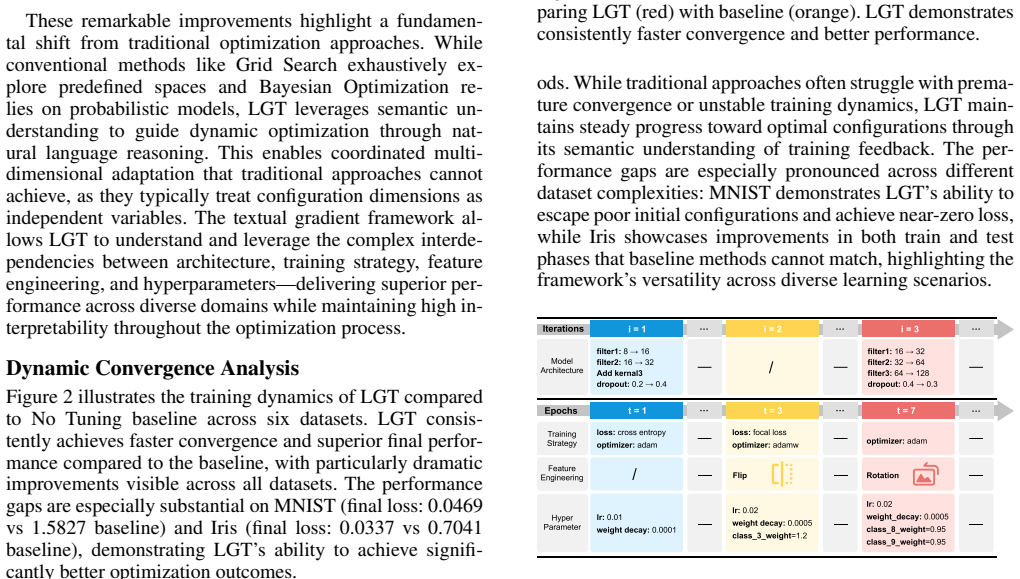
Textual gradients: qualitative, natural-language feedback signals that stand beside numeric loss and gradients. Three agents carry the mechanism: the Advisor proposes configuration deltas, the Evaluator produces a binary success judgment from training history, and the Prompt Optimizer updates the Advisor's prompt with lessons learned. The load-bearing loop is the history accumulation H_t = H_{t-1} plus the current configuration, metrics, and prompt, which lets later suggestions refer to earlier failures and creates the claimed self-improving behavior.
What would settle it
Re-run the comparison with a properly tuned strong baseline: a standard MLP on MNIST (or a ResNet on CIFAR-10) with sensible defaults, plus the same 50-configuration budget for random search, grid search, and Bayesian optimization. If LGT does not beat that baseline by a statistically significant margin over 10 seeds, the claim of consistent superiority fails. Also, compare LGT against a single LLM call that proposes a configuration from prior knowledge with no iterative feedback; if that matches LGT's accuracy, the feedback loop is not the source of the gains.
Extended reading notes
Core claim
On the paper's own terms, LGT establishes that qualitative textual feedback can serve as an optimization signal alongside numerical gradients. At each epoch, an Advisor emits a configuration change, an Evaluator returns a success signal by comparing current and baseline training histories, and a Prompt Optimizer uses that history to refine the Advisor's prompt, forming a self-improving loop. The reported result is that this coordinated loop converges faster and to lower loss than all five baselines, with the sharpest gaps on MNIST (78.41% to 98.99% accuracy) and CIFAR-10 (49.01% to 69.64%), and roughly 49% error reduction on the regression tasks. The convergence claim is formalized in Equati
Load-bearing premise
The comparison is fair: the baselines are implemented well enough that beating them means something, especially the 'No Tuning' baseline which reaches only 78.41% on MNIST, far below what a standard model achieves.
Editorial extensions
If this is right
- Configuration tuning tools could expose a readable log of why each change was made, letting practitioners audit and trust automated decisions.
- Tuning could become dynamic, adjusting architecture, augmentation, loss, optimizer, and hyperparameters during training rather than only as a fixed pre-training search.
- The same framework could improve automatically as backend language models improve, without changing the optimization algorithm.
- The multi-agent loop applies to search spaces where dimensions are discrete and interdependent, which is exactly where numeric gradient methods are unavailable.
Reading between the lines
- The largest reported gains may come more from the LLM's prior knowledge of sensible defaults than from the feedback loop; a controlled test with a one-shot LLM advisor (no history, no Evaluator) would separate the two effects.
- The 'No Tuning' baselines appear far weaker than standard practice—a plain MLP on MNIST typically exceeds 98%, while the paper's baseline sits at 78.41%—so the improvement magnitudes are likely inflated even if the method itself works.
- The paper does not report API cost or wall-clock overhead; LGT is most practical when each training run is expensive relative to a few LLM calls.
- If textual gradients transfer, the same three-agent loop could optimize reward functions, prompts, or simulator parameters, extending beyond machine-learning configuration.
Editorial analysis
A structured set of objections, weighed in public.
Referee Report
Summary. The paper introduces Language-Guided Tuning (LGT), a multi-agent LLM framework for configuration optimization. Three agents (Advisor, Evaluator, Optimizer) propose, assess, and refine configuration changes via natural-language 'textual gradients', with prompt updates forming a self-improving loop. The authors claim convergence to a local optimum and report on six datasets, with 'up to 23.3% absolute accuracy improvement and 49.3% error reduction' over five baselines (No Tuning, Random Search, Grid Search, NAS, Bayesian Optimization). The manuscript includes an ablation study, convergence plots, and example agent outputs.
Significance. If the empirical claims were reliable, LGT would be a useful contribution to LLM-guided AutoML and hyperparameter optimization, and the idea of interpretable, textual-gradient-driven configuration updates is appealing. The code link and 10-seed repeated runs are positive features. However, the central empirical claim is not currently supported: the baseline implementations appear seriously underpowered (e.g., No Tuning on MNIST at 78.41% accuracy), no statistical tests are reported despite the claim of 'statistically significant margins', and the computational budgets of LGT versus the baselines are not aligned. The theoretical convergence analysis is also circular and internally inconsistent. Thus the strengths of the idea are overshadowed by load-bearing problems in validation and theory.
major comments (5)
- [Experimental Setup / Table 2] The No Tuning MNIST baseline reports 78.41% accuracy. A standard two-layer MLP with ReLU activations on MNIST typically exceeds 98% with 10 epochs of training, so this baseline is far below a competent default. The headline 'up to 23.3% accuracy improvement' is therefore driven largely by the weakness of the comparator. The authors must specify the exact model architecture, optimizer, learning rate, and preprocessing used for each baseline, and compare against properly configured standard defaults. The same concern applies to the CIFAR-10 No Tuning baseline (49.01%).
- [Results / Table 2] The paper asserts that LGT 'consistently outperforms all baselines with statistically significant margins' but reports no significance test, p-value, confidence interval, or paired comparison across the 10 seeds. Some gaps are small (e.g., Water Potability: 66.92 vs. 66.67 for Bayesian Optimization). Without a specified test (paired t-test, Wilcoxon, or bootstrap), the significance claim is unsubstantiated. This undermines the central empirical conclusion.
- [Theoretical Analysis, Eqs. (9) and (12)] The convergence analysis is not valid as written. Eq. (9) asserts lim E[L(c_t)] = L* + delta, where delta is defined as the 'approximation gap due to the discrete nature of LLM-based optimization'; this is a tautology rather than a proof. Eq. (12) states L(c_t) - L* <= O(1/sqrt(t)) + O(epsilon_p * t), and the second term diverges as t grows, contradicting the claimed convergence in Eq. (9). The section needs a corrected derivation, or it should be removed and replaced with an empirical convergence characterization.
- [Experimental Setup / Baselines] The computational budget is not fairly specified. LGT trains a single model for 10 epochs with epoch-level updates, while the text states each baseline method evaluates 'maximum 50 configurations with 10 epochs per evaluation', implying up to 50 times the training cost. If this is the intended protocol, the comparison is unequal. The authors must report the total wall-clock or epoch budget per method and ensure all methods receive comparable computational effort.
- [Methods, Eq. (2)] The augmentation selection rule is written as tau_{t+1} = arg max_{tau in T} E[L(tau(x), y)], i.e., it maximizes the expected loss L. Since L is defined in Eq. (1) as the loss to be minimized, this is a sign/optimization-direction error. The intended selection should minimize validation loss or maximize a performance metric. This is a technical error in the formal description of the method.
minor comments (6)
- [Table 2] Several entries are formatted incorrectly, e.g., '77.882.3' and '97.550.4', which appear to be missing '±'. Please fix table formatting.
- [Figure 4] The example agent output contains 'NgO' artifacts and layout issues. Present a clean, verbatim transcript to support the interpretability claim.
- [Table 4 / Table 2] The ablation baseline 'Baseline (No LLM)' reports MNIST AUC 97.55, whereas Table 2's 'No Tuning' reports MNIST accuracy 78.41. Clarify whether these are the same configuration and why the metrics differ so dramatically; also clarify that Table 4 uses AUC while Table 2 uses accuracy.
- [Eq. (13)] The operator norm ||A_adv ∘ A_eval ∘ A_opt|| <= 1 is not defined. These agents are not linear operators, so the inequality is not meaningful without formal definitions.
- [Datasets] The 'House Price' dataset is described as having 50,000 samples with 5 features, but the cited reference (Harrison and Rubinfeld 1978) is the Boston housing dataset with 506 samples. Please specify the exact dataset source and preprocessing.
- [References] The DeepSeek API is cited via the DeepSeek-V3 technical report, but the specific model/API version used is not stated. Also, the code repository link should be versioned or archived for reproducibility.
Circularity Check
Convergence result Eq. (9) is definitional: δ is introduced as the approximation gap, making the limit L*+δ true by construction; the empirical comparison is independent and no load-bearing self-citation chain exists.
-
self definitional
[Theoretical Analysis, Convergence Analysis, Eq. (9)]
"Under the assumption that the configuration space C is compact and the loss functionL is Lipschitz continuous, the system converges to a local optimum: lim_{t→∞} E[L(ct)] = L∗ + δ (9) where L∗ is the optimal loss and δ ≥ 0 represents the approximation gap due to the discrete nature of LLM-based optimization."
δ is introduced as 'the approximation gap' between the limit and L*. With that meaning, the asserted identity lim E[L(ct)] = L* + δ is not derived from compactness/Lipschitz assumptions; it is just the definition of δ and it presupposes that the limit exists. Any bounded process can be written as L* plus its gap, so Eq. (9) has no predictive content. The preceding sentence asserts the very convergence ('the system converges to a local optimum') that the analysis purports to establish, and δ absorbs the entire discrepancy. This is pattern 1: the claimed convergence result is defined in terms of the gap it is supposed to quantify. The empirical results in Tables 2–3 do not rely on Eq. (9), so the circularity is localized to the theoretical section.
full rationale
The central empirical claim—up to 23.3% absolute accuracy improvement and 49.3% error reduction, with consistent gains over NAS and Bayesian optimization—rests on Tables 2 and 3. Those comparisons are externally falsifiable and are not derived from the convergence theory; no fitted parameter is renamed as a prediction. The weak 'No Tuning' MNIST baseline (78.41%) is a baseline-fairness concern, not a circular reduction. The convergence analysis in Eq. (9) is circular/definitional: δ is defined as the approximation gap, so the limit statement reduces to the definition of δ and assumes the limit exists. Separately, Eq. (12)'s O(ε_p·t) term grows with t and does not establish convergence, but that is an internal correctness defect, not a circular step. Self-citations (DoctorRAG, KARMA) appear only in related work and are not load-bearing; no uniqueness theorem or ansatz is imported from the authors' prior work. The empirical core therefore has independent content, and the circularity is a localized, non-central theoretical step.
Assumptions & free parameters
free parameters (2)
- Search space definitions =
2-5 layers, 32-512 hidden units, lr 1e-4 to 1e-1, class weights 0.1-10.0
- LLM sampling temperature =
0.2
assumptions (4)
- domain assumption Configuration space C is compact and loss L is Lipschitz continuous.
- ad hoc to paper LLM update magnitude is bounded: ||Delta c_t|| <= epsilon and ||Delta prompt_t|| <= epsilon_p for t > T0.
- domain assumption The Evaluator's binary success signal and textual gradient correctly indicate optimization progress.
- domain assumption The test set is not used to guide configuration decisions.
Cite this review
Pith. "Pith review of Language-Guided Tuning: Enhancing Numeric Optimization with Textual Feedback." pith.science (2026). https://pith.science/paper/VBQ6GZBM
@misc{pith2026250815757,
  author       = {Pith},
  title        = {Pith review of: Language-Guided Tuning: Enhancing Numeric Optimization with Textual Feedback},
  year         = {2026},
  howpublished = {\url{https://pith.science/paper/VBQ6GZBM}},
  note         = {Machine review of arXiv:2508.15757}
}
read the original abstract
Configuration optimization remains a critical bottleneck in machine learning, requiring coordinated tuning across model architecture, training strategy, feature engineering, and hyperparameters. Traditional approaches treat these dimensions independently and lack interpretability, while recent automated methods struggle with dynamic adaptability and semantic reasoning about optimization decisions. We introduce Language-Guided Tuning (LGT), a novel framework that employs multi-agent Large Language Models to intelligently optimize configurations through natural language reasoning. We apply textual gradients - qualitative feedback signals that complement numerical optimization by providing semantic understanding of training dynamics and configuration interdependencies. LGT coordinates three specialized agents: an Advisor that proposes configuration changes, an Evaluator that assesses progress, and an Optimizer that refines the decision-making process, creating a self-improving feedback loop. Through comprehensive evaluation on six diverse datasets, LGT demonstrates substantial improvements over traditional optimization methods, achieving performance gains while maintaining high interpretability.
Figures


Figures from the paper (1 more)

Reference graph
Works this paper leans on
-
[2]
arXiv preprint arXiv:2505.19538
DoctorRAG: Medical RAG Fusing Knowledge with Patient Analogy through Textual Gradients. arXiv preprint arXiv:2505.19538. Lu, Y .; and Wang, J. 2025. KARMA: Leveraging Multi- Agent LLMs for Automated Knowledge Graph Enrichment. arXiv:2502.06472. Ma, Z.; Guo, H.; Chen, J.; Peng, G.; Cao, Z.; Ma, Y .; and Gong, Y .-J. 2024. Llamoco: Instruction tuning of lar...
arXiv 2025
-
[5]
arXiv preprint arXiv:2303.18223, 1(2)
A survey of large language models. arXiv preprint arXiv:2303.18223, 1(2). Z¨oller, M.-A.; and Huber, M. F. 2021. Benchmark and sur- vey of automated machine learning frameworks. Journal of artificial intelligence research, 70: 409–472
arXiv 2021
-
[2023]
arXiv preprint arXiv:2312.04528
Using large language models for hyperparameter op- timization. arXiv preprint arXiv:2312.04528. Zhao, W. X.; Zhou, K.; Li, J.; Tang, T.; Wang, X.; Hou, Y .; Min, Y .; Zhang, B.; Zhang, J.; Dong, Z.; et al
-
[2024]
arXiv preprint arXiv:2405.16434
The importance of directional feedback for llm-based optimizers. arXiv preprint arXiv:2405.16434. Pontes, F. J.; Amorim, G.; Balestrassi, P. P.; Paiva, A.; and Ferreira, J. R. 2016. Design of experiments and focused grid search for neural network parameter optimization. Neuro- computing, 186: 22–34. Pouyanfar, S.; Sadiq, S.; Yan, Y .; Tian, H.; Tao, Y .; ...
arXiv 2016
-
[2025]
arXiv preprint arXiv:2505.12285
Calm: Co-evolution of algorithms and language model for automatic heuristic design. arXiv preprint arXiv:2505.12285. Karmaker, S. K.; Hassan, M. M.; Smith, M. J.; Xu, L.; Zhai, C.; and Veeramachaneni, K. 2021. Automl to date and be- yond: Challenges and opportunities.Acm computing surveys (csur), 54(8): 1–36. Krizhevsky, A.; Hinton, G.; et al. 2009. Learn...
arXiv 2021
Reviewed August 5, 2026 · model on record in the stance chip above.
Discussion (0). Sign in to comment.