REVIEW 3 major objections 4 minor 1 cited by
The paper proposes that letting designers talk to a Bayesian optimizer in plain language improves their sense of agency and reduces mental load while keeping optimization quality on par with manual and constraint-based cooperation.
Reviewed by Pith at T0; open to challenge. T0 means a machine referee read the full paper against a public rubric. the ladder, T0–T4 →
An LLM-guided Bayesian optimization framework enables designers to intervene in design optimization via natural language, improving agency and reducing cognitive load without sacrificing performance.
T0 review reviewed 2026-08-05 challenge →
load-bearing objection A useful LLM-BO cooperative design system, but the paper's own Study 2 undercuts the agency headline by showing the no-NL condition scored higher on agency. the 3 major comments →
Cooperative Design Optimization through Natural Language Interaction
The pith
A machine-rendered reading of the paper's core claim, the machinery that carries it, and where it could break.
The reading
Core claim
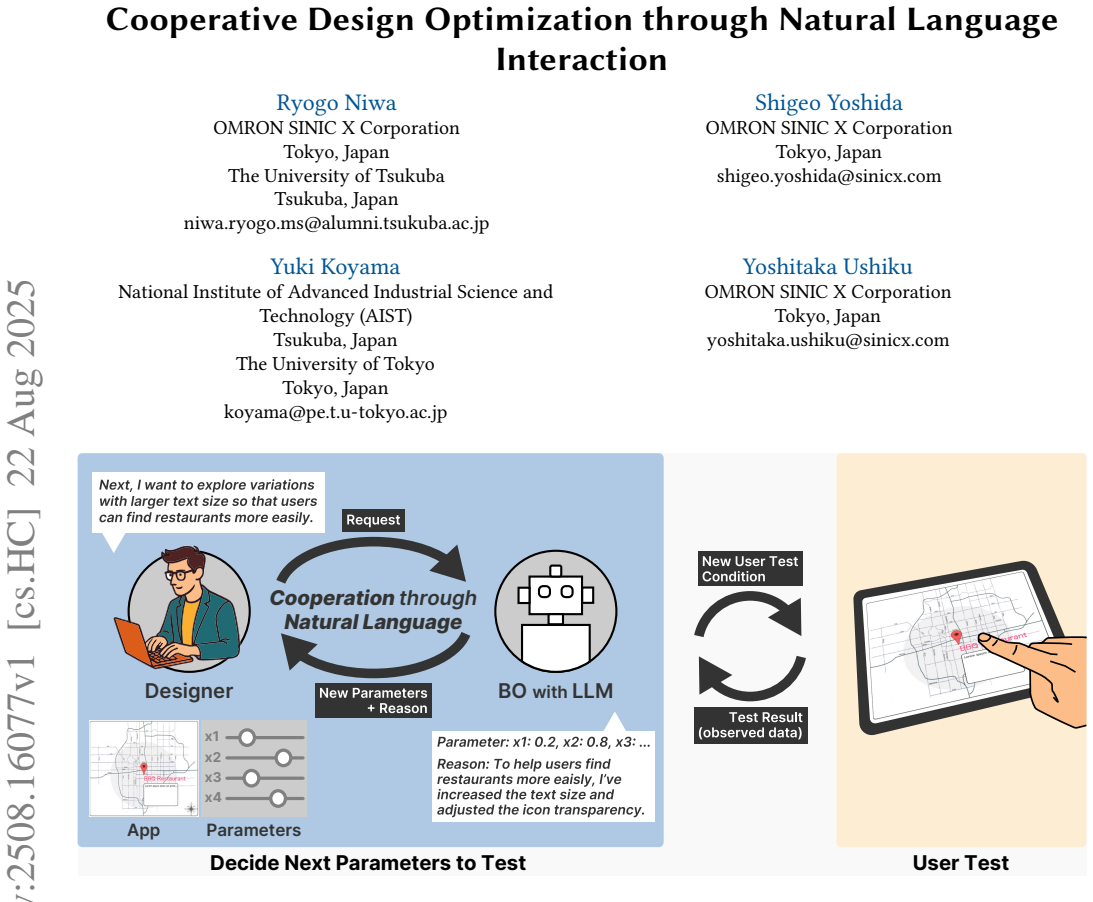
The central claim is that cooperative design optimization can be realized by inserting a large language model as an arbiter inside a Bayesian optimization loop: the underlying BO engine proposes a small batch of diverse candidate parameter sets, and the LLM selects the single candidate that best fits the designer's natural-language request, then writes a plain-language rationale. In Study 1, this natural-language cooperative condition produced agency scores statistically indistinguishable from fully manual design and significantly higher than a system-led BO condition (adjusted p = 0.002), while optimization quality (relative hypervolume) was not significantly worse than manual design and th
What carries the argument
The core mechanism is a batch BO pipeline (qLogNEHVI acquisition on a Gaussian-process surrogate) that produces eight candidate parameter sets per iteration, followed by an LLM 'selector' that receives a structured prompt containing the task description, the designer's natural-language request, the full evaluation history, and each candidate's predicted mean, predictive variance, and acquisition value. The LLM chooses one candidate and generates a natural-language explanation of its reasoning. Designers can also override the suggestion with sliders, so the system supports three control modes—full manual, system-led, and cooperative—within one interface.
Load-bearing premise
The LLM reliably picks the candidate that actually matches the designer's natural-language intent from the eight options, so that the designer's feeling of being heard reflects real fidelity.
What would settle it
Run the same cooperative interface with the LLM's selection step replaced by random selection among the eight candidates while keeping the explanations and sliders unchanged; if agency and cognitive-load benefits persist, they come from the interaction shell rather than intent-faithful selection. Separately, collect open-ended designer requests, have independent raters rank which candidate best matches each request, and measure agreement between the LLM's choice and the raters' choice.
If this is right
- Designers can steer multi-objective search by stating high-level goals ('make it faster', 'improve readability') instead of translating intentions into numeric parameter ranges.
- The same BO backend can be reused across tasks; only the candidate-selection step changes, so the approach is a modular addition to existing multi-objective BO tooling.
- Optimization quality with natural-language cooperation is statistically indistinguishable from manual design and from a constraint-based cooperative method, while imposing lower mental demand.
- Because the LLM's prompt includes only BO statistics and evaluation history, the method may transfer to design spaces where the LLM has no prior domain knowledge.
Where Pith is reading between the lines
- The fidelity of the LLM's candidate selection is the linchpin: if it fails to track open-ended requests, the agency and cognitive-load benefits may come from the interactive wrapper (sliders, explanations, a sense of response) rather than from true intent-following.
- The cognitive-load reduction may be partly an automation effect—designers delegate parameter manipulation to the system—and might persist even if the chosen candidate were effectively random; a control condition with random selection would separate these explanations.
- Explanations did not raise trust scores, suggesting that a textual rationale is insufficient; designers seem to need evidence that their request was actually incorporated, such as a visible mapping between the request and the selected candidate.
- The 'candidate menu plus LLM arbiter' pattern is a general recipe that could extend beyond UI design to any human-in-the-loop optimization setting where users can articulate goals but not parameter values.
- If the selection step is the bottleneck, prompting the LLM to reason about predictive variance more explicitly, or increasing batch size to give the LLM more choices, could improve both fidelity and perceived responsiveness.
Editorial analysis
A structured set of objections, weighed in public.
Referee Report
Summary. This paper presents a cooperative design-optimization framework that combines multi-objective Bayesian optimization (BO) with a large language model (LLM). At each iteration, batch BO proposes q candidate parameter sets, and an LLM selects one based on the designer's natural-language request, also providing a textual rationale. Two within-participant studies are reported, both using synthetic quadratic test functions with simulated user testing on three web-app design tasks. Study 1 (N=18) compares Designer-led, BO-led, and Cooperative-NL; Study 2 (N=12) compares Cooperative-EC (Mo et al.) and Cooperative-NL. The abstract claims higher user agency than a system-led method, promising optimization performance versus manual design, and matched performance of an existing cooperative method with lower cognitive load. The core results are: a significant agency difference between BO-led and Cooperative-NL, a significantly lower NASA-TLX for Cooperative-NL in Study 2, and no significant hypervolume difference in Study 2. However, the agency claim is confounded by the simultaneous availability of manual sliders in the Cooperative-NL condition, and Study 2's no-NL condition scored significantly higher on agency.
Significance. If substantiated, the idea is timely and relevant to human-in-the-loop optimization: using an LLM to let designers steer BO sampling in natural language, with textual explanations, could make system-led optimization more designer-centered. The technical integration is simple, clearly described, and reproducible from the provided prompts and the publicly available implementation of Mo et al. The authors also provide a useful comparison against an existing cooperative baseline and report qualitatively interesting findings on how designers express intent. The main weakness is that the headline agency benefit is not attributable to natural-language interaction based on the current experimental design, and the optimization-performance claim rests on a non-significant p-value. These issues are load-bearing because they directly support the paper's principal contributions.
major comments (3)
- [Section 5.1.1 and Section 6.3.2] The agency comparison is confounded. In Study 1, BO-led participants could not use sliders, while Cooperative-NL participants could both adjust sliders and issue natural-language requests. The headline result (BO-led vs Cooperative-NL, p.adj=0.002) therefore cannot be attributed to natural-language interaction. Study 2's Cooperative-EC condition, which had sliders but no NL, scored significantly higher on the same Agency Score than Cooperative-NL (p=0.032; Appendix E.1.2). The abstract's 'higher user agency' claim must be restricted to the full combined interface (sliders + NL) or better, the NL-specific contribution should be tested with a condition that controls for manual slider availability.
- [Section 5.5.1 and Section 5.6.2] The claim of 'promising optimization performance compared to manual design' is based on a non-significant pairwise comparison (p.adj=0.071), and the authors emphasize r=0.533 as supportive. With N=18, a large effect size from a non-significant test is not reliable evidence; the large r may reflect small-sample variability. Since H1.2 is explicitly not supported, the abstract and conclusion should not assert promising performance without qualification. Report a confidence interval or pre-specified equivalence bound if this claim is retained.
- [Appendix B] The technical validation does not establish that the LLM faithfully interprets free-form designer requests. It alternates only two canned prompts ('increase Objective 1/2'), uses the same synthetic functions as the user studies, and reports centroid distances without a chance-level baseline or significance test. The real requests from the user studies (Section 7.4) include compound and complex instructions that are not tested. Since the entire mechanism depends on this mapping, add a random-selection baseline and evaluate on a sample of actual user requests.
minor comments (4)
- [Appendix B] Typo: 'higher values of Objective 1 (top side)' in the description of blue dots should presumably read 'higher values of Objective 2'; the context indicates the two objectives are being contrasted.
- [Section 6.3.2 / Figure 10] The NASA-TLX subscale analysis reports p=0.000 for mental demand after testing multiple subscales, but no multiple-comparison correction is described. The weighted total p=0.034 is the primary result; please clarify whether subscale p-values are adjusted and report effect sizes for the significant findings.
- [Section 7.4] The content analysis of 187 requests is described as manually tagged with multiple tags, but no inter-rater reliability or detailed coding rubric is reported. If multiple coders were used, report agreement (e.g., Cohen's kappa); otherwise, acknowledge the single-coder nature of this analysis.
- [Section 8.1] The batch size q=8 is selected based on 'empirical observations.' Since the LLM can only choose among q candidates, batch size is central to request fidelity. Consider reporting a small sensitivity analysis or at least candidate-diversity metrics to support the choice.
Circularity Check
No significant circularity; minor background self-citations are not load-bearing.
full rationale
The paper's claims are empirical rather than derivational. The headline results—higher agency than a system-led method, promising performance relative to manual design, and lower cognitive load than an existing cooperative method—are supported by direct user-study comparisons against BO-led, designer-led, and Mo et al.'s Explicit Constraint conditions, using questionnaire instruments (Wang et al.'s agency items, NASA-TLX, MTQ) and measured hypervolume on externally defined synthetic test functions. No parameter is fitted to the target claim and then renamed as a prediction; the BO surrogate and qLogNEHVI candidate generation are standard components, and the LLM candidate selection is the system under test rather than a fitted predictor whose success metric is identical to its training objective. Appendix B is a sanity check of steering behavior, not a predictive benchmark; its lack of a random-selection baseline weakens it, but it does not make the conclusion equivalent to its input. The only self-citations ([16], [17], [18], [34], [36]) occur in related-work and background contexts and are not load-bearing: no uniqueness theorem from the authors' prior work is invoked, and no ansatz is smuggled in via self-citation. The skeptic's concern—that the Study 1 agency difference may be driven by the presence of manual sliders in Cooperative-NL and their absence in BO-led—is a genuine experimental-validity threat, but it is a confound, not a circularity: the agency score is not defined in terms of the natural-language component, and the paper's own Study 2 data make the confound visible rather than concealing it by construction. Therefore no circular step is identified.
Axiom & Free-Parameter Ledger
free parameters (2)
- Batch size q =
8
- Initial random seed length =
5 iterations
axioms (3)
- domain assumption The synthetic quadratic test functions and simulated noisy evaluations adequately represent real user testing of design parameters.
- domain assumption The LLM can select the batch-BO candidate that best satisfies a designer's natural language request.
- domain assumption The counterbalanced within-participant design and task instructions are sufficient to prevent order or learning effects across conditions.
Cite this review
Pith. "Pith review of Cooperative Design Optimization through Natural Language Interaction." pith.science (2026). https://pith.science/paper/GDSL2V46
@misc{pith2026250816077,
  author       = {Pith},
  title        = {Pith review of: Cooperative Design Optimization through Natural Language Interaction},
  year         = {2026},
  howpublished = {\url{https://pith.science/paper/GDSL2V46}},
  note         = {Machine review of arXiv:2508.16077}
}
read the original abstract
Designing successful interactions requires identifying optimal design parameters. To do so, designers often conduct iterative user testing and exploratory trial-and-error. This involves balancing multiple objectives in a high-dimensional space, making the process time-consuming and cognitively demanding. System-led optimization methods, such as those based on Bayesian optimization, can determine for designers which parameters to test next. However, they offer limited opportunities for designers to intervene in the optimization process, negatively impacting the designer's experience. We propose a design optimization framework that enables natural language interactions between designers and the optimization system, facilitating cooperative design optimization. This is achieved by integrating system-led optimization methods with Large Language Models (LLMs), allowing designers to intervene in the optimization process and better understand the system's reasoning. Experimental results show that our method provides higher user agency than a system-led method and shows promising optimization performance compared to manual design. It also matches the performance of an existing cooperative method with lower cognitive load.
Figures


Forward citations
Cited by 1 Pith paper
-
Dynamic Priors in Bayesian Optimization for Hyperparameter Optimization
DynaBO extends prior-weighted Bayesian optimization to multiple time-varying user priors, adds a rejection safeguard, and reports convergence guarantees plus benchmark gains over πBO.
Reference graph
Works this paper leans on
-
[1]
Ali AhmadiTeshnizi, Wenzhi Gao, and Madeleine Udell. 2024. OptiMUS: scal- able optimization modeling with (MI)LP solvers and large language models. In Proceedings of the 41st International Conference on Machine Learning (Vienna, Austria) (ICML’24). JMLR.org, Article 24, 20 pages
work page 2024
-
[2]
Jiang, Samuel Daulton, Benjamin Letham, Andrew Gordon Wilson, and Eytan Bakshy
Maximilian Balandat, Brian Karrer, Daniel R. Jiang, Samuel Daulton, Benjamin Letham, Andrew Gordon Wilson, and Eytan Bakshy. 2020. BoTorch: A Frame- work for Efficient Monte-Carlo Bayesian Optimization. In Advances in Neural Information Processing Systems 33 . http://arxiv.org/abs/1910.06403
Pith/arXiv arXiv 2020
-
[3]
Xiaojun Bi, Tom Ouyang, and Shumin Zhai. 2014. Both complete and cor- rect? multi-objective optimization of touchscreen keyboard. In Proceedings of the SIGCHI Conference on Human Factors in Computing Systems (Toronto, Ontario, Canada) (CHI ’14). Association for Computing Machinery, New York, NY, USA, 2297–2306. https://doi.org/10.1145/2556288.2557414
-
[4]
Liwei Chan, Yi-Chi Liao, George B Mo, John J Dudley, Chun-Lien Cheng, Per Ola Kristensson, and Antti Oulasvirta. 2022. Investigating Positive and Negative Qual- ities of Human-in-the-Loop Optimization for Designing Interaction Techniques. In Proceedings of the 2022 CHI Conference on Human Factors in Computing Systems (New Orleans, LA, USA) (CHI ’22). Asso...
arXiv 2022
-
[5]
Abdoulatif Cissé, Xenophon Evangelopoulos, Vladimir V Gusev, and Andrew I Cooper. 2025. Language-Based Bayesian Optimization Research Assistant (BORA). arXiv preprint arXiv:2501.16224 (2025)
arXiv 2025
-
[6]
Allan Dafoe, Yoram Bachrach, Gillian Hadfield, Eric Horvitz, Kate Larson, and Thore Graepel. 2021. Cooperative AI: Machines Must Learn to Find Common Ground. Nature 593 (May 2021), 33–36. https://doi.org/10.1038/d41586-021- 01170-0
-
[7]
Samuel Daulton, Sebastian Ament, David Eriksson, Maximilian Balandat, and Eytan Bakshy. 2023. Unexpected improvements to expected improvement for Bayesian optimization. In Proceedings of the 37th International Conference on Neural Information Processing Systems (New Orleans, LA, USA) (NIPS ’23). Curran Associates Inc., Red Hook, NY, USA, Article 904, 36 p...
work page 2023
-
[8]
John J. Dudley, Jason T. Jacques, and Per Ola Kristensson. 2019. Crowdsourcing Interface Feature Design with Bayesian Optimization. In Proceedings of the 2019 CHI Conference on Human Factors in Computing Systems (Glasgow, Scotland Uk) (CHI ’19). Association for Computing Machinery, New York, NY, USA, 1–12. https://doi.org/10.1145/3290605.3300482
arXiv 2019
-
[9]
Peter I Frazier. 2018. A tutorial on Bayesian optimization. arXiv preprint arXiv:1807.02811 (2018)
Pith/arXiv arXiv 2018
-
[10]
Hao Hao, Xiaoqun Zhang, and Aimin Zhou. 2024. Large language models as surrogate models in evolutionary algorithms: A preliminary study. Swarm and Evolutionary Computation 91 (2024), 101741. https://doi.org/10.1016/j.swevo. 2024.101741
arXiv 2024
-
[11]
Sandra G. Hart and Lowell E. Staveland. 1988. Development of NASA-TLX (Task Load Index): Results of Empirical and Theoretical Research. In Human Mental Workload, Peter A. Hancock and Najmedin Meshkati (Eds.). Advances in Psychology, Vol. 52. North-Holland, 139–183. https://doi.org/10.1016/S0166- 4115(08)62386-9
doi:10.1016/s0166- 1988
-
[12]
Chenyu Huang, Zhengyang Tang, Shixi Hu, Ruoqing Jiang, Xin Zheng, Dong- dong Ge, Benyou Wang, and Zizhuo Wang. 2025. ORLM: A Customizable Framework in Training Large Models for Automated Optimization Modeling. arXiv:2405.17743 [cs.CL] https://arxiv.org/abs/2405.17743
Pith/arXiv arXiv 2025
- [13]
-
[14]
Carl Hvarfner, Erik Orm Hellsten, and Luigi Nardi. 2024. Vanilla Bayesian Optimization Performs Great in High Dimensions. In Proceedings of the 41st International Conference on Machine Learning (Proceedings of Machine Learning Research, Vol. 235), Ruslan Salakhutdinov, Zico Kolter, Katherine Heller, Adrian Weller, Nuria Oliver, Jonathan Scarlett, and Feli...
work page 2024
-
[15]
Mohammad M. Khajah, Brett D. Roads, Robert V. Lindsey, Yun-En Liu, and Michael C. Mozer. 2016. Designing Engaging Games Using Bayesian Optimization. In Proceedings of the 2016 CHI Conference on Human Factors in Computing Systems (San Jose, California, USA) (CHI ’16). Association for Computing Machinery, New York, NY, USA, 5571–5582. https://doi.org/10.114...
arXiv 2016
-
[17]
Yuki Koyama, Issei Sato, and Masataka Goto. 2020. Sequential gallery for interac- tive visual design optimization. ACM Trans. Graph. 39, 4, Article 88 (aug 2020), 12 pages. https://doi.org/10.1145/3386569.3392444
arXiv 2020
-
[18]
Yuki Koyama, Issei Sato, Daisuke Sakamoto, and Takeo Igarashi. 2017. Sequential line search for efficient visual design optimization by crowds. ACM Trans. Graph. 36, 4, Article 48 (jul 2017), 11 pages. https://doi.org/10.1145/3072959.3073598
arXiv 2017
-
[19]
Connor Lawless, Jakob Schoeffer, Lindy Le, Kael Rowan, Shilad Sen, Cristina St. Hill, Jina Suh, and Bahareh Sarrafzadeh. 2024. “I Want It That Way”: Enabling Interactive Decision Support Using Large Language Models and Constraint Pro- gramming. ACM Trans. Interact. Intell. Syst. 14, 3, Article 22 (Sept. 2024), 33 pages. https://doi.org/10.1145/3685053
doi:10.1145/3685053 2024
-
[20]
Beibin Li, Konstantina Mellou, Bo Zhang, Jeevan Pathuri, and Ishai Menache. 2023. Large Language Models for Supply Chain Optimization. arXiv:2307.03875 [cs.AI] https://arxiv.org/abs/2307.03875
Pith/arXiv arXiv 2023
-
[21]
Yi-Chi Liao, Ruta Desai, Alec M Pierce, Krista E. Taylor, Hrvoje Benko, Tanya R. Jonker, and Aakar Gupta. 2024. A Meta-Bayesian Approach for Rapid Online Parametric Optimization for Wrist-based Interactions. In Proceedings of the 2024 CHI Conference on Human Factors in Computing Systems (Honolulu, HI, USA) (CHI ’24). Association for Computing Machinery, N...
arXiv 2024
-
[22]
Yi-Chi Liao, John J. Dudley, George B. Mo, Chun-Lien Cheng, Liwei Chan, Antti Oulasvirta, and Per Ola Kristensson. 2023. Interaction Design With Multi- Objective Bayesian Optimization. IEEE Pervasive Computing 22, 1 (2023), 29–38. https://doi.org/10.1109/MPRV.2022.3230597
-
[23]
Jie Liu, Kim Marriott, Tim Dwyer, and Guido Tack. 2023. Increasing User Trust in Optimisation through Feedback and Interaction. ACM Trans. Comput.-Hum. Interact. 29, 5, Article 42 (Jan. 2023), 34 pages. https://doi.org/10.1145/3503461
doi:10.1145/3503461 2023
-
[24]
Tennison Liu, Nicolás Astorga, Nabeel Seedat, and Mihaela van der Schaar. 2024. Large Language Models to Enhance Bayesian Optimization. In The Twelfth Inter- national Conference on Learning Representations . https://openreview.net/forum? id=OOxotBmGol
work page 2024
-
[25]
Kanan Mahammadli and Seyda Ertekin. 2024. Sequential large language model- based hyper-parameter optimization. arXiv preprint arXiv:2410.20302 (2024)
Pith/arXiv arXiv 2024
-
[26]
Luca-Maxim Meinhardt, Clara Schramm, Pascal Jansen, Mark Colley, and Enrico Rukzio. 2025. Fly Away: Evaluating the Impact of Motion Fidelity on Optimized User Interface Design via Bayesian Optimization in Automated Urban Air Mobil- ity Simulations. arXiv preprint arXiv:2501.11829 (2025)
work page internal anchor Pith review Pith/arXiv arXiv 2025
-
[27]
Kostis Michailidis, Dimos Tsouros, and Tias Guns. 2024. Constraint Mod- elling with LLMs Using In-Context Learning. In 30th International Conference on Principles and Practice of Constraint Programming (CP 2024) (Leibniz Inter- national Proceedings in Informatics (LIPIcs), Vol. 307) , Paul Shaw (Ed.). Schloss Dagstuhl – Leibniz-Zentrum für Informatik, Dag...
-
[28]
George Mo, John Dudley, Liwei Chan, Yi-Chi Liao, Antti Oulasvirta, and Per Ola Kristensson. 2024. Cooperative Multi-Objective Bayesian Design Optimization. ACM Trans. Interact. Intell. Syst. 14, 2, Article 13 (jun 2024), 28 pages. https: //doi.org/10.1145/3657643
-
[29]
Mayk Caldas Ramos, Shane S Michtavy, Marc D Porosoff, and Andrew D White
-
[30]
Bojana Ranković and Philippe Schwaller. 2023. BoChemian: Large Language Model Embeddings for Bayesian Optimization of Chemical Reactions. In NeurIPS 2023 Workshop on Adaptive Experimental Design and Active Learning in the Real World. https://openreview.net/forum?id=A1RVn1m3J3
work page 2023
-
[31]
Eileen Roesler*, Tobias Rieger*, and Dietrich Manzey. 2022. Trust towards Human vs. Automated Agents: Using a Multidimensional Trust Questionnaire to Assess The Role of Performance, Utility, Purpose, and Transparency. Proceedings of the Human Factors and Ergonomics Society Annual Meeting 66, 1 (2022), 2047–2051. https://doi.org/10.1177/1071181322661065
-
[32]
Bobak Shahriari, Kevin Swersky, Ziyu Wang, Ryan P. Adams, and Nando de Fre- itas. 2016. Taking the Human Out of the Loop: A Review of Bayesian Optimization. Proc. IEEE 104, 1 (2016), 148–175. https://doi.org/10.1109/JPROC.2015.2494218
-
[33]
Bryan Wang, Yuliang Li, Zhaoyang Lv, Haijun Xia, Yan Xu, and Raj Sodhi. 2024. LAVE: LLM-Powered Agent Assistance and Language Augmentation for Video Editing. In Proceedings of the 29th International Conference on Intelligent User Interfaces (Greenville, SC, USA) (IUI ’24). Association for Computing Machinery, New York, NY, USA, 699–714. https://doi.org/10...
arXiv 2024
-
[34]
Kenta Yamamoto, Yuki Koyama, and Yoichi Ochiai. 2022. Photographic Lighting Design with Photographer-in-the-Loop Bayesian Optimization. In Proceedings of the 35th Annual ACM Symposium on User Interface Software and Technology (Bend, OR, USA) (UIST ’22). Association for Computing Machinery, New York, NY, USA, Article 92, 11 pages. https://doi.org/10.1145/3...
arXiv 2022
-
[35]
Chengrun Yang, Xuezhi Wang, Yifeng Lu, Hanxiao Liu, Quoc V Le, Denny Zhou, and Xinyun Chen. 2024. Large Language Models as Optimizers. In The Twelfth International Conference on Learning Representations . https://openreview.net/ forum?id=Bb4VGOWELI
2024
-
[36]
Please propose parameters that increase Objective 1
Shigeo Yoshida, Yuki Koyama, and Yoshitaka Ushiku. 2024. Toward AI-Mediated Avatar-Based Telecommunication: Investigating Visual Impression of Switching Between User- and AI-Controlled Avatars in Video Chat. IEEE Access 12 (2024), 113372–113383. https://doi.org/10.1109/ACCESS.2024.3441233 A Prompt Figure 12 shows an overview of the prompt used to instruct...
-
[2023]
arXiv [physics.chem-ph] (April 2023)
Bayesian optimization of catalysts with in-context learning. arXiv [physics.chem-ph] (April 2023)
work page 2023
This paper was first reviewed by deepseek-v4-flash on August 5, 2026.
discussion (0)
Sign in with ORCID, Apple, or X to comment. Anyone can read and Pith papers without signing in.