REVIEW 4 major objections 5 minor 53 references
Reinforcement learning with a rule-based reward lifts Chinese grammatical error correction to a state-of-the-art F0.5 score on the FCGEC benchmark.
Reviewed by Pith at T0; open to challenge. T0 means a machine referee read the full paper against a public rubric. the ladder, T0–T4 →
Applying GRPO with a rule-based, reference-match reward to a Qwen3-8B model after reasoning-augmented SFT achieves state-of-the-art F0.5 on Chinese GEC benchmark FCGEC and improves recall.
T0 review reviewed 2026-08-05 challenge →
load-bearing objection A solid empirical application of R1-style RL to Chinese GEC with real FCGEC gains, but the reward asymmetry likely drives the recall jump and needs an ablation. the 4 major comments →
Harnessing Rule-Based Reinforcement Learning for Enhanced Grammatical Error Correction
The pith
A machine-rendered reading of the paper's core claim, the machinery that carries it, and where it could break.
The reading
Core claim
The paper's central claim is that rule-based reinforcement learning—only formatting checks and reference-match scoring, with no learned reward model—can push an LLM-based grammatical error corrector past supervised fine-tuning and past existing GEC baselines. Starting from an 8-billion-parameter open LLM, the authors build a two-stage SFT corpus from large learner corpora and then from FCGEC sentences with reasoning traces generated by a reasoning-specialized LLM and filtered by another LLM. They then run GRPO with a composite reward: +0.25 for correct answer-tag structure, and a five-case correctness reward that gives +4.0 for preserving a correct sentence, +2.1 for correcting an error, +0.
What carries the argument
The load-bearing object is the rule-based correctness reward R_c defined in Eq. (2), combined with the GRPO update. R_c is a reference-match reward: after the model writes its final answer inside <answer> tags, the extractor compares that answer against the reference set and assigns one of five rewards. The critical asymmetry is that changing an erroneous sentence earns +0.1 even when the modification is still incorrect, while leaving an error unchanged costs only -0.05; this is what makes training favor recall. GRPO converts the scalar reward into group-relative advantages without a learned critic, and the small format reward keeps outputs parseable and discourages truncation.
Load-bearing premise
The hand-tuned reward values encode the right trade-off: the +0.1 reward for any change to an erroneous sentence and the -0.05 penalty for leaving one unchanged are what teach the model to edit more, so if those values are miscalibrated the recall gain could reflect reward-gaming rather than better grammatical reasoning.
What would settle it
Train the identical pipeline with the process-reward terms in Eq. (2) rebalanced—for example 0.0 for changing an erroneous sentence incorrectly and -0.1 for leaving an error unchanged—and measure FCGEC recall and F0.5. If recall collapses back toward the SFT baseline, the reward asymmetry, not improved error-detection reasoning, was carrying the result.
If this is right
- On the in-domain FCGEC test set, the final RL model with 16-way voting reports the best F0.5 among all compared systems (58.74) and the highest recall (48.94).
- RL training turns a reasoning-tuned SFT model that degrades badly on out-of-domain NaCGEC back into a competitive model (F0.5 59.03 with voting), showing the reward signal generalizes beyond the training distribution.
- Multi-sample voting helps the RL-trained model but not the SFT model; the paper attributes this to RL improving the quality and diversity of sampled outputs.
- Because the reward is precision-weighted, the trained model's main edge is recall; the paper states that further precision gains would need a more precise reward based on minimum edit distance.
- The code and the generated reasoning-augmented training set are released, so the same rule-based RL recipe can be applied to new GEC datasets without collecting human preference judgments.
Where Pith is reading between the lines
- The +0.1 reward for any edit to an erroneous sentence, paired with only -0.05 for inaction, may be the proximal cause of the recall jump; an ablation that reweights or removes this process reward would separate 'more willing to edit' from 'better at detecting errors.'
- The same reward scheme could be carried to English GEC benchmarks such as BEA-19 and CoNLL-14, which the paper deliberately avoids; exact-match reference rewards are harder there, so a minimum-edit-distance matcher would be a more portable variant.
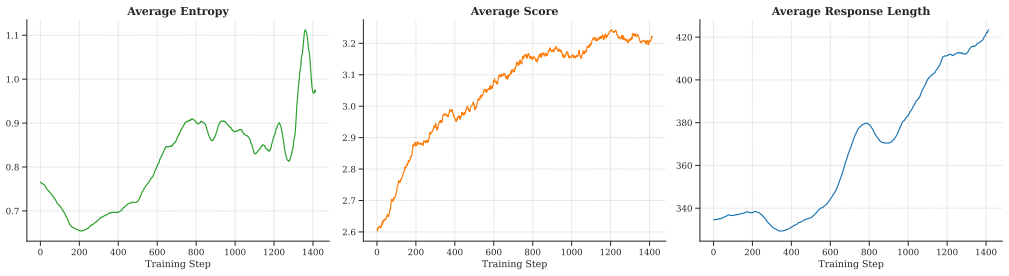
- The entropy dip-then-rise during RL suggests the policy first narrows toward precision-oriented behavior and then broadens; a curriculum that schedules the reward weights explicitly might reproduce the recall gain with less precision loss.
- The voting gain for RL but not SFT hints that RL sharpens the mode structure of the policy; a testable extension is measuring error-span self-consistency across samples before and after RL.
Editorial analysis
A structured set of objections, weighed in public.
Referee Report
Summary. The paper proposes a two-stage pipeline for Chinese grammatical error correction (GEC): first, supervised fine-tuning (SFT) on reasoning-augmented data generated by Qwen3-32B and DeepSeek-R1 and filtered by DeepSeek-V3; second, reinforcement learning (RL) with GRPO using a rule-based reward. The reward combines a format-rule component (Eq. 1) and a correctness component (Eq. 2) that scores tag presence, correct preservation, correct correction, incorrect modification, and failure to edit. Experiments on FCGEC and NaCGEC compare the method against traditional GEC systems, LLM fine-tuning baselines, and reasoning models. The main reported result is that RL improves precision, recall, and F0.5 over the SFT-with-reasoning baseline, and that with 16-sample voting the model achieves the best FCGEC F0.5 among all compared systems (58.74). The paper also reports training dynamics and voting-count curves.
Significance. If the core claim holds, the paper makes a useful contribution: it is among the first to apply rule-based GRPO to GEC, and it demonstrates that RL post-training can shift the precision-recall trade-off toward higher recall while preserving or improving F0.5. The public release of code and training data is a concrete strength, as is the systematic comparison against several strong GEC baselines. The out-of-domain NaCGEC results also suggest that RL can recover robustness lost by the reasoning-augmented SFT model. However, the central interpretive claim—that RL enhances grammatical error-detection reasoning—is not yet fully supported because the reward function was hand-tuned on the validation metric, no ablation isolates the edit-encouraging reward asymmetry, and no significance testing is provided. The paper is therefore promising but needs additional experiments and clearer claims before its headline conclusions can be accepted.
major comments (4)
- [Rule-Based Reward, Eq. (2)] There is a direct inconsistency between the prose and the reward equation. The text states: "We experimented with reward values of 4 and 6 for this case, ultimately selecting 6 as it yielded a higher F0.5 score," but Eq. (2) lists the reward for "Original correct, model preserved" as 4.0. Since this reward value directly shapes the precision/F0.5 trade-off, the manuscript must state which value was actually used in the reported experiments and why Eq. (2) shows 4.0. Without this clarification, the headline results are not reproducible.
- [Rule-Based Reward, Correctness Reward] The reward design and hyperparameter selection procedure undermine the causal claim that RL improves error-detection reasoning. The process reward in Eq. (2) gives +0.1 for modifying an incorrect sentence even when the modification is still incorrect, while leaving an incorrect sentence unchanged yields only -0.05. In GRPO, advantages are normalized per group, so this +0.15 relative difference strongly encourages the policy to attempt edits on error-containing sentences regardless of edit quality. The paper reports that these values were selected by comparing variants on the FCGEC validation set, and the same F0.5 metric is used for the headline test claim. No ablation removes or reweights this process reward, so the observed recall gain could be a mechanical consequence of the reward shape rather than evidence of improved grammatical reasoning. I request an ablation with (a) no process
- [Table 3 and Experimental Setup] All results in Table 3 are reported as single-point estimates without error bars, confidence intervals, or significance tests. The main RL-vs-SFT-with-reasoning differences on FCGEC are F0.5 57.33 vs 55.14 (single sample) and 58.74 vs 53.56 (16-vote), which are sizable, but the NaCGEC SFT-reasoning baseline is unusually low (F0.5 46.53), suggesting high variance across the pipeline. At least three independent runs (or a bootstrap over the test set, where applicable) are needed to establish that the improvements are not due to training stochasticity, especially because reward hyperparameters were selected on validation.
- [Data Generation and Circularity] The reasoning-augmented SFT data for Stage 2 is generated from FCGEC reference answers and then filtered by DeepSeek-V3 specifically to select traces that "can produce the standard answer" (Appendix template, Fig. 6). The RL correctness reward then compares the model's final answer against the same FCGEC reference set. This design is not necessarily invalid, but it means the reasoning traces are heavily conditioned on the reference distribution. The paper's conclusion that RL "compels the model to learn fundamental and generalizable principles of grammatical judgment" (OOD paragraph) goes beyond what the evidence supports; an alternative explanation is that both SFT and RL teach the model to reproduce the reference-matching behavior encoded in the reward. At minimum, the authors should temper this claim and discuss the role of the reference-conditioned data-generation procedure.
minor comments (5)
- [Abstract / Table 3] The abstract claims "state-of-the-art performance" without qualifying the dataset. On NaCGEC, Alirector achieves F0.5 60.71, higher than the proposed model's 59.03. Please qualify the SOTA claim to the FCGEC test set among the compared systems.
- [Appendix / Related Work] The appendix contains duplicated sections: Section 2.2 and 2.3 are repeated verbatim, including the typo "argumation che" and the incomplete citation "(dsgram)". These should be removed or corrected.
- [Rule-Based Reward, Eq. (2)] The notation for the suffix penalty in Eq. (1) defines Lsuffix(T, Sd) but the symbol Sd is not explicitly defined in the text near the equation; please define it as the close tag delimiter "</answer>".
- [Inference Details / Figure 4] The voting analysis reports counts 1, 4, 8, 16, 32, but Figure 4 shows a curve only up to about 30. Please align the axis labels and clarify whether the curve is for FCGEC-dev or FCGEC-test.
- [Related Work] Several references in the related work are cited in a compressed style (e.g., "(Qu, Tang, and Wu 2025)" for arXiv:2307.03972). Please verify all references are complete and correctly matched to the bibliography.
Circularity Check
No significant circularity: central performance claims are evaluated on held-out test sets; reward tuning and reasoning-data generation are standard training procedures, not definitional reductions.
full rationale
The paper's central claim is that rule-based RL improves GEC over SFT baselines, measured on held-out FCGEC-test and NaCGEC-test sets. The reward hyperparameters in Eq. (2) were selected after comparing variants on the validation set, which is standard model selection rather than a definitional reduction: test-set P/R/F0.5 are not equal by construction to the reward weights. The SFT reasoning traces are generated from reference answers and filtered against them, but this is a data-generation step; the final evaluation is external to the training/reward loop. The only self-citation (Xie et al., 2025a, DSGram) appears in related work and is not load-bearing. There is an internal inconsistency in the Rule-Based Reward section: the prose states a reward of 6 was selected for preserving correct sentences while Eq. (2) lists 4.0; this is a consistency issue, not evidence of circularity. The absence of a reward ablation isolating the edit-encouraging +0.1/-0.05 asymmetry is a potential experimental-design limitation, but it does not make the reported test result equivalent to the reward input. No equation or citation chain in the paper reduces a predicted quantity to its own input by construction.
Axiom & Free-Parameter Ledger
free parameters (6)
- Reward for preserving a correct sentence (Original correct, model preserved) =
6 per text; Eq. (2) shows 4.0
- Base reward for correct modification of an erroneous sentence =
2.0
- Process reward for changing an incorrect sentence even if still incorrect =
0.1
- Penalty for leaving an incorrect sentence unchanged =
-0.05
- Penalty for incorrectly modifying a correct sentence =
-0.1
- Rule reward coefficients for tags and suffix penalty =
+0.125, -0.001
axioms (4)
- domain assumption GEC can be viewed as a reasoning task analogous to mathematics, so rule-based RL designed for math reasoning can be applied to GEC.
- domain assumption Exact string comparison against one of the reference answers is a sufficient reward signal for grammar correction quality.
- domain assumption DeepSeek-V3 filtering correctly determines whether a generated reasoning trace reaches the reference answer.
- domain assumption The reference answers in FCGEC and NaCGEC are correct and unambiguous, so a matching output is a valid correction.
Cite this review
Pith. "Pith review of Harnessing Rule-Based Reinforcement Learning for Enhanced Grammatical Error Correction." pith.science (2026). https://pith.science/paper/VQIJMCBH
@misc{pith2026250818780,
  author       = {Pith},
  title        = {Pith review of: Harnessing Rule-Based Reinforcement Learning for Enhanced Grammatical Error Correction},
  year         = {2026},
  howpublished = {\url{https://pith.science/paper/VQIJMCBH}},
  note         = {Machine review of arXiv:2508.18780}
}
read the original abstract
Grammatical error correction is a significant task in NLP. Traditional methods based on encoder-decoder models have achieved certain success, but the application of LLMs in this field is still underexplored. Current research predominantly relies on supervised fine-tuning to train LLMs to directly generate the corrected sentence, which limits the model's powerful reasoning ability. To address this limitation, we propose a novel framework based on Rule-Based RL. Through experiments on the Chinese datasets, our Rule-Based RL framework achieves \textbf{state-of-the-art }performance, with a notable increase in \textbf{recall}. This result clearly highlights the advantages of using RL to steer LLMs, offering a more controllable and reliable paradigm for future development in GEC.
Figures



Reference graph
Works this paper leans on
-
[1]
Bryant, C.; Felice, M.; Andersen, . E.; and Briscoe, T. 2019. The BEA -2019 Shared Task on Grammatical Error Correction. In Yannakoudakis, H.; Kochmar, E.; Leacock, C.; Madnani, N.; Pil \'a n, I.; and Zesch, T., eds., Proceedings of the Fourteenth Workshop on Innovative Use of NLP for Building Educational Applications, 52--75. Florence, Italy: Association...
work page 2019
-
[2]
Bryant, C.; Yuan, Z.; Qorib, M. R.; Cao, H.; Ng, H. T.; and Briscoe, T. 2023. Grammatical Error Correction: A Survey of the State of the Art. Computational Linguistics, 643--701
work page 2023
-
[3]
Fang, T.; Yang, S.; Lan, K.; Wong, D. F.; Hu, J.; Chao, L. S.; and Zhang, Y. 2023. Is ChatGPT a Highly Fluent Grammatical Error Correction System? A Comprehensive Evaluation. arXiv:2304.01746
Pith/arXiv arXiv 2023
-
[4]
Gou, Z.; Shao, Z.; Gong, Y.; Shen, Y.; Yang, Y.; Huang, M.; Duan, N.; and Chen, W. 2024. ToRA: A Tool-Integrated Reasoning Agent for Mathematical Problem Solving. arXiv:2309.17452
Pith/arXiv arXiv 2024
-
[5]
Grattafiori, A.; Dubey, A.; Jauhri, A.; Pandey, A.; Kadian, A.; Al-Dahle, A.; Letman, A.; Mathur, A.; Schelten, A.; et al. 2024. The Llama 3 Herd of Models. arXiv:2407.21783
Pith/arXiv arXiv 2024
-
[6]
Grundkiewicz, R.; Junczys-Dowmunt, M.; and Heafield, K. 2019. Neural grammatical error correction systems with unsupervised pre-training on synthetic data. In Proceedings of the Fourteenth Workshop on Innovative Use of NLP for Building Educational Applications, 252--263
work page 2019
-
[7]
Guo, D.; Yang, D.; Zhang, H.; Song, J.; Zhang, R.; Xu, R.; Zhu, Q.; Ma, S.; Wang, P.; Bi, X.; et al. 2025. Deepseek-r1: Incentivizing reasoning capability in llms via reinforcement learning. arXiv preprint arXiv:2501.12948
Pith/arXiv arXiv 2025
-
[8]
Huang, W.; Jia, B.; Zhai, Z.; Cao, S.; Ye, Z.; Zhao, F.; Hu, Y.; and Lin, S. 2025. Vision-r1: Incentivizing reasoning capability in multimodal large language models. arXiv preprint arXiv:2503.06749
Pith/arXiv arXiv 2025
-
[9]
Jin, B.; Zeng, H.; Yue, Z.; Wang, D.; Zamani, H.; and Han, J. 2025. Search-r1: Training llms to reason and leverage search engines with reinforcement learning. arXiv preprint arXiv:2503.09516
Pith/arXiv arXiv 2025
-
[10]
Junczys-Dowmunt, M.; Grundkiewicz, R.; Guha, S.; and Heafield, K. 2018. Approaching Neural Grammatical Error Correction as a Low-Resource Machine Translation Task. In Walker, M.; Ji, H.; and Stent, A., eds., Proceedings of the 2018 Conference of the North A merican Chapter of the Association for Computational Linguistics: Human Language Technologies, Volu...
work page 2018
-
[11]
Kaneko, M.; Mita, M.; Kiyono, S.; Suzuki, J.; and Inui, K. 2020. Encoder-Decoder Models Can Benefit from Pre-trained Masked Language Models in Grammatical Error Correction. In Jurafsky, D.; Chai, J.; Schluter, N.; and Tetreault, J., eds., Proceedings of the 58th Annual Meeting of the Association for Computational Linguistics, 4248--4254. Online: Associati...
work page 2020
-
[12]
Kaufmann, T.; Weng, P.; Bengs, V.; and H \"u llermeier, E. 2023. A survey of reinforcement learning from human feedback. arXiv preprint arXiv:2312.14925
arXiv 2023
-
[13]
Lewis, M.; Liu, Y.; Goyal, N.; Ghazvininejad, M.; Mohamed, A.; Levy, O.; Stoyanov, V.; and Zettlemoyer, L. 2019. BART: Denoising Sequence-to-Sequence Pre-training for Natural Language Generation, Translation, and Comprehension. CoRR, abs/1910.13461
Pith/arXiv arXiv 2019
-
[14]
Li, W.; and Wang, H. 2024. Detection-Correction Structure via General Language Model for Grammatical Error Correction. arXiv:2405.17804
work page internal anchor Pith review Pith/arXiv arXiv 2024
-
[15]
Li, X.; Zou, H.; and Liu, P. 2025. ToRL: Scaling Tool-Integrated RL. arXiv preprint arXiv:2503.23383
Pith/arXiv arXiv 2025
-
[16]
Li, Y.; Qin, S.; Huang, H.; Li, Y.; Qin, L.; Hu, X.; Jiang, W.; Zheng, H.-T.; and Yu, P. S. 2024. Rethinking the Roles of Large Language Models in Chinese Grammatical Error Correction. arXiv:2402.11420
Pith/arXiv arXiv 2024
-
[17]
Lichtarge, J.; Alberti, C.; and Kumar, S. 2020. Data Weighted Training Strategies for Grammatical Error Correction. arXiv:2008.02976
work page internal anchor Pith review Pith/arXiv arXiv 2020
-
[18]
Liu, X.; Xu, B.; Yang, M.; Cao, H.; Zhu, C.; Zhao, T.; and Lu, W. 2025. A Chain-of-Task Framework for Instruction Tuning of LLM s Based on C hinese Grammatical Error Correction. In Rambow, O.; Wanner, L.; Apidianaki, M.; Al-Khalifa, H.; Eugenio, B. D.; and Schockaert, S., eds., Proceedings of the 31st International Conference on Computational Linguistics,...
work page 2025
-
[19]
Liu, Y.; Li, Z.; Jiang, H.; Zhang, B.; Li, C.; and Zhang, J. 2024. Towards Better Utilization of Multi-Reference Training Data for C hinese Grammatical Error Correction. In Ku, L.-W.; Martins, A.; and Srikumar, V., eds., Findings of the Association for Computational Linguistics: ACL 2024, 3044--3052. Bangkok, Thailand: Association for Computational Linguistics
work page 2024
-
[20]
Loem, M.; Kaneko, M.; Takase, S.; and Okazaki, N. 2023. Exploring Effectiveness of GPT -3 in Grammatical Error Correction: A Study on Performance and Controllability in Prompt-Based Methods. In Kochmar, E.; Burstein, J.; Horbach, A.; Laarmann-Quante, R.; Madnani, N.; Tack, A.; Yaneva, V.; Yuan, Z.; and Zesch, T., eds., Proceedings of the 18th Workshop on ...
work page 2023
-
[21]
Ma, S.; Li, Y.; Sun, R.; Zhou, Q.; Huang, S.; Zhang, D.; Yangning, L.; Liu, R.; Li, Z.; Cao, Y.; et al. 2022. Linguistic Rules-Based Corpus Generation for Native Chinese Grammatical Error Correction. In Findings of the Association for Computational Linguistics: EMNLP 2022
work page 2022
-
[22]
Meng, Y.; Xia, M.; and Chen, D. 2024. SimPO: Simple preference optimization with a reference-free reward. Advances in Neural Information Processing Systems, 37: 124198--124235
work page 2024
-
[23]
Ng, H. T.; Wu, S. M.; Briscoe, T.; Hadiwinoto, C.; Susanto, R. H.; and Bryant, C. 2014. The C o NLL -2014 Shared Task on Grammatical Error Correction. In Ng, H. T.; Wu, S. M.; Briscoe, T.; Hadiwinoto, C.; Susanto, R. H.; and Bryant, C., eds., Proceedings of the Eighteenth Conference on Computational Natural Language Learning: Shared Task, 1--14. Baltimore...
work page 2014
-
[24]
Omelianchuk, K.; Atrasevych, V.; Chernodub, A.; and Skurzhanskyi, O. 2020. GECT o R -- Grammatical Error Correction: Tag, Not Rewrite. In Burstein, J.; Kochmar, E.; Leacock, C.; Madnani, N.; Pil \'a n, I.; Yannakoudakis, H.; and Zesch, T., eds., Proceedings of the Fifteenth Workshop on Innovative Use of NLP for Building Educational Applications, 163--170....
work page 2020
-
[25]
OpenAI; Achiam, J.; Adler, S.; Agarwal, S.; Ahmad, L.; Akkaya, I.; et al. 2024 a . GPT-4 Technical Report. arXiv:2303.08774
Pith/arXiv arXiv 2024
-
[26]
OpenAI; et al. 2024 b . OpenAI o1 System Card. arXiv:2412.16720
Pith/arXiv arXiv 2024
-
[27]
Qin, Y.; Liang, S.; Ye, Y.; Zhu, K.; Yan, L.; Lu, Y.; Lin, Y.; Cong, X.; Tang, X.; Qian, B.; Zhao, S.; Hong, L.; Tian, R.; Xie, R.; Zhou, J.; Gerstein, M.; Li, D.; Liu, Z.; and Sun, M. 2024. ToolLLM: Facilitating Large Language Models to Master 16000+ Real-world APIs. In The Twelfth International Conference on Learning Representations
work page 2024
-
[28]
Qorib, M. R.; Na, S.-H.; and Ng, H. T. 2022. Frustratingly Easy System Combination for Grammatical Error Correction. In Carpuat, M.; de Marneffe, M.-C.; and Meza Ruiz, I. V., eds., Proceedings of the 2022 Conference of the North American Chapter of the Association for Computational Linguistics: Human Language Technologies, 1964--1974. Seattle, United Stat...
work page 2022
-
[29]
Qu, F.; Tang, C.; and Wu, Y. 2025. Evaluating the Capability of Large-scale Language Models on Chinese Grammatical Error Correction Task. arXiv:2307.03972
work page internal anchor Pith review Pith/arXiv arXiv 2025
-
[30]
Rafailov, R.; Sharma, A.; Mitchell, E.; Manning, C. D.; Ermon, S.; and Finn, C. 2023. Direct Preference Optimization: Your language model is secretly a reward model. Advances in Neural Information Processing Systems, 36: 53728--53741
work page 2023
-
[31]
M.; Roberts, A.; Lee, K.; Narang, S.; Matena, M.; Zhou, Y.; Li, W.; and Liu, P
Raffel, C.; Shazeer, N. M.; Roberts, A.; Lee, K.; Narang, S.; Matena, M.; Zhou, Y.; Li, W.; and Liu, P. J. 2019. Exploring the Limits of Transfer Learning with a Unified Text-to-Text Transformer. J. Mach. Learn. Res., 21: 140:1--140:67
work page 2019
-
[32]
Rothe, S.; Mallinson, J.; Malmi, E.; Krause, S.; and Severyn, A. 2021. A Simple Recipe for Multilingual Grammatical Error Correction. In Zong, C.; Xia, F.; Li, W.; and Navigli, R., eds., Proceedings of the 59th Annual Meeting of the Association for Computational Linguistics and the 11th International Joint Conference on Natural Language Processing (Volume...
work page 2021
-
[33]
Schick, T.; Dwivedi-Yu, J.; Dess \` , R.; Raileanu, R.; Lomeli, M.; Hambro, E.; Zettlemoyer, L.; Cancedda, N.; and Scialom, T. 2023. Toolformer: Language models can teach themselves to use tools. Advances in Neural Information Processing Systems, 36: 68539--68551
2023
-
[34]
Schulman, J.; Wolski, F.; Dhariwal, P.; Radford, A.; and Klimov, O. 2017. Proximal policy optimization algorithms. arXiv preprint arXiv:1707.06347
Pith/arXiv arXiv 2017
-
[35]
Shao, Z.; Wang, P.; Zhu, Q.; Xu, R.; Song, J.; Bi, X.; Zhang, H.; Zhang, M.; Li, Y.; Wu, Y.; et al. 2024. Deepseekmath: Pushing the limits of mathematical reasoning in open language models. arXiv preprint arXiv:2402.03300
Pith/arXiv arXiv 2024
-
[36]
Song, H.; Jiang, J.; Min, Y.; Chen, J.; Chen, Z.; Zhao, W. X.; Fang, L.; and Wen, J.-R. 2025. R1-Searcher: Incentivizing the Search Capability in LLMs via Reinforcement Learning. arXiv preprint arXiv:2503.05592
Pith/arXiv arXiv 2025
-
[37]
Song, Y.; Krishna, K.; Bhatt, R.; Gimpel, K.; and Iyyer, M. 2024. GEE ! Grammar Error Explanation with Large Language Models. In Duh, K.; Gomez, H.; and Bethard, S., eds., Findings of the Association for Computational Linguistics: NAACL 2024, 754--781. Mexico City, Mexico: Association for Computational Linguistics
work page 2024
-
[38]
Stahlberg, F.; and Kumar, S. 2020. S eq2 E dits: Sequence Transduction Using Span-level Edit Operations. In Webber, B.; Cohn, T.; He, Y.; and Liu, Y., eds., Proceedings of the 2020 Conference on Empirical Methods in Natural Language Processing (EMNLP), 5147--5159. Online: Association for Computational Linguistics
work page 2020
-
[39]
Stahlberg, F.; and Kumar, S. 2021. Synthetic Data Generation for Grammatical Error Correction with Tagged Corruption Models. In Burstein, J.; Horbach, A.; Kochmar, E.; Laarmann-Quante, R.; Leacock, C.; Madnani, N.; Pil \'a n, I.; Yannakoudakis, H.; and Zesch, T., eds., Proceedings of the 16th Workshop on Innovative Use of NLP for Building Educational Appl...
work page 2021
-
[40]
Sun, X.; and Wang, H. 2022. Adjusting the Precision-Recall Trade-Off with Align-and-Predict Decoding for Grammatical Error Correction. In Muresan, S.; Nakov, P.; and Villavicencio, A., eds., Proceedings of the 60th Annual Meeting of the Association for Computational Linguistics (Volume 2: Short Papers), 686--693. Dublin, Ireland: Association for Computati...
work page 2022
-
[41]
Tang, C.; Qu, F.; and Wu, Y. 2024. Ungrammatical-syntax-based In-context Example Selection for Grammatical Error Correction. arXiv:2403.19283
work page internal anchor Pith review Pith/arXiv arXiv 2024
-
[42]
Tarnavskyi, M.; Chernodub, A.; and Omelianchuk, K. 2022. Ensembling and Knowledge Distilling of Large Sequence Taggers for Grammatical Error Correction. In Muresan, S.; Nakov, P.; and Villavicencio, A., eds., Proceedings of the 60th Annual Meeting of the Association for Computational Linguistics (Volume 1: Long Papers), 3842--3852. Dublin, Ireland: Associ...
work page 2022
-
[43]
Wang, Y.; Wang, B.; Liu, Y.; Wu, D.; and Che, W. 2024 a . LM-Combiner: A Contextual Rewriting Model for Chinese Grammatical Error Correction. arXiv:2403.17413
work page internal anchor Pith review Pith/arXiv arXiv 2024
-
[44]
Wang, Y.; Wang, B.; Liu, Y.; Zhu, Q.; Wu, D.; and Che, W. 2024 b . Improving Grammatical Error Correction via Contextual Data Augmentation. arXiv:2406.17456
work page internal anchor Pith review Pith/arXiv arXiv 2024
-
[45]
Xie, J.; Li, Y.; Yin, X.; and Wan, X. 2025 a . DSGram: Dynamic Weighting Sub-Metrics for Grammatical Error Correction in the Era of Large Language Models. Proceedings of the AAAI Conference on Artificial Intelligence, 39(24): 25561–25569
work page 2025
-
[46]
Xie, T.; Gao, Z.; Ren, Q.; Luo, H.; Hong, Y.; Dai, B.; Zhou, J.; Qiu, K.; Wu, Z.; and Luo, C. 2025 b . Logic-rl: Unleashing llm reasoning with rule-based reinforcement learning. arXiv preprint arXiv:2502.14768
Pith/arXiv arXiv 2025
-
[47]
Xu, L.; Wu, J.; Peng, J.; Fu, J.; and Cai, M. 2022. FCGEC : Fine-Grained Corpus for C hinese Grammatical Error Correction. In Goldberg, Y.; Kozareva, Z.; and Zhang, Y., eds., Findings of the Association for Computational Linguistics: EMNLP 2022, 1900--1918. Abu Dhabi, United Arab Emirates: Association for Computational Linguistics
work page 2022
-
[48]
Yang, H.; and Quan, X. 2024. Alirector: Alignment-Enhanced C hinese Grammatical Error Corrector. In Ku, L.-W.; Martins, A.; and Srikumar, V., eds., Findings of the Association for Computational Linguistics: ACL 2024, 2531--2546. Bangkok, Thailand: Association for Computational Linguistics
work page 2024
-
[49]
Yu, Y.; Wang, Z.; Ma, W.; Guo, Z.; Zhan, J.; Wang, S.; Wu, C.; Guo, Z.; and Zhang, M. 2024. StepTool: A Step-grained Reinforcement Learning Framework for Tool Learning in LLMs. arXiv preprint arXiv:2410.07745
Pith/arXiv arXiv 2024
-
[50]
Zhang, Y.; Cui, L.; Cai, D.; Huang, X.; Fang, T.; and Bi, W. 2023. Multi-Task Instruction Tuning of LLaMa for Specific Scenarios: A Preliminary Study on Writing Assistance. arXiv:2305.13225
Pith/arXiv arXiv 2023
-
[51]
Zhang, Y.; Zhang, B.; Li, Z.; Bao, Z.; Li, C.; and Zhang, M. 2022. S yn GEC : Syntax-Enhanced Grammatical Error Correction with a Tailored GEC -Oriented Parser. In Goldberg, Y.; Kozareva, Z.; and Zhang, Y., eds., Proceedings of the 2022 Conference on Empirical Methods in Natural Language Processing, 2518--2531. Abu Dhabi, United Arab Emirates: Association...
work page 2022
-
[52]
, " * write output.state after.block = add.period write newline
ENTRY address archivePrefix author booktitle chapter edition editor eid eprint howpublished institution isbn journal key month note number organization pages publisher school series title type volume year label extra.label sort.label short.list INTEGERS output.state before.all mid.sentence after.sentence after.block FUNCTION init.state.consts #0 'before.a...
-
[53]
write newline
" write newline "" before.all 'output.state := FUNCTION n.dashify 't := "" t empty not t #1 #1 substring "-" = t #1 #2 substring "--" = not "--" * t #2 global.max substring 't := t #1 #1 substring "-" = "-" * t #2 global.max substring 't := while if t #1 #1 substring * t #2 global.max substring 't := if while FUNCTION word.in bbl.in capitalize " " * FUNCT...
This paper was first reviewed by deepseek-v4-flash on August 5, 2026.
discussion (0)
Sign in with ORCID, Apple, or X to comment. Anyone can read and Pith papers without signing in.