REVIEW 5 major objections 5 minor 6 references
Interpretable by AI Mother Tongue: Native Symbolic Reasoning in Neural Models
T0 review · 5 major / 5 minor · reviewed 2026-08-05 · deepseek-v4-flash
Pith's one-line read The paper claims a text classifier can be transparent by construction: each decision comes out as a chain of discrete symbols, confidence scores, and attention evidence, at accuracy comparable to a standard Transformer.
desk verdict Claims built-in interpretability and competitive accuracy, but the evidence is a draft: ~50% accuracy, placeholder stats, and circular validation. read the letter →
The pith
A machine-rendered reading of the paper's core claim, the machinery that carries it, and where it could break.
The reading
What carries the argument
The load-bearing mechanism is the VQ-AIM encoder: a vector-quantization layer that maps each block's continuous input vector x to the nearest of K=256 codebook vectors zq, producing a discrete 'intuition symbol'. The symbol does three jobs: it forms the thought chain (e.g., 227 -> 227) as it is re-quantized across layers; it feeds the Symbolic Router, which constructs a sigmoid-gated sparse attention mask from outer products of learned query/key transforms of zq; and it enters the Intuition Gate, a single-layer network that outputs g in [0,1] weighting the symbol's contribution to the residual stream. Symbol Purity Loss pushes each symbol's label distribution toward one-hot; Gated Focus Loss
What would settle it
Take a batch of test inputs and intervene on the trained model: for each input, replace the VQ codebook index zq with the nearest alternative code vector that has a different dominant label, keeping all other weights fixed. If prediction outcomes do not shift toward the new symbol's dominant label in a systematic, symbol-consistent way, the symbols are not causally driving decisions and the interpretability claim is not supported. A simpler correlational check: on a new held-out split, test whether the historical success rate of each thought pattern (e.g., 227 -> 227) predicts that pattern's a
Extended reading notes
Core claim
The central claim is that a neural text classifier can be interpretable by design rather than by post-hoc explanation: every prediction is accompanied by a thought chain—the discrete codebook indices selected at each layer (e.g., 227 -> 227), the gate score showing how much weight the intuitive symbol path carried (e.g., 0.41 rising to 0.89), and the attention evidence the model used. The architecture achieves this by replacing ordinary continuous latent vectors with a small finite codebook (VQ-AIM encoder), using the chosen symbol to generate a sparse attention mask (Symbolic Router), and letting a learned gate blend the symbolic path with the standard Transformer path. Two explainability l
Load-bearing premise
The claim collapses if a single discrete codebook index per layer input does not faithfully capture the semantically meaningful content of that input; if it does not, the 'thought chain' is an arbitrary label, not a reasoning trace.
Editorial extensions
If this is right
- Every prediction can be audited as a chain of symbols, per-layer gate scores, and attention heatmaps, so debugging a misclassification becomes a search over internal states rather than a guess.
- The Gated Focus Loss turns the gate value into a confidence signal: high gate should accompany correct predictions and low gate should accompany incorrect ones, making the model's self-assessed reliability inspectable.
- The two-phase refinement procedure is a concrete way to train a specialist: discover where the model is intuitively strong, filter for stable, active, consistent samples, then retrain on that essence subset with purity and focus regularization.
- The architecture challenges the post-hoc XAI paradigm by relocating interpretability into the model's inductive bias, so explanations are not approximations of the model—they are the model's own operating record.
- Because the same symbol mechanism also generates a sparse attention mask, the approach couples interpretability with computational efficiency in a single design.
Reading between the lines
- Editorial extension: the decisive test of the paper's central claim is causal, not correlational. If the codebook index is replaced with a different code vector while attention and gate are held fixed, does the prediction move toward the new symbol's label distribution? The paper does not run this intervention.
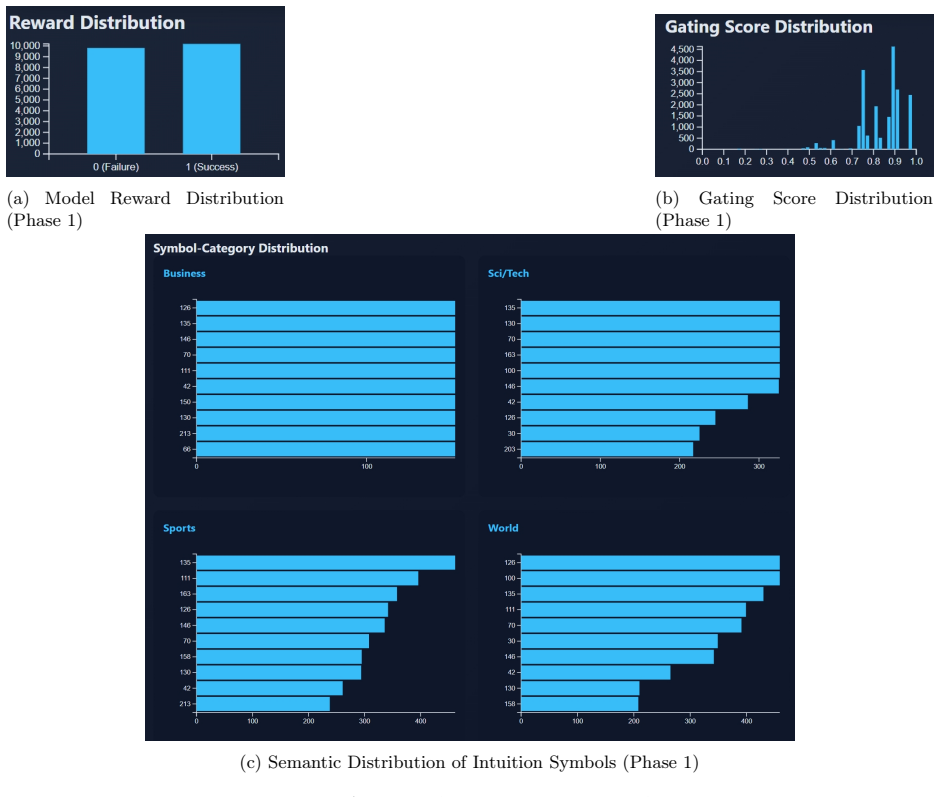
- The reported accuracies (50.94% Phase 1, 47.32% Phase 2 on AG News) are far below state-of-the-art; if scaling codebook size, depth, or embedding dimension does not narrow that gap, the framework's practical value may be limited to auditability rather than raw performance.
- The Iraq War case—where Symbol 227 has a 34.95% Sports association yet the model outputs World—shows that the interpretability claim rests on pattern-level statistics (49.33% success for 227 -> 227), and those statistics are computed from the model's own history. A reader should check whether pattern-level success remains predictive on a fresh, non-training corpus.
- A natural test: apply the same symbol-chain plus gate architecture to sequence labeling or summarization, where one symbol per layer is unlikely to carry enough meaning; that would immediately reveal the compression limit of a single flat codebook.
Editorial analysis
A structured set of objections, weighed in public.
Referee Report
Summary. The paper proposes a Dynamic Intuition Classifier for AG News classification, combining a VQ-AIM encoder, a Symbolic Router, and an Intuition Gate. The central claim is that the model learns an endogenous symbolic 'AI Mother Tongue' in which discrete codebook indices form interpretable thought chains (e.g., '227 -> 227'), and that a two-phase, two-step training procedure with Symbol Purity Loss and Gated Focus Loss yields 'unprecedented built-in interpretability while maintaining high accuracy' (Section 10). The manuscript reports Phase 1 accuracy of 50.94% and Phase 2 accuracy of 47.32% (Sections 8.2–8.3), and includes a case study in Section 9.4 where Symbol 227 is used for a World prediction despite its historical tendency toward Sports.
Significance. The aspiration to build an interpretable-by-design classifier with discrete symbolic traces is timely and relevant. The paper's architecture and training pipeline are described in enough detail to be reproduced, and the use of a public dataset, fixed random seeds, and a documented 'experience database' are strengths. However, the paper's central claims are not supported by its own reported evidence. The reported accuracies are far below standard AG News performance and no baseline comparison is provided; the interpretability evidence relies on the model's own training history rather than external semantic grounding; and the key 'improvements' in symbol purity and gate confidence are directly optimized by the proposed loss functions and sample selection. Because the load-bearing assertions of high accuracy and faithful interpretability fail, the manuscript in its current form cannot be accepted.
major comments (5)
- [Sections 8.2–8.3, 10] The abstract and Discussion claim 'competitive accuracy' and 'high accuracy', but the reported test accuracies are 50.94% (Phase 1) and 47.32% (Phase 2) on 4-class AG News. No baseline numbers are reported anywhere; Section 7.3 merely asserts that the expert model is 'on par' with the baseline. With 4 classes, these numbers are only about 25 points above chance and are far below typical AG News classifiers. Moreover, Section 8.3 states that the Phase 2 accuracy 'showed no significant decline' despite a 3.6-point drop, which is not justified by any test. The claim in Section 10 of 'maintaining high accuracy' is directly contradicted by the paper's own numbers.
- [Table 1 vs. Section 9.4] The interpretability claim rests on the stability of the discrete symbols. In Table 1, Symbol 227 is presented as a Sports-specific intuition for the Celtics headline. In Section 9.4, the same Symbol 227 is used for 'Iraq War Escalates with New Attacks' and supports a World prediction, while the symbol's historical distribution is Sports 34.95%, Business 29.93%, Sci/Tech 23.91%, with no World entry. The paper's Principles (Sections 9.3.1–9.3.3) anticipate this by calling symbols 'semantic atoms' and urging analysis of the whole pattern, but the pattern's 'historical success rate' of 49.33% is the model's own in-sample statistic, not an external ground truth. A 49.33% success rate does not constitute a 'convincing reasoning story' for a specific World prediction, and the example undermines the claim that the two-index chain is a faithful, human-comprehensible reasoning trace.
- [Equations (9)–(11), Section 4] The reported interpretability gains are direct consequences of the optimization objectives and sample selection, not emergent discoveries. Equation (9) explicitly minimizes the cross-entropy between the empirical label distribution of a symbol and the true label, so any increase in symbol purity is manufactured by construction. Equation (10) trains the gate to be 1 on correct predictions and 0 on incorrect ones, so an increase in gate reliability is likewise an artifact of the loss. In addition, Phase 2 filters samples by stability, activation, and symbol-label consistency (Section 4), selecting only cases that already match the model's internal criteria. Therefore, Section 7.3's claims that 'symbols with greater purity' and 'the gated focus loss successfully guided' the model are not independent empirical findings; they are restatements of the training procedure.
- [Section 7.3] This section contains placeholder statistics rather than actual results: '[Expert Model Mean] vs. [Baseline Model Mean], p < 0.01' and 'Intuition Gate Activation Rate ... reached [value] ... (p < 0.05)'. The section also refers to 'Table 1' and 'Table 2' comparing baseline and expert models, but no such results tables appear in the manuscript; the only tables are the illustrative decision flow (Table 1), the filtering-dimension comparison (Table 2), and the training-phase comparison (Table 3). Placeholder values are not reportable experimental results and prevent evaluation of the claimed significance.
- [Sections 4 and 5.2] The experimental setup deviates from the standard AG News protocol in ways that undermine comparability. Section 4 uses 20,000 training samples and 2,000 test samples, whereas standard AG News has 120,000 training and 7,600 test samples. The validation set is further reduced to 150 samples (VALIDATION_SAMPLE_SIZE=150). No rationale is given for these small subsamples, and the small validation set makes the claimed statistical differences unreliable. Additionally, the threshold for 'intuition activated' differs between Sections 5.2 (θ > 0.7) and 7.2 (average gating value > 0.5); the paper should state which threshold was used for the reported results.
minor comments (5)
- [Section 3.3] Typographical issues: 'Lf ocus' appears in the Phase 2 loss formula (Section 3.4) and 'λf ocus' in the same paragraph. The text should use consistent math formatting.
- [Section 3] The table comparing filtering dimensions is duplicated nearly verbatim in Section 3 (Table 2 and the text immediately after), likely a formatting error.
- [Section 10] The Discussion contains placeholder citations '[Reference 1: ...]' and '[Reference 2: ...]' instead of actual references, and no corresponding entries appear in the reference list.
- [Section 9.2] The Self-Attention Heatmap example says 'to understand US to supp..' but the quoted text is incomplete; either the sentence should be completed or the example should be rephrased.
- [Section 6] The paper states that 'conventional threshold for statistical significance is set at p < 0.05' but then says formal hypothesis testing was not conducted. If no tests are run, the earlier statements about p-values in Section 7.3 are inconsistent.
Circularity Check
Interpretability evidence reduces to the model's own objectives and in-sample history; central claim is self-referential.
-
self definitional
[Section 3.3, Eqs. (9)-(11); Section 7.3; Section 10]
"Symbol Purity Loss ... encourage[s] each discrete symbol ... to have a strong, unique correspondence with a specific class label ... Minimizing this loss forces the model to map samples with similar labels to the same symbol. ... The fine-tuned model was able to produce symbols with greater purity, meaning each symbol had a higher correlation with a specific label."
The reported purity improvement is the exact quantity minimized by Eq. (9) (-log P(yi|zq_i)); similarly, Lfocus (Eq. 10) uses correctness to push g->1 on correct and g->0 on incorrect samples. So the Section 10 claim of 'unprecedented built-in interpretability' restates the training objective. The result is manufactured by construction, not an emergent or predicted property.
-
self definitional
[Section 3.4.1 Phase 2 filtering; Section 4 'Filtering Criteria'; Section 5.2, Eq. (14)]
"Then, the script only selects samples where the triggered symbol has the highest historical correlation with the sample's true label. ... This process ensures a strong, verifiable correspondence between the symbols and the semantics they represent. ... Intuitive Accuracy ... proportion of correctly predicted samples within the subset of all samples deemed intuitively activated."
The symbol-label 'consistency' used to build the intuitive-essence dataset is computed from the model's own Phase-1 experience log, and the same symbol-label statistics are then used as evidence of semantic grounding. Intuitive Accuracy is defined only on the subset selected by the model's own high-gate, stable, consistent symbols; because Lfocus trains the gate to be high precisely on correct predictions, the subset is selected for correctness. The metric is therefore self-defined by the selection and training objectives, not an independent measure of interpretability.
2 more flagged steps
-
self definitional
[Section 9.3.3 and Section 9.4, Step 5]
"the historical success rate of the complete thought pattern composed of that symbol may be very high. Therefore, to accurately understand the model's decision, our analytical focus must shift from the static semantics of symbols to the dynamic performance history of thought patterns. ... Thought pattern 227 -> 227 appeared 596 times in history. Historical Success Rate (Average Reward): 49.33% ... This entire process transforms a seemingly contradictory AI decision into a data-supported, logically layered, and convincing reasoning story."
The case study 'explains' the prediction by quoting the pattern's average reward in the model's own experience database. That database is exactly the Phase-1 log used to define symbol-label consistency and to filter Phase-2 data. Thus the semantic validity of Symbol 227->227 is grounded in the model's own training history; 49.33% is the model's in-sample accuracy for that pattern, not an external or human semantic ground. The 'convincing reasoning story' is therefore a self-referential summary of the model's own behavior, not a verification that the symbol chain is interpretable.
-
self citation load bearing
[Section 2 Related Work, reference [5]; Section 3.2 'VQ-AIM Encoder']
"The AI Mother Tongue (AIM) framework proposed by Liu (2025) [5] is a representative example, challenging the necessity of introducing such inductive biases. The AIM framework, based on VQ-VAE, provides agents with an endogenous symbol system. Experiments demonstrate ..."
The paper's foundational premise that discrete VQ codebook indices constitute a meaningful 'AI Mother Tongue' is taken from the author's own prior arXiv preprint [5]. That citation is the only external support offered for treating codebook entries as 'semantic atoms'; the present paper's own evidence is the internally-generated statistics of Steps 1-3. Thus the central interpretability claim rests on a self-citation chain rather than on an independent, machine-checked or externally falsified result.
full rationale
Several of the paper's headline results are not predicted but manufactured by the training and filtering setup. Symbol purity is directly optimized by Eq. (9) and gated focus by Eq. (10), so the Section 7.3/10 claims of improved purity and calibrated gating are restatements of the loss. The 'Intuitive Essence' dataset is filtered on the model's own symbol-label statistics and stability/activation criteria, and 'Intuitive Accuracy' is then evaluated on that self-selected subset, so it is not an independent measure. The Section 9.4 case study 'validates' the 227->227 thought chain by its 49.33% in-sample reward in the model's own experience database—an internal statistic, not an external semantic ground, and far too weak to support an interpretability claim. Finally, the 'AI Mother Tongue' semantic-atom premise is imported from the author's own prior [5], making the chain self-referential. These are not mere self-citations: the claimed interpretability evidence reduces to the model's own objectives and history. Separate correctness concerns (Section 7 contains placeholder statistics; Sections 8.2-8.3 report 50.94% and 47.32% accuracy on 4-class AG News, contradicting 'high accuracy') are flagged as unsupported claims rather than circularity.
Assumptions & free parameters
free parameters (6)
- lambda_purity
- lambda_focus
- beta (VQ commitment loss weight)
- codebook_size K =
256
- gate threshold for intuition metrics =
0.5 or 0.7
- MIN_GATE_SCORE_THRESHOLD =
0.5
assumptions (5)
- standard math Straight-through estimator allows gradient flow through the discrete argmin in Eq. (1)
- domain assumption Nearest-neighbor quantization into a finite codebook yields semantically meaningful prototypes
- domain assumption The gating value g trained with Lfocus is a faithful confidence measure
- ad hoc to paper The filtered intuitive essence dataset (stability, activation, consistency) contains the model's best samples
- ad hoc to paper A two-symbol chain per sample is sufficient to represent reasoning
invented entities (1)
-
AI Mother Tongue (endogenous symbolic language)
Cite this review
Pith. "Pith review of Interpretable by AI Mother Tongue: Native Symbolic Reasoning in Neural Models." pith.science (2026). https://pith.science/paper/HRYR3N3V
@misc{pith2026250818988,
  author       = {Pith},
  title        = {Pith review of: Interpretable by AI Mother Tongue: Native Symbolic Reasoning in Neural Models},
  year         = {2026},
  howpublished = {\url{https://pith.science/paper/HRYR3N3V}},
  note         = {Machine review of arXiv:2508.18988}
}
read the original abstract
We present a framework where neural models develop an AI Mother Tongue, a native symbolic language that simultaneously supports intuitive reasoning, compositional symbol chains, and inherent interpretability. Unlike post-hoc explanation methods, our approach embeds reasoning directly into the model's representations: symbols capture meaningful semantic patterns, chains trace decision paths, and gated induction mechanisms guide selective focus, yielding transparent yet flexible reasoning. We introduce complementary training objectives to enhance symbol purity and decision sparsity, and employ a sequential specialization strategy to first build broad symbolic competence and then refine intuitive judgments. Experiments on AI tasks demonstrate competitive accuracy alongside verifiable reasoning traces, showing that AI Mother Tongue can serve as a unified mechanism for interpretability, intuition, and symbolic reasoning in neural models.
Figures


Figures from the paper (2 more)


Reference graph
Works this paper leans on
-
[1]
In Advances in Neural Information Processing Systems 30 (NeurIPS 2017)
A"aron van den Oord, Oriol Vinyals, and Koray Kavukcuoglu.Neural Discrete Representation Learning. In Advances in Neural Information Processing Systems 30 (NeurIPS 2017) . Available at: https:// arxiv.org/abs/1711.00937. 24
arXiv 2017
-
[2]
arXiv preprint arXiv:1904.10509, 2019
Rewon Child, Scott Gray, Alec Radford, and Ilya Sutskever.Generating Long Sequences with Sparse Transformers. arXiv preprint arXiv:1904.10509, 2019. Available at: https://arxiv.org/abs/1904. 10509
arXiv 1904
-
[3]
A Survey of Methods for Explaining Black Box Models
Riccardo Guidotti, Anna Monreale, Salvatore Ruggieri, Franco Turini, Fosca Giannotti, and Dino Pe- dreschi. A Survey of Methods for Explaining Black Box Models . ACM Computing Surveys , 51(5):1–42,
-
[4]
Hila Chefer, Shir Gur, and Lior Wolf.Transformer Interpretability Beyond Attention Visualization . In Proceedings of the IEEE/CVF Conference on Computer Vision and Pattern Recognition (CVPR 2021) , pages 782–791. Available at:https://arxiv.org/abs/2012.09838
arXiv 2021
-
[5]
arXiv preprint arXiv:2507.10566, 2025
Hung Ming Liu.AI Mother Tongue: Self-Emergent Communication in MARL via Endogenous Symbol Systems. arXiv preprint arXiv:2507.10566, 2025. Available at:https://arxiv.org/abs/2507.10566. 25
arXiv 2025
-
[2018]
Available at:https://arxiv.org/abs/1802.01933
Reviewed August 5, 2026 · model on record in the stance chip above.
Discussion (0). Sign in to comment.