Learning Binary Sampling Patterns for Single-Pixel Imaging using Bilevel Optimisation
Pith reviewed 2026-05-18 21:28 UTC · model grok-4.3
The pith
Bilevel optimization learns binary illumination patterns that improve single-pixel imaging reconstructions in undersampled regimes.
A machine-rendered reading of the paper's core claim, the machinery that carries it, and where it could break.
Core claim
The authors show that binary sampling patterns for single-pixel imaging can be learned end-to-end using a bilevel optimization framework, where the outer loop optimizes the patterns for a given reconstruction task and the inner loop performs the image recovery. Using the straight-through estimator to approximate gradients through the binary constraint, and incorporating a learned variational regularizer, the learned patterns yield superior reconstruction performance compared to conventional patterns and end-to-end deep learning methods, particularly in highly undersampled regimes and scarce-data settings on the CytoImageNet dataset.
What carries the argument
Bilevel optimization with the Straight-Through Estimator to learn task-specific binary illumination patterns for single-pixel reconstruction.
If this is right
- Task-specific binary patterns can be optimized for applications such as single-pixel fluorescence microscopy.
- Performance gains are most pronounced when the number of measurements is much smaller than the number of pixels.
- The method generalizes better than end-to-end networks in settings with limited training data.
- Combining pattern learning with variational regularization increases robustness of the reconstructions.
Where Pith is reading between the lines
- The learned patterns may correspond to physically interpretable illumination strategies that could be derived analytically in future work.
- This bilevel approach might extend to other non-differentiable constraints in imaging hardware design.
- Real-time adaptation of patterns could be possible if the optimization is made efficient enough for online use.
Load-bearing premise
The straight-through estimator gives a good enough approximation to the true gradient of the binary pattern selection so the bilevel solver finds patterns that work on data outside the training set.
What would settle it
Evaluating the learned patterns on a separate test set from CytoImageNet or similar microscopy data and finding no improvement in reconstruction error metrics over random or Hadamard patterns in the low-sample regime would falsify the performance claim.
Figures


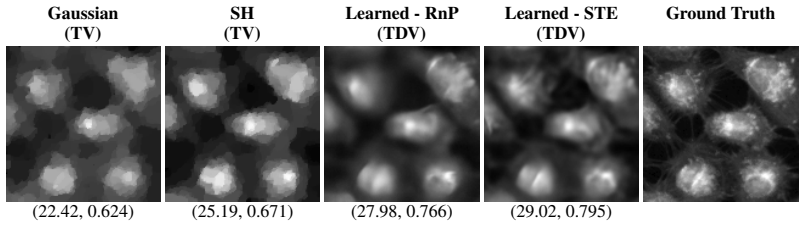

read the original abstract
Single-Pixel Imaging (SPI) enables the reconstruction of objects using a single detector through sequential illuminations with structured light patterns. The choice of illumination patterns is critical, particularly in highly undersampled regimes, where it directly determines reconstruction quality and acquisition speed. Instead of relying on handcrafted or fixed patterns, we propose to learn task-specific patterns directly from data. Practical SPI hardware only supports binary patterns, making binary pattern design a necessary consideration. We propose a bilevel optimisation method for learning task-specific binary illumination patterns optimised for applications such as single-pixel fluorescence microscopy. We address the non-differentiable nature of binary optimisation using the Straight-Through Estimator. In addition, we incorporate learned variational regularisation, improving reconstruction quality and robustness. We demonstrate our method on the CytoImageNet microscopy dataset. We show that our learned patterns achieve superior reconstruction performance compared to baseline methods and end-to-end deep learning, particularly in highly undersampled regimes and in scarce-data settings.
Editorial analysis
A structured set of objections, weighed in public.
Referee Report
Summary. The paper proposes a bilevel optimization framework to learn task-specific binary illumination patterns for single-pixel imaging (SPI). It handles the non-differentiable binary constraint with the Straight-Through Estimator (STE), incorporates learned variational regularization in the inner reconstruction loop, and evaluates the resulting patterns on the CytoImageNet microscopy dataset. The central claim is that the learned patterns yield superior reconstruction quality compared to handcrafted baselines and end-to-end deep learning, particularly at high undersampling ratios and in low-data regimes.
Significance. If the empirical superiority holds under proper controls, the work would provide a practical data-driven alternative to fixed or random patterns in hardware-constrained SPI systems such as fluorescence microscopy. The combination of bilevel optimization with STE and variational regularization is a coherent way to jointly optimize sampling and reconstruction, and the emphasis on scarce-data settings addresses a realistic constraint in biological imaging applications.
major comments (2)
- [Abstract and Experiments section] The abstract and method description assert superior performance on CytoImageNet without reporting concrete metrics (PSNR, SSIM), error bars, or train/validation/test splits. This makes the central claim impossible to verify from the given text and weakens the comparison to baselines and end-to-end DL.
- [Method (bilevel optimization with STE)] The Straight-Through Estimator is used to relax the binary constraint in the outer loop, but no analysis is provided on whether the resulting bias leads to patterns that overfit the training distribution rather than generalize. In the scarce-data regime highlighted by the paper, this approximation could undermine the reported gains; an ablation comparing STE to a true subgradient or to a relaxed continuous relaxation would be needed to support the generalization claim.
minor comments (2)
- [Method] Clarify the exact form of the inner-loop variational reconstruction problem and how the learned regularizer is parameterized.
- [Experiments] Add explicit sampling ratios (e.g., 5 %, 10 %, 20 %) and corresponding reconstruction tables so that the 'highly undersampled' regime can be compared quantitatively across methods.
Simulated Author's Rebuttal
We thank the referee for the constructive feedback, which helps strengthen the clarity and rigor of our claims regarding the bilevel optimization framework for binary pattern learning in single-pixel imaging. We address each major comment below and outline the revisions we will make.
read point-by-point responses
-
Referee: [Abstract and Experiments section] The abstract and method description assert superior performance on CytoImageNet without reporting concrete metrics (PSNR, SSIM), error bars, or train/validation/test splits. This makes the central claim impossible to verify from the given text and weakens the comparison to baselines and end-to-end DL.
Authors: We agree that the abstract would be strengthened by including concrete quantitative metrics. In the revised version, we will update the abstract to report key results such as average PSNR and SSIM values (with standard deviations) for our learned patterns versus baselines and end-to-end DL at representative undersampling ratios (e.g., 5%, 10%). We will also explicitly describe the dataset splits in the experiments section, including the number of training, validation, and test images from CytoImageNet, the protocol for simulating scarce-data regimes (e.g., subsets of 100 or 500 images), and how error bars were computed across multiple random seeds or runs. These details are already present in the full experimental tables and figures but will be highlighted more clearly in the text. revision: yes
-
Referee: [Method (bilevel optimization with STE)] The Straight-Through Estimator is used to relax the binary constraint in the outer loop, but no analysis is provided on whether the resulting bias leads to patterns that overfit the training distribution rather than generalize. In the scarce-data regime highlighted by the paper, this approximation could undermine the reported gains; an ablation comparing STE to a true subgradient or to a relaxed continuous relaxation would be needed to support the generalization claim.
Authors: We appreciate this observation on the potential limitations of the Straight-Through Estimator (STE). While our empirical results demonstrate robust generalization in low-data settings, we acknowledge that a dedicated analysis of STE-induced bias and its impact on overfitting is absent. In the revision, we will expand the method section with a brief discussion of STE's known bias properties and their relevance to our bilevel setup. We will also add an ablation comparing patterns learned via STE against those from a continuous relaxation (e.g., sigmoid annealing) and report reconstruction metrics on held-out test data to empirically support that the learned patterns generalize rather than overfit the training distribution. revision: yes
Circularity Check
No significant circularity; performance claims rest on external test-set evaluation
full rationale
The paper describes a bilevel optimization procedure in which the outer loop learns binary pattern parameters via the Straight-Through Estimator while the inner loop solves a variational reconstruction problem. The reported superiority is measured by reconstruction quality on held-out images from the CytoImageNet dataset, using metrics that are independent of the training loss. No equation or step equates the final performance figure to a quantity defined by the same fitted parameters or by a self-citation chain; the derivation therefore remains self-contained against external benchmarks and does not reduce to its inputs by construction.
Axiom & Free-Parameter Ledger
Reference graph
Works this paper leans on
-
[1]
Vahid Abolghasemi, Saideh Ferdowsi, and Saeid Sanei. “A Gradient-Based Alternating Mini- mization Approach for Optimization of the Measurement Matrix in Compressive Sensing”. In: Signal Processing 92.4 (Apr. 2012), pp. 999–1009
work page 2012
-
[2]
Zico Kolter, and Vladlen Koltun
Shaojie Bai, J. Zico Kolter, and Vladlen Koltun. Deep Equilibrium Models. 2019
work page 2019
-
[3]
Yoshua Bengio, Nicholas Léonard, and Aaron Courville.Estimating or Propagating Gradients Through Stochastic Neurons for Conditional Computation. 2013
work page 2013
-
[4]
Model Selection via Bilevel Optimization
K.P. Bennett et al. “Model Selection via Bilevel Optimization”. In:The 2006 IEEE Interna- tional Joint Conference on Neural Network Proceedings. Vancouver, BC, Canada: IEEE, 2006, pp. 1922–1929
work page 2006
-
[5]
Near-Optimal Signal Recovery From Random Projec- tions: Universal Encoding Strategies?
Emmanuel J. Candes and Terence Tao. “Near-Optimal Signal Recovery From Random Projec- tions: Universal Encoding Strategies?” In:IEEE Transactions on Information Theory 52.12 (Dec. 2006), pp. 5406–5425
work page 2006
-
[6]
A First-Order Primal-Dual Algorithm for Convex Problems with Applications to Imaging
Antonin Chambolle and Thomas Pock. “A First-Order Primal-Dual Algorithm for Convex Problems with Applications to Imaging”. In: Journal of Mathematical Imaging and Vision 40.1 (May 2011), pp. 120–145
work page 2011
-
[7]
Single-Pixel Imaging via Compressive Sampling
Marco F. Duarte et al. “Single-Pixel Imaging via Compressive Sampling”. In:IEEE Signal Processing Magazine 25.2 (Mar. 2008), pp. 83–91
work page 2008
-
[8]
Diffraction-Limited Hyperspectral Mid-Infrared Single-Pixel Mi- croscopy
Alexander Ebner et al. “Diffraction-Limited Hyperspectral Mid-Infrared Single-Pixel Mi- croscopy”. In: Scientific Reports 13.1 (Jan. 2023), p. 281
work page 2023
-
[9]
Principles and Prospects for Single-Pixel Imaging
Matthew P. Edgar, Graham M. Gibson, and Miles J. Padgett. “Principles and Prospects for Single-Pixel Imaging”. In: Nature Photonics 13.1 (Jan. 2019), pp. 13–20
work page 2019
-
[10]
JFB: Jacobian-Free Backpropagation for Implicit Networks
Samy Wu Fung et al. “JFB: Jacobian-Free Backpropagation for Implicit Networks”. In: Proceedings of the AAAI Conference on Artificial Intelligence 36.6 (June 2022), pp. 6648– 6656
work page 2022
-
[11]
Deep Learning for Real-Time Single-Pixel Video
Catherine F. Higham et al. “Deep Learning for Real-Time Single-Pixel Video”. In:Scientific Reports 8.1 (Feb. 2018), p. 2369
work page 2018
-
[12]
Stanley Bryan Z. Hua, Alex X. Lu, and Alan M. Moses. CytoImageNet: A Large-Scale Pretraining Dataset for Bioimage Transfer Learning. 2021
work page 2021
-
[13]
Single-Pixel Camera Photoacoustic Tomography
Nam Huynh et al. “Single-Pixel Camera Photoacoustic Tomography”. In:Journal of Biomedi- cal Optics 24.12 (Sept. 2019), p. 1
work page 2019
-
[14]
Eric Jang, Shixiang Gu, and Ben Poole.Categorical Reparameterization with Gumbel-Softmax. 2016
work page 2016
-
[15]
Total Deep Variation for Linear Inverse Problems
Erich Kobler et al. “Total Deep Variation for Linear Inverse Problems”. In:Proceedings of the IEEE/CVF Conference on Computer Vision and Pattern Recognition. 2020, pp. 7549–7558
work page 2020
-
[16]
Accelerated Proximal Gradient Methods for Nonconvex Pro- gramming
Huan Li and Zhouchen Lin. “Accelerated Proximal Gradient Methods for Nonconvex Pro- gramming”. In: Advances in neural information processing systems 28 (2015)
work page 2015
-
[17]
Exact Penalty Functions for Nonlinear Integer Programming Prob- lems
S. Lucidi and F. Rinaldi. “Exact Penalty Functions for Nonlinear Integer Programming Prob- lems”. In: Journal of Optimization Theory and Applications 145.3 (June 2010), pp. 479– 488
work page 2010
-
[18]
No-Reference Image Quality Assessment in the Spatial Domain
A. Mittal, A. K. Moorthy, and A. C. Bovik. “No-Reference Image Quality Assessment in the Spatial Domain”. In: IEEE Transactions on Image Processing21.12 (Dec. 2012), pp. 4695– 4708. 5
work page 2012
-
[19]
Optimizing Sampling Patterns for Compressed Sensing MRI with Diffusion Generative Models
Sriram Ravula et al. Optimizing Sampling Patterns for Compressed Sensing MRI with Diffusion Generative Models. 2023
work page 2023
-
[20]
Variational Methods in Imaging
Otmar Scherzer et al. Variational Methods in Imaging. V ol. 167. Springer, 2009
work page 2009
-
[21]
Optimization of k -space Trajectories for Compressed Sensing by Bayesian Experimental Design
Matthias Seeger et al. “Optimization of k -space Trajectories for Compressed Sensing by Bayesian Experimental Design”. In: Magnetic Resonance in Medicine 63.1 (Jan. 2010), pp. 116–126
work page 2010
-
[22]
Truncated Back-Propagation for Bilevel Optimization
Amirreza Shaban et al. “Truncated Back-Propagation for Bilevel Optimization”. In:Proceed- ings of the Twenty-Second International Conference on Artificial Intelligence and Statistics. V ol. 89. Proceedings of Machine Learning Research. PMLR, Apr. 2019, pp. 1723–1732
work page 2019
-
[23]
Learning the Sampling Pattern for MRI
Ferdia Sherry et al. “Learning the Sampling Pattern for MRI”. In: IEEE Transactions on Medical Imaging 39.12 (Dec. 2020), pp. 4310–4321
work page 2020
-
[24]
Single-Pixel Imaging Using Physics Enhanced Deep Learning
Fei Wang et al. “Single-Pixel Imaging Using Physics Enhanced Deep Learning”. In:Photonics Research 10.1 (Jan. 2022), p. 104
work page 2022
-
[25]
Yair Weiss, Hyun Sung Chang, and William T Freeman. “Learning Compressed Sensing”. In: Snowbird Learning Workshop, Allerton, CA. Citeseer, 2007
work page 2007
-
[26]
Learning a Compressed Sensing Measurement Matrix via Gradient Unrolling
Shanshan Wu et al. “Learning a Compressed Sensing Measurement Matrix via Gradient Unrolling”. In: Proceedings of the 36th International Conference on Machine Learning . V ol. 97. Proceedings of Machine Learning Research. PMLR, June 2019, pp. 6828–6839
work page 2019
-
[27]
Understanding Straight-Through Estimator in Training Activation Quan- tized Neural Nets
Penghang Yin et al. Understanding Straight-Through Estimator in Training Activation Quan- tized Neural Nets. 2019
work page 2019
-
[28]
Deep Equilibrium Learning of Explicit Regularization Functionals for Imaging Inverse Problems
Zihao Zou et al. “Deep Equilibrium Learning of Explicit Regularization Functionals for Imaging Inverse Problems”. In: IEEE Open Journal of Signal Processing 4 (2023), pp. 390– 398. 6 A Additional Results Table 1: PSNR and SSIM for sampling patterns with respect to M, using the TV regulariser. M = 128 M = 256 M = 512 M = 1024 M = 2048 PSNR SSIM PSNR SSIM P...
work page 2023
discussion (0)
Sign in with ORCID, Apple, or X to comment. Anyone can read and Pith papers without signing in.