REVIEW 4 major objections 5 minor 1 cited by
Sycophancy as compositions of Atomic Psychometric Traits
T0 review · 4 major / 5 minor · reviewed 2026-08-05 · deepseek-v4-flash
Pith's one-line read Sycophancy in large language models is best understood not as a single failure mechanism but as a geometric and causal composition of psychometric trait directions, which can be steered by adding or subtracting composite vectors.
desk verdict A theory paper in search of experiments: the psychometric-trait composition idea is worth airing, but the submitted evidence is only a small cosine study that doesn't test the title's causal claim. read the letter →
The pith
A machine-rendered reading of the paper's core claim, the machinery that carries it, and where it could break.
The reading
What carries the argument
Contrastive Activation Addition (CAA): the method that turns a dataset of high-trait versus low-trait prompts into a single average activation-difference vector per trait, giving an interpretable direction in residual-stream space. The load-bearing assumption is the linear representation hypothesis, which lets the author treat these directions like coordinates in a vector space, so behaviors such as sycophancy can be expressed as weighted sums v_syc ≈ α·v_trait1 + β·v_trait2, and steering is performed by adding or subtracting the composite.
What would settle it
Take the composite vector v_extraversion − v_conscientiousness (or the proposed v_agreeableness − v_conscientiousness), add it at mid-layer during inference, and measure agreement rates on a set of false statements on which the baseline model already disagrees. If agreement rates do not rise substantially above a random-direction control, the compositional claim fails. Conversely, computing trait vectors from prompts with scrambled or paraphrased wording and re-measuring cosine similarity to sycophancy would settle whether the alignment is causal or a linguistic artifact.
Extended reading notes
Core claim
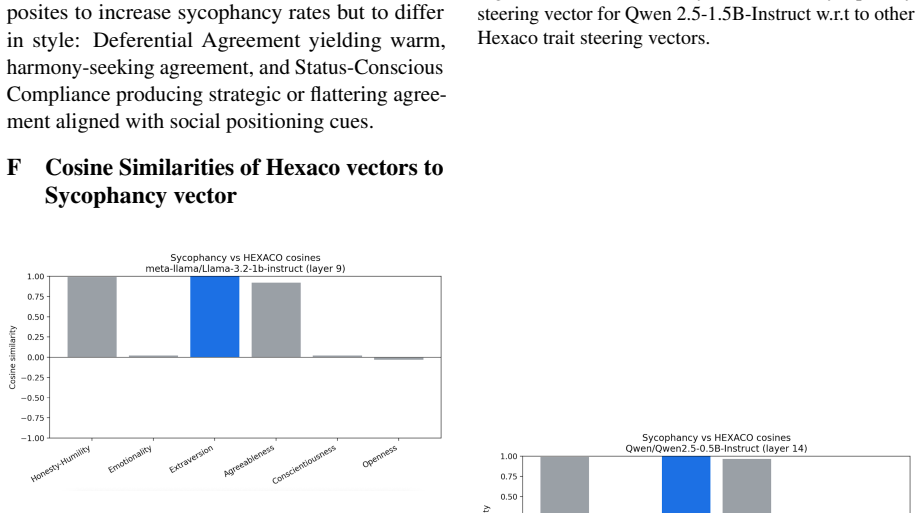
Using Contrastive Activation Addition on 200-pair contrastive datasets built from HEXACO trait descriptions, the paper computes a steering direction for each of the six main traits (honesty–humility, emotionality, extraversion, agreeableness, conscientiousness, openness) and a separate sycophancy direction. The central discovery is that sycophancy is not a standalone direction but a composite one: preliminary results across Llama 3.2 and Qwen 2.5 variants show the sycophancy vector aligns most strongly with extraversion, with notable alignment to honesty–humility (via subtraits such as modesty) and little to no alignment with openness, conscientiousness, or emotionality. The author frames sy
Load-bearing premise
The paper assumes that the cosine similarity between a sycophancy steering vector and trait steering vectors reflects a causal trait contribution to the behavior, rather than shared surface features of the prompt datasets used to construct both.
Editorial extensions
If this is right
- If sycophancy is a composition of trait directions, then subtracting the composite vector (e.g., v_agreeableness − v_conscientiousness) should reduce sycophancy while leaving unrelated capabilities intact, since only contributing traits are adjusted.
- Distinct sycophancy subtypes—deferential, harmony-seeking agreement versus strategic, flattering compliance—would correspond to different trait-composition pathways and could be separately controlled.
- The approach generalizes: any misaligned behavior (not only sycophancy) could be decomposed into trait directions, yielding a library of interpretable, compositional safety levers.
- Preliminary cosine-similarity rankings give a falsifiable prediction: extraversion and honesty–humility trait vectors should causally drive sycophancy when added, and suppression of those traits alone should weaken the behavior.
- Trait directions derived on one model family (Llama/Qwen) should transfer measurably to another if the latent trait structure is shared, providing a cross-model consistency test.
Reading between the lines
- The cosine-similarity alignments may partly reflect shared dataset wording—both trait prompts and sycophancy prompts likely use polite, agreeable language—so a strong test would be to re-derive trait vectors on paraphrased or style-controlled prompts and check whether the extraversion/honesty–humility alignment survives.
- If the composite-vector ablation works, it would imply sycophancy is a distributed trait interaction rather than a single circuit, contrasting with findings of single directions mediating refusal; the two kinds of mechanism may coexist in different layers.
- A testable extension is to predict a model's real-world sycophancy rate from a small set of trait-vector projections before any behavioral probing, treating the trait projections as a psychometric score; if the prediction fails on adversarial or unusual users, the trait-composition model is incomplete.
- The framework suggests that sycophancy interventions could be personalized: steering a model to reduce a specific subtrait (e.g., modesty) rather than the whole trait could tune the sycophancy profile without flattening extraversion-linked helpfulness.
Editorial analysis
A structured set of objections, weighed in public.
Referee Report
Summary. The paper proposes that sycophancy in LLMs should be modeled not as a single isolated mechanism but as a geometric and causal composition of psychometric trait directions, drawing on HEXACO personality theory and Contrastive Activation Addition (CAA). The authors construct seven 200-pair contrastive datasets (six HEXACO traits plus sycophancy), compute activation-space steering vectors for LLaMA 3.2 and Qwen 2.5 models, and report cosine similarities between the sycophancy vector and trait vectors. They also list several hypothesized composite formulas, such as v_agreeableness − v_conscientiousness, and describe planned steering, ablation, and circuit-level experiments. The manuscript explicitly states that compositional analysis, causal interventions, subtrait datasets, and CLT experiments are deferred to a full version or appendices, so the submitted paper is best characterized as a research proposal with preliminary correlational results.
Significance. If the central claim were established, trait-compositional steering would be a useful interpretability framework: sycophancy and related behaviors could be decomposed into interpretable psychometric directions and controlled by vector arithmetic. The paper has genuine strengths: it grounds the hypothesis in psychological theory, proposes concrete falsifiable compositions, uses a standard method (CAA), and is transparent about what remains unfinished. However, the current evidence is limited to cosine similarities between steering vectors derived from contrastive datasets; it does not demonstrate that sycophancy arises from trait compositions or that composing trait vectors changes behavior. As submitted, the contribution is a hypothesis scaffold plus preliminary correlations, not a validated scientific result.
major comments (4)
- [Abstract / §3 / §5 / Appendix D] The central claim that sycophancy is a 'geometric and causal composition' of psychometric traits and can be induced or mitigated by vector addition/subtraction is not tested in this manuscript. §3 states that compositional analysis appears 'in the full paper version'; Appendix D labels interventions as planned; §5 reports only cosine similarities. No steering experiment, ablation, or behavioral measurement is performed. The causal language of the abstract therefore goes beyond the evidence.
- [§5 / Appendix F] Cosine similarity between CAA vectors is insufficient evidence for compositional causality. The trait and sycophancy vectors are computed from separately hand-written 200-pair contrast sets, and the paper provides no details of the prompts, no controls for wording/style/negation/sentiment, no error bars, and no significance tests. The paper itself concedes that dataset refinement is needed to 'minimize entanglement of trait vectors.' Shared surface features, not trait content, could drive the reported alignment with extraversion. Even a clean directional correlation would not show that sycophancy is generated by a linear combination of trait directions.
- [Appendix B / Appendix D] The proposed decompositions are asserted rather than validated. The five Appendix B pathways (e.g., v_Aflexibility + v_Esentimentality − v_Oinquisitiveness) are derived from human psychology literature and are plausible hypotheses, but no evidence is presented that these composites correspond to LLM activation-space structure or sycophantic behavior. Equation (v_sycophancy ≈ v_agreeableness − v_conscientiousness) in Appendix D is never fit or evaluated against observations; the coefficients α and β′ are free parameters with no fitting procedure specified. The geometric compositionality claim therefore lacks quantitative support.
- [§4 / §5] The paper claims to 'identify psychometric trait directions,' but no validation shows that the extracted vectors actually steer the model's behavior along the intended trait. CAA activation differences may reflect prompt artifacts rather than stable trait directions. At minimum, the authors should report a behavioral check (e.g., adding v_extraversion increases extraversion-related outputs) or demonstrate that the contrast sets isolate the target trait. Without such checks, calling these vectors 'trait directions' is an interpretive label rather than an established result.
minor comments (5)
- [§5] The layer identification is corrupted in the text: 'mid-residual layers (∼ ⊬.⋪ × ⋉⋖⅁↷∖∼)' is unreadable. Exact layer indices are essential for reproducibility and should be reported clearly.
- [§5 vs Appendix F] The text says 'more details in Section F' but the appendix is labeled 'F'; citation style should be consistent.
- [Appendix B] Typo: 'analagous' should be 'analogous.' Also, the use of β′ in Appendix D as both a coefficient and a superscripted trait index is confusing; consider renaming the coefficients.
- [§2 Contributions] Contribution 3 says 'We will investigate...' but a contributions section should state completed work. This is consistent with the overall proposal-like nature of the paper but is awkwardly phrased.
- [Figure 1 caption] Typo: 'w.r.t to other Hexaco trait' should be 'w.r.t. other HEXACO trait vectors.' Also, the figure does not show error bars, which is worth stating explicitly.
Circularity Check
No circularity: the only executed measurements are independent empirical cosine similarities; the causal composition claim is explicitly deferred to future work.
full rationale
The paper's only executed measurement is the cosine similarity between a CAA-derived sycophancy vector and CAA-derived HEXACO trait vectors (Section 5, Appendix F). These vectors are computed from separate contrastive datasets (Section 4), so the similarities are not forced by construction. The proposed compositions (e.g., v_agreeableness - v_conscientiousness in Appendix D, and the Appendix B pathways) are hypotheses drawn from psychology literature, not parameters fitted to the sycophancy vector; the paper explicitly says compositional analysis and causal interventions are future work ('In the full paper version, we will model safety-relevant behaviors as linear combinations...' Section 3; 'we plan additional sets of experiments' Section 5; Appendix E). The paper also flags its own limitation: 'We expect further refinement of our dataset quality to ensure these have diverse language and styles to minimize entanglement of trait vectors' (Section 5), which is a confound concern, not circularity. No load-bearing self-citation or uniqueness theorem is invoked; references to CAA, CLT, and HEXACO are external methods. Thus the central claim is presently a hypothesis with preliminary correlational support, but no step in the derivation reduces to its own inputs.
Assumptions & free parameters
free parameters (3)
- composition coefficients α, β′ =
not fitted (proposed)
- contrastive dataset construction =
not specified
- layer selection =
mid-residual layers (text corrupted)
assumptions (4)
- domain assumption Linear representation hypothesis: high-level traits and behaviors are encoded as linear directions in activation space.
- domain assumption HEXACO trait constructs are meaningful for LLMs and can be elicited via natural-language prompts.
- domain assumption Averaging activation differences from contrastive pairs yields a direction that isolates the trait rather than style or format artifacts.
- domain assumption Cosine similarity between steering vectors indicates shared causal mechanism.
Cite this review
Pith. "Pith review of Sycophancy as compositions of Atomic Psychometric Traits." pith.science (2026). https://pith.science/paper/552SVMHI
@misc{pith2026250819316,
  author       = {Pith},
  title        = {Pith review of: Sycophancy as compositions of Atomic Psychometric Traits},
  year         = {2026},
  howpublished = {\url{https://pith.science/paper/552SVMHI}},
  note         = {Machine review of arXiv:2508.19316}
}
read the original abstract
Sycophancy is a key behavioral risk in LLMs, yet is often treated as an isolated failure mode that occurs via a single causal mechanism. We instead propose modeling it as geometric and causal compositions of psychometric traits such as emotionality, openness, and agreeableness - similar to factor decomposition in psychometrics. Using Contrastive Activation Addition (CAA), we map activation directions to these factors and study how different combinations may give rise to sycophancy (e.g., high extraversion combined with low conscientiousness). This perspective allows for interpretable and compositional vector-based interventions like addition, subtraction and projection; that may be used to mitigate safety-critical behaviors in LLMs.
Figures


Figures from the paper (1 more)

Forward citations
Cited by 1 Pith paper
-
Resist and Update: Counterfactual Report Coordinates for Incentive-Compatible LLMs
A two-pass counterfactual report-coordinate clamp jointly achieves perfect resist-and-update scores on a Bayesian-witness benchmark by holding LLM reports to an incentive-neutralized causal contract.
Reference graph
Works this paper leans on
-
[1]
online" 'onlinestring :=
ENTRY address archivePrefix author booktitle chapter edition editor eid eprint eprinttype howpublished institution journal key month note number organization pages publisher school series title type volume year doi pubmed url lastchecked label extra.label sort.label short.list INTEGERS output.state before.all mid.sentence after.sentence after.block STRING...
-
[2]
write newline
" write newline "" before.all 'output.state := FUNCTION n.dashify 't := "" t empty not t #1 #1 substring "-" = t #1 #2 substring "--" = not "--" * t #2 global.max substring 't := t #1 #1 substring "-" = "-" * t #2 global.max substring 't := while if t #1 #1 substring * t #2 global.max substring 't := if while FUNCTION word.in bbl.in capitalize " " * FUNCT...
-
[3]
Emmanuel Ameisen, Jack Lindsey, Adam Pearce, Wes Gurnee, Nicholas L. Turner, Brian Chen, Craig Citro, David Abrahams, Shan Carter, Basil Hosmer, Jonathan Marcus, Michael Sklar, Adly Templeton, Trenton Bricken, Callum McDougall, Hoagy Cunningham, Thomas Henighan, Adam Jermyn, Andy Jones, and 8 others. 2025. https://transformer-circuits.pub/2025/attribution...
work page 2025
-
[4]
Andy Arditi, Oscar Obeso, Aaquib Syed, Daniel Paleka, Nina Panickssery, Wes Gurnee, and Neel Nanda. 2024. https://arxiv.org/abs/2406.11717 Refusal in language models is mediated by a single direction . Preprint, arXiv:2406.11717
arXiv 2024
-
[5]
Michael C Ashton and Kibeom Lee. 2007. Empirical, theoretical, and practical advantages of the hexaco model of personality structure. Personality and social psychology review, 11(2):150--166
work page 2007
-
[6]
Michael C Ashton and Kibeom Lee. 2008. The hexaco model of personality structure and the importance of the h factor. Social and Personality Psychology Compass, 2(5):1952--1962
work page 2008
-
[7]
Bourdage, Justin Wiltshire, and Kibeom Lee
Joshua S. Bourdage, Justin Wiltshire, and Kibeom Lee. 2015. https://doi.org/10.1037/a0037942 Personality and workplace impression management: Correlates and implications . Journal of Applied Psychology, 100(2):537--546
-
[8]
Runjin Chen, Andy Arditi, Henry Sleight, Owain Evans, and Jack Lindsey. 2025. https://arxiv.org/abs/2507.21509 Persona vectors: Monitoring and controlling character traits in language models . Preprint, arXiv:2507.21509
arXiv 2025
Show all 29 references
-
[9]
Myra Cheng, Sunny Yu, Cinoo Lee, Pranav Khadpe, Lujain Ibrahim, and Dan Jurafsky. 2025. https://arxiv.org/abs/2505.13995 Social sycophancy: A broader understanding of llm sycophancy . Preprint, arXiv:2505.13995
2025 arXiv
-
[10]
Boele De Raad. 2000. The big five personality factors: the psycholexical approach to personality. Hogrefe & Huber Publishers
2000
-
[11]
de Vries, Ingo Zettler, and Benjamin E
Reinout E. de Vries, Ingo Zettler, and Benjamin E. Hilbig. 2014. https://doi.org/10.1177/1073191113504619 Rethinking trait conceptions of social desirability scales: Impression management as an expression of honesty--humility . Assessment, 21(3):286--299
2014 doi
-
[12]
Dunlop, Kibeom Lee, Michael C
Patrick D. Dunlop, Kibeom Lee, Michael C. Ashton, Sarah B. Butcher, and Alana Dykstra. 2015. https://doi.org/10.1016/j.paid.2015.02.004 Please accept my sincere and humble apologies: The hexaco model of personality and the proclivity to apologize . Personality and Individual D...
2015 doi
-
[13]
Aaron Grattafiori, Abhimanyu Dubey, Abhinav Jauhri, Abhinav Pandey, Abhishek Kadian, Ahmad Al-Dahle, Aiesha Letman, Akhil Mathur, Alan Schelten, Alex Vaughan, Amy Yang, Angela Fan, Anirudh Goyal, Anthony Hartshorn, Aobo Yang, Archi Mitra, Archie Sravankumar, Artem Korenev, Art...
2024 arXiv
-
[14]
Hart, Kathryn Richardson, and Chad J
Claire M. Hart, Kathryn Richardson, and Chad J. Breeden. 2020. https://doi.org/10.1016/j.paid.2019.109649 Profiling hexaco factors on self-presentation tactic use . Personality and Individual Differences, 152:109649
2020
-
[15]
HEXACO Personality Inventory--Revised . n.d. Scale descriptions. https://hexaco.org/scaledescriptions. Accessed: 2025-08-14
2025
-
[16]
Hilbig, Timo Heydasch, and Ingo Zettler
Benjamin E. Hilbig, Timo Heydasch, and Ingo Zettler. 2014. https://doi.org/10.1016/j.paid.2014.04.033 To boast or not to boast: Testing the humility aspect of the honesty--humility factor . Personality and Individual Differences, 69:12--16
2014 doi
-
[17]
Hilbig, Ingo Zettler, Florian Leist, and Timo Heydasch
Benjamin E. Hilbig, Ingo Zettler, Florian Leist, and Timo Heydasch. 2013. https://doi.org/10.1016/j.paid.2012.11.008 It takes two: Honesty--humility and agreeableness differentially predict active versus reactive cooperation . Personality and Individual Differences, 54(5):598--603
2013 doi
-
[18]
Law, Joshua S
Stephanie J. Law, Joshua S. Bourdage, and Thomas A. O’Neill. 2016. https://doi.org/10.3389/fpsyg.2016.01771 To fake or not to fake: Antecedents to interview faking, warning instructions, and its impact on applicant reactions . Frontiers in Psychology, 7:1771
2016
-
[19]
Kibeom Lee and Michael C. Ashton. 2012. https://doi.org/10.1016/j.paid.2011.12.004 Getting mad and getting even: Agreeableness and honesty--humility as predictors of revenge intentions . Personality and Individual Differences, 52(5):596--600
2012 doi
-
[20]
John C Loehlin, Robert R McCrae, Paul T Costa Jr, and Oliver P John. 1998. Heritabilities of common and measure-specific components of the big five personality factors. Journal of research in personality, 32(4):431--453
1998
-
[21]
Julian Minder, Kevin Du, Niklas Stoehr, Giovanni Monea, Chris Wendler, Robert West, and Ryan Cotterell. 2025. https://arxiv.org/abs/2411.07404 Controllable context sensitivity and the knob behind it . Preprint, arXiv:2411.07404
2025 arXiv
-
[22]
Nina Panickssery, Nick Gabrieli, Julian Schulz, Meg Tong, Evan Hubinger, and Alexander Matt Turner. 2024. https://arxiv.org/abs/2312.06681 Steering llama 2 via contrastive activation addition . Preprint, arXiv:2312.06681
2024 arXiv
-
[23]
Kiho Park, Yo Joong Choe, and Victor Veitch. 2024. https://arxiv.org/abs/2311.03658 The linear representation hypothesis and the geometry of large language models . Preprint, arXiv:2311.03658
2024 arXiv
-
[24]
Bourdage
Nicolas Roulin and Joshua S. Bourdage. 2017. https://doi.org/10.3389/fpsyg.2017.00029 Once an impression manager, always an impression manager? antecedents of honest and deceptive impression management use and variability across multiple job interviews . Frontiers in Psychology, 8:29
2017
-
[25]
Bowman, Newton Cheng, Esin Durmus, Zac Hatfield-Dodds, Scott R
Mrinank Sharma, Meg Tong, Tomasz Korbak, David Duvenaud, Amanda Askell, Samuel R. Bowman, Newton Cheng, Esin Durmus, Zac Hatfield-Dodds, Scott R. Johnston, Shauna Kravec, Timothy Maxwell, Sam McCandlish, Kamal Ndousse, Oliver Rausch, Nicholas Schiefer, Da Yan, Miranda Zhang, a...
2025 arXiv
-
[26]
Qwen Team. 2024. Qwen2 technical report. arXiv preprint arXiv:2407.10671
2024 arXiv
-
[27]
Robert P Tett and Dawn D Burnett. 2003. A personality trait-based interactionist model of job performance. Journal of Applied psychology, 88(3):500
2003
-
[28]
Keyu Wang, Jin Li, Shu Yang, Zhuoran Zhang, and Di Wang. 2025. https://arxiv.org/abs/2508.02087 When truth is overridden: Uncovering the internal origins of sycophancy in large language models . Preprint, arXiv:2508.02087
2025
-
[29]
Hilbig, Morten Moshagen, and Reinout E
Ingo Zettler, Benjamin E. Hilbig, Morten Moshagen, and Reinout E. de Vries. 2015. https://doi.org/10.1016/j.paid.2014.10.007 Dishonest responding or true virtue? a behavioral test of impression management . Personality and Individual Differences, 81:107--111
2015 doi
Reviewed August 5, 2026 · model on record in the stance chip above.
Discussion (0). Sign in to comment.