REVIEW 3 major objections 6 minor 57 references
Beyond BEV: Optimizing Point-Level Tokens for Collaborative Perception
T0 review · 3 major / 6 minor · reviewed 2026-08-05 · deepseek-v4-flash
Pith's one-line read CoPLOT swaps BEV feature maps for compact point-level tokens in collaborative 3D detection, beating the next-best method by 4.2–9.8% AP@0.7 on three benchmarks while using ~80% less computation and ~90% less bandwidth.
desk verdict CoPLOT makes a real break from BEV by exchanging point-level tokens, but the fixed top-k is tuned on the test set and the efficiency numbers hinge on it. read the letter →
The pith
A machine-rendered reading of the paper's core claim, the machinery that carries it, and where it could break.
The reading
What carries the argument
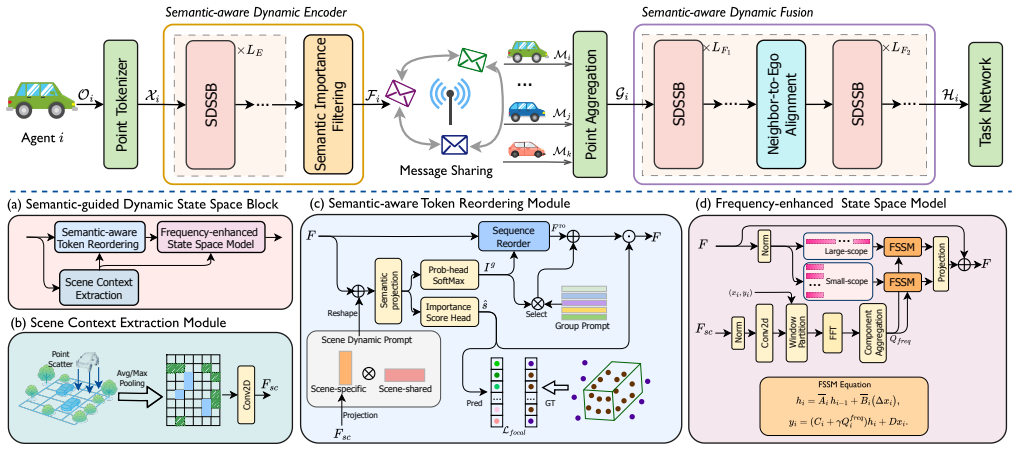
The central mechanism is the point-level token sequence together with three modules that make a 1D token stream viable for outdoor LiDAR. (1) Semantic-aware token reordering (STR) uses scene-level and token-level prompts to assign each token a semantic group index, so semantically related tokens become adjacent in the serialized sequence. (2) The frequency-enhanced state space model (FSSM) is a Mamba-style selective SSM whose output matrix C — formally the counterpart of the query matrix in linear attention — is augmented with a compact frequency descriptor (DC energy, low- and high-frequency energy, and their ratio, from a windowed 2D DFT), letting the model separate object contours from br
What would settle it
A concrete test: keep CoPLOT's importance scorer fixed and raise object density well beyond the training distribution (e.g., the densest OPV2V scenes with 33 vehicles) without raising k; if per-object foreground recall collapses and AP@0.7 follows, the claim that the compact top-k sequence preserves objects fails. A second test targets generalization across gaps: run the scorer trained on simulated OPV2V directly on V2V4Real frames; a large AP drop would mean the scores overfit the simulated geometry rather than capturing objectness itself.
Extended reading notes
Core claim
On the paper's own terms, the discovery is that point-level tokens — fixed-grid aggregations of raw LiDAR points that keep spatial distribution, intensity, density, and sensor distance — can carry enough structural and semantic information to serve as the shared message in multi-agent 3D detection, and that a pipeline of three components makes this work. Semantic-aware token reordering serializes the unordered 3D tokens into a 1D sequence so tokens that refer to the same or neighboring objects sit together, which a Mamba-style state space model can then process with linear complexity. A frequency-enhanced state space model adds a per-token spectral descriptor, derived from a local 2D DFT of
Load-bearing premise
Everything hinges on the learned "which tokens matter" scores: they are trained only from ground-truth object boxes, the agents transmit only the top-k tokens, and if those scores misrank objects in unfamiliar scenes, both the accuracy gain and the ~90% bandwidth saving collapse.
Editorial extensions
If this is right
- If CoPLOT is right, the design space of collaborative perception shifts from compressing 2D BEV grids to serializing, ranking, and aligning sparser 3D token streams — the reported ~90% communication reduction comes from transmitting only object-relevant tokens.
- The reported gains are largest on the two real-world datasets (V2V4Real and DAIR-V2X, +5.3% and +9.8% AP@0.7), where localization noise and height compression are most severe — consistent with the claim that point tokens preserve exactly the cues BEV pipelines damage.
- Because the token stream is a genuine 1D sequence, CoPLOT makes state space models a viable backbone for outdoor LiDAR collaboration: the frequency injection recovers foreground/background discrimination that plain Mamba lacks, at linear complexity.
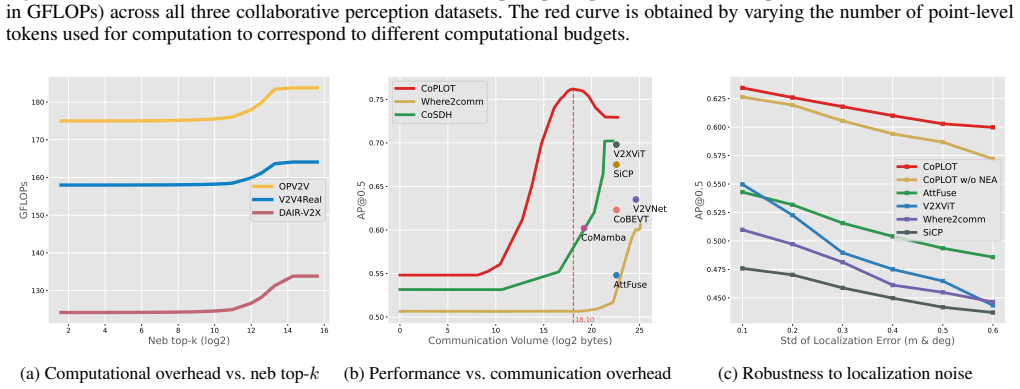
- The relationship between the number of selected tokens and accuracy is a tunable resource curve — computation and communication scale linearly with the selected token count — so a deployed system can adaptively trade perception quality for latency, energy, and bandwidth.
- The noise-sweep experiments show CoPLOT retains accuracy where BEV-based baselines degrade, indicating that explicit learned alignment of token positions is a workable substitute for perfect pose knowledge in real deployments.
Reading between the lines
- A scene-adaptive top-k is the natural next step, and the paper's own analysis points to it: the ~1300-token optimum on OPV2V matches roughly 15 vehicles × ~87 tokens per vehicle, so a module that predicts how many objects a scene holds could beat any fixed threshold; the paper lists the static threshold as a limitation but does not build this.
- Because the importance scores are trained from ground-truth box containment, CoPLOT inherits the closed-world object vocabulary of its training set; an untested extension is to supervise importance with self-supervised foreground cues (free-space, occupancy, temporal persistence) so the compact token stream survives novel object classes.
- The 1D, semantically ordered token stream is shaped by design for sequence backbones such as LLMs; the paper states this compatibility as motivation but does not test it, so a concrete extension is feeding CoPLOT's selected tokens into a language-model-style head for open-vocabulary or language-grounded queries.
- Since the tokens retain dense 3D structure to the final stage, the same encoder and fusion pipeline should transfer to 3D occupancy prediction or semantic segmentation with only a head swap — a testable claim the paper leaves open.
Editorial analysis
A structured set of objections, weighed in public.
Referee Report
Summary. The paper proposes CoPLOT, a collaborative perception framework that replaces 2D BEV intermediate features with point-level tokens. The method introduces a point tokenizer, a semantic-aware token reordering module, a frequency-enhanced state space model, and a neighbor-to-ego alignment module for multi-agent fusion. Experiments on OPV2V, V2V4Real, and DAIR-V2X report state-of-the-art AP@0.5/0.7 for collaborative 3D detection, together with reduced computational and communication overhead. The supplementary material provides component ablations, reordering comparisons, and efficiency analyses.
Significance. If the claims hold, CoPLOT offers a genuine alternative to BEV-based intermediate fusion, preserving 3D structure while achieving strong efficiency. The paper's strengths are its three-dataset evaluation, a broad set of baselines, per-module ablations, and a candid limitations section. However, the central efficiency/accuracy trade-off rests on the top-k token selection mechanism, and this mechanism is not directly validated for object coverage at inference; additionally, the token budget k is justified using post-hoc test-set statistics. These issues are load-bearing but addressable, so the contribution is potentially significant pending verification.
major comments (3)
- [§3.2, Eq. (3); Supp. E.2] The top-k token selection is the linchpin of CoPLOT's efficiency claims, but the paper never measures whether the transmitted tokens actually contain foreground objects at inference. The semantic-importance head is supervised with ground-truth box labels (Eq. 3), so it is a learned predictor; no experiment reports object recall or foreground-token coverage under the fixed k budget. The chosen k=1300 for OPV2V is justified in Supp. E.2 using test-set average statistics (15 vehicles × 86.7 tokens per vehicle), while the same section reports up to 33 vehicles per scene. An average-based k will therefore shed foreground tokens in dense scenes, and the claimed accuracy/efficiency trade-off may be optimistic for those frames. Please add validation-set experiments measuring the fraction of GT objects with at least one selected token, report AP under scene-density buckets, and select/report k ba
- [Supp. E.2] The explanation for the performance peak is post-hoc: the projected-area calculation uses a hand-picked 2/3 visibility factor and fixed vehicle dimensions, with no sensitivity analysis or predictive validation. The authors themselves note the calculation is based on average test statistics and that the optimal k fluctuates. This cannot serve as a principled justification for the fixed threshold. At minimum, reframe the calculation as a heuristic intuition and provide a validation-based sensitivity analysis over the area factor, vehicle size, and density assumptions.
- [§4.2, Table 4, Fig. 4b; Abstract] The headline efficiency reductions ('approximately 80% and 90%') are stated without uniform reference baselines and without error bars. Table 4 shows CoPLOT at 176.2 GFLOPs versus CollaMamba at 198.3 GFLOPs, a reduction of only ~11%, while the 80% figure is relative to the heaviest baselines such as V2VNet. Communication reductions are only presented graphically (Fig. 4b) without exact byte counts, and no variance across runs or seeds is reported. Because computation and communication savings are central claims, please report mean±std over multiple runs, specify the reference baseline for each percentage, and tabulate actual message sizes (tokens + coordinates + pose) for all compared methods.
minor comments (6)
- [§3.2 title] Typos: 'Samentic-aware' should be 'Semantic-aware'.
- [Supp. E.2 / Fig. 5-6] The x-axis labels read 'Num of neb tokens' while the captions say 'point-level tokens'; please unify the terminology.
- [§3.2, Eq. (3)] The loss Ls for semantic importance is defined but not shown in the total training loss. Specify how Ls, Loff, and detection losses are combined and weighted.
- [References] CollaMamba and CoMamba are cited as arXiv preprints; if later peer-reviewed versions exist, cite them for reproducibility.
- [Supp. D.2, Table 6] Grid-interval sensitivity is evaluated only on OPV2V. Reporting the same analysis on at least one real-world dataset (e.g., V2V4Real) would strengthen the choice of 0.4 m, since real-world point density differs considerably from simulated data.
- [Supp. D.4, Table 7] The claim that downsampling rate 4 is the best balance between performance and cost is weakly supported: for V2V4Real AP@0.7, 4× gives 0.447 vs 0.446 for 2×, while 1× gives 0.430. The performance differences are small; please add statistical significance or additional metrics to justify the chosen rate.
Circularity Check
No circularity: CoPLOT's components are learned or architectural choices; the token-count analysis is post-hoc explanation, not a derived prediction.
full rationale
CoPLOT's reported results do not reduce to its inputs by construction. The semantic-importance head is trained with Eq. (3)'s focal loss against GT-box membership labels, but this is a standard supervised training signal; the head must generalize to test tokens, and the top-k selection is an architectural inference-time mechanism rather than a fitted parameter renamed as a prediction. The 1300-token 'peak' analysis in Supp. E.2 is explicitly post-hoc: 'this calculation is based on average statistics from the entire test dataset' and the authors state that individual scenes vary and a dynamic threshold is needed; it therefore explains an observed curve rather than deriving a prediction from the model. The FSSM's C-matrix augmentation is an architectural choice justified by the SSM/linear-attention analogy, not by a self-citation. Self-citations to CollaMamba, CoMamba, and OccMamba appear as related-work baselines and design inspirations (e.g., space-filling curves, state-space models) but are not load-bearing premises; no uniqueness theorem or ansatz is imported. The conclusion/limitations explicitly acknowledge the static top-k threshold and lack of joint optimization, which are robustness/optimization concerns rather than circular steps. Overall, the central accuracy/efficiency claims rest on empirical comparisons and ablations with independent content.
Assumptions & free parameters
free parameters (5)
- grid interval =
0.4 m
- semantic group number =
48
- frequency downsampling rate =
4
- band-split parameters and window size =
alpha=0.125, beta=0.25, window 16x16
- top-k token threshold =
static per dataset, up to 2000
assumptions (5)
- standard math DFT and SSM discretization equations are valid for extracting frequency features and preserving O(N) recurrence
- domain assumption LiDAR point clouds encode sufficient object structure through point-level tokens
- domain assumption Frequency-selective filtering improves foreground/background separation in outdoor LiDAR
- domain assumption The equivalence between SSM output matrix C and attention query matrix Q justifies injecting frequency features into C
- domain assumption Localization noise can be estimated and corrected by a learned per-token offset
Cite this review
Pith. "Pith review of Beyond BEV: Optimizing Point-Level Tokens for Collaborative Perception." pith.science (2026). https://pith.science/paper/BHDIIKDS
@misc{pith2026250819638,
  author       = {Pith},
  title        = {Pith review of: Beyond BEV: Optimizing Point-Level Tokens for Collaborative Perception},
  year         = {2026},
  howpublished = {\url{https://pith.science/paper/BHDIIKDS}},
  note         = {Machine review of arXiv:2508.19638}
}
read the original abstract
Collaborative perception allows agents to enhance their perceptual capabilities by exchanging intermediate features. Existing methods typically organize these intermediate features as 2D bird's-eye-view (BEV) representations, which discard critical fine-grained 3D structural cues essential for accurate object recognition and localization. To this end, we first introduce point-level tokens as intermediate representations for collaborative perception. However, point-cloud data are inherently unordered, massive, and position-sensitive, making it challenging to produce compact and aligned point-level token sequences that preserve detailed structural information. Therefore, we present CoPLOT, a novel Collaborative perception framework that utilizes Point-Level Optimized Tokens. It incorporates a point-native processing pipeline, including token reordering, sequence modeling, and multi-agent spatial alignment. A semantic-aware token reordering module generates adaptive 1D reorderings by leveraging scene-level and token-level semantic information. A frequency-enhanced state space model captures long-range sequence dependencies across both spatial and spectral domains, improving the differentiation between foreground tokens and background clutter. Lastly, a neighbor-to-ego alignment module applies a closed-loop process, combining global agent-level correction with local token-level refinement to mitigate localization noise. Extensive experiments on both simulated and real-world datasets show that CoPLOT outperforms state-of-the-art models, with even lower communication and computation overhead. Code will be available at https://github.com/CheeryLeeyy/CoPLOT.
Figures


Figures from the paper (4 more)


Reference graph
Works this paper leans on
-
[1]
, " * write output.state after.block = add.period write newline
ENTRY address archivePrefix author booktitle chapter edition editor eid eprint howpublished institution isbn journal key month note number organization pages publisher school series title type volume year label extra.label sort.label short.list INTEGERS output.state before.all mid.sentence after.sentence after.block FUNCTION init.state.consts #0 'before.a...
-
[2]
write newline
" write newline "" before.all 'output.state := FUNCTION n.dashify 't := "" t empty not t #1 #1 substring "-" = t #1 #2 substring "--" = not "--" * t #2 global.max substring 't := t #1 #1 substring "-" = "-" * t #2 global.max substring 't := while if t #1 #1 substring * t #2 global.max substring 't := if while FUNCTION word.in bbl.in capitalize " " * FUNCT...
-
[3]
Ackleh, A. S.; and Veprauskas, A. 2021. Frequency-Dependent Evolution in a Predator--Prey System. Natural Resource Modeling, 34(3): e12308
work page 2021
-
[4]
Ali, A.; Zimerman, I.; and Wolf, L. 2024. The Hidden Attention of Mamba Models. arXiv:2403.01590
arXiv 2024
-
[5]
J.; Liu, Y.; Akin Sisbot, E.; Oguchi, K.; and Huang, Z
Bai, Z.; Wu, G.; Barth, M. J.; Liu, Y.; Akin Sisbot, E.; Oguchi, K.; and Huang, Z. 2024. A Survey and Framework of Cooperative Perception : From Heterogeneous Singleton to Hierarchical Cooperation . IEEE Transactions on Intelligent Transportation Systems, 25(11): 15191--15209
work page 2024
-
[6]
Baumbach, J. 2010. Psychophysics of Human Vision: The Key to Improved Camouflage Pattern Design
work page 2010
-
[7]
Chen, L.; Wu, P.; Chitta, K.; Jaeger, B.; Geiger, A.; and Li, H. 2024. End-to-End Autonomous Driving: Challenges and Frontiers. IEEE Trans. Pattern Anal. Mach. Intell., 46(12): 10164--10183
work page 2024
-
[8]
Das, A.; and Geisler, W. 2022. Camouflage Detection: Experiments and a Principled Theory. Journal of Vision, 22(14): 4069
work page 2022
Show all 57 references
-
[9]
Das, A.; and Geisler, W. S. 2023. Predicting Human Camouflage Detection with a Principled Computational Model. Journal of Vision, 23(9): 5530
2023
-
[10]
Dosovitskiy, A.; Ros, G.; Codevilla, F.; Lopez, A.; and Koltun, V. 2017. CARLA : An Open Urban Driving Simulator. In Proceedings of the 1st Annual Conference on Robot Learning , volume 78 of Proceedings of Machine Learning Research , 1--16
2017
-
[11]
Gao, X.; Zhang, X.; Lu, Y.; Huang, Y.; Yang, L.; Xiong, Y.; and Liu, P. 2024. A Survey of Collaborative Perception in Intelligent Vehicles at Intersections. IEEE Transactions on Intelligent Vehicles, 1--20
2024
-
[12]
Gu, Y.; Meng, Y.; Zheng, K.; Sun, X.; Ji, J.; Ruan, W.; Cao, L.; and Ji, R. 2025. An Efficient and Mixed Heterogeneous Model for Image Restoration. arXiv:2504.10967
2025 arXiv
-
[13]
Han, D.; Wang, Z.; Xia, Z.; Han, Y.; Pu, Y.; Ge, C.; Song, J.; Song, S.; Zheng, B.; and Huang, G. 2024 a . Demystify Mamba in Vision: A Linear Attention Perspective. In Advances in Neural Information Processing Systems 38: Annual Conference on Neural Information Processing Sys...
2024
-
[14]
Han, X.; Tang, Y.; Wang, Z.; and Li, X. 2024 b . Mamba3D : Enhancing Local Features for 3D Point Cloud Analysis via State Space Model. In Proceedings of the 32nd ACM International Conference on Multimedia , MM 2024, Melbourne , VIC , Australia , 28 October 2024 - 1 November 20...
2024
-
[15]
Hu, Y.; Fang, S.; Lei, Z.; Zhong, Y.; and Chen, S. 2022. Where2comm: Communication-Efficient Collaborative Perception via Spatial Confidence Maps . Advances in Neural Information Processing Systems, 35: 4874--4886
2022
-
[16]
Jin, X.; Su, H.; Liu, K.; Ma, C.; Wu, W.; Hui, F.; and Yan, J. 2025. UniMamba : Unified Spatial-Channel Representation Learning with Group-Efficient Mamba for LiDAR-based 3D Object Detection. In IEEE / CVF Conference on Computer Vision and Pattern Recognition , CVPR 2025, Nash...
2025
-
[17]
P.; and Ba, J
Kingma, D. P.; and Ba, J. 2015. Adam: A Method for Stochastic Optimization. In 3rd International Conference on Learning Representations , ICLR 2015, San Diego , CA , USA , May 7-9, 2015, Conference Track Proceedings
2015
-
[18]
H.; Vora, S.; Caesar, H.; Zhou, L.; Yang, J.; and Beijbom, O
Lang, A. H.; Vora, S.; Caesar, H.; Zhou, L.; Yang, J.; and Beijbom, O. 2019. PointPillars : Fast Encoders for Object Detection from Point Clouds. In 2019 IEEE / CVF Conference on Computer Vision and Pattern Recognition ( CVPR ) , 12689--12697
2019
-
[19]
Li, H.; Hou, Y.; Xing, X.; Ma, Y.; Sun, X.; and Zhang, Y. 2025 a . OccMamba : Semantic Occupancy Prediction with State Space Models. In IEEE / CVF Conference on Computer Vision and Pattern Recognition , CVPR 2025, Nashville , TN , USA , June 11-15, 2025 , 11949--11959
2025
-
[20]
Li, J.; Liu, X.; Li, B.; Xu, R.; Li, J.; Yu, H.; and Tu, Z. 2024 a . CoMamba : Real-time Cooperative Perception Unlocked with State Space Models . In arXiv .Org
2024
-
[21]
Li, K.; Li, X.; Wang, Y.; He, Y.; Wang, Y.; Wang, L.; and Qiao, Y. 2025 b . VideoMamba : State Space Model for Efficient Video Understanding. In European Conference on Computer Vision , ECCV 2024 , 237--255
2025
-
[22]
Li, Y.; Ren, S.; Wu, P.; Chen, S.; Feng, C.; and Zhang, W. 2021. Learning Distilled Collaboration Graph for Multi-Agent Perception . In Advances in Neural Information Processing Systems , volume 34, 29541--29552
2021
-
[23]
Li, Y.; Yuan, Q.; Luo, G.; Fu, X.; Zhu, X.; Yang, Y.; Pan, R.; and Li, J. 2024 b . CollaMamba : Efficient Collaborative Perception with Cross-Agent Spatial-Temporal State Space Model . arXiv:2409.07714
2024 arXiv
-
[24]
Liang, D.; Zhou, X.; Xu, W.; Zhu, X.; Zou, Z.; Ye, X.; Tan, X.; and Bai, X. 2024. PointMamba : A Simple State Space Model for Point Cloud Analysis. In Advances in Neural Information Processing Systems 38: Annual Conference on Neural Information Processing Systems 2024, Neurips...
2024
-
[25]
Liu, S.; Gao, C.; Chen, Y.; Peng, X.; Kong, X.; Wang, K.; Xu, R.; Jiang, W.; Xiang, H.; Ma, J.; and Wang, M. 2023. Towards Vehicle-to-Everything Autonomous Driving: A Survey on Collaborative Perception. arXiv:2308.16714
2023 arXiv
-
[26]
Liu, Y.; Huang, Q.; Li, R.; Chen, X.; Zhao, Z.; Zhao, S.; Zhu, Y.; and Zhang, H. 2024 a . Select2Col : Leveraging Spatial-Temporal Importance of Semantic Information for Efficient Collaborative Perception. IEEE Trans. Veh. Technol., 73(9): 12556--12569
2024
-
[27]
Liu, Y.; Tian, Y.; Zhao, Y.; Yu, H.; Xie, L.; Wang, Y.; Ye, Q.; Jiao, J.; and Liu, Y. 2024 b . VMamba : Visual State Space Model. In Advances in Neural Information Processing Systems 38: Annual Conference on Neural Information Processing Systems 2024, Neurips 2024, Vancouver ,...
2024
-
[28]
Liu, Y.-C.; Tian, J.; Glaser, N.; and Kira, Z. 2020 a . When2com: Multi-Agent Perception via Communication Graph Grouping . In 2020 IEEE / CVF Conference on Computer Vision and Pattern Recognition ( CVPR ) , 4105--4114
2020
-
[29]
Liu, Y.-C.; Tian, J.; Ma, C.-Y.; Glaser, N.; Kuo, C.-W.; and Kira, Z. 2020 b . Who2com: Collaborative Perception via Learnable Handshake Communication. 2020 IEEE International Conference on Robotics and Automation (ICRA), 6876--6883
2020
-
[30]
Mao, J.; Shi, S.; Wang, X.; and Li, H. 2023. 3D Object Detection for Autonomous Driving: A Comprehensive Survey. Int. J. Comput. Vis., 131(8): 1909--1963
2023
-
[31]
Park, J.; Kim, H.-S.; Ko, K.; Kim, M.; and Kim, C. 2024. VideoMamba : Spatio-Temporal Selective State Space Model. In European Conference on Computer Vision , ECCV 2024 , volume 15083 of Lecture Notes in Computer Science , 1--18
2024
-
[32]
T.; Phan, V
Phung, H.; Dao, Q.; Dao, T. T.; Phan, V. H.; Metaxas, D. N.; and Tran, A. T. 2024. DiMSUM : Diffusion Mamba - a Scalable and Unified Spatial-Frequency Method for Image Generation. In Advances in Neural Information Processing Systems 38: Annual Conference on Neural Information ...
2024
-
[33]
R.; Su, H.; Mo, K.; and Guibas, L
Qi, C. R.; Su, H.; Mo, K.; and Guibas, L. J. 2017. PointNet : Deep Learning on Point Sets for 3D Classification and Segmentation. In 2017 IEEE Conference on Computer Vision and Pattern Recognition , CVPR 2017, Honolulu , HI , USA , July 21-26, 2017 , 77--85
2017
-
[34]
Qu, D.; Chen, Q.; Bai, T.; Lu, H.; Fan, H.; Zhang, H.; Fu, S.; and Yang, Q. 2024. SiCP : Simultaneous Individual and Cooperative Perception for 3D Object Detection in Connected and Automated Vehicles. In 2024 IEEE / RSJ International Conference on Intelligent Robots and System...
2024
-
[35]
Shi, Y.; Xia, B.; Jin, X.; Wang, X.; Zhao, T.; Xia, X.; Xiao, X.; and Yang, W. 2025. VmambaIR : Visual State Space Model for Image Restoration. IEEE Trans. Circuits Syst. Video Technol., 35(6): 5560--5574
2025
-
[36]
Sun, Q.; Wang, X.; Su, R.; and Deng, Y. 2024. Frequency-Aware Natural Camouflage Object Segmentation. In Sixth Conference on Frontiers in Optical Imaging and Technology : Imaging Detection and Target Recognition , volume 13156, 263--274
2024
-
[37]
Tan, C.; Zhao, Y.; Wei, S.; Gu, G.; Liu, P.; and Wei, Y. 2024. Frequency-Aware Deepfake Detection: Improving Generalizability through Frequency Space Domain Learning. In Thirty-Eighth AAAI Conference on Artificial Intelligence , AAAI 2024, Thirty-sixth Conference on Innovative...
2024
-
[38]
Wang, T.-H.; Manivasagam, S.; Liang, M.; Yang, B.; Zeng, W.; and Urtasun, R. 2020. V2VNet : Vehicle-to-Vehicle Communication for Joint Perception and Prediction . In European Conference on Computer Vision , ECCV 2020 , volume 12347, 605--621
2020
-
[39]
Wang, X.; Wang, S.; Ding, Y.; Li, Y.; Wu, W.; Rong, Y.; Kong, W.; Huang, J.; Li, S.; Yang, H.; Wang, Z.; Jiang, B.; Li, C.; Wang, Y.; Tian, Y.; and Tang, J. 2024. State Space Model for New-Generation Network Alternative to Transformers: A Survey. CoRR, abs/2404.9516
2024
-
[40]
Wu, X.; Jiang, L.; Wang, P.-S.; Liu, Z.; Liu, X.; Qiao, Y.; Ouyang, W.; He, T.; and Zhao, H. 2024. Point Transformer V3 : Simpler, Faster, Stronger. In IEEE / CVF Conference on Computer Vision and Pattern Recognition , CVPR 2024, Seattle , WA , USA , June 16-22, 2024 , 4840--4851
2024
-
[41]
Xu, J.; Zhang, Y.; Cai, Z.; and Huang, D. 2025. CoSDH : Communication-Efficient Collaborative Perception via Supply-Demand Awareness and Intermediate-Late Hybridization. In IEEE / CVF Conference on Computer Vision and Pattern Recognition , CVPR 2025, Nashville , TN , USA , Jun...
2025
-
[42]
Xu, R.; Guo, Y.; Han, X.; Xia, X.; Xiang, H.; and Ma, J. 2021. OpenCDA : An Open Cooperative Driving Automation Framework Integrated with Co-Simulation . In 2021 IEEE International Intelligent Transportation Systems Conference ( ITSC ) , 1155--1162
2021
-
[43]
Xu, R.; Tu, Z.; Xiang, H.; Shao, W.; Zhou, B.; and Ma, J. 2022 a . CoBEVT : Cooperative Bird's Eye View Semantic Segmentation with Sparse Transformers. In Conference on Robot Learning , Corl 2022, 14-18 December 2022, Auckland , New Zealand , volume 205 of Proceedings of Machi...
2022
-
[44]
Xu, R.; Xia, X.; Li, J.; Li, H.; Zhang, S.; Tu, Z.; Meng, Z.; Xiang, H.; Dong, X.; Song, R.; Yu, H.; Zhou, B.; and Ma, J. 2023. V2V4Real : A Real-World Large-Scale Dataset for Vehicle-to-Vehicle Cooperative Perception . In 2023 IEEE / CVF Conference on Computer Vision and Patt...
2023
-
[45]
Xu, R.; Xiang, H.; Tu, Z.; Xia, X.; Yang, M.-H.; and Ma, J. 2022 b . V2X-ViT : Vehicle-to-Everything Cooperative Perception with Vision Transformer. In European Conference on Computer Vision , ECCV 2022 , volume 13699 of Lecture Notes in Computer Science , 107--124
2022
-
[46]
Xu, R.; Xiang, H.; Xia, X.; Han, X.; Li, J.; and Ma, J. 2022 c . OPV2V : An Open Benchmark Dataset and Fusion Pipeline for Perception with Vehicle-to-Vehicle Communication . In 2022 International Conference on Robotics and Automation ( ICRA ) , 2583--2589
2022
-
[47]
Xu, R.; Yang, S.; Wang, Y.; Cai, Y.; Du, B.; and Chen, H. 2024. Visual Mamba: A Survey and New Outlooks. arXiv:2404.18861
2024 arXiv
-
[48]
Yang, D.; Yang, K.; Wang, Y.; Liu, J.; Xu, Z.; Yin, R.; Zhai, P.; and Zhang, L. 2023. How2comm: Communication-Efficient and Collaboration-Pragmatic Multi-Agent Perception . Advances in Neural Information Processing Systems, 36: 25151--25164
2023
-
[49]
Yao, Y.; Liu, Z.; Cui, Z.; Peng, Y.; and Zhou, J. 2025. Selective Visual Prompting in Vision Mamba. In AAAI-25 , Sponsored by the Association for the Advancement of Artificial Intelligence , February 25 - March 4, 2025, Philadelphia , PA , USA , 22083--22091
2025
-
[50]
Yazgan, M.; Graf, T.; Liu, M.; Fleck, T.; and Z \"o llner, J. M. 2024. A Survey on Intermediate Fusion Methods for Collaborative Perception Categorized by Real World Challenges. In IEEE Intelligent Vehicles , June 2-5, 2024 , 2226--2233
2024
-
[51]
Yu, H.; Luo, Y.; Shu, M.; Huo, Y.; Yang, Z.; Shi, Y.; Guo, Z.; Li, H.; Hu, X.; Yuan, J.; and Nie, Z. 2022. DAIR-V2X : A Large-Scale Dataset for Vehicle-Infrastructure Cooperative 3D Object Detection . In 2022 IEEE / CVF Conference on Computer Vision and Pattern Recognition ( C...
2022
-
[52]
Zhang, G.; Fan, L.; He, C.; Lei, Z.; Zhang, Z.; and Zhang, L. 2024. Voxel Mamba: Group-Free State Space Models for Point Cloud Based 3D Object Detection. In Advances in Neural Information Processing Systems 38: Annual Conference on Neural Information Processing Systems 2024, N...
2024
-
[53]
Zhong, Y.; Li, B.; Tang, L.; Kuang, S.; Wu, S.; and Ding, S. 2022. Detecting Camouflaged Object in Frequency Domain. In 2022 IEEE / CVF Conference on Computer Vision and Pattern Recognition ( CVPR ) , 4494--4503
2022
-
[54]
Zhou, Y.; and Tuzel, O. 2018. VoxelNet : End-to-End Learning for Point Cloud Based 3D Object Detection. In 2018 IEEE / CVF Conference on Computer Vision and Pattern Recognition , 4490--4499
2018
-
[55]
Zhu, L.; Liao, B.; Zhang, Q.; Wang, X.; Liu, W.; and Wang, X. 2024. Vision Mamba: Efficient Visual Representation Learning with Bidirectional State Space Model. In Forty-First International Conference on Machine Learning , ICML 2024, Vienna , Austria , July 21-27, 2024
2024
-
[56]
Zimerman, I.; Ali, A.; and Wolf, L. 2024. Explaining Modern Gated-Linear RNNs via a Unified Implicit Attention Formulation. arXiv:2405.16504
2024 arXiv
-
[57]
Zou, Z.; Yu, H.; Huang, J.; and Zhao, F. 2024. FreqMamba : Viewing Mamba from a Frequency Perspective for Image Deraining. In Proceedings of the 32nd ACM International Conference on Multimedia , MM '24, 1905--1914
2024
Reviewed August 5, 2026 · model on record in the stance chip above.
Discussion (0). Sign in to comment.