REVIEW 4 major objections 6 minor 54 references
SAT, a two-process framework with supervisor feature regularization and online animation augmentation, reconstructs textured 3D humans from a single image and reports state-of-the-art results on CustomHuman and THuman3.0.
Reviewed by Pith at T0; open to challenge. T0 means a machine referee read the full paper against a public rubric. the ladder, T0–T4 →
A two-stage Gaussian-splatting framework with supervisor feature regularization and online animation augmentation improves monocular textured 3D human reconstruction on CustomHuman and THuman3.0.
T0 review reviewed 2026-08-05 challenge →
load-bearing objection A plausible incremental improvement with two genuinely new training-time ideas (SFR, OAA), but the headline SOTA claim is unverifiable from the preprint because the evaluation protocol is underspecified and baseline numbers come from the authors' own prior work. the 4 major comments →
SAT: Supervisor Regularization and Animation Augmentation for Two-process Monocular Texture 3D Human Reconstruction
The pith
A machine-rendered reading of the paper's core claim, the machinery that carries it, and where it could break.
The reading
Core claim
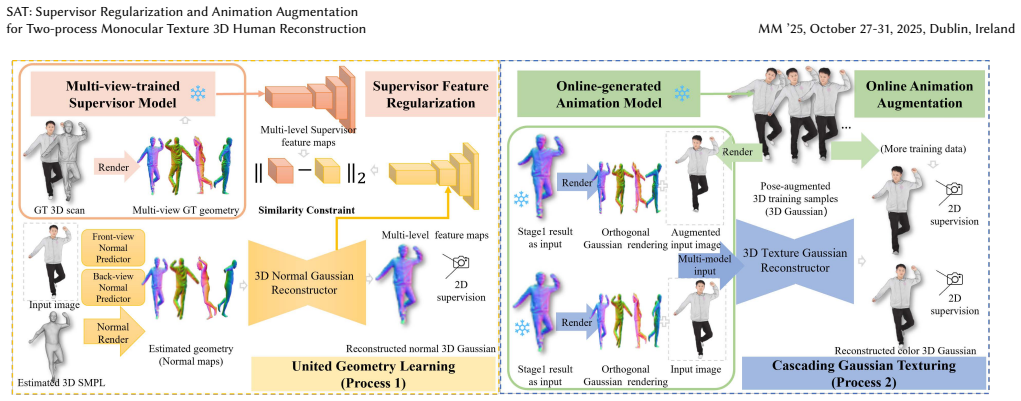
SAT's central claim is that monocular textured human reconstruction should be split into two cascaded Gaussian-splatting processes—United Geometry Learning (UGL) for shape, then Cascading Gaussian Texturing (CGT) for appearance—rather than treating geometry and texture as one joint regression or as fully separate stages. UGL feeds a unified UNet with four-view normal maps plus a rendered SMPL-X body mesh, and is regularized by a Supervisor Feature Regularization (SFR) module: a frozen twin network trained on ground-truth multi-view normals whose mid and up-block features pull the monocular network's hidden features toward what a near-perfect reconstruction would encode. CGT feeds the first s
What carries the argument
The central object is the cascaded Gaussian-splatting pipeline built on a shared UNet architecture: UGL outputs a 3D normal Gaussian, CGT outputs a 3D texture Gaussian, and both are supervised by differentiable rendering losses (MSE plus LPIPS) against ground-truth scans. Two supporting mechanisms carry the argument: SFR, a frozen multi-view supervisor UNet whose middle and up-block features are used as regression targets for the monocular network, and OAA, a trained feedforward animation UNet that transforms existing scans to random SMPL pose templates online. The 'two-process' design matters because the second stage consumes the actual output distribution of the first, closing the train/in
Load-bearing premise
The load-bearing premise is that the baseline comparisons are apples-to-apples: MultiGO's published numbers were imported and PSHuman and Human-3Diffusion were reproduced without a stated protocol, with single runs and no error bars; if those numbers came from different training data or settings, the reported gains may be evaluation artifacts rather than real improvements.
What would settle it
Re-run both benchmarks with all methods trained from the same scan set, using identical estimated SMPL-X priors, rendering code, and evaluation metric implementation, over multiple seeds; if the f-score gap between SAT and MultiGO falls well below the reported 2.011 and 1.514, or reverses, the claimed SOTA margin is not robust. A more targeted check: compare two training runs that differ only in augmentation source, LBS versus the animation model; if animation augmentation no longer beats LBS, the module's reported advantage fails.
If this is right
- With SFR, hidden-layer features of a monocular network can be pulled toward a multi-view ground-truth teacher, improving geometric detail at inference time.
- Cascaded training, where the second stage consumes the first stage's predicted Gaussians, reduces distribution mismatch and should transfer to other multi-stage reconstruction pipelines.
- Online animation augmentation is a workaround for scarce 3D human scan data: generating new poses at training time improves f-score over offline or LBS-based augmentation.
- The unified fusion of four-view normal maps and an SMPL prior yields more consistent geometry, reducing side-face distortion and other view inconsistencies.
Where Pith is reading between the lines
- If SFR generalizes beyond Gaussian UNets, the same feature-level supervision idea could be tested on implicit-field or point-based human reconstruction backbones.
- The OAA result suggests a broader principle: distortion-free augmentation beats augmentation volume alone; a controlled study varying sample quality versus quantity would test this directly.
- The paper's reported margins are against imported baseline numbers, so an independent matched-protocol re-run on both benchmarks would reveal how much of the f-score gap is architectural versus evaluation setup.
- A natural extension is to apply online animation augmentation at test time, allowing the reconstruction model to refine its output over multiple re-posed views instead of using a single frontal input.
Editorial analysis
A structured set of objections, weighed in public.
Referee Report
Summary. The paper proposes SAT, a two-process framework for monocular textured 3D human reconstruction from a single front-view RGB image. The first process (UGL) fuses front/back normal maps and SMPL-X-derived side normal maps through a UNet with cross-view attention to predict a 3D normal Gaussian. This geometry is regularized by SFR, which trains a same-architecture supervisor on multi-view ground-truth normal maps and distills its intermediate features into the monocular network. The second process (CGT) cascades the inferred geometry Gaussian with the input image to predict a texture Gaussian. Finally, OAA trains a feed-forward animation network to generate pose-augmented training samples online. The method is evaluated on CustomHuman and THuman3.0, with ablations on each component. The paper claims SOTA performance, including f-score improvements of 2.011 and 1.514 over MultiGO, the strongest baseline.
Significance. If the claimed results hold, the paper makes a useful engineering contribution: the two-process UGL+CGT design is a sensible way to combine geometric priors and reduce train/test distribution mismatch, SFR is a clean feature-distillation mechanism that avoids direct GT input at inference, and OAA is an original online augmentation strategy. The internal ablations (Tables 3–5) are consistent with incremental gains from each component, and evaluating on two public benchmarks is appropriate. The main weakness is verification: the 3D evaluation protocol is underspecified, most baseline numbers are imported from the authors' own earlier work, and no error bars or code are provided. These omissions make the headline SOTA claim unverifiable from the preprint, although the method itself appears defensible and the issues are addressable.
major comments (4)
- [§4.1, Tables 1–2] The 3D metrics (CD, NC, f-score) are computed on point clouds or meshes, but the method outputs 3D Gaussians. The paper never states how Gaussians are converted to the geometry used for metric computation (e.g., Gaussian centers, unprojected rendered depth, or mesh extraction), nor the f-score distance threshold. Since the headline margin over MultiGO is only 2.011/1.514 f-score points, and the conversion plus threshold can easily change such margins, the quantitative comparison is not verifiable as written. Please specify the exact extraction and threshold, and ideally release the evaluation script.
- [§4.2, Tables 1–2] The majority of baseline numbers are taken from MultiGO [44], with only PSHuman and Human-3Diffusion reproduced. No reproduction protocol is given: no details on the estimated SMPL-X fitting, data split, rendering views, metric extraction, or alignment. Because MultiGO is the same group's prior work, these imported numbers are not independent evidence. To support the SOTA claim, either rerun all baselines under a single pipeline with identical preprocessing and metrics, or provide the exact artifacts and protocol so the comparison is apples-to-apples.
- [Tables 1–5] All experiments are reported as single runs without error bars or variance. The SOTA margins (2.011/1.514 f-score) and several ablation increments (e.g., Table 3: 42.204 vs. 42.822; Table 4: 1.609/1.699 vs. 1.607/1.695) are small enough that random seed or optimization variability could affect the conclusions. Reporting at least three seeds, or otherwise characterizing variance, is necessary to assess whether the differences are meaningful.
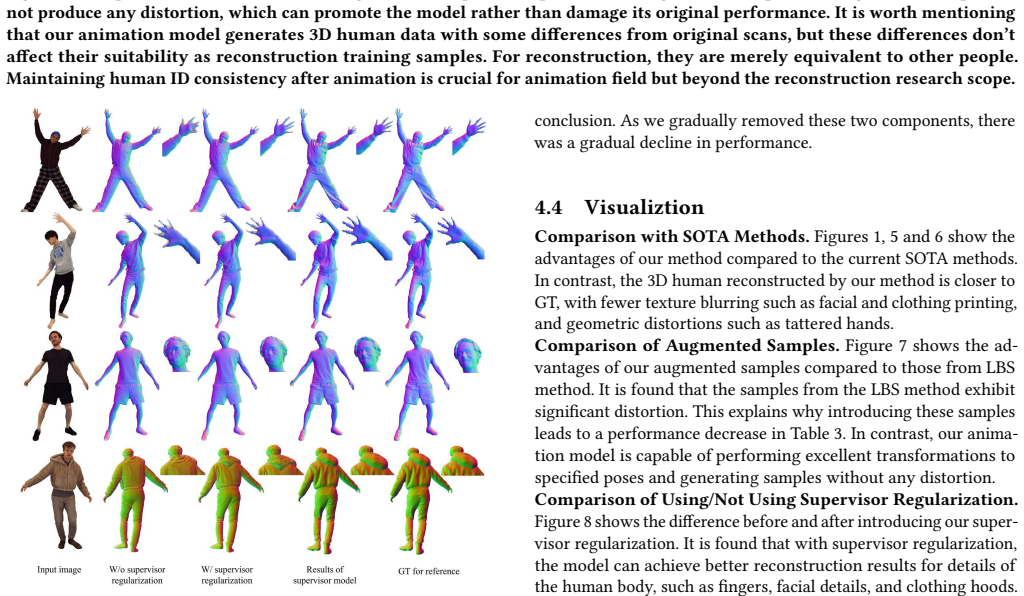
- [§3.6, Table 3] For OAA, the augmented training samples are generated by a frozen animation model, and rendered images from the generated Gaussians are used as supervision. The paper acknowledges in Figure 7's caption that identity consistency is not preserved. This raises the risk that the f-score gain attributed to animation augmentation (Table 3, +3.0 on CustomHuman) reflects training on self-generated pseudo-GT rather than on geometrically faithful samples. Please provide quantitative validation of the augmented samples—for example, pose accuracy or distance to real scans—or show that the gain persists when using ground-truth scans in the same target poses.
minor comments (6)
- [§3.1] "Linear Blend Spinning" should be "Linear Blend Skinning."
- [§3.4, Eq. (2)] Equation (2) uses subscript i in the LPIPS term but j elsewhere; the index is inconsistent.
- [§4.4] Section heading "Visualiztion" is misspelled; should be "Visualization."
- [References] References [7] and [8] are duplicates of the same paper (Learning locally editable virtual humans).
- [§4.2] Capitalization of "multiGO" vs. "MultiGO" is inconsistent in the text and table captions.
- [Figure 7] The statement that ID consistency is "beyond the reconstruction research scope" is a limitation that should be discussed in the main text or experiments, not only in the figure caption.
Circularity Check
No significant circularity; SFR/OAA are standard training mechanisms, and the MultiGO self-citation affects evaluation independence, not derivation.
full rationale
The paper contains no derivation chain that reduces to its own inputs. UGL fuses pretrained priors into a Gaussian UNet and supervises by GT normals; SFR is a teacher–student feature-matching loss (Eq. 3) in which a GT-conditioned supervisor guides the monocular network only during training, not at inference. CGT simply cascades the first stage's output into the second stage, and OAA trains an external animation model on XHuma to synthesize pose-augmented samples. None of these steps defines a prediction in terms of the target, fits a parameter and then re-predicts it, or imports a uniqueness/ansatz from the authors' prior work. The only self-citation is the import of MultiGO's baseline numbers in Tables 1–2. Since MultiGO is the authors' own prior work and its numbers are not reproduced in the same protocol, the headline SOTA margin is less independently verified; however, this is an evaluation-comparison concern, not a circularity of the method's derivation. The missing f-score threshold and Gaussian-to-surface extraction protocol are correctness risks, not circularity. Therefore the circularity score is low.
Axiom & Free-Parameter Ledger
free parameters (2)
- Regularized feature blocks =
mid, up1-up5
- Online augmentation schedule =
not reported
axioms (5)
- domain assumption Pretrained geometry priors (SMPL-X estimator and front/back normal predictors) are accurate enough on the evaluation benchmarks.
- ad hoc to paper A supervisor trained on multi-view GT normals yields intermediate features that are valid training targets for a monocular student despite the input mismatch.
- domain assumption The Xhuman-trained animation network generalizes to Thuman2.0 scans and produces augmentation samples whose quality is sufficient for reconstruction training.
- domain assumption Benchmark metrics and taken-from-paper baseline numbers are comparable, and single-run results are stable.
- standard math 3D Gaussian splatting and differentiable rendering provide gradients adequate for learning geometry and texture from multi-view normal and RGB losses.
Cite this review
Pith. "Pith review of SAT: Supervisor Regularization and Animation Augmentation for Two-process Monocular Texture 3D Human Reconstruction." pith.science (2026). https://pith.science/paper/ZJUL3C7F
@misc{pith2026250819688,
  author       = {Pith},
  title        = {Pith review of: SAT: Supervisor Regularization and Animation Augmentation for Two-process Monocular Texture 3D Human Reconstruction},
  year         = {2026},
  howpublished = {\url{https://pith.science/paper/ZJUL3C7F}},
  note         = {Machine review of arXiv:2508.19688}
}
read the original abstract
Monocular texture 3D human reconstruction aims to create a complete 3D digital avatar from just a single front-view human RGB image. However, the geometric ambiguity inherent in a single 2D image and the scarcity of 3D human training data are the main obstacles limiting progress in this field. To address these issues, current methods employ prior geometric estimation networks to derive various human geometric forms, such as the SMPL model and normal maps. However, they struggle to integrate these modalities effectively, leading to view inconsistencies, such as facial distortions. To this end, we propose a two-process 3D human reconstruction framework, SAT, which seamlessly learns various prior geometries in a unified manner and reconstructs high-quality textured 3D avatars as the final output. To further facilitate geometry learning, we introduce a Supervisor Feature Regularization module. By employing a multi-view network with the same structure to provide intermediate features as training supervision, these varied geometric priors can be better fused. To tackle data scarcity and further improve reconstruction quality, we also propose an Online Animation Augmentation module. By building a one-feed-forward animation network, we augment a massive number of samples from the original 3D human data online for model training. Extensive experiments on two benchmarks show the superiority of our approach compared to state-of-the-art methods.
Figures



Reference graph
Works this paper leans on
-
[1]
Dragomir Anguelov, Praveen Srinivasan, Daphne Koller, Sebastian Thrun, Jim Rodgers, and James Davis. 2005. SCAPE: shape completion and animation of people. In ACM SIGGRAPH 2005 Papers (SIGGRAPH ’05) . 408–416
work page 2005
-
[2]
Angel X. Chang, Thomas Funkhouser, Leonidas Guibas, Pat Hanrahan, Qixing Huang, Zimo Li, Silvio Savarese, Manolis Savva, Shuran Song, Hao Su, Jianxiong Xiao, Li Yi, and Fisher Yu. 2015. ShapeNet: An Information-Rich 3D Model Repository. arXiv:1512.03012 [cs.GR] https://arxiv.org/abs/1512.03012
Pith/arXiv arXiv 2015
-
[3]
Matt Deitke, Ruoshi Liu, Matthew Wallingford, Huong Ngo, Oscar Michel, Aditya Kusupati, Alan Fan, Christian Laforte, Vikram Voleti, Samir Yitzhak Gadre, Eli VanderBilt, Aniruddha Kembhavi, Carl Vondrick, Georgia Gkioxari, Kiana Ehsani, Ludwig Schmidt, and Ali Farhadi. 2023. Objaverse-XL: A Universe of 10M+ 3D Objects. arXiv preprint arXiv:2307.05663 (2023)
Pith/arXiv arXiv 2023
-
[4]
Matt Deitke, Dustin Schwenk, Jordi Salvador, Luca Weihs, Oscar Michel, Eli VanderBilt, Ludwig Schmidt, Kiana Ehsani, Aniruddha Kembhavi, and Ali Farhadi
-
[5]
Yao Feng, Vasileios Choutas, Timo Bolkart, Dimitrios Tzionas, and Michael J. Black. 2021. Collaborative Regression of Expressive Bodies using Moderation. arXiv:2105.05301 [cs.CV] https://arxiv.org/abs/2105.05301
work page internal anchor Pith review Pith/arXiv arXiv 2021
-
[6]
Hsuan-I Ho, Jie Song, and Otmar Hilliges. 2024. SiTH: Single-view Textured Human Reconstruction with Image-Conditioned Diffusion. In Proceedings of the IEEE Conference on Computer Vision and Pattern Recognition (CVPR)
work page 2024
-
[8]
Hsuan-I Ho, Lixin Xue, Jie Song, and Otmar Hilliges. 2023. Learning locally editable virtual humans. In Proceedings of the IEEE/CVF Conference on Computer Vision and Pattern Recognition . 21024–21035
work page 2023
-
[9]
Shoukang Hu, Tao Hu, and Ziwei Liu. 2024. Gauhuman: Articulated gaussian splatting from monocular human videos. In Proceedings of the IEEE/CVF Confer- ence on Computer Vision and Pattern Recognition . 20418–20431
work page 2024
-
[10]
Yuheng Jiang, Zhehao Shen, Penghao Wang, Zhuo Su, Yu Hong, Yingliang Zhang, Jingyi Yu, and Lan Xu. 2024. HiFi4G: High-Fidelity Human Performance Render- ing via Compact Gaussian Splatting. In 2024 IEEE/CVF Conference on Computer Vision and Pattern Recognition (CVPR) . 19734–19745. doi:10.1109/CVPR52733. 2024.01866
-
[11]
Akash Karthikeyan, Robert Ren, Yash Kant, and Igor Gilitschenski. 2024. Avatarone: Monocular 3d human animation. In Proceedings of the IEEE/CVF Winter Conference on Applications of Computer Vision . 3647–3657
work page 2024
-
[12]
Bernhard Kerbl, Georgios Kopanas, Thomas Leimkuehler, and George Drettakis
-
[13]
Muhammed Kocabas, Jen-Hao Rick Chang, James Gabriel, Oncel Tuzel, and Anurag Ranjan. 2024. HUGS: Human Gaussian Splatting. In 2024 IEEE/CVF Conference on Computer Vision and Pattern Recognition (CVPR) . https://arxiv.org/ abs/2311.17910
Pith/arXiv arXiv 2024
-
[14]
3D Gaussian Splatting for Real-Time Radiance Field Rendering. ACM Trans. Graph. 42, 4, Article 139 (jul 2023), 14 pages. doi:10.1145/3592433
doi:10.1145/3592433 2023
-
[15]
Peng Li, Wangguandong Zheng, Yuan Liu, Tao Yu, Yangguang Li, Xingqun Qi, Mengfei Li, Xiaowei Chi, Siyu Xia, Wei Xue, et al. 2024. PSHuman: Photorealistic Single-view Human Reconstruction using Cross-Scale Diffusion. arXiv preprint arXiv:2409.10141 (2024)
Pith/arXiv arXiv 2024
-
[16]
Samuli Laine, Janne Hellsten, Tero Karras, Yeongho Seol, Jaakko Lehtinen, and Timo Aila. 2020. Modular Primitives for High-Performance Differentiable Ren- dering. arXiv:2011.03277 [cs.GR] https://arxiv.org/abs/2011.03277
Pith/arXiv arXiv 2020
-
[17]
Matthew Loper, Naureen Mahmood, Javier Romero, Gerard Pons-Moll, and Michael J Black. 2023. SMPL: A skinned multi-person linear model. In Seminal Graphics Papers: Pushing the Boundaries, Volume 2 . 851–866
work page 2023
-
[18]
Leyuan Liu, Yuhan Li, Yunqi Gao, Changxin Gao, Yuanyuan Liu, and Jingying Chen. 2024. VS: Reconstructing Clothed 3D Human from Single Image via Vertex Shift. In IEEE/CVF Conference on Computer Vision and Pattern Recognition (CVPR) . 10498–10507
work page 2024
-
[19]
Gyeongsik Moon, Takaaki Shiratori, and Shunsuke Saito. 2024. Expressive whole- body 3D gaussian avatar. In European Conference on Computer Vision . Springer, 19–35
work page 2024
-
[20]
Ben Mildenhall, Pratul P Srinivasan, Matthew Tancik, Jonathan T Barron, Ravi Ramamoorthi, and Ren Ng. 2021. Nerf: Representing scenes as neural radiance fields for view synthesis. Commun. ACM 65, 1 (2021), 99–106
2021
-
[21]
Jeong Joon Park, Peter Florence, Julian Straub, Richard Newcombe, and Steven Lovegrove. 2019. DeepSDF: Learning Continuous Signed Distance Functions for Shape Representation. In The IEEE Conference on Computer Vision and Pattern Recognition (CVPR)
work page 2019
-
[22]
Haokai Pang, Heming Zhu, Adam Kortylewski, Christian Theobalt, and Marc Habermann. 2024. ASH: Animatable Gaussian Splats for Efficient and Photoreal Human Rendering. In Proceedings of the IEEE/CVF Conference on Computer Vision and Pattern Recognition (CVPR) . 1165–1175
work page 2024
-
[23]
Georgios Pavlakos, Vasileios Choutas, Nima Ghorbani, Timo Bolkart, Ahmed AA Osman, Dimitrios Tzionas, and Michael J Black. 2019. Expressive body capture: 3d hands, face, and body from a single image. In Proceedings of the IEEE/CVF conference on computer vision and pattern recognition . 10975–10985
work page 2019
-
[24]
Pramish Paudel, Anubhav Khanal, Danda Pani Paudel, Jyoti Tandukar, and Ajad Chhatkuli. 2024. ihuman: Instant animatable digital humans from monocular videos. In European Conference on Computer Vision . Springer, 304–323
work page 2024
-
[25]
Zhiyin Qian, Shaofei Wang, Marko Mihajlovic, Andreas Geiger, and Siyu Tang
-
[27]
Shunsuke Saito, Zeng Huang, Ryota Natsume, Shigeo Morishima, Angjoo Kanazawa, and Hao Li. 2019. PIFu: Pixel-Aligned Implicit Function for High- Resolution Clothed Human Digitization. In The IEEE International Conference on Computer Vision (ICCV)
work page 2019
-
[28]
Kaiyue Shen, Chen Guo, Manuel Kaufmann, Juan Jose Zarate, Julien Valentin, Jie Song, and Otmar Hilliges. 2023. X-avatar: Expressive human avatars. In Proceedings of the IEEE/CVF Conference on Computer Vision and Pattern Recognition. 16911–16921
work page 2023
-
[29]
In Proceedings of the IEEE/CVF Conference on Computer Vision and Pattern Recognition (CVPR)
3DGS-Avatar: Animatable Avatars via Deformable 3D Gaussian Splatting. In Proceedings of the IEEE/CVF Conference on Computer Vision and Pattern Recognition (CVPR). 5020–5030
-
[30]
Javier Romero, Dimitrios Tzionas, and Michael J Black. 2022. Embodied hands: Modeling and capturing hands and bodies together. arXiv preprint arXiv:2201.02610 (2022)
Pith/arXiv arXiv 2022
-
[31]
Jiaxiang Tang, Zhaoxi Chen, Xiaokang Chen, Tengfei Wang, Gang Zeng, and Ziwei Liu. 2024. LGM: Large Multi-View Gaussian Model for High-Resolution 3D Content Creation. arXiv preprint arXiv:2402.05054 (2024)
Pith/arXiv arXiv 2024
-
[32]
Yingzhi Tang, Qijian Zhang, Junhui Hou, and Yebin Liu. 2025. Human as Points: Explicit Point-based 3D Human Reconstruction from Single-view RGB Images. arXiv:2311.02892 [cs.CV] https://arxiv.org/abs/2311.02892
work page internal anchor Pith review Pith/arXiv arXiv 2025
- [33]
-
[34]
Stanislaw Szymanowicz, Christian Rupprecht, and Andrea Vedaldi. 2023. Splatter image: Ultra-fast single-view 3d reconstruction. arXiv preprint arXiv:2312.13150 (2023)
Pith/arXiv arXiv 2023
-
[35]
GoMAvatar: Efficient Animatable Human Modeling from Monocular Video Using Gaussians-on-Mesh
Jing Wen, Xiaoming Zhao, Zhongzheng Ren, Alexander G. Schwing, and Shenlong Wang. 2024. GoMAvatar: Efficient Animatable Human Modeling from Monocular Video Using Gaussians-on-Mesh. arXiv:2404.07991 [cs.CV] https://arxiv.org/ abs/2404.07991
work page internal anchor Pith review Pith/arXiv arXiv 2024
-
[36]
Yuliang Xiu, Jinlong Yang, Xu Cao, Dimitrios Tzionas, and Michael J. Black. 2023. ECON: Explicit Clothed humans Optimized via Normal integration. InProceedings of the IEEE/CVF Conference on Computer Vision and Pattern Recognition (CVPR)
work page 2023
-
[37]
Maxim Tatarchenko, Stephan R Richter, René Ranftl, Zhuwen Li, Vladlen Koltun, and Thomas Brox. 2019. What do single-view 3d reconstruction networks learn?. In Proceedings of the IEEE/CVF conference on computer vision and pattern recogni- tion. 3405–3414
work page 2019
-
[38]
Jing Wen, Alexander G Schwing, and Shenlong Wang. 2025. LIFe-GoM: General- izable Human Rendering with Learned Iterative Feedback Over Multi-Resolution Gaussians-on-Mesh. arXiv preprint arXiv:2502.09617 (2025)
work page internal anchor Pith review Pith/arXiv arXiv 2025
-
[39]
Yinghao Xu, Zifan Shi, Wang Yifan, Hansheng Chen, Ceyuan Yang, Sida Peng, Yu- jun Shen, and Gordon Wetzstein. 2024. Grm: Large gaussian reconstruction model for efficient 3d reconstruction and generation. arXiv preprint arXiv:2403.14621 (2024)
Pith/arXiv arXiv 2024
-
[40]
Yuxuan Xue, Xianghui Xie, Riccardo Marin, and Gerard Pons-Moll. 2024. Human- 3Diffusion: Realistic Avatar Creation via Explicit 3D Consistent Diffusion Models. arXiv:2406.08475 [cs.CV] https://arxiv.org/abs/2406.08475
work page internal anchor Pith review Pith/arXiv arXiv 2024
-
[41]
Yuliang Xiu, Jinlong Yang, Dimitrios Tzionas, and Michael J. Black. 2022. ICON: Implicit Clothed humans Obtained from Normals. In Proceedings of the IEEE/CVF Conference on Computer Vision and Pattern Recognition (CVPR) . 13296–13306
work page 2022
-
[42]
Dejia Xu, Ye Yuan, Morteza Mardani, Sifei Liu, Jiaming Song, Zhangyang Wang, and Arash Vahdat. 2024. Agg: Amortized generative 3d gaussians for single image to 3d. arXiv preprint arXiv:2401.04099 (2024)
Pith/arXiv arXiv 2024
-
[43]
Ye Yuan, Xueting Li, Yangyi Huang, Shalini De Mello, Koki Nagano, Jan Kautz, and Umar Iqbal. 2024. Gavatar: Animatable 3d gaussian avatars with implicit mesh learning. In Proceedings of the IEEE/CVF Conference on Computer Vision and Pattern Recognition. 896–905
work page 2024
-
[44]
Gangjian Zhang, Nanjie Yao, Shunsi Zhang, Hanfeng Zhao, Guoliang Pang, Jian Shu, and Hao Wang. 2024. MultiGO: Towards Multi-level Geometry Learning for Monocular 3D Textured Human Reconstruction. arXiv preprint arXiv:2412.03103 MM ’25, October 27-31, 2025, Dublin, Ireland Gangjian Zhang, Jian Shu, Nanjie Yao, & Hao Wang (2024)
work page internal anchor Pith review Pith/arXiv arXiv 2024
-
[45]
Yifan Yang, Dong Liu, Shuhai Zhang, Zeshuai Deng, Zixiong Huang, and Mingkui Tan. 2024. HiLo: Detailed and Robust 3D Clothed Human Reconstruction with High-and Low-Frequency Information of Parametric Models. InProceedings of the IEEE/CVF Conference on Computer Vision and Pattern Recognition . 10671–10681
work page 2024
-
[46]
Tao Yu, Zerong Zheng, Kaiwen Guo, Pengpeng Liu, Qionghai Dai, and Yebin Liu. 2021. Function4D: Real-time Human Volumetric Capture from Very Sparse Consumer RGBD Sensors. In IEEE Conference on Computer Vision and Pattern Recognition (CVPR2021)
work page 2021
-
[47]
Richard Zhang, Phillip Isola, Alexei A Efros, Eli Shechtman, and Oliver Wang
-
[48]
Zechuan Zhang, Li Sun, Zongxin Yang, Ling Chen, and Yi Yang. 2024. Global- correlated 3d-decoupling transformer for clothed avatar reconstruction.Advances in Neural Information Processing Systems 36 (2024)
work page 2024
-
[49]
Hongwen Zhang, Yating Tian, Yuxiang Zhang, Mengcheng Li, Liang An, Zhenan Sun, and Yebin Liu. 2023. Pymaf-x: Towards well-aligned full-body model regres- sion from monocular images. IEEE Transactions on Pattern Analysis and Machine Intelligence 45, 10 (2023), 12287–12303
work page 2023
-
[50]
Kai Zhang, Sai Bi, Hao Tan, Yuanbo Xiangli, Nanxuan Zhao, Kalyan Sunkavalli, and Zexiang Xu. 2024. GS-LRM: Large Reconstruction Model for 3D Gaussian Splatting. arXiv preprint arXiv:2404.19702 (2024)
Pith/arXiv arXiv 2024
-
[51]
Wojciech Zielonka, Timur Bagautdinov, Shunsuke Saito, Michael Zollhöfer, Justus Thies, and Javier Romero. 2023. Drivable 3D Gaussian Avatars. arXiv:2311.08581 [cs.CV] https://arxiv.org/abs/2311.08581
Pith/arXiv arXiv 2023
-
[54]
Zechuan Zhang, Zongxin Yang, and Yi Yang. 2024. SIFU: Side-view Conditioned Implicit Function for Real-world Usable Clothed Human Reconstruction. In Proceedings of the IEEE/CVF Conference on Computer Vision and Pattern Recognition (CVPR). 9936–9947
work page 2024
-
[55]
Shunyuan Zheng, Boyao Zhou, Ruizhi Shao, Boning Liu, Shengping Zhang, Liqiang Nie, and Yebin Liu. 2024. GPS-Gaussian: Generalizable Pixel-wise 3D Gaussian Splatting for Real-time Human Novel View Synthesis. In Proceedings of the IEEE/CVF Conference on Computer Vision and Pattern Recognition (CVPR)
work page 2024
-
[2018]
In Proceedings of the IEEE conference on computer vision and pattern recognition
The unreasonable effectiveness of deep features as a perceptual metric. In Proceedings of the IEEE conference on computer vision and pattern recognition . 586–595
-
[2023]
InProceedings of the IEEE/CVF Conference on Computer Vision and Pattern Recognition
Objaverse: A universe of annotated 3d objects. InProceedings of the IEEE/CVF Conference on Computer Vision and Pattern Recognition . 13142–13153
-
[2024]
3DGS-Avatar: Animatable Avatars via Deformable 3D Gaussian Splatting. (2024)
2024
This paper was first reviewed by deepseek-v4-flash on August 5, 2026.
discussion (0)
Sign in with ORCID, Apple, or X to comment. Anyone can read and Pith papers without signing in.