REVIEW 4 major objections 5 minor 1 cited by
A holographic effective Hamiltonian built from three bulk exchanges and one contact interaction is shown to reproduce every leading-twist anomalous dimension of the O(2) model at order ε², for all charge Q and spin J.
Reviewed by Pith at T0; open to challenge. T0 means a machine referee read the full paper against a public rubric. the ladder, T0–T4 →
A holographic effective Hamiltonian with a ghost subtraction reproduces all leading-twist operator dimensions of the O(2) model at order epsilon squared for all charges and spins.
T0 review reviewed 2026-08-05 challenge →
load-bearing objection A real result with a real caveat: the Hamiltonian works, the unpredicted sectors match beautifully, but two parameters are fitted and the core potentials sit in an unpublished companion. the 4 major comments →
Towards Large-Spin Effective Theory II: $O(2)$ model in $d=4-\epsilon$
The pith
A machine-rendered reading of the paper's core claim, the machinery that carries it, and where it could break.
The reading
Core claim
The central claim is that the effective Hamiltonian H = H1 + H2 + H3, assembled from the diagrams of Fig. 2, exactly reproduces the O(ε²) anomalous dimensions of all leading-twist operators with any charge Q and spin J. The key matching subtlety is that a naive bulk theory overcounts the composite operator Φ²Φ*: it appears both as an independent three-particle state and, through the equations of motion, as a descendant of Φ. The paper removes the redundant exchange by adding a ghost field c with a coupling fixed by matching the [Φ,Φ²]_J family, and shows that one coefficient then works for all J. After this subtraction, the spectrum exhibits the expected structures: a unique [Φ,Φ²]_J traject
What carries the argument
The load-bearing object is the effective Dilatation operator H acting on a Fock space of single-particle highest-weight states a†_ℓ|vac⟩ with spin ℓ. It is written as H = H1 + H2 + H3 with one-, two-, and three-body terms; the two- and three-body potentials are taken from the scalar exchange formula (A.1) and the Φ/ghost three-body potentials (A.3). The crucial mechanism is the ghost subtraction: a 'ghost' field c with vertex c φ² φ* removes the spurious exchange of Φ²Φ* that would otherwise appear as an independent bulk primary, so that the composite operator is counted only once. This subtraction-plus-local-contact-term structure is what allows a finite, small Hamiltonian to encode the inf
Load-bearing premise
The load-bearing premise is that the spurious bulk primary Φ²Φ* is correctly removed by adding a ghost field whose coupling is fixed from one Q=3 family, and that this single subtraction reproduces every spin and charge. If that subtract-and-add matching rule is not the correct effective-field-theory prescription, the claimed all-Q, all-J agreement at O(ε²) fails.
What would settle it
Take the Q=10, J=10 spectrum printed in (V.8) or the log J/J² coefficient of the Q=4 [Φ²,Φ²]_J trajectory. Compute these independently from the two-loop mixing matrix without using any of the paper's Hamiltonian matrix elements; any mismatch beyond numerical precision (20 digits in the paper's checks) would falsify the claim that one small Hamiltonian encodes the full leading-twist spectrum.
If this is right
- All leading-twist anomalous dimensions of the O(2) model at O(ε²) are summarized by the paper's four-diagram Hamiltonian; no further bulk input is needed beyond the dimensions of Φ, S, and the scalar operators used to fix contact terms.
- Large-spin phenomena such as the leading log series c²_{SΦΦ*}/J^{ΔS} and the Z_Q configurations with γ_{Z_Q} ≈ −ε² Q³(Q²−1)/(300 J²) follow automatically from tree-level S exchange.
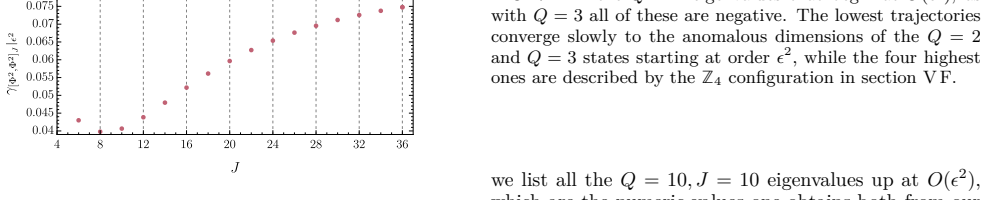
- At Q=4 the O(ε) degeneracies split at O(ε²) into identifiable operator families, including [Φ²,[Φ,Φ]ℓ], [Φ,[Φ,Φ²]ℓ], and [Φ²,Φ²]_J, the last exhibiting log J/J² behavior.
- At Q≥5 the paper checks many sectors numerically, matching the two-loop mixing matrix to at least 20 digits, for example the full Q=10, J=10 spectrum.
- The twist-to-charge ratio r(Q) is computable from the Hamiltonian; the small-Q results hint at nontrivial 'blob' bound states at larger Q.
Where Pith is reading between the lines
- The ghost-subtraction rule is likely a general feature of holographic effective theories: whenever a bulk field is dual to a composite that is redundant with a descendant through equations of motion, matching will require subtracting an unwanted exchange; the same 'subtract a field of the redundant twist' trick should apply to other models.
- Because the Hamiltonian is so compact, a natural test is to push it to O(ε³) or to the O(N) Wilson–Fisher model; any need for additional bulk fields or interactions at the next order would directly probe the completeness of the exchange classification.
- The apparent coincidence that no |φ|⁶ contact term is needed for Q=3, J=0 may signal an unbroken structure, such as a symmetry or a cancellation between exchange and contact diagrams, worth isolating at higher orders.
- The paper's comparison between treating Φ² as a fundamental bulk field and treating it as a composite suggests a practical rule: for composite double-twist operators, tree-level diagrams in the composite basis automatically resum the one-loop diagrams one would have to compute in a fundamental-field basis.
Editorial analysis
A structured set of objections, weighed in public.
Referee Report
Summary. The paper constructs a holographic effective Hamiltonian for the leading-twist operators of the O(2) model in d=4−ϵ, working to O(ϵ^2). The Hamiltonian is built from bulk exchanges of a charged scalar φ, a neutral scalar s∼φφ*, and a 'ghost' field c, together with a single local quartic interaction (φφ*)^2. At O(ϵ) the S-exchange is shown to be equivalent to a contact term; at O(ϵ^2) the authors add φ-exchange and a ghost subtraction designed to remove a spurious Φ^2Φ* exchange. Two parameters are fixed by CFT input: the quartic coupling λ to the dimension of Φ^2 (Eq. III.5 and IV.2), and the ghost coupling to the [Φ,Φ^2]_J family (Sec. IV). The resulting spectrum is compared with Kehrein's two-loop mixing matrix for Q=2,3,4 analytically/numerically and for Q≥5 numerically to 20 digits. The paper also derives large-J logarithms, Z_Q configurations, and the twist-to-charge ratio r(Q).
Significance. If correct, the paper is a significant proof of principle: a non-large-N, strongly coupled CFT can have its entire leading-twist spectrum at O(ϵ^2) encoded in a small holographic Hamiltonian. The paper contains extensive internal checks, including closed-form results for Q=2 and the [Φ,Φ^2]_J family, full Q=4 spectra, and 20-digit agreement for Q≥5. It also makes falsifiable predictions, such as r(Q) and Z_Q large-J anomalous dimensions. However, the central EFT matching prescription is not fully derived in this manuscript: the ghost subtraction is presented as a fit, and the core potentials are quoted from the unpublished companion [5]. These issues must be resolved before the central claim is fully established.
major comments (4)
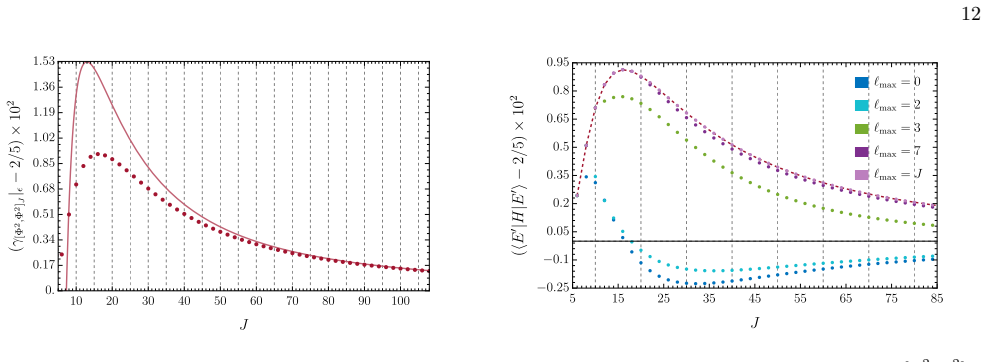
- [Sec. IV, Eqs. (IV.3)–(IV.4); App. A, Eq. (A.6)] The ghost subtraction is the load-bearing step of the O(ϵ^2) construction. Section IV states that the coefficient of the ghost coupling is fixed by matching the [Φ,Φ^2]_J family, but App. A, Eq. (A.6) states V_{3,gh} = −V_3^{(2)} with g = \tildeλ, which looks like a fixed identity rather than a fitted parameter. Please clarify whether the coefficient is derived from the bulk Feynman rules (e.g., by subtracting the ΔE=0 pole term in second-order perturbation theory) or is fitted. As written, the 'reproduction' includes its own fitting points, and the fact that one coefficient fits all J is evidence but not a derivation. An independent computation of the cφ^2φ* vertex, or an explicit matching argument, is needed.
- [App. A, Eqs. (A.1), (A.3)–(A.5)] All scalar exchange potentials and their epsilon expansions are quoted from the unpublished companion [5]. This is not merely a presentation issue: the numerical agreement reported in Sec. V cannot be independently checked from the material in this paper. Please include the derivations or a self-contained summary sufficient to reproduce the potentials, or arrange for [5] to be available. Without this, the central numerical claim is unverifiable.
- [Abstract and Sec. V.D] The abstract and Introduction claim that the Hamiltonian 'completely reproduces' the dimensions for all Q and J. Section V.D explicitly states that there is no analytic proof for Q≥5, only numerical checks (albeit to 20 digits) for a large number of sectors. Either provide an argument that the Hamiltonian must agree for all Q,J (e.g., by induction on Q or by structural uniqueness), or soften the claim to 'for all sectors checked'. The current overclaim is not supported by the evidence presented.
- [Sec. IV, Eq. (IV.3)] The mismatch (IV.3) has the 1/J^3 large-J behavior expected from a twist-3 exchange, and the interpretation that Φ^2Φ* is doubled in the bulk is plausible. However, the subtraction is justified only by the fit described above. Please show explicitly that the ghost term removes precisely the spurious exchange of the composite Φ^2Φ*, rather than just fitting the numerical discrepancy in one family. This would turn the prescription into a derivation.
minor comments (5)
- [Sec. V.D, Eq. (V.8)] The last eigenvalue in the list is written in a different format from the others; aligning the notation would improve readability.
- [App. A, Eq. (A.2)] The indicator notation I(ℓ4≤ℓ2) is not defined until after the equation; define it before first use.
- [Sec. VIII, Eq. (VIII.2)] The Q=5 entry is an upper bound, not a value; label it clearly as an upper bound in Eq. (VIII.2) as well as in the text.
- [References] Reference [5] is listed without an arXiv number or publication status; please add one if available, or state that it is a companion paper in preparation.
- [Notation around Eq. (III.9) and Eq. (V.4)] The notation γ2Φ can be misread as γ_{Φ_2} or γ_Φ². Consider using an unambiguous notation, e.g., 2γ_Φ or γ_{Φ^2}.
Circularity Check
Fitted matching points are counted among the 'reproduced' spectrum; core potentials are imported from unpublished companion [5], but the Q>=4 sectors provide independent confirmation against Kehrein's external two-loop matrix.
specific steps
-
fitted input called prediction
[Section III Eq. (III.5), Section IV Eq. (IV.2), Section V.A Eq. (V.1)]
"However, after fixing the coupling λ to ε3λ =πd/2(−1600ϵ + 800(5 +γE)ϵ2 +O(ϵ3)), (IV.2) ... in order to reproduce the dimension for Φ 2 at O(ϵ2) from (II.4), one finds ... γΦ2≡ ∆Φ2− 2∆Φ = ϵ 5 + ϵ2 25, (V.1)"
The contact coupling λ is the only free parameter at this stage; it is fixed by requiring the Hamiltonian to give exactly the O(ε²) dimension of Φ² from the CFT input (II.4). Equation (V.1) then reports that same value as a 'found' anomalous dimension. Thus the Q=2, J=0 entry in the claimed 'all dimensions' reproduction is the input restated, not an independent output. The J>0 Q=2 dimensions are independent, but they do not remove the tautological character of this one datum.
-
fitted input called prediction
[Section IV (after Eq. IV.3), Section V.B Eq. (V.3), Appendix A Eq. (A.6)]
"We fix the coefficient of the coupling to the ghost by matching the dimension of the operators [Φ, Φ2]J. A nontrivial test of this procedure is that a single value of the coefficient is sufficient to match all J."
The ghost vertex is introduced to cancel the spurious Φ²Φ* exchange, but its coefficient is not derived from the bulk Feynman rules; it is adjusted so that the Hamiltonian reproduces the known Q=3 [Φ,Φ²]_J anomalous dimensions. Consequently the later formula (V.3) for exactly those dimensions is a matching condition, not a prediction. Appendix A makes the by-construction nature explicit: V3,gh = −V3^(2) (A.6), so the ghost term is defined to be minus the problematic part, with its overall coefficient set by the same matching. The all-J match is nontrivial because one coefficient must reproduce the full J-dependence, and the Q=4 and Q≥5 sectors are genuinely independent; nevertheless, the Q=3 family is counted among the 'reproduced' data by construction.
full rationale
The paper is not fundamentally circular: after λ and the ghost coefficient are fixed by two Q=2/Q=3 inputs, the same HEFT reproduces the full J-dependence of those families as a consistency check, the entire Q=4 spectrum, and all Q≥5 sectors checked numerically to 20 digits against Kehrein's external two-loop mixing matrix [8] (e.g., Eq. V.8). These are independent, falsifiable benchmarks, so the central claim has real content. The circularity is partial: the abstract's 'correctly reproduces all dimensions' includes the two sets of data used for matching — the Φ² dimension fixes λ, and the [Φ,Φ²]_J family fixes the ghost — so those entries are reproduced by construction rather than predicted. A secondary concern is provenance rather than logical circularity: the core potentials (A.1)-(A.8), including the ghost potential V3,gh = −V3^(2), are quoted from the authors' unpublished companion [5], making the derivation chain depend on a load-bearing self-citation; the external comparison with [8] mitigates this. Net score 4.
Axiom & Free-Parameter Ledger
free parameters (2)
- lambda, bulk quartic coupling |phi|^4 =
lambda = -1600 pi^2 / epsilon^2 at O(epsilon); epsilon^3 lambda = pi^(d/2)(-1600 epsilon + 800(5+gamma_E) epsilon^2 + O(
- ghost coupling of c phi^2 phi* vertex =
not given a symbol; one coefficient fixed by matching gamma_[Phi,Phi^2]_J
axioms (6)
- domain assumption At large spin J and any charge Q, leading-twist states can be modeled as Q particles in AdS_(d+1) separated on average by log J, with short-distance effects local.
- standard math The Lorentzian inversion formula converges for spin J>=2, so all bulk exchanges can in principle be recovered and only local contact terms need fitting.
- domain assumption At O(epsilon^2) only the Phi and S exchanges contribute; higher-twist/higher-spin exchanges and more-particle OPE coefficients are suppressed until higher order.
- domain assumption No |phi phi*|^n bulk terms with n>=4 are generated at O(epsilon^2), and the n=3 term is not needed.
- domain assumption Phi^2 Phi* is a descendant of Phi by the O(2) model equations of motion, so its bulk exchange is spurious and removable.
- domain assumption Kehrein's two-loop mixing matrix M (B.1) is the correct benchmark for Csym to O(epsilon^2).
invented entities (1)
-
Ghost bulk field c
no independent evidence
Cite this review
Pith. "Pith review of Towards Large-Spin Effective Theory II: $O(2)$ model in $d=4-\epsilon$." pith.science (2026). https://pith.science/paper/KBBPMDLL
@misc{pith2026250820160,
  author       = {Pith},
  title        = {Pith review of: Towards Large-Spin Effective Theory II: $O(2)$ model in $d=4-\epsilon$},
  year         = {2026},
  howpublished = {\url{https://pith.science/paper/KBBPMDLL}},
  note         = {Machine review of arXiv:2508.20160}
}
abstract
We show how to construct a holographic effective theory for the leading-twist operators in the $O(2)$ model in the $4-d=\epsilon$ expansion up to $O(\epsilon^2)$, based on the separation of short-distance and long-distance effects that arises as a function of spin $J$. We obtain the Hamiltonian of the theory and show that it correctly reproduces all the dimensions at $O(\epsilon^2)$ of the leading twist operators for all values of the charge $Q$ and spin $J$. The holographic Hamiltonian is given by the bulk exchange of a charged scalar $\phi$, neutral scalar $s \sim \phi \phi^*$, and a `ghost' field $c$, as well as a single local bulk interaction $(\phi \phi^*)^2$. We analyze various aspects of the spectrum and discuss their interpretation in light of the bulk description.
Figures



Forward citations
Cited by 1 Pith paper
-
Thermal One-point Functions and Asymptotic CFT Data: QFT in AdS
Thermal inversion formulas produce asymptotically accurate CFT data for heavy operators that remains reliable at intermediate dimensions and survives first-order bulk interactions.
Reference graph
Works this paper leans on
-
[1]
A. L. Fitzpatrick, J. Kaplan, D. Poland, and D. Simmons-Duffin, JHEP 12, 004 (2013), arXiv:1212.3616 [hep-th]
Pith/arXiv arXiv 2013
-
[2]
Z. Komargodski and A. Zhiboedov, JHEP 11, 140 (2013), arXiv:1212.4103 [hep-th]
Pith/arXiv arXiv 2013
-
[3]
S. Pal, J. Qiao, and S. Rychkov, Commun. Math. Phys. 402, 2169 (2023), arXiv:2212.04893 [hep-th]
arXiv 2023
-
[4]
B. C. van Rees, (2024), arXiv:2412.06907 [hep-th]
Pith/arXiv arXiv 2024
-
[5]
G. Fardelli, A. L. Fitzpatrick, and W. Li, Towards Large- Spin Effective Theory I: Three-Particle States in AdS ϕ4 Theory
- [6]
-
[7]
S. K. Kehrein and F. Wegner, Nucl. Phys. B 424, 521 (1994), arXiv:hep-th/9405123
work page internal anchor Pith review Pith/arXiv arXiv 1994
- [8]
-
[9]
S. E. Derkachov and A. N. Manashov, Nucl. Phys. B455, 685 (1995), arXiv:hep-th/9505110
work page internal anchor Pith review Pith/arXiv arXiv 1995
- [10]
-
[11]
Revisiting the dilatation operator of the Wilson-Fisher fixed point
P. Liendo, Nucl. Phys. B 920, 368 (2017), arXiv:1701.04830 [hep-th]
work page internal anchor Pith review Pith/arXiv arXiv 2017
-
[12]
K. G. Wilson and J. B. Kogut, Phys. Rept. 12, 75 (1974)
1974
-
[13]
Caron-Huot, JHEP 09, 078 (2017), arXiv:1703.00278 [hep-th]
S. Caron-Huot, JHEP 09, 078 (2017), arXiv:1703.00278 [hep-th]
Pith/arXiv arXiv 2017
-
[14]
Simmons-Duffin, JHEP 03, 086 (2017), arXiv:1612.08471 [hep-th]
D. Simmons-Duffin, JHEP 03, 086 (2017), arXiv:1612.08471 [hep-th]
Pith/arXiv arXiv 2017
-
[15]
Penedones, JHEP 03, 025 (2011), arXiv:1011.1485 [hep-th]
J. Penedones, JHEP 03, 025 (2011), arXiv:1011.1485 [hep-th]
Pith/arXiv arXiv 2011
-
[16]
N. Anand, A. L. Fitzpatrick, E. Katz, Z. U. Khandker, M. T. Walters, and Y. Xin, (2020), arXiv:2005.13544 [hep-th]
Pith/arXiv arXiv 2020
-
[17]
F. Bertucci, J. Henriksson, and B. McPeak, JHEP 10, 104 (2022), arXiv:2205.09132 [hep-th]
Pith/arXiv arXiv 2022
-
[18]
L. F. Alday, J. Henriksson, and M. van Loon, JHEP 07, 131 (2018), arXiv:1712.02314 [hep-th]
Pith/arXiv arXiv 2018
-
[19]
J. Henriksson and M. Van Loon, J. Phys. A 52, 025401 (2019), arXiv:1801.03512 [hep-th]. 15
Pith/arXiv arXiv 2019
- [20]
-
[21]
R. Gopakumar, A. Kaviraj, K. Sen, and A. Sinha, Phys. Rev. Lett. 118, 081601 (2017), arXiv:1609.00572 [hep- th]
Pith/arXiv arXiv 2017
-
[22]
R. Gopakumar, A. Kaviraj, K. Sen, and A. Sinha, JHEP 05, 027 (2017), arXiv:1611.08407 [hep-th]
Pith/arXiv arXiv 2017
-
[23]
P. Dey, A. Kaviraj, and A. Sinha, JHEP 07, 019 (2017), arXiv:1612.05032 [hep-th]
Pith/arXiv arXiv 2017
-
[24]
Towards a Bootstrap approach to higher orders of epsilon expansion
P. Dey and A. Kaviraj, JHEP 02, 153 (2018), arXiv:1711.01173 [hep-th]
work page internal anchor Pith review Pith/arXiv arXiv 2018
-
[25]
J. Henriksson, P. Kravchuk, and B. Oertel, JHEP07, 248 (2024), arXiv:2312.09283 [hep-th]
Pith/arXiv arXiv 2024
-
[26]
G. Fardelli, A. L. Fitzpatrick, and W. Li, JHEP 08, 202 (2024), arXiv:2403.07079 [hep-th]
Pith/arXiv arXiv 2024
-
[27]
A. L. Fitzpatrick and J. Kaplan, JHEP 10, 032 (2012), arXiv:1112.4845 [hep-th]
Pith/arXiv arXiv 2012
-
[28]
M. S. Costa, V. Gon¸ calves, and J. a. Penedones, JHEP 09, 064 (2014), arXiv:1404.5625 [hep-th]
Pith/arXiv arXiv 2014
This paper was first reviewed by deepseek-v4-flash on August 5, 2026.
discussion (0)
Sign in with ORCID, Apple, or X to comment. Anyone can read and Pith papers without signing in.