REVIEW 4 major objections 5 minor 2 cited by
DentalQA presents a bilingual test for how well LLMs understand dentistry, plus a corpus for improving them.
Reviewed by Pith at T0; open to challenge. T0 means a machine referee read the full paper against a public rubric. the ladder, T0–T4 →
A new bilingual dental QA benchmark and corpus reveals large performance gaps in LLMs for dentistry, and shows that domain adaptation with the corpus improves accuracy.
T0 review reviewed 2026-08-05 challenge →
load-bearing objection DentalBench is a genuinely new bilingual dental benchmark and corpus, but the reported numbers rest on unverified gold answers and thin statistics. the 4 major comments →
DentalBench: Benchmarking and Advancing LLMs Capability for Bilingual Dentistry Understanding
The pith
A machine-rendered reading of the paper's core claim, the machinery that carries it, and where it could break.
The reading
Core claim
On the paper's own terms, the central discovery is that currently available large language models, including those trained for medicine, are not reliably dental-literate: multiple-choice factual accuracy is moderate, open-ended clinical reasoning and terminology scores are far lower, and which model leads depends on language (DeepSeek-R1 leads Chinese, GPT-4o leads English). The discovery is made concrete by showing that in-domain adaptation of one 3B model (Qwen-2.5-3B) with fine-tuning or retrieval moves scores upward, and the two are additive on Chinese multiple-choice questions. The benchmark is the load-bearing instrument: without DentalQA, these comparisons and adaptation gains would n
What carries the argument
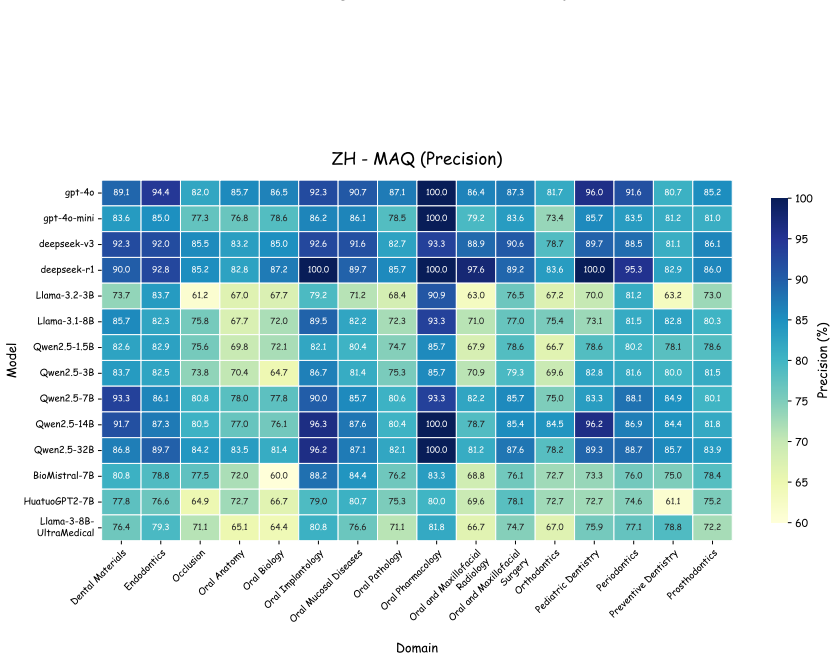
The object carrying the argument is DentalQA, a bilingual question bank with 36,597 items in four formats: single-answer multiple choice (MCQ), multi-answer multiple choice (MAQ, Chinese only), open-ended clinical questions (OEQ), and definition questions (DEF). It spans 16 dental subfields and is scored by accuracy for MCQs, precision/recall/F1 for MAQs, and BERTScore for OEQ/DEF. A companion resource, DentalCorpus, supplies 337.35M tokens of filtered textbooks, PubMed articles, and medical datasets; it is used both to fine-tune a model and to retrieve supporting passages during inference (RAG).
Load-bearing premise
The whole benchmark depends on the 36,597 questions being correctly labeled and truly dental; only 300 (0.8%) were manually reviewed, so a materially higher error rate in the unseen questions would make the measured gaps and adaptation gains unreliable.
What would settle it
Have several dental specialists independently verify answer correctness and dental relevance on a random sample of roughly 1,000 questions drawn from the 99.2% of DentalQA that was not manually reviewed; if label-error or relevance-error rates substantially exceed the 4-8% range seen in the 300-sample check, the reported performance and adaptation numbers cannot be trusted as measures of dental understanding.
If this is right
- Any future dental LLM can be scored on the same 16 subfields and four task formats, making model comparisons consistent across languages.
- Per-task reporting matters: a single aggregate score would hide that open-ended questions and definitions are the weak points.
- In-domain text helps in two different ways—fine-tuning boosts factual multiple-choice accuracy, retrieval boosts open-ended generation—so they should be combined rather than treated as alternatives.
- Current medical-specific LLMs are not automatically strong on dentistry, so medical adaptation alone is not enough for specialized dental applications.
- The Chinese and English halves rank models differently, so a dental safety claim based on one language may not carry to the other.
Where Pith is reading between the lines
- Beyond the paper, the same benchmark could be extended with an English MAQ format; whether the reported cross-lingual gaps persist would separate language coverage from true dental knowledge.
- A reasonable next stress test would be to run the SFT+RAG recipe on larger open models; the 3B gains may shrink or grow with scale, and that is not measured here.
- Because DentalQA reuses public exam and QA datasets filtered by keyword lists, some items may resemble pretraining text; scoring on fresh, unpublished dental licensing questions would reveal contamination.
- A practical clinical extrapolation: retrieval over DentalCorpus raised open-ended Chinese scores the most, suggesting RAG-style support could help with dental documentation or patient education even when full fine-tuning is impractical.
Editorial analysis
A structured set of objections, weighed in public.
Referee Report
Summary. The paper introduces DentalBench, a bilingual (English-Chinese) resource for dentistry-domain LLM evaluation and adaptation. It has two components: DentalQA, 36,597 questions across four task formats (MCQ, MAQ, OEQ, DEF) and 16 dental subfields, and DentalCorpus, a 337.35-million-token corpus for supervised fine-tuning and retrieval-augmented generation. The authors evaluate 14 proprietary, open-source, and medical LLMs in zero-shot settings on a held-out test split, and report that domain adaptation of Qwen-2.5-3B via SFT, RAG, and SFT+RAG improves performance, especially on Chinese MCQ/MAQ and open-ended tasks. The paper also includes a limitations section acknowledging cross-lingual asymmetry and the absence of English MAQ items.
Significance. If the benchmark and corpus are valid, this is a useful and reusable resource: dentistry is under-served by current medical QA benchmarks, and the bilingual design plus 16-subfield coverage is a genuine gap. The paper provides a relatively transparent construction pipeline, including filtering prompts and keyword lists, and evaluates a broad model suite. The main contribution is empirical and resource-based rather than methodological. The strongest advertised claims are the benchmark's quality and the conclusion that domain adaptation 'significantly improves' performance; both currently rest on validation and statistical evidence that is thinner than the claims require. The reported experiments are plausible, but the manuscript needs strengthening in gold-answer validation, contamination analysis, and significance testing before the central claims can be accepted as established.
major comments (4)
- [Section 2.1, Human Validation] The reported manual review of 300 samples validates only the GPT-4o topical classification (oral / non-oral / insufficient), not the correctness of the retained gold answers, the consistency of MCQ/MAQ answer keys, or the faithfulness of OEQ/DEF reference answers. Because English items are inherited from upstream datasets and Chinese items from exams/textbooks, any source-level label errors propagate directly into every number in Table 1 and into the SFT/RAG deltas. The paper provides no estimate of the gold-answer error rate on the 99.2% of items not manually reviewed, and no expert check on a sample of the held-out test split. A validation study that flags incorrect or ambiguous answers and reports corrected performance would be a necessary condition for the benchmark's central claim to measure dental understanding.
- [Section 3.1 / Table 1 / Section 3.2] The main results are reported as point estimates without error bars, confidence intervals, or significance tests, and the domain-adaptation experiments use a single SFT seed. Several of the headline gains are small enough to be within run-to-run noise, especially on English OEQ/DEF (e.g., SFT+RAG vs. SFT: 37.68 vs. 37.74 BERTScore for EN-OEQ and 29.65 vs. 30.79 for EN-DEF, i.e., negative deltas; RAG alone on EN-DEF is +0.42). The claim that domain adaptation 'significantly improves' performance needs bootstrapped confidence intervals or multiple-seed runs with significance tests, at least for the central MCQ/MAQ gains and the open-ended task comparisons.
- [Section 3.2 RAG / Section 2.2 DentalCorpus] The RAG experiments retrieve from DentalCorpus, which is built from PubMed full-text articles and MedRAG PubMed snippets, while English DentalQA sources include PubMedQA and MedQuAD-derived content. There is no contamination or overlap analysis between the test set and the retrieval corpus. If the corpus contains passages that are near-duplicates of test questions or reference answers, the RAG gains (e.g., MCQ-ZH +11.43, MAQ-ZH +9.88) could partly reflect direct answer lookup rather than improved dental understanding. The authors should quantify overlap between test items and corpus chunks, and ideally run an ablation where retrieval excludes chunks that contain answer-derived or question-overlapping text, or use a temporally/structurally held-out retrieval index.
- [Section 3.1, Evaluation Metrics] OEQ and DEF performance is measured only by BERTScore F1, with absolute scores mostly in the 15-35 range. The paper provides no evidence that BERTScore differences of 1-3 points correspond to meaningful quality differences in dentistry answers, nor any human or expert correlation study for the metric on this domain. Since the adaptation claims for open-ended tasks rest on these numbers, a small expert rating sample or an additional metric (e.g., LLM-as-judge with a rubric, or token-level F1 against reference keywords) is needed to make the improvements interpretable.
minor comments (5)
- [Table 1 caption] Typo: 'Precistion' should be 'Precision'.
- [Section 2.1, Data Sources] The text says 'seven public medical QA datasets' but the enumeration lists eight sources (MMLU, MedQA, MedMCQA, MedQuAD, PubMedQA, iCliniq, Medical Meadow Flashcards, Medical Meadow Wikidoc). Please correct the count or split the list.
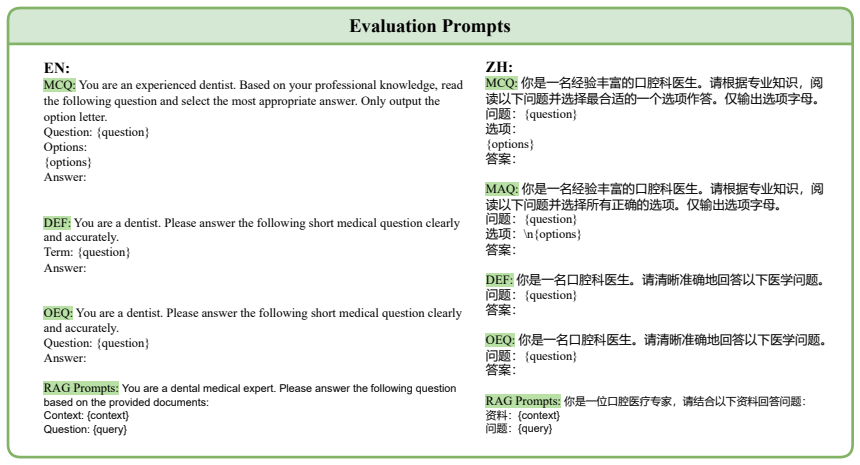
- [Appendix C.2] The sentence 'Fig. 5 shows the prompt formats...' duplicates the text in Appendix A.3 and appears to be a copy-paste error; the intended cross-reference is missing.
- [Appendix figures 8-17] In the provided PDF, the supplementary performance figures appear as encoded strings rather than readable plots, so the per-subfield and per-model results they are meant to convey are not accessible. These should be regenerated as standard figures.
- [Limitations] The limitations section acknowledges that MAQ is Chinese-only and that the bilingual resources are asymmetric. This is useful, but the abstract and introduction's 'bilingual benchmark' claim should explicitly qualify that the four task types are not all available in both languages.
Circularity Check
No circularity: benchmark construction and evaluation are self-contained; the RAG corpus overlap is a confound, not a circular derivation.
full rationale
This paper makes no mathematical derivation claim; its contributions are a constructed benchmark (DentalQA), a corpus (DentalCorpus), and empirical evaluations. Each load-bearing step is externally sourced or held-out: DentalQA questions are filtered from seven public QA datasets, Chinese licensing exams, textbooks, and clinical OEQs; DEF answers come from UMLS definitions; the 4:1 train/test split is reported on the held-out test set; SFT is trained only on the training split; and the 300-sample human validation checks the GPT-4o filtering step. No parameter is fitted to the reported test numbers, and no 'prediction' is derived from a fitted input. The paper's citations to the authors' own prior work (e.g., Shi et al. 2024, Xiong et al. 2023) are context citations for dental deep learning, not load-bearing premises or uniqueness theorems. The one legitimate concern—that DentalCorpus and DentalQA are filtered with overlapping keyword lists, so RAG gains may partly reflect term overlap—is an experimental design confound, not a reduction of the reported result to its inputs by construction. Similarly, the fact that human validation covers only 300 samples and checks classification rather than gold-answer correctness is a reliability limitation, not circularity.
Axiom & Free-Parameter Ledger
axioms (4)
- domain assumption The GPT-4o-based classification into oral/non-oral/insufficient is accurate, with human validation on 300 samples generalizing to the full dataset.
- domain assumption BERTScore F1 is a reliable proxy for answer quality on open-ended and definition tasks in dentistry.
- domain assumption The keyword density threshold (>1% and two distinct matches per sentence) and dental keyword lists yield a corpus with high domain relevance (99% EN, 96% ZH on 100 samples).
- domain assumption The DentalQA test set is not contaminated by pretraining corpora or the DentalCorpus beyond what is intended.
Cite this review
Pith. "Pith review of DentalBench: Benchmarking and Advancing LLMs Capability for Bilingual Dentistry Understanding." pith.science (2026). https://pith.science/paper/EZSPXAEU
@misc{pith2026250820416,
  author       = {Pith},
  title        = {Pith review of: DentalBench: Benchmarking and Advancing LLMs Capability for Bilingual Dentistry Understanding},
  year         = {2026},
  howpublished = {\url{https://pith.science/paper/EZSPXAEU}},
  note         = {Machine review of arXiv:2508.20416}
}
read the original abstract
Recent advances in large language models (LLMs) and medical LLMs (Med-LLMs) have demonstrated strong performance on general medical benchmarks. However, their capabilities in specialized medical fields, such as dentistry which require deeper domain-specific knowledge, remain underexplored due to the lack of targeted evaluation resources. In this paper, we introduce DentalBench, the first comprehensive bilingual benchmark designed to evaluate and advance LLMs in the dental domain. DentalBench consists of two main components: DentalQA, an English-Chinese question-answering (QA) benchmark with 36,597 questions spanning 4 tasks and 16 dental subfields; and DentalCorpus, a large-scale, high-quality corpus with 337.35 million tokens curated for dental domain adaptation, supporting both supervised fine-tuning (SFT) and retrieval-augmented generation (RAG). We evaluate 14 LLMs, covering proprietary, open-source, and medical-specific models, and reveal significant performance gaps across task types and languages. Further experiments with Qwen-2.5-3B demonstrate that domain adaptation substantially improves model performance, particularly on knowledge-intensive and terminology-focused tasks, and highlight the importance of domain-specific benchmarks for developing trustworthy and effective LLMs tailored to healthcare applications.
Figures






Forward citations
Cited by 2 Pith papers
-
OralMLLM-Bench: Evaluating Cognitive Capabilities of Multimodal Large Language Models in Dental Practice
OralMLLM-Bench is a new benchmark with 27 tasks in four cognitive categories that evaluates six MLLMs on dental radiographs and shows clear performance gaps versus clinicians.
-
OralMLLM-Bench: Evaluating Cognitive Capabilities of Multimodal Large Language Models in Dental Practice
OralMLLM-Bench reveals performance gaps between multimodal large language models and clinicians on cognitive tasks for dental radiographic analysis across periapical, panoramic, and cephalometric images.
Reference graph
Works this paper leans on
-
[1]
Asma Ben Abacha and Dina Demner - Fushman. 2019. https://bmcbioinformatics.biomedcentral.com/articles/10.1186/s12859-019-3119-4 A question-entailment approach to question answering . BMC Bioinform. , 20(1):511:1--511:23
-
[2]
Junying Chen, Xidong Wang, Ke Ji, Anningzhe Gao, Feng Jiang, Shunian Chen, Hongbo Zhang, Dingjie Song, Wenya Xie, Chuyi Kong, Jianquan Li, Xiang Wan, Haizhou Li, and Benyou Wang. 2024. https://arxiv.org/abs/2311.09774 Huatuogpt-ii, one-stage training for medical adaption of llms . Preprint, arXiv:2311.09774
Pith/arXiv arXiv 2024
-
[3]
DeepSeek-AI, Daya Guo, Dejian Yang, Haowei Zhang, Junxiao Song, Ruoyu Zhang, Runxin Xu, Qihao Zhu, Shirong Ma, Peiyi Wang, Xiao Bi, Xiaokang Zhang, Xingkai Yu, Yu Wu, Z. F. Wu, Zhibin Gou, Zhihong Shao, Zhuoshu Li, Ziyi Gao, and 181 others. 2025. https://arxiv.org/abs/2501.12948 Deepseek-r1: Incentivizing reasoning capability in llms via reinforcement lea...
Pith/arXiv arXiv 2025
-
[4]
Aaron Grattafiori, Abhimanyu Dubey, Abhinav Jauhri, Abhinav Pandey, Abhishek Kadian, Ahmad Al-Dahle, Aiesha Letman, Akhil Mathur, Alan Schelten, Alex Vaughan, Amy Yang, Angela Fan, Anirudh Goyal, Anthony Hartshorn, Aobo Yang, Archi Mitra, Archie Sravankumar, Artem Korenev, Arthur Hinsvark, and 542 others. 2024. https://arxiv.org/abs/2407.21783 The llama 3...
Pith/arXiv arXiv 2024
-
[5]
Dan Hendrycks, Collin Burns, Steven Basart, Andy Zou, Mantas Mazeika, Dawn Song, and Jacob Steinhardt. 2021. https://arxiv.org/abs/2009.03300 Measuring massive multitask language understanding . Preprint, arXiv:2009.03300
Pith/arXiv arXiv 2021
-
[6]
Aaron Jaech, Adam Kalai, Adam Lerer, Adam Richardson, Ahmed El-Kishky, Aiden Low, Alec Helyar, Aleksander Madry, Alex Beutel, Alex Carney, and 1 others. 2024. Openai o1 system card. arXiv preprint arXiv:2412.16720
Pith/arXiv arXiv 2024
-
[7]
Di Jin, Eileen Pan, Nassim Oufattole, Wei-Hung Weng, Hanyi Fang, and Peter Szolovits. 2020. https://arxiv.org/abs/2009.13081 What disease does this patient have? a large-scale open domain question answering dataset from medical exams . Preprint, arXiv:2009.13081
Pith/arXiv arXiv 2020
-
[8]
Qiao Jin, Bhuwan Dhingra, Zhengping Liu, William W. Cohen, and Xinghua Lu. 2019. https://arxiv.org/abs/1909.06146 Pubmedqa: A dataset for biomedical research question answering . Preprint, arXiv:1909.06146
Pith/arXiv arXiv 2019
-
[9]
Yanis Labrak, Adrien Bazoge, Emmanuel Morin, Pierre-Antoine Gourraud, Mickael Rouvier, and Richard Dufour. 2024. https://arxiv.org/abs/2402.10373 Biomistral: A collection of open-source pretrained large language models for medical domains . Preprint, arXiv:2402.10373
Pith/arXiv arXiv 2024
-
[10]
Chunyuan Li, Cliff Wong, Sheng Zhang, Naoto Usuyama, Haotian Liu, Jianwei Yang, Tristan Naumann, Hoifung Poon, and Jianfeng Gao. 2023. Llava-med: Training a large language-and-vision assistant for biomedicine in one day. Advances in Neural Information Processing Systems, 36:28541--28564
2023
-
[11]
Aixin Liu, Bei Feng, Bing Xue, Bingxuan Wang, Bochao Wu, Chengda Lu, Chenggang Zhao, Chengqi Deng, Chenyu Zhang, Chong Ruan, and 1 others. 2024. Deepseek-v3 technical report. arXiv preprint arXiv:2412.19437
Pith/arXiv arXiv 2024
-
[12]
Jiaxiang Liu, Jin Hao, Hangzheng Lin, Wei Pan, Jianfei Yang, Yang Feng, Gaoang Wang, Jin Li, Zuolin Jin, Zhihe Zhao, and 1 others. 2023. Deep learning-enabled 3d multimodal fusion of cone-beam ct and intraoral mesh scans for clinically applicable tooth-bone reconstruction. Patterns, 4(9)
work page 2023
-
[13]
OpenAI, Josh Achiam, Steven Adler, Sandhini Agarwal, Lama Ahmad, Ilge Akkaya, Florencia Leoni Aleman, Diogo Almeida, Janko Altenschmidt, Sam Altman, Shyamal Anadkat, Red Avila, Igor Babuschkin, Suchir Balaji, Valerie Balcom, Paul Baltescu, Haiming Bao, Mohammad Bavarian, Jeff Belgum, and 262 others. 2024. https://arxiv.org/abs/2303.08774 Gpt-4 technical r...
Pith/arXiv arXiv 2024
-
[14]
Ankit Pal, Logesh Kumar Umapathi, and Malaikannan Sankarasubbu. 2022. https://arxiv.org/abs/2203.14371 Medmcqa : A large-scale multi-subject multi-choice dataset for medical domain question answering . Preprint, arXiv:2203.14371
Pith/arXiv arXiv 2022
-
[15]
Pengcheng Qiu, Chaoyi Wu, Xiaoman Zhang, Weixiong Lin, Haicheng Wang, Ya Zhang, Yanfeng Wang, and Weidi Xie. 2024. https://arxiv.org/abs/2402.13963 Towards building multilingual language model for medicine . Preprint, arXiv:2402.13963
Pith/arXiv arXiv 2024
-
[16]
Qwen, :, An Yang, Baosong Yang, Beichen Zhang, Binyuan Hui, Bo Zheng, Bowen Yu, Chengyuan Li, Dayiheng Liu, Fei Huang, Haoran Wei, Huan Lin, Jian Yang, Jianhong Tu, Jianwei Zhang, Jianxin Yang, Jiaxi Yang, Jingren Zhou, and 25 others. 2025. https://arxiv.org/abs/2412.15115 Qwen2.5 technical report . Preprint, arXiv:2412.15115
Pith/arXiv arXiv 2025
-
[17]
Lasse Regin. 2017. Medical question answer data. https://github.com/LasseRegin/medical-question-answer-data. Accessed: May 15, 2023
work page 2017
-
[18]
Zefeng Shi, Zijie Meng, Ruizhe Chen, Yang Feng, Zeyu Zhao, Jin Hao, Bing Fang, Zuozhu Liu, and Youyi Zheng. 2024. Leta: Tooth alignment prediction based on dual-branch latent encoding. IEEE Transactions on Visualization and Computer Graphics
work page 2024
-
[19]
Gemma Team, Aishwarya Kamath, Johan Ferret, Shreya Pathak, Nino Vieillard, Ramona Merhej, Sarah Perrin, Tatiana Matejovicova, Alexandre Ram \'e , Morgane Rivi \`e re, and 1 others. 2025. Gemma 3 technical report. arXiv preprint arXiv:2503.19786
Pith/arXiv arXiv 2025
-
[20]
U.S. National Library of Medicine . 2025 a . Pubmed: Medline retrieval system. https://pubmed.ncbi.nlm.nih.gov/. Accessed: 2025-05-20
work page 2025
-
[21]
U.S. National Library of Medicine . 2025 b . Unified medical language system (umls). https://www.nlm.nih.gov/research/umls. Accessed: 2025-05-20
work page 2025
-
[22]
Guodong Wei, Zhiming Cui, Yumeng Liu, Nenglun Chen, Runnan Chen, Guiqing Li, and Wenping Wang. 2020. Tanet: towards fully automatic tooth arrangement. In Computer Vision--ECCV 2020: 16th European Conference, Glasgow, UK, August 23--28, 2020, Proceedings, Part XV 16, pages 481--497. Springer
work page 2020
-
[23]
Chaoyi Wu, Weixiong Lin, Xiaoman Zhang, Ya Zhang, Weidi Xie, and Yanfeng Wang. 2024. Pmc-llama: toward building open-source language models for medicine. Journal of the American Medical Informatics Association, 31(9):1833--1843
work page 2024
-
[24]
Chaoyi Wu, Pengcheng Qiu, Jinxin Liu, Hongfei Gu, Na Li, Ya Zhang, Yanfeng Wang, and Weidi Xie. 2025. Towards evaluating and building versatile large language models for medicine. npj Digital Medicine, 8(1):58
work page 2025
-
[25]
Huimin Xiong, Kunle Li, Kaiyuan Tan, Yang Feng, Joey Tianyi Zhou, Jin Hao, Haochao Ying, Jian Wu, and Zuozhu Liu. 2023. Tsegformer: 3d tooth segmentation in intraoral scans with geometry guided transformer. In International Conference on Medical Image Computing and Computer-Assisted Intervention, pages 421--432. Springer
work page 2023
-
[26]
An Yang, Anfeng Li, Baosong Yang, Beichen Zhang, Binyuan Hui, Bo Zheng, Bowen Yu, Chang Gao, Chengen Huang, Chenxu Lv, and 1 others. 2025. Qwen3 technical report. arXiv preprint arXiv:2505.09388
Pith/arXiv arXiv 2025
-
[27]
Haoran Yu, Chang Yu, Zihan Wang, Dongxian Zou, and Hao Qin. 2024. https://arxiv.org/abs/2408.04138 Enhancing healthcare through large language models: A study on medical question answering . Preprint, arXiv:2408.04138
Pith/arXiv arXiv 2024
-
[28]
Kaiyan Zhang, Ning Ding, Biqing Qi, Sihang Zeng, Haoxin Li, Xuekai Zhu, Zhang-Ren Chen, and Bowen Zhou. 2024. Ultramedical: Building specialized generalists in biomedicine. https://github.com/TsinghuaC3I/UltraMedical
2024
-
[29]
Tianyi Zhang, Varsha Kishore, Felix Wu, Kilian Q Weinberger, and Yoav Artzi. 2019. Bertscore: Evaluating text generation with bert. arXiv preprint arXiv:1904.09675
Pith/arXiv arXiv 2019
-
[30]
Xuejiao Zhao, Siyan Liu, Su-Yin Yang, and Chunyan Miao. 2025. https://arxiv.org/abs/2502.04413 Medrag: Enhancing retrieval-augmented generation with knowledge graph-elicited reasoning for healthcare copilot . Preprint, arXiv:2502.04413
Pith/arXiv arXiv 2025
-
[31]
Zhihe Zhao, Yanheng Zhou, and Yuxing Bai. 2020. Orthodontics. People's Medical Publishing House, Beijing. In Chinese
work page 2020
-
[32]
Yukun Zhou, Mark A Chia, Siegfried K Wagner, Murat S Ayhan, Dominic J Williamson, Robbert R Struyven, Timing Liu, Moucheng Xu, Mateo G Lozano, Peter Woodward-Court, and 1 others. 2023. A foundation model for generalizable disease detection from retinal images. Nature, 622(7981):156--163
work page 2023
-
[33]
online" 'onlinestring :=
ENTRY address archivePrefix author booktitle chapter edition editor eid eprint eprinttype howpublished institution journal key month note number organization pages publisher school series title type volume year doi pubmed url lastchecked label extra.label sort.label short.list INTEGERS output.state before.all mid.sentence after.sentence after.block STRING...
-
[34]
write newline
" write newline "" before.all 'output.state := FUNCTION n.dashify 't := "" t empty not t #1 #1 substring "-" = t #1 #2 substring "--" = not "--" * t #2 global.max substring 't := t #1 #1 substring "-" = "-" * t #2 global.max substring 't := while if t #1 #1 substring * t #2 global.max substring 't := if while FUNCTION word.in bbl.in capitalize " " * FUNCT...
This paper was first reviewed by deepseek-v4-flash on August 5, 2026.
discussion (0)
Sign in with ORCID, Apple, or X to comment. Anyone can read and Pith papers without signing in.