REVIEW 3 major objections 6 minor 39 references
MERIT: Maximum-normalized Element-wise Ratio for Language Model Large-batch Training
T0 review · 3 major / 6 minor · reviewed 2026-08-15 · deepseek-v4-flash
Pith's one-line read MERIT claims that replacing LAMB's layer-wise $l_2$ trust ratio with max-norm, row/column-local ratios lets GPT-2 Medium train at a 6k batch size with no quality loss versus the 480-batch baseline.
desk verdict Useful optimizer with an honest mechanism and consistent empirical gains, but the headline 'no degradation at 6k batch' is under-supported by the experimental design. read the letter →
The pith
A machine-rendered reading of the paper's core claim, the machinery that carries it, and where it could break.
The reading
What carries the argument
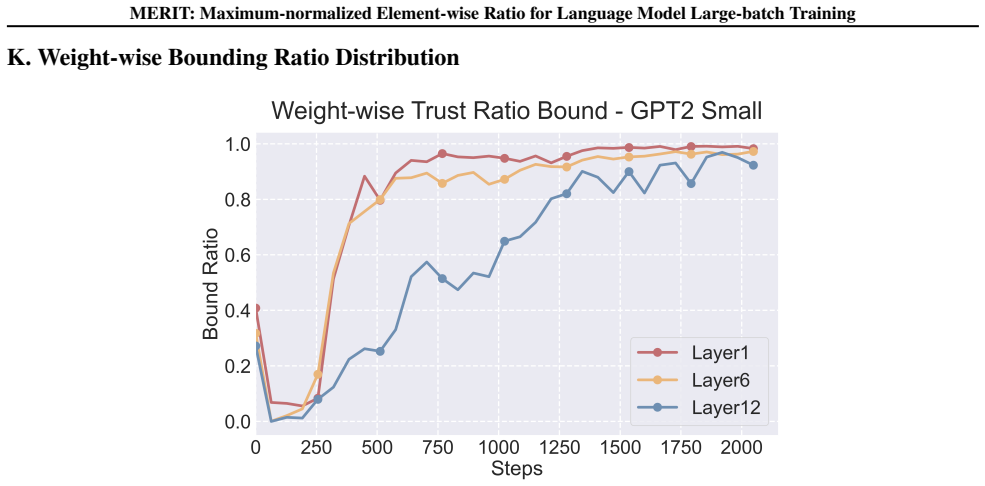
The load-bearing object is the element-wise trust ratio $s^{(i,j)}_t=\max\{r^{(i)}_t, c^{(j)}_t, b_t\}$, where $r$ and $c$ are row-wise and column-wise max-norm ratios $\|w^{(i)}\|_m/\|u^{(i)}+\lambda w^{(i)}\|_m$ and $\|w^{(j)}\|_m/\|u^{(j)}+\lambda w^{(j)}\|_m$, and $b_t$ is the whole-matrix max-norm ratio. Rows are similar because attention is multi-headed, and columns are similar because of outlier dimensions, so a per-element ratio isolates local structure instead of letting one extreme value contaminate the whole layer's update scale. An element-wise clipping operation caps every update at magnitude 1. Together these pieces bound the max-norm of query and key weights, hence bound the max attention logit and prevent the one-hot attention collapse that the paper identifies as the large-batch failure mode.
What would settle it
Repeat the paper's 48B-token GPT-2 Medium comparison with, say, five seeds each for MERIT at batch 6K and AdamW at batch 480, and compute the five-task average with standard errors. If the MERIT average does not exceed the AdamW average, or their confidence intervals overlap broadly, the "no performance degradation" claim fails as stated. Separately, if the max attention logit in the 12th self-attention layer under MERIT grows to the level LAMB reaches at the same step count, the proposed mechanism is not what is doing the work.
Extended reading notes
Core claim
MERIT's central claim is that a finer-grained, max-norm-based version of LAMB's trust ratio removes the large-batch training gap for decoder-only language models. In LAMB, the trust ratio is $R=\|w_t\|/\|u_t+\lambda w_t\|$ with the $l_2$ norm; MERIT computes a weight-wise max-norm ratio, row- and column-wise max-norm ratios, and sets each element's ratio to the maximum of its row ratio, column ratio, and the weight-wise ratio, then clips the update magnitude to 1. Because the attention logit is bounded by $\sqrt{d}\,M_Q M_K C_X^2$, where $M_Q$ and $M_K$ are the max-norms of the query and key weight matrices, controlling max-norm keeps the max attention logit from spiking in mid-depth layers where LAMB still fails. The paper reports that this lowers validation loss on GPT-2 Small, Medium, and Large at batch sizes 1K, 4K, and 8K, and that on GPT-2 Medium with 48B tokens, MERIT at batch 6K matches AdamW at batch 480 on five downstream tasks, averaging 46.70 versus 46.59.
Load-bearing premise
The load-bearing premise is that the reported single-run numbers are representative: the headline "no degradation" for GPT-2 Medium rests on a 0.11-point average downstream difference (46.70 vs 46.59) with no seeds or variance estimate, so if that gap is run-to-run noise the central claim collapses.
Editorial extensions
If this is right
- An optimizer-only change, with no architectural or data changes, can remove the large-batch generalization gap at the tested GPT-2 scales.
- GPT-2 Medium can be trained with a batch size of 6,000 under a 48B-token budget and still match AdamW's 480-batch downstream average, implying about 12.5x more data parallelism at equal quality.
- The gap between MERIT and LAMB grows with model size in the paper's runs, so the reported advantage is not confined to the smallest model.
- MERIT's convergence point has a smaller top Hessian eigenvalue and trace than AdamW's, consistent with landing in a flatter region of the loss landscape.
- Because only the optimizer changes, the speed-up composes with other large-batch techniques such as gradient accumulation and distributed data parallelism.
Reading between the lines
- If the max-attention-logit diagnosis is right, the same failure signature could be monitored online during pretraining: a rising max attention logit in mid-depth layers would signal that the trust-ratio granularity is too coarse, independent of validation-loss movement.
- A testable extension is to apply MERIT at 1B-plus parameter scale with in-context-learning benchmarks; the paper evaluates up to 770M parameters and explicitly leaves larger-scale validation open.
- The optimizer applies its element-wise ratio to all tensors, not just query and key weights, so ablating attention-only updates could reveal whether the gains come from constraining attention logits or from a more general update-scaling benefit.
- The paper does not report a MERIT small-batch run that matches a LAMB small-batch run, so part of the advantage could be optimizer quality rather than batch-size invariance; comparing both optimizers at small and large batches would separate the two effects.
Signed reviews
Editorial analysis
A structured set of objections, weighed in public.
Referee Report
Summary. The paper proposes MERIT, a new optimizer for large-batch training of language models. MERIT modifies LAMB by replacing the l2-norm weight-wise trust ratio with a max-norm weight-wise ratio, adding element-wise row/column trust ratios, and applying an element-wise clipping operation. The motivation is that large-batch AdamW training causes a sharp increase in max attention logits and that LAMB's l2-norm-based ratio does not control the maximum query/key weight values. Experiments compare MERIT against AdamW, LAMB, Lion, and Sophia-G on GPT-2 small/medium/large and on two Llama sizes, reporting validation loss, zero-shot downstream tasks, Hessian curvature, and computational overhead. The headline claim is that MERIT enables a 6k batch size for GPT-2 Medium without performance degradation compared with AdamW at batch size 480, using 48B training tokens. A convergence theorem is provided for a simplified weight-wise max-norm variant, MERIT-W.
Significance. If the central claim were established, the paper would make a practically valuable contribution: an optimizer-only change that supports roughly 12x larger batches while matching small-batch generalization would substantially reduce wall-clock time for LLM pretraining. The work has several genuine strengths: it evaluates four model sizes across two architectures, releases code, provides component ablations, measures computational overhead, and offers a Hessian-curvature analysis that connects MERIT to flatter minima. The max-attention-logit diagnosis is a useful, falsifiable observation that connects the optimizer design to a measurable training instability. However, the headline claim currently rests on a single-run 0.11-point average gap, and the convergence theorem does not analyze the actual algorithm as submitted; both issues are fixable but are load-bearing for the paper's main assertions.
major comments (3)
- [Section 5.3, Table 1] The headline claim that MERIT enables a 6k batch size without performance degradation compared with the standard 480 batch size is not supported by the reported evidence. For GPT-2 Medium, Table 1 shows MERIT at batch 6k averaging 46.70 across five tasks versus AdamW at batch 480 averaging 46.59; this 0.11-point difference comes from a single run of each configuration and is within typical run-to-run variability for a 355M-parameter model. In addition, per-task results are mixed: MERIT is worse on COPA (70 vs 71) and HellaSwag (32.32 vs 32.39). More importantly, the table contains no MERIT run at batch 480 and no AdamW run at batch 4k or 6k, so the experiment cannot distinguish a genuine batch-size-invariance property of MERIT from an optimizer-quality advantage that would appear at any batch size. The authors should provide multiple seeds with standard errors for the headline comparison and add the two missing baselines (MERIT at small batch, AdamW at large batch) to support the claimed 12x batch-size benefit.
- [Section 4.4, Appendix J, Eq. (5)] Theorem 1 analyzes a different algorithm from the one proposed as MERIT. The proof studies MERIT-W with the update in Appendix J Eq. (5), w_{t+1} = w_t - eta_t * (||w_t||_m / ||u_t||_m) * u_t, whereas Algorithm 1 lines 10-12 use the element-wise ratio s_t(i,j) = max{r_t(i), c_t(j), b_t} followed by clip(s_t * (u_t + lambda w_t), 1). The paper's statement that clipping makes it sufficient to study the weight-wise max-norm ratio as a lower bound is not justified: although b_t <= s_t(i,j), this means the pre-clip MERIT update can be larger than the analyzed MERIT-W update, and the clipping operation is not part of the proof. The proof also sets beta_1 = 0 and lambda = 0, so it additionally omits the weight-decay term present in Algorithm 1. As written, the convergence guarantee does not apply to the actual algorithm. The authors should either prove convergence for Algorithm 1 or explicitly restrict the theorem to MERIT-W and support the full algorithm only empirically.
- [Section 5.1, Figures 4-6, Table 3] All main comparisons and ablations are reported as single runs without seeds or variance estimates. The text states in Section 5.2 that MERIT 'consistently achieves lower validation loss' than the baselines, and the ablation study in Figure 9 and Table 3 draws conclusions from differences such as 3.470 (AdamW) versus 3.355 (LAMB) versus 3.280 (MERIT) in GPT-2 Small validation loss. Without at least a small number of seeds and confidence intervals, these differences cannot be distinguished from optimization noise, and the word 'consistently' is not statistically supported. The authors should report seed variation for the central comparisons and for each of the ablations, or explicitly characterize the reported numbers as single-trial observations and soften the claims accordingly.
minor comments (6)
- [Table 1] The column header 'HelllaSwag' is a typo and should read 'HellaSwag'.
- [Section 5.2, Figure 6] The caption of Figure 6 says the Llama experiments use '2.6B tokens ... for GPT-2 small and 8B tokens ... for GPT-2 medium', which mixes the Llama architecture with GPT-2 size names; please clarify that these are Llama models of approximately those sizes.
- [Algorithm 1, Section 4.3] The clip operation in line 12 is written as clip(·, 1), while the text says it 'limits the max update magnitude to 1'; please specify whether this is an element-wise clamp to [-1, 1] or a max-norm projection, since the two interpretations lead to different algorithms.
- [Appendix J] The proof bounds ||u_t||_m but uses u_t = m_t / (sqrt(v_t) + epsilon) in the algorithm while the analysis omits epsilon; please define the exact normalized update used in the proof and justify the bound on its max-norm.
- [Section 5.3] The text says experiments use '48 billion tokens' following the protocol of Liu et al. (2024), but the rest of Section 5.1 specifies 2B/8B/16B token budgets under the Chinchilla protocol; please state explicitly which runs produced Table 1 and how the token budgets relate to the rest of the experiments.
- [Appendix D] The quantity C_X is introduced as a token-dependent sum of absolute input values and then treated as a constant upper bound; if LayerNorm is used, please state explicitly under what conditions C_X is uniformly bounded across tokens.
Circularity Check
No material circularity: MERIT's empirical claims are judged by external validation loss and downstream tasks, not by the max-attention-logit diagnostic that motivated the design; the only notable overlap is a minor non-load-bearing self-citation in the convergence analysis.
full rationale
I walked the derivation chain and found no step in which a claimed prediction reduces by construction to an input or to a self-citation chain. The optimizer design is motivated by an observed correlation between large-batch training and growth of the max attention logit, and the paper argues that max-norm trust ratios bound that logit through the inequality in Appendix D. However, the success criterion is external: validation loss on OpenWebText, perplexity on LAMBADA and WikiText, and SuperGLUE accuracies (Section 5.2, Table 1, Figure 5). Those metrics are not defined in terms of the max attention logit or of the trust-ratio formula, so the empirical comparison is not circular. The trust-ratio framework is a modification of LAMB, and the paper states 'Following the analysis in (You et al., 2020), we focus on the setting where beta1 = 0 and lambda = 0' before proving Theorem 1. This is a self-citation by an overlapping author, but the theorem is re-derived in Appendix J rather than merely asserted, and the central empirical claim does not depend on the convergence proof. One non-circular weakness should be flagged: Section 4.4 says 'we only need to consider the convergence analysis of weight-wise maximum-normalized ratio that is the lower bound of the proposed MERIT, which is noted as MERIT-W,' while Algorithm 1 includes element-wise row/column ratios and clipping. The proof therefore does not establish convergence of the actual algorithm; this is a formal coverage gap, not a circularity. Similarly, the 'no degradation' claim in Table 1 rests on single training runs and lacks a MERIT-small-batch or AdamW-large-batch control, which is a statistical and comparison-design limitation rather than a circular reduction. Because the only notable issue is a minor self-citation that is not load-bearing for the headline result, the circularity score is 2.
Assumptions & free parameters
free parameters (5)
- Peak learning rates (MERIT, LAMB, AdamW) =
MERIT: 9e-3,9e-3,6e-3; LAMB: 1e-2,1e-2,8e-3; AdamW: 1e-3,4e-3,2e-3
- Peak learning rates (Lion, Sophia-G) =
Lion: 1e-4,8e-5,8e-5; Sophia-G: 1e-4,1e-4,2e-4
- Element-wise clipping bound =
1
- Beta and epsilon settings =
AdamW 0.9/0.95; Lion 0.95/0.98; Sophia-G 0.92/0.99; MERIT epsilon not reported
- Weight decay, warmup, gradient clipping =
weight decay 0.1; warmup ratio 0.02; grad clip 1.0
assumptions (7)
- standard math The loss function is Li-smooth per block and stochastic gradients have bounded variance (Assumptions 1 and 2).
- standard math Gradients are bounded element-wise by G (Assumption 3).
- ad hoc to paper The max-norm of the normalized update u satisfies the bound sqrt(2 log(d)/(1-beta2)) and sqrt(v_t) <= G.
- domain assumption Input embeddings X satisfy a bounded absolute-sum constant C_X after LayerNorm.
- domain assumption Rows and columns of query and key weight matrices are highly similar during large-batch training.
- domain assumption The gradients of the loss with respect to W_Q and W_K are independent of the learning rate eta.
- ad hoc to paper Max attention logit growth is a primary cause of large-batch AdamW performance degradation.
Cite this review
Pith. "Pith review of MERIT: Maximum-normalized Element-wise Ratio for Language Model Large-batch Training." pith.science (2026). https://pith.science/paper/SGJNRTRP
@misc{pith2026250820577,
  author       = {Pith},
  title        = {Pith review of: MERIT: Maximum-normalized Element-wise Ratio for Language Model Large-batch Training},
  year         = {2026},
  howpublished = {\url{https://pith.science/paper/SGJNRTRP}},
  note         = {Machine review of arXiv:2508.20577}
}
abstract
Large-batch training has become a cornerstone in accelerating the training of deep neural networks, yet it poses challenges in optimization and generalization. Existing optimizers like AdamW present performance degradation during language models' large-batch training, due to the information bottleneck in attention layers caused by the sharp increase of max attention logit. While the LAMB optimizer partially addresses this issue, some attention layers still face this issue. The reason is that $l_2$-norm-based trust ratios in LAMB are less effective in directly influencing the max value of query/key weights. Furthermore, the weight-wise trust ratio in LAMB is error-prone as it overlooks relationships of weight values within rows or columns. Building on these observations, we propose a novel optimizer, MERIT, which leverages the max-norm to calculate the trust ratio to constrain the max attention logit more effectively. Moreover, we further construct element-wise trust ratios to provide more robust update scaling by focusing on local weight structures. Extensive experiments of large-batch training across various sizes of GPT-2 models demonstrate the superior performance of MERIT. Notably, during the training of GPT-2 Medium, MERIT enables a 6k batch size without any performance degradation compared to the standard batch size (480) with 48B training tokens. This work highlights the importance of considering the max attention logit and finer-granularity trust ratio in large-batch training. It successfully improves the training stability and paves the way for larger batch usage, enabling faster development and iteration of large language models. Code is available at https://github.com/NUS-HPC-AI-Lab/MERIT.
Figures


Figures from the paper (12 more)


Reference graph
Works this paper leans on
-
[1]
Anil, R., Dai, A. M., Firat, O., Johnson, M., Lepikhin, D., Passos, A., Shakeri, S., Taropa, E., Bailey, P., Chen, Z., Chu, E., Clark, J. H., Shafey, L. E., Huang, Y., Meier-Hellstern, K., Mishra, G., Moreira, E., Omernick, M., Robinson, K., Ruder, S., Tay, Y., Xiao, K., Xu, Y., Zhang, Y., Abrego, G. H., Ahn, J., Austin, J., Barham, P., Botha, J., Bradbur...
arXiv 2023
-
[2]
Ba, J. L., Kiros, J. R., and Hinton, G. E. Layer normalization, 2016. URL https://arxiv.org/abs/1607.06450
arXiv 2016
-
[3]
signsgd: Compressed optimisation for non-convex problems, 2018
Bernstein, J., Wang, Y.-X., Azizzadenesheli, K., and Anandkumar, A. signsgd: Compressed optimisation for non-convex problems, 2018. URL https://arxiv.org/abs/1802.04434
arXiv 2018
-
[4]
Brown, T. B., Mann, B., Ryder, N., Subbiah, M., Kaplan, J., Dhariwal, P., Neelakantan, A., Shyam, P., Sastry, G., Askell, A., Agarwal, S., Herbert-Voss, A., Krueger, G., Henighan, T., Child, R., Ramesh, A., Ziegler, D. M., Wu, J., Winter, C., Hesse, C., Chen, M., Sigler, E., Litwin, M., Gray, S., Chess, B., Clark, J., Berner, C., McCandlish, S., Radford, ...
arXiv 2020
-
[5]
Chen, X., Liang, C., Huang, D., Real, E., Wang, K., Liu, Y., Pham, H., Dong, X., Luong, T., Hsieh, C.-J., Lu, Y., and Le, Q. V. Symbolic discovery of optimization algorithms, 2023. URL https://arxiv.org/abs/2302.06675
arXiv 2023
-
[6]
Chowdhery, A., Narang, S., Devlin, J., Bosma, M., Mishra, G., Roberts, A., Barham, P., Chung, H. W., Sutton, C., Gehrmann, S., Schuh, P., Shi, K., Tsvyashchenko, S., Maynez, J., Rao, A., Barnes, P., Tay, Y., Shazeer, N., Prabhakaran, V., Reif, E., Du, N., Hutchinson, B., Pope, R., Bradbury, J., Austin, J., Isard, M., Gur-Ari, G., Yin, P., Duke, T., Levska...
arXiv 2022
-
[7]
Dehghani, M., Djolonga, J., Mustafa, B., Padlewski, P., Heek, J., Gilmer, J., Steiner, A. P., Caron, M., Geirhos, R., Alabdulmohsin, I., Jenatton, R., Beyer, L., Tschannen, M., Arnab, A., Wang, X., Riquelme Ruiz, C., Minderer, M., Puigcerver, J., Evci, U., Kumar, M., Steenkiste, S. V., Elsayed, G. F., Mahendran, A., Yu, F., Oliver, A., Huot, F., Bastings,...
work page 2023
-
[8]
An image is worth 16x16 words: Transformers for image recognition at scale
Dosovitskiy, A., Beyer, L., Kolesnikov, A., Weissenborn, D., Zhai, X., Unterthiner, T., Dehghani, M., Minderer, M., Heigold, G., Gelly, S., Uszkoreit, J., and Houlsby, N. An image is worth 16x16 words: Transformers for image recognition at scale. In International Conference on Learning Representations, 2021. URL https://openreview.net/forum?id=YicbFdNTTy
2021
Show all 39 references
-
[9]
The llama 3 herd of models, 2024
Dubey, A., Jauhri, A., Pandey, A., Kadian, A., Al-Dahle, A., Letman, A., Mathur, A., Schelten, A., Yang, A., Fan, A., Goyal, A., Hartshorn, A., Yang, A., Mitra, A., Sravankumar, A., Korenev, A., Hinsvark, A., Rao, A., Zhang, A., Rodriguez, A., Gregerson, A., Spataru, A., and e...
2024 arXiv
-
[10]
Sharpness-aware minimization for efficiently improving generalization
Foret, P., Kleiner, A., Mobahi, H., and Neyshabur, B. Sharpness-aware minimization for efficiently improving generalization. In International Conference on Learning Representations, 2021. URL https://openreview.net/forum?id=6Tm1mposlrM
2021
-
[11]
and Cohen, V
Gokaslan, A. and Cohen, V. Openwebtext corpus. http://Skylion007.github.io/OpenWebTextCorpus, 2019
2019
-
[12]
Accurate, large minibatch sgd: Training imagenet in 1 hour, 2018
Goyal, P., Dollár, P., Girshick, R., Noordhuis, P., Wesolowski, L., Kyrola, A., Tulloch, A., Jia, Y., and He, K. Accurate, large minibatch sgd: Training imagenet in 1 hour, 2018. URL https://arxiv.org/abs/1706.02677
2018 arXiv
-
[13]
A., Welbl, J., Clark, A., Hennigan, T., Noland, E., Millican, K., van den Driessche, G., Damoc, B., Guy, A., Osindero, S., Simonyan, K., Elsen, E., Vinyals, O., Rae, J
Hoffmann, J., Borgeaud, S., Mensch, A., Buchatskaya, E., Cai, T., Rutherford, E., de las Casas, D., Hendricks, L. A., Welbl, J., Clark, A., Hennigan, T., Noland, E., Millican, K., van den Driessche, G., Damoc, B., Guy, A., Osindero, S., Simonyan, K., Elsen, E., Vinyals, O., Ra...
2022
-
[14]
B., Chess, B., Child, R., Gray, S., Radford, A., Wu, J., and Amodei, D
Kaplan, J., McCandlish, S., Henighan, T., Brown, T. B., Chess, B., Child, R., Gray, S., Radford, A., Wu, J., and Amodei, D. Scaling laws for neural language models, 2020. URL https://arxiv.org/abs/2001.08361
2020 arXiv
-
[15]
S., Mudigere, D., Nocedal, J., Smelyanskiy, M., and Tang, P
Keskar, N. S., Mudigere, D., Nocedal, J., Smelyanskiy, M., and Tang, P. T. P. On large-batch training for deep learning: Generalization gap and sharp minima. In International Conference on Learning Representations, 2017. URL https://openreview.net/forum?id=H1oyRlYgg
2017
-
[16]
Kingma, D. P. and Ba, J. Adam: A method for stochastic optimization, 2017. URL https://arxiv.org/abs/1412.6980
2017 arXiv
-
[17]
BERT busters: Outlier dimensions that disrupt transformers
Kovaleva, O., Kulshreshtha, S., Rogers, A., and Rumshisky, A. BERT busters: Outlier dimensions that disrupt transformers. In Zong, C., Xia, F., Li, W., and Navigli, R. (eds.), Findings of the Association for Computational Linguistics: ACL-IJCNLP 2021, pp.\ 3392--3405, Online, ...
2021 doi
-
[18]
Liu, H., Li, Z., Hall, D. L. W., Liang, P., and Ma, T. Sophia: A scalable stochastic second-order optimizer for language model pre-training. In The Twelfth International Conference on Learning Representations, 2024. URL https://openreview.net/forum?id=3xHDeA8Noi
2024
-
[19]
Towards efficient and scalable sharpness-aware minimization, 2022
Liu, Y., Mai, S., Chen, X., Hsieh, C.-J., and You, Y. Towards efficient and scalable sharpness-aware minimization, 2022. URL https://arxiv.org/abs/2203.02714
2022 arXiv
-
[20]
and Hutter, F
Loshchilov, I. and Hutter, F. Decoupled weight decay regularization, 2019. URL https://arxiv.org/abs/1711.05101
2019 arXiv
-
[21]
Came: Confidence-guided adaptive memory efficient optimization
Luo, Y., Ren, X., Zheng, Z., Jiang, Z., Jiang, X., and You, Y. Came: Confidence-guided adaptive memory efficient optimization. In Proceedings of the 61st Annual Meeting of the Association for Computational Linguistics (Volume 1: Long Papers), pp.\ 4442--4453, 2023
2023
-
[22]
Pointer sentinel mixture models
Merity, S., Xiong, C., Bradbury, J., and Socher, R. Pointer sentinel mixture models. In International Conference on Learning Representations, 2017. URL https://openreview.net/forum?id=Byj72udxe
2017
-
[23]
Muennighoff, N., Rush, A., Barak, B., Le Scao, T., Tazi, N., Piktus, A., Pyysalo, S., Wolf, T., and Raffel, C. A. Scaling data-constrained language models. In Oh, A., Naumann, T., Globerson, A., Saenko, K., Hardt, M., and Levine, S. (eds.), Advances in Neural Information Proce...
2023
-
[24]
Gpt-4 technical report, 2024
OpenAI. Gpt-4 technical report, 2024. URL https://arxiv.org/abs/2303.08774
2024 arXiv
-
[25]
Q., Bernardi, R., Pezzelle, S., Baroni, M., Boleda, G., and Fern \'a ndez, R
Paperno, D., Kruszewski, G., Lazaridou, A., Pham, N. Q., Bernardi, R., Pezzelle, S., Baroni, M., Boleda, G., and Fern \'a ndez, R. The LAMBADA dataset: Word prediction requiring a broad discourse context. In Erk, K. and Smith, N. A. (eds.), Proceedings of the 54th Annual Meeti...
2016 doi
-
[26]
Pytorch: An imperative style, high-performance deep learning library, 2019
Paszke, A., Gross, S., Massa, F., Lerer, A., Bradbury, J., Chanan, G., Killeen, T., Lin, Z., Gimelshein, N., Antiga, L., Desmaison, A., Köpf, A., Yang, E., DeVito, Z., Raison, M., Tejani, A., Chilamkurthy, S., Steiner, B., Fang, L., Bai, J., and Chintala, S. Pytorch: An impera...
2019 arXiv
-
[27]
Outlier dimensions that disrupt transformers are driven by frequency
Puccetti, G., Rogers, A., Drozd, A., and Dell ' Orletta, F. Outlier dimensions that disrupt transformers are driven by frequency. In Goldberg, Y., Kozareva, Z., and Zhang, Y. (eds.), Findings of the Association for Computational Linguistics: EMNLP 2022, pp.\ 1286--1304, Abu Dh...
2022 doi
-
[28]
Language models are unsupervised multitask learners
Radford, A., Wu, J., Child, R., Luan, D., Amodei, D., and Sutskever, I. Language models are unsupervised multitask learners. 2019. URL https://api.semanticscholar.org/CorpusID:160025533
2019
-
[29]
Raffel, C., Shazeer, N., Roberts, A., Lee, K., Narang, S., Matena, M., Zhou, Y., Li, W., and Liu, P. J. Exploring the limits of transfer learning with a unified text-to-text transformer, 2023. URL https://arxiv.org/abs/1910.10683
2023 arXiv
-
[30]
J., Lee, J., Antognini, J., Sohl-Dickstein, J., Frostig, R., and Dahl, G
Shallue, C. J., Lee, J., Antognini, J., Sohl-Dickstein, J., Frostig, R., and Dahl, G. E. Measuring the effects of data parallelism on neural network training, 2019. URL https://arxiv.org/abs/1811.03600
2019 arXiv
-
[31]
Dropout: a simple way to prevent neural networks from overfitting
Srivastava, N., Hinton, G., Krizhevsky, A., Sutskever, I., and Salakhutdinov, R. Dropout: a simple way to prevent neural networks from overfitting. J. Mach. Learn. Res., 15 0 (1): 0 1929–1958, January 2014. ISSN 1532-4435
1929
-
[32]
Llama: Open and efficient foundation language models, 2023
Touvron, H., Lavril, T., Izacard, G., Martinet, X., Lachaux, M.-A., Lacroix, T., Rozière, B., Goyal, N., Hambro, E., Azhar, F., Rodriguez, A., Joulin, A., Grave, E., and Lample, G. Llama: Open and efficient foundation language models, 2023. URL https://arxiv.org/abs/2302.13971
2023 arXiv
-
[33]
N., Kaiser, L
Vaswani, A., Shazeer, N., Parmar, N., Uszkoreit, J., Jones, L., Gomez, A. N., Kaiser, L. u., and Polosukhin, I. Attention is all you need. In Guyon, I., Luxburg, U. V., Bengio, S., Wallach, H., Fergus, R., Vishwanathan, S., and Garnett, R. (eds.), Advances in Neural Informatio...
2017
-
[34]
Superglue: A stickier benchmark for general-purpose language understanding systems
Wang, A., Pruksachatkun, Y., Nangia, N., Singh, A., Michael, J., Hill, F., Levy, O., and Bowman, S. Superglue: A stickier benchmark for general-purpose language understanding systems. In Wallach, H., Larochelle, H., Beygelzimer, A., d Alch\' e -Buc, F., Fox, E., and Garnett, R...
2019
-
[35]
J., Xiao, L., Everett, K
Wortsman, M., Liu, P. J., Xiao, L., Everett, K. E., Alemi, A. A., Adlam, B., Co-Reyes, J. D., Gur, I., Kumar, A., Novak, R., Pennington, J., Sohl-Dickstein, J., Xu, K., Lee, J., Gilmer, J., and Kornblith, S. Small-scale proxies for large-scale transformer training instabilitie...
2024
-
[36]
Large batch training of convolutional networks, 2017
You, Y., Gitman, I., and Ginsburg, B. Large batch training of convolutional networks, 2017. URL https://arxiv.org/abs/1708.03888
2017 arXiv
-
[37]
Large batch optimization for deep learning: Training bert in 76 minutes, 2020
You, Y., Li, J., Reddi, S., Hseu, J., Kumar, S., Bhojanapalli, S., Song, X., Demmel, J., Keutzer, K., and Hsieh, C.-J. Large batch optimization for deep learning: Training bert in 76 minutes, 2020. URL https://arxiv.org/abs/1904.00962
2020 arXiv
-
[38]
Zhai, S., Likhomanenko, T., Littwin, E., Busbridge, D., Ramapuram, J., Zhang, Y., Gu, J., and Susskind, J. M. Stabilizing transformer training by preventing attention entropy collapse. In Krause, A., Brunskill, E., Cho, K., Engelhardt, B., Sabato, S., and Scarlett, J. (eds.), ...
2023
-
[39]
write newline
" write newline "" before.all 'output.state := FUNCTION n.dashify 't := "" t empty not t #1 #1 substring "-" = t #1 #2 substring "--" = not "--" * t #2 global.max substring 't := t #1 #1 substring "-" = "-" * t #2 global.max substring 't := while if t #1 #1 substring * t #2 gl...
Reviewed August 15, 2026 · model on record in the stance chip above.
Discussion (0). Continue with ORCID to comment.