REVIEW 3 major objections 6 minor 40 references
C3-GS enhances generalizable Gaussian splatting with three lightweight feature modules—coordinate-guided attention, cross-dimensional attention, and cross-scale fusion—achieving state-of-the-art rendering and generalization from sparse pose
Reviewed by Pith at T0; open to challenge. T0 means a machine referee read the full paper against a public rubric. the ladder, T0–T4 →
C3-GS improves generalizable Gaussian Splatting by adding coordinate-aware attention, cross-dimensional attention, and cross-scale opacity fusion to the MVSGaussian baseline.
T0 review reviewed 2026-08-05 challenge →
load-bearing objection Incremental but solid improvement on MVSGaussian for generalizable Gaussian splatting; the modules work in ablations, but the SOTA claim rests on small margins without error bars. the 3 major comments →
${C}^{3}$-GS: Learning Context-aware, Cross-dimension, Cross-scale Feature for Generalizable Gaussian Splatting
The pith
A machine-rendered reading of the paper's core claim, the machinery that carries it, and where it could break.
The reading
Core claim
The paper establishes that enhancing source-view features in three complementary ways—coordinate-aware long-range attention, cross-dimensional 2D-3D attention, and cross-scale opacity modulation—makes feed-forward Gaussian parameter prediction more geometry-consistent and visually accurate. The three modules plug into the MVSGaussian coarse-to-fine cost-volume framework, adding negligible overhead, and produce consistent gains on DTU (3-view PSNR 27.03 → 27.87) and on datasets unseen during training, plus better depth maps. The central claim is that explicit multi-scale, multi-dimensional feature constraints substitute for depth or mask supervision.
What carries the argument
CGA (Coordinate-Guided Attention) pools features along height and width, merges them through a 1D convolution and sigmoid, and applies the resulting attention maps multiplicatively to modulate feature responses, capturing long-range spatial dependencies while keeping coordinate cues. CDA (Cross-Dimensional Attention) concatenates voxel features sampled from the 3D cost volume with aggregated 2D image features, then uses this fused representation as a query in cross-view attention over the source-view 2D features, jointly integrating geometric consistency and appearance detail. CSF (Cross-Scale Fusion) concatenates Gaussian features from adjacent coarse and fine stages, predicts a modulation
Load-bearing premise
The cost volume built via differentiable homography from a few posed views must produce trustworthy Gaussian centers; when that geometry estimate fails under wide baselines or extrapolated viewpoints, the added feature modules cannot compensate.
What would settle it
Run C3-GS and its MVSGaussian baseline on a wide-baseline or view-extrapolation benchmark where target views lie outside the input camera arc; if PSNR degrades to baseline levels, the stated limitation dominates. Also perform a one-module-at-a-time ablation on a held-out dataset to verify the reported gains are not specific to DTU.
If this is right
- If the claim holds, generalizable Gaussian splatting can approach per-scene-optimization quality without per-scene training, using only posed images as supervision.
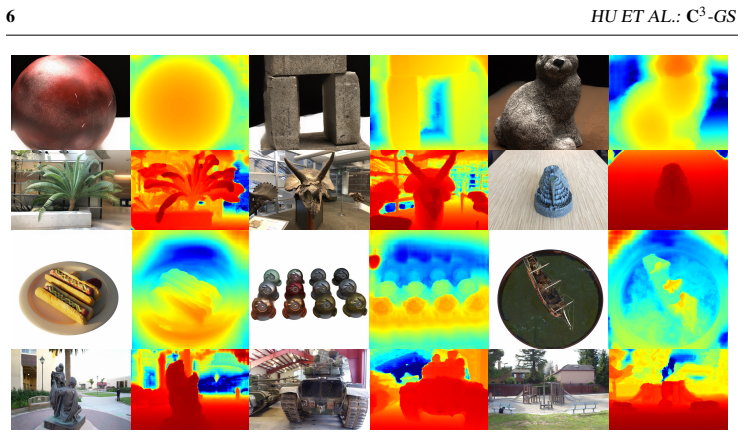
- The intermediate depth maps improve as a byproduct, strengthening multi-view reconstruction tasks that consume predicted depth.
- The modules are lightweight and architecture-agnostic enough to be added to other cost-volume-based generalizable splatting pipelines.
- Cross-scale opacity modulation suggests that scale relationships among Gaussians are a cheap lever for visual quality; refining only opacity is sufficient in practice.
- The framework works with varying view counts (2, 3, 4) trained consistently, easing deployment where scene capture density is not fixed.
Where Pith is reading between the lines
- One could test whether CDA's query design generalizes to transformer-based MVS features (e.g., MVSFormer) or to monocular depth priors, potentially reducing dependence on the cost volume for Gaussian centers.
- The ablation pattern—CGA alone helps little while CDA and CSF help more—suggests cross-view consistency and scale modeling matter more than 2D receptive field; ablating under wide-baseline or view-extrapolation conditions could reveal where each module fails first.
- The opacity-only cross-scale refinement could be stacked or applied iteratively for further multi-scale refinement, a natural extension beyond the paper's single-step design.
- Because the method is built on MVSGaussian, the gains may be partly inherited from that baseline's cost volume; a ceteris-paribus test on another base (e.g., MVSplat) would show whether the modules transfer.
Editorial analysis
A structured set of objections, weighed in public.
Referee Report
Summary. The paper proposes C3-GS, a generalizable 3D Gaussian Splatting framework built on top of MVSGaussian. It introduces three lightweight modules: Coordinate-Guided Attention (CGA) for coordinate-aware 2D feature enhancement, Cross-Dimensional Attention (CDA) to fuse 2D appearance features with 3D cost-volume features, and Cross-Scale Fusion (CSF) to modulate Gaussian opacity across coarse-to-fine stages. The method is trained on DTU with only image supervision and evaluated for generalization on Real Forward-facing, NeRF Synthetic, and Tanks and Temples. The paper reports improved PSNR/SSIM/LPIPS and depth accuracy over several baselines, with ablations attributing gains to the proposed modules. Code is released.
Significance. If the reported gains are robust, C3-GS provides a simple and effective extension to MVSGaussian, improving feature learning for generalizable Gaussian Splatting without additional supervision. The three modules are conceptually clear, the experiments cover four standard benchmarks, and the paper includes ablations and resource analysis. The code release is a strength. However, the central 'state-of-the-art' claim is tempered by small and somewhat inconsistent margins, single-run results without uncertainty estimates, and the absence of a capacity-matched baseline. The acknowledged limitations (wide-baseline scenarios, view extrapolation) appropriately bound the scope of the claim.
major comments (3)
- [Section 4, Tables 1, 2, 5] The paper reports single-run metrics without error bars or repeated runs. Several decisive margins are small: Real Forward-facing 3-view PSNR improves by only +0.10 dB (23.97 vs 23.87), and the CGA-only ablation in Table 5 gains +0.04 dB. On Real Forward-facing 2-view, the method is worse than the baseline in PSNR (22.32 vs 22.58) and LPIPS (0.201 vs 0.192). Since the MVSGaussian baseline was retrained once (Sec. 4.1), it is unclear whether these differences are beyond training noise. The 'state-of-the-art' claim at 3 and 4 views requires multi-seed or per-scene bootstrap uncertainty estimates.
- [Section 4.4 / Table 5] No capacity-matched baseline is included. The proposed modules add parameters and computational cost; without a control that increases capacity equally but without CGA/CDA/CSF, the observed gains cannot be attributed specifically to the proposed mechanisms rather than to added model capacity. A parameter count / FLOP comparison or a capacity-matched ablation is needed to support the claim that the modules themselves are the cause of the improvement.
- [Abstract and Section 4.2] The claim of 'state-of-the-art rendering quality and generalization ability' is too broad. While the method is top-ranked for 3 and 4 views on most benchmarks, Table 2 shows a regression on Real Forward-facing 2-view PSNR (22.32 vs 22.58), and Table 1 shows 2-view PSNR below MatchNeRF. The text only explains the latter via MatchNeRF's optical-flow prior. The headline claim should be qualified to the settings where the evidence holds.
minor comments (6)
- [Sec. 3.2, Eq. (12)] The decision to update only opacity in CSF is stated as empirically motivated, but no ablation is shown comparing opacity-only against updating all Gaussian attributes. Please add this ablation or soften the claim.
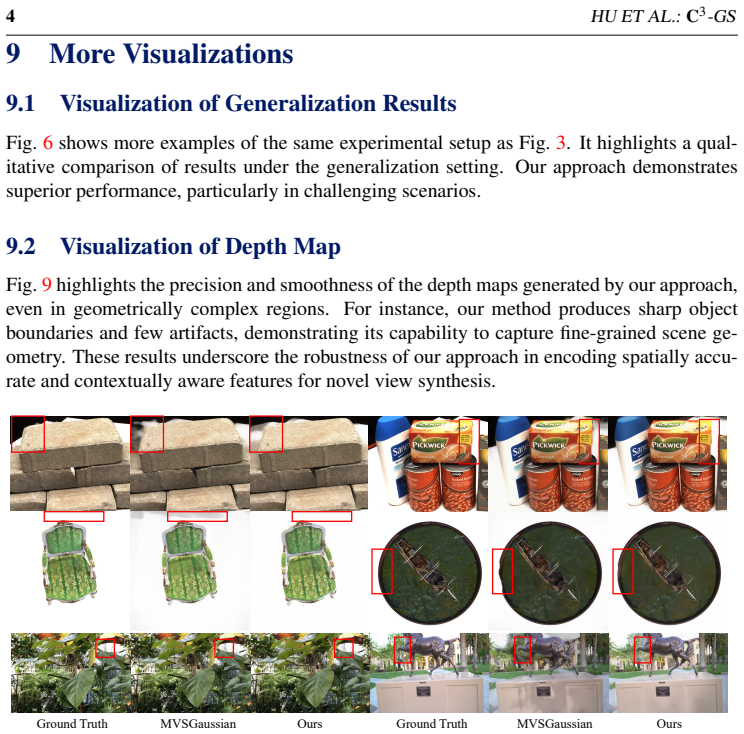
- [Sec. 4.1] The text states that MVPGS is 're-trained a fixed number of times' but gives no details; the MVSGaussian baseline training is similarly described without specifying the number of runs or seeds. Please state the exact procedure.
- [Table 4] IBRNet's Abs err value of 324 appears anomalously large relative to other methods. Please verify the number or add a note explaining this outlier.
- [Fig. 2 caption] The acronyms CGA, CDA, CSF are used in the caption without being spelled out. Define them in the caption or refer to Section 3.
- [Supplementary Sec. 6.2] The statement 'we achieve the best PSNR performance in Table 1 under the 2-views setting' is only true when training with 2 views (Table 6). This nuance should be clarified in the main text to avoid confusion.
- [Conclusion] The limitations are clearly stated and appreciated. Consider moving them to a dedicated 'Limitations' subsection for greater visibility.
Circularity Check
No significant circularity: the central claim is an empirical, externally evaluated improvement; modules are specified by explicit equations and tested on held-out benchmarks.
full rationale
The paper's derivation chain is a trained neural architecture, not an analytic derivation from fitted constants. The three proposed modules (CGA, CDA, CSF) are defined by explicit equations (Eqs. 1-12) and trained end-to-end using the image-based loss in Eq. 13. There is no step in which an output quantity is defined in terms of the target metric, no fitted parameter is later relabeled as a prediction, and no 'uniqueness theorem' is imported from the authors' prior work to force a particular design. The self-citations [14,39] are used only as inspiration for the CGA module; the module itself is specified and ablated in the present paper, and the state-of-the-art claim rests on held-out benchmarks (DTU for training; Real Forward-facing, NeRF Synthetic, Tanks and Temples for direct generalization) rather than on those citations. The baseline MVSGaussian [23] is retrained from scratch for fair comparison, and the conclusion explicitly acknowledges failure modes in wide-baseline and view-extrapolation settings. The absence of multi-seed error bars is a statistical robustness concern, not evidence of circularity. No circular step can be exhibited from the paper's own equations or citations.
Axiom & Free-Parameter Ledger
free parameters (3)
- loss weights (βs, βp, γ(1), γ(2)) =
βs=0.1, βp=0.05, γ(1)=0.5, γ(2)=1
- number of depth hypotheses =
64 (coarse), 8 (fine)
- number of source views during training =
3
axioms (4)
- standard math The differentiable Gaussian splatting rasterizer provides a correct gradient model for end-to-end training.
- domain assumption Source images come with accurate camera poses and intrinsic parameters.
- domain assumption A cost volume built from a sparse set of views is a sufficient geometry prior for accurate Gaussian centers.
- ad hoc to paper The Cross-Scale Fusion module should update only opacity and not other Gaussian attributes.
invented entities (3)
-
CGA (Coordinate-Guided Attention)
independent evidence
-
CDA (Cross-Dimensional Attention)
independent evidence
-
CSF (Cross-Scale Fusion)
independent evidence
Cite this review
Pith. "Pith review of ${C}^{3}$-GS: Learning Context-aware, Cross-dimension, Cross-scale Feature for Generalizable Gaussian Splatting." pith.science (2026). https://pith.science/paper/RTBUR4IV
@misc{pith2026250820754,
  author       = {Pith},
  title        = {Pith review of: $C^3$-GS: Learning Context-aware, Cross-dimension, Cross-scale Feature for Generalizable Gaussian Splatting},
  year         = {2026},
  howpublished = {\url{https://pith.science/paper/RTBUR4IV}},
  note         = {Machine review of arXiv:2508.20754}
}
abstract
Generalizable Gaussian Splatting aims to synthesize novel views for unseen scenes without per-scene optimization. In particular, recent advancements utilize feed-forward networks to predict per-pixel Gaussian parameters, enabling high-quality synthesis from sparse input views. However, existing approaches fall short in encoding discriminative, multi-view consistent features for Gaussian predictions, which struggle to construct accurate geometry with sparse views. To address this, we propose $\mathbf{C}^{3}$-GS, a framework that enhances feature learning by incorporating context-aware, cross-dimension, and cross-scale constraints. Our architecture integrates three lightweight modules into a unified rendering pipeline, improving feature fusion and enabling photorealistic synthesis without requiring additional supervision. Extensive experiments on benchmark datasets validate that $\mathbf{C}^{3}$-GS achieves state-of-the-art rendering quality and generalization ability. Code is available at: https://github.com/YuhsiHu/C3-GS.
Figures





Reference graph
Works this paper leans on
-
[1]
Chenjie Cao, Xinlin Ren, and Yanwei Fu. Mvsformer: Multi-view stereo by learning robust image features and temperature-based depth.Transactions on Machine Learning Research, 2023
work page 2023
-
[2]
DiffSSC: Semantic LiDAR Scan Completion using Denoising Diffusion Probabilistic Models
Helin Cao and Sven Behnke. DiffSSC: Semantic LiDAR scan completion using de- noising diffusion probabilistic models. arXiv preprint arXiv:2409.18092, 2024
work page internal anchor Pith review Pith/arXiv arXiv 2024
-
[3]
SLCF-Net: Sequential LiDAR-camera fusion for seman- tic scene completion using a 3D recurrent U-Net
Helin Cao and Sven Behnke. SLCF-Net: Sequential LiDAR-camera fusion for seman- tic scene completion using a 3D recurrent U-Net. In IEEE International Conference on Robotics and Automation, pages 2767–2773, 2024
work page 2024
-
[4]
pixel- splat: 3d gaussian splats from image pairs for scalable generalizable 3d reconstruction
David Charatan, Sizhe Lester Li, Andrea Tagliasacchi, and Vincent Sitzmann. pixel- splat: 3d gaussian splats from image pairs for scalable generalizable 3d reconstruction. In Proceedings of the IEEE/CVF Conference on Computer Vision and Pattern Recog- nition, pages 19457–19467, 2024. HU ET AL.: C3-GS 11
work page 2024
-
[5]
Mvsnerf: Fast generalizable radiance field reconstruction from multi-view stereo
Anpei Chen, Zexiang Xu, Fuqiang Zhao, Xiaoshuai Zhang, Fanbo Xiang, Jingyi Yu, and Hao Su. Mvsnerf: Fast generalizable radiance field reconstruction from multi-view stereo. In Proceedings of the IEEE/CVF Conference on Computer Vision and Pattern Recognition, pages 14124–14133, 2021
work page 2021
-
[6]
Evloc: Event-based visual lo- calization in lidar maps via event-depth registration
Kuangyi Chen, Jun Zhang, and Friedrich Fraundorfer. Evloc: Event-based visual lo- calization in lidar maps via event-depth registration. In IEEE International Conference on Robotics and Automation , 2025
work page 2025
-
[7]
Mvsplat: Efficient 3d gaussian splatting from sparse multi-view images
Yuedong Chen, Haofei Xu, Chuanxia Zheng, Bohan Zhuang, Marc Pollefeys, Andreas Geiger, Tat-Jen Cham, and Jianfei Cai. Mvsplat: Efficient 3d gaussian splatting from sparse multi-view images. In Proceedings of the European Conference on Computer Vision, pages 370–386, 2024
work page 2024
-
[8]
Explicit correspondence matching for generalizable neural radiance fields
Yuedong Chen, Haofei Xu, Qianyi Wu, Chuanxia Zheng, Tat-Jen Cham, and Jianfei Cai. Explicit correspondence matching for generalizable neural radiance fields. IEEE Transactions on Pattern Analysis and Machine Intelligence, 2025
work page 2025
-
[9]
Transmvsnet: Global context-aware multi-view stereo network with transformers
Yikang Ding, Wentao Yuan, Qingtian Zhu, Haotian Zhang, Xiangyue Liu, Yuanjiang Wang, and Xiao Liu. Transmvsnet: Global context-aware multi-view stereo network with transformers. In Proceedings of the IEEE/CVF Conference on Computer Vision and Pattern Recognition, pages 8585–8594, 2022
work page 2022
-
[10]
Object-centered surface reconstruction: Combining multi-image stereo and shading
Pascal Fua and Yvan G Leclerc. Object-centered surface reconstruction: Combining multi-image stereo and shading. International Journal of Computer Vision , 16(1):35– 56, 1995
work page 1995
-
[11]
Massively parallel multi- view stereopsis by surface normal diffusion
Silvano Galliani, Katrin Lasinger, and Konrad Schindler. Massively parallel multi- view stereopsis by surface normal diffusion. In Proceedings of the IEEE International Conference on Computer Vision, pages 873–881, 2015
work page 2015
-
[12]
Cas- cade cost volume for high-resolution multi-view stereo and stereo matching
Xiaodong Gu, Zhiwen Fan, Siyu Zhu, Zuozhuo Dai, Feitong Tan, and Ping Tan. Cas- cade cost volume for high-resolution multi-view stereo and stereo matching. In Pro- ceedings of the IEEE/CVF Conference on Computer Vision and Pattern Recognition , pages 2495–2504, 2020
work page 2020
-
[13]
3d map recon- struction using a monocular camera for smart cities
Yuxi Hu, Taimeng Fu, Guanchong Niu, Zixiao Liu, and Man-On Pun. 3d map recon- struction using a monocular camera for smart cities. The Journal of Supercomputing , 78(14):16512–16528, 2022
work page 2022
-
[14]
Icg-mvsnet: Learning intra-view and cross-view rela- tionships for guidance in multi-view stereo
Yuxi Hu, Jun Zhang, Zhe Zhang, Rafael Weilharter, Yuchen Rao, Kuangyi Chen, Runze Yuan, and Friedrich Fraundorfer. Icg-mvsnet: Learning intra-view and cross-view rela- tionships for guidance in multi-view stereo. In Proceedings of the IEEE International Conference on Multimedia and Expo , 2025
work page 2025
-
[15]
Large scale multi-view stereopsis evaluation
Rasmus Jensen, Anders Dahl, George V ogiatzis, Engin Tola, and Henrik Aanæs. Large scale multi-view stereopsis evaluation. In Proceedings of the IEEE/CVF Conference on Computer Vision and Pattern Recognition, pages 406–413, 2014
work page 2014
-
[16]
3d gaussian splatting for real-time radiance field rendering
Bernhard Kerbl, Georgios Kopanas, Thomas Leimkühler, and George Drettakis. 3d gaussian splatting for real-time radiance field rendering. ACM Transactions on Graph- ics, 42(4), 2023. 12 HU ET AL.: C3-GS
work page 2023
-
[17]
Adam: A method for stochastic optimization
Diederik P Kingma and Jimmy Ba. Adam: A method for stochastic optimization. arXiv preprint arXiv:1412.6980, 2014
Pith/arXiv arXiv 2014
-
[18]
Tanks and temples benchmarking large-scale scene reconstruction
Arno Knapitsch, Jaesik Park, Qian-Yi Zhou, and Vladlen Koltun. Tanks and temples benchmarking large-scale scene reconstruction. ACM Transactions on Graphics , 36 (4):1–13, 2017
work page 2017
-
[19]
Yuqi Li, Junhao Dong, Zeyu Dong, Chuanguang Yang, Zhulin An, and Yongjun Xu. Srkd: Towards efficient 3d point cloud segmentation via structure-and relation-aware knowledge distillation. arXiv preprint arXiv:2506.17290, 2025
Pith/arXiv arXiv 2025
-
[20]
Frequency-Aligned Knowledge Distillation for Lightweight Spatiotemporal Forecasting
Yuqi Li, Chuangang Yang, Hansheng Zeng, Zeyu Dong, Zhulin An, Yongjun Xu, Yingli Tian, and Hao Wu. Frequency-aligned knowledge distillation for lightweight spatiotemporal forecasting. arXiv:2507.02939, 2025
work page internal anchor Pith review Pith/arXiv arXiv 2025
-
[21]
Feature pyramid networks for object detection
Tsung-Yi Lin, Piotr Dollár, Ross Girshick, Kaiming He, Bharath Hariharan, and Serge Belongie. Feature pyramid networks for object detection. In Proceedings of the IEEE/CVF Conference on Computer Vision and Pattern Recognition , pages 2117– 2125, 2017
work page 2017
-
[22]
Geometry-aware reconstruction and fusion-refined rendering for generalizable neural radiance fields
Tianqi Liu, Xinyi Ye, Min Shi, Zihao Huang, Zhiyu Pan, Zhan Peng, and Zhiguo Cao. Geometry-aware reconstruction and fusion-refined rendering for generalizable neural radiance fields. In Proceedings of the IEEE/CVF Conference on Computer Vision and Pattern Recognition, pages 7654–7663, 2024
work page 2024
-
[23]
Mvsgaussian: Fast generalizable gaussian splat- ting reconstruction from multi-view stereo
Tianqi Liu, Guangcong Wang, Shoukang Hu, Liao Shen, Xinyi Ye, Yuhang Zang, Zhiguo Cao, Wei Li, and Ziwei Liu. Mvsgaussian: Fast generalizable gaussian splat- ting reconstruction from multi-view stereo. InProceedings of the European Conference on Computer Vision, pages 37–53, 2025
work page 2025
-
[24]
Local light field fusion: Practical view synthesis with prescriptive sampling guidelines
Ben Mildenhall, Pratul P Srinivasan, Rodrigo Ortiz-Cayon, Nima Khademi Kalantari, Ravi Ramamoorthi, Ren Ng, and Abhishek Kar. Local light field fusion: Practical view synthesis with prescriptive sampling guidelines. ACM Transactions on Graphics , 38 (4):1–14, 2019
work page 2019
-
[25]
Srinivasan, Matthew Tancik, Jonathan T
Ben Mildenhall, Pratul P. Srinivasan, Matthew Tancik, Jonathan T. Barron, Ravi Ra- mamoorthi, and Ren Ng. Nerf: Representing scenes as neural radiance fields for view synthesis. In Proceedings of the European Conference on Computer Vision , 2020
work page 2020
-
[26]
Rethink- ing depth estimation for multi-view stereo a unified representation
Rui Peng, Rongjie Wang, Zhenyu Wang, Yawen Lai, and Ronggang Wang. Rethink- ing depth estimation for multi-view stereo a unified representation. In Proceedings of the IEEE/CVF Conference on Computer Vision and Pattern Recognition , pages 8645– 8654, 2022
work page 2022
-
[27]
Structure-from-motion revisited
Johannes L Schonberger and Jan-Michael Frahm. Structure-from-motion revisited. In Proceedings of the IEEE Conference on Computer Vision and Pattern Recognition , pages 4104–4113, 2016
work page 2016
-
[28]
Pix- elwise view selection for unstructured multi-view stereo
Johannes L Schönberger, Enliang Zheng, Jan-Michael Frahm, and Marc Pollefeys. Pix- elwise view selection for unstructured multi-view stereo. In Proceedings of the Euro- pean Conference on Computer Vision, pages 501–518, 2016. HU ET AL.: C3-GS 13
work page 2016
-
[29]
Splatter image: Ultra-fast single-view 3d reconstruction
Stanislaw Szymanowicz, Chrisitian Rupprecht, and Andrea Vedaldi. Splatter image: Ultra-fast single-view 3d reconstruction. In Proceedings of the IEEE/CVF Conference on Computer Vision and Pattern Recognition, pages 10208–10217, 2024
work page 2024
-
[30]
Barron, Ricardo Martin-Brualla, Noah Snavely, and Thomas Funkhouser
Qianqian Wang, Zhicheng Wang, Kyle Genova, Pratul Srinivasan, Howard Zhou, Jonathan T. Barron, Ricardo Martin-Brualla, Noah Snavely, and Thomas Funkhouser. Ibrnet: Learning multi-view image-based rendering. In Proceedings of the IEEE/CVF Conference on Computer Vision and Pattern Recognition, 2021
work page 2021
-
[31]
Image quality assessment: from error visibility to structural similarity
Zhou Wang, Alan C Bovik, Hamid R Sheikh, and Eero P Simoncelli. Image quality assessment: from error visibility to structural similarity. IEEE Transactions on Image Processing, 13(4):600–612, 2004
work page 2004
-
[32]
Gmflow: Learning optical flow via global matching
Haofei Xu, Jing Zhang, Jianfei Cai, Hamid Rezatofighi, and Dacheng Tao. Gmflow: Learning optical flow via global matching. In Proceedings of the IEEE/CVF Confer- ence on Computer Vision and Pattern Recognition , pages 8121–8130, 2022
work page 2022
-
[33]
Mvpgs: Excavating multi-view priors for gaussian splatting from sparse input views
Wangze Xu, Huachen Gao, Shihe Shen, Rui Peng, Jianbo Jiao, and Ronggang Wang. Mvpgs: Excavating multi-view priors for gaussian splatting from sparse input views. In Proceedings of the European Conference on Computer Vision , pages 203–220, 2024
work page 2024
-
[34]
Dense hybrid recurrent multi-view stereo net with dynamic consistency checking
Jianfeng Yan, Zizhuang Wei, Hongwei Yi, Mingyu Ding, Runze Zhang, Yisong Chen, Guoping Wang, and Yu-Wing Tai. Dense hybrid recurrent multi-view stereo net with dynamic consistency checking. In Proceedings of the European Conference on Com- puter Vision, pages 674–689. Springer, 2020
work page 2020
-
[35]
Mvsnet: Depth inference for unstructured multi-view stereo
Yao Yao, Zixin Luo, Shiwei Li, Tian Fang, and Long Quan. Mvsnet: Depth inference for unstructured multi-view stereo. In Proceedings of the European Conference on Computer Vision, pages 767–783, 2018
work page 2018
-
[36]
pixelNeRF: Neural radi- ance fields from one or few images
Alex Yu, Vickie Ye, Matthew Tancik, and Angjoo Kanazawa. pixelNeRF: Neural radi- ance fields from one or few images. In Proceedings of the IEEE/CVF Conference on Computer Vision and Pattern Recognition, 2021
work page 2021
-
[37]
Fast-mvsnet: Sparse-to-dense multi-view stereo with learned propagation and gauss-newton refinement
Zehao Yu and Shenghua Gao. Fast-mvsnet: Sparse-to-dense multi-view stereo with learned propagation and gauss-newton refinement. In Proceedings of the IEEE/CVF Conference on Computer Vision and Pattern Recognition, pages 1949–1958, 2020
work page 1949
-
[38]
The unreasonable effectiveness of deep features as a perceptual metric
Richard Zhang, Phillip Isola, Alexei A Efros, Eli Shechtman, and Oliver Wang. The unreasonable effectiveness of deep features as a perceptual metric. In Proceedings of the IEEE/CVF Conference on Computer Vision and Pattern Recognition , pages 586– 595, 2018
work page 2018
-
[39]
Geomvsnet: Learning multi- view stereo with geometry perception
Zhe Zhang, Rui Peng, Yuxi Hu, and Ronggang Wang. Geomvsnet: Learning multi- view stereo with geometry perception. In Proceedings of the IEEE/CVF Conference on Computer Vision and Pattern Recognition, pages 21508–21518, 2023
work page 2023
-
[40]
Ours” refer to the generalization setting in Table 2, while “MVSGaussian f t
Shunyuan Zheng, Boyao Zhou, Ruizhi Shao, Boning Liu, Shengping Zhang, Liqiang Nie, and Yebin Liu. Gps-gaussian: Generalizable pixel-wise 3d gaussian splatting for real-time human novel view synthesis. In Proceedings of the IEEE/CVF Conference on Computer Vision and Pattern Recognition, pages 19680–19690, 2024. HU ET AL.: C3-GS 1 In the supplementary mater...
work page 2024
This paper was first reviewed by deepseek-v4-flash on August 5, 2026.
discussion (0)
Sign in with ORCID, Apple, or X to comment. Anyone can read and Pith papers without signing in.